Speaker 1 (32:51):
I can't start with empty seats.
Speaker 2 (32:54):
We're all watching the SCOTUSblog anyway. The Supreme Court is issuing its decisions right now.
Speaker 1 (33:07):
That's probably where Hank is too. I want you to know that we did not get Spielberg to do the video for today. It was all cut and paste. So if it doesn't wow you and it looks like last weekend's comic opening, okay, what can I say? Ready.
Speaker 3 (33:48):
Yes, sir.
Speaker 1 (33:55):
The committee will come to order. Today, the subcommittee without objection be authorized and declare a recess at any time. We welcome everyone here today for the intellectual property and internet subcommittee hearing, which will cover a broad range of current but important issues. Candidly, we in Congress often wait until there is a crisis to move. We're known for the expression that what we do is nothing at all or overreact. We cannot afford to do either at this time. The growth of various types of theft of intellectual property through counterfeiting and piracy in fact has become an epidemic. Most of the rest of the world has at least made efforts to deal with these problems. This hearing will establish once and for all that the various pieces of legislation need to move and need...
Chairman Issa (35:00):
... that the various pieces of legislation need to move and need to move quickly. That means that this committee must come together along with the Senate to deal with economic crimes around the world, but particularly those who come to our shores and take advantage of a weaker enforcement. Additionally, the growth of AI means that in the near future, what we see as a growing epidemic will rise even further.
(35:29)
I want to particularly though focus on something here today. It's not just the money that's stolen from people whose creative works are being taken, it is in fact the funding of criminal networks. Whether it's Hamas and Hezbollah, ISIS, Al-Qaeda, or others, almost all of these groups, in addition to the conventional drug cartels, are operating criminal syndicates that include various forms of intellectual property theft. That means that, in fact, not doing something in a timely fashion is causing people to die. It's causing countries to live in terror. It's costing countless amounts of dollars that US citizens pay in addition to the loss of revenue to those who create intellectual property.
(36:26)
I want to make it clear, we all know that there are people who innocently think that watching on a bootleg channel something they would otherwise pay for, the cost is simply they're getting a deal of free. But if that money is in fact going to syndicates that are involved in other illegal activities, you are funding criminals, you are funding people who hurt people.
(36:52)
Four decades ago, Advanced Research Project Agency, ARPANET, adopted a communications protocol. I was a young lieutenant in those days and we used it. We used it in a very limited fashion. One day somebody came up with the idea of a way to communicate that became known as email. In those decades, half a century or so, we have gone from a connection of military bases and universities for purposes of furthering research to the internet as we know today. In addition, the advantage of Moore's Law in fact has made almost anything that you've ever seen in science fiction, all the way back to Jules Verne and all the way through to the Terminator, a reality today or in the near future.
(37:52)
Decades ago, we passed the Internet Freedom Act and the DMCA laws to protect a fostering and nascent technology. They were good. They worked some. They have in fact been modified over times and the notice and take down orders have in fact made them more effective. The cooperation of all parties, including the internet providers for whom this is simply overhead, in fact has been appreciated. It has not come without a cost.
(38:26)
Recently, the Supreme Court made decisions that provide certainty as to, in fact, whether there is liability for various actions or inactions. We're not here to talk about that today. We are in fact recognizing that we have to all work together if we're going to stop copyright piracy over the internet.
(38:50)
Only a few days ago, I was honored to be at the White House to watch a UFC fight. It was amazing. The problem is all over the world, people are watching those fights for free. The cost of that fight included $3 million of setup and take down there at the White House. Somebody has to recognize that that's not without a cost. In addition, those who took the blows deserved to be compensated, to do so requires that in fact the purveyors be able to put that out in a streaming format and have it in fact only go to those who pay the small amount to get it. Digital video piracy includes illegal downloads, streamings of films and television, and it has resulted in an estimate of a loss of over 230,000 jobs and conservatively 47.5 billion reduced to our GDP. That's the economic cost. I've already covered in fact the cost that I'm not overreacting to say people have died as a result of the money that is gained from that piracy.
(40:07)
While millions of listings for copyright infringing content are removed every day under notice and take down process set forth in the Digital Millennium Copyright Act, right holders have raised concerns with the speed. Today, our witnesses come prepared to answer the major question, what is the reasonable speed? Can we do it at the speed of sound? Can we do it the speed of light? More importantly, in a 45 minute or sometimes a fraction of that live sports broadcast, can we do it soon enough to make it no longer profitable for those who pop up and sell their clandestine wares?
(40:50)
The internet has opened substantial new sales revenues for brands, that is enabling the trafficking of fake brands. And I want to make it very clear, I live on the Mexican border. My district covers 80 miles of Mexican border. In my district, we have a holding facility that holds up to 40,000 square feet racked three and four high of illicit drugs. Those drugs often look like the real drug. They're in similar packaging. The pill or other container always seems to look very legitimate, even has the right letters on it. But when it's fentanyl, it has led to people dying. So counterfeiting is not simply a matter of getting a purse that looks cool that you can take to a party and maybe no one will know, or even you may even brag that it's a fake. It also includes the counterfeiting of pharmaceuticals that in fact once again lead to people dying.
(42:01)
The patchwork of laws in many of these cases state by state asked the question, should we continue to have states make decisions that make honest law abiding purveyors of products life difficult while in fact not effectively stopping the clandestine work? We made this decision in 1972 through both legislation and court that we weren't going to do it with copyright for music. It's been a long time since that and there's needed to be some additional items done, but we have profited as a nation from having not just one standard, but having the federal government being able to aid states in the enforcement of copyright protection. The same needs to happen relative to AI. I think we all know it has to happen. And more importantly, if we're going to protect the law abiding citizen, we can't have it be simply an additional law on top of hodgepodge laws that in fact can create conflicts or greater regulatory requirements.
(43:12)
There needs to be a congressional act targeted in a measured way, meaning don't overreact. Any federal legislation must balance three goals to avoid hobbling American innovation in online services and AI technology, which will in fact ensure the continued leadership around the globe of US technology.
(43:36)
Let's make it sure in closing that there is one thing beyond all that I have mentioned that is at stake and that is global leadership. America leads the world in high tech. We do so because we welcome people from around the world to join us through immigration. Our universities are the envy of the world for both those who come and stay and those who come and go back. But that leadership is challenged by many others, but particularly by a China that in fact does not respect intellectual property but does appreciate the innovation. They appreciate it so much, they steal it.
(44:16)
It is Congress's responsibility thus to in fact make clear that we are in a war, we are in a battle, we are in a competition against China and we are determined to win. Before I recognize the ranking member for his opening statement, I'd like to set a tone quickly with a short video if we could please run the video. With audio.
Video (44:49):
Speaker 2: ... movies all over the world, from the last four Jurassic World films and too many locations to count to twisters in the great state of Oklahoma. Filmmaking is global, but truly gifted storytelling is an American specialty and one worth protecting. I want to thank Chairman Issa and Ranking Member Johnson for your important work. Today, our filmmakers have no remedy to combat rampant competition from piracy websites based overseas, offering up exact digital copies of our work for free. This illegal marketplace is threatening the bedrock of America's creative economy. Congress has the ability to provide an effective remedy to this. Please pass the same laws already being used by our friends and allies in nearly 60 countries around the world, site blocking legislation. Please act now to save millions of American livelihoods. Americans who get up each day to make the next dinosaur movie or sci-fi epic or romcom that will bring joy and entertainment to audiences around the globe all while bringing profits and jobs back to us here at home. Denise Huth: My name is Denise Huth and I was the executive producer of The Walking Dead, which shot almost entirely in Georgia for over a decade. I come to you today with an urgent problem and a sincere hope for your help. The United States is the best incubator of talent and innovation in the world as evidenced by the movies and TV shows that we make here every day.
(46:19)
On the last season of The Walking Dead, we hired almost 4,000 people in Georgia, spending over $57 million over 11 months. But even more enduring than those statistics is the fact that the little town where we shot the series, Senoia, Georgia, was completely revitalized from a few businesses when we arrived to becoming a thriving tourist mecca.
(46:40)
Our local productions continue to be undermined by widespread digital piracy, accessible on websites and apps from any home with internet service. Most are based overseas, outside US law enforcement's reach. The United States needs site blocking legislation urgently. We must give our hardworking American labor force the ability to be paid fairly for their work rather than have their success and the profits from it stolen by criminals overseas. Please protect these livelihoods, the millions of Americans working in the film and TV industry and the vitality of the culture that we export to the world.
(47:15)
Wendy Finerman: My name is Wendy Finerman and I'm a film producer. America is the global leader in storytelling and innovation and nowhere is this more evident than in the movies and TV shows that we export around the world. In all 50 states, over two million workers get up every day to make the entertainment that audiences love. For my most recent film, The Devil Wears Product 2, we employed almost 1500 local cast and crew in New York State alone. We paid more than $45 million in local wages and the production contributed over $67 million in economic activity to the local economy, and that was just in 46 days.
(47:56)
But this work is increasingly undermined by widespread digital piracy. Each year, this piracy causes an estimated losses of between $29 and $71 billion from the US economy and costs as many as 560,000 American jobs. Congress should enact the same laws already used by our friends and allies in over 60 countries around the world. The United States needs site blocking legislation and we need it today. We must act to stop offshore piracy. I'm asking you to protect the millions of Americans working in the industry that I love and the on that represents one of our most valuable exports. Thank you for protecting it.
(48:37)
Mark Vahradian: Hi, my name is Mark Vahradian and I'm a film producer. I want to thank Chairman Issa and Ranking Member Johnson for the important work this subcommittee has been doing to address digital piracy. Last year, I was happy to speak to visiting members of Congress at a field hearing in Los Angeles about the urgent need for a solution. Today, we can't release a movie without immediately losing significant income to piracy websites based overseas. This is an existential threat to the American film business at a time when Hollywood economics are under tremendous stress. America remains the world's best storyteller, exporting those stories globally and creating an economic engine here in the US that benefits millions of Americans in all 50 states.
(49:20)
But those jobs are at risk from digital piracy. Congress can and should enact the same laws already being used by our friends and allies in nearly 60 countries around the world. The United States needs site blocking legislation, we need it today. Please act no to protect one of America's most successful export industries, preserve millions of well-paying jobs and ensure the future generations of American filmmakers will continue creating the stories that move audiences around the world.
(49:49)
Scott Turow: I'm Scott Turow. I certainly don't need to remind this audience that protection of authors and their copyrights is delegated to the Congress in the Constitution. It reflects the vision of our founders that an independent class of creators supported by their audience, not by the government, not by private patrons is essential to the flourishing of our democracy and the free flow of ideas. For more than a decade now, that constitutional vision has been jeopardized by the existence of offshore pirate sites that have sold millions of stolen e-books without a cent in compensation to authors or their publishers. If this was a storefront selling stolen books, we'd have no hesitation about closing it down, and we should have no hesitation in this case either about the needed federal legislation that will allow authors to enforce their rights in the face of theft that has been organized and industrial and flourishing beyond our borders.
(50:59)
Lee Thomas Miller: My name is Lee Thomas Miller. I'm the president of the National Songwriters Association International and I am an American songwriter. Growing up on a farm in Nicholasville, Kentucky, the radio was my window to the world. I dreamed someday being part of the music industry that delivered the songs I loved. After moving to Nashville, I struggled for 11 years in a 10-year town, trying to pay the bills with a wife four young kids. Along the way, I signed a music publishing deal and one day I finally started hearing my songs on the radio.
(51:35)
But over the last few decades, the internet has made that tough. First came music piracy. It is hard to make a living when your creation is being illegally offered for free. Then there was music streaming, almost free. Pay so low that our jobs were immediately threatened. Now there's artificial intelligence. Software that takes what I create without my permission or payment creating songs for which I get nothing.
(52:03)
I thank the subcommittee for today's hearing. American songwriters need your help. Thank you.
Chairman Issa (52:12):
I now recognize the ranking member of the subcommittee for his opening statement.
Ranking Member Johnson (52:22):
Thank you, Mr. Chairman. When the modern internet was born in January of 1983, many considered it just another Department of Defense project for the military. But thanks to taxpayer funding, the United States was able to partner with research universities and eventually private companies to harness this innovation for use by the general public. Over its first 10 years, the internet evolved from an application to compete with the Soviets to a place where people could socially connect, conduct business, and communicate with others and even it evolved into a medium for artistic expression. Today, it's hard for many of us to imagine a world without new recipes at our fingertips, instant news updates, or pictures of our friends and family on our social media newsfeeds. Good or bad is no longer the question. The internet is inescapable from modern society. This is quickly becoming the same with generative artificial intelligence, which has been adopted by businesses and consumers alike in just a few short years.
(53:44)
Even with widespread adoption of transformative technology, it is imperative that we continue to protect rights holders when technology is used to steal intellectual property, defraud consumers, and increase inequality. Products available online from a trusted website can seem identical to those at brick and mortar stores, but instead are produced with harmful chemicals or contain dangerous malware. These nearly identical knockoffs can damage your favorite brand's reputation and harm their ability to stay in business. Websites that miraculously have Project Hail Mary streaming for free really are too good to be true, and that product with Tom Hanks in the commercial may not have actually been endorsed by Tom Hanks, just a replica created with AI.
(54:49)
Some of these may seem harmless at first glance, but they matter to me and my constituents. Film and TV spending in Georgia, the Hollywood of the South, hit $4.4 billion in 2022 with 412 productions, but increased costs have devastated our film and TV market. Spending was down $2.3 billion in the last fiscal year with just 245 productions. Our writers and actors need jobs to keep creating, and market changes have made that all the more difficult to achieve. Across creative industries, innovators from writers and software developers, to musicians and painters, are watching their works used to train AI models for free while the barrier to entry gets higher and higher. If Congress's role today is to play armchair psychologists to the internet's midlife crisis, it is imperative we view harms to creators as the symptom of a more pernicious disease.
(56:04)
The question we should be asking ourselves is, are the innovations before us serving the American people or do they exclusively benefit a small handful of the wealthiest, most powerful corporations and individuals in the world? Georgia's 11 million plus residents have a medium household income of just under $82,000. Mark Zuckerberg is worth $220 billion as of December 2025. Groceries in Georgia were found to be the 11th highest in the country earlier this month. Elon Musk just became the world's first trillionaire. Homes in 79% of Georgia's counties are considered unaffordable for the average worker. Jeff Bezos just spent an estimated nearly $50 million on his wedding. Americans are clearly facing an affordability crisis, but those at the very top are doing well and getting wealthier and wealthier every day.
(57:19)
The price of everyday consumer devices such as your laptops and computers have continued to climb now to an estimated 15 to 25%. Data centers are driving up utility costs, straining the grid and degrading the quality of the everyday appliances families depend on like our air conditioning and heating systems. Senior citizens are having to choose between paying their utility bills and their prescriptions and the rich get richer, the middle class shrinks, and the poorer get poorer. The benefits from technological innovations, while impressive, are minimized if everyone can't enjoy their benefits. We can do this by meaningfully deploying technology in a way that uplifts us all. This means acknowledging creators as a key part of the ecosystem that is building AI and compensating them as such. This means enacting protections for American workers, building responsibility, and deploying equitably.
(58:36)
I look forward to hearing from the witnesses how we can better protect America's artists, innovators, and the creative fields. I thank Chairman Issa for holding this important hearing and I yield back the balance of my time.
Chairman Issa (58:51):
Gentleman yields back. Thank you. We now recognize the chairman of the Full Committee, Mr. Jordan, for his opening statement.
Congressman Jordan (58:57):
Thank you, Mr. Chairman. I'll be brief. I just want to thank you for your work for now over two decades on trying to stop copyright piracy and harmful uses of AI while not harming choice, innovation, and maybe most importantly, First Amendment liberties. We appreciate your tireless work and I know this is your last session in Congress. We'll probably have a few more hearings, but I did want to take the time to thank you for this issue and so many others that you've worked so hard on, and I thank our witnesses for being here and look forward to hearing from today's panel. With that, I yield back.
Chairman Issa (59:30):
I thank the chairman. I profusely thank the chairman. We now recognize the ranking member of the Full Committee, Mr. Raskin, for his opening statement.
Congessman Raskin (59:39):
Thank you kindly, Mr. Chairman. Welcome to our witnesses.
(59:41)
A couple months ago, I got a postcard in my mailbox, which let me know that three books that I've written over the course of my career had been used to train Anthropic's Claude AI large language models. And because of this, I was entitled to be part of the settlement in the Bartz v. Anthropic case. Now this surprised me because first of all, it reminded me that I used to write books. Now I just post 280 characters every day. But it also surprised me because I didn't know anything about the litigation, much less did I know anything about the fact that Anthropic had essentially swallowed up the contents of three of my books, apparently rejecting the relevance and the utility of several other books I'd written.
(01:00:29)
But Anthropic had never called to ask me to use my books, but a judge found that Anthropic's ingestion and digestion of my books without payment was fair use. Claude AI may not be allowed to simply reprint my book and regurgitate it line for line and sell it, but it may profit off of my word choice, my cadence, my style, such as it is my conceptualizations and my research, among other attributes of my writing, for free.
(01:01:06)
Now, if I finally get around filling out the form, which means I have to finally get around to finding the postcard, I may get a de minimis check in the mail because the judge did find Anthropic had used pirated versions of the books that it used to train its large language model and the parties, including apparently me, settled shortly after this holding.
(01:01:32)
Now, we'd be cavalier to write these training episodes off as a random or minor incidents. AI companies intentionally select works with which to train their large language models, often with zero intention of paying the creators any royalties for use of their creative intellectual labor. Bartz v. Anthropic is just one ominous decision floating in a sea of developing case law in this brave new world, to engage in a fair use vernacular borrowing of H.G. Wells' famous work of science fiction, but it's illustrative of the proliferating tensions between existing law and social values that are materialized as we live through this time of astonishing technological transformation. The advent of the internet and the explosive emergence of AI have fundamentally changed the way that we interact with each other. The way we conduct business, the way we think about human thought, human feelings and human work, and the way we create and consume books, songs, and other creative works. Now, I tend much more to the heady enthusiast side of such changes over the brooding Luddite side when it comes to technological innovation, but that's only because I have a profound faith in democracy and our capacity to manage technological change when we put our minds to it. So now is the time to pose and grapple with urgent and searching questions about the moment. How do we integrate titanic new technological changes in a way that supports rather than undermines the basic needs and values of our society? We know from experience that innovations mean little if they are left to create inequality and domination, joblessness, and poverty. How do we prevent the concentration of power and wealth, but instead work to fairly distribute the benefits of new technology so they become part of our common life and inheritance?
(01:03:26)
In this new era, we must ask ourselves what is fair and what is just and what will secure the greatest good to the greatest number of people. And that's what I hope we will be doing today. When the DMCA became governing copyright law nearly 30 years ago, dangerous products and merchandise that infringed on intellectual property rights overwhelmingly had to be bought in person. Movie and music pirates created physical copies of recordings and literally sold them on the street corners. Our laws did not contemplate the spread of streaming where content piracy occurs on a daily basis all over the world as far away as Vietnam and the Philippines, and the pirates can create a new infringing site the moment one gets taken down. Consumer products used to be bought almost exclusively in stores with the occasional counterfeit handbag on the street.
(01:04:16)
Today, harmful counterfeit products, like exploding batteries, toxic baby cream, and asbestos ladened crayons can be bought often, usually unwittingly by consumers online and they arrive at their doorsteps in a matter of hours. Even our music laws were designed for a world where listeners discovered music through their stereos, which is why we are left with laws that prevent performers from being paid when their music is played on the radio. These issues affect not just the two million employees of the movie industry or the nearly $12 billion in revenue from the music industry, but also the consumers who end up paying the cost of counterfeit goods that break or cause harm or just drive up the price of the real product.
(01:05:02)
The laws on the books may no longer be fair for these affected industries and they are almost certainly unfair to consumers. I understand there are many proposals out there with ideas for improving on the current situation. I'm a proud co-sponsor of one of them, the American Music Fairness Act, which would ensure that performers are paid when their music is actually played on the radio.
(01:05:22)
In many ways, AI has supercharged problems that have been percolating since the advent of the internet. Generative AI models allow us to use the internet faster, more accurately, and beyond our individual technological capacities, but our laws have not kept pace with all the changes. Our intellectual property laws were created a time when it was safe to presume that one must be human to have cognition and an intellect. Some would argue that's no longer the case. It's long past time. We considered how to continue protecting the creative fields and address the ramifications of the proliferation of deep fakes training AI models on copyrighted material and other areas where AI may be unfair to both consumers and creators.
(01:06:07)
I know some of my colleagues want to do away with the regulation of AI companies altogether, but we can protect content creators and help businesses thrive. At the same time, we don't have to choose. Congress should help provide for the safe adoption of generative AI models that take into account the environmental labor and social consequences of such technology, and we should do so while allowing the states to experiment with different approaches.
(01:06:33)
I'm dismayed by those who have caved to a small group of billionaires, and now a trillionaire, who own these AI models and have proposed broad preemption of state common law causes of action and state legislative decision making with no federal regulation at all. There's no reason we should do away with common law tort claims that act as the basic national safety net for fairness. The National Institute of Science and Technology should absolutely be allowed to test frontier models. And if AI models are being built on the hard work of artists, writers, and inventors, we should be thinking long term to ensure that there are more artists, writers, and inventors a generation from now creating material to sustainably train the next wave of generative innovation to come.
(01:07:21)
The rational next step for this committee is to ask ourselves how we can map a path forward for all Americans to use technology while ensuring laws that protect consumers and creators, workers, and families. Thank you, Mr. Chairman. I yield back to you.
Chairman Issa (01:07:35):
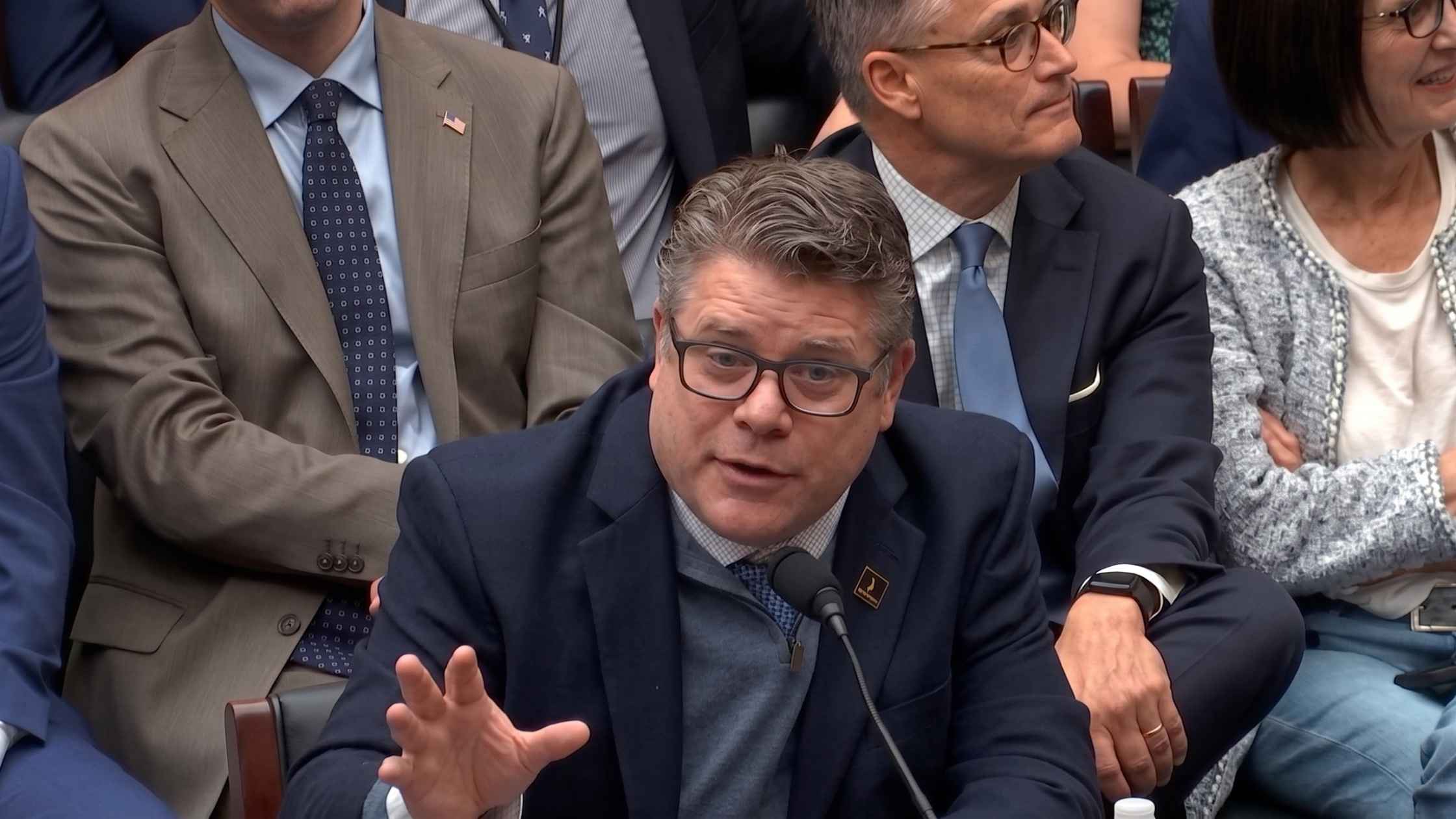
The gentleman yields back. Without objection, all other opening statements will be included in the record. We now go to our distinguished panel of witnesses. Mr. Sean Astin. Mr. Astin is the president of the Screen Actors Guild. By the way, one of the few things I haven't done and I continue to say I'm available for a bit part. Am I allowed to do that? Anyhow. The American Federation of Television and Radio Artists, commonly known as SAG-AFTRA, he is himself an actor and a long distinguished career in film and television. To name just a few, he has appeared in The Goonies, Rudy. By the way, we're going to talk about Rudy. That's going to happen. How can we not? Even if you didn't go to the right college? The Lord of the Rings trilogy, Stranger Things, Teenage Mutant Ninja Turtles, and many more. Thank you for being here as a well knowledgeable expert witness in addition to your current role.
(01:08:40)
Mr. Chris Floyd. Mr. Floyd is a legal and business strategy advisor to Amblin Entertainment and film and television production company. Basically, he's Steven Spielberg's most trusted advisor. He previously served as the chief operating officer and general counsel at the partnership for a decade and held various positions with Dreamwork Studios, Universal, Pictures, Paramount, and Walt Disney Productions. Welcome.
(01:09:11)
Mr. Steve Francis. Mr. Francis is the executive chairman and president of IP House, a global intellectual property enforcement company. He previously served as the Acting Executive Associate Director of Homeland Security Investigations as the Director of National Intellectual Property Rights Coordinator. Thank you and very much welcome.
(01:09:36)
Mr. Christopher Mohr. Mr. Mohr is president and chief executive officer of the Software and Information Industry Association, a collection of entertainment, consumer and business software companies. He previously served as a senior vice president for intellectual property and general counsel at the same organization where he led the association's intellectual property policy and anti-piracy.
(01:10:02)
Lastly, but not-
Chairman Issa (01:10:00):
Anti-piracy. Lastly, but not leastly by a long shot, Dr, hold on, Viswanathan, or close to it. The doctor is a non-resident fellow at the Kernochan Center for Law, Media, and the Arts at Columbia University. She is also a visiting assistant professor at Suffolk University Law School, where she teaches courses in contract and transactional law. The doctor is in fact the author of a number of books, including How Creative Industries Can Harness Intellectual Property to Survive in a Digital Age. Welcome, and I apologize. As one left hander to another, I said, I'm not going to mess this up. And between my horse throat and the other, I apologize.
(01:11:10)
I want to thank all of you for being here. Pursuant to the committee rules, I'd ask you please rise, raise your right hand to take the oath. Do you solemnly swear or affirm under penalty of perjury that the testimony you're about to give is true and correct to the best of your knowledge, information, and belief so help you God? Thank you. You may be seated. Let the record reflect that all witnesses answered in the affirmative.
(01:11:39)
If you've watched C-SPAN, you know I have to give this admonishment that you'll have five minutes in your opening statements, but 100% of all the material you brought with you in your opening statement, plus additional material you may supplement with, will be placed on the record, thus leaving you completely free not to just read what you brought, although some of you just might. So with that, we begin. Mr. Astin.
Sean Astin (01:12:04):
Well, this is good stuff. You're going to want to hear it. Chairman Issa, Ranking Member Johnson, members of the committee, thank you very much for convening the hearing and for your continued work, Modernizing American Intellectual Property Law. Thank you, Representative Lofgren, for your leadership on combating foreign digital piracy, and Chairman Issa for all of your work and for your work on the American Music Fairness Act. The issues therein matter to the livelihoods of the 160,000 union performers and media professionals I represent as president of SAG-AFTRA.
(01:12:35)
Today I'd like to speak about the abuse of non-consensual digital replicas of our voices and likenesses. For all of human history, if someone saw your face, they knew it was you. If they heard your voice, they knew you had spoken. For thousands of years, that simple connection was enough. Your face, your voice, your presence, reality itself was affirmed, and simply put, we knew who we were to each other.
(01:13:03)
Artificial intelligence has begun to intervene and break that ancient connection. Today, someone can realistically make you appear to say something you never said, to endorse something you don't believe in, or even convincingly depict you confessing to something you had no knowledge of. For the first time in human history, the experiences we've always shared are no longer secure. Our relationship to community is distorting thanks to a wave of technology made widely available without much concern for public safety.
(01:13:37)
In my line of work, we deal with emotions. So on behalf of our performers, I'm here to tell you what this moment feels like. To begin, we make our livings by granting the use of our voices and likenesses to our employers. That's what they pay us for. Through every audition and with every career setback, we know we rely on the fact that when the jobs finally come, we have something uniquely ours to offer.
(01:14:04)
Now imagine a performer waking up one morning to discover on their phone a version of themselves that never was, but they're watching it, and so is the rest of the world. The voice and face are a perfect match. For the performer, it's a moment of terror. Who is seeing it? Will anyone ever hire them again? Will their reputation built over a lifetime be destroyed in a moment? Every casting director, every producer, every executive, every member of the public can see it. Even their family may hesitate for a moment, but they can reach for something deeper. He would never say that. That's not who she is. But who are we?
(01:14:43)
Think about anyone you love. Your understanding of them is built from memory. Imagine that memory being contaminated. The thing that brings us back to the real person is our faith in who they truly are. In the world of deep fakes, the damage is done instantly and without mercy. The public has no obligation to discover the truth about someone. They just keep scrolling. Our members have no ability to protect themselves from this kind of abuse. Neither does the teenager humiliated by a fabricated image. Neither do parents trying to protect their children. Neither does anyone whose reputation can be threatened by a digital replica they never authorized.
(01:15:26)
Artificial intelligence is changing the way human beings experience life. We all know that this moment demands wisdom and action. Technology is not our enemy. Throughout our history, America has chosen both innovation and responsibility. Usually sadly only after ordinary people have suffered some calamity. But there is a right path. It is obvious that civilization is in the throes of a technological whirlwind, the likes of which we have never seen. And as of this moment, Americans are being forced to surrender their basic relationship to one another. We don't want to stop progress. We need to civilize it. Many Americans may never own a home or accumulate significant financial wealth, but every American does possess something of immeasurable value, their identity. That God-given gift really should belong to us and surely we can all agree that no one else should be permitted to commercially exploit our identity without consent.
(01:16:28)
In the world of entertainment, our image and likeness have been the substance of our transactions, but in the wild we do not own them. We should and you can make it so. Members of the committee, what I'm saying about this moment and about who we are is that every human being should remain the author of their own existence. Reality should remain verifiable. Consent is not a nuisance. Reputation matters. And truth is truth and it's worth protecting. Thank you very much.
Chairman Issa (01:16:57):
I thank the gentlemen. Mr. Floyd.
Christopher Floyd (01:17:02):
Chairman Issa, Ranking Member Johnson, and distinguished members of the subcommittee. Thank you for inviting me here today. I am of counsel at Amblin Entertainment, Steven Spielberg's film and television company. I worked in the Amblin family for 20 years, including a decade as chief operating officer and general counsel. I've overseen many business and legal functions, including content protection.
(01:17:23)
Two weeks ago, Amblin and Universal released Steven's film Disclosure Day, adding to his legacy of films like War of the Worlds and Minority Report, Disclosure Day fully embodies Steven's beloved sci-fi genre, embracing modern technology that makes transporting audiences to another world even more thrilling. However, these technological advancements also present challenges. Steven's prior sci-fi movies were released in a drastically different marketplace before the internet supercharged digital piracy.
(01:17:52)
When Minority Report was released in 2002, piracy was still limited largely to hard goods. DVD bootlegs from camcorders in a theater with muddled sound and shaky video then sold on street corners. They were poor knockoffs and customers knew it. While the scale of piracy was reason for some concern then, today digital piracy costs the US economy a staggering amount, at least $29 billion annually. We now expect each release will be made available immediately in perfect digital form from offshore pirate sites with global reach. This substantial increase in quality, coupled with wide and immediate availability on any device, makes this an urgent economic and consumer safety problem.
(01:18:36)
Together with our studio distribution partners, we spend hours seeking removal of these infringing videos. Additionally, all the studios and streamers created the Alliance for Creativity and Entertainment to work with global law enforcement to combat piracy. But even with these extensive efforts representing tens of millions of dollars and countless work hours, piracy still inflicts huge harm on the market for our films. When we find Disclosure Day online, we have limited recourse, primarily because most pirate sites are operated by overseas criminal enterprises. We have laws that enable us to go after pirate sites in the US, but Bulgaria, Vietnam, the Philippines, these jurisdictions sit outside the practical reach of US law enforcement, but easily reach US consumers online.
(01:19:23)
Now, global revenues from US films are shared with cast and crew and residuals and pension, health, and welfare payments. Profits are poured into new productions in every state of the union, including with local businesses. Shooting a one hour television episode generates around $475,000 per day locally while a feature film generates $670,000 per day. The billions siphoned from our economy by these overseas criminals should be available for these future productions and payments to industry workers, but they're not.
(01:19:54)
Today, piracy detrimentally impacts millions of creatives in the US entertainment industry and the economy as a whole while funding a global network of crime. According to Digital Citizens Alliance, European authorities dismantled a piracy operation across 11 countries in 2024 that generated $3.5 billion yearly, seizing drugs, weapons, and millions in cryptocurrency. In Spain, Operation Fake exposed another site that also dealt in drug trafficking and money laundering, resulting in 30 arrests and millions in frozen assets.
(01:20:26)
So what is to be done? Well, I ask you today for the tool proven effective in nearly 60 countries globally but still lacking in the US. Judicial site blocking. Under these laws, when a court determines through a full and transparent process that an offshore site is dedicated to piracy, it can direct internet providers to block local access. Studies prove site blocking results in fewer visits to piracy sites and an increase to legitimate sites. Portugal witnessed a 70% drop in traffic. Australia saw a 25% decrease and the UK experienced a 10% surge to legal services. This would be a game changer for our industry's 2.3 million workers and America's creative economy.
(01:21:11)
Historically, the US led the world in IP enforcement, but we've lagged behind for the past decade. Other countries have shown us how to do this without impacting speech, due process, or the internet. It's time the US reasserts its leadership role on anti-piracy.
(01:21:25)
And finally, allow me to turn briefly to artificial intelligence, where the US is the leader in innovation, as it should be. As a tool, AI can further empower us to tell compelling stories and reach audiences. But as we consider how to maintain America's competitive advantage against China and other countries, we must also remain the global leader in both the innovation and creative industries. How these AI companies win the AI race and how they treat copyrighted work will affect the force of human creativity in the future. We'll never maintain America's lead by lowering our IP standards to match those of the Chinese. That's why our industry supports the NO FAKES Act, which combats dissemination of unauthorized AI generated deep fakes while safeguarding protected expressions such as parody news and biopics. My community thanks to subcommittee for your dedication, and as we look forward to working together to rebuild a vibrant US entertainment industry. Thank you.
Chairman Issa (01:22:17):
I thank the gentlemen. Mr. Francis.
Steve Francis (01:22:19):
Chairman Issa, Ranking Member Johnson, and distinguished members of the subcommittee. Thank you for the opportunity to testify today. I spent over 25 years in federal law enforcement, including as the director of the National IPR Center. Working alongside colleagues from Homeland Security Investigations, US Customs and Border Protection, the Department of Justice and law enforcement partners across more than 30 countries.
(01:22:40)
I've seen IP enforcement from multiple angles. I know where the government excels and where the prioritization creates challenges for enforcement. I appear today on behalf of IP House, a global IP protection enforcement company I co-founded after recognizing critical gaps in the enforcement landscape. IP House operates across every major jurisdiction because IP crime is truly global. We detect and disrupt infringement networks at scale, bringing global intelligence and operational visibility that compliments the work of governments and rights holders worldwide.
(01:23:12)
What I see at IP House confirms what I witnessed throughout my career. As commerce has moved online, IP crime has grown more sophisticated, more organized, and harder to disrupt. Criminal networks now exploit the speed, scale, and anonymity of the internet to steal IP and endanger consumers on a global scale.
(01:23:29)
So today's hearing is incredibly timely. Counterfeiters operate through anonymous digital storefronts on the trusted online marketplaces American consumers use every day. They rapidly cycle through the seller identities, domains, and payment processors to evade enforcement, often moving illicit proceeds long before traditional legal remedies can take effect. That is why IP House focuses on following the networks and the money, not just removing individual listings, to dismantle criminal organizations rather than chasing one product at a time. They are not harmless knockoffs. They include counterfeit pharmaceuticals, automotive parts, electronics, children's toys, and household products that threaten the health and safety of the American consumers. One of the most effective US civil tools against counterfeiting is what practitioners call Schedule A litigation. It allows rights holders to bring a single action against multiple anonymous foreign sellers engaged in the same infringing conduct. Just as importantly, it allows the courts to quickly freeze the seller accounts and related assets before these proceeds disappear beyond the reach of US jurisdiction. That changes the economics of infringement.
(01:24:38)
Without this tool, rights holders are forced to file dozens or even hundreds of nearly identical lawsuits against anonymous defendants who have moved assets and simply reappear under new identities faster than the courts can reach a judgment. Schedule A is one of the few law enforcement tools capable of matching the speed, scale, and anonymity of today's online infringes while preserving judicial efficiency and due process.
(01:25:03)
Online piracy presents an equally sophisticated challenge. Our recent organized piracy crime report published with the Digital Citizens Alliance demonstrates that many of today's piracy operations have evolved into criminal enterprises built on the systematic theft of American intellectual property. A single network we examined reached more than 22 million subscribers, and generated roughly $288 million a month. When law enforcement dismantled that operation, they uncovered drugs, weapons, and cryptocurrency, evidence that these organizations are engaged in far more copyright infringement.
(01:25:36)
Large scale piracy networks view IP theft as low risk, high reward criminal enterprise. And changing the calculation is what IP House was built to do. The enforcement gap is real and measurable. Rights holders are stuck with reactive platform tools that provide relief measured in just hours. More than 40 peer nations now use court ordered site blocking to cut off foreign, fully infringing content sites and services at the source. The results have been significant. In the UK traffic to the targeted piracy fell nearly 89% after blocking orders took effect. The United States has not kept pace with its international partners leaving creators, consumers, and businesses at a competitive disadvantage.
(01:26:16)
Meanwhile, criminal organizations are now using generative AI to accelerate infringement to an unprecedented scale. These include mass produced counterfeit listings and brand impersonation to synthetic media as well as the name, image, and likeness violations. While the technology is new, the underlying challenge is not. Bad actors continue to exploit innovation faster than our enforcement tools can adapt. I hope my testimony today provides a subcommittee with an operational perspective on how today's online infringement networks actually function, where the current enforcement tools are succeeding and where meaningful gaps remain. IP House is committed to working with Congress to ensure American innovators, creators, consumers, and businesses are protected in the digital age. Thank you and I welcome your questions.
Chairman Issa (01:27:01):
Thank you, and the gentlemen yield back. Mr. Moore.
Mr. Moore (01:27:03):
Chairman Issa, Ranking Member Johnson, and members of the subcommittee, thank you for the opportunity to appear here today. Before I get into the substance, I just want to take a moment to thank you, Mr. Chairman, on behalf of our members. You've been a genuine ally to us on patents and a straight shooter even when we've disagreed. That leadership shows up here too convening round tables on foreign piracy, advancing thoughtful site blocking discussions, and choosing an educational hearing over a rush to markup. It's been a privilege to work with you and we're grateful for the way that you've sought to both protect and advance American innovation.
(01:27:44)
SIA represents more than 350 companies in the business of information. AI developers, publishers, financial data firms, and software creators. Unusually for a technology trade association, our members sit on both sides of many IP issues. We have platforms that distribute works and they're rights holders. Some of our members have both functions.
(01:28:07)
Over the course of our 40-year existence, we've seen a lot of technological change that's affected member operations, some of which cause them to bring competing worldviews. When examining new IP and other policy proposals, we tend to ask the same questions every time. Does existing law already address the harm? What new risk does the technology create? And what limits make a statute both effective and constitutional?
(01:28:32)
I'm going to briefly highlight two areas. Two years ago, SIA testified in front of this committee about unauthorized digital replicas. And on digital replicas, the harm that these unauthorized uses cause is real. These AI generated voices and likenesses are already defrauding consumers and exploiting performers. We support the creation of a federal right here and we supported the TAKE IT DOWN Act last year as proof Congress can build precise targeted tools for AI enabled harms.
(01:29:06)
In terms of vehicles that have recently moved, the NO FAKES Act has received a lot of attention, but from our perspective, there are four problems that remain, and each one is fixable. First, the preemption clause grandfathers in existing state law and only displaces state regimes for expressive works so the bill doesn't really deliver on the promise of a national standard. Second, the counternotification safeguard against wrongful takedowns only exists inside the bill's safe harbor framework. As statutory damages up to $750,000 per work and a life plus 70 term, no company will risk staying outside that framework. So in practice, this isn't a narrow opt-in category. It's close to the entire digital ecosystem operating under a takedown regime with no guarantee necessarily to put wrongly remove content back up. That raises concerns over speech at scale. Third, there's no general intent requirement risking liability for general purpose AI tools and inadvertent lookalikes alongside the actual bad actors. And fourth, again, this goes to scope. The bill's framed as touching only user content platforms, but it reaches deep into the broader digital economy and shifts section 230 treatment along the way. We don't have a problem with that resolution, but it emphasizes the importance of getting the details right. Now we've supplied redline language on these issues. And these are fixes, not objections to the bill's premise, and we're ready to keep working on it until we handle these problems correctly.
(01:30:39)
The second topic that I'm going to address is foreign piracy and site blocking specifically. This is a different question, and our members are genuinely split on site blocking as a remedy. And my goal here's not to advocate a specific solution, but to present the equities that Congress has already begun to consider. First, the underlying problem is real. These pirate sites sit outside US courts reach and they keep operating through mirror domains and offshore hosting, no matter how many times they're shut down.
(01:31:15)
But the concerns over how blocking gets implemented are just as real. Blocking at the level of DNS resolvers doesn't respect [inaudible 01:31:24]. Targets increasingly share cloud infrastructure with thousands of unrelated lawful sites so a narrow order can have over broad effects. And foreign experience shows that legitimate services can get swept up by mistake.
(01:31:40)
So we're not here to endorse or oppose a specific proposal. We're here to say that if Congress moves forward, four guardrails should be non-negotiable. Real judicial process with some adversarial testing, not rubber stamp petitions, targeting precise enough to protect shared infrastructure and lawful content, strong good faith safe harbors for the providers required to comply, and no mandate for a single government prescribed technical method. On both issues, our position is the same, get the goal right, get the mechanism right, and we all win. And our members are going to have to operate under whatever regime Congress creates. Thank you again for the opportunity to testify and I welcome your questions.
Chairman Issa (01:32:25):
Thank you, Dr. Viswanathan.
Bhamati Viswanathan (01:32:32):
Chairman Issa, Ranking Member Jordan, Ranking Member Raskin. Thank you, Johnson. Pardon me. It's catching. Thank you so much for having me. My name is Bhamati Viswanathan. I teach at Suffolk Law School where I teach copyright law, constitutional law contracts, and artificial intelligence in the law. Happily for all of us, I'm here today to talk about contracts and copyright both, and not constitutional law.
(01:32:57)
And I want to frame this with three thoughts quickly and then I'm going to move on to three potential solutions that I see. The framing is I'm going to take it from the title of this hearing, which struck me, the midlife crisis question. Those of us who sit around thinking about our midlife sometimes think of midlife as both a crisis sometimes, but also an opportunity. It's an opportunity to rethink. And it's a very strategic moment for us to rethink.
(01:33:26)
Disruption, as we found with the internet 40 years ago, which is how we framed this hearing, begins with opportunity and it begins with innovation. It also begins with disruption. And we're at another moment and another inflection point. And I want to frame this by saying we're not talking about one industry. We're talking about two, two critical industries. So Mr. Issa, you said that America leads the world in high tech. Yes. We also lead the world in arts and entertainment, in culture. $2 billion industry for tech, many people are surprised to hear $3.3 trillion and more in 2024 was the estimate that was given. So two robust industries. We cannot kill the goose that lays the golden eggs. We need the goose to be alive and we need the eggs to be culled. We need both sides.
(01:34:18)
Second, we believe in our IP system. We have a strong and robust IP system. It's the pride and joy of our country and it's in our Constitution. Sorry, I said I wasn't going to talk about Con law, and I just did. But we believe in the patent system. The patent system is strong and robust. We need to make sure that the copyright side is strong and robust too. We can't just throw up and scrap it at the behest of a few tech companies that say, "Oh, we're going to lose the arms race." There are multiple arms races going on here. Our arts and culture, no one compares to it. K-pop, Bollywood, Eurovision, sorry, nothing is as great as our export of IP in both areas of technology and culture. It's a new time. We need new rights, and importantly, we need new enforcement mechanisms.
(01:35:04)
So let me get to my three solutions that I think are strong, on the table, and that we should really contemplate right now as urgent. The first, as you've heard my fellow panelists speak about, judicial site blocking. For those of you who don't know what that is, it's a process through which you ask a court to stop an infringing website. You know already that it exists almost exclusively to disseminate infringing materials. So you're worried about a bad actor here. And there are due process steps in place to say, okay, we need to make sure that's true.
(01:35:42)
But once we've made sure that's true, what can we do? We can ask a court to say, through a no fault process without seeking damages, you need to shut this down because we can't. We can't go after these bad actors. They're often extraterritorial. We really have no other recourse. Over 50 countries have adopted it, as you've heard. The US Copyright Office has written a letter of support to you, Congress, about it. It's timely. And I think it's a fair and reasonable balanced solution.
(01:36:10)
Second, I'm going to talk very quickly about digital replicas because I know you've heard about them a lot. They are a problem. They affect people. And because we are people, we have personal property rights in our identity and in our autonomy. Let's not forget why this exists. It's rights in ourselves. As Mr. Astin said, we have human rights and those rights deserve to be federalized. They deserve to be made into a federal property right, and this needs to be made something that occurs across the country. We can carve out First Amendment concerns. We can carve out the scope of it, but it's something that needs to be addressed now.
(01:36:47)
Thirdly, and perhaps nearest and dearest to my heart, is the question of the treatment of the ingestion of copyrighted materials by large language models, LLMs. What does that mean? We use this word a lot. We say LLMs train themselves on copyrighted materials. Well, they can train, but just like the rest of us who train, they have to pay for the training. Licensing agreements need to flourish. They are beginning to happen. We need to make sure that creators, creators who create the stuff that we consume, are compensated. Small creators too, not just large intermediaries. And we need to do that now. There's a lot of court cases pending, as Mr. Raskin said, fair use cases, but we also need to make sure that there are licensing and market-based solutions that make it fair for all of us. Thank you so much for giving me the time to hear.
Chairman Issa (01:37:38):
Thank you, doctor. We will now proceed under the five-minute rule for questions. By mutual agreement, we will go to the gentleman from Virginia, Mr. Cline, first.
Rep. Ben Cline (01:37:51):
Thank you, Mr. Chairman. Thank you for your leadership on this issue. You've given us a historical perspective that dates back many decades, and I know many here and watching have been a large part of that history. And so as you said in your opening remarks, it's important to remember that history, but also to be cautious in any movement that we take moving forward. Recognizing that the DMCA notice and take down, all of these things that were put in place 20 years ago may need updating but don't need wholesale replacing. Not going to throw out the baby with the bathwater, the goose that laid the golden eggs, whatever metaphor we want to use.
(01:38:37)
Mr. Moore, in Cox versus Sony this spring, the Supreme Court held nine to zero that an internet service provider's not contributory liable for its user's piracy unless it induced the infringement or tailored its service to it, which retired the older knowledge plus material contribution theory. With that route against intermediates now narrowed, does a no fault judicial remedy to restrict access to foreign piracy sites become both the cleaner legal tool and the more realistic one since it turns on blocking rather than on anyone's fault.
Mr. Moore (01:39:10):
So I think certainly from the rights holder side of our constituency that that is exactly how they view the significance of the Cox decision. I will say that for the platforms that we represent that the problem, however, of these offshore sites existed well before the Cox decision was decided. And the folks like Sci-Hub that I mentioned in my testimony, and the other sites that are ripping off the other folks on this panel don't care about Cox. And so that's really the reason for, from the copyright owner side, for the push for site blocking orders because they need a way to get at websites that US courts can't reach. Because if these websites existed in the United States, they would not last long.
Rep. Ben Cline (01:40:19):
You're absolutely right. And the chairman led a delegation of members on a visit to the UK and other countries more than a year ago to see firsthand how their site blocking regimes are working. And what we saw very clearly was that these remedies can work to reduce traffic to foreign pirate sites and increase traffic to legitimate sites while safeguarding speech, due process, and legitimate internet activities, all without imposing undue burden or liability risks on the ISPs that are directed to implement the court orders.
(01:40:50)
My understanding is that liability concerns on the part of domestic ISPs has been the most significant impediment to advancing legislation in the US, though I'm also told that the proposals offered to date in the House and Senate all include provisions to address that concern. My questions are these. First, do we now know enough from the experience of the many foreign jurisdictions that have implemented this remedy successfully over the last 15 years that we can confidently move forward with the US legislation and avoid any unintended consequences? And two, in light of the Cox decision, is the concern about ISP liability now a moot issue?
Mr. Moore (01:41:26):
I'm not sure I understand the second part of that question. With respect to the first part, I think, as my testimony makes clear, I'm not in a position where I can say a bill is good, a bill is bad. But what I can say is that a bill that contains the guardrails is one that I believe Congress can advance. And those guardrails I mentioned in the opening, but adversarial testing. The targeting is the biggest concern because the internet architecture, again, from the kind of infrastructure/internet side of our membership, the architecture of the internet is designed to efficiently distribute, it's not designed to throttle.
(01:42:19)
And so the risk then of overblocking because of that architecture and liability for overblocking from the standpoint of those providers is real. And so with respect to the guardrails, if the safe harbors are there, if there's no tech mandate, if the targeting is precise and the process is fair, that is a roadmap for a successful site blocking bill. And then again, devil's in the details and I am not in a position where I can give you those.
Rep. Ben Cline (01:42:46):
Thank you. Yield back.
Chairman Issa (01:42:49):
Gentlemen yields back. We now go to the ranking member of the subcommittee, Mr. Johnson, for his five minutes.
Ranking Member Johnson (01:42:54):
Thank you, Mr. Chairman. Professor Viswanathan, AI systems require massive amounts of data for their training and development. And AI companies are continuing to train on copyrighted material to release better and better models. Should AI developers be required to disclose the data sets used to train their models?
Bhamati Viswanathan (01:43:24):
Thank you so much for asking me that question, Mr. Johnson. I want to start by saying we use the word training, and I'm not sure that that is always the right word. They do ingest enormous amounts of material to generate what they generate. But when we train, when you and I train, when we learn, when we go use things, we pay for those materials. We license them or we buy them. I buy a book in the bookstore. I use it in the library, which has already paid a licensing fee. I am training in a respect, but that's not the same thing that the AI companies are doing.
(01:43:57)
What they're doing is they're gobbling up huge amounts of material. Do they need to disclose their data sets? Yes, that's, I think, one part of it. I think that in the fair use cases I've been talking about that Mr. Raskin was just referring to the one where his books were ingested. What happened there? I don't think they ever paid you for those books. You will be paid, go find that postcard in the settlement, because it's the point is, it's not just disclosing what they trained on.
(01:44:24)
By the way, in the Bartz case, we'd found that they were in fact training on pirate sites as well. So we're learning what they're training on, and it's not good. But they should also be made to realize that you can't just take it. It's not a get out of jail for free card to say, "Oh, it's expensive to license." They need to license the materials that they're using, as one does. I think market-based solutions are the preferred solution because parties come to them. But we need to monitor what in fact they're doing. I think disclosure is a part of that but not the entire story. I think it's an important part of it, but most of all, I-
Bhamati Viswanathan (01:45:00):
... not the entire story, I think it's an important part of it. But most of all, I think we need to recognize that harm is being done to the markets, the actual and potential markets of copyright holders. That is not what fair use, in the copyright fair use term, was ever legally or in the spirit meant to have happen. It was not meant to be a, oh, it's beneficial and so you get to use it for free. It's beneficial, but it's also valuable and the value needs to be paid.
Ranking Member Johnson (01:45:33):
Thank you. Mr. Floyd, how has the proliferation of internet piracy changed the way that movies are made?
Christopher Floyd (01:45:44):
It's had a direct impact on the number of movies that we make and which movies we make. When we're making a decision as to go forward with the film, we do a profit and loss analysis, and we look at the history of the movies in the last few years and we look and see what kind of revenues have been generated. As piracy cuts down on the revenues, the legitimate revenues that we're getting, we determine that our next movie is going to make fewer dollars. And so that impacts maybe our ability to spend a certain amount of money on a movie or make that movie at all. So what you end up with are fewer movies being made, fewer people being employed along the way, and more risk being taken by the studios on the movies that they do go forward on.
Ranking Member Johnson (01:46:25):
Thank you. Mr. Astin, you've made a career off of your name, image, likeness, and voice, everything we talk about when we examine digital replica legislation. What about individuals whose names or likenesses is not a commercial business? Do you think those individuals need to be protected as well?
Sean Astin (01:46:49):
Absolutely. They needed as much, if not more. Yes. I mentioned in my testimony that if you're a teenager somewhere in your district, for example, and for whatever reason with very little difficulty, someone is able to depict you as you, not you, this imagined teenager, saying or doing something or you too, everyone in here. I mean, we traffic in our identity and our reputations all the time. Well, so does a 14-year-old kid. And yet these big platforms benefit financially from when some horrible depiction is done of them, and they have no ability to do anything about it. So yes, they should have their identity protected as a right. Thanks.
Ranking Member Johnson (01:47:47):
Thank you. I yield back.
Chairman Issa (01:47:50):
The gentleman yields back. We now go to the gentleman from Wisconsin, Mr. Fitzgerald.
Mr. Fitzgerald (01:47:54):
Thank you, Chairman. I just wanted to go back to February of 2024 for a moment because that's when our committee first began discussing the issue of AI and digital replicas. And I see a lot of familiar faces on the witness stand as well, and in the audience where we were in Los Angeles for that field hearing.
(01:48:15)
Mr. Moore, in fact, you testified at that hearing if I remember correctly. And it was also the first time, I think, Mr. Astin was there as well, that first time we met. Mr. Moore, let me start with you. When you testified in 2024 at that field hearing, you mentioned that there are already a number of state and federal laws that address many of the concerns with digital replicas. So if Congress were to act, and it should act in areas where AI poses a particular risk of harm left unaddressed by current federal state laws. So is that still kind of your testimony today or has anything changed in the past two years since we last debated the issue of AI?
Mr. Moore (01:49:03):
What I would say is that it is true that a number of the harms that occur from the unauthorized use of digital replicas in many instances will be covered by existing state laws and remedies, but there is no federal remedy. And that presents an opportunity for Congress to present a uniform rule and uniform protection, which will benefit both the folks who are injured and the businesses that actually have to implement this by a uniform set of rules, and a clear standard of what's allowed and what's not allowed. And in order to do that, there are a number of equities that this body will have to balance. But our members view the current state of digital replica law as an opportunity to legislate constructively.
Mr. Fitzgerald (01:50:05):
Mr. Astin, let me come to you. I remember that we were able to visit in L.A. I know this is kind of general and wide open, but why is the federal digital replica right, well, why is it important to you and those that are in the entertainment industry right now? What's prompting people to kind of move in one direction or another?
Sean Astin (01:50:28):
Well, every day we're having our images and our voices and our faces and us created fictitiously in ways that people can't tell the difference. So it looks like I'm saying or doing things, it's happening all the time. I had one friend, a colleague, I saw a video image of him, and he was really upset in this image and he was talking in great detail about some problem that happened. And I called him up and I said, "Hey man, are you okay?" And he goes, "Yeah, what are you talking about?" And I said, "Well, I saw that you were so upset about this thing." He said, "No, I wasn't." I said, "You were sitting in this room and there was a thing behind you." He said, "No, I wasn't." And his wife walks in and says, "I can't believe you fell for that fake."
(01:51:06)
And I'm thinking. I went back and looked at it, and I opened it up and I couldn't tell the difference between him and this creation. So you know what? It's like, could you please take this down, YouTube? Could you please pull this off your site? They need this law in order to have the instruction that it's okay to take it down.
Mr. Fitzgerald (01:51:28):
And the process to do that is tedious.
Sean Astin (01:51:31):
No, they just have to know it's okay. Let them work out the tech, or these guys back here have it worked out pretty good, right? They got a system for how to take it down, right? Yeah.
Mr. Fitzgerald (01:51:42):
That's good.
Sean Astin (01:51:43):
It's working. They have to know that it's okay, that we've got our First Amendment that we love and we have to protect. And the First Amendment is implicated in this NO FAKES Act in both directions. You have to be able to do satire, tell the news. You have to be able to tell historical things. You have to be able to do all these things. You also can't rob someone else of their First Amendment right by having it misrepresented as them. So it needs to be clarified for these companies where this country stands in federal law on the nature of intellectual property, individual intellectual property.
Mr. Fitzgerald (01:52:29):
Very well said.
Sean Astin (01:52:30):
Thank you for asking.
Mr. Fitzgerald (01:52:31):
Very well said. I'll yield back, Chair.
Chairman Issa (01:52:33):
Would the gentleman yield?
Mr. Fitzgerald (01:52:33):
I do yield.
Chairman Issa (01:52:36):
I just want to cover one thing. Doctor, you said you're not going to do constitution, but since you're here, I'm going to pinch you a little bit. Is it true that states under the constitution don't have international reach? In other words, they, by definition, might be able to pass a law, but to enforce against countries outside the U.S. is completely limited in the constitution to the federal government.
Bhamati Viswanathan (01:53:05):
I invite you to my con law class next year, and we'll talk. It's still to a certain extent an open question, but yes, what you're saying is essentially true. There's a case called Vetter right now that's pending that's asking about international reach of certain copyrights that we have. And that case is in the Fifth Circuit and going up hopefully, and it's unclear. So I think that one thing that federalizing laws like the Digital Replicas Law does, is it gives us a level of security that we're playing at a national level, and that we're not getting into the morass of state's rights versus international rights.
(01:53:47)
Site blocking too, this is something that's so agreed upon amongst so many countries in the developed world. I think it's relatively uncontroversial at this point. I think it's fair to say that. And I think digital replicas are going to be a problem worldwide. I think we can get, not just bipartisan support but international support behind this, which it's a rare opportunity. I think we should grab it.
Chairman Issa (01:54:12):
Thank you, Doctor. That tees it up for our constitutional scholar here on the dais. The ranking member, `.
Congessman Raskin (01:54:22):
Well, thank you for that, Mr. Chairman. I'm going to have to get you a copy of some of my books.
Chairman Issa (01:54:28):
I downloaded them already, what are you talked about?
Bhamati Viswanathan (01:54:29):
Not pirated.
Congessman Raskin (01:54:33):
So Professor Viswanathan, the Northern District Court in California held in Bartz v. Anthropic that the use of copyrighted works for AI training constitutes fair use. You just voiced your skepticism about thinking that it is training. But according to Court, Anthropic is permitted to purchase a copy of a book and then use that work to train the model on language, writing, and story. Do you agree with the court's conclusion? Is that the right analysis?
Bhamati Viswanathan (01:55:09):
That's not constitutional, that's a leading question. I think that courts are struggling, and they're struggling for the same reason we are. The court said to be accurate that it was transformative, but it's still a question about fair use. Y'all, for those of you who are not copyright people, I'm sorry for you, but there's still time and I will help you through this, right? So I say to you, "You infringed." And you say, "Well, you're right..I did, but I did it for good reason." It's an affirmative defense, and it has four prongs to it. The biggest ones are, did you do something really important, transformative? Did you change it in some meaningful way that makes it important that we preserve that?
(01:55:56)
And the fourth factor is, does it affect the market? And I want to point this out, actual or potential market for the work, for the original work. The courts are confused, and they're concerned because they see the effect on potential markets, at least the Bartz court does, right? What's the potential market? You could license that work otherwise, right?
Congessman Raskin (01:56:20):
All right. so are there licensing regimes in copyright law that can serve as a model?
Bhamati Viswanathan (01:56:24):
Absolutely there are. There are licensing regimes that exist right now. You just asked someone a couple of moments ago, how are movies made? They license and cross license all the time. That's how movies get made. When you embed a piece of song into a movie, you license it, you cross license it. So there are regimes that exist, and fair use is not an open and shut case. There's over a hundred cases that are pending right now.
Congessman Raskin (01:56:46):
All right. Let me just ask you, are we going to be able to get to the solution within the existing contours of copyright law, or do we need to legislate to address the brave new world we're in?
Bhamati Viswanathan (01:56:59):
It's hard because we're at a moment right now where we want to go with a light hand because we don't want to hamper innovation. We'd like to encourage licensing regimes. The thing I'm concerned about, Mr. Raskin is the small creator who can't go up against the big tech company and say, "Help me here." There are also, by the way, schemes to help pay small creators. We have BMI and ASCAP standing as examples of collective rights. Collective rights organizations that clear rights for people so that they can get their royalties. So what exists right now? There's a lot that exists right now that we need to tap into.
Congessman Raskin (01:57:34):
Okay. Thank you. Mr. Astin, I know that digital replicas are a big issue for SAG-AFTRA. You negotiated hundreds of pages of a four-year deal with the Motion Picture Association that would prevent studios from creating fake actors, as I understand it, absent some compelling reason for doing so or replicating real ones. And that seems to be more categorical, you can't do that, to get out of using living, breathing individuals on screen. Could you explain why collective bargaining agreements with provisions like those are necessary? And then answer whether they're sufficient to protect creators from individuals using AI to replicate name, image, likeness, voice, intonation and so on.
Sean Astin (01:58:23):
Yeah, absolutely. So they're absolutely necessary because the relationship between workers and their bosses is often fraught with being taken advantage of. And so we are very grateful that the companies, in the previous cycle when we had our big strike but in this cycle, were willing to work with us to try and figure out how to manage the fairness when it comes to digital replication, and what you were talking about with synthetics. And when it comes to digital replication, we're able and bargaining to achieve an understanding about how much you should be competent.
Congessman Raskin (01:59:05):
Is that sufficient in your field? Does it cover all of the people in the workforce?
Sean Astin (01:59:10):
Well, our collective bargaining agreement is our labor. So no.
Congessman Raskin (01:59:14):
No.
Sean Astin (01:59:15):
I mean, each different union, the writers, the directors, the IATSE, everybody has to make their own deals.
Congessman Raskin (01:59:21):
But has everybody represented such that they could come up with a similar agreement?
Sean Astin (01:59:27):
Everybody has to try to accomplish what we did first, which is to get meaningful artificial intelligence protections language in our bargaining, and we're respected. SAG-AFTRA and our policy writer, our contract negotiating team has really been in the vanguard in this. But to me for this moment, the important thing is, it's only good for contracts that we are working with, people who are signatory to our union. This No Fakes Act in the digital replication we're talking about exists everywhere else. And that's where nobody other than this body can offer the protections that we require, which is why we really appreciate you all working so hard on the piracy, but on this No Fakes Act.
Congessman Raskin (02:00:22):
Thank you. Mr. Chairman, yield back.
Chairman Issa (02:00:24):
I thank the gentlemen. We now go to the gentleman from Texas, Mr. Gooden, for five minutes.
Mr. Gooden (02:00:29):
Thank you. And I'm impressed with the ranking member who can turn a Republican witness into a collective bargaining chat. I'm not surprised but impressed. I actually have questions.
Chairman Issa (02:00:42):
You do know that Ronald Reagan once sat in a similar position. It can happen.
Mr. Gooden (02:00:47):
It can happen, yes. No, we're not surprised. Professor, I'm so fascinated with some of the things I've heard. These LLMs, how do they ingest all of this material? The books we're talking about, the things that you're talking about they should have paid in, so to speak for. How do they consume all of this information?
Bhamati Viswanathan (02:01:12):
Think of them as the giant hoover, they suck them up. Where do they get them? They trawl the internet. They get them from various websites. As I said, it's come out in some discovery in some of the cases that they get them from pirate websites as well. In the Anthropic case, interestingly, they bought tons of books and ripped the covers off of them and copied them, but it's essentially disambiguating and copying.
Mr. Gooden (02:01:33):
So what do you say, and I'm not trying to be combative, I'm genuinely curious. What do you say when someone, because you said, you and I have to pay for these books before we read them. What would you say if I said, "Well, yeah, but what if I paid for the book and give it to you?" You're not going to then go write a check to the author, you're just going to read the book I gave you. So how is that any different than me just giving a book to an LLM?
Bhamati Viswanathan (02:01:58):
It's not, but who's given it to them? I don't give them my book. I wrote a book called Cultivating Copyright, and it was uploaded to research gate a pirate website in about three minutes. I mean, I know I don't get a lot of royalties on my book, but that's too-
Mr. Gooden (02:02:12):
I'm sure it was interesting too.
Bhamati Viswanathan (02:02:13):
... 200 book. No, it wasn't, but it was 200 bucks that could have been a couple Starbucks. So I think that it's a little false to say that it's just like receiving a book. And sure, the first sale doctrine would say that you could receive a book, but they're not receiving it. They're trawling the internet, they're finding it, they're taking it. I mean, they're actually claiming fair use. And again, I'll just say fair use means you're saying, "I infringed." You're not saying, "I have the right to this." You're saying, "I infringed, but I did this for a good reason." So there's an admission there that they're in fact taking stuff that's under copyright. The whole point of copyright loyal is to make sure that creators get incentivized, but also that they get paid so that they keep doing what they do. We all work because we love what we do, but we also need to put food on the table.