


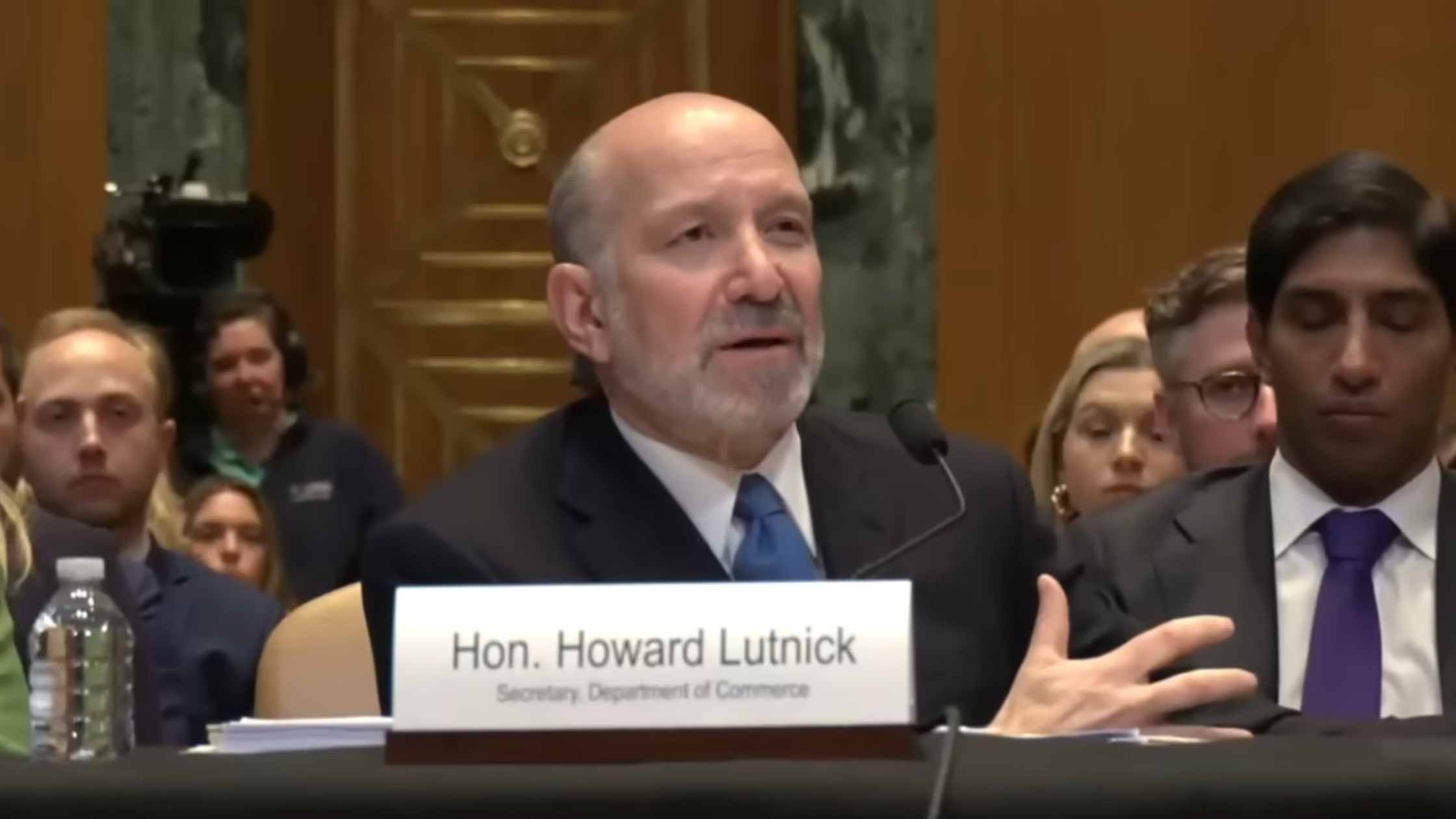
Senator Chris Van Hollen (00:00):
... and the International Trade Administration. Congress rejected those proposals then on a bipartisan basis because they would've undermined the very economic competitiveness and innovation this administration claims to champion. So what does the fiscal year '27 budget proposal do? The same thing you proposed last year. EDA proposed to be eliminated. MBDA, eliminated. Maryland, the Manufacturing Extension Program, eliminated. NIST, cut by 54%. NOAA, cut by 27%. ITA, cut by 25% even as the trade enforcement caseload is skyrocketing. These proposed cuts to important economic development programs come as consumer sentiment has fallen to 47.6%, the lowest reading in the 74-year history of the University of Michigan survey, lower than the worst of the Great Recession, lower than the worst of the post-COVID inflation crisis. These proposed cuts arrive as inflation just hit 3.3%, the highest level in two years, and gas prices are way up. GDP growth in the fourth quarter of last year came in at just a half a percent. On trade, the illegal tariffs cost the American people $166 billion, estimated to mean $1,700 on average per American family, and they haven't gotten their money back.
(01:35)
So, Mr. Secretary, you would think that we would see a budget that supports trade and economic growth, not one that would make things worse, not one that this committee rejected on a bipartisan basis. So I hope, Mr. Chairman, that the committee is once again able to work on a bipartisan basis here and put together a budget that meets the needs of the American people. I do look forward to your testimony, Mr. Secretary, and the questions. Thank you, Mr. Chairman.
Senator Jerry Moran (02:02):
Senator Van Hollen, thank you. We will in that regard. Secretary Lutnick, you are now recognized for your testimony. Welcome.
Secretary Howard Lutnick (02:11):
Thank you. Chairman Moran, Ranking Member Van Hollen, and members of the subcommittee, it is an honor to join you here today.
(02:20)
Over the past 15 months, President Trump has proven that the American economy is the strongest and most resilient in the world. When businesses look for places to expand manufacturing, drive innovation and hire more workers, they decisively are choosing the United States. Micron, $200 billion investment in memory semiconductor manufacturing in Idaho, Upstate New York, and Virginia, TSMC's $165 billion advanced manufacturing investment in America's semiconductor logic sector and Texas Instruments' $60 billion investment for seven U.S. semiconductor fabs across three manufacturing mega sites in Texas and Utah are just a few examples of the Trump administration's commitment to driving semiconductor investment and bringing jobs back to the United States.
(03:13)
I could spend our entire time together listing the record-setting commitments company after company and industry after industry have made to build in the America. Trillions of dollars of capital investment are pouring into America, led by President Trump and the United States Department of Commerce. I am proud of the leadership role that Department of Commerce has played in providing the support and encouragement these businesses need to revive American manufacturing, and we have only just begun.
(03:42)
Over the past few months alone, the Department of Commerce has announced a multiple, multiple, $15 billion-plus record-setting critical energy investments across the country from Pennsylvania and Georgia to Texas and Tennessee that will accelerate economic growth, ensure U.S. energy dominance, bolster critical supply chains, and strengthen U.S. national and economic security.
(04:07)
In addition to the massive historic trade agreements with Korea and Taiwan, the impressive $550 billion trade deal with Japan has announced six projects in the last six months, up to $40 billion for small modular nuclear reactors in both Tennessee and Alabama, $33 billion for a 9.2 gigawatt natural gas fired power plant in Ohio, $17 billion for natural gas fired power generation hub in Southwest Pennsylvania, and $16 billion for another natural gas fired power generation hub in East Texas. In addition, $2 billion for deep water crude oil export terminal in the Gulf of America and $600 million for the critical high-pressure, high-temperature synthetic diamond grit facility, which we need in Georgia. Just last month, Secretary Wright and I were in Southern Ohio to break ground on that 9.2 gigawatt natural gas facility. This project will develop the largest natural gas facility in history. It'll lower electricity costs across the region, create thousands of American jobs, and strengthen national security and help the U.S. meet the energy needs of the future.
(05:22)
Beyond these historic investments, the Department of Commerce continues around the clock to implement President Trump's America- first trade policy. Under Section 232, the Commerce Department is taking action on steel, aluminum, copper, pharmaceuticals, autos, and semiconductors. And we are investigating other sectors to make sure we protect, reassure, and revitalize manufacturing capacity across our critical industries. These actions have led to multi-billion dollar commitments to reshore steel and aluminum manufacturing and reshore American excellence in critical industries.
(05:59)
In the first year of a second term, President Trump has dramatically reduced the trade deficit, lowered imports, and increased exports to over $3.4 trillion, a 6% increase from 2024. In October 2025, the trade deficit was the lowest we've had in 16 years. I am tremendously proud of the lead role I have played in negotiating our most important trade deals, including the largest deal ever negotiated with the European Union.
(06:29)
BIS works hand in hand with the Department of Health and Homeland Services, arranged historic agreements to lower our cost of drugs and our most favored nation deals, and I'm happy to report the pharmaceutical industry has committed $400 billion to America. ITA has helped Boeing and Wabtec and led $244 billion of contracts for America as compared to the Biden industry's $17 billion.
(06:57)
So for far too long, our nation was mired in the status quo, leaving American consumers and producers alike with unfair, poorly implemented trade agreements, outsourced jobs, and paltry investments. And President Trump is committed to ushering in a golden age of domestic commerce, bringing jobs back to the United States, and that's exactly what he's done in the first 15 months of this administration. I look forward to working with you as the department continues to spur economic growth and secure unprecedented prosperity for the American people.
Senator Jerry Moran (07:30):
Let me begin with where we left off in February. I was expecting something concrete from the department. At that February 10 hearing, you committed to using the remaining $21 billion in BEAD non-deployed funds and to conduct listening sessions with stakeholders to determine the best use. My impression from that hearing was that those funds will be utilized to make certain that there is connectivity, broadband availability to all Americans, and that you would conduct listening sessions to help determine the best way to accomplish that goal is.
(08:15)
During those listening sessions, staff indicated that guidance would be issued by March the 11th, following those stakeholder engagements. However, that guidance has not yet been released. Additionally, Senator Collins and Senator Fischer and I submitted a letter to you on March the 5th regarding BEAD funding and talking about an available round of broadband deployment, and we've yet to receive a response. Could you provide us with an update and perhaps something more than soon in your response?
Secretary Howard Lutnick (08:56):
Sure. I'm glad to talk about the high-class problems that we have. The Department of Commerce rebid the BEAD program. We have 54 states and territories done. I think 46 have literally signed the documents and are drawing money, and the rest have the documents. They're just finishing up the documents. So these are states and territories drawing down on the execution of the plan for the first $21 billion.
(09:26)
Then, on the redeployment money, we have 21 billion remaining. We held listening sessions, over thousand people attended, 280 comments. We're sorting through those comments and trying to determine the plan, which we're going to go over with the administration. Unfortunately, I am going to answer, it's going to come shortly, but that is the plan. We're working on it and-
Senator Jerry Moran (09:49):
Thank you for not using the word soon. Thank you for not using the word soon. Please, next time, don't tell me the answer is soon or shortly.
Secretary Howard Lutnick (09:55):
Okay.
Senator Jerry Moran (09:57):
Mr. Secretary, what do you expect without ... I mean, perhaps you're still going through the details or analyzing those comments, which is what we would expect you to do, but what do you think the plan is going to be? Are these dollars going to be spent for purposes of deploying broadband in the United States to customers that would not otherwise be served?
Secretary Howard Lutnick (10:22):
It's our objective to make sure that the funds are used state by state broadly across our great nation to help Americans with respect to broadband and within the statute to which you've written. So we will adhere to the statute that's been written, and the monies will be deployed across our great nation.
Senator Jerry Moran (10:44):
Well, Mr. Secretary, I worried in the last hearing and I worry in your answer today that you will follow the laws of the statute. That doesn't sound like something I should be worried about, but there is a catchall provision in a list of things that are permissible, and the very last one would suggest you have significant discretion in this regard. I will state to you, and for the record, I'm worried that you ... I would hope that you do not use that last catchall phrase to do something other than broadband deployment.
(11:17)
So when you tell me that you're going to follow the statute, I can't complain about you following the statute, but I would certainly suggest, hope, encourage, insist that this money be used because I'm absolutely certain that even though we've deployed significant billions of dollars in broadband development support, there are plenty of Kansans and Americans who will be unserved or underserved with a significant challenge in connecting with the rest of the world if this last $21 is diverted someplace else.
Secretary Howard Lutnick (11:53):
I am in complete agreement with you that our objective is to cover Americans' broadband needs. We set out to do exactly that, working with the states, and your state did an excellent job trying to cover everything. If there are still places that need to be covered, I'm happy to work with your staff to try to come up with the right way to cover them. But we have a high-class problem. We've done a great job in executing this plan, and we have the ability to both cover everyone in broadband and do other things that will be exceptional for America.
Senator Jerry Moran (12:24):
I will take you up on your offer for my team, our staff, and your staff to sit down, and we'll try to give you the examples of where, not only the examples, but the places in which we think broadband could be improved and deployed in our state. Thank you, Mr. Secretary. Senator Van Hollen.
Senator Chris Van Hollen (12:41):
Thank you, Mr. Chairman. I'm informed, Mr. Secretary, that last night we did get the fiscal year '26 NOAA spend plan. So that makes you one out of four in terms of responses. So I am going to go back to requests and letters that were not responded to because you did say at the last hearing, with respect to the Epstein affair, that you had "nothing to hide." I assume that is still your testimony today. Is that right, Mr. Secretary?
Secretary Howard Lutnick (13:16):
That is right.
Senator Chris Van Hollen (13:17):
So why have you not responded to the letter that Senator Merkley and I sent following up on the last hearing, asking for documents, just to be transparent about the situation, and answering the questions that we presented in that letter?
Secretary Howard Lutnick (13:40):
The last time we were together, I agreed and answered every question on that topic with this committee, and I answered each and every topic. I have voluntarily agreed in less than two weeks to sit and answer questions on this topic fully, whatever questions are asked of me, voluntarily in less than two weeks with your House colleagues. I would ask you if there are any questions that you want me to answer, please give them to House colleagues, and I am going to answer them all. But I am here today to testify about the budget, and I look forward to discussing the president's budget with you today. But I am volunteering within two weeks to answer any and all questions on this topic.
Senator Chris Van Hollen (14:26):
Well, Mr. Secretary, I'm aware of that. We presented you with questions and requests from this committee that have not been responded to, so we're going to have to continue to pursue that. We will follow closely what happens in that proceeding. I hope you will provide them with the materials that we hope to secure here as well. Again, the reason I'm asking this question at this hearing is because we didn't get a response to the letter. No response at all to that earlier letter.
(15:07)
The other letter we haven't gotten a response to relates to the issue, as I mentioned, of the U.S. decision, the Commerce Department decision to take a stake, a U.S. government stake in US Rare Earth, $1.6 billion in federal support. According to reports, the Rare Earth's owned CEO publicly said that this deal originated in a November 2025 conversation between yourself and herself with no formal application, no public solicitation, and no competitive process. Is that accurate?
Secretary Howard Lutnick (15:50):
I met the executives of USA Rare Earth, introduced to me by a gentleman named Ken Moelis, who is a famous banker, who has a firm by his own name. So he brought the deal to us because it is well known that China has weaponized rare earths and critical minerals against the country, and it is very important for the United States to unleash our ability to do rare earths, critical minerals, and magnets. And USA Rare Earth has a mine to magnet integrated model, and that was interesting. It was presented to me by Ken Moelis, and then I introduced them to the CHIPS team to pursue the transaction.
Senator Chris Van Hollen (16:41):
Mr. Secretary, I have no complaint with the decision to take some U.S. ownership stake in exchange for the investment. Something that some of us encourage the Biden administration to do in strategic sectors, like this one, certain others. It's more the complete lack of transparency and process under which this deal took place, because before that transaction, I understand that this company's total federal contracting history was worth less than $100,000. It also, as you well know, coincided with the fact that your previous firm, Cantor Fitzgerald, helped arrange the transaction on the other side of the deal, on the private investment side, which raises considerable conflict of interest concerns. So can you respond to the letter? Would you respond to the letter by the end of this month that we sent that lays out some of these questions?
Secretary Howard Lutnick (17:45):
I will take another look at the letter and see if we can work together to resolve your issues.
Senator Chris Van Hollen (17:50):
I would appreciate that, Mr. Secretary, because it would ... Again, I want to look at this year's budget too, and the challenge we've got here is when we present you questions, chairman mentioned some of the things he's asked about, and we get no answers. That's a real problem. It means that we are going to spend more time focusing on the things that you didn't respond to when we want to focus on the future. Thank you, Mr. Chair.
Senator Jerry Moran (18:24):
Thank you, Senator. Senator Capito.
Senator Shelley Moore Capito (18:26):
Thank you, Mr. Chairman, and thank you, Mr. Secretary, for being here. I won't ask another BEAD question, but I will ... I think every time you've come, I've asked you that question, but I do want to say that I heartily agree with what the chairman is saying. I'm going to be talking with my broadband council folks tomorrow, and I wish I could give them something more specific on the non-deployment funds. So as soon as that comes, and I hope it will adhere to ... There are going to be places that are still left uncovered, and there's going to be infrastructure that still needs to be built and to support the new structures of the future to keep everybody connected into the future. So I hope those non-deployment funds can stay within our respective states. So I'm anxious to hear how you do that. So I appreciate that.
(19:17)
I wanted to ask about NOAA. You mentioned in your ... Well, in your written statement, you said 135 million increase above enacted level for NOAA's shipbuilding and unmanned systems. We know they have an aging fleet. They have rising repair needs. There are also new and low cost, rapidly deployable technologies, unmanned systems that are currently available. We ask you to explicitly, in the 2026 bill, directed NOAA to integrate these autonomous platforms. So I'm glad to see you're accelerating that. What kind of execution plan do you have here, and what capabilities are you prioritizing?
Secretary Howard Lutnick (19:59):
I mean, we are very excited about the prospects that ... person in there. So we are incredibly excited because these vehicles can live inside the hurricane and sort of stay there with much less risk and give us much better data. And we are really excited about the way technology is going to improve our safety of the American people going forward. I'm going to make sure that that is what ... When I leave this office at the end of my term, I'm going to make sure the American people are much, much safer, and they're using technology the best they possibly can.
Senator Shelley Moore Capito (21:10):
Good, good. I think that will have great results. I appreciate that. The Manufacturing Extension Partnership Program, which is used by small and medium-sized businesses and manufacturers, certainly in our state, it helps us with technical specialists and allows our businesses to compete globally. The budget, again, has suggested severe cuts to the program, I believe, we did last year, but we restored those. What can you tell me about the department and about the Manufacturing Extension Program?
Secretary Howard Lutnick (21:41):
So the awards are given out quarterly, and they continue basically just the same. So every quarter they come up, and we're distributing the money as you've appropriated correctly. The issue with the program is, the inspector general's reports were very, very critical of the way these programs had been run in the past. They said that it wasn't accurate where they were saying they were using the money for. In its effect, these hubs were overpaying the executives, and there were all sorts of problems. So we want to clean those problems up. Remember, this program was set up in the late '80s, and really high-tech advanced manufacturing is much better now. I think we need to reimagine it, and I'd really like to sit together on talking about how to reimagine that. I think that would be very effective.
Senator Shelley Moore Capito (22:32):
Have you begun to do that now? Or is that just something into the future?
Secretary Howard Lutnick (22:36):
Well, if you appropriate funds, we will do exactly that. So yes, of course, we have thought about it because you did appropriate funds last year. We need to do it better. If you appropriate funds to us, because it's advanced manufacturing and America's got 18, as you've heard President Trump say, $18 trillion of advanced manufacturing coming, but if you appropriate funds, we will do it effectively and efficiently and really think about it. And I'd love to work with your team to reexamine the way to do that.
Senator Shelley Moore Capito (23:07):
That would be great. I will say, congratulations on the announcements of a lot of the energy development. I just noticed one glaring problem there. You're in Ohio and Pennsylvania and Alabama. There's at least one state, two states, three states missing from that list. So we look forward to seeing you spread that around. As you probably know, I've been very involved in my other responsibilities over on the Environment and Public Works Committee, working with my Democratic counterparts there to try to come together for a permitting reform bipartisan bill, which I think many of the projects that you're working on and can expand to would benefit greatly from us coming together on that. Thank you very much.
Senator Jerry Moran (23:56):
Senator Capito, and others in the committee, my suggestion based upon the secretary's response to your question about MEP is that we invite the inspector general to come visit with us and learn about any challenges that the inspector general finds in the program. And if those, as they exist, we would fix them, because I think there's broad support for getting MEP. If there's something wrong that in the organization of the program, we want to fix it. So we'll get the information necessary for members of this subcommittee and the committee to have an understanding of any challenges the program faces. Make sure it's Senator Shaheen. It is. Senator Shaheen.
Senator Jeanne Shaheen (24:34):
Yes, thank you. Great idea, Mr. Chairman. Thank you, Mr. Secretary, for being here today. Last year, according to the World Travel & Tourism Council, the United States saw 5.5% decline in international visitors. We were the only major economy to see any decline. In my home state of New Hampshire, tourism is the second-largest industry, both by revenue and it supports 70,000 jobs. Canada has long been our largest share of foreign visitors, but last year we saw a 30% drop in Canadian tourism, largely due to the loss of trust and goodwill because of this administration's rhetoric around Canada.
(25:16)
Secretary Lutnick, last week, you said about Canada's economic strategy, and I quote, "They suck." I believe your spokesperson then said this was about Canada's economy leaching off of the U.S. How does insulting our closest ally and neighbor help the businesses in my state of New Hampshire and states all across this country who are hurting because of the loss of Canadian business and tourism?
Secretary Howard Lutnick (25:47):
Canada's economy leans on the incredible $30 trillion economy of America, but-
Senator Jeanne Shaheen (25:55):
There's no doubt about that, Mr. Secretary, but insulting our closest ally and neighbor who provides a lot of business. We have a lot of businesses in New Hampshire, small businesses who work on both sides of the border. We have all those Canadian visitors who are not coming because of your comments and comments by the administration. How does that help our economy?
Secretary Howard Lutnick (26:19):
It is outrageous that Canada will not put U.S. spirits on the shelf. It is insulting-
Senator Jeanne Shaheen (26:27):
It is.
Secretary Howard Lutnick (26:27):
... and disrespectful to America that they won't even put-
Senator Jeanne Shaheen (26:30):
Absolutely. My husband has an interest in a company that has American spirits, and they won't do it because of the insults from this president and comments like yours. I want to go on to another question.
Secretary Howard Lutnick (26:47):
But can I have just one small comment, which is, dairy is treated so badly, and your state cares about dairy, and we are trying desperately to get them to live to the deal that they have on USMCA and stop treating our dairy farmers so poorly. Your state cares about that, and we are fighting for that.
Senator Jeanne Shaheen (27:07):
We do, but we are not going to get agreement when we keep insulting people. When we have allies and partners, we should try and work with them, not insult them. I find your rhetoric insulting to the people in my state who are working so hard to try and ensure that they can do business.
(27:27)
I want to move on to BEAD and the non-deployment funds because, Secretary Lutnick, as I said the last time you were here, Senator Collins and I led the negotiations around the bipartisan infrastructure law and those broadband provisions. When we enacted BEAD into law, as Chairman Moran said, we understood that any remaining funds after broadband deployment would be used for adoption. New Hampshire was promised nearly $200 million
Senator Jeanne Shaheen (28:00):
... million dollars in BEAD funding, yet only 18.6 million has been awarded for deployment. That means New Hampshire has nearly $180 million left for non-deployment activities. So when can we expect guidance from NTIA on how states can spend the estimated $21 billion in remaining non-deployment BEAD funds?
Secretary Howard Lutnick (28:24):
We finished our listening tour. We took the comments over 280 comments and thousand people who spoke to us. We are narrowing the gap. We will make sure that we are covering all broadband access and we will have a plan that we would be happy to discuss with you, as I said, within the coming months.
Senator Jeanne Shaheen (28:47):
And do you have a deadline for when you're hoping to get that plan to us-
Secretary Howard Lutnick (28:53):
My objective-
Senator Jeanne Shaheen (28:54):
... other than soon?
Secretary Howard Lutnick (28:55):
Well, my objective was to start by getting the money out and getting America the benefit of the bargain, which we've done, 54 states and territories executed and out the door. Finally, right? This is getting the money out the door, but I would expect over the next two months we will have our plan in place and we will be happy to discuss it with you.
Senator Jeanne Shaheen (29:14):
Okay. I only have a few seconds left, but in your confirmation hearing last year, you said that the United States needed to stop China from, and I quote, "Using our tools to compete with us." And you specifically called out US companies for advancing Beijing's AI ambitions. Since then, the administration has allowed powerful chips to be exported to China. Can you assure us today that the administration is going to stop those chip sales to China that would advance its military modernization? We heard yesterday at the Armed Services Committee from Admiral Paparo who expressed concern about China being able to access those advanced chips.
Secretary Howard Lutnick (30:06):
There is a delicate balance in the relationship with China. President Trump has the best relationship with President Xi and he balances that. I want to be crystal clear, we are not selling our best chips to China under any circumstance. We are not even selling the best scale of chips, meaning they're called Blackwell, they're not even that brand. This is multi-years ago and there's that balance and I understand that balance, but the president understands it the best and he is trying to balance in between there. I would tell you they have not bought any as of today.
Senator Jeanne Shaheen (30:42):
Well, I'm out of time, Mr. Secretary, but I would urge you to look at the intelligence on the chips because that is not what the intelligence says about what we are selling to China. Thank you, Mr. Chairman.
Senator Jerry Moran (30:56):
Senator Shaheen, thank you. We're pleased by the presence of the full committee chairman. I recognize Senator Collins.
Sen. Collins (31:01):
Thank you, Mr. Chairman. Welcome, Secretary Lutnick. Good to see you. It probably won't surprise you that my first two questions for you have to do with the lobster industry, and I want to thank you for joining with the Department of Agriculture and putting a spotlight on American produced seafood and recognizing the need for more help in that area. As you're well aware, back in fiscal year '22, Congress included language in the appropriations' legislation that imposed a moratorium through 2028 on new NOAA regulations affecting the American lobster fishery to provide more time for additional research and data collection on the North Atlantic right whale, and also to prevent essentially what would have occurred, the closure of the lobster fishery. With the moratorium on right whale regulations set to expire in 2028, NOAA must soon begin the rulemaking process.
(32:22)
I'm asking today for your commitment to ensure that the department will work with the lobster sector, they are the best stewards imaginable and also with me and the rest of the Maine and New Hampshire delegation, to ensure that future regulatory actions will fully incorporate the most current population data for right whales, real time monitoring technologies and region specific risk assessments, rather than relying on outdated assumptions that may no longer reflect the actual right whale distribution or fishing patterns.
Secretary Howard Lutnick (33:14):
I hope to be considered the greatest friend of the lobstermen who are a great asset, and you know, I think that they're a great asset to our country. I had the pleasure when I was last over in the United Kingdom of going out and having them serve us Maine lobster in the United Kingdom, because it was important because we opened that market. It had never been done before, so this was opening that market for our great lobster fishermen. We promise you that we will use the best data and the most precise data to make sure that our decisions are right for America and they need to be right for the lobstermen of Maine. That is clearly we should not be using outdated data, we should use the best data and to make sure that we are protecting and doing the right thing for our great lobstermen.
Sen. Collins (34:12):
Thank you so much for that commitment and for what you've already done. I want to mention a specific technology that the department has been pushing. It's called ropeless gear. The problem is that it remains prohibitively expensive and it's also very challenging from an operational perspective, particularly for our smaller lobster boats. Lobstermen and women have also stated to me that the technology poses safety risks to them. What investments is NOAA making in alternative scalable risk reduction technologies, such as weak links so that the line can break, reduce line lengths, enhanced gear marking, and real time tracking systems, which could achieve the kinds of meaningful conservation and protective benefits for the right whale without putting our small boat operators at risk or putting them out of business because of the cost of this ropeless gear. My point is we shouldn't just focus on one kind of technology. The industry has all sorts of ideas and I hope that you will commit to looking beyond just ropeless gear.
Secretary Howard Lutnick (35:52):
That is an easy commitment for us. We will never pick just one winner. That makes no sense for America. The key to America is great innovation. Someone who comes up with an interesting idea that's very expensive, I understand, and for maybe for some big lobster boats, that would be great, but you need to cover all of America. And I am happy to engage with you to make sure we are examining all ways that we can be better, and there needs to be economically reasonable ways to be better. Everything can't just be, "Well, that's a good idea, but it's darn expensive." That's just not the American way and it's not the Department of Commerce's way and it's not NOAA's way.
Sen. Collins (36:35):
Thank you so much for those words and that commitment. And finally, the budget, the proposed budget would eliminate the economic development administration. EDA has been such an important source of investment in Maine. It's supported our working waterfronts, it's helped our small businesses. It's been an economic engine in a lot of our smaller communities, particularly in rural Maine. These investments are really critical to sustaining small businesses and port infrastructure, and thus to support job growth and economic development. With the proposed elimination of the EDA, which I hope this committee will reject, but if it is to be eliminated, how would the department plan to ensure continued federal support for rural projects in states like Maine?
Secretary Howard Lutnick (37:49):
I think engaging with you and your staff to help us design, if you appropriate it, to design the model the best we can, to make sure we are covering the areas, both rural, suburban, and make sure we're doing the best job we can. So I'd like to engage with you and your staff to make sure the monies that is appropriated is reconsidered, re-imagined, and done the best that it possibly can do.
Sen. Collins (38:16):
Thank you very much. Thank you, Mr. Chairman.
Senator Jerry Moran (38:18):
Thank you, Chairman Collins. Senator Schatz.
Sen Schatz (38:21):
Thank you, Chairman Moran, Secretary, thank you for being here. I have a narrow question about BEAD. I'm not going to ask the question about timing again. Hawaii's different. A friend of mine who's a political operative came to Hawaii for the first time and said, "Every place says they're different and that's only true in Hawaii and Louisiana."
Sen. Collins (38:39):
And Maine.
Sen Schatz (38:42):
And Maine. Yeah. Well see, then you go to Alaska and Alabama. I understand, but I want to be precise here. For us, Middle Mile entails from island to island, and I just wanted you to acknowledge the geographic and sort of topographic difference so that we're not stuck trying to do that middle mile for the non-deployment funds, and we have technicians who are thinking about the continental United States who do not acknowledge that the physical realities of Hawaii are different. Can I have your commitment to bird dog that particular narrow issue?
Secretary Howard Lutnick (39:18):
I think that is a fair issue for us to deeply consider. I appreciate you pointing it out and I'll make sure my team is on it and we have a full discussion on that topic. That makes sense to me.
Sen Schatz (39:28):
Thank you. In January of this year, the Inouye Regional Center suffered significant water damage from a burst pipe. You've already been helpful to repair the damage. There may be mold and mildew we don't know yet, but do I have your commitment to kind of watch this issue and give NOAA and the Inouye Regional Center whatever they need?
Secretary Howard Lutnick (39:50):
I'll be happy to examine it together with you and make sure we understand the problems and the best way to address it.
Sen Schatz (39:58):
Thank you. I want to ask you about the executive order tasking the commerce department to evaluate whether state AI laws are onerous and burdensome. And I think the question that I have in my, first of all, I don't like preemption generally. I think if we're going to do preemption, we should at least legislate in the space of AI rather than just tell the states that they may not take any action. But I'm worried about the onerous and burdensome standard because it gives a fair amount of, not just flexibility, but a lack of clarity to a state legislature. Like is the judiciary chairman from the Missouri State House supposed to call the OLA at the commerce department and say, "Is this onerous and burdensome? Is this not? If we do an AI disclosure requirement here, if we try to protect kids over here, if we're doing AI education over there?" How does anybody in a state legislature or in a state department of commerce equivalent determine what is onerous and burdensome?
(41:02)
Do they have to kind of, "Mother, may I?", the commerce department? Do they take a swing at it and then find out after the fact? How are we going to do this?
Secretary Howard Lutnick (41:11):
I think the challenge is that if each state comes up with its own set of rules, it becomes a patchwork of impossible outcomes.
Sen Schatz (41:20):
Totally understand the point of view. I'm just asking, how does one figure out whether they're in compliance with the EO, if you're a state policymaker? Is the standard basically don't legislate or do any policymaking in the AI space lest it be considered onerous and burdensome or do you have a rubric for those considerations? How does a sincere lawmaker try to be in compliance with this EO if they're a state legislator?
Secretary Howard Lutnick (41:47):
I think we should come up with best practices and work together to come up with best practices so we don't have a patchwork that makes AI execution impossible across America and we should work together to do that.
Sen Schatz (42:04):
Okay. You had a March 11th deadline outlined by the EO directing the department to come up with essentially a framework here and I'm just kind of wondering how anyone is supposed to comply with this. I get the principle, everyone talks about a patchwork not working, especially in the tech space. I sometimes agree with that, sometimes don't, but the EO is the EO. I'm just telling you, Secretary, I'm not sure anyone knows how to comply with this except to not do anything, and if that's not your intent, then we need to get some clarity here. Finally, this census, you and I had a very constructive conversation both privately and publicly about the census, and I believe that you want to make sure that the census counts every person in the United States, not every citizen, but every person as the Constitution provides. We may have some sort of minor disagreements about some other things, but I want to specifically talk about the idea of using the postal service to help to conduct the census.
(43:09)
GAO came in and said kind of the obvious stuff, which is, "Letter carriers are not trained to do this, letter carriers have different standards for confidentiality, and also letter carriers get paid reasonably well compared to census workers." And that was my intuition, and then I read the GIO study and it confirmed all of that. Why do we think this is a good idea? It seems like it's going to be very expensive and also, I should have led with this, it'll probably delay the delivery of mail. So I don't understand why we like this idea.
Secretary Howard Lutnick (43:46):
Normally, the census would hire 500,000 people, pay them by the hour, train them, with no training whatsoever. They don't wear a uniform and they try to find out where Americans live, rent them cars, pay their gas, buy them handheld devices, and send them out, and then they're going to be knocking on your door, which would cause your heart to beat a couple of times when someone's knocking on your door you don't know. As compared to the postal service, which we have a test case coming in 2026, which we're going to do together, they wear uniforms. They're already trusted. We already own their cars. They already know where everybody lives. They already have the gas and they already have electronic devices that we can put the application on. I think this will make the census more efficient, more accurate, pay the postman more money and be beneficial to all of America. And I'm excited to try it in '26.
Sen Schatz (44:50):
Chairman, can I just have 20 more seconds to just complete this? Thank you. Secretary, I think you have articulated the reason for exploring this. I don't think we know whether this will work and I think the GAO's study should weigh on you at least. I'll be open to the idea that this may be in fact the best way to conduct the census, but you have to be prepared to conduct this pilot and go, "Turns out the GAO was right." Can we both remain open-minded about this and not dig into our positions? Because I agree, I thought, "Huh, postal service, maybe." And then I kept thinking about training and the delay of mail and the cost, and I thought, "Maybe not." So can we both remain open-minded? I don't want you to dig in and I promise you I won't.
Secretary Howard Lutnick (45:35):
I think that's why we're doing the test. That's the whole reason to do a test.
Sen Schatz (45:38):
Okay. I thank you.
Secretary Howard Lutnick (45:39):
I'm with you.
Sen. Britt (45:45):
Mr. Secretary, thank you for being here today. It's great to see you. I want to just start right in on NOAA and listing the Rice whale and the Gulf of America as an endangered species that happened in 2019. However, an in depth peer review that came out and was published in December raise an important question about, is it an actual distinct population from the wide-ranging and abundant Bryde whale? I can't emphasize enough the implications of misclassifying these whales as endangered. The listing created a substantial national security risk, which you and the entire Endangered Species Committee recently highlighted. In October of 2023, I led the Alabama delegation, the Republicans in the Alabama delegation, on a letter to the former NOAA administrator highlighting these impacts and the national securities concerns. So my question for you is with this in mind, are you going to reevaluate the science based in this new study and take that into consideration and consider de-listing the population until there is a stronger scientific record to go on?
Secretary Howard Lutnick (47:03):
Thank you, Senator. Nice to see you.
Sen. Britt (47:04):
Very nice to see you.
Secretary Howard Lutnick (47:06):
It is important that we use the best science. It is vital and the points you're raising were exactly right, right? The Rice's whale, is it actually a different species than the Bryde's whale? And we need to study that and if it is not, we need to stop the nonsense of treating something as if it's endangered when of course it's plentiful. So that's study, that's research, but not done with the research that was done in the past, which was biased. Let's do it correctly and let's get the answers, and I think we will be on the same side of that page. We want to do it correctly, we want to do it honestly, and we don't want something that is inappropriate in the way of our fishermen and our energy, because we are the Department of Commerce. We need America to thrive and succeed. We need the Gulf of America to thrive and succeed. We need the Alabama fishermen to thrive and succeed and we are on side and we will make sure that we will use science honestly to make sure that's the outcome and not what has previously been seen as bias.
Sen. Britt (48:13):
Thank you so much, Mr. Secretary. And just in follow up to that, recognizing that the National Marine Fisheries Service has a significant research budget, will you commit to any of that funding being used to validate the limited amount of research that formed the basis for designating this and will you make sure that we use the funds available to do exactly what you just said in your previous answer?
Secretary Howard Lutnick (48:38):
Sounds right to me.
Sen. Britt (48:39):
Okay. Thank you. I'm going to shift for a moment. I'd like to address the department's critical role in the collection and dissemination of lifesaving information during severe weather events. In recent years, we have just witnessed unthinkable devastation. I'm thinking specifically about July 4th of last year in Texas. You and I probably use a weather app to know what the weather is, and we know that there is really very limited information with regards to showing us how significant particularly flooding can be. Senator Peter Welch and I have a bill, the Water Research Optimization Act that I hope that this body will really take a look at. But in addition to that, the University of Alabama and the National Water Center work hand and glove, obviously with NOAA, to make sure that we can have better data and inform people better in the future, and I think they are really on the cutting edge there.
(49:39)
I know delivering that information is a challenge, but I think it is critical that it not be buried in government bureaucracy, but that we actually utilize it to inform people better and make people's lives better and safer. So are there any efforts underway to partner with private weather industry to bring flood inundation mapping directly to the public?
Secretary Howard Lutnick (50:03):
I think that's an area that we are beginning to explore, try to figure out how we can do better. Obviously, the key part of the National Weather Service is safety for Americans, and we need to use all resources that are possible to do the best job we can. I think the people at the National Weather Service are really, these are extraordinary Americans and they-
Senator Jerry Moran (50:24):
Yeah, they are.
Secretary Howard Lutnick (50:24):
... work their tails off to protect us and I am honored to lead them. And this hurricane season was the most accurate and earliest warning ever and I'm really proud of what they've accomplished. And by the end of our term, we will automate, we will work hard together with your water center in your state, and we will work hard to do the best we possibly.
Sen. Britt (50:48):
Thank you. And in closing, I appreciate the additional commitment when it comes to severe weather. We have pockets of Alabama that do not have the proper radar. We are working diligently to close that gap and certainly hope that you'll help us do that. Thank you.
Senator Jerry Moran (51:02):
Senator Britt, thank you. Senator Coons.
Sen. Coons (51:03):
Thank you, Mr. Chairman. Mr. Secretary, four quick questions about the MEP and NIST, the patent trademark office and AI chips. On MEP, my understanding, I wasn't here for at another hearing, but Chairman Moran, Senator Capito expressed concerns about the future of the manufacturing extension partnership. As you know, I come out of a manufacturing family and experience. I saw how it helps small manufacturing companies in Delaware work more efficiently and compete more effectively. We appropriated 175 million for it last year, yet your budget zeroes it out. My expectation is any bipartisan bill will restore robust funding. Will you commit to following the signed law for FY26 and continue implementing the MEP program? It's a simple question.
Secretary Howard Lutnick (51:51):
Yes, we are. I'm sorry you missed it earlier. Thanks for the point. But these awards are given quarterly, they are on pace and yes, of course we will follow the appropriations I just said.
Sen. Coons (52:03):
I look forward to working with you to ensure MEP survives and thrives. NIST is our nation's leading entity for promoting American innovation and competitiveness and I think it's a tremendous agency. I've worked closely with it over the more than decade I've been on this subcommittee, but you propose a $350 million cut to NIST's operating budget, and in particular, 120 million cut to their scientific, technical and research programs. I'm concerned this threatens American leadership and will allow our adversaries to take advantage of that opening. Could you just explain briefly why that deeper cut to NIST? And if we in fact reverse it on a bipartisan basis, will you continue to advocate for what I think is one of our real treasures for innovation?
Secretary Howard Lutnick (52:55):
Metrology first. Thank you. Metrology is most important in NIST. Analytics, most important in NIST, and we are not cutting those things. We are cutting things that are not on those points, right? So what happens to these organizations is they drift and they start adding things that are not key to the outcome.
Sen. Coons (53:17):
Well, if I might, because I'm going to try and keep to my time since Senator Fisher suffered through me going over in the other hearing, and I will do my best, Senator. One of the things they drifted into is the manufacturing of biopharmaceuticals where their national hub for that is in Delaware, and I believe they've made a dramatic difference. I'll just continue to advocate for NIST. I look forward to hearing from you about how you think they might have drifted, but let me move on. Patent and Trademark office, I was very encouraged in our last exchange that you were no longer considering values-based patent fees, but we are about to see the expiration of the capability of the patent and trademark office to set their own fees. Something that was extended in 2018 when President Trump signed the Success Act. I'm ready to help you with this, but I've had no outreach from PTO.
(54:05)
As you know, I support the pro-innovation, pro-patent work of John Squires. I'm just inviting outreach if there is something we can do before that authority expires to retain what is critical to PTO's success, their ability to set their own fees rather than having it done in some other way. I'll move to my last point with my last minute and a half. Admiral Paparo testified to Armed Services yesterday, he's the commanding officer of INDOPACOM, that giving the PLA access to more advanced AI will improve their war fighting capability at the expense of our service members. And despite that, the administration approved the export of H200 chips in January, chips that are six times more powerful than the previously approved H20s and significantly more powerful than anything the Chinese are making. Can you tell us how many H200s have been licensed for export, how many more you intend to license, and what makes you confident that any chips sold to a company like Alibaba will stay out of the hands of the PLA?
Secretary Howard Lutnick (55:05):
The process is those chips, the H200 chips, which are not Blackwell, meaning they're not in the top category.
Sen. Coons (55:15):
We're not giving them the absolute best, the most cutting edge, but we're giving them incredibly powerful chips that they don't otherwise have access to. We're not talking about a commercial interest. We're talking about the Chinese Communist Party and the People's Liberation Army, which is our number one military adversary on earth. You may continue.
Secretary Howard Lutnick (55:35):
Their cloud companies, my understanding is their cloud companies want to buy these chips.
Sen. Coons (55:40):
Of course they do.
Secretary Howard Lutnick (55:41):
And central government has not let them, Chinese central government has not let them as of yet buy the chips because they're trying to keep their investment focused on their own domestic industry. So that's my understanding of what's happening. So we have not sold them chips as of yet.
Sen. Coons (55:59):
So
Sen. Coons (56:00):
No H200s have been sold to PRC-affiliated companies or companies that we, frankly, given their roles and how they operate, can expect will then be handed on to the PLA?
Secretary Howard Lutnick (56:10):
That's my understanding as I sit here with you today.
Sen. Coons (56:12):
That's encouraging because bluntly the dual use policy in China means that anything that goes to a commercial entity is accessible to the military. I hope that we will reverse the decision and not license any H200 sales. Thank you, Mr. Chairman.
Senator Jerry Moran (56:25):
Senator Coons, I won't cut into Senator Fischer's time, but in your absence of one of the answers from the Secretary and MEP, on MEP, was an IG report showing problems. And my suggestion or what I'm going to plan to do is to ask IG to come visit with members of this subcommittee. If there are problems, we can modify maybe some of the concerns of the department and the administration, so that we can move forward in our usual bipartisan support of this program. Senator Fischer.
Senator Fischer (56:55):
Thank you, Mr. Chairman. Senator Coons, to be honest with you, I followed your example in our previous hearing.
Sen. Coons (57:03):
Robust questioning is partisan.
Senator Fischer (57:05):
Mr. Secretary, welcome. Nebraska saw one of the most dramatic reductions in the BEAD allocation of $405 million to its NTIA-approved final proposal, which only spends $45 million. After administrative costs, around $340 million remain. And Nebraskans need guidance on how they may use those dollars to further the goals of the BEAD program in my state. More than a month after NTIA delayed releasing guidance for how states may use these dollars, the guidance has not yet been released. So, Mr. Secretary, what steps has the Department of Commerce and NTIA taken to effectuate the goals of the BEAD program as it relates to the use of those non-deployment funds?
Secretary Howard Lutnick (57:59):
Nice to see you, Senator.
Senator Fischer (58:00):
Good to see you, sir.
Secretary Howard Lutnick (58:01):
So, we set out to have a listening tour. We had over 1,000 people participate, over 280 comments. We are focused on those comments to make sure we are both going to make sure that we cover all broadband access requirements so that each state has made sure they covered everyone. And then we will have a new program coming out. And I've testified here before, over the next two months, we will come out with our plan. And then I'm happy to sit and talk with you about how best to serve your state.
Senator Fischer (58:38):
That would be great. I worked really hard on that infrastructure bill to make sure we could get funding to deploy broadband across my state, so it's disappointing to see the funding that hasn't been deployed yet. I've worked closely with NTIA. I want to make sure that the guidance that they're developing is driven by the needs of the states and it aligns with the law that authorized the program. Connectivity-supported precision agriculture operations is the prime example, I think, of potential eligible use for those non-deployment dollars that falls squarely within the bounds of the law, which emphasizes connectivity, that enables, quote, "economic development and modern digital applications."
(59:33)
And last December, I led my colleagues in the Nebraska delegation in sending a letter to Assistant Secretary Roth, urging the administration to allow states to retain that unspent BEAD money, encouraging NTIA to clarify that precision agriculture connectivity constitutes an eligible use of the remaining BEAD funds. Would you agree, sir, that connectivity enabling precision agriculture is consistent with the goals of the BEAD program?
Secretary Howard Lutnick (01:00:09):
That's an important topic and we are researching it and looking at it, as you've suggested. And I think it's really interesting, and it is very much a part of our topic of conversation.
Senator Fischer (01:00:19):
Okay. Hope to continue to visit with you about that. I know NTIA has received a lot of volume of feedback on that. As NTIA continues to implement the BEAD program, one of my foremost priorities is to ensure that every dollar spent on broadband deployment is going to be maximized. And to that end, I secured a provision in the law that authorized the BEAD program that would require the FCC to create and continually refresh a mapping tool, the broadband funding map to maximize responsible use of those federal dollars. And since I authored report language and appropriations bills also that directs them to do that, how are the Department of Commerce and the NTIA working together with the FCC to ensure that broadband deployment efforts, particularly under BEAD, are harmonized across all the federal agencies?
Secretary Howard Lutnick (01:01:25):
Your leadership on that topic is very important, and we are working hard to make sure that we are integrating our information and our data with those maps so they can be the best they can be.
Senator Fischer (01:01:40):
Have you had, I guess, a positive experience in reaching out to the other federal agencies and trying to make sure that it is harmonized though?
Secretary Howard Lutnick (01:01:51):
I think that's true. I think we feel good about it. I will weigh back in again, and we can have a conversation about it, but what's come up to me has been positive so far. I haven't heard anything otherwise.
Senator Fischer (01:02:03):
Okay. Thank you very much. Thank you, Mr. Chair.
Senator Jerry Moran (01:02:06):
Senator Fischer, thank you. Senator Van Hollen.
Senator Chris Van Hollen (01:02:11):
Thank you. Thank you, Mr. Chairman. Mr. Secretary, I want to turn to some of the efforts of the Bureau of Industry and Security. And the request in the budget is to double the BIS appropriation, and it's something that I support. I want to though bring up a conversation we had a while ago regarding what's known as the Affiliates Rule. The Affiliates Rule was put in place by the administration to prevent China or Chinese companies from evading American export controls on chips and AI by creating subsidiaries or other entities. It was essentially designed to close loopholes, and it was something that I thought was a good idea.
(01:03:03)
Unfortunately, it was then traded away or terminated by the Trump administration. At least for a year, it was suspended. I think it was suspended this last November for one year. So, my question is, if we're going to provide these additional funds to BIS to undertake this kind of work, can you commit that we will reinstate the Affiliates Rule to try to prevent the export of high-end US technology to China, including for potential use by the Chinese military?
Secretary Howard Lutnick (01:03:42):
Thank you. Our trade relationship with China is very complex. It's led by President Trump and his relationship with President Xi, but there is a trade team led by Secretary Bessent and Ambassador Greer who are focused on that, and I focus on the rest of the world. So, the idea that there is balance to figure that out... I agree that the affiliates rule is a smart thing for the United States of America to consider, but it is part of the balance of that full trade agreement, which those other leaders in our administration are driving, and I am part of that team.
Senator Chris Van Hollen (01:04:27):
Well, Mr. Secretary, it's interesting because I think I mentioned before that when I ask other members of the administration, they say to ask the other guy. And so we get into this circle and no answers because everybody I talk to agrees that we should apply the Affiliates Rule, but we have not yet reinstated it. Let me turn to an issue on which I expect, hope we'll agree, which is increasing recreational fishing off the Maryland coast, a local matter. Earlier this month, NOAA informed the Mid-Atlantic States and Relevant Fisheries Council and Commission that the