Senator Deb Fischer (17:16):
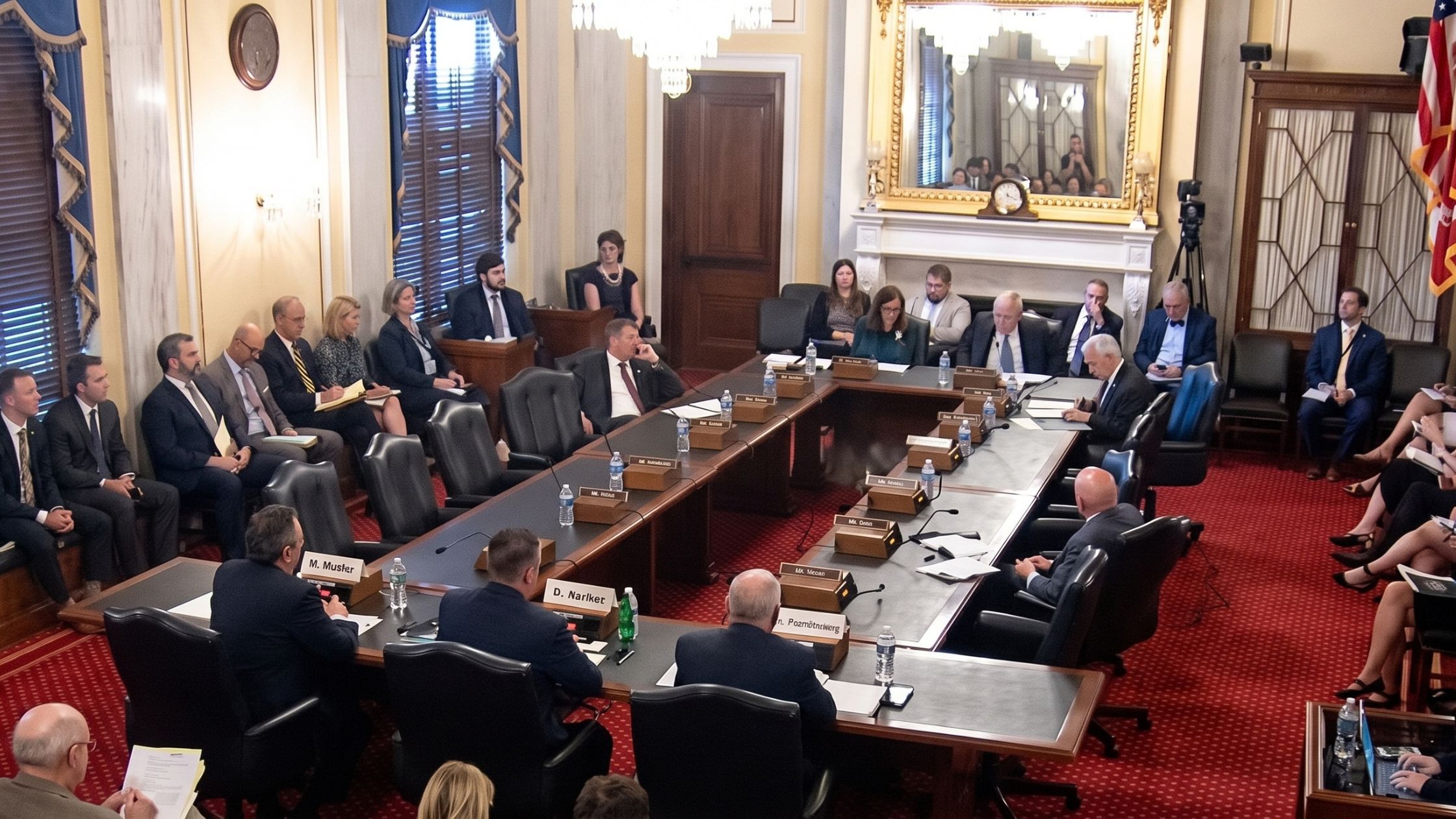
Good afternoon. The hearing will come to order. I'd like to welcome our witnesses who are joining us to discuss outside perspectives on Golden Dome for America. Our homeland is not a sanctuary. Our adversaries are developing and fielding long range capabilities specifically designed to challenge and evade the limited defenses currently deployed. These include cruise missiles, hypersonic weapons, and large drones. Threats that fall below the threshold of a full nuclear attack, yet could still provide devastating damage to our ports, critical infrastructure and military installations. We do not have an effective counter to these threats, and we cannot afford to remain complacent. Our adversaries must never believe that they can coerce us with the threat of a limited conventional missile attack on our country, which is why this subcommittee has been clear for years on a bipartisan basis that the United States needs a more comprehensive integrated air and missile defense system.
(18:29)
This administration has supercharged these efforts. The department is finally prioritizing Homeland Defense and has requested the resources needed to rapidly develop and field new systems, and has granted General Guetlein with all of the authorities necessary to realize this vision as direct reporting program manager for Golden Dome for America. I greatly appreciate General Guetlein's close communication with this committee, and I am confident that he's building out an architecture that will provide the United States with much better coverage against a greater variety of threats. He is committed to working with industry to lower costs, explore innovative ideas, and deliver capability as quickly as possible. Golden Dome completed its first successful test in June, and I look forward to hearing about future tests when our committee will be formally briefed in November. Most of the details of the architecture are highly classified, and rightly so. We do not want our adversaries to know the exact contours of Golden Dome.
(19:46)
Unfortunately, keeping these details from the public has led to irresponsible speculation, often based on false assumptions about what Golden Dome will look like and what it will cost the taxpayer. Mr. Mosier, I understand that CBO's cost estimate released earlier this year was underpinned by assumptions CBO made based solely on the limited language from President Trump's executive order, and it does not reflect any of General Guetlein's subsequent decisions about the overall program architecture, his engagements with industry to lower cost per shot, or how he plans to sequence the introduction of capability over time and leverage emerging technologies. I look forward to continue engagements with CBO on more informed analysis in the future. However, there is plenty we can talk about in this setting, and I look forward to hearing from the expert witnesses here today about their views on what the department should prioritize in Golden Dome. Senator King, do you have any remarks you would like to give at this time?
Senator Angus King (21:00):
Briefly, Madam Chair, thank you. This is an important hearing and it's a difficult hearing. As the chairman alluded, a lot of the details by definition are classified and must be so. I'm sure our friends in China and Russia are watching us at this very moment. But on the other hand, this will be one of the most expensive and largest projects ever undertaken by the United States government, and therefore the American people have a right to know how much of their money is going to go for this purpose and what will be achieved, how this can and should be effective, particularly given the evolution of technology, of missiles, cruise missiles, space-based weapons, all of the alternatives that are being developed today. So I look forward to the hearing and I hope that the witnesses, we can talk generally about the concept, its feasibility, and its potential cost of a protective shield against missile and airborne attacks on the United States.
(22:11)
So I look forward to hearing from you, bearing in mind that we have to be careful in terms of the specifics of what we talk about. And frankly, I haven't yet quite figured out exactly where those lines are, but we will try to be mindful of not alerting our potential adversaries of exactly what it is that we're working on on behalf of the American people. So with that, Madam Chair, we'll hear from our witnesses.
Senator Deb Fischer (22:39):
Thank you, Senator King. Again, welcome to our witnesses. Mr. Trachtenberg, you are a senior scholar with the National Institute for Public Policy. Appreciate you being here today, and you are recognized for five minutes for your opening statement.
David Trachtenberg (22:54):
Thank you, Chairperson Fischer, Ranking Member King, members of the subcommittee. Thank you for the invitation to testify today. I would ask that my full statement, along with an occasional paper I wrote on the topic, be submitted for the record. Let me begin by expressing my condolences on the passing of your former colleague, Senator Jon Kyl, who was a tireless champion of defending the American people against missile attack. His loss will be keenly felt. Let me also note that I have no special insight into the current architectural details of Golden Dome. The department's reticence to be more forthcoming is apparently due to concern that additional details may provide adversaries with information we prefer they not have, highlighting the tension between the desire for transparency and the need for operational security. Nevertheless, I appreciate this committee's need to better understand what you are being asked to fund, and the administration must be willing to communicate the important rationale for this presidential initiative at every opportunity.
(23:57)
That said, I would like to focus on three issues. First, does the strategic threat to the homeland justify the Golden Dome...
David Trachtenberg (24:00):
First, does the strategic threat to the homeland justify the Golden Dome effort? Second, what impediments exist that may stifle its progress? And third, what should Congress do to help overcome them? First, I believe the risk of coercive threats from adversaries with a variety of increasingly capable missile systems is growing. This may complicate force planning, discourage U.S. military action where the risk of enemy responses may be considered too great, and have a chilling effect on U.S. decision-making and freedom of action, undermining longstanding U.S. extended deterrence policy. An effective Golden Dome system can help mitigate these concerns.
(24:39)
Second, I believe the most significant impediments to Golden Dome's success reflect more political, bureaucratic, and institutional biases rather than technological or fiscal challenges. These include outdated Cold War nostrums, bureaucratic opposition, a poor understanding of deterrence issues, a belief that adversary nuclear threats against the homeland are improbable, a culture of risk avoidance, and the desire to spend resources on what are perceived to be other more urgent priorities. Ideologically based political opposition is rooted in the Cold War notions that a more robust missile defense is both unnecessary because deterrence is reliable and destabilizing because it will spark an offensive arms race as others seek to overwhelm the defense. Both notions are seriously flawed.
(25:31)
Moreover, the argument that Golden Dome can never be 100% effective is also misleading as perfection is not the objective. Heightening an adversary's uncertainty that any attack would be successful strengthens deterrence and providing some protection against the possible failure of deterrence is, in my view, the only morally acceptable course of action for a government whose primary constitutional duty is to protect the safety and security of Americans. In light of growing missile threats, it's time to abandon the outdated thinking that American vulnerability to missile attack is stabilizing.
(26:11)
With respect to cost, speculative estimates are fraught with uncertainty and based on assumptions and variables that may not be valid or even known. Therefore, allowing such estimates to drive policy decisions is shortsighted and unwise. There is also an unfortunate tendency to confuse cost with value. I believe the value of Golden Dome, both as a deterrent and a defense against the possible failure of deterrence is worth the cost. It is not that Golden Dome is unaffordable, but rather the critics believe the fiscal resources it requires would be better spent on other priorities. And there is certainly a legitimate debate to be had over spending priorities, but suggesting that extreme cost estimates make Golden Dome unaffordable, I believe is disingenuous. Finally, how might the Congress help overcome these impediments? First, Congress should reaffirm its support for Golden Dome and the NDAA and codify as a matter of policy that the United States shall be defended against all types of missile threats of any range launched from any location. Second, Congress needs to work with the administration to make the promise of Golden Dome a reality. This includes rejecting a business as usual approach to missile defense and supporting efforts to accelerate the acquisition of critical military capabilities, including kinetic and non-kinetic space-based intercept systems to stay ahead of the threat curve. History demonstrates that technology challenges can be overcome if we are committed to overcoming them and not prematurely dismissing them as impossible.
(27:47)
Finally, Congress should commit to a regular long-term appropriations funding stream that is not subject to the vagaries of reconciliation bills, continuing resolutions or partisan politics. The defense of the American people requires nothing less. With these initial comments, I appreciate the opportunity to offer my views to the subcommittee and look forward to your questions. Thank you.
Senator Deb Fischer (28:07):
Thank you, Mr. Trachtenberg Next we have Dr. Karako, who is a director of missile defense project at the Center for Strategic and International Studies. Welcome, Doctor.
Thomas Karako (28:20):
Well, Chairman Fischer, Ranking Member King and distinguished members of the subcommittee, thank you for the invitation to be here today. Missiles have become weapons of choice and missile defenses have in turn become foundational to deterrence and defense. We find ourselves at a moment of unprecedented global demand for capabilities that have, for instance, helped keep Ukraine sovereign. It's a little surprise the Ukrainians have put a Patriot launcher on their currency. Over the next few minutes, I'd like to highlight a handful of topics, communication, strategic stability, cost, space-based interceptors, and the missile defense enterprise.
(29:02)
First, communication. Despite being a flagship priority for the White House, as both of you noted, Golden Dome suffers from a serious lack of strategic messaging, an explanation of what it is and what it's trying to do. References to Golden Dome conjure up fanciful ideas and memes. Critics and cheerleaders project onto it their fears or fantasies, and political polarization doesn't help. So let me tell you what I think Golden Dome is quite simply. It is about creating a limited but meaningful measure of air and missile defense that enhances stability and deterrence. Now, what do I mean by that? Well, the Cold War idea of strategic attack was synonymous with big nuclear attack on the homeland. Today, it comprehends much more.
(29:51)
With cyber attacks, drones and missiles, there is now the specter of non-nuclear strategic attack. If Guam went away, if Offutt went away without the release of radiation, it would still be a strategic event. Weakness here is provocative. The absence of air and missile defense invites crisis instability. Tempting an adversary to try a disarming non-nuclear first strike is not deterrence. It is an invitation to an adversary to see what they can get away with short of a nuclear reprisal. Now with apologies to Ronald Reagan, Golden Dome will not make nuclear weapons impotent and obsolete, but deterrence by denial does raise the threshold for attack.
(30:39)
That was the logic when the Biden administration began work on the defense of Guam and cruise missile defense of the homeland. Golden Dome extends that same logic. Russia and China know this. They have sophisticated homeland air and missile defenses for their homelands, but we refer to them with boring names like anti-access and area denial.
(31:02)
Third, cost. And here again, insufficient communication fuels misperception. Some estimates are an order of magnitude greater than General Guetlein's publicly stated budget of $185 billion over 10 years. One of the layers of Golden Dome referenced in public industry day slides refers to pockets of limited area defense and NORAD term of art. The word limited is literally right there in the title. Another reason cost estimates are off is I think inattention to the art of the possible and even what public information tells us. This is a home game and home field advantage translates to eased manning and ruggedization requirements. A containerized FAD launcher plugged into the power grid of your local military base has a lighter footprint than a mobile battery bouncing around the desert.
(31:58)
A home game would also permit things like a mesh network of sensors analogous to what Ukraine did with acoustics. We could, for instance, integrate data feeds from things like the FAA's air traffic control radars. Next, space-based interceptors or SBIs. The implications of space as a war fighting domain are still beginning to sink in, but as with all other war fighting domains, it will be home to the various war fighting functions, including fires, space to space, space to ground, and yes, space to boosting missile. The question isn't whether SBIs can work, but whether the constellation can be scalable and affordable. Here, it's important to be clear-eyed, open-minded and imaginative.
(32:48)
Cheerleaders should stop ignoring physics and the absentee ratio. This is a hard problem. Likewise, critics should acknowledge improved feasibility and leave intellectual baggage from the Cold War behind. It's not the 1980s anymore. This can't just be a repeat of Brilliant Pebbles. Congress can push the Pentagon and industry to innovate, solve, and get after those hard problems that will meet those criteria of scalability and affordability and consistent with the fundamentals of war fighting functions to build capability that allows us to mass fires from space and to partake of maneuver warfare.
(33:27)
New technologies and capabilities are available, more innovative operational concepts can be devised. This is America. I would urge objectivity and patience. Let these experiments advance. Let's see what industry can deliver and render judgment in a few years. Finally, we should think about how to institutionalize these efforts within the broader missile defense enterprise. The DURPAM construct is a temporary one. We probably don't need more than one joint national missile defense acquisition centric organization for the foreseeable future. It may make sense to merge GDA with MDA into something else more fit for purpose. Ingredients for success would include unity of effort, authorities, high level access and control of resources.
(34:16)
And it's no secret that the Golden Dome name has contributed to polarization, but there's probably ways to get after that too. Congress could even rename it in the future NDAA. In closing, let me emphasize that it is the threat that drives the need for Golden Dome and for deterrence by denial. My written statement includes recommendations for how to shape and improve these efforts. The most immediate need, of course, however, is to appropriate funds for both the munition acceleration ramp and this Homeland Defense effort. All these efforts will stand or fall on 2027 funding. Thank you and I look forward to your questions.
Senator Deb Fischer (34:52):
Thank you, Doctor. I would remind everyone that while President Trump has named Golden Dome, the focus for this layered missile defense system came from the Senate Armed Services Committee and it was put into a study put into effect in the FY24 NDAA. So it came from us. Thank you, Doctor. Mr. Mosher, Director of National Security Analysis with the CBO, Congressional Budget Office. Welcome, sir.
David E. Mosher (35:34):
Thank you very much, Chairperson Fischer, Ranking Member King and Senator Reed and the committee. Thank you for having us the opportunity to talk about our analysis of national missile defense. I'd like to submit my formal statement for the record and then just emphasize a few points. Just to be clear about our tasking, CBO was asked to estimate the costs of implementing President Trump's January 2025 executive order, the Iron Dome for America. CBO has estimated the cost of a notional NMD architecture based on the goals and capabilities outlined in that executive order.
(36:09)
The Department of Defense, since the executive order implementing it, has created an initiative now called the Golden Dome for America. It's that sort of term that we all use now. It's still being developed and the details about what they will develop and when they will deploy it, as people have talked about here, the objective architecture has not been publicly released. So we did not estimate the cost of that system at all. CBO estimates that a system that is consistent with the executive order would cost about $1.2 trillion to build and operate over 20 years, and these numbers are all in 2026 dollars.
(36:46)
That estimate includes $740 billion for a boost phase space-based interceptor layer, 270 billion for multiple layers of ground-based defenses as called for in the executive order, and 180 billion for other activities, including deploying a sensor system and conducting research and development. The Golden Dome's price has been mentioned that they've announced a cost target of 185 billion, which as people have raised is very different than our number. Let me talk briefly about the executive order. It marks a real change in U.S. missile defense policy, as some of my co-panelists have mentioned. It's more in common really with Reagan's strategic defense initiative than recent policy.
(37:29)
Recent policy is largely focused on defending against small numbers of missiles coming from small countries like North Korea with limited countermeasures, and the system we have in Alaska sort of reflects that focus. But Golden Dome in the executive order calls to protect the entire United States, its critical infrastructure and its population from all air missile attacks from any country, including Russia and China. That could amount to hundreds of ICBMs if it's a large attack, thousands or more nuclear warheads that they may carry, hundreds of hypersonic weapons. It could be cruise missiles or other aerial threats and conventional as well as nuclear attacks. So it's a whole range of threats that we've been talking about here.
(38:15)
To arrive at our estimate, CBO analyzed this notional system. It's a multi-layered system consistent with the executive order. To counter missile threats, it includes several layers of ground-based systems and a layer of boost phase interceptors based in space, all of which were specified in executive order. To counter hypersonic threats, it includes space-based sensors and it includes specialized interceptors based on the ground. To provide protection against cruise missiles and long range drones, it includes air defense interceptors and radars. And to protect itself against the sorts of drone threats we've seen recently in other countries, it includes counter drone defenses.
(38:52)
To the largest extent possible, CBO's notional architecture relies on existing systems, the idea being that you can deploy things quickly if they're existing, new technologies just take longer to develop. Some technologies like space-based interceptors, we don't have at hand. I just want to sort of emphasize here that CBO's estimate is subject to considerable uncertainty and it's based on this notional system. Cost could be higher or cost could be lower depending on a number of things. The biggest determinant of whether the costs are higher or lower is the size of the threat and the type of the threat that the defense is designed to handle. And the executive order in our view sets a very high bar on that and so that's reflected in our estimate.
(39:38)
To help address that uncertainty and allow readers to kind of make up their own mind, we used a building block approach and reported the cost of each of the elements that we have at each of the layers so that we could see what we have done and you also could, if you were so inclined, come up with your own architecture and use those pieces. In general though, cost could be lower, as I mentioned, if DOD builds a system that's smaller and some of the things that my co-panelists have mentioned is sort of building smaller and building up, that could certainly cost less than our estimate. If you had space-based interceptors to deal with a smaller attack than the 10 missiles we talk about would reduce costs.
(40:15)
If you focused, as Dr. Karako has mentioned, on just parts of the country with your ground-based systems, that would reduce costs. On the other hand, costs could be higher if they build a larger system that's really intended to deal with a full Soviet, excuse me, Russian or a Chinese attack, could also be higher if new systems encounter cost growth and also in sort of an important way could be higher if our potential adversaries take steps to try to undermine those defenses, they increase the size of their forces, they engage in countermeasures and involve in different systems that would reduce the effectiveness of our defenses. And so all those things could lead to higher costs. Thank you again for the opportunity to talk about CBO's work and I look forward to all your questions.
Senator Deb Fischer (41:01):
Thank you, Mr. Mosher. Dr. Karako, in the near term, what are the best opportunities to improve coverage of the homeland against missile attacks? What is your opinion?
Thomas Karako (41:15):
Well, there's a lot there. There's a lot of different types of missiles. I will say, and I want to harken back to the title of the executive order from last January, it was originally called Iron Dome for America. I think they decided that might come into copyright issues, so it's now called Golden Dome, but Iron Dome is the lowest tier of Israel's multi-tiered missile defense. And so where I start from is at the bottom from the lower tier threats. We have a limited GMD ICBM defense from rogue states as was said, but the degree of vulnerability is extraordinary at the, let's just say counter-drone, counter cruise missile type of things. This is one of the-
Senator Deb Fischer (41:54):
Do you think at that level that we currently have a number of defensive systems that we could leverage?
Thomas Karako (42:01):
Actually, yes. Those are systems that largely are used over there for "regional defense" or base defense. We put out a report a couple of years ago called North America is a region two because to emphasize that those air and missile threats are coming to a theater near you. And that's kind of what this Golden Dome, I would also say the Joint Integrated Air and Missile Defense Task Force 401 is getting after, the drone threats and the cruise missile threats. And so to get to the additional part of your question, Senator, the first and most needful thing are the sensing capabilities, to have better air surveillance and better tracking and better target identification of the low and slow drones, of the cruise missiles and things like that. So first and foremost, you can't kill it if you can't see it. And so first and foremost, I'd go after the sensors and start there with the aerial threats and build up.
Senator Deb Fischer (42:53):
What do you see as challenges in trying to develop a management system out there that would integrate systems across different domains, across multiple services, across a number of agencies? And I guess the main point I'd like you to hit here is our industrial base up to the task right now.
Thomas Karako (43:20):
So I mentioned along the way the Biden administration's initiative for the defense of Guam. At the time it was described as the perfect air and missile defense problem. Why? First and foremost, because of the neighborhood that it's in and the number of threats that it faces, but also because of the systems integration challenge of fitting together the Aegis and the THAAD and the Patriot or IBCS fire control systems. These are systems that were designed to operate alone and unafraid within their silo. And so the defense of Guam efforts and now the Golden Dome effort must first get these systems that we have today to be able to work together and in concert with another.
(43:58)
And what that means especially is to not all shoot at the same thing. You could have multiple systems, and we've seen this in the real world over the past couple years, you need fire's deconfliction and fire control so that you can use these things efficiently and not shoot more interceptors than you need at a given target. That's just an example of the battle management problem.
Senator Deb Fischer (44:17):
Okay. Thank you. Mr. Trachtenberg, what capabilities do Russia and China have that they're developing that you believe threaten our homeland the most and why are these threats fundamentally different from what we've faced in the past?
David Trachtenberg (44:37):
Thank you, Senator. I think both Russia and China have been engaged now for many years in a very aggressive nuclear strategic and non-strategic modernization program to develop newer, more sophisticated systems. For the Russian Federation, everything from the Sarmat, for example, to the Oreshnik, which was used against Ukraine, an intermediate range nuclear capable system to nuclear torpedoes and things like that. The Russians have been very aggressively modernizing their capabilities. In fact, I think it was Vladimir Putin himself who not long ago said that the strategic modernization program of the Russian Federation was well over 95% complete, while the same cannot be said obviously for the United States.
(45:28)
The Chinese have also been modernizing their nuclear weapon system and building up their conventional capabilities as well. The discovery of some 350 previously unknown Chinese ICBM silos suggests that the Chinese have abandoned the policy of minimum deterrence if they ever actually believed that. They have been developing fractional orbital bombardment systems, hypersonic capabilities. So the threats themselves have been growing, I believe, substantially. And my concern, Senator, is that the growth in the missile threat is outpacing our ability to deal with it. We still have a very limited national missile defense capability primarily directed against rogue states like North Korea with a limited number of terrestrial based interceptors. I think we have the capability to do more.
Senator Deb Fischer (46:32):
Thank you. Thank you. Senator King.
Senator Angus King (46:36):
Thank you, Madam Chair. First, I have an issue with how this program is being funded, and that's not really your gentlemen's problem, but it's being funded principally through reconciliation, which is a totally partisan process with very little input from the Appropriations Committee or the members of this committee, and it has very little restrictions in the way of how it can be spent. So I just want on the record that this is, as I mentioned at the beginning, one of the most expensive and important initiatives of this government, and it should be one that has broad popular support indicated by broad support here in the Congress.
(47:18)
The fact that the vast bulk of it was funded first in the reconciliation last year and is proposed for this year, I think is very bothersome from a point of view of process. I have a hard time figuring out how this would actually work in practice, and here's a simple example. Guam, as we know, is a U.S. place in the Pacific, territory in the Pacific that is highly important to us strategically. So we have a very substantial missile defense capacity there, and sitting right where you are, Mr. Mosher, was the general in charge of that. I asked him how much it cost to develop a comprehensive missile...
Senator Angus King (48:00):
I asked him how much it cost to develop a comprehensive missile defense strategy for Guam. The answer was $8 billion. I wasn't doing my email on my phone. I was asking Claude, how many cities in the United States have 50,000 people or more? The answer was 780. So if we're going to protect those 780 cities, the way we protect Guam, the calculation is $6.2 trillion. So this $ 185 billion to me is not a realistic number. And the other piece of this that bothers me, I was looking at the president's executive order. It says, "We'll deter and defend its citizens and critical infrastructure, provide for the common defense of its citizens." The implication of the term Golden Dome is a national coverage. And I think all of you will agree that that's just not in the card. So one of the questions that has to be discussed is who's being protected and what is the Golden Dome actually going to do?
(49:06)
The nomenclature implies an arch over the entire country that's protected from any kind of missile attack. And would you agree that that is not what we're talking about here?
David Trachtenberg (49:22):
Senator, I would suggest that the nature of Golden Dome is to try to produce a system that is capable of a much broader level of defense for the American people, for the country.
Senator Angus King (49:36):
So, this means every American citizen can sleep better tonight because they're going to be protected from a missile attack?
David Trachtenberg (49:42):
Well, with all due respect, Senator, I don't think that's the appropriate metric to use. I believe the appropriate metric, as I stated, is can we build a system that provides a level of protection that dissuades and discourages-
Senator Angus King (49:58):
To whom? To whom?
David Trachtenberg (49:58):
I'm sorry.
Senator Angus King (49:59):
Who is being protected and who makes that decision? Are you telling me that every citizen in America can be protected by this system?
David Trachtenberg (50:07):
No, I'm not saying every citizen can be protected. I'm saying-
Senator Angus King (50:11):
Okay, so if that's the case, who decides who's protected and who isn't?
David Trachtenberg (50:15):
Oh, I think that the actual architecture would be... Again, I don't have insight into the current architectural plans, but I think it would be deployed probably in phases or in stages at certain times when the architecture is ready, but I think it should be expansive. I'm a firm believer, Senator, in the old Air Force recruiting motto, aim high. I think we should aim high on this. We may not get there. I agree, but I'd rather aim high than aim low in terms of what you're telling me to do.
Senator Angus King (50:48):
As you can tell, and these are good faith questions. I mean, I'm just trying to understand this thing. If it's not going to protect the entire country, who is it going to protect? How is that going to be decided? And what is the realistic cost estimate? Is my Guam example just completely crazy? I mean, there's a case where there's been a Golden Dome over Guam and it cost $8 billion to cover, I think it's 200 square miles. Los Angeles is 400 square miles. So protecting Los Angeles would cost twice as much as protecting Guam. What am I missing?
Thomas Karako (51:24):
If I could take a stab at that, I would suggest that the Guam analogy is perhaps not the most apt one. Guam has, as you noted, Senator, an outsized significance for our overall operational plans for the Pacific. And in that sense, the defense of Guam is about buying time for the forces that are stationed there or based out of there to be able to end the threat by other means, to last long enough.
Senator Angus King (51:52):
Protecting Guam.
Thomas Karako (51:54):
Not just the territory, but especially the power projection capability.
Senator Angus King (51:58):
Of course, I understand.
Thomas Karako (51:59):
And so Los Angeles has some ports, but it doesn't have that power projection capability. And so to answer your question of what should be protected, I would suggest walking down the hall of the Pentagon to the NORTHCOM office and asking them for their defended asset list, the 1 to N list and start there.
Senator Angus King (52:17):
Well, one of the things in the executive order, which I think makes sense is the United States will guarantee its secure second strike capability. That would imply a special protection for the Sentinel project or the stealthiness of our submarines or the basis of our Air Force. I understand that, but I'm just trying to get at what this thing will really do at what cost. The most serious national security threat facing this country today is the $40 trillion debt. The chairman of the joint chiefs of staff testified to that several years ago and I can't disagree. We can't just say, "Well, this is important and we're going to spend whatever it takes." I think we need to have some realistic cost estimates and 185 billion to protect what part of the country, 10%, 20%. I think we have to have answers to those questions. Thank you, Madam Chair.
Deb Fischer (53:16):
Thank you, Senator King. End of the day. Senator Rounds, you are recognized.
Marion Michael Rounds (53:23):
Thank you, Madam Chair. Look, let me look at this a little bit different. I respect what Senator King is suggesting here, but let's start where we're at today and what the difference would be. If as the senator had suggested that this may protect 10% and we're spending that kind of money, the answer is, is today, do we have any protection at all? I will simply begin with Dr. Karako, let's just begin with this. What percent of the United States is protected today from these incoming missiles?
Thomas Karako (53:56):
You're talking about North Korea ICBM [inaudible 00:53:58].
Marion Michael Rounds (54:00):
Put your mic and start over again.
Thomas Karako (54:02):
Pardon me. If you're talking about a rogue ICBM, the GMD system is designed to provide continental coverage or national coverage against a very small number of threats. But again, the kind of threats that we see on a weekly basis in Ukraine or the Middle East, the garden variety cruise missiles and drones, the short answer is, sir, we are astonishingly not protected. The heads of NORTHCOM have come up here and said the same thing. You see drones around Barksdale.
Marion Michael Rounds (54:29):
If you were to ask the American public, they would say, "We have NORAD and the protection is there." The reality is for a lone shot from North Korea, we can handle that. But right now what we're really talking about is taking the next step, which is to avoid a nuclear conflict. Part of that means being able to assure our competitors, the adversaries, that even if they were to get off a successful first strike, that we would be able to defend against it and that we would respond with a devastating response, a responsive strike that they would never want to see. And this is one more step in saying, "Let's not go to nuclear war." Then the question is how do we do that without destroying our economy?
(55:21)
The idea behind this to begin with was the layered effect that we have right now as a first step, but let's just think about how this has all got to be put together a little bit so that we have a better understanding of what we're really talking about. I also agree with Senator King when he says, "Should this taken, should it have been necessary to go to a reconciliation to get this started?" And I would say, no, this should have been on a bipartisan basis. I won't lay fault for why that isn't happening. I'm just simply saying we need to get back to a bipartisan approach to this as soon as possible, but we couldn't wait another year to have that happen or we'd be farther behind than what we are right now. So let's get back to a bipartisan and let's include it in the underlying appropriations bill, which is ongoing.
(56:09)
Now, if we talk about the plan itself today, there are a couple things we need. Number one, we've got to be able to sense it. In other words, identify if there is an adversary who is actually coming out. We can do some of that by cyber. We check on them, we know what they're up to, we can see their planning. We also know that before the left of a launch, we can have some sort of sense of what's going on. But upon a launch, we need worldwide coverage, in other words, the ability to actually see these launches. Can you talk for just a second about what that would entail in terms of our ability to see worldwide on these types of launches that would create the confirmation that something is going on? I'll start with Dr. Karako once again.
Thomas Karako (56:54):
Yes. Well, in terms of the launch detection, if you're talking about ICBM, we've got all kinds of overhead infrared to detect the launch, but there's some very important initiatives, go back to the Biden administration and before in terms of especially hypersonic and ballistic tracking for the more maneuverable phase.
Marion Michael Rounds (57:12):
So we need more than just infrared. We also got to be able to attract a moving object and separate it out from other moving objects, correct?
Thomas Karako (57:18):
The discrimination general.
Marion Michael Rounds (57:19):
Which means radar for the most part.
Thomas Karako (57:21):
For the most part.
Marion Michael Rounds (57:22):
Okay. The 3.1 to 3.45 portion of the magnetic spectrum is critical for all of our radars, our best radars. Right now, it constantly is under attack by commercial operations that want to take that over. Can you talk about how serious that is just in terms of a very simple issue that we have to protect right now?
Thomas Karako (57:38):
Thank you for your leadership on this. The lower three that you identified, the S-band, that's where so many of our radars operate, our Aegis SPY radars, G/ATOR, the Army's TPQ-53, LRDR. A lot of the radars we have today and that we're going to be deploying are in that band. If you have commercial noise, it will jam them.
Marion Michael Rounds (57:56):
Okay. And so that's just the sensing of it, but then we've got to be able to identify, and this is where the space-based systems come in. We've got to be able to identify early on because we don't want to have that come into the United States. We play away games. We want the ability to have systems available to take out these targets, and some of those are going to be space-based, aren't they?
Thomas Karako (58:15):
Yes, sir. It could be X-band related things that are involved there. It could be kinetic things as well.
Marion Michael Rounds (58:20):
Okay. I'm running out of time, but I think this is very important that we have this discussion and the fact that right now, compared to what we have right now, what the Golden Dome will provide is magnitudes more of an opportunity. The question is how do we efficiently deliver this thing in a period of time and how do we do it on a bipartisan basis? Thank you, Madam Chair.
Deb Fischer (58:40):
Thank you, Senator Rounds. Ranking Member Reed, you are recognized.
Jack Reed (58:45):
I will defer to Senator Kelly.
Deb Fischer (58:49):
Okay. Thank you. Senator Kelly.
Mark Edward Kelly (58:51):
Thank you, Madam Chair. Thank you, Senator Reed. Mr. Trachtenberg, I've got some major issues on the physics of this system, especially the space-based interceptor part of this. The physics favors the offense in a big way. Interceptors can be defeated by countermeasures, and often when we test these things, we don't account for those. But the other issue here is deterrence is about perception, and this administration might see Golden Dome as a defensive system, but what also matters here for strategic stability is how does China and Russia see this? I mean, for decades, US nuclear strategy has recognized the relationship between strategic offensive and defensive forces. They're connected. The basic concern is pretty straightforward. If one side builds defenses that could substantially reduce the effectiveness of the other side's nuclear deterrent, the other side has an incentive to build more or better offensive weapons with more countermeasures, and that dynamic was part of the rationale behind negotiating limits on offensive and defensive systems during the Cold War.
(01:00:15)
We considered this very seriously, so we need to understand what the response and expansion of US strategic missile defense could generate. If Russia and China believe that Golden Dome could reduce the effectiveness of their retaliatory forces, they could respond by expanding their arsenals, developing new ways to penetrate our defenses, or seeing the United States as willing to take a lot more risk if we're in a crisis. So Mr. Trachtenberg, what do you assess Russia and China are thinking about Golden Dome today?
David Trachtenberg (01:01:01):
Thank you, Senator. I appreciate your comments. I think Russia and China have been moving out irrespective of what the United States plans to do or may do in the future. As I said, both Russia and China have been modernizing their own nuclear systems, and I believe that they're doing that because their goals and objectives don't align with ours. I do think Russia and China will oppose Golden Dome just as they have opposed all US missile defense efforts.
Mark Edward Kelly (01:01:33):
But it sounds like you think they're on a path regardless of any steps we take, as I think Senator King pointed out-
David Trachtenberg (01:01:45):
What I'm saying-
Mark Edward Kelly (01:01:45):
... Chinese are watching this today?
David Trachtenberg (01:01:47):
Yeah, sure. But what I'm saying, Senator, is that there is no mechanistic action-reaction formula. Historically, the belief that the United States generates reactions on the part of adversaries has not been proven to be so. And I go back, you mentioned the Cold War.
Mark Edward Kelly (01:02:06):
But isn't it logical that if we were to build, let's just say, when you study math, you look at things at the limit. If we were to build a system that they perceive is able to take out, let's say a large salvo of ICBMs, what would the logical thing for them to do? What would be a logical response?
David Trachtenberg (01:02:32):
I think the logical thing for them to do would be not to consider attack in the first place.
Mark Edward Kelly (01:02:36):
You don't think the logical thing would be a larger salvo in nuclear weapons? Because this is going to be sized for something.
David Trachtenberg (01:02:43):
Sure, sure. But Senator, again, if you look at history-
Mark Edward Kelly (01:02:47):
So you think that is logical? Let's say just theoretically.
David Trachtenberg (01:02:50):
No, no. If you look at the historical record, I think you see the Russians and the Chinese moving out based on their own considerations, irrespective of what the United States has or has not done. You may recall-
Mark Edward Kelly (01:03:04):
On all kinds of things, and we do exactly the same thing.
David Trachtenberg (01:03:06):
No, you may recall the ABM Treaty of 1972 was intended to prevent the Soviet Union at the time from building up its offensive capability because we eschewed defense of the national territory, so they had no defense to counter. In reality, what happened was the greatest increase in Soviet ICBM weapons and warheads occurred after the signing of the ABM treaty. So their reaction suggests-
Mark Edward Kelly (01:03:33):
The greatest increase after the signing of the treaty.
David Trachtenberg (01:03:35):
After the signing of the ABM treaty.
Mark Edward Kelly (01:03:39):
And how many ICBMs does the Russians have today as a percentage compared to what they had previously?
David Trachtenberg (01:03:48):
The Russians put most of their nuclear capability on large land-based missiles because they-
Mark Edward Kelly (01:03:54):
But isn't it true that because of treaties that we have signed, we have reduced the size of our nuclear arsenal and the Russians have reduced considerably the number of nuclear weapons that they have today?
David Trachtenberg (01:04:09):
It is true that we have reduced as a result of arms control treaties, the number of nuclear weapons in our arsenal. It is also true that we currently really don't know what the Russians have because the Russians suspended inspections under the New START Treaty years ago and have refused to allow them to continue. And without onsite inspections, it's very difficult to know whether the Russians have continued to MIRV missiles or build up their capabilities. What we do know, Senator, is that they have been aggressively working to modernize their own nuclear capabilities for many, many years while the United States has not.
Mark Edward Kelly (01:04:46):
Well, we're in the process of doing that as we should.
David Trachtenberg (01:04:49):
We've been thinking about doing that [inaudible 01:04:51].
Mark Edward Kelly (01:04:50):
Well, we've got a program to modernize Minuteman III.
David Trachtenberg (01:04:54):
Sure.
Mark Edward Kelly (01:04:54):
And we're building more ballistic missile submarines, and we should be modernize our forces. My biggest concern here is that this system, because their perception of this matters and that this sets off another arms race and suddenly we're having to build... I mean, they're building thousands of more ICBMs. The Chinese are building thousands of more ICBMs. This system is in size to handle it. We spent $1.2 trillion on a system that then becomes irrelevant. I mean, let's just say theoretically, not what the real numbers are. I don't like to talk about this. Let's say we could shoot down 100 ICBMs. Well, they fire another 100 or maybe they fire 500. And then our system was we spent $1.2 trillion. People don't have healthcare coverage. They can't afford their lives anymore. We're investing trillions of dollars into the defense industry. And what we get out of it is we get 5, 10 years down the road, even after this thing is built, and we got a system that doesn't even provide us what the level one requirements for the system was in the beginning on the piece of paper that the president signed.
David Trachtenberg (01:06:13):
Senator, I appreciate your perspective. I do. I don't think it's an accurate reflection of how history has evolved throughout the Cold War and the post-Cold War period in terms of US actions driving some kind of an arms race.
Mark Edward Kelly (01:06:26):
Mr. Trachtenberg, you said after the ABM treaty that that's when the Russians accelerated their development of ICBMs. I'm way over my time. Thank you, Madam Chair.
Deb Fischer (01:06:41):
Thank you, Senator Kelly. Mr. Trachtenberg, is it true that China has spent decades building their own integrated air and missile defense system, the A2/AD?
David Trachtenberg (01:06:50):
Yes, Senator.
Deb Fischer (01:06:51):
Is it also true that Russians have a massive missile defense system surrounding Moscow?
David Trachtenberg (01:06:58):
Yes, that is true for decades.
Deb Fischer (01:06:59):
For decades. Thank you. Senator Reed, are you ready to jump in?
Jack Reed (01:07:06):
I'm ready to jump in with both feet. Thank you, gentlemen, for your testimony. I want to get a perspective on this course issue. I think all of you have essentially conceded that this will be a phased development. It will not be a duplication of the president's initial executive order. Is that fair, Mr. Trachtenberg?
David Trachtenberg (01:07:28):
Senator, would you rephrase that question, please?
Jack Reed (01:07:30):
Well, you have indicated that in your own testimony that the numbers, the course estimates are far excessive, et cetera. I think what has happened though is that General Guetlein has not taken the president's executive order literally, that he has essentially re-scoped it so it's less expensive. Is that something you would concede?
David Trachtenberg (01:08:00):
I can't speak for how General Guetlein has been addressing the particular issue vis-a-vis the executive order. I haven't spoken to General Guetlein here in a private capacity. But I think the executive order establishes a goal and an objective. That is a legitimate objective. Whether we can get to that or whether we get to that in pieces over time is-
Jack Reed (01:08:30):
We have to deal with not goals so much as budgets, technologies available, et cetera. And again, my sense, and I might be wrong, is this is going to be step by step. Dr. Karako, you have any comments?
Thomas Karako (01:08:47):
Yes, sir. I think it is not necessarily the case that it has been de-scoped from the executive order. I've observed that the executive order and the Golden Dome nomenclature is a kind of a Rorschach test that people bring to bear certain assumptions and read into it. The executive order doesn't say anything about being in a penetrable shield. It doesn't say anything about numbers of missiles. It talks about types of missiles, but it doesn't talk about numbers. And so actually, I think it is entirely consistent with the thing that I think several of us here are emphasizing, which is a little bit goes a long way. And I hope that the Chinese and Russian friends are watching this and hearing that we're going to try to pull up the drawbridge on some limited attacks so the super onesies and twosies, not just of ICBMs, but drone attacks and Operation Spiderweb attack here at home. I want them to know that we're thinking about that and preparing for that.
Jack Reed (01:09:45):
Mr. Mosher, you costed out the president's executive order, but I think in your comments, you reflected that it would be a much less expensive if it was not fully implemented than if it was done in phases over the next 10 years. Is that clear?
David E. Mosher (01:10:04):
Yes, that's accurate. Our sense is that basically the size of the threat that the defense is designed to go against to counter is a big factor in how expensive that system is. We read the executive order and our takeaway was it was a fairly comprehensive defense. It included multiple layers, space-based interceptors. It wasn't specific about nuclear versus conventional, and I think Tom has talked about the conventional threat, the Spiderweb type of threat. It's very different than what SDI and missile defense that we've had to date has focused on. But yes, certainly if you built less and phased it in, but we wrote this report and had no information from the Golden Dome office about how they were planning to do it. And we actually got a briefing from them just Friday, finally, thanks to your excellent staff making sure that that happened. We appreciate that.
(01:10:59)
I can't talk about that here, but it is true that if you built it in a phased way or built less, it would cost less. And we built our estimate that way so that you could play parlor games of how much it would cost to do less.
Jack Reed (01:11:11):
Dr. Karako, if this is a phase, it strikes me that the SBI, space-based interceptors, are probably far away from doing that. And if that's the case, I think we have to ask ourselves, if we build a system without that space-based interceptors for the kind of money, even the $185 billion, are we getting what we invested? For example, the most dangerous, one of the most dangerous [inaudible 01:11:47] now is hypersonics, and they're most vulnerable in their boost phase, and the SBI is designed to take them out in the boost phase. So if we don't have SBI, but we spent $185 billion, have we really invested wisely?
Thomas Karako (01:12:03):
I think-
Jack Reed (01:12:00):
We really invested wisely.
Thomas Karako (01:12:03):
I think the answer to that is that yes, we would still get a lot of value. General [inaudible 01:12:09] just described the SBI thing as having demonstrations in 2028, and the next epic after that is 2035. So maybe we get there. And this is why I talked about we got to figure out the viability, especially in terms of whether it makes sense for scalability and affordability. And I think the answer is we don't know yet on that front. But again, you can close the door and leave all the windows open. And that's kind of where we are on all these other threats across the spectrum.
(01:12:33)
So look, I believe that the logic of space as a war fighting domain will necessitate space fires and SBIs will be a subset of that, but it may be very limited. That's entirely plausible, but there's still lots of value to closing all these other windows to threats across the spectrum.
David Trachtenberg (01:12:53):
May I make a comment on that, Senator Reed?
Jack Reed (01:12:55):
Yes, sir. Briefly because [inaudible 01:12:57].
David Trachtenberg (01:12:57):
Yes. Thank you. I do believe that we do need to go to space. And saying that in no way diminishes the technical challenges that we face with respect to space-based interceptors or what have you. But I also believe that we have a very capable scientific and engineering cadre of specialists who are working, who are innovative, who are inventive, who are creative, and who can actually solve some of the technical issues. Rather than dismiss the technical issues as something that is just impossible and not worth the effort. That is my personal sense, Senator.
Jack Reed (01:13:34):
Appreciate that. Thank you, Madam Chairman.
Senator Kaine (01:13:40):
Thank you, Madam Chair, for recognizing me, especially since I'm not a member of this subcommittee. But when you guys put out invitations for hearings, they're usually important and I like to attend them.
Senator Deb Fischer (01:13:51):
I appreciate your attendance here. It's nice to have members of the full committee take an interest in what is the bedrock of our security. So welcome.
Senator Kaine (01:14:01):
Thank you. This program will be scoped and we'll work to find the funding and we'll phase it in because nothing happens easily or quickly here. How does it impact the effectiveness of this effort to do it in cooperation with Canada?
Thomas Karako (01:14:25):
I'd be happy to jump on that. The President in the Oval Office last May, Canada was the only country that he identified as part of the Golden Dome thing. A couple of things. Canada and the United States have this joint command, NORAD, that's been around forever. Canada to its credit is pushing forward on over the horizon radars, polar over the horizon radars. Aegis equipped frigates, and they were looking at, for instance, the F-35. So I think they're going to be critical. I think the President was right in May. I think it's extremely unfortunate that politics is getting in the way of that cooperation because we need our Canadian friends in the high north.
(01:15:09)
There's also an aspect of Greenland that's involved here. There's Pituffik early warning missile base there. I can think of about six other types of sensors I'd like to plop down there for early detection and tracking of various threats and arctic maritime domain awareness, et cetera, et cetera. So the answer is very important and there is an international allied partner aspect here that needs to be gotten after.
Senator Kaine (01:15:31):
I thought that might be your answer and I completely agree with that answer. It's really unfortunate as a member of the Senate Foreign Relations Committee and the lead Democrat on the Western Hemisphere Subcommittee, I've never had to do peacekeeping visits to Ottawa before and I've had to do like two in the last year and a half and it is unfortunate. And look, I mean, I'm going to be blunt. I think this is not completely a two-way street, although it's now kind of devolved into it. The decision of the United States under this administration to launch a trade war against Canada with full knowledge that there's never been a one-sided trade war, that if you launch, then there's going to be a response, has taken a relationship that has just been so important, so stable, so critical to our economy, much less the defense issues we're talking about today.
(01:16:22)
And the fact that that relationship is now in such a bad place is a real tragedy. And it's unrealistic to expect that you can treat an ally badly in one domain on the economy, but expect, but hey, we really need to work cooperatively in terms of our defense. That's just not human nature. And I see this problem all over the globe. I was in Germany about a year plus ago to talk to Germany and other European allies about Ukraine and about, "Hey, what more can we do? Do you have any new ideas? How can we work together?" And I got kind of a tough lecture from my German parliamentarians and others that I met with.
(01:17:01)
Like, "Yeah, I know you want to talk about Ukraine, but here's what we want to talk about. We just elected a chancellor who will be probably the most pro-American chancellor, pro-transatlantic chancellor for quite a while. And we've been doing a lot in Ukraine and we want to do more. We want to do more with you, but we elected a chancellor with a mandate to jumpstart a German economy that's been in the doldrums since 2019. And right now the principle obstacle to our chancellor, our pro- American chancellor meeting our economic objective and his own mandate from the public is the United States and the tariff policies."
(01:17:38)
So we need to look at these things not in silos. We need to look at them comprehensively. And I really worry that using Golden Dome as an example, and for those in the room that don't know, the Canadians call it Continental Shield, but it's the same idea. But to expect them to do what you say they need to do or what the President would want them to do in this current environment is just completely unrealistic. And so I hope we align our defense priorities with our economic actions and rhetoric.
(01:18:12)
Let me ask a second question because I think Senator Fischer asked this before I came in, so I apologize if I'm repeating. In an unclassified way, recognizing that we're here, and so there's some things that you can't say, what are choke points in our supply chain? Or areas where we should be focusing on as a committee to try to accelerate capabilities and production to achieve the objective that the President has set out?
David E. Mosher (01:18:44):
Can I try that?
Senator Kaine (01:18:45):
Yeah, please. Yeah, please, Mr. Mosher.
David E. Mosher (01:18:49):
It is basically the interceptors that we are using to a large extent. Overseas is the biggest one. Solid rocket motors, some of the components there. So we're in a situation where depending on what the Golden Dome office decides to deploy, they're likely to rely on systems that exist today, but those interceptors are also being depleted abroad and trying to boost production and solve that problem. I'd say it's the first and foremost. And I haven't done a detailed analysis, but that's a real obvious one.
Senator Kaine (01:19:19):
And even before Dr. Karako answers, even that kind of depends too, or could be helped by productive relationships with allies because it's not just the US that can produce solid rocket motors. I mean, others can as well. If they produce them to our standard, that could help us have a capacity to enable us to meet whatever the appropriate scope of this is.
Thomas Karako (01:19:40):
Right. Yes, Senator. The Germans in particular, since you mentioned them, they're doing remarkable things. They are very interested in co-production. We have our foreign ally friends over all the time to CSIS. They're going to go bonkers on producing PAC-2s, for instance. It's not the 1980s anymore. They want ground-based Tomahawk, which is right now built in Arizona, Tucson, Arizona. They want ground-based Tomahawk, and it's going to be hard for them. It's going to be hard for the Japanese to get that based on the expenditures, of course, as you know.
(01:20:13)
So this is where I would just point to the munitions ramp, the munitions acceleration thing that's going on. I mentioned that at the end, right alongside Golden Dome [inaudible 01:20:22]. It has to happen forget Golden Dome, but for everything, just to get back to pre-January levels. But you're right, the Germans and a lot of other folks are very interested in doing this and broadening the industrial base and the supply chain for at least some kinds of interceptors.
Senator Kaine (01:20:36):
Madam Chair, if I could just ask, could Mr. Trachtenberg address either of those that-
Senator Deb Fischer (01:20:40):
[inaudible 01:20:42].
Senator Kaine (01:20:44):
Canada or supply chain.
David Trachtenberg (01:20:45):
Yeah, Senator, I'll leave the supply chain issues to those who know more about the supply chain. But I will say this, it is important. I agree. It is important to work with friends and allies on this effort, I believe. That includes the Canadians, that includes NATO countries. That also includes... We should be learning lessons from the Ukrainians. We should be learning lessons and taking away information from the Israelis, those who have suffered from the consequences of missile attack and rocket attack. Those who have invested despite the concerns that investing in defensive capabilities is more expensive than the offensive missiles being fired at them. They still find value in that in saving lives. We should be engaging them and learning from them and taking away lessons that we can apply to Golden Dome.
(01:21:39)
The other thing I would say, Senator, if I might, the more we are able of defending our own country, our own people, the nation, I think the more flexibility we will have in being able to come to the aid and defense of other countries with whom we have treaty commitments or are pledged to defend if push comes to shove. And I think that's an aspect of Golden Dome that often gets overlooked, but it would provide us additional flexibility to help defend friends and allies abroad.
Senator Kaine (01:22:18):
Great. Thank you. Thanks, Madam Chair.
Senator Deb Fischer (01:22:20):
Thank you, Senator Kaine. When we talk about defending our homeland, I think many people believe it's the GBIs that we have in Alaska and the few in California, 44, but those are not geared to defend against China and Russia. They are for defense against North Korea. And I would say, my staff's going to correct me, but a more simplistic nuclear warhead that would be coming to our homeland without the added extras that our peer adversaries would have. So would it be safe to say that we don't have an effective counter to the threats that we're facing? Just yes or no?
David Trachtenberg (01:23:21):
I would agree, Senator. I would say yes.
Senator Deb Fischer (01:23:22):
Okay. Doctor?
Thomas Karako (01:23:23):
Yes, Senator.
Senator Deb Fischer (01:23:27):
And Tim, Senator Kaine, you talked about the relationship we have with Canada, and I'll conclude with this comment. They're a good ally. They're a good neighbor. They are modernizing NORAD right now. It's my understanding for over the horizon to be able to handle that. It's my understanding though that an agreement hasn't been reached with Canada yet on Golden Dome. I think as we progress along there, I mean, my hope would be that we can continue to have a good working relationship there to really protect both of our countries. So I appreciate you bringing that up as well. Senator King, any comments? And we'll conclude then with Senator Reed.
Senator Angus King (01:24:21):
Thank you. Let's return to deterrence. What we're talking about here is defending our country and the theory of the defense of the country since the World War II has been deterrence, mutually assured destruction. Any country that attacks us knows that they're going to be devastated, that they're going to be decimated, and therefore they're deterred from acting. I've always been suspicious of deterrence by denial. If we could really do, if there was some magic solution that you could deny any attack on the United States by cruise missiles, space-based missiles, ICBMs, terrorists, UAVs, maybe.
(01:25:04)
But why not... It seems to me if we're talking about finite dollars, the most important expenditure we could make would be to ensure our second strike capability, which underlies the whole concept of deterrence. If they know that they can't knock out the missile field in Montana or Wyoming, that they can't knock out our ballistic missile submarines, and that we have great capacity with the B-21, they're not going to attack us in the first place.
(01:25:39)
The best attack is the one that doesn't occur. And it strikes me that if we're talking about, again, finite dollars, which we are, that it would be better put, and the President even mentioned this in his executive order, it would be better put toward ensuring the protection of our second strike capability. Which feeds into the whole concept of deterrence that's protected this country for 80 years. What are your thoughts? This is sort of-
David Trachtenberg (01:26:04):
Senator, if I may, at the risk of sounding like a maximalist here, I don't believe this should be an either or proposition. Either we protect our offensive nuclear retaliatory-
Senator Angus King (01:26:17):
It's because you don't have to [inaudible 01:26:18].
David Trachtenberg (01:26:18):
... capability or we build defenses. I see Golden Dome as an adjunct to help deterrence, not to undermine it or not to take resources away from the necessary offensive nuclear modernization programs that we need, but I see those two things as complementary.
Senator Angus King (01:26:36):
Well, it's a question of cost and it's a question of allocation of resources and it's a question of... I go back to my original set of questions. What is it? Is it going to protect Cleveland but not Sioux Falls? Is it going to protect New York but not Richmond? I think that's an unanswered question and as near as I can tell, protecting the entire country is impossible. And so there are going to be choices made, and I think the President and the administration and the Congress, if we endorse this, have to be honest with the American people about what it is that we're doing.
(01:27:14)
We're not building something that's going to protect every person in this country from the possibility of either conventional or nuclear attack. And that's where we get into making choices. And again, I think the question is cost and a much more effective use of our dollars would be to ensure our second strike capability, which underlies the whole premise of [inaudible 01:27:35].
David Trachtenberg (01:27:34):
Senator, yes. We do not know yet because it hasn't been built yet. So we do not know what ultimately it is going to look like. I agree with you. There are choices that have to be made with respect to cost.
Senator Angus King (01:27:49):
But you have to start out with a plan. You have to start out, okay, we're going to protect these assets, these cities or these military assets. Or the talks about critical infrastructure, that's the entire grid in the United States. Is that what we're doing? I just think we need to be a little more real about this and honest with the American people.
David E. Mosher (01:28:09):
I think Senator, if I could on this, one of the things that we have... Well, first of all, I used to work for Bob Hale when I first started at CBO who was a comptroller. And one time when I was doing work, I went in and said, "Maybe we should have a map that shows probability of survival by congressional district." He didn't think that was very funny, but I did at the time. The issue is, and you raised this about how much are we defending and what are we defending? I actually happened to teach a class on missile defense at Georgetown. I have for a number of years now. And one of the things that I try to instill in my students-
Senator Angus King (01:28:42):
I wrote my thesis on this 60 years ago.
David E. Mosher (01:28:44):
It's probably still relevant, actually. All the sort of main forces are there, right? Deterrence, et cetera. But what I tell them is when you're thinking about a missile defense, what is the goal of that defense and what is the threat you're trying to deal with? And so if you sort of parse the different pieces, the different threats we've talked about here, whether it's ICBMs, long range systems, which we might have one set of defenses for, whether it's the-
Senator Angus King (01:29:07):
Yeah, they talked about space-based weapons that are directly overhead a dwelling.
David E. Mosher (01:29:11):
It could be space. All those things are possible. It could be the short range stuff that we're talking about with drones. That's another type of defense. And so if you think about what is it I'm trying to defend against what kind of threat, that sort of helps lead you to the sorts of solutions that might be required. Now whether you decide that's worth the funding or not, that's up to you.
Senator Angus King (01:29:28):
That's essentially what I'm asking is what's the plan?
Thomas Karako (01:29:31):
Senator King, can I take a stab at it? So the question you asked is why not put the dollar for dollar... Why not have a secure second strike and specifically secure nuclear second strike? But I think the problem with that logic is that it presupposes that the first thing we reach for is that nuclear retaliation.
Senator Angus King (01:29:52):
I think it should be conventional second strike as well. I agree with you. It's not a credible deterrent if nuclear is our only option. That's why the chair and I have supported [inaudible 01:30:02].
Thomas Karako (01:30:01):
And that's frankly how I think about the defense of Guam. It has an outsized importance because it's protecting our conventional power projection capabilities. And here in the homeland where we have 70% of the joint force at any given time, for instance, think about it as the prospect of deterrence by denial of a decapitating non-nuclear strategic attack. Could be our leadership, General Guetlein's talked about that, the decapitation problem, or it could be some other way to pin up the joint force within the United States so that we cannot flow forces abroad.
(01:30:32)
People talk about a space Pearl Harbor and a cyber Pearl Harbor. I worry about a Pearl Harbor Pearl Harbor, that no kidding takes out our ability to project power. The Japanese came pretty close to taking out a lot more than they did, and that's the logic of trying to have deterrence by denial for that non-nuclear strategic attack.
Senator Angus King (01:30:49):
I agree with the danger of a decapitation strike. That's why I think the Vice President's office should be in Kansas City.
Thomas Karako (01:30:59):
Not Maine?
Senator Deb Fischer (01:31:00):
No, you don't want anything in Maine, do you?
Senator Angus King (01:31:04):
Not if it's going to be a nuclear target.
Senator Deb Fischer (01:31:07):
Ranking Member Reed, close it for us, please.
Jack Reed (01:31:10):
Thank you, Madam Chairman. The whole premise of the Golden Dome is that we're going to be able to defeat a limited number of missiles encroach upon the United States. Which raises the question, what's cheaper to build Golden Dome if you're in the United States, or to build a heck of a lot more missiles if you're somebody else and you can defeat this system? Mr. Mosher?
David E. Mosher (01:31:40):
Generally, the view is that offense is cheaper to do than defense, and you don't have to necessarily build missiles. You can have countermeasures, you can do other things. So that's the general calculus that people use. I think the counter to that is what is it that if we can outspend them, and this was the logic really with defending against North Korea, that they can't outspend us, we can outspend them. And that's an exchange, even if we have to spend 10 for every dollar they spend, that's worth it. Where that trade happens is sort of up to the executive branch in the Congress to figure out where that is.
Jack Reed (01:32:18):
Dr. Karako?
Thomas Karako (01:32:19):
Sir, if you've put yourself in the shoes of the Chinese, I wouldn't try to just take out the missiles, the more offensive missiles that the US has, but rather attack our entire kill chain. As Senator King just said, attacking our leadership, attacking our command and control. There's so many nodes, there's so many ways in which to take us apart into little small pieces besides offense versus defense. And that's where I see the real value of limited air and missile defense for the homeland is protecting those critical things so that they can't accomplish a fait accompli with a couple cheap shots.
Jack Reed (01:32:54):
I don't want to delay this, but the question really is what is the threat? And the threat definition all through this discussion is 10 missiles or 10 or 20 drones, something small, when in fact it's quite easy and a lot cheaper to build lots of these things. The other issue too is in this asymmetric world, we not only have to worry about the Chinese launching a missile from China, we've got to worry about somebody out in Bethesda launching a drone and hitting our executive offices. But thank you, gentlemen.
Senator Deb Fischer (01:33:37):
Thank you, Senator Reed. Thank you to our panel. If any committee members have questions for the record, I would ask that they submit those soon and we'll get those to you then if you could respond within two weeks, that would be good. With that, the hearing is adjourned.