Representative Foxx (19:26):
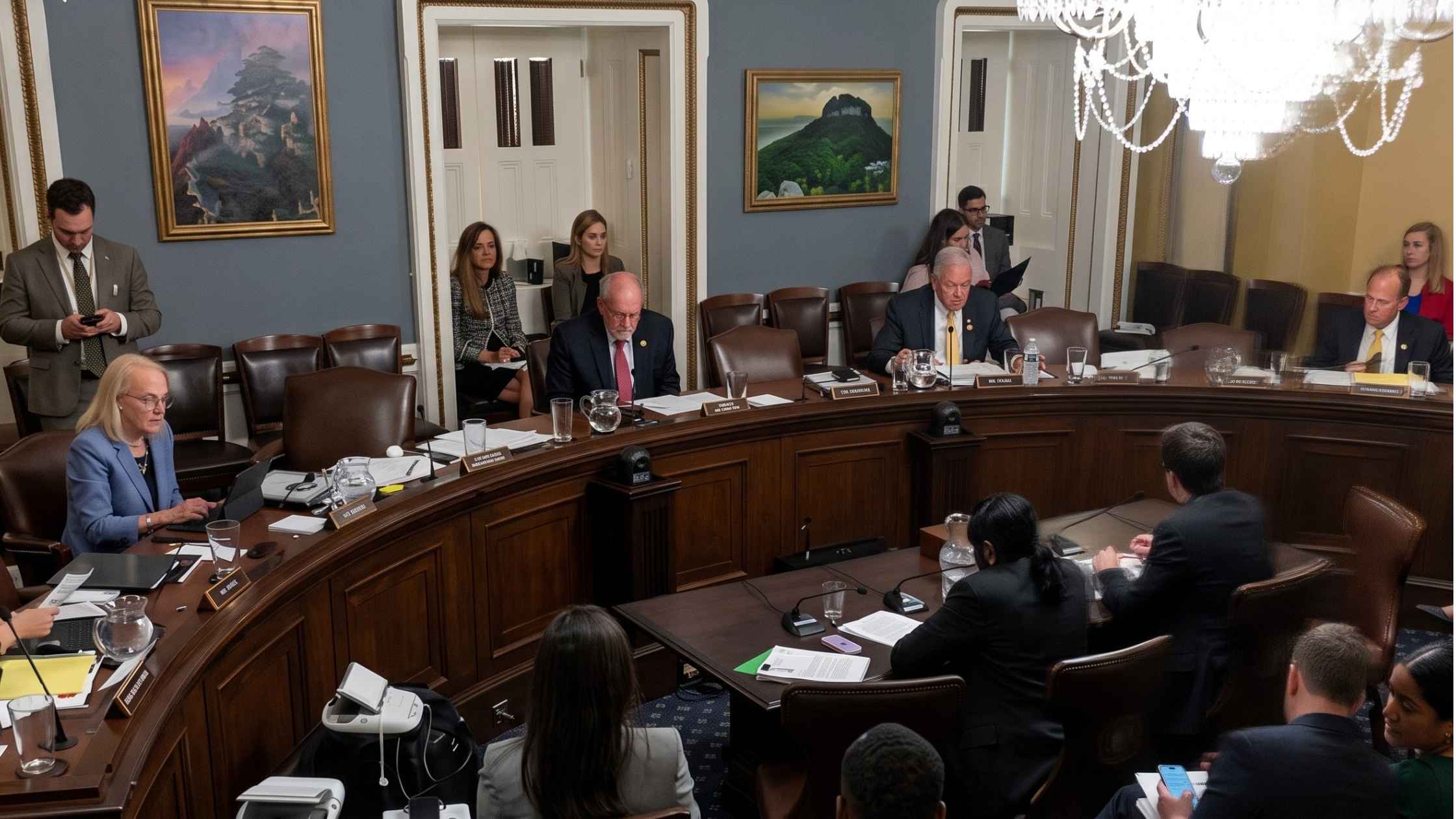
Good afternoon. The committee will come to order. Without objection, the chair is authorized to declare recess at any time. Today, the Rules Committee is convening to consider four measures, H.R. 9022, H.R. 8595, H.R. 1181 and H.R. 9237. H.R. 9022, the Energy and Water Development and Related Energy Agencies Appropriations Act 2027 provides 58.5 billion in funding for the agencies and programs that safeguard US National Security, unleash American energy dominance and advance economic prosperity.
(20:12)
H.R. 8595, the National Security Department of State and Related Programs Appropriations Act 2027 provides 27.32 billion in funding, 6% below the FY26 enacted level. This legislation reflects priorities of the America First agenda and supports the president's vision to refocus and realign foreign policy to make America safer, stronger, and more prosperous while ensuring all funds are spent in a manner consistent with relevant executive orders.
(20:52)
Both bills at their very core embody the America First agenda. They also harbor the identical commitment to place the safety, security, and prosperity of the American people and the entire nation first. I'm quite certain our panel from the Appropriations Committee will give us a thorough and pointed run through of these two bills and I'm looking forward to the testimony that will be shared from our colleagues.
(21:23)
H.R. 1181, the Protecting Privacy and Purchases Act would prohibit payment card networks from using merchant codes that distinguish firearm retailers from general merchandise retailers or sporting goods retailers. Americans who exercise their constitutionally guaranteed right to keep and bear arms should never find themselves corralled under the microscope of the federal government, but that's exactly what we saw under the Obama and Biden administrations when the private firearm and ammunition transactions of these citizens were monitored by the federal government under the guise of preventing mass shootings. The decision to do so was intrusive and entirely unacceptable. We can and should pass this legislation so that law-abiding Americans are not subject to scrutiny and surveillance of their financial privacy when exercising their constitutional rights.
(22:26)
Finally, we turn to H.R. 9237, the Take Care of America's Veterans Act that would improve the benefits and services provided to veterans and their families by amending existing laws and enhancing the efficiency of VA. This legislation is a compilation of over 60 separate bills, the majority of which are overwhelmingly bipartisan to support America's veteran community and further enhance the healthcare and benefit services of the VA. As Secretary Collins has stated on numerous occasions and has been reflected in his and the agency's actions, the veteran is once again the core of the VA's mission. This package reflects that commitment and those actions.
(23:16)
Our panel from the Veterans Affairs Committee, I'm sure, will articulate in depth how this package of bills will help cut through government bureaucracy and deliver the service and quality that our nation's veterans so deserve. With that, I now yield to the Ranking Member, Mr. McGovern for any comments he wishes to make.
Ranking Member McGovern (23:36):
Well, thank you, Madam Chair. And let me begin by being perfectly honest here. Every week, Republicans come here and pretend that they're doing serious work. In reality, they're bending over backwards for Donald Trump, for billionaires, big donors, and every awful priority under the sun. While regular people get ignored and squeezed by the high prices and inflation that Republicans are causing. Just look at this week's agenda. The State and Foreign Operations Bill guts diplomacy. It guts development and it guts humanitarian aid. At the exact same time that this administration is hollowing out USAID and pushing out some of our country's very best experts. We've already seen what that means in the real world. Food assistance. Food assistance is getting disrupted. Life-saving health programs are being thrown into chaos. Vulnerable people are getting left behind. Not because it makes us safer, but because this administration would rather score political points than save lives.
(24:40)
I also take issue with how this administration continues to undermine global human rights, putting us on the side of human rights abusers. That's why I have submitted an amendment to prohibit Trump from withdrawing from landmark international human rights treaties. I hope that my amendment will be made in order so that we can have a vote on it. Given the majority's track record of making amendments, or of not making amendments in order, I don't have much faith, but again, I'm asking for it to be made in order so that we can at least have a debate and a vote on whether or not this administration or this Congress should be withdrawing the United States from Senate ratified treaties.
(25:18)
The Energy and Water Bill before us cuts clean energy, grid improvements and energy research while families are crushed by electric bills and gas prices. Republicans will call it fiscal responsibility while families see even higher costs.
(25:33)
And the so called Protecting Privacy and Purchase Act makes it harder to flag suspicious gun and ammunition of purchases. I mean, gun violence is out of control and Republicans want to take tools away from law enforcement. And now Republicans are advancing a veterans package that gives support for one group of veterans paid for by slashing the benefits from another group of veterans. Instead of just doing the right thing and giving veterans the benefits that they've earned and deserve, Republicans insist on paying for it by cutting other veterans' benefits, specifically veterans with service connected tinnitus also known as ringing of the ears and sleep apnea. Both of those things are the most common veterans' casework in my district. These are real conditions that affect veterans' health, their work, their families, and their daily lives and Republicans are choosing to screw them over. But that's the story of this Republican controlled government. Their priorities are all screwed up.
(26:42)
They want to help Trump and his friends let him steal taxpayer money to build the ballroom and ruin the reflecting pool. I mean, what a joke. They sit back while this war and his tariffs cause inflation to skyrocket and everyday families to struggle and then they come here and they want a pat on the back for doing nothing to fix the mess that they've created. I mean, it is absurd.
(27:07)
The clock is ticking down for Congress to pass all 12 spending bills and fund the government. Now, we could be writing bipartisan bills that keep the government open and help people afford groceries, housing, energy, healthcare, and the basics. But instead, Republicans keep dragging us through these partisan exercises that make people's lives harder and then they wonder why their approval rating is in the toilet. This majority has made its priorities clear and come November, the American people will have their say. I yield back.
Representative Foxx (27:42):
Thank you, Mr. McGovern. I now welcome our panel, Representative Cloud, Ranking Member Kaptur from the House Committee on Appropriations, Energy and Water Development and Related Agency Subcommittee. That's a mouthful. And Chairman Díaz- Balart and Representative Torres from the House Committee on Appropriations National Security Department of State and Related Programs Subcommittee. Your full statements will be submitted for the record and we ask you summarize your statement in five minutes. Representative Cloud, I welcome your testimony.
Representative Cloud (28:25):
Thank you, Chairwoman. Obviously, I'm not Chair Fleischmann, so I'm his stunt double today. He's on a plane.
Representative Foxx (28:31):
Is your microphone on?
Representative Cloud (28:32):
Yes. Hello, hello, hello. Can you hear me? All right. I want to thank you, Chairwoman Foxx, Ranking Member McGovern, members of the committee for the opportunity to testify before you today. I'm pleased to present to the Rules Committee the fiscal year 2027 Energy and Water Development and Related Agencies Appropriation Bill. The FY27 Energy and Water Bill provides 58.5 billion to uphold our commitment to safeguarding the US National Security, unleashing American energy dominance and advancing our economic prosperity in a fiscally responsible manner. The bill delivers a historic investment in our national defense by providing 27.1 billion for the National Nuclear Security Administration, prioritizing the modernization of nuclear weapons stockpile and the US Navy nuclear fleet. The bill strengthens our nation's energy security by focusing research and development efforts on base load energy sources and maintaining funding for programs that deliver affordable energy prices, a secure grid, and long-term energy stability for all Americans.
(29:39)
We continue our support for the Trump administration's efforts to expand domestic nuclear power capacity and advance American leadership in civil nuclear energy around the world. Just this month, two advanced reactors reached criticality under the Department of Energy's Reactor Pilot Program, marking an important step toward ushering in American nuclear renaissance. This bill also makes investments to secure our domestic supply chain of critical minerals and reduces reliance on China and other foreign adversaries. To ensure America remains at the forefront of scientific discovery and innovation, the bill includes 8.5 billion for the Department of Energy's Office of Science. This includes support for the Trump administration's Genesis Mission, which will harness our higher performing computing capabilities and leverage AI to help address our greatest scientific challenges.
(30:32)
America's network of coastal and inland waterways facilitates commerce, transportation and recreation across all states and territories connecting us with the wider world. This bill advances our economic prosperity and promotes public safety, providing 9.8 billion for the Army Corps of Engineers, including full funding of Harbor Maintenance Trust Fund activities and funding for the highest priority construction projects on the Inland Waterways system. Funding for the Bureau of Reclamation is directed towards projects that increase water supply, assist in drought resilience, and support rural America. This is a strong bill and I ask that the committee provide an appropriate rule for its consideration today. Thank you again for the opportunity to appear today and I look forward to your questions.
Representative Foxx (31:21):
Thank you for your succinctness. Ranking Member Kaptur, you're recognized.
Ranking Member Kaptur (31:28):
Thank you, Madam Chair and Ranking Member McGovern and members of the Rules Committee. Rising energy and water costs weigh heavily on American households and businesses. I'm pleased to appear with our colleague, Congressman Cloud of Texas. Our nation must build and usher in a new affordable energy age and ensure Mother Earth is a livable planet. I'm deeply disappointed that the bill before us today tilts toward a partisan framing and hope we can course correct as the days ensue. US energy independence and perpetuity is a strategic imperative. Respect for Mother Earth must be our North Star. We meet today at an historical moment where again, energy, water, and war are hyperlinked. Due to the current administration's war of choice on Iran, gas prices rose above $4.50 per gallon. Diesel in my region topped $6 a gallon, a shrill siren song for farmers, truckers, manufacturers, and businesses. History instructs us that when gas exceeds $4 per gallon, deep recession follows.
(32:48)
We know working citizens and retirees face crushing sticker shock for transportation, heating, electricity, and food. The American people want and rightly deserve a fair energy cost structure. Of our nation's $40 trillion debt, at least 20% of it, $8 trillion, that's 20% has been added by wars related to crude oil. America cannot remain energy vulnerable. Our nation needs broad domestic energy innovation, real competition, and investment not fealty to any one energy source. Competition and investment in modernization will drive better pricing. To reach a bipartisan agreement, which our subcommittee often does, the bill's funding levels require adjustment. The bill increases defense programs by $774 million or 2%, while cutting non-defense innovation programs by $1.8 billion or 6%. Let us address the most harmful cuts in this bill which drive our nation's energy backward. Let me run through the major cuts.
(34:06)
These are cuts. A $1.3 billion cut or 40%, 40% to critical minerals and energy innovation. This devastating reduction completely seeds promising energy breakthroughs to our commercial adversaries like China. This massive reduction in critical minerals undermines our ability to meet fierce global competition. Our nation must lead in all clean energy technologies not seed the field in critical minerals and not ignore the irresponsible accumulation of atmospheric pollutants.
(34:46)
Also, a $50 million cut is proposed or 14% to ARPA-E, our most advanced research in energy. With global population surging toward 10 billion abandoning transformative clean energy-
Ranking Member Kaptur (35:00):
... toward 10 billion. Abandoning transformative clean energy threatens our livable future. The warning signs are all around us, whether it's coastal battering, vast forest fires, prolonged droughts that destroy crops or atmospheric rivers and gale force winds. Also, a $25 million cut occurs to electricity and grid deployment programs. With energy prices rising, cutting funds to modernize our aging grid is a non-starter for rate payers needing relief.
(35:34)
Also, a $282 million cut, or 12%, to nuclear non-proliferation activities, that's quite a reduction. And this retreat is incredibly unwise in an increasingly dangerous world made far more risky by the on again, off again war of choice in the Middle East and Straight of Hormuz. Cutting nuclear non-proliferation leaves our world highly vulnerable as reckless nuclear threats increase. The bill totally eliminates the Army Corps of Engineers fuse wrap program that cleans up former nuclear waste sites. That makes no sense to me. Walking away from cleaning up toxic nuclear industry waste is completely unacceptable and it directly threatens the health of our citizenry today and tomorrow.
(36:22)
Let's not saddle the next generation with the legacy of the 20th century. Critically, this bill should only repurpose infrastructure investment in Jobs Fund X through the bipartisan agreement embracing an all of the above energy strategy to assure competition and innovation going forward. And furthermore, the bill must be free of policy riders, including provisions to allow firearms on core public lands and prohibit clean energy solutions for federal buildings.
(36:51)
In closing, glaringly, the bill fails to protect Congress's power of the purse. Any bipartisan bill must prevent and reverse the administration's project terminations of over $9 billion nationwide. Funding for these projects was passed by Congress, both chambers, duly signed into law and vetted by the administration.
(37:12)
Finally, this bill should require transparency and accountability for federal spending to avoid and prevent government corruption. Until these changes are made, I urge my colleagues to oppose this bill. Working together can yield a better deal for Americans today and open new energy and water frontiers for the tomorrows to come. And I yield back. Thank you.
Chairwoman Foxx (37:35):
Thank you, Ms. Kaptur. Chairman Diaz-Balart.
Chairman Diaz-Balart (37:39):
Madam Chair, what a privilege to be in front of your committee, a ranking member and all the members, what a privilege to be testifying in front of your committee on the fiscal year 2027 National Security Department of State and Related Programs appropriation bills. I know that the ranking member had a flight issue, but I am joined by a brilliant member of the subcommittee, the gentlewoman from California, Ms. Torres. It's a privilege to be with her as well.
(38:06)
The bill presented today is another step in our historic efforts to strengthen national security while reducing spending. Under Chairman Cole's leadership, we have delivered nearly 12 billion in responsible cuts to spending under the purview of the subcommittee since 2023. This bill continues that effort with an additional $2.7 billion of reductions from the enacted level. So it's helping to address, frankly, one of the greatest long-term threats to our country's stability and security and prosperity, and that is our national debt.
(38:47)
Now, there are some who will say that the magnitude of these reductions jeopardize the United States leadership in the world and make us less safe. I completely disagree. In fact, it's just the opposite. It's just the opposite with this bill. The bill provides the funds necessary for the president and the secretary of state to address our national security priorities and continue to transform the world in a way that frankly is bold and durable and supports freedom and security.
(39:25)
I've said this before. If you're a friend or an ally of the United States, this bill supports you, but if you're an adversary or you're in cahoots with the adversaries of the United States, well, frankly, you're not going to like this bill. The bill maintains 1.8 billion for partners in the Pacific, including 500 million in military assistance for Taiwan and robust funding for the Philippines and our partners in the Pacific Island countries.
(39:58)
It demonstrates unwavering support for Israel by providing $3.3 billion in security assistance and maintaining support for other key partners in the Middle East as well. It recognizes the valuable partnerships in the Western hemisphere, which continue to expand, frankly, and realign under the leadership of President Trump and Secretary Rubio. It does so by increasing support for our friends and allies such as Paraguay, Argentina, Costa Rica, just to name a few, expanding funding for counter narcotics and related law enforcement efforts in our hemisphere, including investments to combat fentanyl trafficking and providing funds to support democratic transitions for the people of Cuba, Venezuela, and Nicaragua.
(40:50)
Last year, the members of the NSRP subcommittee, we focused on how to responsibly transition PEPFAR, a program that has been successful, back to its partner countries, to our partner countries, I should say. Look, it's been a great success as I mentioned, but I think most of us would agree that the program should not and cannot just be there forever and ideally we should, again, partner with other countries to have them step up. That's happening. That's actually happening right now.
(41:26)
So working alongside the administration, countries are now really committing for the first time, in many cases, significant sums of their own resources as part of the America First Global Health Strategy, enabling our committee to reduce funding while still achieving the same outcomes. Isn't that what we actually want to happen? Just as critical as what's in the bill and what this bill funds is what the bill does not fund and how it strengthens conditions. It prioritizes oversight and demands accountability for every single tax dollar spent on this bill.
(42:12)
The bill prohibits funds to the PRC and the Communist Chinese Party and prohibits funds to other countries from being used to repay debt owed that they may owe to communist China. It continues a key provision that blocks assistance to anyone that supports, finances or facilitates the operations of the Cuban military, including the Cuban Ministry of the Revolutionary Armed Forces and the Ministry of the Interior. It maintains the prohibition on all assistance to the Taliban. It puts America first by withholding funds from Mexico until that neighbor of ours delivers the water that is owed to the United States, and supports full implementation of key executive orders that reflect a clear commitment to national sovereignty, a secure border, limited government and American values, including those related to restoring free speech, supporting religious freedom and ending censorship. Assessed funding for the UN is cut by $1.8 billion. No funds are included for the UN regular budget and funds are prohibited to the World Health Organization, the United Nations Commission of Inquiry Against Israel, the United Nations Relief and Works Agency, commonly known as UNRA, the United Nations Human Rights Council, the Office of High Commissioner for Human Rights, the International Criminal Court, and the International Court of Justice.
(44:03)
The bill includes a provision to ensure that we finally have justice for the victims of October 7th, 2023 of those heinous terrorist attack, by way that included 50, 50, murdered Americans, by requiring full accountability for UNRA staff who participated in those heinous acts of terrorism. The bill maintains all longstanding pro-life provisions, parts funding for the UNFPA and prohibits spending that violates the president's protecting life and foreign assistance policy. These measures, as you know, along with stronger oversights, ensure taxpayer dollars do not fund abortions.
(44:50)
So again, good bill, spends less money, does more with less money, something that we proved was possible last year. So this continues in that same vein. And with that, Madam Chair, I thank you all for allowing us to be at this hearing and I look forward to your questions. I yield back.
Chairwoman Foxx (45:08):
Thank you. Ms. Torres, you're recognized. You're a former member of the committee and we welcome you back.
Norma J. Torres (45:15):
Thank you, Chairwoman Foxx and also our ranking member, McGovern and members of the committee. Ranking Member Frankel ran into travel delays, so as a member of the NSRP subcommittee, I am appearing on her behalf.
(45:33)
I want to thank our colleagues on both sides of the aisle who understand how central this funding is to our national security. Regretfully, I oppose the Republican fiscal year 2027 National Security and State Department Appropriations Bill as drafted. This bill should be our moment to lead. Done right, this bill would make America safer. However, this bill falls short. Real security is not achieved with bombs, bullying and tariffs, the apparent policies of choice for the Trump administration. Real security includes strong diplomacy, development and humanitarian leadership. That's how we build alliances. That is how we grow trading partners and that is how we stop disease and extremism at the source.
(46:29)
That is how we prevent costly wars before they begin. Yet, this bill hollows out our ability to pursue these critical efforts. And let's be clear about the backdrop. USAID dismantled. Programs canceled. Expertise pushed to the door. Now a weekend State Department is expected to carry the full load despite the fact that it was never built to do so. Alarmingly, this bill caters to the worst instincts of the Trump administration and pulls back American leadership at exactly the wrong moment.
(47:12)
With another 2.7 billion cut proposed from the International Affairs budget this year, we are investing 14 billion less through this bill than we were just four years ago. These reductions will weaken our diplomats, dismantle development programs/humanitarian aid, the lifeline that keeps millions alive and undermine global health and security efforts that stop threats before they reach our shores. And at the very same time in another appropriation's bill scheduled to be marked up tomorrow, my Republican colleagues are seeking hundreds of billions more for war, more than $1 trillion for the first time in our history. Let me be clear. I support a strong military and like most Americans, I would rather prevent war than have our loved ones fighting in it. That's why the soft power in this bill before you is so essential. Diplomacy stops costly wars before they start. Global health programs stop disease outbreaks before they spread. Development reduces the desperation that fuels extremism and alliances ensure that we do not face threats alone.
(48:37)
Those are essential ways that we keep America safe. Instead, this bill abandons that proven strategy. It eliminates funding for the United Nations and UN peacekeeping at a time when global cooperation has never been more important. As Ambassador Waltz told the subcommittee when we visited the UN in March, US leadership at the UN is not optional. It is essential.
(49:07)
This bill rescinds one billion in humanitarian aid while crisis intensified across Africa, Eastern Europe, and the Middle East. It undermines the health and futures of women and girls worldwide by cutting family planning funding for UNFPA and reinstating an expanded global gag rule, undermining the health and futures of vulnerable people worldwide. It zeroes out critical institutions like the US Institute of Peace, the Inner American Foundation, and the US African Development Foundation.
(49:46)
This is not strength, it is retreat. And when America retreats, other like China step in. Nowhere is that clearer than in Africa, a continent with the fastest growing population and enormous economic potential. If we lead, Africa can be one of our strongest partners in growth and stability. If we walk away, others will shape that future without us. This is not about choosing between hard power and soft power. It is about being smart enough to use both. This bill fails that test. I urge this committee to reject this bill and reject floor amendments that would further weaken our alliances and partnerships, retreat from our commitments and turn our backs on people at risk and in need. Thank you, Chairwoman, and I yield back.
Chairwoman Foxx (50:50):
Thank you, Ms. Torres. Ms. Fischbach, I recognize you.
Michelle Fischbach (50:51):
Thank you, Madam Chair. And thank you all for being here and I appreciate you bringing the bills forward because I support the priorities and the direction you're taking these in. I'll just start with Mr. Cloud. I represent a rural district and I was very happy to see in the bill that it does invest significant funding in many of the rural priorities that many of us share, including construction projects, flood infrastructure and electric grid improvements. So I'm just kind of wondering if maybe you could talk a little bit more about that and how does this bill help build a foundation for the future success in critical areas like energy, critical minerals, water, and more?
Michael Cloud (51:36):
Right. I too am from a rural district, a town of 60,000 people. My district is one of those where there's more cows than people in it. And this bill does a lot to get us back to base load energy, which was so important. The Biden administration put a lot of dollars into chasing intermittent energy into supply chains that went through adversarial nations. I know for example, in my community, in our district, there's a small community where they were looking to close down a coal fire plant. It was the only source of energy for this small town and we worked with the [inaudible 00:52:23]. We were able to get that converted to a natural gas, but under the Biden administration, they had said, literally in the budget, no investment for oil and gas, anything related to it when we realized how important it is to have base load and that's the quickest and easiest way to get to affordable energy.
(52:38)
Continues the investment on water technology, there's a new center of excellence that's been developed. This puts research dollars into providing smart water research and technologies and building out the infrastructure that's needed. That along with what the administration is working on, it was just about two weeks ago, three weeks ago, OMB announced that they're lifting what had been a $30 million cap on water infrastructure projects.
(53:08)
And so with the funds provided in this bill along with the removing of that cap, that opens up the door to serious water infrastructure projects going forward that can really help rural communities and really just continues to provide a economically sustainable path to affordable energy specifically for our rural communities. And thank you for serving in an area like that, it has certainly unique demands that we don't find in metroplexes.
Michelle Fischbach (53:41):
That's right. Well, and thank you very much and I appreciate you being here today and thank you for the response because I do think it is that direction that we are moving and trying to make sure that we support those areas and that we are doing what we need to do for sustainability to continue, and economic growth and all of the things that we want in our rural areas and across the country. But thank you very much.
(54:07)
Mr. Chairman, turning to HR 8595, I think international security obviously is of the utmost importance and it's incredibly important right now. And so I do appreciate the way that you've moved the direction and you also recognize that we are facing incredible amounts of debt. And so I think one of the things that really struck me was the provision in the bill, although there's many great ones, it's the $1.66 billion for the international narcotics control and law enforcement and that's an increase because I think it's so critical and maybe you can expand on how this will really help combat the ongoing fentanyl crisis that's killing Americans every day.
Chairman Diaz-Balart (54:56):
Well, thank you for the question and thank you for the interest in that issue. Look, that's an issue that I think has strong support in Congress and the House. In our committee, we're fortunate to have one of the leaders fighting fentanyl, for example, and other type drugs that are killing Americans in the droves. And that's the dean of the house, Hal Rogers. He keeps us focused on that issue time and time again.
(55:18)
And you're right, we put additional money to do that in this bill. So while we are reducing funding, we're putting more money onto things that have an impact and that are hugely important. This is one of those. So we're putting more money, and I will tell you, I just recently got back from leading at Codel to South America and this is one of those areas that our ambassadors will always talk to us about and specifically where we've put the additional money are areas that actually have an impact, save American lives and we're very proud of doing that.
(55:54)
As I mentioned at the beginning of my presentation, while we are spending less overall, we're doing more critical spending on issues that are highly important. We did this in FY26. A lot of folks thought it was impossible, I remember coming here and we had some interesting debates. We were able to pass that off the floor and negotiate with the Senate. And again, a reduction overall, but doing more important things.
(56:18)
If there's one area that we have been making, can make an impact and we can do so by putting some more resources, is in this area that you're talking about, fighting narcotics, fighting fentanyl, fighting transnational criminal organizations that, by the way, not only traffic and fentanyl and in drugs, but they also traffic in humans and they traffic in weapons. These are dangerous organizations. So we've put more resources, more funding. It's something that I think has, I hope, strong bipartisan support and that I hope that we'll be able to, like we were able to do in '26, keep after the negotiations with the Senate.
Michelle Fischbach (56:58):
Well, and thank you very much because I recognize this is a huge issue, the fentanyl issue. And you mentioned the other kind of crimes that you're combating by just doing this and so I appreciate that and I appreciate that you recognize the debt, you recognize the need to reduce spending, but you also prioritize those things. That will really, truly make a difference, so thank you very much and thank you both for being here. I yield back.
Chairwoman Foxx (57:31):
Thank you, Ms. Fischbach. I understand we're going to have a little switch in witnesses here, so we'll give them a chance to do that and I'll recognize Mr. McGovern.
Ranking Member McGovern (57:45):
I love when my Republican friends talk about that they need to cut humanitarian aid programs, food aid programs because they're worried about the debt, but nobody on the other side said a word that we passed a tax cut bill that benefited multimillionaires and billionaires that added trillions to the debt. And the week before last, we added another $70 billion to the $100 billion that ICE and CPP already have. None of it is offset, no one says a word about that, but when it comes to programs to feed hungry people, all of a sudden, oh, we got to tighten our belts.
(58:26)
I want to begin with ... I just have a few questions, I'll try to be quick here. Since you're all appropriators, this is a question that I got asked a lot during the break by my constituents. In fact, a gentleman on the airplane down here today asked me about this and that's the president's ballroom. His lavish ballroom, which he said on multiple occasions, would be a hundred percent privately funded. I mean, he said that a million times, a hundred percent privately funded. So let me just ask you yes, no, or maybe. Do you support using taxpayer dollars to fund President Trump's ballroom? Ms. Kaptur, do you support using taxpayer funding to fund the ballroom?
Ranking Member Kaptur (59:15):
No, Mr. Ranking Member, I do not.
Ranking Member McGovern (59:17):
Thank you. Ms. [inaudible 00:37:36]?
Norma J. Torres (59:17):
No.
Ranking Member McGovern (59:17):
Mr. Diaz-Balart?
Chairman Diaz-Balart (59:23):
There's no funding for any ballroom in my appropriation bill, just so you know because it deals with foreign policy.
Michael Cloud (59:29):
I'll note there's no funding in the energy and waters bill as well.
Ranking Member McGovern (59:32):
So let me let both of you, Mr. Diaz-Balart and Cloud in on something. You're appropriators, and I'm surprised you don't know this, but are you aware that President Trump and his team have transferred roughly $400 million in taxpayer dollars that Congress appropriated to the Secret Service and put into the White House repair and restoration account in order to make "security upgrades" as part of the ballroom construction project?
(59:59)
So when you say there's no taxpayer funds going to this, are you aware that ... Well, I mean, but you're appropriators, I mean, you're on the full committee as well, are you aware that taxpayer dollars, hundreds of millions of dollars are going to this ballroom? Yeah. Yeah, absolutely. Well, I'm questioning you so you don't have to get permission from the chair.
Chairman Diaz-Balart (01:00:20):
So I am aware that we have a pretty high risk security situation. We have a president who's now suffered ...
Ranking Member McGovern (01:00:27):
And so you support that?
Chairman Diaz-Balart (01:00:28):
I support in making sure that the President of the United States is safe-
Ranking Member McGovern (01:00:31):
So you support ...
Chairman Diaz-Balart (01:00:32):
... but I have not seen any details.
Ranking Member McGovern (01:00:34):
Well, I will provide you the details because -
Chairman Diaz-Balart (01:00:36):
Look forward to it.
Ranking Member McGovern (01:00:37):
... OMB has provided us all the monies where there were transfers. I mean, in fact, I can tell you right now that a transfer of $340.8 million in taxpayer dollars to the ballroom construction on June 12th, 2026, a second transfer of $10.75 million in taxpayer dollars to the ballroom construction also on June 12th. A third transfer on June 15th of $45 million in taxpayer dollars again to the ballroom construction.
(01:01:06)
I mean, I have the documents from the Office of Management and Budget right here, so it's stunning to me that as appropriators that you're unaware of the transfers. But here's my question, if I run the appropriations committee and I work to get money appropriated for X or for Y, I would want to make sure that the executive branch, whether it's a Republican administration or a Democratic administration, respected the will of Congress, that actually did what appropriators said they would do. I mean, this is like an end run around Congress.
Ranking Member Kaptur (01:01:42):
Yes.
Ranking Member McGovern (01:01:44):
Is that something you support? And if not, what can the appropriations committee do to stop it?
Michael Cloud (01:01:49):
I will note, I took a tour of the White House defense apparatus with the Secret Service recently. I would wonder if you've taken that same tour.
Ranking Member McGovern (01:01:56):
I don't think they'll let me onto White House grounds. With this president, I don't think. But the point of matter is if you support ...
Michael Cloud (01:02:05):
But have you ever taken that tour?
Ranking Member McGovern (01:02:06):
[Inaudible 01:02:07].
Michael Cloud (01:02:07):
Have you ever taken that tour?
Ranking Member McGovern (01:02:08):
If you support ...
Michael Cloud (01:02:09):
Have you ever taken that tour?
Ranking Member McGovern (01:02:10):
Yeah, I have taken the tour. Yeah.
Michael Cloud (01:02:12):
Not the White House tour of the security defense apparatus.
Ranking Member McGovern (01:02:14):
Yeah, I...
Michael Cloud (01:02:15):
I had the chance to talk to the Secret Service, and you know when we visit the White House right now, the visitors to the White House go through tents basically. They stand out in the open. When we hold state dinners, it's basically a lawn that could be have just been rained under and the ballroom portion ...
Norma J. Torres (01:02:38):
Let him answer.
Michael Cloud (01:02:38):
There's a [inaudible 01:02:39].
Ranking Member McGovern (01:02:39):
No, he isn't. I mean with all due respect [inaudible 01:02:41].
Michael Cloud (01:02:41):
There's a security component to the ballroom that you should probably look into and certain things of course, we can't talk about in this committee.
Ranking Member McGovern (01:02:48):
[inaudible 01:02:48] as appropriators why don't you appropriate the funding? Why do you allow the administration to do an end run around this? I mean, you have appropriation bills coming up right now, you can fund hundreds of millions of dollars as you see fit. Why not just do it?
Chairman Diaz-Balart (01:02:59):
May I address that? May I address it? Thank you, sir. Look, valid question, but it is a little rich because I do remember when in the previous administration there were hundreds of billions of dollars that were spent by then President Biden's administration that were neither appropriated nor authorized and then it went to the Supreme Court of the United States when the Supreme Court of United States said it was unconstitutional, by the way, I don't remember the outrage by some of our Democratic colleagues about that taking place. Now having said that ...
Ranking Member McGovern (01:03:30):
Is that constitutional?
Chairman Diaz-Balart (01:03:32):
No, no. No, what was unconstitutional was a time when the Democrats did not speak out when President Biden did it. Now ...
Ranking Member McGovern (01:03:39):
Let me [inaudible 01:03:40] my time.
Chairman Diaz-Balart (01:03:40):
Well, if you don't want me to answer it, then I get that because you don't like the answer, but that is ...
Ranking Member McGovern (01:03:44):
My question is, are you saying that this money that the president is spending, which was not authorized or appropriated for this use is unconstitutional? If not, then do you approve of this money being spent on the ballroom? It's a simple question, not a trick question.
Chairman Diaz-Balart (01:04:00):
No, if I may, what I'm saying is that we are here, we have appropriation bills in front of you. We have two appropriation bills. By the way, none of these two bills deal with that specific issue, but again, it's a little rich when I heard all of a sudden a wake-up that money that was not appropriated should or should not be appropriated when the previous administration did so and the Supreme Court of the United States said that it was wrong. And I do not remember, I may be wrong because maybe you can get me some of your quotes demanding accountability to the president.
Ranking Member McGovern (01:04:32):
You support taxpayer funding for this ballroom?
Chairman Diaz-Balart (01:04:35):
I support ...
Ranking Member McGovern (01:04:36):
The reason why is because they tried to put it in the reconciliation bill, but it became so unpopular that they removed it.
Chairman Diaz-Balart (01:04:41):
I support these two appropriation bills that are in front of you right now, again, neither of which have that issue.
Ranking Member McGovern (01:04:46):
So then I will put you both down as saying that you support [inaudible 01:04:51].
Chairman Diaz-Balart (01:04:50):
No, no, what I'm saying, Mr. Ranking Member ... You don't
Ranking Member McGovern (01:04:53):
Shall I put you down as you don't support that money.
Chairman Diaz-Balart (01:04:54):
No. What I'm saying is I support these appropriation bills in front of you. None of these ...
Ranking Member McGovern (01:04:59):
Is it a maybe? I don't know. No?
Chairman Diaz-Balart (01:05:02):
Anyway, well, look, you don't like the answer and you sure were not complaining when the previous administration did a lot more egregious than what you're claiming is happening today.
Ranking Member McGovern (01:05:12):
[inaudible 01:05:12] defending this president's unauthorized transfer of funds to do this. But let me add Mr. Cloud, you have submitted your amendment to permanently block the federal government from issuing a central bank digital currency 38 times to this Congress.
Michael Cloud (01:05:28):
You're welcome.
Ranking Member McGovern (01:05:28):
And each and every one of those times the rules committee controlled by your party has blocked your amendment from being made an order. So I see that you have filed your amendment for 39th time today before our committee. My question is -
Michael Cloud (01:05:43):
Holding out hope.
Ranking Member McGovern (01:05:44):
... if Republicans block your amendment for the 39th time, will you vote against the rule?
Michael Cloud (01:05:53):
I'll think about it.
Ranking Member McGovern (01:05:56):
The question would be, why would you continue to vote for rules that block your own amendments from getting votes? I mean, your party's in the majority. Let me just, one final question for Mr. Diaz-Balart. Yeah, I'm looking over the National Security Department of State and Related Progress Appropriations Bill. And I'll be honest with you, that does not reflect my values and I think it weakens the United States. I think gutting programs that actually help deal with humanitarian crises is a bad thing for the United States, undercuts our national security. And I think national security needs to be thought of in terms that is not just about our military might, but about the good stuff that we do.
(01:06:37)
And I also am deeply troubled by the de-emphasis of human rights by this administration and by quite frankly, Congress. I mean, the president went to China recently and met with President Xi, I was stunned that human rights was not a priority on their agenda and not part of the readout of his statement. I think President Xi is a horrific dictator that is abusing the Chinese people, that anybody who disagrees with them is put in jail. We have tons of political prisoners, and I would like to think that if any country in the world was out there fighting for these people, it would be the United States.
(01:07:16)
But my question to you is the Trump administration is relying on the UN over and over for their priorities as the main channel for humanitarian aid to legitimize the Gaza ceasefire, for new security arrangements in Haiti and now to get nuclear weapons inspectors back into Iran. That's what the Trump administration is relying on the UN, yet this committee isn't funding the UN. That just seems illogical. It's counterproductive and it makes us look like a cowardly cheapskate in the eyes of the world.
(01:07:46)
The US should lead and it is beneath us to be a freeloader. So my question is, why isn't this committee funding the UN to meet both the president's priorities, what the president has said he wants the UN to do and Congress's on human rights, on disease prevention, on conflict prevention and other matters.
Chairman Diaz-Balart (01:08:08):
Thank you. Yeah, you're right that we do cut a lot of funding for the, for example, the UN General Fund. We do, however, fund some key issues that the UN does. Now, we don't fund some things that frankly are just a waste of money. You mentioned human rights. I think you and I would probably agree on one thing, which is that the UN Human Rights Council is made up of among the worst human rights violators in the planet and to continue to fund entities like that, which all they do is they take our money and then use that money to frankly just go after the United States or our allies while being made up of the worst human rights violators in the world, it's this not serious? So while we're funding, again, I go back to what I said at the beginning, we're funding key issues, but we're not just spending money and throwing money away wastefully.
Ranking Member McGovern (01:08:59):
But the money doesn't go to those countries. It goes to the body, right? I mean, it doesn't go to those countries.
Chairman Diaz-Balart (01:09:04):
Yes. It goes ...
Ranking Member McGovern (01:09:06):
And I'm just going to say this because I'm about to be gaveled down here, as the co-chair of the Tom Lantos Human Rights Commission named after Tom Lantos, the only Holocaust survivor to serve in Congress, it is stunning to me how our country has withdrawn from being a leader on human rights. It is an afterthought. And some of the president's closest allies are the worst human rights abusers in the world. And again, it's really troubling and I think it's one of those things that undercuts our overall national security. And I'm being cut off so I yield back.
Chairwoman Foxx (01:09:40):
Thank you, Mr. McGovern. Mr. Griffith, you're recognized.
Morgan Griffith (01:09:45):
Thank you, Madam Chair. Anything additional, Mr. Cloud, that you would like to add?
Michael Cloud (01:09:52):
About the bill?
Morgan Griffith (01:09:53):
About the bills. It's always good to talk about the bill.
Michael Cloud (01:09:56):
I'd love an energy and water question. I kind of thought this is what we were going to be talking about today.
Morgan Griffith (01:10:00):
Yeah, welcome to rules.
Michael Cloud (01:10:02):
Oh, thank you.
Morgan Griffith (01:10:03):
We don't always ...
Mr. Griffith (01:10:00):
Yeah, welcome to rules.
Speaker 1 (01:10:02):
Oh, thank you.
Mr. Griffith (01:10:03):
We don't always talk about what we're supposed to. I understand. It drives me crazy too.
Speaker 1 (01:10:08):
I will say that central bank digital currency would present the ultimate surveillance tool and tool of control. And it is so vitally important that we do everything we can to make sure that our kids and our grandkids never have to deal with that.
Mr. Griffith (01:10:23):
And I agree with you. I am told, however, it's not germane to this bill.
Speaker 1 (01:10:29):
I understand that, but I will keep trying.
Mr. Griffith (01:10:32):
And I appreciate your efforts and when we can get it germane, I will vote with you. Chairman Díaz-Balart, did you have anything additional you'd like to add?
Chairman Díaz-Balart (01:10:42):
No, thank you. Look, I think this is a very good bill. You'll recall that when we were here for fiscal year '26, we heard of the same naysayers say that we couldn't cut spending, that the world's just going to fall apart. And what we found is that if you're an ally, we're supporting you, we're helping you, but we're just not wasting money on things that don't work or that are actually not only not helping our national security, but they're hurting our national security. This bill goes a little bit further in that same direction. We proved that we were right in fiscal year '26, and assuming this bill goes to the floor, we hope to continue in that same trajectory of spending less money while doing more to strengthen our national security. So thank you, sir.
Mr. Griffith (01:11:25):
I appreciate it. With that, Madam Chair, I yield back.
Madam Chair Foxx (01:11:29):
Thank you, Mr. Griffith. Ms. Scanlon.
Mr. McGovern (01:11:32):
Yeah, I just want to say for the record, this committee, while they may not make specific amendments in order that are non-germane, routinely self-execute matters that are non-germane into bills. So the reality is that that's just not a good excuse. But I wanted to clarify that for the record. I yield back.
Ms. Scanlon (01:11:54):
Thank you. So we've got two appropriations bills here today, and I don't think by any stretch of the imagination you can credibly say that they put Americans first. Instead, they cut programs. They cut programs that would increase our national security and they cut programs that would decrease energy costs. I mean, for months the president has been waging a war against Iran that has cost American taxpayers hundreds of billions of dollars. Every American is feeling the impact of this illegal war as it's disrupted global energy markets, it's driven up fuel and fertilizer costs, and it's worsened the cost of living crisis that is facing families and businesses across the country. My constituents feel it every time they fill up their gas tanks, pay their electric bills, or try to make ends meet. But instead of addressing these challenges, these two appropriation bills are going to make those problems worse.
(01:12:51)
In the energy and water bill Republicans cut billions from non-defense programs so they can increase defense spending by nearly $800 million. It slashes funding for programs that help develop clean, affordable, and secure energy by 40%, investments that would strengthen American energy independence and promote the all of the above strategy rather than increasing reliance on fossil fuels. The alternative would help lower costs, this bill will raise them. It also cuts funding for the Army Corps of Engineers by $660 million. In my district, that agency has been an essential partner in developing long overdue flood mitigation solutions for Eastwick, a community that has experienced repeated and devastating flooding because of unchecked development and aging infrastructure. But just recently the Corps said, "Oh, we can't afford to continue helping you." So the misplaced priorities don't stop with the energy and water bill. While Republicans spent billions on foreign wars and power grabs, their National Security and State Department bill continues to gut global health programs and humanitarian assistance, which objectively have made us more secure.
(01:14:06)
We're already seeing the consequences of hollowing out USAID, withdrawing from the World Health Organization, and canceling programs to identify and contain dangerous disease outbreaks. Research indicates that already 750,000 people, including half a million children, have died as a direct result of the cuts that have already been made to USAID and the cancellation of programs which have allowed malaria, HIV/AIDS, and tuberculosis to spread without being checked, that have interrupted nutrition, vaccines, and treatment for new mothers and infants, and the abrupt end of humanitarian aid has led to the collapse of food distribution and sanitation services in several countries. It is projected that the cuts to USAID will cause more than 14 million deaths by 2030. I mean, we've just seen in recent days that health officials are struggling to contain the Ebola outbreak in Central Africa. The US is once again confronting the spread of the new world screwworm, a pest that was eradicated in this country in the 1960s, but is now on the move again in several states threatening our beef industry.
(01:15:27)
So we know that an outbreak miles away, countries away can become local in a matter of days, and investments in global health are investments in American national security. And because no Republican appropriations bill would be complete without partisan culture war riders, this bill also includes provisions to ban pride flags at US embassies and to dramatically expand the global gag rule, which prohibits even foreign nonprofits from providing reproductive health counseling or services if they receive US dollars and if those services include abortion care, even if no US funds are being used to provide those services. We know where that leads. Clinics close, healthcare providers withdraw services, and patients lose access to maternal healthcare, HIV treatment, and other basic health services.
(01:16:21)
So as one of our witnesses said earlier, national security is about more than military force. We have to prioritize energy security, resilient infrastructure, and our ability to respond to global crises before they reach our shores. These bills don't meet that test and they fail to address the real challenges facing Americans. Ranking member Kaptur, Americans are paying higher prices for gas, electricity, and other necessities. Does this energy and water bill do anything meaningful to lower energy costs and does it help us reach energy independence?
Ranking Member Kaptur (01:17:00):
No, actually the bill takes a backward step in so many of the areas that we summarized in our formal testimony to provide more modern grid, to provide greater competition, which is really the answer to lowering costs, to invest in innovation in the energy sector. All of those accounts have been reduced. And in the critical minerals area, which is so important to new forms of power, the cut is 40%. I mean, it's massive. It yields unfortunately extra advantage, especially to China, but not only China as we look at the ways in which we source critical minerals around the world. So it doesn't reduce energy prices to anyone and it cuts many of the behind the grid inventions that have made more affordable power possible. So for example, in the arena of solar power, for example, I could give you many examples, Mrs. Fishbach was talking about rural America, where even in Ohio, what innovative mayors have been doing in towns of under 5,000 people actually providing back to the grid power to their people. It's revolutionary and it's important to them and it reduces costs.
(01:18:31)
So no, this bill is not admirable in that regard. And I wanted to just, if I could just say a word, Ranking Member McGovern talked about the role of the Appropriations Committee. I'm a senior member on the Appropriations Committee. I've never served, and I've served in Congress a long time through many presidencies, I have never seen an administration abuse the appropriation's power as this administration is doing unconstitutionally, certainly in the examples you've pointed out with the ballroom. But now we're at war and when we attempt to find out, and that is not the purpose of this hearing today, I understand that, where the money is being taken from, billions of dollars a week to conduct this war, there are no appropriated accounts that have been submitted to us for approval on an emergency basis, and that money's being taken from somewhere and this is what Secretary Hegseth said to me when I asked him, "From which accounts are you taking dollars in order to conduct this war?"
(01:19:30)
He said, "From the general accounts." I replied to him, "There are no such accounts. I want to know exactly from where you are taking the funds away." And his answer was, "Call my office." I said, "With whom in your office should I speak?" And he said, "Anyone." Now, the law will eventually lock down and we will follow the constitutional mandates for the movement of dollars. That is our responsibility under Article I of the Constitution as appropriators and we intend to pursue it, but it won't happen tomorrow. It will require litigation.
Ms. Scanlon (01:20:09):
Thank you for that. I share your concern, and with respect to the energy and water bill, with respect to solar energy, we've seen the impact of federal investment in being able to move communities, churches, temples, mosques, schools to adopt solar energy, which then lowers their costs and enables them to accomplish their mission, and it just doesn't happen without assistance from the government to help people make that transition. So it is very concerning to see those cuts coming in and undermining the progress that our country has been making in that way.
Ranking Member Kaptur (01:20:46):
Very good point. Very good.
Ms. Scanlon (01:20:49):
Representative Frankel, we're seeing a lot of this sort of penny wise, pound foolish approach to the appropriations bills, talking about, " Oh, we're saving X amount of money by cutting all these efforts to control diseases overseas or to relieve hunger overseas." What is the impact when we cut this kind of humanitarian aid and crises worsen, instability grows? How does this create greater costs and security challenges for our country?
Representative Frankel (01:21:23):
Thank you for your question. Thank you to the members of rules for your work. And just to say that regretfully, as you know, I'm not supporting this bill. I'm hoping we can do a better job together. We do work well together, but this bill falls very short. I don't know if you know this, but my son Ben, he's alive and well, I'll start with that, but he's a US Marine veteran, he went to two wars. And I came to Congress with the mission to keep any other people's children from going to war, and that's really what drove me to get on this particular committee. We call it the committee really of soft power.
(01:22:06)
As my colleague, Ms. Torres said, that you can't just have ... The Trump administration with the bombs and the tariffs and the bullying, that's not going to be the way to keep us secure and prosperous. And it is through diplomacy, development, and humanitarian assistance is the way to ... We create trading partners, we keep people from being disenchanted and maybe joining terrorist groups and we keep diseases from coming here. So this bill falls far short. I think we can do better, I know we're going to strive to do better and I thank you for your attention.
Ms. Scanlon (01:22:51):
I appreciate that. I was really struck a few years back, I had the opportunity to visit the Northern Triangle countries in Central America and meet with folks there and they talked about how the very small investment, $600 a year I think was the figure we were given, could provide enough support to fight corruption, fight hunger, fight disease, and help people stay in their home countries as opposed to migrating. And that's much of what can be done with this bill, as opposed to this migration from this administration to renaming ... They're no longer trying to defend the country, they're trying to commit wars.
Representative Frankel (01:23:30):
Well, you could see tomorrow we'll be marking up a defense bill over a trillion dollars for the first time on our history. That's where the money's going. It's not going to lift us up domestically or even where I think we should be going into soft power. And I want to just add this. We had Marco Rubio in front of our committee and we asked him why contraceptives were just basically rotting away in warehouses overseas, millions of dollars worth. And he said to us, "Well, we're not in the family planning business." And that was evident when this bill came across to us, where family planning for women, under-resourced women around the world was completely cut. We need to do much more to uplift the mothers and the grandmothers and the sisters.
Ms. Scanlon (01:24:22):
Absolutely. I mean, we've seen time and again, food left to rot, medicines left to spoil or become out of date. It is the worst form of fraud, waste, and abuse, I think. Although of course the rotting reflecting pool is way up there. I yield back. Thank you.
Madam Chair Foxx (01:24:41):
Thank you very much. Mr. Jack, you're recognized.
Mr. Jack (01:24:45):
Thank you, Madam Chair. Chairman Díaz-Balart, appreciate your testimony today. Could you walk us through, compared to 2026, how much spending you were able to cut from this appropriations bill in line with what the American people wanted when they elected us the majority, which is a more efficient government that spends money more wisely?
Chairman Díaz-Balart (01:25:05):
Yes, sir. Thank you. Thanks for the question. This bill has an additional $2.7 billion reduction from the enacted fiscal year '26 bill.
Mr. Jack (01:25:14):
And just to frame this going forward, I always like to try to bring voters back home into the mindset that we have here in Congress. What is a vote against this bill? When we have this on the floor later this week, if the rule passes, which it will, what are voters or rather what are members of Congress voting against if they vote no?
Chairman Díaz-Balart (01:25:35):
Confronting our adversaries, helping our allies. Making sure that our country is stronger, more secure, more prosperous, safer. But in a way that also spends less money. And so what we have proven in this Congress under the chairmanship of Tom Cole, of Chairman Cole, is that in this particular subcommittee, we've proven it, this is no longer a theory, is that we can spend less and do better. That not only helps our taxpayer, our fiscal situation, which is obviously a grave of concern. It should be a grave concern to everyone, but we can also, while spending less overall, do more to help our allies, do more to confront our adversaries, do more for the national security interests of the United States. We proved that in fiscal year ... Actually we started that process in fiscal year '25 under President Biden, but those were tough negotiations, but we reduced some spending even with President Biden in the White House once I got this chairmanship.
(01:26:38)
And fiscal year '26, we did it in a much more dramatic way and I think in a much more effective fashion. This takes us in the same direction. So if you vote against this bill, you're voting in essence against confronting our adversaries in a stronger way, helping our allies in a more forthright way, and yet doing so with spending less taxpayer money.
Mr. Jack (01:26:57):
Well put. Madam Chair, I yield back.
Mr. McGovern (01:27:00):
Madam Chair?
Madam Chair Foxx (01:27:01):
Thank you very much. Mr. McGovern?
Mr. McGovern (01:27:04):
Just for the record, the size of the cut in your bill is about 4% of what you spent on ICE and CBP with no offset, which is one of the reasons why the debt has gone up $3 trillion since Trump took office.
Madam Chair Foxx (01:27:20):
Thank you, Mr. McGovern. Mr. Chairman, I was going to ask you a similar question to what Mr. Jack asked you. I think he did a very good job of helping you explain a little bit more when you were interrupted earlier, I think, in your comments. And let me step back a minute. I want to thank the veterans who are here in the Rules Committee today. Thank you for coming to the Rules Committee, but more importantly, thank you very much for your service. We're very grateful to have you here today. Is there anything else, Chairman Díaz-Balart, that you want to add to what ... it seems to me that you've spelled out very clearly the choice that we will be making on whether we vote for or against this piece of legislation, as you said, helping our allies, denying money to our adversaries, those things that you spelled out. Is there anything else you'd like to add?
Chairman Díaz-Balart (01:28:25):
Look, you all are extremely busy and I want to thank you all for your service and your time and I think I've explained it, but obviously always willing to answer any other questions. But Madam Chairwoman, I hope that I've explained this bill in a way that is understandable. It's a good bill, it's common sense bill, spends less money, does more for our national security, I think it's a darn good bill. Thank you.
Madam Chair Foxx (01:28:48):
And national security is our number one role at the federal government level, our number one role. It's why we are a United States of America. It's why we came together 250 years ago. And that was for national security. I thank our witnesses very much for being here. You are excused.
Speaker 2 (01:29:10):
Oh, thank you.
Madam Chair Foxx (01:30:19):
I now welcome our panel, Chairman Bost and Ranking Member Takano from the House Veterans' Affairs Committee. Yeah, sure. Mark, Mark, hand those to me if you want to. Let's just put them up here. It's okay, just put them up here and we'll get them. We'll take care of them. We'll take care of them. Thank you. I didn't want you to have a chance of spilling them, so I'll spill them for you.
Ranking Member Takano (01:31:00):
No need to spill them.
Madam Chair Foxx (01:31:04):
Thank you, Ryan. Thank you, Ryan. Again, I welcome our panel, Chairman Bost and Ranking Member Takano from the House Veterans' Affairs Committee. Your full statements will be submitted for the record. We ask that you summarize your statement in five minutes. Chairman Bost, I welcome your testimony.
Chairman Bost (01:31:25):
Well, thank you, Chairwoman Foxx, ranking member McGovern, and members of the Rules Committee. I appreciate the opportunity to testify before you today, and I am here to speak on support of HR 9237, the Take Care of Americans Veterans Act. I respectfully ask that you issue an appropriate rule for its consideration. If you choose to make amendments in order, I ask that you do not include any amendments that would undermine the purpose of the bill or increase its cost. Madam Chairwoman, the legislation is the most comprehensive veterans package to be considered in Congress in decades. HR 9237 includes more than 60 bipartisan bills to improve VA veterans benefits, veterans healthcare, and accountability across the entire department. But this bill is not important because of how many provisions are in it. It is important because of whom it helps.
(01:32:24)
The bill begins with the Major Richard Star Act. For decades, combat injured veterans who were medically retired from the military have been forced to give up a portion of their earned retirement pay simply because they also receive VA disability compensation. This issue has persisted for years because we cannot and have not been able to find a way to pay for fixing it. These are men and women who were injured in service to their country, and the federal government turned around and told them they could not receive the full benefits they had earned. This bill would end that injustice and allow combat injured veterans to receive both benefit by ensuring these veterans receive no more than 20 years retirees with the same disability.
(01:33:15)
This bill also includes the Love Lives On Act, which would eliminate the choice survivors have to face when choosing to remarry or keep their benefits. Under current law, those that choose to remarry before age 55 must give up those VA benefits, but those benefits were earned by a service members and veterans who sacrificed for this country. We want surviving spouses to rebuild their lives. This bill would make sure to help them make that a little easier. HR 9237 also includes the Sharri Briley and Eric Edmundson Veterans Benefit Expansion Act. This would increase benefits for catastrophic disabled veterans who require round the clock care and increase survivor's pensions.
(01:34:04)
These are veterans whose injuries change the course of their lives and the lives of their families forever. Our nation's surviving spouses and severely disabled veterans have not seen an increase in benefits in decades. And I'm proud to announce that this bill would significantly boost and increase both of those. HR 9237 also includes the Veterans Access Act. For years, veterans have watched government bureaucracies restrict the community healthcare access Congress promises them. That is not what Congress intended under the Choice Act, that is not what Congress intended under the Mission Act, and veterans deserve better. Veterans should be able to access care in their communities, period.
(01:34:56)
This bill rightfully puts veterans back in the center of the VA healthcare. It would also improve transitions, assistance, and education benefits to better prepare veterans for civilian life. Furthermore, it would modernize the disability claims appeals process so veterans are not treated like a number and lost in a huge system. This bill would also reform VA construction, leasing, and IT systems that are bogged down with red tape. Madam Chairman, consideration of this legislation is long overdue. Many of these provisions are not new ideas. They are longstanding priorities of veterans, military families, survivors, caregivers, veteran service organizations have been waiting for Congress to fix for years. The Major Richard Star Act is the best example. A press release and a handshake alone will not end an unfair policy. Only passing paid for legislation does that. I want to take a moment to address the offset in this legislation. House Democrats' opposition to this offset is politics at its worst. This offset codifies a Biden era proposed rule. Let me say it again. This proposal came from the Biden administration originally. The rule would alter the way VA evaluates service connected sleep apnea and tendonitis. The offset is pointing forward. Let me say this very clearly. No current recipient would see their benefits change by this legislation. No. No current recipient would see their benefits changed by this legislation. VA testified before the VA subcommittee that they planned to finalize this rule by the end of the fiscal year. These changes are not new. They reflect a bipartisan scientific process. I want these changes to benefit the veterans. Democrats want to play politics. This bill would give the House a serious responsible path to promoting real change for our veterans.
(01:37:20)
Madam Chairman, this is basic good government principle at stake here. When Congress passes legislation, it has a responsibility to pay for it. Senate VA Committee Chairman Jerry Moran and I have worked hard to put forward a paid for package that can become law. Unfortunately, my Democrat colleagues have chosen a different path. They have pushed a discharge petition designed to message a vote on legislation that they know will die in the Senate because it's not paid for. My colleagues know that and my fellow veterans deserve more. That is what the Take Care of Americans Veterans Acts will do. I respectfully ask the committee to report an appropriate rule and allow the House to consider the Take Care of American Veterans Act. Thank you for your consideration. I yield back.
Madam Chair Foxx (01:38:15):
Thank you, Chairman Bost. Ranking Member Takano, you're recognized.
Ranking Member Takano (01:38:20):
Thank you, Madam Chair. Well, good afternoon, Chairwoman Foxx and ranking member McGovern. I wish I were here under better circumstances, yet here I am to warn you and members of this House about the dangerous and harmful bill before you today. What my Republican colleagues have concocted, a bill they've completely without irony called the Take Care of America's Veterans Act, is the largest cut to veterans benefits in the history of this country. Now, I wish I were being hyperbolic here, but I'm sadly not. Republicans are prepared to rip away benefits from at least 1.5 million veterans, including currently serving members of the military. Republicans are willingly taking tens of billions of dollars from veterans' pockets because they are too timid to do the right thing for our nation's veterans. They have argued that this is inevitable. My colleague, Chairman Bost referred to something inevitable, that it is necessary and that it is the only way.
(01:39:26)
Emphatically, it is not and they know it and veterans know it. And even the Trump VA knows it and has said so publicly when Republicans tried to pin this cut on the VA. Veterans are telling us they don't want this cut. Veterans' service organizations, including veterans of foreign wars and disabled American veterans, the Iraq and Afghanistan Veterans of America, and many others have publicly stated that they oppose this bill and reject the premise of its funding mechanism. We should reject it too. We cannot accept that the only way to fulfill our sacred promise to veterans is by taking benefits away.
(01:40:05)
What makes me most angry is how cynical this legislation is and how cruel it is. This bill represents Republicans' response to the fact that we are just five signatures away from getting the Major Richard Star Act to the House floor. Momentum is growing here and in the Senate, and their plan to tamp down that enthusiasm and stop the train on the number one VSO priority is to cram a watered down concurrent receipt section into a monster bill, slap benefit cuts and home loan fees increases on it, and then have the gall to call it the Take Care of America's Veterans Act. No, this bill is the taking benefits from America's veterans act, and I want to emphasize the word taking.
(01:40:53)
What is even more confounding is that this bill takes benefits from veterans to pay for what the Department of Defense owes. Military retirement is a DOD obligation and DOD holds the balance of what is owed to veterans who were medically retired due to combat injuries. So why are Republicans insisting on siphoning money away from veterans to pay for the Major Richard Star Act? This stands in direct contradiction to what Chairman Bost told this committee the last time we were here and what he said on the floor numerous times. He loves to boast that as a veteran himself, he would never do anything to harm veterans. We know that isn't true because of the very bill we have before us today. Now how is it okay for DOD to reach into veterans' pockets past, present, or future to pay for this bill? It makes no sense in any context. The House has reached new lows this Congress, but this is a new low for our committee. A totally partisan bill drafted in secret, no discussion, no negotiation, no collaboration with VSOs and stakeholders, no legislative process or markup on a massive 600 page bill.
(01:42:06)
This is a complete departure from how the Veterans Affairs Committee has done business in the past. Maybe it was drafted in the dark because Republicans know that if this bill were exposed to the light of day for too long, it would be revealed to be for what it truly is. Unfortunately, for my colleagues, their ploy didn't work. Veterans have taken notice and they overwhelmingly object. My Republican colleague has also tried to argue that this benefits cut is inevitable because of the Department of Veterans Affairs was already trying to do the same thing and they needed to get ahead of it so Republicans can control the money. And he's also referred to the false notion that this was an attempt by the Biden administration to put through a similar rule. They did propose a rule overwhelmingly opposed by the Veterans Service organizations, public comments, thousands and thousands of public comments were filed, and the Biden administration retreated from that proposed rule.
(01:43:09)
So no, this was never a rule that was ever completed by the Biden administration. And it is not a rule that the current administration is looking to put forward. Yet this has also been revealed ... So it is a false premise. VA itself stated last week that there are no plans to move forward on making changes to regulations that will lead to a benefits cut saying, quote, "No changes are planned or imminent." VA knows that doing so would be deeply unpopular just as it was unpopular during the Biden administration and VSOs and veterans spoke loud and clear on that. And just as they did earlier this year when VA issued an interim final rule that would have significantly changed how disability ratings are determined and that would have negatively impacted thousands of veterans, VA rescinded that rule because veterans were again vocal in opposition just as they are now.
(01:44:00)
Sadly, the problems with this bill don't end here. In addition to the poison pill funding mechanism, there are numerous provisions in this bill that are hugely problematic. This bill hastens the privatizations of VA, including for mental health services. It contains handouts to industry and allows them to double dip, diverting taxpayer dollars meant to serve veterans. It creates a slush fund for the tech industry. It harms student veterans by throwing more dollars at predatory for profit schools. It also strips away collective bargaining rights from certain VA employees. This bill does not have enough redeeming value and when you tie it to harmful funding provisions, it should be a non-starter. The harms of this bill do not end with benefits cuts. It also includes significant home loan fee, increases for veterans and service members who are in financial distress. Our country is in the middle of an affordability crisis brought on by the terrible Trump administration policies, and yet my Republican colleagues want to pile on with more fees in order to make it unaffordable for veterans to stay in their homes during a foreclosure crisis. Benefit cuts, higher housing costs for veterans-
Ranking Member Takano (01:45:00):
... major crisis. Benefit cuts, higher housing costs for veterans, that is what this bill is built on. I cannot support it. I reject the premise, and I urge all my colleagues to reject the premise as well.
(01:45:10)
I yield back.
Madam Chair (01:45:11):
Thank you, Mr. Takano.
(01:45:13)
Ms. Fischbach, you're recognized.
Michelle Fischbach (01:45:15):
Thank you, Madam Chair.
(01:45:17)
Chairman Bost, I really appreciate that you brought this package forward, and I want to thank you for your service. And I think it's incredibly important that a veteran brought this legislation, this package forward, to help your fellow veterans.
Chairman Bost (01:45:32):
Thank you.
Michelle Fischbach (01:45:33):
And so I appreciate that.
(01:45:35)
And it contains more than 60 bipartisan bills, and it really is a care and enhancing veterans' quality of life.
(01:45:44)
This administration, under this administration, the Department of Veterans Affairs has reduced processing times for disability claims and pension and survivor benefits, and it's reduced the VA benefits backlog to less than 100,000. So there have been great achievements, an achievement that the Biden administration failed to reach in four years.
(01:46:04)
Trump's VA has also decreased the time to complete veterans' pension claims, burial claims, DIC claims, and more. And President Trump and the Republicans did make a commitment to fight for our veterans, as you are doing as they fought for our country, and we continue to deliver on that promise.
(01:46:23)
And your bill brings together dozens of measures focused on improving veterans' cares even further, strengthening benefits and enhancing the quality of life for veterans. And I thank the chairman for bringing it forward.
Chairman Bost (01:46:35):
Thank you.
Michelle Fischbach (01:46:36):
And I look forward to supporting it on the floor.
(01:46:41)
And I know this is a very comprehensive package with many significant reforms. So before I yield back, I just want to check with you to see if there's anything, given there's so much in this bill, is there anything that you want to specifically highlight that you didn't in your opening statement?
Chairman Bost (01:46:56):
Right. Well, you brought up the fact, first off, remember the four important is Richard Star Act, it is the Briley Edmundson Act, which is our most vulnerable veterans that really do need the support, the Love Lives On Act for those widows that, for years, have had to try to make a choice whether they go ahead and having a life and get married, or they wait till they're 55 not to lose their benefits.
(01:47:23)
Now those are just three. There are so many others in there. And what is vitally important is, is that there are 60 bills. Of those, about, no, 48 of them were co-sponsored and/or already been supported by Democrats in bipartisan way. And it has been brought up that we are actually taking benefits away from veterans, and that is not true. No one who receives a benefit today will have that benefit reduced or changed in any way, shape or form. There are pay-fors here that is vitally important as we move forward.
(01:48:04)
And let me say this. As my veterans and the veterans that I know, and let me tell you there's veterans of organizations also in support of this bill, okay? There's several organizations in support of the bill.
(01:48:16)
Let me say that the thing we need to realize is that pay-for rule is a rule of this House and a rule in the Senate. And we can either go down the path of trying to put something over that has a pay-for, or just tell our veterans, "Oh, we're going to do great and wonderful things for you," only to watch it to go to the Senate and die.
(01:48:37)
As a veteran, I want to see something passed, and there's a whole pile of things here that have been promised to be passed for a long time, and we're going to get it done.
Michelle Fischbach (01:48:45):
Thank you very much, Chairman Bost.
(01:48:46)
And I do want to just recognize that there are veterans in the audience-
Chairman Bost (01:48:51):
Yes, there are.
Michelle Fischbach (01:48:51):
... from, I believe, from the VFW. So thank you for being here with us. Always appreciate having the public come in and hear what's going on here. So thank you for being here, and thank you all for your service. Really genuinely appreciate it. And I appreciate your response and thank you very much.
(01:49:08)
And with that, I yield back.
Madam Chair (01:49:10):
Thank you, Ms. Fischbach.
(01:49:11)
Mr. McGovern, you're recognized.
Ranking Member McGovern (01:49:13):
Well, thank you very much, Madam Chair. And I, too, want to thank our veterans here, and thank you for your service to our country, and we appreciate your presence here in this committee, and Chairman Bost and our Ranking Member Takano, thank you for being here.
(01:49:29)
Mr. Chairman, I think you said that you asked for an appropriate rule with no amendments basically that you don't like, that you think will, kind of, that you believe will undermine the bill. I think basically that's how I interpreted it.
(01:49:46)
But here's a problem. The whole point of having a vote is because you might think an amendment makes the bill worse, but I might think it makes it better, right? And that's the whole point of why we have votes. And this isn't mock debate club. If you think an amendment undermines the bill, then you vote against it.
(01:50:06)
But this majority kind of has one mode, which is block, block, block almost everything. And just for the record, the Republican majority so far has blocked 60% of all bipartisan amendments that have been offered to various bills. They have blocked 60% of Republican amendments that have been offered to bills that we've considered, and they've blocked 90% of Democratic amendments. I find that pretty disturbing.
(01:50:38)
I also want to ask unanimous consent to insert into the record a statement by Veterans of Foreign Wars entitled, VFW Strongly Opposes Disability Benefit Cuts Included in Proposed Take Care of America's Veterans Act.
Madam Chair (01:50:54):
Without objection.
Ranking Member McGovern (01:50:54):
Yeah. And let me just read a paragraph here.
(01:50:57)
It says, "The VFW strongly opposes the Take Care of America's Veterans Act that's currently drafted because it asks future disabled veterans to bear the cost of expanding benefits through changing the VA rating schedule for tinnitus and obstructive sleep apnea, which are common conditions associated with combat polytrauma." This is according to the VFW National Commander Carol Whitmore. "We have long-maintained that veterans' benefits are an earned obligation of the nation, a promise made through the military service contract and should not be financed through offsets, fee increases or reductions that place additional burdens on veterans, military families and survivors."
(01:51:39)
Mr. Chairman, I assume you've seen the latest cost estimate by the Congressional Budget Office, which says that your bill would be a net $1.3 billion cut to benefits for veterans.
Chairman Bost (01:51:55):
Actually, what it says is, is 1.3 billion is in excess because of, and let me also say again, no reduction in benefits for our veterans. It's very clear that it's not deduction, reduction in any benefits.
(01:52:13)
The proposal that we are using truly was and is a Biden-era proposal that this administration actually set before us in committee and said they were going to implement it, at which time, if we should not use that as an offset in a sensible way, seems only proper to do that.
(01:52:35)
We are not trying to reduce any benefits for our veterans. We are trying desperately to make sure all the positive things in this bill get done, which we have been doing that, as I said, is a majority of a bipartisan group of bills.
Ranking Member McGovern (01:52:51):
Well, I appreciate it, but I'm reading... I don't know if you've seen the same CBO document that I have, but this document's cuts for a total of $1.3 billion in cuts.
(01:53:03)
And this bill would cost veterans refinancing their homes an additional $3,780 in fees, on average. It would cut benefits for tinnitus and sleep apnea which, as the VFW pointed out, are some of the most common medical conditions that qualify veterans for disability benefits.
(01:53:25)
And Kenny, here's my problem when you keep on talking about PAYGO, and everything requires pay-fors. You guys pick and choose when you need a pay-for. You need a pay-for when it comes to benefits for veterans, but when it comes to tax cuts for millionaires or billionaires, there's no offset. A couple of weeks ago, you all voted for an additional $70 billion, billion with a B, for CBP and ICE on top of the $100 billion that they already have, they haven't spent.
(01:54:02)
None of that was offset. None of you guys asked for a pay-for for that. And let's not even get into the current war in Iran.
(01:54:09)
Mr. Takano, do you want to add anything?
Ranking Member Takano (01:54:13):
Yeah, yeah. Mr. Ranking Member, Chairman Bost clearly doesn't understand the disability, how the disability rating system works. Because while the bill's cuts to disability ratings may not directly be retroactive, they can and will lead to cuts for those who already have a service-connected disability ratings for sleep apnea and tinnitus.
(01:54:35)
This is because anytime a veteran applies for a rating increase or applies for a new rating for some other condition, VA can and does review previous ratings, sometimes even lowering them. So when he says no veterans' ratings are subject to any danger, he's not being actually accurate. It's foolish to think that VA won't apply the new rules that statutorily were being asked to put into effect for sleep apnea and tinnitus when veterans have their ratings reviewed.
(01:55:08)
But let's be clear, the forward-looking application of these changes, meaning to present and future veterans, is problematic as well. It means that veterans who aren't currently rated and active-duty service members who are incurring these injuries right now will be treated worse than those that came before them. The contract will unilaterally be changed on them for the worst. How can we say with a straight face that two veterans with the same exact condition should be treated differently? This is beyond me.
(01:55:38)
Now, Ranking Member McGovern, let's be clear what the chairman wants to completely ignore. We've had veterans subjected on our military bases to blasts from Iranian missiles. We've had, not veterans, we've had active-duty service members, active duty service members on ships.
(01:55:58)
What this legislation would do, what members of this committee are being asked to do is to move forward legislation, which would make it impossible for those veterans to go in the future and get a diagnosis of tinnitus, which is a very common diagnosis with good reason. They're subjected to blasts all the time, subjected to loud noises. They will not be able to apply that diagnosis to a disability rating.
Ranking Member McGovern (01:56:23):
And I suspect that that's why the VFW has concerns about this bill and why many veterans have concerns about this bill is because they interpret the cuts to actually mean cuts in the future.
(01:56:37)
Let me just kind of end with one question because I've been asking this of various panels when we talk about offsets and need for savings. Why did you vote for $70 billion in additional money for CBP and ICE without asking for an offset? I mean, I just don't understand why that's okay, but this has to be thought of in a different way. I mean, what makes that different? And why didn't anybody offer, I mean, some of us tried to offer amendments on making sure it was offset.
(01:57:17)
But that's the thing. You guys vote for things all the time that have no offsets. That's why the debt has gone up $3 trillion since we have a total Republican government here, but I'm just curious. I don't know whether there's an explanation for that.
Chairman Bost (01:57:35):
I know what is with my committee and I know the rules of my committee and I have to have the offsets. I moved forward so that actually the veterans are not lied to and said, "Oh, look, we're going to move this bill," knowing it's going to die in the Senate. The offsets that we're using do not reduce any other, any person's benefits.
Ranking Member McGovern (01:57:55):
Okay. Well, we've heard that it would impact certainly future-
Chairman Bost (01:57:59):
Well, you've heard from his side. Now you're hearing from my side.
Ranking Member McGovern (01:58:01):
We've also heard from veterans.
Chairman Bost (01:58:02):
And I hear from veterans that say they understand this offset. And understand this, we can't say that all veterans, because if you look at the groups, with all due respect, if you look at the groups that are in support, many VSOs organizations are in support of the legislation. Yes, there are some that are opposed based on what the rules are and everything like that.
Ranking Member McGovern (01:58:26):
But my question, though, is, it's not about your committee. It's about your vote on the floor for $70 billion that have no offset. I mean, I asked basically the same question of the previous panels. I mean, they're cutting programs to help hungry people here we're negatively impacting veterans because we need to have offsets, but yet there was no, nobody wanted, nobody cared about an offset and you all voted for it.
(01:58:55)
And so I just, yeah, I'll yield to Mr. Takano and then I'll... Okay.
Ranking Member Takano (01:58:58):
Yeah, well, Ranking Member McGovern, I agree with you this inconsistency on the insistence on offsets, but you know what? What I object to most is that the offset that the majority is attempting to use here is to take money from veterans, to take money out of veterans' pockets, disabled veterans' pockets, and to give it to other disabled veterans. That to me is abhorrent.
(01:59:25)
Look, I agree with you that they've passed legislation without offsets. So here's what I would urge this committee to do, to consider making my amendments in order to meet the chairman's insistence on an offset. We have alternatives. Make DOD pay for a DOD program. We're asking for DOD pensions to be paid for.
Ranking Member McGovern (01:59:45):
And Chairman Bost, just one quick question. If the Major Richard Star Bill were put on the floor today without an offset, would you vote for it or against it? Because that's what the discharge petition is.
Chairman Bost (01:59:57):
Right. Well, you know what? Multiple of people claim they'll vote for it. So if it comes and this doesn't go, we'll see what happens.
(02:00:04)
The problem is, the problem is that's a lie to your veterans because you just lie to your veterans because you think it's going to pass in the Senate, and the Senate has already been very, very clear they will not support it.
Ranking Member McGovern (02:00:15):
We're five signatures away from getting that to the floor. But I mean, the idea that when it comes to other things, nobody wants, no one cares about an offset, but when it comes to veterans, we're insisting on an offset. I just find that a little bit puzzling, but I thank you.
(02:00:29)
I yield back.
Madam Chair (02:00:31):
Thank you, Mr. McGovern.
(02:00:32)
Mr. Griffith, you're recognized.
Mr. Griffith (02:00:35):
Chairman Bost, we've heard one of the VSOs referenced by name as being opposed, and you've said there are VSOs that support. I'm just wondering if you could-
Madam Chair (02:00:46):
The list total is, and then you have to look at it, is it the VSOs or is it PACS? There is about 12 in opposition, and 14 to 15 that are in support, and there are a couple that are waiting on what the administration's positioning on that.
Mr. Griffith (02:01:05):
Can you give us the names of a couple of them? I don't have to have all 14 in favor. There you go.
Chairman Bost (02:01:16):
The American Legion is one of them that's in support. There's a whole lot more. Hold on just a second. BVA, Legion, AMVETS, TAPS, Elizabeth Dole Foundation, Gold Star Spouses, Gold Star Wings. So there's several. Yep.
Mr. Griffith (02:01:36):
Okay, a fair number. And I'm trying to get my arms around it.
(02:01:40)
On the sleep apnea, my understanding is, and I could be mistaken, is that currently, if you are a veteran and you come in and you have a sleep apnea problem, you're automatically given a 50%? Is that-
Chairman Bost (02:01:55):
That is correct, 50%, and-
Mr. Griffith (02:01:57):
And does this bill lower that to 10% automatic?
Chairman Bost (02:02:00):
No. No, it doesn't. What it does is it says that it is a revamping of it to say, "Okay, what's a scientific background of that is what caused it?" And then you can still apply for it. However, under current rule, it's just kind of granted out there.
Mr. Griffith (02:02:17):
Yeah, you have it. I guess what I'm saying is, is you can show science up to whatever level with the medical histories and so forth, but I thought it was 10% automatic if you had sleep apnea. Is that not accurate?
Chairman Bost (02:02:30):
It's 15. It is 50 automatic.
Mr. Griffith (02:02:32):
It's 50 now.
Chairman Bost (02:02:34):
50 automatic.
Mr. Griffith (02:02:34):
But I thought the bill said 10.
Chairman Bost (02:02:35):
Is that right?
Mr. Griffith (02:02:39):
Am I right or wrong on that?
Staff (02:02:40):
Sorry, it's on a scale, but-
Chairman Bost (02:02:41):
It's on a sliding scale with the least being 10. Is that correct?
Mr. Griffith (02:02:45):
With the least being 10, okay. And that was my understanding. I just want to make it clear. So if you come in and it's clear that it was caused by action in Iran or anywhere else-
Chairman Bost (02:02:57):
Then you get the [inaudible 02:03:00] yep.
Mr. Griffith (02:03:00):
... then you get the... and you have sleep apnea, it's 10% minimum, but then it could go up as high as 100%, theoretically.
Chairman Bost (02:03:05):
Theoretically.
Mr. Griffith (02:03:06):
It's unlikely to go to 100%, but it could. Okay. I mean, that was kind of my understanding as well.
(02:03:12)
Is there anything else that you want to say in response to comments that-
Chairman Bost (02:03:17):
No, I think it's wild that around this place when we talk about offsets and everything like that.
(02:03:19)
The other thing we do is the people that argue that you want to follow science up until that science doesn't fit where you want it to be. And I think that we do not want to reduce... And remember this, this is the most important thing, it doesn't reduce veterans' benefits that are already received. It does not.
Mr. Griffith (02:03:41):
I appreciate that. And I yield back, Madam Chair.
Madam Chair (02:03:43):
Thank you, Mr. Griffith.
(02:03:44)
Ms. Scanlon, you're recognized.
Ms. Scanlon (02:03:46):
Thank you. I mean, this is a massive bill, right?
Chairman Bost (02:03:49):
Yes, it is.
Ms. Scanlon (02:03:50):
Over 500 pages of text and all and some really important provisions that have bipartisan support from veterans, military families, et cetera. But despite all that, because of what a fair number of people say are the cuts to veterans benefits, so we seem to have a real dispute here about that. The Veterans of Foreign Wars, the Disabled American Veterans, Iraq and Afghanistan Veterans of America all oppose the bill, not because of the provisions that are in it, but because of how Republicans have chosen to pay for it with what appears to be $64 billion in cuts from other benefits, not the same ones at issue-
Chairman Bost (02:04:35):
Not that.
Ms. Scanlon (02:04:35):
... in the bill. I mean, we absolutely should be strengthening benefits for veterans and their families, but not by taking benefits away from other veterans or increasing costs on military families.
(02:04:46)
Now we've mentioned the support, or lack thereof, from the VFW and other organizations. But AFGE, a major union, is also opposing this bill because it is going to remove psychologists who provide thousands of psychologists from their current protected status under the VA and remove labor protections from them.
(02:05:15)
We're already seeing at the VA a real problem with being able to hold onto our medical personnel because of the cuts to the VA, because of the overturning of labor provisions. And here, it looks like we're about to see more of that, and that kind of disruption of care really impacts our veterans because our VA folks are specialists. They are world experts on this, and if we are pushing them out, then it has a real impact.
(02:05:46)
Can you comment on that, Mr. Takano?
Ranking Member Takano (02:05:47):
Yeah. Well, I wanted to say the chairman was able to mention less than 10 VSO, veteran service organizations, that favor this bill. I have a list here of 20, at least 20 that are in opposition.
(02:06:02)
And I doubt there's any VSO in the room that's represented. It's unprecedented that we have veteran service organizations represented in the Rules Committee hearing room, but I would invite the chairman to point to one VSO present today, look around, that is in favor of this bill.
Ms. Scanlon (02:06:24):
It's usually pretty quiet in the Rules Committee, but we do have a number of folks from the VFW here today.
Ranking Member Takano (02:06:29):
So let me also say the chairman says he doesn't want to lie to veterans about the passage in the Senate of the Richard Star Act. I would argue that the Richard Star Act, if we pass it in the House, would have so much momentum.
(02:06:44)
That's what's irresistible. What's irresistible is the grassroots support across this country for the Richard Star Act, which is the number one priority of all the veteran service organizations, including the ones who the chairman cites as favoring this bill before us. I'd say the Senate has been clear that there's not a path forward for the Taking Care of America's Veterans Act that he's proposing. I have here a letter signed by 46 senators to Doug Collins, Secretary Collins stating that they oppose the Taking Care of America's Veterans Act.
(02:07:20)
And Madam Chair, I would ask that it be put into the record.
Madam Chair (02:07:24):
Without objection.
Ranking Member Takano (02:07:27):
I also want to say one thing, Congresswoman Scanlon. Let's talk about some of the offices a little bit. You know that 10 days of war in Iran, the 10 days of a war in Iran is about a billion dollars a day, will pay for 10 years of the Major Richard Star Act. There is right now a hundred billion dollars of unused money that was appropriated to the Department of Defense. We could just take one-tenth of that and pay for this Act.
(02:07:59)
So there are other ways to pay for this. I have amendments that I wish would be made, that I hope would be made an order. Let the House, let our colleagues decide if the Taking Care of Veterans Act is the only way to move forward.
(02:08:14)
What the chairman proposes to do is to take money out of some disabled veterans' pockets and to give it to others that are very, very deserving. But this is not a path we want to go down, I don't think.
(02:08:28)
I think we have alternatives to pay for this. We don't have to pay for it in this way. And as Ranking Member McGovern says, there are other instances when this body, the majority that governs this House, has decided that we don't need offsets.
(02:08:42)
So anyway, I yield back.
Ms. Scanlon (02:08:44):
Well, I'm really concerned about the impact on service because we've already seen a great deal of impact on the medical personnel who provide services to our veterans in our area between layoffs, cuts and squeezing the folks who do provide those services.
(02:09:01)
I understand that there are also issues created by this bill concerning increasing home loan costs for service members and veterans. And that one really concerns me because, I mean, we're seeing this housing crisis across the country and is this really a time when we should be putting more home loan costs on our veterans who've already served us so well?
Ranking Member Takano (02:09:23):
Well, thank you for asking that question. You know, I'm disappointed that the majority canceled a Economic Opportunity Subcommittee hearing on this very issue. We had with us a plan to have witnesses testify about the eminent danger they are of losing their homes.
(02:09:43)
Why? Because the majority and the Secretary ended the VASP program. They have supposedly implemented a partial claims substitute, which is not fully operational and which is leaving our veterans in danger of losing... 10,000 veterans have lost their homes unnecessarily to foreclosure. And what this bill does before us today is increase the burden on our active duty. So our active-duty service members are eligible for the Veteran Home Loan Program. Right now, what this majority is proposing to do is ask Congress to vote to increase the burden of the fees that our active-duty service members have to pay for their GI Bill loans.
(02:10:32)
I think this is unconscionable at a time when housing costs are high. We expect the Federal Reserve probably to raise interest rates. This is going the opposite direction to help our service members and veterans afford homes.
Ms. Scanlon (02:10:49):
Certainly a big concern is we hear from too many service members who have trouble affording food and housing for their families. So to see this going in the wrong direction, as you suggest, is really, really concerning.
(02:11:02)
So thank you for your work on this, and I'll support you in opposing the bill.
Ranking Member Takano (02:11:05):
Welcome. Thank you.
Ms. Scanlon (02:11:06):
I yield back.
Ranking Member Takano (02:11:06):
Thank you.
Madam Chair (02:11:08):
Thank you, Ms. Scanlon.
(02:11:09)
Mr. Jack, you're recognized.
Mr. Jack (02:11:11):
Thank you, Madam Chair.
(02:11:13)
Mr. Chairman, I want to ask you at the outset, how many bills are tucked into this overarching legislation?
Chairman Bost (02:11:19):
There are 60 proposals that have already, many of them have already been moving through the process either this year or years before, and 48 of them are bipartisan in nature.
(02:11:32)
Matter of fact, if you add up the amount of sponsors on these bills, there are over 500 Democrat co-sponsors of those 48. So this is truly a bipartisan bill.
Mr. Jack (02:11:45):
And if you could help define for this committee, when members of Congress are considering this legislation later this week once we pass the rule, what are people voting against? If a member of Congress who votes against this bill on the floor, what are they doing?
Chairman Bost (02:11:58):
Right. What you're voting against is, one, the correction that would needed to be done as far as the Richard Star Act, which is one of the major issues that we're trying to deal with here.
Mr. Jack (02:12:07):
Yep.
Chairman Bost (02:12:08):
Two is you're voting against the increase, for the first time in decades, to those most disabled veterans, the quadriplegic, paraplegic that have 24-hour care in their home, their families, whether it's a spouse or whether it's mothers and fathers, other family members have to take care of, you're voting against that.
(02:12:28)
And you're voting against an increase in the benefit of the surviving spouses. You're also voting against the opportunity for the widows and our widowers of that person that gave all from getting remarried without losing their benefit until they're 55 years old. And when you start looking through all of those bills, those 60 bills, you put those, those are huge things to our veterans.
(02:12:58)
Now, we are doing what's right and what's really important is, is that you're not just telling the veterans in a political way, "Oh, yeah, see, I voted for that," and then they're wondering next year, "Man, why didn't that happen?" This time it will happen if we get it through.
Mr. Jack (02:13:15):
Madam Chair, I yield back.
Madam Chair (02:13:17):
Thank you very much.
(02:13:18)
Ms. Leger Fernandez, you're recognized.
Ms. Leger Fernandez (02:13:20):
Thank you very much, Chairwoman, and thank you to the Chair and Ranking Member. It's good to see you again.
Ranking Member Takano (02:13:26):
Thank you.
Ms. Leger Fernandez (02:13:27):
Just a few weeks ago, we were having conversations and those conversations are kind of similar because we were discussing legislation, part of which we have strong bipartisan support for.
(02:13:41)
But the question that Democrats were posing is how do you pay for it? Do you pay for it by making other veterans suffer consequences, or should Congress prioritize?
(02:13:54)
And that's what we have here in terms of some of the inclusion of these bipartisan pieces of legislation. We are not against the bipartisan piece of legislation.
(02:14:05)
The Richard Star Act, Major Richard Star Act-
Ranking Member Takano (02:14:07):
[inaudible 02:14:08]
Ms. Leger Fernandez (02:14:08):
... I'm a sponsor. I signed the discharge petition. I would like to see that bill come to the floor, and we're really close to getting into the floor.
(02:14:19)
And I love looking out and looking out at the veterans. My father was a veteran. The only place I could ever get Shirley Temples was at the VFW. Loved it. My sister and I had to share one in which they would give us two cherries, though, so we were always really happy.
(02:14:38)
How many veterans are in the room, if I could have a raise of hands? I always say it's not enough, and you made that real clear, Chairman. Last time is that you bring to this job your role as veteran, but how many of you are in favor of the Richard Star Act?
(02:14:58)
I want to recognize that, have the record show that I think every single veteran in the room is also in favor of the Major Richard Star Act.
(02:15:10)
Chairman, are you also in favor of the...
Chairman Bost (02:15:13):
[inaudible 02:15:14]
Ms. Leger Fernandez (02:15:14):
Oh, have you signed the discharge-
Chairman Bost (02:15:15):
[inaudible 02:15:16]
Ms. Leger Fernandez (02:15:15):
Have you signed the discharge petition?
Chairman Bost (02:15:16):
I have not. I have not-
Ms. Leger Fernandez (02:15:17):
You have not signed the discharge?
Chairman Bost (02:15:18):
I have not signed the discharge position. One, I'm chairman. Two is, is that it is vitally important to make sure that whatever we do that we pay for it.
(02:15:28)
And the reason I say that is because if we give up and not pay for and continue down the path that we continue not paying for, everything that these veterans fought for behind us is for naught if China owns our debt. Because I got a feeling if China owns our debt, they won't take care of our veterans.
Ms. Leger Fernandez (02:15:47):
Ah. So I find that very interesting because, yes, it was last time we were in session, did you vote for Reconciliation 2.0, which was $72 billion?
Chairman Bost (02:15:59):
Yes, I did.
Ms. Leger Fernandez (02:15:59):
And how is that being paid for?
Chairman Bost (02:16:03):
Through the same process as I did. And when those bills come before us, if you want to vote for it-
Ms. Leger Fernandez (02:16:10):
You mean through the same process as what?
Chairman Bost (02:16:12):
Well, let me tell you that as far as our committee is concerned, we are required to have pay-fors.
Ms. Leger Fernandez (02:16:17):
Okay.
Chairman Bost (02:16:17):
And so as chairman, I have a responsibility.
Ms. Leger Fernandez (02:16:19):
So may the record reflect that the chairman voted for a bill that was $72 billion that is not paid for. $72 billion that is not paid for. He voted and last... God, how long has it been, almost a year ago, for a bill that was paid for, but it was paid for on the backs of veterans' entitlement to nutrition assistance, of Medicaid and so many other things.
(02:16:54)
But just the last time we were in session, $72 billion that were not paid for, but he won't move to the floor a bill that every veteran in this room supports, a bipartisan bill that every veteran in this room supports.
(02:17:10)
Now that is your bill, isn't it Ranking Member Takano?
Ranking Member Takano (02:17:15):
The Richard Star Act?
Ms. Leger Fernandez (02:17:16):
Major Star Act.
Ranking Member Takano (02:17:18):
It's a bill that I have-
Ms. Leger Fernandez (02:17:20):
Your discharge petition.
Ranking Member Takano (02:17:21):
I've discharged petition on. It's actually Dr. Ruiz and Bilirakis' bill.
(02:17:27)
But let me say, look, yes, you make a good point about how the majority has spent tens of billions of dollars without having it being paid for. And the chairman want to go off onto a tangent about China and that they hold our bonds, our US bonds.
(02:17:48)
But the fact is he has voted for tens of billions of dollars for that to happen, but is insisting on paying for this particular bill by reaching into the pockets of disabled veterans. That's what I find so galling. I mean, he will rail about like doesn't want to see us go into more debt and have it be financed by China and other countries. But when it comes to taking care of veterans who, present-day veterans that are fighting for us right now in the Gulf, they're not going to be able to go and get their tinnitus be recognized as a percentage of their disability rate. They're not going to get their sleep apnea, which can range... Now, it's not true that automatically it's 50%. But look, this is the first time in history that we are trying to put into statute that Congress is trying to decide something which should be decided by professionals and medical professionals. We're now getting into the business of deciding what should be counted as a disability? That's kind of a ridiculous debate to be having.
(02:18:54)
So I think, I want to just make sure that the American people know how ridiculous this Congress is being, how the majority is being. We should not be legislating into statute, which is very difficult to remove, how disability ratings are going to operate from now on. And especially when what's at stake is what our brave men and women right now, whose lives are in the balance in the waters around Iran, that that's who we're talking about.
(02:19:26)
We're saying that, "Oh, we're going to treat these veterans in the future differently than present-day veterans," and that is what I think really riles our veteran service organizations.
(02:19:35)
By the way, I just want to add to the record this letter from seven VSOs in opposition, including the disabled veterans who are also in the audience along with the VFW. So I just want to make sure.
Ms. Leger Fernandez (02:19:47):
Because I think that gets to the point of where, I think, veterans want us to do the right thing in terms of there are many aspects in this bill that are the right thing to do, but I would venture to ask again of the question of the veterans in the room. Does anybody want them to see-
Teresa Leger Fernandez (02:20:00):
... question of the veterans in the room. Does anybody want them to see benefits come? No? Does anybody want to see Congress making the decisions about disability benefits? I don't see anybody in the room, Chairman Bost. I mean it's not that you have your back to them, you have your face to us.
Mike Bost (02:20:24):
No, I [inaudible 02:20:25].
Teresa Leger Fernandez (02:20:24):
But if you turned around, if you turned around, you would see.
Mike Bost (02:20:27):
And [inaudible 02:20:28] that disagree with them.
Teresa Leger Fernandez (02:20:28):
If you turned around, you'd see the veterans shaking their head. They do not want to see their disability benefits, but that's what this does.
Mike Bost (02:20:36):
But you're saying their benefits are being reduced, they are not.
Teresa Leger Fernandez (02:20:39):
Oh.
Mike Bost (02:20:39):
They are not.
Teresa Leger Fernandez (02:20:44):
I think that I would like to enter into the record, Madam Chair, a article dated June 16th, 2026 from the Government Executive titled, GOP's VA Overhaul Bill Narrow some Employees Rights, Spurs Privatization, Union Says.
Virginia Foxx (02:21:02):
Without objection.
Teresa Leger Fernandez (02:21:03):
Thank you. And quote, "The VFW strongly opposes the Take Care of Americans Veterans Act as currently drafted because it asks future disabled veterans to bear the cost of expanding benefits through changing the VA waiting schedule for tinnitus and obstructive sleep disorder." And in regards to some of the questions and discussion earlier with regards to how disability benefits are doing, right now no changes are planned or imminent. Why-
Ranking Member Takano (02:21:37):
Right, the VA is...
Teresa Leger Fernandez (02:21:39):
Still reviewing them?
Ranking Member Takano (02:21:40):
The majority has inaccurately stated previously that we should take advantage of the cost savings because of a projected VA change in how disability ratings are going to... Change in specifically tinnitus and the sleep apnea. But the VA has stated flat out they have no intention of changing the eligibility of those conditions precisely because they know that change would be hugely, hugely unpopular, just as the Biden administration discovered the same thing. The chairman has tried to refer to, "Oh, well, Biden tried to do the same thing."
(02:22:24)
It is true that they did propose a rule, but they pulled back from it. So they did not go forward, just as this VA is not going forward with it. But what are they doing instead? The VA is refusing to move forward with a rules change, but this Congress, under this bill, what's being proposed in this Congress is that statutorily we're going to change the rules of what is eligible for disability ratings. We're going to make sleep apnea and tinnitus ineligible. And understand that tinnitus is a very common, common disability. Why? It deals with hearing loss. And of course, it's going to save us a lot of money by taking money from the pockets of very, very deserving disabled veterans who deserve that rating.
Teresa Leger Fernandez (02:23:14):
So we should not be saving money on the pain of our veterans who suffered, whether it's sleep apnea or tinnitus because of the sound. I just want to read, Madam Chair, as the VA spokesperson. I mean, I think I wanted to introduce this letter because there was the VA itself who said, "We have no plans."
Virginia Foxx (02:23:38):
Without objection.
Teresa Leger Fernandez (02:23:39):
Right. And an interesting continuation of the quote, which the ranking member accurately summarized, that the VA learned of the Take Care of Americans Veterans Act last week. And it's like this is being moved so quickly, I think precisely because veterans are really good at making their voices heard. We've all attended events in our home district with veterans several days ago, and they made their voices heard to me. What you're doing here with your discharge petition they do not like and they are opposed to having veterans lose benefits, whether it's housing or any other benefits, in order to pay for other benefits. That is not how it works. You do not say thank you for your service and then take away some of the benefits that you've earned. These are not giveaways, these are not gifts, veterans have earned this. And I think we should all be in opposition to this thrown together impact, which does have some bipartisan bills in it, but the way they are paying for it is outrageous, and I think a disgrace [inaudible 02:25:07].
Ranking Member Takano (02:25:06):
There are a number of poison pills in this bill because of the process. Has it been inserted? Yes, there are some bipartisan elements of this bill, but there are a lot of poison pills in this bill that have not been duly considered.
Teresa Leger Fernandez (02:25:19):
Thank you very much. And with that, Madam Chair, I yield back.
Virginia Foxx (02:25:22):
Thank you, Ms. Leger Fernandez. Mr. Bost, I think you might want to say some things in response to-
Mike Bost (02:25:34):
Yes, first off, one state-
Virginia Foxx (02:25:35):
... comments that have been made by Mr. Takano and Ms. Leger Fernandez.
Mike Bost (02:25:39):
Thank you.
Virginia Foxx (02:25:39):
Would you like to hear by be [inaudible 02:25:40]?
Mike Bost (02:25:40):
Once again, they've continued to say that there's going to be reductions in benefits for our veterans. There is not going to be reductions. Their science is applied on the one question as far as tendonitis, and both Biden and this administration. The letter they quoted was by a person at the VA. However, we also had the VA say specifically in committee that they were going to implement this. That being said, also as far as the rush toward these bills, a bill does not become partisan just because it's finally moving. If these policies were good enough to have all those co-sponsors on them, then it wasn't rushed. We've already moved many of these bills. All we did was come up with a sensible pay for for the future that reduces no veterans benefit.
(02:26:39)
I think we should also say that in our last hearing, whenever we talked about a pay for and we talked about the home loans, the advantage is that it does not put a fee on any veteran. First off, at a veteran's disability... They have to be under a certain disability rating. Two, it is not on their primary loan. It is on a refinancing of the loan. And it's $8 fee per month. Let me tell you that another pay for that they don't mention, is that in here we also now make it easier for those who have served in National Guard and Reserve rather than having 90 days of Article 10 rating, they only need 10, which gives us a tremendous amount of people also participating in that loan that helps offset that. That's not reducing a benefit, that's actually adding a benefit.
(02:27:36)
And so all we're doing is using those things that were available to offset this bill. But if you look, the most important thing is, it covers so many things that are vitally important, including the Richard Star Act, the spouses of our veterans who could not receive or would lose their benefit if they married before 55. You've got also your Briley and Edmundson Act, which is our most vulnerable to provide for. Veterans sometimes disagree, as we can show you, that the veterans organizations certain ones for, certain ones against, but the package itself is a long-term benefit for our veterans and will be done.
Virginia Foxx (02:28:26):
A lot is being said in the press these days about how few days we have available to us, legislative days available to us and to the Senate. You have 60 bills here, 48 of them that are bipartisan. You've already indicated that if this package does not pass, it is unlikely that any of the things that everybody agrees on will pass in this session. Is that correct?
Mike Bost (02:29:06):
That is correct, yes.
Virginia Foxx (02:29:07):
So I've yet to see a perfect bill here in the House of Representatives.
Mike Bost (02:29:16):
Nor have I.
Virginia Foxx (02:29:19):
My first bill here was to benefit active duty military. It was called the HERO Act. It allowed members of the military to put combat pay, which is non-taxable into an IRA. I had a young soldier in my district who wanted that. We passed it out of the House with, I think, four people voting against it, I think it was four. Went to the Senate, the Senate wanted to make it retroactive, but even in those days, no, you couldn't do that because we had pay fors. You could make things prospective without a pay for. And we finally got that bill passed after it sat in the Senate for almost a year by getting the Senate to not make it prospective, but just apply to people current going forward. That sounds a lot like what you're doing to me.
Mike Bost (02:30:35):
Right.
Virginia Foxx (02:30:36):
And I'm very concerned about the 48 bipartisan bills that you have that won't get passed in this session of Congress at all if this bill isn't passed.
Mike Bost (02:30:52):
Right.
Virginia Foxx (02:30:52):
So I just wanted to clarify that for you, and also clarify Mr. Griffith's question, which was people who have service related tinnitus and service related sleep apnea will still be eligible for those benefits?
Mike Bost (02:31:13):
That's correct.
Ranking Member Takano (02:31:14):
That's not true.
Virginia Foxx (02:31:15):
Okay.
Mike Bost (02:31:15):
No, that's correct.
Ranking Member Takano (02:31:16):
No, it's incorrect. Going forward-
Virginia Foxx (02:31:19):
Mr. Takano, I didn't recognize you.
Ranking Member Takano (02:31:21):
That's fine, but I just wanted to say it's not correct.
Mike Bost (02:31:24):
Thank you.
Virginia Foxx (02:31:25):
I believe what Mr. Bost told me, I've never had any reason to doubt him in what he has said. Thank you very much, Mr. Bost. I see no other people eligible to ask questions, therefore, the witnesses are excused.
Mike Bost (02:31:44):
Thank you very much. And I thank the veterans for being here too. We may disagree at times, but we're still working for them.
Bryan Steil (02:32:35):
Chairwoman Foxx, you got a full committee today.
Virginia Foxx (02:32:40):
I have what?
Bryan Steil (02:32:40):
You have a full committee today.
Virginia Foxx (02:32:42):
Yes, sir. Thank you. You're recognized.
Bryan Steil (02:32:48):
I am. It was a little hard to hear. Thank you very much. Thank you, Chairwoman Foxx, Ranking Member McGovern, and members of the committee. And thank you for the opportunity to testify today on H.R. 1181, the Protecting Privacy in Purchases Act. This legislation addresses a fundamental principle that should unite every American regardless of party. Law-abiding citizens should not be monitored, tracked, or profiled by the government simply for exercising their constitutional rights. However, under the Obama and Biden administrations, we saw that federal financial regulators and their agencies blurred the lines between legitimate law enforcement and surveillance of ordinary Americans in dangerous ways.
(02:33:35)
Take, for example, the House Judiciary Committee's 2024 report that detailed how federal law enforcement agencies engaged in broad financial surveillance of Americans and pried into the private transactions of consumers. This was not based on specific evidence of criminal conduct, but instead relied on sweeping searches of financial data that touched on constitutionally protected political and religious activity. The report found that the federal officials encouraged financial institutions to use keyword filtering transaction monitoring to identify Americans based on search terms such as MAGA or Trump. They also flagged book purchases including religious texts and transactions involving firearm related products as indicators warranting scrutiny, including at places such as the Bass Pro Shops or Dick's Sporting Goods. Think about what that means. An American who buys a Bible or purchases hunting equipment at an outdoor sporting goods store has unique scrutiny by the federal government. None of these actions, of course, are crimes. None of these activities justify government's suspicion. They're lawful expressions of rights guaranteed by the Constitution. Yet this surveillance likely swept in millions of Americans who simply held conservative political views or exercised their Second Amendment rights. That should concern you whether you're a Democrat or Republican, because you can easily imagine how the shoe would fit on the other foot.
(02:35:07)
The question that each member of this committee should ask themselves is whether the payment systems should be surveilled to monitor lawful purchases? The obvious answer is no. Unfortunately, this is part of a broader pattern that many of Americans have watched develop over the years. From Operation Choke Point to the debanking of the digital assets sector, we have seen repeated attempts to use the financial sector as a political tool for monitoring and discouraging lawful behavior that some in government may disfavor. That's why H.R.1181 is so important.
(02:35:42)
The bill establishes clear guardrails to prevent payment card networks from requiring retailers to use a separate merchant category code solely because they sell firearms or ammunition. It protects Americans from the creation of financial tracking systems that could be used to identify, monitor and profile citizens based on lawful purchases. Importantly, H.R.1181 does not prevent law enforcement from investigating crimes. It does not shield illegal conduct. It simply ensures that Americans are not treated as suspects, because they engage in legal commerce, exercise their constitutional rights, or hold views that some in Washington may not agree with.
(02:36:24)
Americans shouldn't have to worry that legally purchasing a firearm will place them in a government database or trigger enhanced scrutiny. The Constitution does not condition our rights on government approval. Americans do not surrender their privacy when they make a lawful purchase. H.R.1181 is a common sense measure that protects privacy, safeguards civil liberties, and reinforces the constitutional principles that define our nation. Thank you, Mr. Chairman. I yield back.
Speaker 3 (02:36:54):
The chairman yields back. Now, I recognize Mr. Green for his fives minute for an opening statement.
Al Green (02:36:59):
Thank you, Mr. Chairman. I thank the ranking member. I thank all of the members of the committee as well. And I would rise today in the name of the mothers and fathers who have laid their children to rest as a result of senseless gun violence. I rise in the name of the children who had to look over into the casket and see their parents who have been killed by gun violence. I rise in the name of liberty and justice for all as extolled in the Jeffersonian Independence Declaration. And I believe and urge this committee to oppose this bill, which limits efforts to combat gun violence. And let's start with a few statistics. Americans are 26 times more likely to be shot and killed than if you lived in any other high income country. On average, 327 people are shot in the United States daily, this includes 23 children who are shot daily. On average, 117 people die every day in the United States because of senseless gun violence.
(02:38:52)
Now a few states, including California, New York and Colorado, have taken action to require payment card networks to use a merchant category code or MCC to distinguish firearm retailers from other types of retailers. Many different types of retailers require this unique MCC code, including florists, barbershops, art dealers, automotive tire shops, and even candy stores. While those don't reveal the individual goods are purchased, they can indicate an unusual large purchase at a type of business that might reveal a risk. This information could be used to help law enforcement track suspicious purchases to prevent even more gun violence.
(02:39:58)
We really are at a point where continuing to do nothing is not a very good option. In fact, it's not a good option at all. Leading gun safety groups including Brady, Community Justice, Every Town for Gun Safety, Giffords, Guns Down America, and Newtown Action Alliance have sent a letter to urge members to vote no on this harmful legislation. And I might add in some cases it will be deadly harmful. Madam Chair, excuse me, Mr. Chair now, pardon my commentary, please, I ask unanimous consent to enter the letter from these various groups in the record.
Speaker 3 (02:40:54):
With out objection.
Al Green (02:40:57):
Thank you, Mr. Chair. I also ask unanimous consent to enter records in the record letters that I have sent to the equivalent of our Chamber of Commerce in Houston, Texas. It's called the Partnership. These are letters that I've sent over the years since 2022. These letters are indicative of something that I believe to be very important, a request to meet with the partnership to discuss gun violence. Hundreds, if not thousands of people are addressed in these letters. I actually list violent activities that have occurred, mass shootings. And I have not been accorded an opportunity to speak to the Houston Partnership about the gun violence. I ask that these letters be submitted and received into the record, Mr. Chair.
Speaker 3 (02:41:56):
Without objection. Seeing none, so ordered.
Al Green (02:41:59):
Thank you. In their letter, and I'm talking about the letter from the many organizations that I referenced, they quote, "We write in strong opposition to H.R.1181, the Protecting Privacy and Purchases Act. This bill would make it easier for mass shooters, gun traffickers, and even terrorists to abuse our financial systems to stockpile firearms and ammunitions undetected." They go on to note that between 2007 and 2018, credit cards were used to finance at least eight major mass shootings. One of those included the shooting at the Pulse Nightclub in Orlando, Florida.
(02:42:55)
Stepping aside from the letter for just a moment, I went to Orlando, Florida after the Pulse shooting. One standing in the area where the shootings took place would have tears to well in your eyes understanding what took place, a dastardly deed that took lives. 49 people were killed. 50 more were injured. Just days before the shooter opened fire, his internet search history included the terms, "Credit card unusual spending, FBI," and, "Why banks stop your purchases." He had opened six new credit card accounts in the eight months prior, and 12 days before the shooting, spent more than $26,000 on things like a rifle, a semi-automatic pistol, several large magazines, and thousands of rounds of ammunition. Before this, his average monthly spending on his single card was about $1,500.
(02:44:16)
None of these credit card operators, payment processors, or banks were alerted to the types of transactions being undertaken. And they did not notify law enforcement officials about these purchases. Americans are tired of the senseless gun violence and want Congress to act and enact stricter gun control measures. Unfortunately, this bill goes in the opposite direction and would implement a ban on such merchant reporting on the federal level and would preempt existing state laws, like those in California, New York, and Colorado. If I may just end this with my closing then, Mr. Chairman, this is about SARS, suspicious activity for anomalous behavior. When anomalous behavior, unusual behavior is detected, even in the banking system, we report it. I think that when we can save lives, we should do a similar thing. And I thank you for allowing me the time.
Speaker 3 (02:45:28):
The chairman yields back. Now I recognize Ms. Fischbach for her time.
Michelle Fischbach (02:45:34):
Thank you, Mr. Chair. And Mr. Style, I just want to... Just yes or no, but the purpose really of this bill is to prevent a firearm specific merchant category code, the MCC, and that's the four digit code that identifies a retailer type. So is that correct? Because we strayed a little bit, and so I wanted to make sure that we were focused on what was actually in the bill.
Bryan Steil (02:45:58):
Yeah, no, that's exactly right, Representative Fischbach.
Michelle Fischbach (02:46:01):
Okay, okay. Because more and more recently, gun control advocates have called for a firearm specific MCC that would allow financial institutions and credit card companies to track firearm and firearm related purchases. And they argue, as we've heard, that it is to prevent mass shootings, but really their intention is really to create a backdoor gun registry by private institutions and establish a tool that can be used to block an American from exercising their constitutional Second Amendment rights. So Mr. Steil, isn't it also true that financial institutions can block purchases based on specific MCCs?
Bryan Steil (02:46:42):
Well, this is the whole challenge is to... If we look back to Operation Choke .1.0 in particular under the Biden administration, they're putting significant pressure on financial institutions in the United States to take action or to not engage or provide them the capital such that they could operate. And so this is a backdoor attempt by the federal government then in Choke. 1.0 under the Obama administration to accomplish through the financial regulatory framework what they couldn't accomplish politically or constitutionally, in my opinion. And so this code is a mechanism that we need to prevent from being labeled on lawful sale of firearms or ammunition, so individuals aren't tracked in a suspicious manner simply for making what is otherwise a legal purchase.
Michelle Fischbach (02:47:35):
So just a firearm specific MCC could act as a tool for the financial institution to block an everyday citizen from exercising their Second Amendment right. Is that...
Bryan Steil (02:47:44):
Yeah, it gets a little technical as to what exactly the financial institutions can use the MCC code for, but unquestionably the driving concern of this is the tracking mechanism that that metadata would exist and be susceptible to government review.
Michelle Fischbach (02:48:01):
Okay. Well, thank you very much. And just to sum it up, a firearm specific MCC would not prevent mass shootings, but it would create in essence a national gun registry and allow financial institutions to block Americans Second Amendment right. Is that a fair summary?
Bryan Steil (02:48:21):
It's pretty clear. There are those in the federal government, in particular previous administrations that don't share our belief in the importance of the Second Amendment are looking for backdoor avenues to stifle the ability of the private sector to actually produce and sell these types of firearms legally. And this is the mechanism that they have tried to utilize. It's the exact reason why this legislation is so important.
Michelle Fischbach (02:48:46):
And Mr. Steil, I think to reiterate what you said, is they couldn't do it one way, so they're trying it this way. So I thank you and I yield back.
Speaker 3 (02:48:57):
The gentle lady yields back. Now I recognize the ranking member, Mr. McGovern, for his time.
Ranking Member McGovern (02:49:01):
Yeah, no, I'm just trying to understand some of the facts here. I just looked online and for MasterCard and Visa, I mean there are hundreds, literally hundreds of different "merchant category codes." Are you aware that there's a code for florists?
Bryan Steil (02:49:19):
I didn't know florists, but there's a very significant large number of codes.
Ranking Member McGovern (02:49:22):
Yeah. There's a code for cigar stores. There's a code for massage parlors. Did you know that there's even a code for dating and escort services? And if I understand correctly, what we're talking about here is that this code doesn't tell you whether somebody bought a gun or ammunition. It basically just focuses on the place where you made the purchase. You could buy $1,000 worth of potato chips at a gun store. And so it doesn't tell you what you buy. But I guess my question to you, Steil, is when it comes to gun and ammo dealers, suddenly they need Republicans and Congress to step in to make a special exemption just for them. And I guess if you have concern about these codes, then the policy solution should apply to everyone, not make a special carve out for your friends in the gun industry, who quite frankly support Republicans generously financially. It wreaks of a payoff to a special interest, payback to a special interest. Why just gun and ammo dealers? Why not everything?
Bryan Steil (02:50:45):
I actually think the answer to that, Ranking Member McGovern, is rather straightforward.
Ranking Member McGovern (02:50:48):
[inaudible 02:50:50].
Bryan Steil (02:50:49):
These MCC codes have been abused by Democratic administrations. So this is not about telling the free market exactly how they should or should not utilize the MCC codes, which you noted there's a large number of them. The concern is the abuse we have seen through previous Democratic administrations to utilize these codes to drive forward a political agenda against Second Amendment rights.
Ranking Member McGovern (02:51:13):
I don't want to be lectured on political agendas and political vengeance from anybody who supports the current administration because of what they're doing. But I would just simply say going to Mr. Green's point, I mean, if somebody walked into a gun and ammo store and bought this exorbitant amount, I mean, we don't know what they're buying, but an unusual high tens of thousands of dollars in purchases, I don't know, I mean, that might be somebody going in there to do something terribly bad. I mean, you talked about the Pulse Nightclub, you talked about the other instances where this has happened.
(02:51:56)
I mean, I guess I'm just so sick and tired of every time there's a mass shooting and a massacre that we come to the floor and you guys have a moment of silence and then we move on to the next thing, and don't do a damn thing about preventing mass shootings, which unfortunately are a regular occurrence in this country. I mean, we're unique in that regard, where mass shootings happen on a regular basis. They're no longer an isolated instance. Mr. Green, I mean, the whole point of this is not to track people, every purchase they make, it's to detect whether something unusual and whether something highly suspicious is happening that might in fact be somebody planning a mass shooting. Am I correct on that?
Al Green (02:52:50):
Eminently so. Anomalous activity, unusual activity, something that would cause one to pause and question why is this occurring? I think that we ought to note also, if I may say so, Mr. Ranking Member, this notion that codes have been abused. We have a president that abuses the Constitution.
Ranking Member McGovern (02:53:19):
Well, yeah, I mean-
Al Green (02:53:20):
We're not going to eliminate the Constitution because he abuses the Constitution. Why eliminate the codes? This is no back door to anything, it's a front door to saving lives. At some point we have to do more than have moments of silence.
Ranking Member McGovern (02:53:37):
Yeah, I agree. I mean, we have a president right now who's trying to prosecute people for hanging out around the Reflecting Pool for God's sakes. I mean, talk about nuts. That's where we are. I'll be honest with you, with all that's going on in this country, people can't afford their groceries, people can't afford their rents. I mean, gas prices are still too high. Inflation is still too high. I mean, all the stuff that's going on, and we had the chairwoman basically say before she left that we only have a few days that we can legislate, because we're going to be in recess and people aren't going to be here. So we got to get stuff done right away. That this is the priority? I don't know, I mean, I don't know. We don't share the same values. And again, I just think it's ridiculous that we're wasting time on this. But in any event, you guys are in charge of all of government, so you could do whatever the hell you want. I yield back.
Speaker 3 (02:54:42):
The gentleman yields back. Now I recognize the gentleman from Georgia, Mr. Scott, for his time.
Austin Scott (02:54:46):
Thank you, Mr. Chairman. I think that it's pretty clear if you watch the testimony that from the Democratic standpoint, they do want these codes so that they can track the purchases of firearms. That's what Mr. McGovern-
Austin Scott (02:55:00):
... firearms. That's what Mr. McGovern pretty much just said. Mr. Steil, I've got a couple of other things to say, but before I go any further, I want to give you an opportunity to speak for just a few minutes. I don't have many other questions, but the debanking of the firearms industry was real and it's bigger than just this. It's the debanking of the whole industry. I know manufacturers whose banks were pressed to cancel their loans.
Bryan Steil (02:55:31):
Yeah. This is a really important point and I appreciate you flagging it. The bill doesn't stop regulators combating illegal activities. What we're trying to prevent is regulators from going after legal activity that's constitutionally protected. And the evidence is incredibly quick. The Biden administration Choke Point 2.0 demonstrated regulars compel financial institutions to try to cut off services to lawful industries like firearms. And so... Thank you very much.
(02:56:08)
As we see this, you see the Biden administration drive forward their agenda Choke Point 2.0. You see the Obama administration Choke Point 1.0. We know that these MCC codes are a mechanism that can be utilized by administrations that don't believe in the role of the Second Amendment like you and I do, Mr. Scott. And that we hear time and again about what this is. This is, again, it's not about preventing people from combating illegal behavior. We should be encouraging combating illegal behavior and enforcing our laws on the books. This is about really preventing your federal government from targeting legal activity that an administration simply disagrees with.
Austin Scott (02:56:55):
Well, I put in quotation marks a couple of the words that were used from my Democratic colleagues who I respect and just have a different opinion on this. But the words they used literally were law enforcement to track. And we have a Constitution in the United States of America and unless law enforcement has probable cause, they do not have the right to track your purchases.
Bryan Steil (02:57:23):
And this is why the backdoor aspect of this is so important for people to understand what is actually taking place. We saw the Obama administration and then the Biden administration try to utilize the financial services industry in the United States to obtain the political goals, stifle the Second Amendment, and go after firearms dealers, that they can't accomplish through the regular legislative channels. It was why when the Ranking Member pointed out that there are a large number of MCC codes, we're specifically interested in the MCC code that relates to firearms and ammunition dealers. The reason for that is because they have been targeted by the previous two Democratic administrations. There's a lot of work we could do to clean up... There's a lot of work we could do to clean up from the previous two administrations. This is focused in on making sure that we're protecting Americans Second Amendment rights, which is constitutionally protected.
Austin Scott (02:58:20):
Well, there's a lot of discrimination against firearms owners. I mean, you can go on Amazon right now and you can literally buy a bond to smoke dope, but they prohibit those of us who actually own firearms from being able to list. And I'm not talking about a gun, I'm just talking about accessories to firearms. A lot of accessories are not available, but you can buy stuff to smoke dope if you want to. I mean, it's just a sad day that America's gotten to the point that people think that dope is good and guns are bad. I look forward to the day when we get back to some sense of normalcy in this country. And with that, Mr. Chair, I yield the remainder of my time.
Morgan Griffith (02:59:03):
Chairman yields back. Now recognize gentle lady of Pennsylvania, Ms. Scanlon, for her time.
Mary Gay Scanlon (02:59:08):
Thank you.
(02:59:09)
Our Republican colleagues are claiming that this bill is about protecting privacy, but in reality, it's going to make it harder for law enforcement to do its job and for communities across the country who want to prevent crime and gun violence to do their jobs. It's one more roadblock that is thrown up by folks for whom the Second Amendment might as well be a death pact. One more roadblock to throw in the way of actually being able to combat gun violence, whether it's outlawing lawsuits against gun manufacturers, whether it's underfunding the Bureau of Alcohol, Tobacco, and Firearms, whether it's preventing the digitalization of records regarding gun shops. All of these things are roadblocks to actually being able to get a handle on gun violence in this country and particularly gun trafficking. Merchant category codes, MCCs are used throughout our financial system. There is nothing in the law or nothing that's been proposed that says that the merchant category codes will be turned over to the federal government. You have a law in the book saying there's no federal registry of gun owners or guns. The merchant category codes don't change that at all.
(03:00:33)
Now it's true that the government could get warrants if they go to a judge and they're able to prove that there's some reason to believe that crimes might being committed. We're big believers in warrants around here except apparently when it comes to the FISA bill, but this just takes a tool away from federal law enforcement or from local law enforcement as well. And what we've seen in recent years is that when there's seriousness about addressing gun violence, our communities can make progress. In Philadelphia and Chester, two cities in my district, which has had historically high rates of gun violence when there was the ability of law enforcement to work with community groups with our merchants, with faith groups and with folks on the ground, we've seen over 60% reduction in gun violence in communities that took it seriously. So we need to encourage this kind of strategic collaboration.
(03:01:37)
Representative Green, what we're hearing here is that this is yet another area where firearms dealers should be given special treatment. Do you have any response to that?
Al Green (03:01:51):
Indeed, I do. They should not be given special treatment and you are again, imminently correct. This is about really saving lives. It's about providing law enforcement with the tools that they can utilize to save lives. At some point doing nothing becomes more than an option. It becomes a methodology by which we allow things to occur. I've been to the funerals. I've seen the bodies over in the caskets. I've seen the parents who have seen the natural order circumvented by having to lay their children to rest. At some point, thoughts and prayers are not enough. I'm a prayerful guy. I routinely wear a pin that says God is good all the time. I believe this, but I also believe that here on earth, as John Kennedy put it, God's work must truly be our own. This is our time. This is our moment. We can do something to circumvent some of the gun violence that takes lives, mass killings.
(03:03:22)
I would add this also. There's been quite a bit said about the Biden administration. I sit on the financial services committee and I'm familiar with what is being said, but let's just for a moment put it aside and say this. We have law enforcement officers who commit crimes, but we don't want to end the police departments. We don't want to prevent law enforcement officers from doing their jobs. We have judges that have taken bribes, but we don't conclude that the judiciary is no longer fit to serve the purpose that we intended to serve. I don't want to see anybody abuse ever, but in the process of doing things, occasionally that may happen. I don't say that it happened in the Biden administration, but what I am saying is this. If we do nothing, you will see more deaths. And when you see these deaths, I trust that you'll harken back to this moment and realize that we could have done something possibly to prevent it when we have an anomalous activity, not just a usual course of business, but an anomalous activity where someone goes in and buys this unusual amount of guns and ammunition.
(03:04:44)
We're not tracking people. We're trying to prevent crime and save lives.
Mary Gay Scanlon (03:04:50):
Well, I would disagree with you in that this isn't about doing nothing. This is about actively impeding a tool that could be used to prevent mass shootings. And we've seen that there have been credit card purchases used in a number of mass shootings and you mentioned the Pulse shooting, which was so devastating. So we're not talking about not doing anything. We're talking about actively impeding the ability of law enforcement to find a pattern to track down a killer and prevent shootings in the future. So I think it's actually enabling gun violence or the use of guns for violence.
(03:05:37)
Just obviously support the bill, [inaudible 03:05:39].
Al Green (03:05:39):
May I concur with you?
Mary Gay Scanlon (03:05:40):
Yeah.
Al Green (03:05:40):
I concur with you in every way. When I use the terminology doing nothing, I mean that my dear colleagues on the other side, whom I have great respect for, would have us do nothing in the area of utilizing the codes. They would have us do nothing. Let's let this just go away. And if this just goes away, you're right. That is in a sense enabling, but they would have us do nothing and take law enforcement out of the game.
Mary Gay Scanlon (03:06:08):
Mm-hmm. Well, certainly law enforcement is not in the game when we are talking about merchant codes.
Al Green (03:06:13):
Yes.
Mary Gay Scanlon (03:06:15):
It's simply one more piece and it's just not giving preferential treatment to something which actually is a proven danger to the public. I yield back. Thank you.
Al Green (03:06:23):
Thank you.
Morgan Griffith (03:06:24):
Gentle lady yields back. Now recognize the other gentleman from Georgia, Mr. Jack.
Brian Jack (03:06:29):
No questions other than to say, Mr. Steil, you always testify well. And I also want to applaud my colleague, Riley Moore, who authored this legislation, a freshman member of the House of Representatives who's done a tremendous job on Second Amendment rights and very much appreciate your testimony. So with that, I yield back. Oh, please.
Bryan Steil (03:06:46):
If I can, I should have opened my remarks with the work of Riley Moore in this regard in the importance of protecting Second Amendment rights. He's been a great leader in this and I'm proud to be here on his behalf for his legislation.
Brian Jack (03:06:57):
Thank you, Chairman. I yield back.
Morgan Griffith (03:06:59):
Now recognize Ms. Leger Fernández for her time.
Teresa Leger Fernández (03:07:05):
Thank you, Chairman. Thank you, Chairman and representative, actually the two representatives.
(03:07:12)
I find it fascinating. I come from a family. My kids all went shooting yesterday. We had a box of ammo delivered to my house. We had lots of other things delivered to my house over the last week. And all of that other stuff had a code, didn't it, Representative Green?
Al Green (03:07:33):
It did.
Teresa Leger Fernández (03:07:34):
Everything else had a code.
Al Green (03:07:37):
It did.
Teresa Leger Fernández (03:07:38):
And so what the Republicans are doing is saying, "We are going to have a carve out. We're going to have a carve out for the gun industry and things you buy from there." When I went and bought anything at the grocery store, when I went and bought anything, when I filled the prescription, there was a code on that, wasn't there Representing Green?
Al Green (03:08:00):
Yes. A code is utilized as has been indicated at the florist shop. If you're going to buy automotive parts. And this would be a carve out and it would be a carve out that would allow someone to buy an automatic coalition of cough, perhaps many of them, to buy thousands of rounds of ammunition and to do so and go out and do something dastardly when there's a possibility that there could be a means by which this could be circumvented.
Teresa Leger Fernández (03:08:45):
So for every other purchase, none of them would have had the consequences where there have been over 200 mass shootings. You've already pointed that out. And we also pointed out that you submitted this letter, the June 22nd, 2026 letter opposing this legislation and some of these numbers are staggering, right? We bought a box of ammunition. My kids are getting ready to go hunting this fall and so they need to go do some target practice. Everything else we purchased this last week had a code. $95,000 were spent by the shooter in Las Vegas, Nevada in just a few weeks, which you could have provided or would provide after the fact important information.
(03:09:46)
And I think that what's interesting is what Republicans are proposing is not supported by the American people. The American people actually want us to do gun safety legislation. We recognize the constitutional right, but we also recognize that these are deadly weapons. I'm looking at some polls here that actually show that strengthening background checks, 2024 voters were 79%. You know what? Trump voters? 73%. Gun owners, 75%. Holding the gun industry to similar regulatory standards as a tobacco, automobile and opioid industries, 69% gun owners, 64% 2024 Trump voters, 58%. The kind of stuff that they are trying to impose, not undo, as Representative Scanlon pointed out, is not publicly supported. People want us to take action, not to eliminate our ability to safely own and utilize guns, but to take action to protect those children that you described, Representative Green, the idea that children are not just mourning their parents. They are looking. They are looking at other children who have been killed and bloodied in their school room. And we have shootings in my district and everybody in this Congress was going to eventually go down and have a moment of silence. And the idea that we can't do a basic thing like track the purchase.
(03:11:34)
I'm the last Democrat to speak Representative Green. Is there anything else you would like to clarify about why this law is deadly for our children and deadly for our communities?
Al Green (03:11:47):
Well, some things just bear repeating that this is not about gun control. You are correct. It's about gun safety. It is about wanting people to live their lives and do safe things and enjoy the benefits of owning firearms. This is not about eliminating firearms or preventing persons from purchasing firearms. It does not stop one single purchase. So at some point I just believe that we ought to honor the notion that all persons are created equal endowed by their creator with certain unalienable rights among them life, liberty, and the pursuit of happiness with the emphasis on life. Thank you.
Teresa Leger Fernández (03:12:40):
I have no further questions. I yield back.
Morgan Griffith (03:12:45):
Gentlemen, yields back. Now recognize the gentleman from South Carolina, Mr. Norman.
Ralph Norman (03:12:50):
Ms. Steil, thank you for your putting this bill up. Appreciate your work on it. Does this take an attorney general? If a violation occurs, does the attorney general have the only say so to prosecute this?
Bryan Steil (03:13:05):
Yeah, this would go to the United States Attorney General for any violation would be submitted to the United States Attorney General's office. They would do a review and then decide if enforcement action is warranted.
Ralph Norman (03:13:18):
And if attorney general... Okay. So once you follow that, if nothing is still done, there's no private action that you can take.
Bryan Steil (03:13:25):
There's not a private right of action [inaudible 03:13:27].
Ralph Norman (03:13:27):
Okay. I keep hearing things like no action taken and things like that. Was the action taken by the Biden administration to stop the mass immigration of 20 million people?
Bryan Steil (03:13:40):
No.
Ralph Norman (03:13:41):
Was the Biden administration or any Democrat offering prayers up and sympathy for the children who were trafficked as a result of illegal immigration?
Bryan Steil (03:13:51):
Not to my recollection.
Ralph Norman (03:13:54):
Was there any thought given to those who are killed by illegal aliens that are direct result of the Biden administration letting any and everyone in this country?
Bryan Steil (03:14:05):
Not to my recollection.
Ralph Norman (03:14:07):
So it's kind of interesting that now when you're trying to protect legal gun owners from buying things from being exploited and being tracked by an administration, we may have one in the future. Thank God this administration values a Second Amendment and values the right to carry a gun and not be tracked down by the federal government. So thank you for putting it up and it's a good bill. We'll be supporting it. I yield back.
Morgan Griffith (03:14:38):
Gentlemen yields back. Now recognize the gentleman from New York, Mr. Langworthy.
Nicholas Langworthy (03:14:42):
Thank you very much, Mr. Chairman. Coming from a state like New York, I've seen firsthand with our state capitol's obsession with constantly finding ways to target law-abiding gun owners. No matter how many laws we have on the books, regulations, mandates, it seems that there's always another proposal designed to make it harder for lawful firearm owners to exercise their Second Amendment rights. Now we're seeing that same debate play out across the country through firearm specific merchant category codes. In states like Texas and Florida, Indiana, and Utah, they've prohibited these codes because they believe lawful firearm purchases should be treated the same as any other legal transaction. Now, meanwhile, states like New York have moved in the opposite direction and chosen to require them. The result is a state by state tug of war that leaves Americans facing different rules depending on where they happen to live.
(03:15:40)
I represent thousands and thousands of hunters and sportsmen and law-abiding gun orders across Western New York and the southern tier, and many of them are frustrated by efforts to single out lawful firearm purchases and they're concerned about the direction that our home state of New York has continued to take to strip away their Second Amendment rights. Chairman Steil, can you talk about why a consistent national standard is needed and why many Americans believe lawful firearm purchases should not be treated differently simply because they involve the exercise of a constitutional right?
Bryan Steil (03:16:16):
Thank you very much, Mr. Langworthy. When I open this, I just want to address a comment that was made earlier because I think it's a point of clarification that's pretty worthy. Everything you buy utilizing a credit card functionally has an MCC code. And I think that there was an assumption possibly made that this legislation would remove all MCC codes from firearm purchases. That would not be accurate. It simply says you're not going to have a firearm specific MCC code. So just to step back, if you went into, you go to your super targeted home and you got some groceries on one side, you got some sports equipment on the other side of the store, that store may or may not have one code, it may have two. So if you go to florist, it may have one code and you might buy a card to write your mom a note and you might buy some flowers. It might just show up as a florist shop, even though you bought a card on one and you bought flowers on another.
(03:17:12)
Other places, some stores, have multiple MCC codes inside the store. And so you go into some big box store and you buy $100 of groceries and you buy $100 of sporting equipment. It may show up actually as two separate MCC codes, which is the issue when we were talking about Bass Pro Shop or other sporting goods stores that an individual may go into. It doesn't just always show up as sporting goods, Bass Pro Shop, a single code. It may show up as sporting goods for this, but firearms under the firearm code. So when we remove that MCC code from being utilized specifically for firearms and ammunition, there will be a code. It will just be a non-ammunition or non-firearm specific code. It may go back into sporting goods. We don't dictate what code they use. We just simply say you can't have a specific firearm or ammunition code.
(03:18:06)
And then of course the question was like, well, why single out those businesses engaged in providing goods based on the Second Amendment? Well, the answer is pretty obvious. The past two Democratic administrations went after ammunition and firearm dealers and tried to stifle them out using the regulatory framework of the financial services space. And so if the previous Democratic administration was going after and attacking florists, I bet our friend Riley Moore would have a bill up to say, "No, you're not going to have MCC codes going after florists." But uniquely in the Second Amendment space, we have a constitutional right to bear arms. And what we have seen is the past two Democratic administrations one after the other, Choke Point 1.0, Choke Point 2.0, trying to utilize the financial services space to specifically target lawful transactions protected by your Second Amendment.
(03:19:09)
I think it would also be misleading to allow a comment that was made stand without point of clarification. Nothing in this legislation stops regulators from combating illegal activity. So if an individual goes and engages in illegal activity, they should rightfully be prosecuted, held accountable. Lawful gun owners want individuals that engage in illegal behavior to be held accountable. I'm a gun owner. I want people who utilize a weapon or a gun illegally to be held accountable. This legislation is about preventing the abuses that we saw under the two previous Democratic administrations from continuing in the event that a future administration does not share the Second Amendment view that you and I do, Mr. Langworthy. And so I think it's just so important to clarify that, that this is a bill directly coming out of the fact that the previous two Democratic administrations, in particular the Biden administration, were abusive of the fact that they could track these MCC codes.
(03:20:14)
I think a lot of Americans would actually be really surprised to realize that there is an MCC code specifically tied to ammunition and firearms and that the previous Biden administration has a history of abuse of trying to stifle constitutionally protected transactions for individuals to buy both guns as well as ammunition.
Nicholas Langworthy (03:20:42):
Well, I think you're exactly right, Mr. Chairman. And law-abiding Americans shouldn't have one set of rules in New York and other set of rules in Texas or Florida. Congress has the opportunity to provide consistency and ensure that lawful purchases are treated the same way across this country. I appreciate the work that has gone into this legislation and I yield back, Mr.
Morgan Griffith (03:21:01):
Chairman. Chairman yields back and I recognize myself for my time. I could ask some interesting questions, but I thought your answers to Mr. Langworthy were outstanding and made a good summation. Is there anything you wish to add to that?
Bryan Steil (03:21:19):
I'll just close out by saying, I think this is a really important piece of legislation for those of us that believe in protecting the Second Amendment and the abuses that we've seen in the previous administrations. And I'd like to just to close by thanking Riley Moore, Congressman from West Virginia for his hard work on this.
Morgan Griffith (03:21:34):
And I concur with your comments and I yield back and that concludes this panel's testimony. You all are excused. All right. We will now recognize Ms. Stansbury and Ms. Ramirez for amendment testimony. Members... All right, that's our first panel. Is anybody else in the room that I failed to recognize that wishes to add to the amendment testimony? No other members being seen. Let's get going. Ms. Stansbury, if you would like to start with your five minutes.
Melanie Stansbury (03:22:38):
Yes. Thank you so much, Mr. Chairman, Ranking Member, members of the committee. I want to say thank you to the Rules Committee for giving us the opportunity to testify today on the set of bills that are included in this rule. I'm going to focus my attention today on the Energy and Water Appropriations Bill. I've also offered amendments for the State and Foreign Affairs budget as well, but we'll discuss those elsewhere because I really want to focus on the importance of water to the West and especially states like New Mexico where water is life and water is essential to everything that we do in our state. And I've offered three amendments to help our communities across the west who are facing unprecedented water challenges, especially due to low snow pack and drought conditions this year.
(03:23:25)
In particular, I have filed an amendment to restore funding in the budget for the WaterSMART program. This program is essential to communities across the west for modernizing infrastructure, preparing from drought, and also to help our communities get through difficult times and has been cut in this budget and we would propose to restore that funding. I've also offered an amendment to provide additional funding to our tribes in particular our New Mexico Pueblos to address the water challenges and infrastructure needs they have around water. And finally, I filed an amendment to include my Water Data Act, which is a bipartisan bill that would transform the way that we manage water not just in the West, but all across the United States.
(03:24:11)
Now, I want to zoom out and talk about why these amendments are so critical. As a water resources professional, I've worked on water and drought management most of my career. And in New Mexico and across the West, we are experiencing some of the most challenging water years in recent memory. Across our state, drought conditions are continuing to intensify with rising temperatures, reduced precipitation, and particularly because we have seen the lowest snow pack in recorded history year after year over the last several years, but this is not simply a temporary drought condition. I want to make clear that what we are witnessing is a long-term shift in the baseline of conditions in the West water systems. Snowpack, which is our natural reservoir has becoming increasingly variable. It's Reduce the reliability of runoff and it has changed the entire way in which we are going to have to manage water going forward. This means our farmers, our tribes, our acequias, our local governments, our states are being forced to make difficult decisions about how to stretch increasingly limited water supplies. And as we sit here today, the Rio Grande, which is the major river of our state, is dry.
(03:25:29)
Now, as a child, it was very unusual for the river to go dry, but what we have seen is that this river has been dry now for weeks because of the low snowpack year. And that is why I cannot sit silently as we watch as the budget for one of the most essential water infrastructure programs in the west is being cut in this budget. And these challenges are not unique to New Mexico. They are not unique to the Rio Grande. We know that communities from the Southwest to the Great Plains and beyond are facing these challenges and now is the time for Congress to step up and answer the call, to invest in water conservation, to modernize our aging infrastructure, to address drought preparedness, and to invest in the fundamental long-term changes in how we manage water so that our communities are able to be resilient in the face of drought and climate change. That is our responsibility as Congress.
(03:26:29)
So I urge the adoption of these amendments. I ask for your support for these vital programs and ask for your support for our communities who are facing severe water challenges and the farmers, tribal communities and local governments who are currently trying to figure out how they're going to get through this difficult year. And I thank you and yield back.
Morgan Griffith (03:26:51):
I think Gen Lee and now Ms. Ramirez.
Delia Ramirez (03:26:55):
Thank you, Chairman. And thank you, Ranking Member McGovern for the opportunity to testify today. I often say that budgets are moral documents. They reflect our values and they certainly reflect our priorities. For far too long, our appropriations have failed to demonstrate that in fact, our priority are working people.
(03:27:13)
What H.R. 8595, the National Security Department of State and Related Programs Appropriation Act is telling us is that we live in a country that's addicted to war, competition, death, and destruction. With leaders who wage war because they believe in this whole strongman idea and peace through strength. And we've seen the effects of appropriations like HR 8595. Because across the globe, our communities are confronting interconnected acts of violence. We're seeing cuts of services that Americans rely on. We're seeing mass detention and deportations. We're seeing attacks on human right defenders. We're seeing a displacement of Puerto Ricans, the violence extraction of resources Congo, the genocide of Palestinian people, and unlawful wars waged against Iran, against Scuba, Venezuela, and Lebanon, just to name a few.
(03:28:03)
When our nation funds wars, when it defunds diplomacy and erodes our commitment to the international community, we fail to confront global crisis and frankly, we all become complicit to those crises. And our colleagues on the right are doubling down. We're rolling back commitments to around reproductive healthcare, LGBTQ rights and climate change, cutting over a billion dollars to the United Nations international bodies that hold war criminals accountable, decimating lifesaving humanitarian aid, and gutting migration refugee assistance and undermining domestic and international laws. What does that do to us? It makes us all less safe in the process. You see, true safety cannot be brought into our lives at the end of the barrel of a gun by a bomb or via the chokehold of suppression or oppression. True safety results when we build a world that's rooted in peace, that's strengthened through democracy and justice, and that's built on diplomacy and undeniable understanding of universal human rights. And that is a security our resources must advance.
(03:29:04)
My amendments today, I have six of them, recognize our interconnectedness and strengthen the partnership needed to confront the complex challenges of the 21st century. They direct resources from death and destruction and reaffirm our commitment to advance our collective interests and build stronger relationships across the Americas and across the world. My amendment number 56 directly strikes a $3.3 billion of foreign military funding earmark for Israel, putting an end to the money that is being used to commit genocide against Palestinians with absolutely no accountability, especially when Israeli ministers are explicit about their intention of expanding their genocidal campaign to Lebanon. My amendment number 162 explicitly prohibits funds to Trump's board of peace, a money laundering scam meant to displace Palestinians and ensure a new Riviera for Trump and his billionaire friends. My amendment number 163 strikes a section of the bill that limits funds to the Palest-
Delia Ramirez (03:30:00):
... 63 strikes a section of the bill that limits funds to the Palestinian Authority if Palestinians initiate or support an international criminal court investigation into Israel's crimes against Palestinians. Because let's be frank. Impunity can't be and should not be an option.
(03:30:17)
Amendment number 164 strikes the language of the bill that allows Trump and the GOP to continue their harmful interference in Colombian affairs.
(03:30:26)
Amendment number 60 strikes the section of the bill limiting funds to countries that facilitate irresponsible migration, which has really devastated the local organizations supporting vulnerable communities and frankly the organizations that actually help us limit migration by providing stability in the region.
(03:30:44)
My amendment number 62 increases the available assistance to the Inter-American Foundation to $29 million, which in fact just restores the funding to what we had in 2026 so that we can continue to strengthen civil society and economic stability through the Americas. You see, these amendments ask us, what type of member, what type of country, and what type of world do we want to be? One that is obsessed with war or one that is committed to peace? One that's perpetrating domination and cruelty, or one that is committed to dignity and compassion? One steeped in selfishness or one committed to community?
(03:31:23)
Look, my constituents have made it very clear. Our tax dollars must not be used to terrorize our communities at home or abroad. So my message today is very simple. There is another way. We can reimagine security. We can build another world. A world where our children, regardless of their race or origin of geography, can in fact thrive, and we can redirect our resources to do just that.
(03:31:49)
With that, Chairman, I yield back in hopes that you will support my amendments. Thank you.
Mr. Griffith (03:31:55):
Thank you very much. We appreciate your coming forward and testifying before us today and this panel is now excused. Thank you.
(03:32:04)
Oh, question. Sorry. About to get rid of all the questions. No questions from Mr. Jack? Mr. Langworthy? No? We don't have any questions? Sorry.
Ranking Member McGovern (03:32:20):
Well, let me just say, I want to thank both of you for being here. I think you're two of the most thoughtful members in the House and I support them.
(03:32:29)
And I just want to say that the humanitarian crisis in the Middle East continues to worsen. And I worry that we're not paying enough attention to it because there's so many other crises that are happening thanks to the guy in the White House right now.
(03:32:45)
But I appreciate you bringing those to our attention and I hope all your amendments are made in order. And I yield back.
Delia Ramirez (03:32:52):
Thank you.
Chairwoman Foxx (03:32:52):
Thank you, Mr. McGovern.
Ranking Member McGovern (03:32:53):
Oh, and just want to ... I ask unanimous consent to insert into the record written testimony from Representative Doggett in support of amendments 46 and 47 to H.R. 9022, which would transfer 103 million to the National Nuclear Security Administration's Defense Nuclear Nonproliferation account.
Chairwoman Foxx (03:33:10):
Without objection.
(03:33:12)
Ms. Scanlon.
Ms. Scanlon (03:33:13):
Thank you.
(03:33:13)
And I would just adopt the Ranking Members' remarks and also wanted to thank Ms. Stansbury for her longstanding expertise on the water issues because they really are important. So thank you.
Ms. Leger Fernández (03:33:29):
I'd just also like to express gratitude. I mean, it was disappointing to see that unlike last fiscal year where we had the appropriations really come together in a very bipartisan way, and very much agree on many of their bills, we had so much more tension.
(03:33:46)
And we had the kind of cuts that we're seeing, right? We have the kind of cuts that for a place like New Mexico and the entire Southwest, the entire Southwest, that we're having a 6% cut of the non-defense budget is really worrisome.
(03:34:03)
And then that, in terms of what we're doing on the other side, Representative Ramirez, you highlight how important it is to actually have the budget reflect these values that need to be applied at home and everywhere else.
(03:34:21)
And so I really thank both of you for raising these issues, not just in the amendments you spoke to, but in all of the amendments you submitted. And so no questions, but a lot of gratitude for your very thoughtful work.
Delia Ramirez (03:34:37):
Thank you.
Chairwoman Foxx (03:34:38):
Thank you both very much.
(03:34:46)
Oh, I don't have it in my hand, but I would like to introduce into the record Representative Fine's statement relative to his amendment.
(03:35:10)
Without objection.
Ms. Leger Fernández (03:35:13):
Madam Chair? I would just like to say that earlier you referred to the $72 billion reconciliation bill and it was $70 billion. It was originally $72, but in the Senate, they took out the two billion that was going to go to the slush fund and so I misspoke. So I just want to make sure that I correct the record there. Thank you.
Chairwoman Foxx (03:35:37):
Always good to correct the record. Thank you, Ms. Leger Fernandez.
(03:35:42)
Is there anyone else seeking to testify on today's agenda? Seeing none, this closes the hearing portion of our meeting.
(03:35:51)
The Chair will be in receipt of a motion from the gentleman from Georgia, Mr. Jack.
Mr. Jack (03:35:55):
Madam Chair, I move the committee grant H.R. 1181, the Protecting Privacy and Purchases Act, a closed rule. The rule waives all points of order against consideration of the bill.
(03:36:04)
The rule provides that the amendment in the nature of a substitute recommended by the Committee on Financial Services, now printed in the bill, shall be considered as adopted and the bill as amended shall be considered as read. The rule waives all points of order against provisions in the bill as amended.
(03:36:17)
The rule provides one hour of general debate equally divided and controlled by the Chair and Ranking Minority Member of the Committee on Financial Services or their respective designees. The rule provides one motion to recommit.
(03:36:28)
The rule further provides for consideration of H.R. 9022, the Energy and Water Development and Related Agencies Appropriations Act, 2027 under a structured rule. The rule waives all points of order against consideration of the bill.
(03:36:41)
The rule provides one hour of general debate equally divided and controlled by the Chair and Ranking Minority Member of the Committee on Appropriations or their respective designees. The rule provides that the bill shall be considered as read. The rule waives all points of order against provisions in the bill for failure to comply with clause 2 of Rule XXI.
(03:36:58)
The rule makes in order only those amendments printed in Part A, the Rules Committee report, amendments en block described in Section 4, and pro forma amendments described in Section 5.
(03:37:07)
Each amendment shall be considered only in the order printed in the report, may be offered only by a member designated in the report, shall be considered as read, shall be debatable for the time specified in the report equally divided and controlled by the proponent. And an opponent shall not be subject to amendment except as provided by Section 5 of the rule, and shall not be subject to a demand for division of the question.
(03:37:28)
The rule waives all points of order against the amendments printed in Part A of the Rules Committee report or amendments en block described in Section 4 of the rule.
(03:37:36)
The rule provides that the Chair of the Committee on Appropriations or his designee may offer amendments en block consisting of amendments printed in part A of the Rules Committee report not earlier disposed of. Amendments en block shall be considered as read, shall be debatable for 20 minutes, equally divided and controlled by the Chair and Ranking Minority Member of the Committee on Appropriations or their respective designees, shall not be subject to amendment except as provided by Section 5 of the rule, and shall not be subject to demand or division of the question.
(03:38:04)
The rule provides that the Chair and Ranking Minority Member of the Committee on Appropriations or their respective designees may offer up to 10 pro forma amendments each at any point for the purpose of debate. The rule provides one motion to recommit.
(03:38:16)
The rule further provides for consideration of H.R. 8595, the National Security, Department of State, and Related Programs Appropriations Act, 2027 under a structured rule. The rule waives all points of order against consideration of the bill.
(03:38:29)
The rule provides one hour of general debate equally divided and controlled by the Chair and Ranking Minority Member of the Committee on Appropriations or their respective designees. The rule provides that the bill shall be considered as read. The rule waives all points of order against provisions in the bill for failure to comply with clause 2 or clause 5(a) of Rule XXI.
(03:38:47)
The rule makes in order only those amendments printed in Part B of the Rules Committee report. Amendments en block described in Section 9 and pro forma amendments described in Section 10.
(03:38:55)
Each amendment shall be considered only in the order printed in the report, may be offered only by a member designated in the report, shall be considered as read, shall be debatable for the time specified in the report equally divided and controlled by the proponent. And an opponent shall not be subject to an amendment except as provided by Section 10 of the rule, and shall not be subject to a demand for division of the question.
(03:39:14)
The rule waives all points of order against the amendments printed in Part B of the Rules Committee report or amendments en block described in Section 9 of the rule.
(03:39:21)
The rule provides that the Chair of the Committee on Appropriations or his designee may offer amendments en block consisting of amendments printed in Part B of the Rules Committee report not earlier disposed of. Amendments en block shall be considered as read, shall be debatable for 20 minutes equally divided and controlled by the Chair and Ranking Minority Member of the Committee on Appropriations or their respective designees shall not be subject to the amendment except as provided by Section 10 of the rule, and shall not be subject to a demand for division of the question.
(03:39:46)
The rule provides that the Chair and Ranking Minority Member of the Committee on Appropriations or their respective designees may offer up to 10 pro forma amendments each at any point for the purpose of debate. The rule provides one motion to recommit.
(03:39:58)
The rule further provides for consideration of H.R. 9237 the Take Care of America's Veterans Act under a closed rule. The rule waives all points of order against consideration of the bill.
(03:40:06)
The rule provides that the amendment printed in Part C of the Rules Committee report shall be considered as adopted and the bill as amended shall be considered as read. The rule waives all points of order against provisions in the bill as amended.
(03:40:16)
The rule provides one hour of general debate equally divided and controlled by the Chair and Ranking Minority Member of the Committee on Veterans' Affairs or their respective designees. Finally, the rule provides one motion to recommit.
Chairwoman Foxx (03:40:30):
Thank you, Mr. Jack.
(03:40:34)
You've now heard the motion from the gentleman from Georgia. Is there any discussion or amendment to the rule?
Ranking Member McGovern (03:40:41):
Yes. Amend, Chair.
Chairwoman Foxx (03:40:41):
Mr. McGovern.
Ranking Member McGovern (03:40:42):
Yeah. Well, first of all, I want it known for the record there were two additional closed rules contained in this big rule, which brings the majority's total up to 154 closed rules this session, which again, breaks every record in the book. And of the amendments that are being made in order today, I just want the record to reflect that you're blocking the majority of bipartisan amendments. You're blocking over 90% of Democratic amendments. And you're blocking 44% of Republican amendments.
(03:41:16)
And having said that, I have an amendment to the rule. I move the committee make in order amendment number two to H.R. 1181, offered by Representative Pettersen, which would strike the language that would preempt state and local laws governing the assignment, use, or disclosure of merchant category codes associated with firearms related retailers.
(03:41:37)
And Republicans love to talk about states' rights when it's convenient for them, but you all have repeatedly tried to pass laws this Congress to preempt existing state laws. You all tried to pass a nationwide preemption so that states would not be allowed to regulate AI. You tried to pass a nationwide preemption to block states from having laws to protect college athletes.
(03:41:59)
And now you're trying to preempt states like Colorado that want to be able to use credit card codes to crack down on illegal gun rings and possibly stop mass shooters. So I urge a yes vote on my motion and I yield back.
Chairwoman Foxx (03:42:14):
Anyone else? Any further discussion on Mr. McGovern's amendment? Hearing none, the question is on the amendment. All those in favor signify by saying aye.
Ranking Member McGovern (03:42:25):
Aye.
Chairwoman Foxx (03:42:26):
Those opposed, no.
House Committee Members (03:42:28):
No.
Chairwoman Foxx (03:42:29):
In the opinion of the Chair, the noes have it. The amendment's not agreed.
Ranking Member McGovern (03:42:31):
Ask for a roll call then, Chair.
Chairwoman Foxx (03:42:32):
Mr. McGovern requests a roll call. The Clerk will call the roll.
The Clerk (03:42:36):
Ms. Fischbach?
Ms. Fischbach (03:42:36):
No.
The Clerk (03:42:37):
Ms. Fischbach, no.
(03:42:37)
Mr. Norman.
Mr. Norman (03:42:38):
No.
The Clerk (03:42:38):
Mr. Norman, no.
(03:42:39)
Mr. Roy.
(03:42:39)
Ms. Houchin.
Ms. Houchin (03:42:40):
No.
The Clerk (03:42:41):
Ms. Houchin, no.
(03:42:41)
Mr. Langworthy.
Mr. Langworthy (03:42:42):
No.
The Clerk (03:42:42):
Mr. Langworthy, no.
(03:42:43)
Mr. Scott.
Mr. Scott (03:42:43):
No.
The Clerk (03:42:44):
Mr. Scott, no.
(03:42:45)
Mr. Griffith.
Mr. Griffith (03:42:45):
No.
The Clerk (03:42:45):
Mr. Griffith, no.
(03:42:46)
Mr. Jack.
Mr. Jack (03:42:46):
No.
The Clerk (03:42:47):
Mr. Jack, no.
(03:42:48)
Mr. McGovern.
Ranking Member McGovern (03:42:48):
Aye.
The Clerk (03:42:49):
Mr. McGovern, aye.
(03:42:49)
Ms. Scanlon.
Ms. Scanlon (03:42:50):
Aye.
The Clerk (03:42:50):
Ms. Scanlon, aye.
(03:42:51)
Mr. Neguse.
Mr. Neguse (03:42:52):
Aye.
The Clerk (03:42:52):
Mr. Negus, aye.
(03:42:53)
Ms. Leger Fernandez.
Ms. Leger Fernández (03:42:53):
Aye.
The Clerk (03:42:54):
Ms. Leger Fernandez, aye.
(03:42:55)
Madam Chair.
Chairwoman Foxx (03:42:56):
No.
The Clerk (03:42:57):
Madam Chair, no.
Chairwoman Foxx (03:42:58):
The Clerk will report the total.
The Clerk (03:43:00):
Four ayes, eight nays.
Chairwoman Foxx (03:43:01):
The noes have it. The amendment's not agreed to. Any other amendment or discussion?
Ranking Member McGovern (03:43:05):
Madam Chair, I have an amendment to the rule. I move the committee make an order of amendment number four to H.R. 9237 offered by Ranking Member Takano, which would strike the entire text and replace it with the text of the Major Richard Star Act using Department of Defense funds from the Republican's One Big, Beautiful Act as the offset.
(03:43:25)
Madam Chair, last July, Republicans voted to give the military more than $ 150 billion without any offsets. The DoD still has over $100 billion unspent. And instead of cutting benefits for veterans within the tinnitus or sleep apnea or raising fees on VA home loans, which your proposal would do, this amendment would cut the bloated DoD budget by $13 billion in order to fully pay for the Major Richard Star Act.
(03:43:57)
Republicans seem obsessed with making sure there's an offset in this bill. As I pointed out earlier, you didn't insist on an offset for the additional $70 billion for ICE and CBP. You didn't insist on a offset for the tax cuts for millionaires and billionaires. You've added $3 trillion to the debt since you all took over. So I think we're trying to find an offset and that's what we have done here. I think it's reasonable. And I urge you yes to vote on my motion and I yield back.
Chairwoman Foxx (03:44:28):
Thank you, Mr. McGovern. Any further discussion?
Ms. Leger Fernández (03:44:31):
Madam Chair.
Chairwoman Foxx (03:44:32):
Ms. Leger Fernandez.
Ms. Leger Fernández (03:44:33):
Madam Chair, I think that this is exactly the kind of thing that can be done in the Rules Committee where we acknowledge that Chairman Bost did not sign the discharge petition. He felt he could not have moved forward without bringing a bill to the committee and to the floor that didn't cut from other programs from the veterans. And this is the way to do it. So there is an offset. There's lots of money available as the Ranking Member has pointed out and I think we should support the veterans by not cutting veterans' benefits and with that I yield back.
Chairwoman Foxx (03:45:15):
Thank you.
(03:45:16)
Further discussion. Hearing none, the questions on the amendment. All those in favor signify by saying aye.
House Committee Members (03:45:23):
Aye.
Chairwoman Foxx (03:45:24):
Those opposed say no.
House Committee Members (03:45:26):
No.
Chairwoman Foxx (03:45:26):
In the opinion of the Chair, the noes have it.
Ranking Member McGovern (03:45:28):
Ask for roll call, Chair.
Chairwoman Foxx (03:45:29):
Mr. McGovern, requests a roll call. Clerk will call the roll.
The Clerk (03:45:32):
Ms. Fischbach?
Ms. Fischbach (03:45:32):
No.
The Clerk (03:45:33):
Ms. Fischbach, no.
(03:45:34)
Mr. Norman.
Mr. Norman (03:45:35):
No.
The Clerk (03:45:35):
Mr. Norman, no.
(03:45:36)
Mr. Roy.
(03:45:37)
Ms. Houchin.
Ms. Houchin (03:45:37):
No.
The Clerk (03:45:38):
Ms. Houchin, no.
(03:45:38)
Mr. Langworthy.
Mr. Langworthy (03:45:38):
No.
The Clerk (03:45:39):
Mr. Langworthy, no.
(03:45:40)
Mr. Scott.
Mr. Scott (03:45:40):
No.
The Clerk (03:45:41):
Mr. Scott, no.
(03:45:42)
Mr. Griffith.
Mr. Griffith (03:45:42):
No.
The Clerk (03:45:43):
Mr. Griffith, no.
(03:45:43)
Mr. Jack.
Mr. Jack (03:45:43):
No.
The Clerk (03:45:44):
Mr. Jack, no.
(03:45:45)
Mr. McGovern.
Ranking Member McGovern (03:45:46):
Aye.
The Clerk (03:45:46):
Mr. McGovern, aye.
(03:45:47)
Ms. Scanlon.
Ms. Scanlon (03:45:48):
Aye.
The Clerk (03:45:48):
Ms. Scanlon, aye.
(03:45:48)
Mr. Neguse.
Mr. Neguse (03:45:48):
Aye.
The Clerk (03:45:48):
Mr. Neguse, aye.
(03:45:50)
Ms. Leger Fernandez.
Mr. Neguse (03:45:51):
Aye.
The Clerk (03:45:52):
Ms. Leger Fernandez, aye.
(03:45:52)
Madam Chair.
Chairwoman Foxx (03:45:53):
No.
The Clerk (03:45:54):
Madam Chair, no.
Chairwoman Foxx (03:45:55):
Clerk will report the total.
The Clerk (03:45:56):
Four yays, eight nays.
Chairwoman Foxx (03:45:58):
The noes have it. The amendment's not agreed to. Further discussion.
Ranking Member McGovern (03:46:02):
Yeah, Madam Chair, this may be an oversight, but I'm looking under M's from the McGovern amendments and I can't find it.
Chairwoman Foxx (03:46:13):
It must be an oversight.
Ranking Member McGovern (03:46:14):
It has to be an oversight because the amendment that I offered is totally rule compliant. So it violates no rules. It's perfectly within making it in order. So I have an amendment to the rule. I move the committee make in order, amendment number 40 to H.R. 8595, offered by myself, which prohibits funds from being used to withdraw the United States from three duly ratified international human rights treaties.
(03:46:42)
Madam Chair, in May 1998, President Ronald Reagan put the United States signature on the UN Convention Against Torture. In his statement, he said, and I quote, "Ratifications of the convention by the United States will clearly express United States opposition to torture, an abhorrent practice, unfortunately still prevalent in the world today." End quote. Thanks to the implementing legislation of this convention, torture is illegal in the United States. The convention helps our foreign policy.
(03:47:14)
In February last year, Secretary Rubio condemned the government of Thailand for sending Uyghurs back to China where they could be tortured. This convention is what gave legal force to Secretary Rubio's statement. International Human Rights Treaties help Americans safeguard their own basic rights.
(03:47:33)
The International Covenant on Civil and Political Rights enhances our First Amendment rights on free speech, religious freedom, and freedom of the press. It protects Americans when they travel and live in other countries. The International Convention on the Elimination of All Forms of Racial Discrimination helps Americans defend their civil rights. It gives international sanction to the core idea in our Declaration of Independence that all men are created equal.
(03:48:02)
And under Executive Order 14199, the State Department is reviewing, whether to recommend to the President that the United States withdraw from any conventions or treaties. It would be disastrous to withdraw from the International Human Rights Treaties it is party to. It would send a signal to the world that we are on the side of the dictators and the thugs who repress human rights rather than those who seek to defend them. It would deny a tool for Americans to assert their own rights.
(03:48:35)
Most of us, both parties have co-sponsored legislation or signed letters about human rights cases or conditions in other countries. Withdrawal would cut the legs out from under those efforts. So I believe unilateral withdrawal would be illegal. The Senate would need to vote to give its approval.
(03:48:55)
My amendment simply says that no funds under the bill can be used to withdraw from any of these treaties. I ask that it be made in order. The only reason why I think it's not being made an order is because the chairman probably thinks it's going to pass, but the idea that this is even controversial is not only stunning but chilling. And I would urge us to correct the omission and make this amendment in order.
(03:49:26)
I yield back my time.
Chairwoman Foxx (03:49:28):
Thank you, Mr. McGovern. I recognize myself.
(03:49:32)
Mr. McGovern, there are a lot of people who are opposed to your amendment. That amendment does not advance civil rights or anti-torture protections. It locks the US into treaty regimes that are vehicles for overreach and ideological abuse. Let's start with the facts.
(03:49:54)
Torture is already a federal crime in the United States. Racial discrimination is already prohibited by core US law. Title VI already prohibits discrimination and programs receiving federal financial assistance and Title VII already prohibits employment discrimination. You said that we need these treaties to have legal force for Mr. Rubio's statement. No. Mr. Rubio's statement is a moral statement. It ought to be able to stand by itself. Concerns with your amendment are not opposition to civil rights or anti-torture protection. It's opposition to locking the United States into treaty regimes that are vehicles for overreach and ideological abuse.
(03:50:47)
Frankly, there are many of us who would get the United States out of the UN altogether, let alone not being signed on to most of these treaties. Congress should not lock the United States into those dynamics through an appropriations' rider. This is not the appropriate place to do that. So the UN is basically a feckless organization. And again, in my opinion, and I think the opinion of many, many people in this body and in the United States would get us out of the United Nations. The interpretation by the UN Human Rights Committee that treaties can't be withdrawn from at all is an overreach, which should give us every right not to be supporting these.
(03:51:47)
Ms. Scanlon?
Ms. Scanlon (03:51:48):
Yes. Thank you. I would have to vehemently disagree and I think it's one of the reasons why the amendment deserves a vote. But I think the main point here is that it's not just about our domestic law, it's about whether we participate in the rule of law of nations. And that's why it is important to engage in treaties, important to engage in the UN. And while some, including this administration, think we should go it alone, I think many of us disagree. And I would yield time to Mr. McGovern if he wishes it.
Ranking Member McGovern (03:52:19):
Yeah. I mean, the idea that the administration can unilaterally withdraw from treaties that were voted for by the United States Senate. Again, I question the legality of all of that, but the idea that somehow we think that the UN Convention Against Torture that President Reagan signed us onto is somehow signs us on to some sort of ideological course that goes against our values. I mean, I don't know, torture is torture. Torture is wrong.
Chairwoman Foxx (03:52:52):
Right. And it's a federal crime in the United States.
Ranking Member McGovern (03:52:52):
And the idea is that if we withdraw from that treaty, our standing in the world in terms of condemning torture becomes less effective and basically non-existent. I said this earlier, I'm going to say it again because I want everyone to hear this.
(03:53:11)
When Donald Trump went to China, I expected him to raise the issue of human rights front and center. I expected him to call for the release of all the political prisoners to talk about Jimmy Lai, to talk about the genocide against the Uyghurs, and to talk about the persecution of Tibetans. We got none of that. We got none of that. We got none of that. And in too many instances, we are looking the other way when countries are torturing and abusing their own people.
(03:53:41)
So the idea that somehow joining together with the world community and condemning human rights atrocities that somehow that's a bad thing, or that we should be able to unilaterally withdraw without even a vote by Congress or the Senate. I mean, I just find this stunning.
(03:53:59)
I will tell you this, and I say this sincerely, our standing in the world is being diminished because we were walking away from a commitment to human rights. Everything is transactional. It's about money. It's about oil. It's about a deal. It's about that. And we are losing our credibility on this issue. I think that jeopardizes our national security.
(03:54:23)
If we stand for anything, we need to stand out loud and four square for human rights in this country. And the idea that we are walking away from this and not only walking away. In some cases, deliberately turning a blind eye to the mistreatment of innocent civilians. We are no longer being regarded as a defender of human rights, but as an abuser of human rights. And so I think maybe one of the reasons, as I said, that this is being blocked is because you're afraid it may pass on the floor.
(03:54:52)
I think we ought to have a debate on this and if a majority of people, Madam Chair, agree with you that we should just tear all this up and walk away from it, so be it. Go on record. But the idea that a totally rule compliant amendment on a subject that is germane to what we're talking about here today is being blocked because ... What? I don't know who made the decision, but the deal is that I'm urging my colleagues to reverse that decision. This is not the way we should be running this committee and certainly on these issues they ought to be front and center on the house floor for debate. I thank you gentle lady and I yield back to her.
Ms. Scanlon (03:55:32):
Well, I would agree with that. And not only should they be front and center in this committee, they should be front and center in this Congress and for this country.
(03:55:40)
I think it goes beyond what you said that this administration is turning a blind eye to torture. In some cases, this administration has purchased it from other countries, such as when we send innocent people to El Salvador to be in a gulag down there where there is known torture occurring. So I think it is time that we reclaim the moral high ground and actually live up to it. So I wholeheartedly support this amendment and I yield back.
Chairwoman Foxx (03:56:07):
Further discussion. Hearing none, the question is on the amendment. All those in favor signify by saying aye.
House Committee Members (03:56:17):
Aye.
Chairwoman Foxx (03:56:19):
Those opposed say no.
House Committee Members (03:56:20):
No.
Chairwoman Foxx (03:56:21):
In the opinion of the Chair, the noes have it. The amendment's not agreed to.
Ranking Member McGovern (03:56:24):
I would ask for a recorded vote.
Chairwoman Foxx (03:56:26):
Clerk will call the roll.
Ranking Member McGovern (03:56:27):
Yeah.
The Clerk (03:56:27):
Ms. Fischbach?
Ms. Fischbach (03:56:27):
No.
The Clerk (03:56:31):
Ms. Fischbach, no.
(03:56:32)
Mr. Norman.
Mr. Norman (03:56:32):
No.
The Clerk (03:56:33):
Mr. Norman, no.
(03:56:33)
Mr. Roy.
(03:56:34)
Ms. Houchin.
Ms. Houchin (03:56:35):
No.
The Clerk (03:56:35):
Ms. Houchin, no.
(03:56:36)
Mr. Langworthy.
Mr. Langworthy (03:56:36):
No.
Ms. Houchin (03:56:37):
Mr. Langworthy, no.
The Clerk (03:56:37):
Mr. Scott.
Mr. Scott (03:56:38):
No.
The Clerk (03:56:39):
Mr. Scott, no.
(03:56:40)
Mr. Griffith?
Mr. Griffith (03:56:41):
No.
The Clerk (03:56:41):
Mr. Griffith, no.
(03:56:42)
Mr. Jack.
Mr. Jack (03:56:42):
No.
The Clerk (03:56:43):
Mr. Jack, no.
(03:56:43)
Mr. McGovern.
Ranking Member McGovern (03:56:44):
Aye.
The Clerk (03:56:44):
Mr. McGovern, aye.
(03:56:45)
Ms. Scanlon.
Ms. Scanlon (03:56:46):
Aye.
The Clerk (03:56:46):
Ms. Scanlon, aye.
(03:56:47)
Mr. Neguse.
Mr. Neguse (03:56:47):
Aye.
The Clerk (03:56:48):
Mr. Neguse, aye.
(03:56:48)
Ms. Leger Fernandez.
Ms. Leger Fernández (03:56:50):
Aye.
The Clerk (03:56:50):
Ms. Leger Fernandez, aye.
(03:56:51)
Madam Chair.
Chairwoman Foxx (03:56:53):
Oh. No.
The Clerk (03:56:55):
Madam Chair, no.
Chairwoman Foxx (03:56:56):
The Clerk will report the total.
The Clerk (03:57:00):
For yays, eight nays.
Chairwoman Foxx (03:57:02):
Amendments not agreed to. Are there other amendments or discussion?
Ms. Scanlon (03:57:07):
Yes.
Chairwoman Foxx (03:57:07):
Ms. Scanlon.
Ms. Scanlon (03:57:08):
Madam Chair, I have an amendment to the rule. I move the committee making order amendment 87 to H.R. 8595 offered by Representative Jayapal, which repeals the anti-equality provisions in that bill.
(03:57:21)
Once again, our colleagues are using an appropriations bill to score political points by targeting some of the most vulnerable people in the world. These riders include petty performative provisions like banning pride flags at US embassies and dangerous clauses restricting programs that assist LGBTQ individuals who face violence, discrimination, and persecution.
(03:57:45)
In dozens of countries that criminalize same-sex relationships, people can face life imprisonment or even the death penalty because of who they are or who they love. For decades, bipartisan, American foreign assistance has helped provide healthcare, legal services, and basic protections for people living under those conditions. These programs save lives, but my Republican colleagues want to eliminate them because they serve people that this administration has decided to target and discriminate against in order to score political points.
(03:58:21)
This amendment would strip the anti-equality provisions from this bill because American foreign assistants should promote dignity and opportunity, not discrimination. I urge a yes vote on the amendment and I yield back.
Chairwoman Foxx (03:58:34):
Thank you, Ms. Scanlon.
(03:58:36)
Is there any further discussion on the amendment? Hearing none, the question is on the amendment. All those in favor signify by saying aye.
House Committee Members (03:58:45):
Aye.
Chairwoman Foxx (03:58:45):
Those opposed say no.
House Committee Members (03:58:47):
No.
Chairwoman Foxx (03:58:48):
In the opinion of the Chair, the noes have it.
Ms. Scanlon (03:58:50):
I would request a recorded vote, please.
Chairwoman Foxx (03:58:52):
Ms. Scanlon requests a recorded vote. The Clerk will call the roll.
The Clerk (03:58:55):
Ms. Fischbach.
Ms. Fischbach (03:58:55):
No.
The Clerk (03:58:56):
Ms. Fischbach, no.
(03:58:57)
Mr. Norman.
Mr. Norman (03:58:58):
No.
The Clerk (03:58:58):
Mr. Norman, no.
(03:58:59)
Mr. Roy.
(03:58:59)
Ms. Houchin.
Ms. Houchin (03:59:01):
No.
The Clerk (03:59:01):
Ms. Houchin, no.
(03:59:01)
Mr. Langworthy.
Mr. Langworthy (03:59:01):
No.
The Clerk (03:59:02):
Mr. Langworthy, no.
(03:59:03)
Mr. Scott.
Mr. Scott (03:59:03):
No.
The Clerk (03:59:04):
Mr. Scott, no.
(03:59:04)
Mr. Griffith.
Mr. Griffith (03:59:05):
No.
The Clerk (03:59:05):
Mr. Griffith, no.
(03:59:06)
Mr. Jack.
Mr. Jack (03:59:06):
No.
The Clerk (03:59:07):
Mr. Jack, no.
(03:59:08)
Mr. McGovern.
Ranking Member McGovern (03:59:08):
Aye.
The Clerk (03:59:08):
Mr. McGovern, aye.
(03:59:09)
Ms. Scanlon.
Ms. Scanlon (03:59:09):
Aye.
The Clerk (03:59:10):
Ms. Scanlon, aye.
(03:59:11)
Mr. Neguse.
Mr. Neguse (03:59:11):
Aye.
The Clerk (03:59:12):
Mr. Neguse, aye.
(03:59:13)
Ms. Leger Fernandez.
Ms. Leger Fernández (03:59:14):
Aye.
The Clerk (03:59:14):
Ms. Leger Fernandez, aye.
(03:59:15)
Madam Chair.
Chairwoman Foxx (03:59:16):
No.
The Clerk (03:59:16):
Madam Chair, no.
Chairwoman Foxx (03:59:17):
The Clerk will report the total.
The Clerk (03:59:20):
Four yays, eight nays.
Chairwoman Foxx (03:59:21):
The amendment's not agreed to. Is there further discussion?
Ms. Scanlon (03:59:24):
Yes, Madam Chair.
Chairwoman Foxx (03:59:25):
Ms. Scanlon, you're recognized.
Ms. Scanlon (03:59:27):
Madam Chair, I have an amendment to the rule. I move the committee making order amendment 97 to H.R. 8595 offered by Representative Wasserman Schultz, which strikes new global gag rule riders.
(03:59:39)
For decades, the global gag rule has prohibited certain organizations that receive US global health funding from using their own resources to provide, refer for, or even discuss abortion care or abortion-related care. Republicans are now trying to take that policy even further by expanding those restrictions across virtually all non-military foreign assistance.
(04:00:04)
Organizations will be forced to choose between accepting US assistance or complying with sweeping restrictions on the services they provide, what populations they serve, and even what they're allowed to say. We know where that leads. Clinics close, healthcare providers withdraw services, and patients lose access to maternal healthcare, HIV treatment, and other basic health services. People's health, women's health shouldn't be held hostage to political ideology.
(04:00:35)
This amendment strikes the harmful codification of the expanded global gag rule to help ensure US foreign assistance is driven by public health and national security interests, not partisan politics.
(04:00:48)
I urge a yes vote on this amendment and I yield back.
Chairwoman Foxx (04:00:52):
Is there further discussion on the amendment from Ms. Scanlon? Hearing none, the questions on the amendment. All those in favor signify by saying aye.
House Committee Members (04:01:01):
Aye.
Chairwoman Foxx (04:01:01):
Those opposed say no.
House Committee Members (04:01:03):
No.
Chairwoman Foxx (04:01:04):
In the opinion of the Chair the noes have it. Ms. Scanlon requests a recorded vote. The Clerk will call the roll.
The Clerk (04:01:09):
Ms. Fischbach.
Ms. Fischbach (04:01:10):
No.
The Clerk (04:01:10):
Ms. Fischbach, no.
(04:01:12)
Mr. Norman.
Mr. Norman (04:01:13):
No.
The Clerk (04:01:13):
Mr. Norman, no.
(04:01:13)
Mr. Roy.
(04:01:13)
Ms. Houchin.
Ms. Houchin (04:01:13):
No.
The Clerk (04:01:14):
Ms. Houchin, no.
(04:01:15)
Mr. Langworthy.
Mr. Langworthy (04:01:15):
No.
The Clerk (04:01:16):
Mr. Langworthy, no.
(04:01:16)
Mr. Scott.
Mr. Scott (04:01:17):
No.
The Clerk (04:01:17):
Mr. Scott, no.
(04:01:18)
Mr. Griffith.
Mr. Griffith (04:01:20):
No.
The Clerk (04:01:20):
Mr. Griffith, no.
(04:01:20)
Mr. Jack.
Mr. Jack (04:01:20):
No.
The Clerk (04:01:21):
Mr. Jack, no.
(04:01:21)
Mr. McGovern.
Ranking Member McGovern (04:01:22):
Aye.
The Clerk (04:01:22):
Mr. McGovern, aye.
(04:01:23)
Ms. Scanlon.
Ms. Scanlon (04:01:24):
Aye.
The Clerk (04:01:24):
Ms. Scanlon, aye.
(04:01:24)
Mr. Neguse.
Mr. Neguse (04:01:25):
Aye.
The Clerk (04:01:26):
Mr. Neguse, aye.
(04:01:26)
Ms. Leger Fernandez.
Ms. Leger Fernández (04:01:28):
Aye.
The Clerk (04:01:28):
Ms. Leger Fernandez, aye.
(04:01:29)
Madam Chair.
Chairwoman Foxx (04:01:29):
No.
The Clerk (04:01:30):
Madam Chair, no.
Chairwoman Foxx (04:01:31):
Clerk will report the total.
The Clerk (04:01:33):
Four yays, eight nays.
Chairwoman Foxx (04:01:34):
The noes have it. The amendment is not agreed to. So further discussion or amendment? Hearing none, the question is on the motion from the gentleman from Georgia. All those in favor signify by saying aye.
House Committee Members (04:01:50):
Aye.
Chairwoman Foxx (04:01:52):
Those opposed say no.
House Committee Members (04:01:53):
No.
Chairwoman Foxx (04:01:54):
In the opinion of the Chair, the ayes have it. The motion's agreed to. Mr. McGovern requests a roll call. The Clerk will call the role.
The Clerk (04:02:01):
Ms. Fischbach.
Ms. Fischbach (04:02:02):
Yes.
The Clerk (04:02:02):
Ms. Fischbach, aye.
(04:02:03)
Mr. Norman.
Mr. Norman (04:02:04):
Aye.
The Clerk (04:02:04):
Mr. Norman, aye.
(04:02:04)
Mr. Roy.
(04:02:05)
Ms. Houchin.
Ms. Houchin (04:02:06):
Yes.
The Clerk (04:02:06):
Ms. Houchin, aye.
(04:02:07)
Mr. Langworthy.
Mr. Langworthy (04:02:07):
Yes.
The Clerk (04:02:08):
Mr. Langworthy, aye.
(04:02:08)
Mr. Scott.
Mr. Scott (04:02:09):
Yes.
The Clerk (04:02:09):
Mr. Scott, aye.
(04:02:10)
Mr. Griffith.
Mr. Griffith (04:02:11):
Aye.
The Clerk (04:02:11):
Mr. Griffith, aye.
(04:02:12)
Mr. Jack.
Mr. Jack (04:02:12):
Aye.
The Clerk (04:02:13):
Mr. Jack, aye.
(04:02:14)
Mr. McGovern.
Ranking Member McGovern (04:02:14):
No.
The Clerk (04:02:15):
Mr. McGovern, no.
(04:02:16)
Ms. Scanlon.
Ms. Scanlon (04:02:16):
No.
The Clerk (04:02:17):
Ms. Scanlon, no.
(04:02:17)
Mr. Neguse.
Mr. Neguse (04:02:17):
No.
The Clerk (04:02:17):
Mr. Neguse, no.
(04:02:20)
Ms. Leger Fernandez.
Ms. Leger Fernández (04:02:21):
No.
The Clerk (04:02:22):
Ms. Leger Fernandez, no.
(04:02:23)
Madam Chair.
Chairwoman Foxx (04:02:24):
Aye.
The Clerk (04:02:25):
Madam Chair, aye.
Chairwoman Foxx (04:02:25):
Clerk will report the total.
The Clerk (04:02:28):
Eight yays, four nays.
Chairwoman Foxx (04:02:32):
The ayes have it. The motion to report is agreed to. Representative Jack re-managing the rule for the majority. And Mr. McGovern for the Democrats. Without objection, the committee is adjourned.