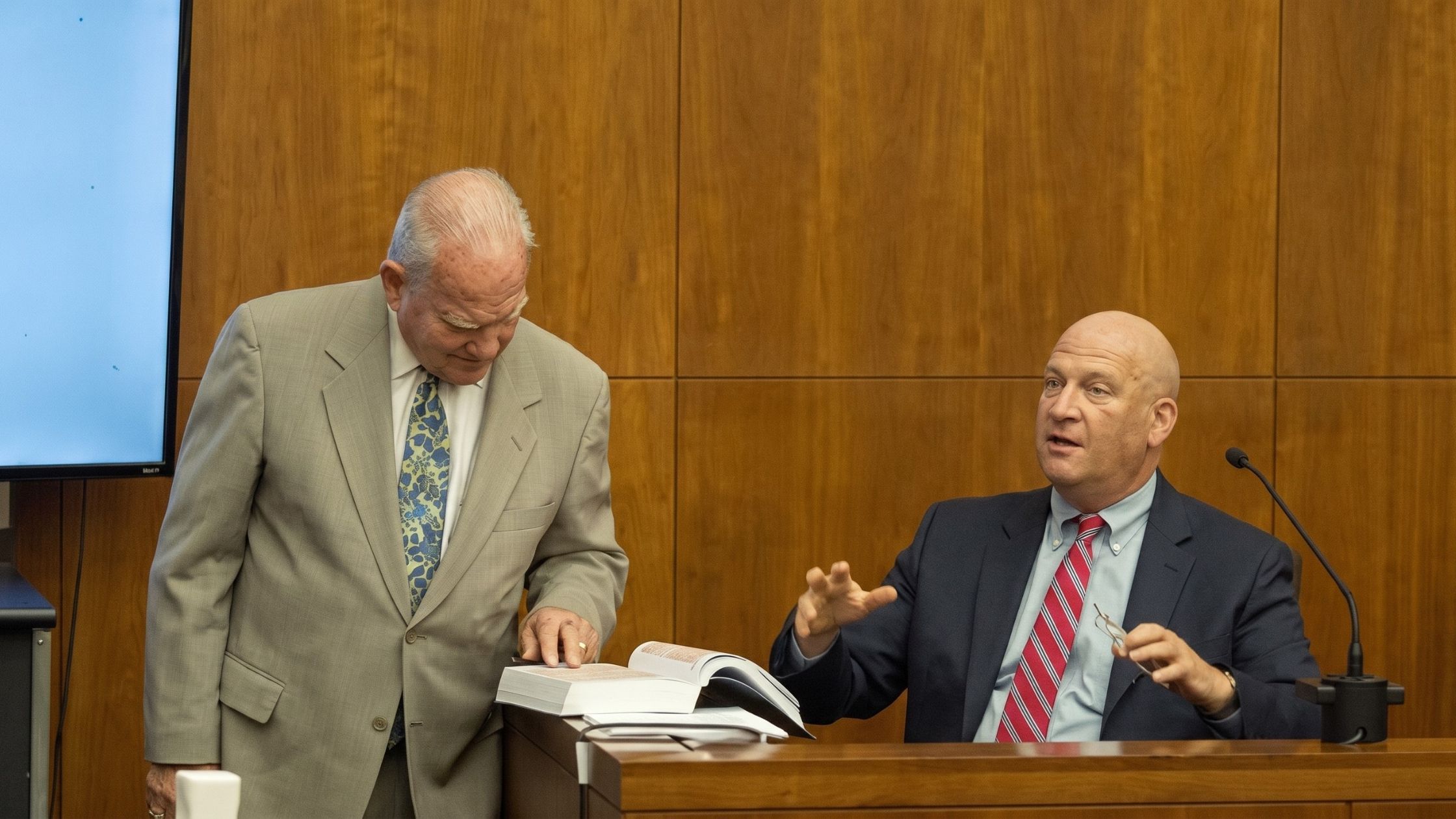
The Court (00:01):
This court is now in session. Please be seated.
Court Clerk (00:19):
Good morning, Your Honor. May I proceed?
Judge William Sullivan (00:19):
Yes, please.
Court Clerk (00:19):
Your honor [inaudible 00:00:20] we got the matter of Commonwealth versus Lindsay Clancy. She is represented by attorney Kevin Reddington, The Commonwealth is represented by Assistant District Attorney Jennifer Sprague and Assistant District Attorney Shannon [inaudible 00:00:20].
Judge William Sullivan (00:19):
All right. Well, good morning everyone. Good morning, counsel. Good morning, Ms. Clancy.
Court Clerk (00:20):
Good morning your honor.
Judge William Sullivan (00:22):
All right. So can I see counsel sidebar, please?
The Court (00:24):
All set, Your Honor. Thank you.
Judge William Sullivan (00:24):
Okay.
Speaker 1 (00:24):
Your honor, [inaudible 00:04:35] before the jurors come out.
Judge William Sullivan (00:24):
[inaudible 00:04:37].
(00:24)
All right.
The Court (06:04):
Court all rise, please.
(06:04)
Hear ye, hear ye, hear ye. All persons having anything to do before the honorable William Sullivan, Justice of the Superior Court now sitting [inaudible 00:06:10] within the Florida Commonwealth. Drawn in, give your attendance, and you shall be heard. God save the Commonwealth of Massachusetts. This court is now in session. Please be seated.
Court Clerk (06:18):
Good morning, Your Honor. May I proceed?
Judge William Sullivan (06:18):
Please.
Court Clerk (06:32):
Your Honor, before the court today, we have a continuation of the [inaudible 00:06:28] trial in the matter of Commonwealth versus Lindsay Clancy. Ms. Clancy is present. She is represented by attorney Kevin Reddington. The Commonwealth is represented by Assistant District Attorney Jennifer Sprague and Assistant District Attorney Shannon [inaudible 00:06:41].
Judge William Sullivan (06:42):
All right. Good morning, everyone.
The Court (06:44):
Good morning, judge.
Judge William Sullivan (06:44):
What I'm going to do is I was looking for my little cheat sheet about the questions that I thought you could probably say along with me at this point. But let me ask them just to make sure everybody's able to follow those instructions. So has any member of the jury read, seen, heard, or overheard anything from any source that would affect your ability to be a fair and impartial juror?
The Court (07:06):
[inaudible 00:07:08].
Judge William Sullivan (07:08):
Next question. Is there any other serious matter or concern bearing on your service as a juror in this case anybody needs to bring to my attention?
The Court (07:16):
No.
Judge William Sullivan (07:16):
All right. Again, as always, thank you for following those instructions. Now, what the schedule for today is that I would expect a longer day. All right? Similar to some of the days we had earlier this week. So what we're going to do is we're going to return to the defendant who's going to call their next witness.
(07:37)
And that witness is going to be testifying by Zoom or over the monitors that you're going to have here. There was an earlier witness, I think, who had also testified that way. And so the delay we had coming in here was just setting that up. It should be all set. They kept me away from all the technology, so I think it should be working pretty well. And then at that point, we'll see what we'll deal with after this witness and then we'll go on from there. Okay. All right. Thank you. Mr. Reddington?
Kevin Reddington (08:10):
Judge.
(08:10)
I don't know who's going to turn it on.
Court Clerk (08:10):
[inaudible 00:08:27].
Kevin Reddington (08:10):
Okay. Thank you.
Court Clerk (09:20):
Could you please raise your right hand, sir? Would you please raise your right hand, sir? Do you solemnly swear that the testimony and the evidence you shall give to the court and the jury in the matter now pending between the Commonwealth and the defendant [inaudible 00:09:20], shall be the truth, the whole truth, and nothing but the truth, so help you God?
Kevin Reddington (09:20):
I don't think there's volume.
Court Clerk (09:20):
Could you turn on your volume? You're muted.
Phillip Resnick (09:24):
Okay. I think I've got it. But it's a little hard for me to hear you on your end. If you could keep your voices up, please.
Court Clerk (09:32):
Do you want me to swear him in again?
Kevin Reddington (09:32):
Yes, please.
Court Clerk (09:35):
Please raise your right-hand one more time. Do you solemnly swear that the testimony and the evidence you shall give to the court and the jury in the matter now pending between the Commonwealth and the defendant [inaudible 00:09:45], shall be the truth, the whole truth, and nothing but the truth, so help you God?
Kevin Reddington (09:52):
He froze.
Phillip Resnick (09:57):
Yes, I do.
Court Clerk (09:58):
Thank you.
Phillip Resnick (09:59):
Thank you. I am going to be able to hear you now.
The Court (10:00):
All right. Give it a try.
Judge William Sullivan (10:02):
All right, counsel.
Kevin Reddington (10:05):
Good morning, doctor. Will you tell us your name in a loud voice so that we can all hear you and spell it for the record?
Phillip Resnick (10:13):
Phillip Resnick. P-H-I-L-L-I-P, R-E-S-N-I-C-K.
Kevin Reddington (10:22):
And where do you live, sir? Where do you live? Can you hear me?
Phillip Resnick (10:36):
I'm in... You froze up. I can hear you now.
Kevin Reddington (10:38):
Okay. Where do you live?
Phillip Resnick (10:43):
I live in the Cleveland, Ohio area.
Kevin Reddington (10:45):
So this is a delay. If I ask a question, there's like a two or three second delay for your answer. So that's a little difficult, but we'll try to get through it. Can you tell us what you do for work, sir?
Phillip Resnick (11:00):
Yes. I'm a forensic psychiatrist.
Kevin Reddington (11:03):
And first off, the reason that you are not appearing here today in court, is that because you have had recent unexpected major surgery regarding an illness. And as of last week, you've now been released from the hospital and you're at home?
Judge William Sullivan (11:24):
Overruled.
Phillip Resnick (11:26):
I was discharged from the hospital Tuesday night and there was a recommendation that I not fly for the next few days.
Kevin Reddington (11:33):
Okay. So you did intend and had tickets to come here and testify, but obviously the court has accommodated us with a Zoom.
Phillip Resnick (11:41):
Yes.
Kevin Reddington (11:43):
Okay. Have you worked on this case with Lindsay Clancy at my request, sir?
Phillip Resnick (11:54):
Yes, I have.
Kevin Reddington (11:57):
Okay. Can you tell the jurors your educational and professional background, please?
Phillip Resnick (12:02):
Yes. I have a bachelor's degree in psychology from [inaudible 00:12:12] Western Reserve University. [inaudible 00:12:18].
Kevin Reddington (12:17):
Yeah, it's really low in [inaudible 00:12:19].
Phillip Resnick (12:19):
I graduated high school in 19-
Kevin Reddington (12:21):
Hold up for a second. We're having technical difficulties.
Judge William Sullivan (12:26):
All right. Can I see counsel here at the side, please?
(12:27)
Well, members of the jury, just like in the old days when you're watching TV, the little sign used to come up and say technical difficulties. That's where we are. So what we're going to do is we're going to take a short break and have people who know more about this than I do to kind of readdress this. All right. To see if we can have a smoother presentation so you're able to follow and listen to the testimony without kind of being broken up and choppy. All right. So I'm going to ask you... Well, I hope it's a short break, but the goal is to get this in a manner that is easier for you to hear and absorb this information.
(14:50)
So we're going to take a short break, I hope. And we'll see you in a couple of minutes. All right. Thank
The Court (14:55):
You. All rise please. Jurors exiting.
Kevin Reddington (14:56):
[inaudible 00:15:37].
Judge William Sullivan (15:41):
All right.
Kevin Reddington (15:43):
No, it's [inaudible 00:15:45].
Judge William Sullivan (15:46):
All right. So we'll be in a short recess.
Kevin Reddington (15:49):
Yep.
Judge William Sullivan (15:49):
We'll kind of see if we can get this working again and we'll be out as soon as that's done.
The Court (15:58):
Court all rise. This court is back in session. You may be seated.
Court Clerk (16:13):
Your Honor, for the purpose of the record, we return back to the trial of Commonwealth versus Lindsay Clancy. All parties are present excluding the jury.
Judge William Sullivan (16:22):
Are we ready for the jury?
Kevin Reddington (16:22):
Yes. Fingers crossed.
Judge William Sullivan (16:22):
All right.
Speaker X (16:22):
[inaudible 00:17:13].
The Court (16:22):
All rise, please. Jurors entering.
(16:22)
Court is back in session. You may be seated.
Court Clerk (18:03):
Your Honor, for the purpose of the record, we return back to the trial of Commonwealth versus Lindsay Clancy. All parties are present, including the defendant and including the 18 jurors.
Judge William Sullivan (18:12):
Thank you, Madam Clerk. Members of the jury, we're going to give it another go. All right. All right. Go ahead.
Kevin Reddington (18:18):
Great. Thank you.
Judge William Sullivan (18:18):
Mr. Reddington.
Kevin Reddington (18:26):
[inaudible 00:18:21].
(18:26)
All right, doctor, can you hear me?
Phillip Resnick (18:28):
Yes. Yes.
Kevin Reddington (18:30):
Excellent. Tell us again your name for the record and spell the last name.
Phillip Resnick (18:37):
Okay. Phillip, last name Resnick. P-H-I-L-L--I-P, R-E-S-N-I-C-K.
Kevin Reddington (18:47):
All right. And you're going to have to speak a little slower only because of the microphone. Okay. Tell us your background, sir. I know you're a physician. Tell us your educational background and your work history.
Phillip Resnick (19:04):
I am a forensic psychiatrist and I received a bachelor's degree [inaudible 00:19:12] in 1959 and a medical degree in 1963. Both from Case Western Reserve University in Cleveland, Ohio. I then had a one-month internship in a military hospital in Texas. And then I came back to University Hospital of Cleveland where I completed my residency in psychiatry.
Kevin Reddington (19:40):
And do you have-
Phillip Resnick (19:41):
[inaudible 00:19:42].
Kevin Reddington (19:42):
I'm sorry, go ahead.
Phillip Resnick (19:45):
Yeah. Would you like me to continue?
Kevin Reddington (19:47):
Yeah, you can continue. I interrupted. I apologize.
Phillip Resnick (19:51):
Yeah. I have remained at Case Western Reserve University as now a full professor. And I've also become interested in forensic psychiatry. That is that aspect of psychiatry, which relates to legal issues such as this case. And I initiated a fellowship in forensic psychiatry in 1979 and directed that for 40 years. I also served as director of the Court Psychiatric Clinic in Cleveland, Ohio for over 40 years.
Kevin Reddington (20:36):
Doctor, do you have board certifications as well?
Phillip Resnick (20:41):
Yes. I'm board certified in psychiatry, 1971. And board certified in forensic psychiatry, 1979.
Kevin Reddington (20:51):
Did you also have added qualifications in forensic psychiatry in 2014, 2024 and re-certifications?
Phillip Resnick (21:01):
Yes.
Kevin Reddington (21:02):
And have you, without going through them, also had a number of visiting professorships?
Phillip Resnick (21:11):
Yes. I've had about 14 visiting professorships.
Kevin Reddington (21:15):
Now, doctor, this case involves what I guess is referred to as filicide, F-I-L-L-I-C-I-D-E, I believe. Did I spell that right?
Phillip Resnick (21:28):
Single L.
Kevin Reddington (21:29):
Single L. Okay. Can you tell the jurors what that means?
Phillip Resnick (21:36):
Yeah. Filicide is a parent killing a child and it is a relatively infrequent phenomenon that occurs in the United States somewhere between 400 and 500 times a year.
Kevin Reddington (21:54):
And doctor, is it fair to say that you have, at least in the country, if not outside the country, the most experience in working on filicide cases?
Phillip Resnick (22:09):
I believe that's true. I have been personally involved in, I'd estimate about 80 cases where I was asked to evaluate mothers and fathers who had killed their children.
Kevin Reddington (22:22):
And question that I have, doctor, is have you had occasion to work on cases that found themselves in court where you gave testimony either for the government or for the defense?
Phillip Resnick (22:40):
Yes, I have. [inaudible 00:22:42].
Kevin Reddington (22:42):
Let me just go through if I can... So let me just go through so we can cut to the chase. Did you work as an expert on the case of Jeffrey Dahmer?
Phillip Resnick (22:55):
Yes. I consulted with the prosecution in that case.
Kevin Reddington (23:00):
Did you also work on the case of what is referred to as the Unabomber. A fellow by the name of Kaczynski?
Phillip Resnick (23:09):
Yes. I was also a consultant to the government on that case.
Kevin Reddington (23:13):
Did you also find yourself consulting on the matter of, in Florida, the Commonwealth versus or the State versus Casey Anthony?
Phillip Resnick (23:22):
I was a consultant to the defense in that case, but I could not be held [inaudible 00:23:27].
Kevin Reddington (23:27):
Did you also work on the matter of Andrea Yates?
Phillip Resnick (23:33):
Yes. I testified for the defense in both of her trials.
Kevin Reddington (23:38):
Did you also work on the case of what is known as the Aurora Movie Theater shooting?
Phillip Resnick (23:45):
Yes. I was a consultant to the prosecutor in that case.
Kevin Reddington (23:50):
Did you also work on the case involving the Oklahoma City Bombing, courthouse?
Phillip Resnick (23:58):
Yes. Again, I was employed by the government in that case.
Kevin Reddington (24:03):
And in addition to those cases, did you also, in your practice, consult with the defense as well as the prosecution on a number of homicide cases, many of which involve filicide?
Phillip Resnick (24:18):
Yes, I have.
Kevin Reddington (24:19):
All right. In the course of this case, sir, did I reach out to you and ask if you would assist me in evaluating Lindsay Clancy?
Phillip Resnick (24:30):
Yes, you did.
Kevin Reddington (24:31):
And can you tell the jurors when and for how long you would actually interview? Whether it would be Lindsay, whether it would be third party contacts. Just give us an idea as to how you evaluated her.
Phillip Resnick (24:45):
Yes. About four months after the crime, I did a personal evaluation of Lindsay and her parents to gain information. And I spent three hours interviewing her on that date.
Kevin Reddington (25:03):
And how long did you spend interviewing third party contacts of her parents?
Phillip Resnick (25:09):
An hour and 15 minutes.
Kevin Reddington (25:11):
And this would be in May of 2023?
Phillip Resnick (25:16):
That's right.
Kevin Reddington (25:17):
Where did the interview take place?
Phillip Resnick (25:21):
The interview took place at Duxbury Hospital.
Kevin Reddington (25:28):
Is that a hospital facility that's a mental institution in the town or city of Tewksbury?
Phillip Resnick (25:37):
Tewksbury, yes.
Kevin Reddington (25:38):
And Lindsay actually came and was living in Duxbury at the time of the incident. Is that correct?
Phillip Resnick (25:45):
That's correct.
Kevin Reddington (25:46):
All right. So can you describe for us, without getting into any statements that she made to you, tell us about the circumstances. How did she appear to you physically? And how was she able to answer your questions? Just tell us what her appearance was. Her mood?
Phillip Resnick (26:08):
Yes. Well, first of all, at the time, of course, she had suffered a major injury and was paralyzed. So that was the setting. So during the examination, she did not have control of the lower part of her body. During the interview, she appeared somewhat matter of fact, but at the time she was still grieving. The nurses told me that she was crying daily about the loss of her three children. And she was also medicated at that time. She was fully cooperative and gave me a detailed account of her recollections of the critical events.
Kevin Reddington (27:01):
Did you make an observation of her affect? Did she appear to have what you refer to as a flat affect?
Phillip Resnick (27:11):
Yes. She did have, where I would call it a blunted affect. That is, her emotions were not as you would expect. Her feeling tone was muted.
Kevin Reddington (27:28):
Muted? Is that what you said, muted?
Phillip Resnick (27:31):
Muted, yes.
Kevin Reddington (27:32):
Okay. Now, doctor, in the course of evaluating this case, and again, in the interest of time, would you agree that you had a chance to review a number of items to assist you in your evaluation?
Phillip Resnick (27:49):
I reviewed extensive records in this case, both records referring to Ms. Clancy's mental illness, how it developed, who her treaters were, and then also I was able to evaluate records after her conduct.
Kevin Reddington (28:13):
And that would include police reports?
Phillip Resnick (28:17):
Extensive police reports, yes.
Kevin Reddington (28:19):
Grand jury testimony?
Phillip Resnick (28:23):
Yes.
Kevin Reddington (28:23):
Photographs?
Phillip Resnick (28:26):
Yes.
Kevin Reddington (28:27):
Videos?
Phillip Resnick (28:30):
Yes.
Kevin Reddington (28:30):
Medical records from healthcare providers such as Dr. Tufts, Nurse Practitioner Gelata and McLean Hospital?
Phillip Resnick (28:41):
Yes.
Kevin Reddington (28:42):
Were you aware that she had also contacted suicide hotlines and went to a facility in Rhode Island, women and infants?
Phillip Resnick (28:54):
Yes. I reviewed all those records.
Kevin Reddington (28:56):
So with all of that information, Doctor, that you had access to, did you also have the opportunity to review any records from, let's say, the government's doctors? Dr. Helbren, Dr. Mack, Dr. Satoff.
Phillip Resnick (29:17):
Yes. After I prepared my report, I was aware that there are three experts employed by the prosecution. And I was able to review their reports in detail [inaudible 00:29:29].
Kevin Reddington (29:29):
Okay. And your report is actually dated. You saw her in 2023, and you prepared your report ultimately after your evaluation in September. Do you know when the government's doctor's reports were available to you? Was that recently?
Phillip Resnick (29:56):
My recollection is that they did their evaluation about two years after the crime, and I had the opportunity to see her four months after the crime.
Kevin Reddington (30:07):
Now, did you also have occasion, sir, to see from Dr. Helbren, government's doctor, psychiatric testing?
Phillip Resnick (30:19):
Yes, I did.
Kevin Reddington (30:20):
Can you tell us, for example, was one of the results on the psychiatric testing a test that he administered for the government called the MMPI, or Minnesota Multiphasic Personality Inventory Test?
Phillip Resnick (30:35):
That was a psychological test that he administered, yes.
Kevin Reddington (30:38):
And do you recall from reviewing the records what the results were? Was she faking? Was she lying or was she telling the truth and-
Speaker X (30:45):
[inaudible 00:30:46].
Phillip Resnick (30:47):
The results showed no evidence of faking.
Kevin Reddington (30:51):
Hold on. Okay, Doctor, I had asked you if you were aware that government's Dr. Helbren had administered the MMPI test. And came to a conclusion as to whether or not Lindsay was telling the truth, faking, or exaggerating symptoms. And you relied on that test as a portion of your opinion. Is that right?
Phillip Resnick (31:39):
Yes, I did.
Kevin Reddington (31:40):
Can you tell the jurors what the results of that test were, to your knowledge?
Phillip Resnick (31:48):
In summary, the results were that Lindsay Clancy had a tendency to minimize. And did not have a tendency to exaggerate what she was saying in her own symptoms.
Kevin Reddington (32:06):
Did it also indicate that she was not, I think the terminology is faking or lying in her answers, but in fact was being truthful as best she could be?
Phillip Resnick (32:20):
Yes. Although the test is a little more specific about symptoms rather than lying or not lying. But it did not suggest any evidence of faking symptoms.
Kevin Reddington (32:36):
Okay. And I'm sorry, that broke up. It did not suggest any evidence of what?
Phillip Resnick (32:41):
No evidence of faking psychiatric symptoms.
Kevin Reddington (32:44):
Okay. And then finally, one of the scales in that test is referred to as the K... I think from the books, the K scale or the lie scale. Is that correct?
Phillip Resnick (32:56):
Yes, that was not elevated.
Kevin Reddington (32:58):
Not elevated. Okay. Now, doctor, in your experience, do you have any particular subspecialty or interest in the concept of people that are malingering or faking in the forensic world? In other words, if it's a criminal case, if it's a workman's comp case where somebody's pretending their back hurts, things of that nature, have you focused on that as a subspecialty or interest in your career?
Phillip Resnick (33:32):
That has been a major interest. I've actually written 46 articles or book chapters in this area. The first was 1984. And over the course of that, of course, new research comes out. So when you write a new edition of a book chapter, it would incorporate new material. So even though the chapter may go through five editions in a particular book, they're up-to-date. And the ones which were written earlier would no longer be the best basis for forming an opinion.
Kevin Reddington (34:14):
Now, for example, when you reviewed Dr. Helbren's report for the government, did he refer to your articles?
Phillip Resnick (34:24):
He did refer to my research, yes.
Kevin Reddington (34:27):
And was that updated research or was it old research that he referenced?
Phillip Resnick (34:33):
He referenced older research.
Kevin Reddington (34:36):
So can you tell us, Doctor, when you consider the... Let me start over again. When you reviewed Lindsay's medical records, you also reviewed the psychopharmacology? In other words, the medications that Dr. Tufts and Gelata and all of these other doctors had prescribed to her during that period of time?
Phillip Resnick (35:00):
Yes, I did.
Kevin Reddington (35:02):
And have in mind your...
Phillip Resnick (35:00):
Yes, I did.
Kevin Reddington (35:02):
And have in mind your interview, the time that you spent with her directly reviewing all of the documents, all of the medical records, everything that we've talked about, and you're also aware from her, not specifically what she said to you, but you're aware of the circumstances from her recollection as to the killings that she told you. Is that correct?
Phillip Resnick (35:27):
Yes, as well as the journal she kept and other evidence of her thinking and symptoms as the time approached for the crime on January 24th, 2023.
Kevin Reddington (35:42):
Okay. You were also aware of her access to her cellphone doing Google searches and looking up medications during that period of October, November, December and January? You're aware of that, correct?
Phillip Resnick (35:56):
Yes.
Kevin Reddington (35:57):
Okay. Can you tell the jurors, in your opinion, sir, with your years of experience in the issue of filicide, working for just the government on a number of cases and the defense and your evaluation of Lindsay, can you tell this jury your opinion as to whether or not at the time of the killings that she was suffering from a disease or defect that impaired her ability to substantially appreciate and/or conform her conduct to the requirements of the law?
Phillip Resnick (36:41):
Well, sure. Let me begin with the issue of whether she had a mental disease or a defect. Ms. Clancy had a severe depression. There is a book called the DSM, or Diagnostic Manual, prepared by the American Psychiatric Association, which lists criteria for various diseases. In the Diagnostic Manual, for example, one needs to have five out of nine symptoms to make a diagnosis of major depression. Ms. Clancy, as she approached the date of the crime, actually had seven of the nine symptoms and was severely depressed.
(37:36)
In addition to that, she had some earlier evidence of what's called a mild mania, and that fits together in what's called bipolar II. In other words, it's a type of bipolar illness where there is more frank depression, severe depression, but the manic aspects are not as severe. So my final diagnosis of her was called bipolar II with a severe depression on January 24th, 2023, and from reading the reports of all of the experts that will be testifying, no one failed to diagnose a major mental disease on the day of the climb.
Kevin Reddington (38:40):
Now Doctor, in the course of that diagnosis, have you considered the concept of postpartum depression and/or postpartum psychosis?
Phillip Resnick (38:51):
Yes.
Kevin Reddington (38:52):
Can you tell the jurors how that-
Phillip Resnick (38:54):
First of all-
Kevin Reddington (38:55):
I'm sorry. Can you tell the jurors how that factors into your diagnosis and opinion?
Phillip Resnick (39:03):
Yes. Ms. Clancy had a history of anxiety and difficulty with each of her children. It was minor with her first child, more significant with her second child. On the occasion of Callan's birth, things went well for the first three months, but then Ms. Clancy became very anxious and depressed, and it took quite a toll on her. I believe the jury has heard from various treaters such as Dr. Tufts and Nurse Jollotta and others and her own anguish about how depressed she was, where she actually felt she couldn't function, her brain was damaged. She would never be the same. So she definitely met the definition of a major depression as well as this bipolar phenomenon.
(40:12)
Now with respect to the postpartum aspect, since Ms. Clancy's symptoms began within three months of Callan's birth, that would be considered a postpartum onset. Then of course she had considerable difficulty over the next five months, and at the time of the crime itself on January 24, 2023, Ms. Clancy was frankly psychotic. So in that sense, she had a postpartum psychosis. It's actually not frequent to have a postpartum psychosis eight months after a birth, but it does occasionally occur. What I can say is whether it is a classic postpartum psychosis or not, with a postpartum onset and frank psychosis on the day of the killing, I would label that a postpartum psychosis in the sense that it was a postpartum onset and she was clearly psychotic on that day.
Kevin Reddington (41:32):
Doctor, when a person is psychotic or involved in having a psychosis, in your opinion, are they able to appear "normal," quote, unquote, communicate with people, drive a car, things of that nature?
Phillip Resnick (41:50):
Well, let me say there that Ms. Clancy herself did her best to not reveal the extent of her depression. She was frank with members of her own family. Her sister, her mother, her mother-in-law were aware of how anguished and depressed she was, but with more casual friends, she tended not to show the extent of her depression. I'm not suggesting that she was, although psychosis can indeed wax and wane. For example, on the day of her crime, I'm not suggesting that she was frankly psychotic every minute. She was functioning. In fact, she said she was having a better day than other days. She actually went out and made a snowman with the kids, visited with, took Cora to a doctor for the fifth birthday checkup, and was functioning at a level that was not frankly psychotic until she had a command hallucination while her husband Patrick was out doing a couple of chores.
Kevin Reddington (43:22):
Can you tell us, Doctor, in your opinion, what a command hallucination is and how it fits, if you will, in a diagnosis of psychosis?
Phillip Resnick (43:34):
Yes. If we take, first of all, a hallucination is simply hearing a voice, and the voice can be benign or it can be more malignant. A voice may just simply say, "Open the window." About one-third of voices are called command hallucinations. That is, an instruction to do something. The majority of those commands are benign. It might be open a window, get a glass of water. It might be something much more ominous, such as to kill oneself or harm someone else. Those are dangerous command hallucinations.
(44:22)
Now, in Ms. Clancy's case, she had not only a command hallucination on the day that she killed her children, she had what is known as a delusion of influence. That is, not only did she hear a command, but she felt that her body was taken over by an external force where she was in a green space and did not have control of her own body. It was almost like she was a puppet and someone else was pulling the strings.
Judge William Sullivan (45:03):
Yep. Hold on a second. Counsel? Members of the jury, I want to give you an instruction at this point. I'm going to go into this also a little bit later when I give you the full instructions at the end of the case, but you are not to consider the defendant's statements to any psychiatrist or psychologist as establishing the truth of any facts that are contained in those statements. All right? The defendant's statements to any psychiatrist or psychologist for purposes of evaluation cannot be considered by you as evidence of premeditation, extreme atrocity or cruelty or specific intent to kill. Such statements are admissible only as they relate to the basis for the doctor's opinion of the defendant's mental condition. All right? I'll go into that a little bit later. Okay. Go ahead, Mr. Reddington.
Kevin Reddington (47:22):
So Doctor, to conclude, would you relate your opinion as it relates to the standard of a person lacking criminal responsibility at the time of the commission of a crime in the Commonwealth of Massachusetts?
Phillip Resnick (47:41):
Well, there are two arms to the test for criminal responsibility. One has to do with the defendant's ability to control their conduct and the other has to do with their knowledge of the wrongfulness of their acts. I'd like to address each of those separately, if I may.
Kevin Reddington (48:03):
Sure.
Phillip Resnick (48:07):
With regard to my opinion, my opinion is that Ms. Clancy was, due to her mental disease, unable to conform her conduct was to the requirements of the law on the day that she took the lives of her children. Let me give you the basis of that opinion. First of all, she was hearing a voice which was commanding her to engage in the killing behavior and she did not feel any sense of control. She felt that she had to obey the instructions she was receiving. It was a matter where she was just following the command rather than being able to make any decision to do it or not. For example, I asked Ms. Clancy-
Kevin Reddington (49:31):
No, you can't say what you talked... Doctor, you cannot say what she told you. All right?
Phillip Resnick (49:38):
Okay. All right. I will not do that. Let me just make sure I'm covering other aspects of this. The second evidence that she was lacking control is the fact that she made a severe suicide attempt also based on the command hallucination that she heard that day, so that she not only cut her throat and jumped out of the window, she very much wanted to die. Now, in my research on women who kill their children, I've divided the motives into five categories, and I want to look at how Ms. Clancy [inaudible 00:50:36] to those motives.
Kevin Reddington (50:40):
Tell us the five categories.
Phillip Resnick (50:44):
Yeah. The five categories are, first, altruistic filicide.
Kevin Reddington (50:53):
What does that mean?
Phillip Resnick (50:54):
Secondly-
Kevin Reddington (50:54):
What does that mean, altruistic filicide?
Phillip Resnick (50:58):
Altruistic filicide occurs when a murder is committed out of love rather than hostility. It is an effort on a mother's part to do what is best for the child. They may believe that the child is... they may have a delusional belief the child is about to be tortured in their delusional mind and they take their life in doing what they believe is in the best interest of the children based on their delusional idea. Altruistic filicide also occurs when a mother may plan to take her own life, and in her psychotic thinking and severe depression, it is distorted, and she may believe that the child will be worse off if she remains alive.
(51:59)
For example, in Ms. Clancy's case, she believed that, as the jury has already heard, she was obsessional about caring for her children. She consulted with others at work to try and do exactly what was right for her children, and she believed that if Ms. Clancy took her own life, her children would be in terrible shape. In her mind, she believed that she would be doing her children a favor by having them go to heaven with her rather than remain on earth without her doing the mothering. Her mind was very distorted like that.
Kevin Reddington (52:48):
Okay. If you could just tell us the other titles of the other four types that you will refer to. Just tell it without getting into detail if they don't apply to Ms. Clancy.
Phillip Resnick (53:04):
All right. The second category does apply to Ms. Clancy, and that is it's called acutely psychotic filicide. This occurs when someone is frankly psychotic. They may have delusions or hallucinations, they're out of touch with reality, and rather than having any rational motive, they're simply acting on their psychotic beliefs. Those two both apply to Ms. Clancy. The other three-
Kevin Reddington (53:50):
Okay, go ahead.
Phillip Resnick (53:50):
I'm sorry?
Kevin Reddington (53:50):
Go ahead. No, that's all right. Just give us the other three, the captions of them.
Phillip Resnick (53:51):
The other three, which do not apply, one is called child maltreatment, in which a parent may shake the child to death or throw a child against a will in an abusive manner. The next category is unwanted child, where someone, just for their convenience, the child is a burden and they kill the child for that motive. The final motive is spouse revenge filicide. That is, someone hates their spouse so much that they're willing to sacrifice the child as a way to punish the spouse. The three latter categories clearly do not apply to Ms. Clancy. She loved her husband, respected her husband, had a good marriage. She never spanked or ever abused her child, and all of her children were wanted. In fact, she planned to have a fourth child. So those three categories clearly do not apply.
(54:56)
If I can explain how the two categories did apply, I've already mentioned that Ms. Clancy believed a distorted belief that her children would just be miserable and she could not imagine them continuing to exist and have a decent life without her being there as a mother. So in that sense, she did what she believed was morally right. Even though she understood that ordinarily killing a child is against the law, she believed that she was doing what was right for her children with her distorted psychotic thinking about the children's need for her. Then with respect to the second category of acutely psychotic, Ms. Clancy was under the influence of a command hallucination and idea of influence, so that at that time, rather than the ability to make a rational decision, she was so in the grip of her psychotic command hallucination and idea of influence that she lacked the capacity to conform her conduct to the requirements of the law.
Kevin Reddington (56:42):
Okay. Doctor, pretty much finally, there've been some questions or allegations that Ms. Clancy did not provide information to her healthcare providers about her adverse effects of medication that she had been prescribed. Do you agree with that from your review of the medical records or did she in fact tell her healthcare providers how she felt as a result of what she perceived to be the medications that were prescribed?
Phillip Resnick (57:13):
It's my opinion with reasonable medical certainty that Ms. Clancy was actually a more sophisticated patient than most and she was forthcoming in conveying her symptoms. The one area in which she was not fully revealing was the area of when she had an impulse to harm her children, and that was because she had a rational belief that her children may be taken away
from her by a social service agency. She had an irrational belief that if she even entered a medical hospital, that her children will be taken away. So that is the one area in which she was not fully forthcoming.
Kevin Reddington (58:10):
Now, Doctor, in your experience, do you find that many women that are caretakers of children, postpartum after the child is born, that are having these intrusive thoughts and having these dark thoughts are in fact afraid of reporting them because of that very reason that you're talking about?
Jennifer Sprague (58:32):
Objection.
Judge William Sullivan (58:33):
Sustained.
Phillip Resnick (58:36):
Yes, as a matter of fact-
Kevin Reddington (58:36):
Yeah, you can't answer that.
Judge William Sullivan (58:37):
[inaudible 00:58:38] rephrase that.
Kevin Reddington (58:38):
Okay. It's also been mentioned here a couple of times that she hasn't killed herself yet, even though she's in the Tewksbury Hospital. Can you tell the jurors briefly, while she's in the Tewksbury Hospital, what are the circumstances of her confinement and what type of care is being provided to her as it relates to why she hasn't killed herself yet?
Phillip Resnick (59:05):
Well, let's see. Indeed, there is evidence of her ongoing suicidality to such an extent that she is never allowed to be out of the presence of a staff member. Even when I conduct an examination of her and requested privacy, a staff member had to be present. Her ability to take her life in view of her impulses and observation is [inaudible 00:59:41] and she recognizes that, so that the reality is no matter she does not want to live at any point, she has no choice but first to live at this time.
Kevin Reddington (01:00:00):
Thank you very much, Doctor. You have to answer some questions from the DA. Your Honor, at this point, I would like to, because I'm looking at 40-page resumes, so I just offer that if I could.
Judge William Sullivan (01:00:25):
Any objection?
Jennifer Sprague (01:00:26):
No objection.
Judge William Sullivan (01:00:26):
Okay. That may be marked.
Kevin Reddington (01:00:28):
Thank you.
Jennifer Sprague (01:00:28):
[inaudible 01:00:30]. If I may?
Judge William Sullivan (01:00:37):
Yes, please. [inaudible 01:00:38].
Jennifer Sprague (01:00:39):
Good morning, Dr. Resnick.
Phillip Resnick (01:00:43):
Good morning.
Jennifer Sprague (01:00:44):
In addition to the evaluations that you do, is it true that you've also taught some courses to other forensic psychiatrists and psychologists about how to testify in cases like these?
Phillip Resnick (01:00:59):
Yes, I have.
Jennifer Sprague (01:01:01):
And you teach them how to answer questions and how to dress and how to appear believable and trustworthy, correct?
Phillip Resnick (01:01:09):
That's correct.
Jennifer Sprague (01:01:11):
In one of your trainings, excuse me, Do's and Don'ts of Depositions by Dr. Philip Resnick, in your course description, you state information beyond the question should not be volunteered because it will open up new areas for questioning, provide ammunition for attacks, eliminate the opportunity for surprise, and information fails to get to the jury. Correct?
Phillip Resnick (01:01:36):
That's correct.
Jennifer Sprague (01:01:37):
So you teach other psychologists how to hold back information in the discovery process to surprise the other side?
Phillip Resnick (01:01:48):
No, that's not [inaudible 01:01:49], and I'm not a [inaudible 01:01:51].
Jennifer Sprague (01:01:58):
Now, a woman who kills her child can have more than one motive, correct?
Phillip Resnick (01:02:05):
Yes.
Jennifer Sprague (01:02:05):
Actually, the most common motive for women who kill their children is fatal maltreatment or child abuse, correct?
Phillip Resnick (01:02:11):
That's correct.
Jennifer Sprague (01:02:14):
And in fact, most women who kill their kids don't do it due to mental illness, correct?
Phillip Resnick (01:02:22):
That's correct.
Jennifer Sprague (01:02:23):
And in fact, there's a quote from you in an article, Child Murdered by Mothers: Patterns and Prevention, where you say, quote, "More filicides occur due to fatal maltreatment than because of maternal psychiatric illness," correct?
Phillip Resnick (01:02:37):
Correct.
Jennifer Sprague (01:02:37):
You also have written about parents having significant emotional devastation after killing their children, correct?
Phillip Resnick (01:02:47):
Yes.
Jennifer Sprague (01:02:48):
And in fact, you've written in chapter six of family murder, Child Murder by Parents, n the aftermath section, you've written, quote, "These life events are likely to prolong the parent's depression. The anniversary of the children's deaths and exposure to things that remind the parent of it are likely to be upsetting." Correct?
Phillip Resnick (01:03:16):
Yes.
Jennifer Sprague (01:03:17):
Things like birthdays and holidays and the anniversary of the killings would all be something that would be upsetting, correct?
Phillip Resnick (01:03:25):
They sometimes are, yes.
Jennifer Sprague (01:03:29):
Now, you've written a lot about malingered psychosis, correct?
Phillip Resnick (01:03:35):
Yes.
Jennifer Sprague (01:03:37):
Malingering psychosis, you can have a mental illness and your malingering could be exaggerating those symptoms or saying you have psychosis symptoms when you don't, correct?
Phillip Resnick (01:03:49):
That's correct.
Jennifer Sprague (01:03:55):
One of the things that you have written, and there's an article that you wrote called Faking It, you've written in here, quote, "Command auditory hallucinations are easy to fabricate. Persons experiencing genuine command hallucinations do not always obey the voices, especially if doing so would be dangerous." Correct?
Phillip Resnick (01:04:19):
That's correct.
Jennifer Sprague (01:04:23):
You've also given some points to other practitioners, quote, "If you suspect a person of malingered auditory hallucination, ask what he or she does to make the voices go away or diminish an intensity," correct?
Phillip Resnick (01:04:39):
Yes.
Jennifer Sprague (01:04:39):
Because typically someone who hears a voice telling them to do something horrible like kill their child will try to resist that voice initially, correct?
Phillip Resnick (01:04:52):
There's variability. Some do and some don't.
Jennifer Sprague (01:04:55):
And in fact, the case you mentioned earlier, Andrea Yates, Ms. Yates, in fact, committed herself to a hospital five times and tried to kill herself twice, all while trying to not kill her children, correct?
Phillip Resnick (01:05:15):
Yes.
Jennifer Sprague (01:05:15):
She had heard voices for months telling her to kill her children, and to resist those voices, she actually tried to kill herself, correct?
Phillip Resnick (01:05:26):
Until she could no longer resist the voices, yes.
Jennifer Sprague (01:05:29):
Right. But she tried.
Phillip Resnick (01:05:34):
Right, as did Ms. Clancy.
Jennifer Sprague (01:05:38):
Well, according to the records and reports that we have that are in evidence, Ms. Clancy heard the voice and immediately acted, correct? According to those records? Is that correct?
Phillip Resnick (01:05:51):
Well, Ms. Clancy had impulses to harm her children, which she did resist until the command hallucination when she was overwhelmed, yes.
Jennifer Sprague (01:06:03):
But according to the records and the testimony that you've had, she had an impulse in December one time to harm her children, correct?
Phillip Resnick (01:06:15):
I believe it was on two occasions that she mentioned it to her husband.
Jennifer Sprague (01:06:20):
And then never again after that, until her kids were killed, correct?
Phillip Resnick (01:06:26):
There were only two occasions she mentioned it, but she referred to having these horrible impulses, so that suggests to me she was dealing with it on an ongoing basis, although she mentioned it only twice to her husband.
Jennifer Sprague (01:06:42):
But she never said she had thoughts to kill her children. She said she had thoughts to harm her children, correct?
Phillip Resnick (01:06:50):
Yes, but actually, I think it's clear that to harm her children was to kill her children.
Jennifer Sprague (01:07:00):
Well, in the records where you say that she was so clear in presenting her symptoms to her doctors, she repeatedly was asked if she had any homicidal ideations and she repeatedly said no, correct?
Phillip Resnick (01:07:15):
That's right, and she didn't in the initial parts of her treatment, but by late December and January is when she did have those impulses, and she did not acknowledge them.
Jennifer Sprague (01:07:28):
But what she told her doctors-
Phillip Resnick (01:07:29):
She did now acknowledge them to her doctors.
Jennifer Sprague (01:07:31):
What she told her doctors in December is that she had no homicidal ideation. She only reported suicidal ideation, correct?
Phillip Resnick (01:07:40):
Yes, and as noted, that's very common, because people fear their children will be taken away.
Jennifer Sprague (01:07:48):
So it's better to kill them than to have them taken away?
Kevin Reddington (01:07:51):
Objection.
Judge William Sullivan (01:07:53):
Sustained.
Phillip Resnick (01:07:55):
No, it's not better to kill them-
Judge William Sullivan (01:07:56):
Hold on, Doctor.
Phillip Resnick (01:07:57):
... than have them taken away.
Judge William Sullivan (01:08:00):
That question is stricken, that answer is stricken. Okay.
Jennifer Sprague (01:08:03):
You say that she was very forthcoming in her symptoms to her medical providers, but she never told those medical providers that she had an impulse to harm her children, correct?
Phillip Resnick (01:08:18):
That's correct.
Jennifer Sprague (01:08:21):
You also, in teaching people about malingering, about faking hearing voices or being psychotic, you give pointers of what people should look for, such as patient uses no strategies to diminish hallucinations, patient states he obeys all commands. Correct?
Phillip Resnick (01:08:41):
Yes.
Jennifer Sprague (01:08:50):
You also, in a podcast, evidence entitled Identifying Malingering with Dr. Phillip Resnick, you were asked about malingering and asked about hearing voices and you said, quote, "So a common example I'll use in teaching is if you hear a voice out of the blue that says kill your mother, your moral fiber would cause you to hesitate. But if you have concurrent delusion that your mother is an evil wizard, you're more likely to act on that command hallucination." Correct?
Phillip Resnick (01:09:24):
Correct.
Jennifer Sprague (01:09:25):
And there's no evidence in the records or in the testimony that we've had thus far that Ms. Clancy believed that her children were evil or that they were possessed or that there was any danger posed by them or to them by such forces, correct?
Phillip Resnick (01:09:43):
Instead, Ms. Clancy-
Jennifer Sprague (01:09:45):
Well, it's a yes-or-no question, Doctor.
Judge William Sullivan (01:09:48):
No, go ahead. You can answer that.
Phillip Resnick (01:09:52):
Instead, Ms. Clancy had the dichotic distorted belief that her children would be better off in heaven rather than being motherless, but that...
Phillip Resnick (01:10:00):
They're off in heaven rather than being motherless. So that was her psychotic distortion coupled with the command hallucination. So she met the exact requirement you're referring to.
Jennifer Sprague (01:10:11):
And you believe that that was her psychotic delusion that they would be better off in heaven without her because according to your report, you could figure out no rational non-psychotic motive for her to kill her children, correct?
Phillip Resnick (01:10:29):
Yes.
Jennifer Sprague (01:10:30):
And so just because you can't figure out a motive or you don't know a motive or the person doesn't tell you a motive, doesn't mean that there actually isn't a motive, correct?
Phillip Resnick (01:10:42):
There was a motive.
Jennifer Sprague (01:10:44):
But that's not what I asked you. I did not ask you about Ms. Clancy. I said just because someone tells you that they don't have a motive or you can't figure out a motive doesn't mean they didn't actually have a motive, correct?
Phillip Resnick (01:10:57):
That's possible, yes.
Jennifer Sprague (01:11:03):
You also state in another article identifying malingering with Dr. Phillip Resnick, you point out that the rapid resolution of symptoms with medication can be a red flag as genuine psychotic symptoms usually take longer to subside, correct?
Phillip Resnick (01:11:23):
That's correct.
Jennifer Sprague (01:11:28):
Were you aware from the Tewksbury records that on page 1136, it says Ms. Clancy has been clinically stable since her admission. There have been no events of effective cognitive or behavioral instability since her admission. And that Ms. Clancy has not evidenced any challenges in accepting and conforming to the rules and standards. Did you review that note?
Phillip Resnick (01:11:55):
Yes, I'm aware of that.
Jennifer Sprague (01:11:55):
Okay. Were you also aware on page 1168 that it says Ms. Clancy denies that she has ever experienced hallucinatory content prior to or since that event, referring to when she killed her children, correct?
Phillip Resnick (01:12:10):
Yes.
Jennifer Sprague (01:12:13):
And you're aware on page 1170, it states Ms. Clancy presents with intact reality testing and no observable symptoms of psychosis. She's actively engaged in treatment. She's able to identify possible hopes for her future, including serving as an activist for postpartum psychosis awareness and participating in a wheelchair marathon. Were you aware of that?
Phillip Resnick (01:12:36):
Yes.
Jennifer Sprague (01:12:37):
I move to submit these three sections as the next three exhibits.
Judge (01:12:43):
Any objection?
Reddington (01:12:44):
No.
Judge (01:12:44):
All right. Are those part of the Tewksbury records they're already in?
Jennifer Sprague (01:12:46):
Yes.
Judge (01:12:47):
Okay. Those may be admitted.
Madam Clerk (01:12:48):
[inaudible 01:13:06].
Jennifer Sprague (01:13:17):
Doctor, you mentioned that when you interviewed Ms. Clancy, you spoke to some nurses who told you she had been crying every day, correct?
Phillip Resnick (01:13:26):
Yes.
Jennifer Sprague (01:13:26):
Are you aware that in the Tewksbury records, in the one-to-one notes of people who watched her every minute of every day, there's no record of her crying every day?
Phillip Resnick (01:13:40):
Well, when I saw her at four months, I'm not sure, was she already... How long had she been at Tewksbury. Well, I'm not aware of that note, but my recollection is that she was observed crying.
Jennifer Sprague (01:14:06):
But there's no record of her crying at Tewksbury every day, correct?
Phillip Resnick (01:14:12):
I have no knowledge of it.
Jennifer Sprague (01:14:14):
And you mentioned that during the interview, not getting into anything that she said, but her affect, her expressions, her emotions, you said that they were flat and blunted, correct?
Phillip Resnick (01:14:25):
Yes.
Jennifer Sprague (01:14:25):
Do you remember the portions of the video where she smiled and laughed?
Phillip Resnick (01:14:33):
Are you talking about the video of my interview?
Jennifer Sprague (01:14:36):
What was that?
Phillip Resnick (01:14:39):
Are you talking about the videotape of my interview with her?
Jennifer Sprague (01:14:42):
Yes. Yes. At the end of the video, do you recall her smiling and laughing?
Reddington (01:14:47):
Does that open up the video?
Jennifer Sprague (01:14:49):
This is affect and behavior.
Judge (01:14:52):
That's an issue we could talk about over here and probably something best raised on cross.
Reddington (01:14:59):
Okay.
Judge (01:14:59):
I mean, on redirect. I'm sorry.
Jennifer Sprague (01:15:03):
And just getting into her affect and behavior, doctor.
Phillip Resnick (01:15:07):
Yes. Yeah. That's not inconsistent with her affect throughout the interview. Especially for example, in talking about-
Jennifer Sprague (01:15:17):
Well, not getting into what she talked about, Doctor. I'm not asking anything about what she talked about. Just her expressions and her affect. Now, you mentioned that the Commonwealth experts saw Ms. Clancy three years after you examined her, correct?
Phillip Resnick (01:15:39):
I said it was three years after the crime.
Jennifer Sprague (01:15:42):
Okay. And you're aware that the Commonwealth was not permitted to interview Ms. Clancy until after defense had filed a notice of their defense and we'd been given permission by the court to have our experts interview her, correct?
Phillip Resnick (01:15:58):
Yes.
Jennifer Sprague (01:16:00):
And you're aware that did not occur until approximately two and a half years after the incident, correct?
Phillip Resnick (01:16:07):
Yes.
Jennifer Sprague (01:16:11):
Now you mentioned that postpartum psychosis doesn't typically happen eight months after a child's born, correct?
Phillip Resnick (01:16:19):
Yes.
Jennifer Sprague (01:16:20):
In fact, typically it's within four weeks of a child being born, correct?
Phillip Resnick (01:16:25):
Most often, yes.
Jennifer Sprague (01:16:27):
And you mentioned that her postpartum, Ms. Clancy's postpartum symptoms begin within that three month timeframe of postpartum. Do symptoms have to occur within that three month period to be postpartum?
Phillip Resnick (01:16:46):
Well, there's a wide range of definitions of postpartum. Some scholars in the area make it the whole first year, others three months, others four weeks.
Jennifer Sprague (01:17:01):
And in fact, her seeking help from a psychiatrist happened in September, which would have been four months after she gave birth, correct?
Phillip Resnick (01:17:10):
Correct.
Jennifer Sprague (01:17:14):
You mentioned that Ms. Clancy was able to hide her symptoms of depression from her friends, that she was open with some people, but she was able to hide those symptoms from friends and other people she interacted with, correct?
Phillip Resnick (01:17:30):
Yes. Hide the depths of her depression.
Jennifer Sprague (01:17:33):
And so she was able to control and conform her behavior to situations in which she did not want to show people how she was feeling, correct?
Phillip Resnick (01:17:46):
Sure. Very common.
Jennifer Sprague (01:18:03):
Now you wrote in your report on page 24 that Ms. Clancy had paranoid beliefs that her children would be taken away from her if anyone knew what she was going through, correct?
Phillip Resnick (01:18:17):
Yes.
Jennifer Sprague (01:18:18):
But that's actually a rational belief, is it not, that if someone knows you want to harm your children, they might be taken away?
Phillip Resnick (01:18:28):
It can be rational that it was more approached irrational in her case rather than rational.
Jennifer Sprague (01:18:36):
I have nothing further.
Judge (01:18:46):
Redirect? Bless you.
Reddington (01:18:55):
No. Thank you, doctor.
Judge (01:18:58):
All right. So if we could turn off that. Thank you, Doctor.
Jennifer Sprague (01:19:12):
Thank you.
Judge (01:19:32):
All right. Reddington.
Reddington (01:19:35):
Your Honor, Lindsay Clancy rests her case.
Judge (01:19:38):
All right. So members of the jury, the defense has now rested its case. All right. So I'm going to talk to counsel for a minute or so over here. And we're about to go into the next phase of this case. The Commonwealth has offered, given the opportunity to offer rebuttal witnesses on certain issues. And so I'm going to talk to counsel first and I'll inquire of the Commonwealth if they wish to offer these rebuttal witnesses. Okay? So counsel, can I see you at sidebar? All right. Attorney Sprague, the Commonwealth wish to offer any rebuttal?
Jennifer Sprague (01:21:23):
Yes, Your Honor.
Judge (01:21:23):
All right. If you call your next witness, please.
Madam Clerk (01:21:29):
The Commonwealth would call Dr. Avram Mack.
Judge (01:21:31):
Madam Clerk, raise your right hand.
Madam Clerk (01:21:57):
Good morning. Do you solemnly swear the testimony of the evidence you shall give to the court [inaudible 01:22:00] shall be the truth, the whole truth and nothing but the truth?
Dr. Avram Mack (01:22:03):
I do.
Madam Clerk (01:22:03):
Thank you. You may proceed, sir.
Judge (01:22:10):
All right. Good morning, Doctor.
Dr. Avram Mack (01:22:11):
Morning.
Judge (01:22:11):
All right. I just ask you to keep your voice up so the jury can hear you. And with that, Attorney Buckingham, please.
Attorney Buckingham (01:22:19):
Thank you. Good morning, sir.
Dr. Avram Mack (01:22:23):
Good morning.
Attorney Buckingham (01:22:23):
Could you please tell the jurors your first and last name?
Dr. Avram Mack (01:22:26):
Avram Mack.
Attorney Buckingham (01:22:27):
And would you spell your name for the record, please?
Dr. Avram Mack (01:22:30):
Avram is spelled A-V like Victor, R like Robert, A like apple, M like Mary.
Attorney Buckingham (01:22:36):
And I'm just going to ask you to speak in a loud, clear voice. And if you need to push closer to the microphone, that might help.
Dr. Avram Mack (01:22:43):
I will.
Attorney Buckingham (01:22:43):
Thank you. What do you do for work, sir?
Dr. Avram Mack (01:22:47):
I'm a psychiatrist.
Attorney Buckingham (01:22:48):
And how long have you been a psychiatrist?
Dr. Avram Mack (01:22:53):
After training, I've been a psychiatrist for 22 years now.
Attorney Buckingham (01:22:56):
And can you tell us a little bit about your educational background?
Dr. Avram Mack (01:23:01):
Sure. I went to the University of Michigan College, Cornell University for medical school. I was here at the Brigham for residency in psychiatry. And then that was followed by a fellowship in child psychiatry at Columbia University and a one-year fellowship in forensic psychiatry at New York University.
Attorney Buckingham (01:23:22):
And what do you do now? What's your area of practice now?
Dr. Avram Mack (01:23:27):
I'm a psychiatrist. For all these 22 years, I've been serving in a lot of different roles. Currently, I'm a professor of psychiatry at Thomas Jefferson University in Philadelphia, and I see patients at a child hospital called Nemours.
Attorney Buckingham (01:23:42):
And so you, in your current practice, have a clinical practice and you also do forensic psychiatry. Is that correct?
Dr. Avram Mack (01:23:50):
That's correct.
Attorney Buckingham (01:23:51):
And do you have any board certifications?
Dr. Avram Mack (01:23:55):
I do.
Attorney Buckingham (01:23:56):
And what are you board certified in?
Dr. Avram Mack (01:23:57):
I'm board certified in psychiatry, child and adolescent psychiatry, and also forensic psychiatry. I had been board certified in addiction medicine by the American Board of Addiction Medicine, but they closed. So I don't know if I can still say that I'm board certified by them.
Attorney Buckingham (01:24:13):
Okay. And to what extent are you engaged in the forensic psychiatry? What areas of forensic psychiatry have you testified in?
Dr. Avram Mack (01:24:28):
I've provided testimony in perhaps almost every area of forensic psychiatry, ranging from testamentary capacity of adults who engage in contracts or appropriateness for adoption, or whether or not a person is competent, or if a person is criminally responsible.
Attorney Buckingham (01:24:53):
Now, in what areas of the country have you testified on those topics?
Dr. Avram Mack (01:24:57):
Around the country. I'm not sure how many states I've testified in, but I've been engaged in reviews or investigations of cases in I think more than half the states.
Attorney Buckingham (01:25:12):
And what does it mean to conduct a forensic evaluation in psychiatry?
Dr. Avram Mack (01:25:17):
Well, it can mean a lot of different things depending on the question that's being asked by a court or other authority. Sometimes there are statutes that you as the forensic psychiatrist need to try to answer a particular question that a statute requires. Or sometimes it is a matter of giving an opinion, say in a civil case, where it's your understanding of say the degree of harm that the person has experienced. Sometimes great, sometimes not so great.
Attorney Buckingham (01:25:47):
And you, in your experience, have testified as a forensic psychiatrist in both civil and criminal matters, correct?
Dr. Avram Mack (01:25:54):
Correct.
Attorney Buckingham (01:25:56):
And are you aware of a difference between forensic psychiatry versus forensic psychology?
Dr. Avram Mack (01:26:03):
There are differences aside from the fact that they're different professions, but they both cover mental health. There are different rules that apply to forensic psychologists in their carrying out their roles as psychologists.
Attorney Buckingham (01:26:21):
Now, you mentioned that you have done some work and testified in matters regarding criminal responsibility, right?
Dr. Avram Mack (01:26:31):
Correct.
Attorney Buckingham (01:26:32):
And you're aware that different states have slightly different statutes when it comes to criminal responsibility?
Dr. Avram Mack (01:26:39):
Yes.
Attorney Buckingham (01:26:39):
And so in this case, you were asked to review the matter of the Commonwealth versus Lindsay Clancy, correct?
Dr. Avram Mack (01:26:47):
Yes.
Attorney Buckingham (01:26:48):
And so in order to do that, did you review the statutes here in Massachusetts regarding criminal responsibility?
Dr. Avram Mack (01:26:54):
Yes, I did.
Attorney Buckingham (01:26:56):
And can you tell us how it came that you were involved in this case?
Dr. Avram Mack (01:27:02):
I was asked by the prosecutor's office to be involved as a psychiatrist reviewing the matter.
Attorney Buckingham (01:27:11):
And when you're asked or you're retained by either side in a case, a defense or a prosecution, what is the goal of the evaluation? Are you just trying to advocate for the side who hired you or are you conducting an independent evaluation of the evidence?
Judge (01:27:29):
Overruled.
Attorney Buckingham (01:27:31):
You can answer.
Dr. Avram Mack (01:27:33):
Well, to answer your question, certainly the goal is to provide an independent evaluation. Or one would also add to provide clarity and to say what can be said. In criminal matters, sometimes it's a very certain question. It's either a yes or a no. In other matters, it's not always necessarily a strict yes or a no.
Attorney Buckingham (01:27:59):
Now, in criminal matters where you were asked to conduct these independent evaluations, how do you approach it? What kind of information do you seek or would you prefer to have in order to conduct the evaluation?
Dr. Avram Mack (01:28:14):
Well, generally, one starts with the statute and then tries to gather or review what information exists to understand the mental state of the person, if that's pertaining to the particular statutory question, and to understand the mental history and the mental state of the individual and to see if that can be applied to the questions at hand.
Attorney Buckingham (01:28:38):
And so what types of records are you generally looking at when conducting a forensic evaluation for something like criminal responsibility?
Dr. Avram Mack (01:28:45):
Well, one would certainly want to review psychiatric records if they exist. Ideally also to have examined the individual and to gather information, not only historical information from the individual, but to do in that sense, an examination in real time. And that provides you the information, what we call a mental status examination. Other records are also important. Medical records, educational records, and other records that describe the individual.
Attorney Buckingham (01:29:16):
And when we're talking about a criminal case, fair to say you review the entire criminal file too, right?
Dr. Avram Mack (01:29:24):
Yes.
Attorney Buckingham (01:29:26):
And when you're doing these evaluations and creating a database of this particular information, are there any limitations to your opinion or evaluation?
Dr. Avram Mack (01:29:39):
Not sure how you mean that.
Attorney Buckingham (01:29:41):
Well, when you have these evaluations that you're conducting, namely for criminal responsibility, do those evaluations... Are they limited based on the information that you have? Meaning if you don't have everything at the time you do your evaluation, is there a caveat to your opinion?
Dr. Avram Mack (01:30:03):
Well, when I write an opinion or state an opinion, it is based on the totality of the information that I have. If additional information comes along, I am open to receiving that and integrating them to my understanding of the totality.
Attorney Buckingham (01:30:19):
Now, when you interview the individual in these evaluations, the purpose of the interview or purpose of your contact with them is not to provide treatment, correct?
Dr. Avram Mack (01:30:30):
Correct.
Attorney Buckingham (01:30:31):
And the opinion that you reach ultimately is based on the defendant's mental state, correct?
Dr. Avram Mack (01:30:41):
To the extent that impacts the question, yes.
Attorney Buckingham (01:30:43):
Okay. Well, when we're talking about criminal responsibility, you'd agree that's the central issue, is the person's mental state at the time of the alleged offense, correct?
Dr. Avram Mack (01:30:54):
That's correct.
Attorney Buckingham (01:30:55):
Okay. So in Massachusetts here with the question of criminal responsibility, are you aware of what the standard is?
Dr. Avram Mack (01:31:03):
Yes.
Attorney Buckingham (01:31:04):
And what is it?
Dr. Avram Mack (01:31:05):
Well, it uses particular language based on a common concept throughout the country called the M'Naghten standard. And I could read to you the specifics of the language, but effectively it refers to two pieces. Well, actually it starts with three. One is, did the person have a mental disorder at the time of the event? And then secondly, the two prongs speak to specifics about the mental state at the time. One being... And I would want to refer to the actual statute.
Attorney Buckingham (01:31:40):
If we can, maybe we break that down for the jury. So the first part of this for criminal responsibility is the question of, does the person suffer from a mental disease or defect, correct?
Dr. Avram Mack (01:31:50):
Correct.
Reddington (01:31:51):
Objection to the leading. Let's see if he knows.
Judge (01:31:54):
Yeah, if you just ask him.
Attorney Buckingham (01:31:57):
I can rephrase it.
Judge (01:31:58):
And if you want to refresh his memory, you can.
Attorney Buckingham (01:32:01):
Well, you've already testified the first part of the analysis, and I think you used the terminology mental disorder, right?
Dr. Avram Mack (01:32:07):
Yes. I did.
Attorney Buckingham (01:32:08):
And you're aware that a mental disorder is a clinical term?
Dr. Avram Mack (01:32:13):
Yes.
Reddington (01:32:14):
I'm sorry, I didn't hear that. I apologize. What was that?
Attorney Buckingham (01:32:17):
A mental disorder is a clinical term. The terminology mental disease or defect, are you aware that's a legal term?
Dr. Avram Mack (01:32:28):
Okay.
Attorney Buckingham (01:32:29):
Okay. Well, so when you are conducting evaluations for criminal responsibility-
Judge (01:32:34):
Is that an answer?
Dr. Avram Mack (01:32:36):
Yes. I'm sorry. Yes.
Judge (01:32:37):
Yeah. All right.
Attorney Buckingham (01:32:39):
When you're conducting an evaluation for criminal responsibility and you're trying to determine whether a person suffers from a mental disease or defect, do you look to mental disorders to see if that meets criteria?
Dr. Avram Mack (01:32:54):
I would evaluate if the person has ever had a psychiatric or a mental disorder.
Attorney Buckingham (01:33:00):
And what kinds of tools do you have available to you to do that?
Dr. Avram Mack (01:33:05):
Well, there are two tools. One is gathering of historical information, and the other is the information you gather from actually seeing the person face to face.
Attorney Buckingham (01:33:14):
And as a psychiatrist, that's something you do in your clinical practice all the time, right?
Dr. Avram Mack (01:33:18):
Correct.
Attorney Buckingham (01:33:18):
Because one of the main things you're going to do is look to try to diagnose an individual.
Dr. Avram Mack (01:33:23):
Correct.
Attorney Buckingham (01:33:24):
And so how do you go about determining that if a person has a mental disorder?
Dr. Avram Mack (01:33:32):
In psychiatry, we make diagnoses in a descriptive manner. We look to see ways in which the individual has symptoms or signs of mental disorders or mental defects or psychiatric disorders. So in particular, one will start with trying to gather as much information as possible about what are the things that bother the individual. That may be their mood, that might be things that they get anxious about, that may be abnormal movements that they make. And that will also be aligned with understanding their medical condition, any medications that they take, any substances that they use. There's an array of sets of information that one gathers in that portion where you ask questions, but effectively you're asking questions about symptoms. And one is trying to understand not just symptoms, but the degree of impairment that symptoms might be causing an individual.
Attorney Buckingham (01:34:32):
Okay. And do you work with any sort of tools that help you identify particular characteristics of symptoms associated with disorders in your field?
Dr. Avram Mack (01:34:45):
Well, at times, individuals use scales or tests, which can be psychological tests or scales that ask particular questions. Or other times you might use tests that are biological tests like the person brainwaves called an EEG or laboratory tests.
Attorney Buckingham (01:35:07):
When you're talking about diagnosing an individual for any particular mental disorder, are there specific criteria for different types of disorders?
Dr. Avram Mack (01:35:15):
Yes, there are.
Attorney Buckingham (01:35:16):
And is there a source that you use as a psychiatrist in order to identify the criteria for different disorders?
Dr. Avram Mack (01:35:23):
We use a text called the DSM, otherwise known as the Diagnostic and Statistical Manual. It's currently in its fifth edition, or actually a revision was made of its fifth edition. And so that text, which is created and vetted by a large number of professionals, provides criteria for the different disorders. And these are known as operational criteria. In psychiatry, there aren't necessarily gold standards that you can use for diagnosis like finding a bacterium or finding an anatomical tissue. So for the last 60 years, 70 years, psychiatry has turned to agreed upon definitions that are listed in the DSM.
Attorney Buckingham (01:36:07):
Okay. And you said it's not the end all be all, right? Of diagnosing. You use your training and experience as well, but it's a tool that you use.
Dr. Avram Mack (01:36:20):
Well, they are the criteria that one uses to make the diagnosis. It is not a guidebook for how to gather that information. It's not a how to, but it is the standard.
Attorney Buckingham (01:36:32):
Okay. So now going back to the legal standard here in Massachusetts. So one part is the disorder, right? And you said there's a second part.
Dr. Avram Mack (01:36:43):
Right. So the second part are particular criteria about the person's state at the time of the event. So one of them is they both utilize to have retained, retained substantial capacity to know that the act was wrong or against the law. And the other being retained substantial capacity to control or conform one's behaviors to the law. Okay.
Attorney Buckingham (01:37:11):
And so when you're talking about criminal responsibility here in Massachusetts, is it fair to say you're looking at the person's conduct and their condition at the time of the offense?
Dr. Avram Mack (01:37:22):
That's right.
Attorney Buckingham (01:37:22):
And the information that you're gathering in this overall evaluation, getting history and looking at the person as a whole, is that helpful to understand the person's diagnosis when you're being asked this particular question?
Dr. Avram Mack (01:37:39):
Yes.
Attorney Buckingham (01:37:40):
Okay. But ultimately, you're rendering an opinion of the person at the time of the offense?
Dr. Avram Mack (01:37:45):
That's correct.
Attorney Buckingham (01:37:48):
So in this particular case, you were provided a series of records and information regarding the defendant, Lindsay Clancy, correct?
Dr. Avram Mack (01:37:58):
Yes.
Attorney Buckingham (01:37:59):
And can you just give us a general overview of the sources of information you had available to you?
Dr. Avram Mack (01:38:05):
Generally speaking, there was the criminal file, as you mentioned before. And then in terms of medical or psychiatric records, there was the records from the hospital that she's at right now. The hospital that she was at right before called Spalding. The hospital that she was at before that, which was Brigham and Women's. In addition, there was the medical records from outpatient treaters, and there was also the records from her admission to McLean Hospital. So overall, there were outpatient records, there were inpatient records. For the most part, those all correlated with her own care. Additionally, we received the pediatric records for some of the victims in this matter. And as I mentioned before, the criminal file.
Attorney Buckingham (01:39:03):
Okay. And in addition to the records related to the defendant herself, were you also provided some other reports to review?
Dr. Avram Mack (01:39:13):
I was.
Attorney Buckingham (01:39:13):
By other psychiatrists and psychologists?
Dr. Avram Mack (01:39:16):
Yes.
Attorney Buckingham (01:39:18):
Now, you mentioned that one of the things that's useful in these evaluations is an interview with the person themselves, right?
Dr. Avram Mack (01:39:27):
Yes.
Attorney Buckingham (01:39:28):
And did you engage in an interview with the defendant?
Dr. Avram Mack (01:39:31):
I did.
Attorney Buckingham (01:39:32):
And when did that occur?
Dr. Avram Mack (01:39:34):
I interviewed her on April 10th and April 12th of this year.
Attorney Buckingham (01:39:38):
And that's of this year in 2026?
Dr. Avram Mack (01:39:40):
Correct.
Attorney Buckingham (01:39:41):
And what were your observations of her when you first met with her on April 10th? Can you describe her demeanor?
Dr. Avram Mack (01:39:53):
Generally, she was friendly and cooperative.
Attorney Buckingham (01:39:58):
When you begin an interview with an individual that you're evaluating, do you conduct what's referred to as a mental status exam?
Dr. Avram Mack (01:40:07):
Well, the mental status exam happens all the while that you're interacting with somebody. You're always observing for aspects of their emotions, how they speak, their mood, and so forth. Sometimes there are directed aspects of the mental status examination where you are asking about particular cognitive capacities like executive functioning and attention and concentration. But the gathering of information about the person's mood, for example, or their thought process, that happens throughout the entire portion.
Attorney Buckingham (01:40:40):
Okay. And so over the course of the time that you met with the defendant, were you able to make observations of, for instance, whether she maintained eye contact with you when speaking?
Dr. Avram Mack (01:40:54):
Right. So she did maintain eye contact.
Attorney Buckingham (01:40:56):
Okay. What about her emotional state?
Dr. Avram Mack (01:40:59):
So overall, if we go through the various components, like what's called her affect, which is her emotional expression or her mood, generally speaking, there were not many abnormalities in her presentation. And I can go through them. They include the way in which she speaks. That is to say the rapidity of speech, if the speech is made in sort of regular intervals between words. In terms of though, does the person, and in this case, did Ms. Clancy make goal directed ideas? Was there a particular content of the ideas? So generally speaking, for all the components of the mental status examination, excuse me, there were not really abnormalities. I would say at some point she seemed distressed by some topics. I believe tearful at one point, but otherwise nothing remarkable on mental status examination.
Attorney Buckingham (01:42:00):
Okay. And in these evaluations, when you're interviewing the individuals, are you also taking account of their physical presentation?
Dr. Avram Mack (01:42:11):
Yes.
Attorney Buckingham (01:42:12):
And obviously when you met with her in April of 2026, you were able to observe her physical condition, right?
Dr. Avram Mack (01:42:19):
Yes.
Attorney Buckingham (01:42:20):
And what were your observations of her physical condition?
Dr. Avram Mack (01:42:24):
Well, she's utilizing a wheelchair. Generally speaking, there were not necessarily abnormal movements that I observed. She seemed comfortable physically-
Attorney Buckingham (01:42:39):
Did you find that she was able to kind of navigate her situation herself? Meaning you were in a room with her with other individuals, right?
Dr. Avram Mack (01:42:48):
Yes.
Attorney Buckingham (01:42:49):
And she was able to kind of take care of her own-
Reddington (01:42:52):
I'm going to object, leading at this point, just as they object.
Judge (01:42:56):
Sustained. If you just asked the observations.
Attorney Buckingham (01:43:00):
What did you observe her do as far as moving herself around the room? Was she able to do that?
Dr. Avram Mack (01:43:07):
Yes. At the moments when there were transitions, when we took a break and she went out to the hall, she was able to navigate her wheelchair one place or another.
Attorney Buckingham (01:43:20):
And when you spoke with her on April 10th and April 12th, were you able to have a conversation with her about her level of functioning at the Tewksbury?
Dr. Avram Mack (01:43:33):
Yes.
Attorney Buckingham (01:43:34):
And did she tell you anything about what her general day looked like?
Dr. Avram Mack (01:43:41):
She described her general day. She described basically her existence there at Tewksbury.
Attorney Buckingham (01:43:46):
Okay. And did she indicate to you whether she engaged with other patients or did she spend her day mostly in bed or what did she say about that?
Dr. Avram Mack (01:43:58):
Mostly she described she stays in bed or on her own. I don't think she described interacting with patients very much. There were a couple of ways in which she did interact with staff, at least. There was a therapist that she described working with. She did describe having had a physical therapist at a certain point. I'm not sure if I remember if she still was getting physical therapy. She stated she wasn't very interested in the physical therapy that she was getting there. She wasn't interested in the food there. She described having visitors at a not infrequent basis and that sometimes she was able to eat food or drinks that were brought in by them.
Attorney Buckingham (01:44:48):
And who were her visitors, if you recall?
Dr. Avram Mack (01:44:51):
Family members mostly, as well as I believe both... And I'm not sure if they were specifically from the Brigham or Mass General, or any place in particular, but I believe religious...
Dr. Avram Mack (01:45:00):
... or any place in particular, but I believe religious figures, chaplain or priest from some organizations.
Attorney Buckingham (01:45:08):
And her having told you that, that she has visitors, were you able to corroborate that in reviewing records that she had visitors?
Dr. Avram Mack (01:45:20):
Yes.
Attorney Buckingham (01:45:21):
And were you able to corroborate or were you able to identify in the records that she did interact with staff and patients at the hospital according to the records?
Dr. Avram Mack (01:45:31):
To some degree, yes.
Attorney Buckingham (01:45:34):
And you said that she had indicated to you that the food wasn't appealing at the hospital. And did you have a chance to observe her consuming her own snacks or beverages?
Dr. Avram Mack (01:45:47):
Beverages, yes.
Attorney Buckingham (01:45:50):
Now, did she indicate to you her level of attention to hygiene and grooming while at Tewksbury?
Dr. Avram Mack (01:45:59):
She did. She described that she wasn't very interested in her own hygiene or grooming.
Attorney Buckingham (01:46:04):
And were you able to later, in the conversation, speak with her about her ability to take care of her own daily activities like grooming? For instance, showering. Was she able to do that on her own?
Dr. Avram Mack (01:46:17):
Showering is embarrassing. It requires staff to help her. And that's one way in which she would rather not. It may also be that she described a lack of interest, so it's both components.
Attorney Buckingham (01:46:33):
When you observed her, did she appear to be disheveled or not properly groomed in your meetings on April 10th and 12th?
Dr. Avram Mack (01:46:40):
No, she appeared groomed sufficiently, and I believe her hair was combed and she was wearing neat clothing.
Attorney Buckingham (01:46:49):
Now, did she describe to you her thoughts or feelings about her current situation?
Dr. Avram Mack (01:46:59):
Yes.
Attorney Buckingham (01:46:59):
And what did she say about that?
Dr. Avram Mack (01:47:02):
Well, she described feeling depressed, which she termed situational depression. She described feeling... I'm not sure the exact term she used, but feeling miserable, not wanting to be alive.
Attorney Buckingham (01:47:19):
And-
Speaker 2 (01:47:19):
Let him finish, please. If he's finished, that's fine, but don't cut him off.
Speaker 3 (01:47:26):
Yeah. That's fine.
Attorney Buckingham (01:47:27):
I'm sorry, Doctor, were you done?
Dr. Avram Mack (01:47:30):
Yes.
Attorney Buckingham (01:47:30):
Thank you. So when you were meeting with her, do you recall her indicating that she reported being devastated?
Dr. Avram Mack (01:47:42):
Yes.
Attorney Buckingham (01:47:42):
That she was devastated and grieving by her current situation?
Dr. Avram Mack (01:47:45):
Yes.
Attorney Buckingham (01:47:50):
When you met with her at the Tewksbury Hospital, did you go over with her what her current treatment regimen is, what current medication she was on?
Dr. Avram Mack (01:47:59):
I did.
Attorney Buckingham (01:47:59):
Was she able to tell you what medication she was taking?
Dr. Avram Mack (01:48:02):
Yes.
Attorney Buckingham (01:48:03):
And were you able to confirm that with the records, that that was an accurate report?
Dr. Avram Mack (01:48:08):
Yes.
Attorney Buckingham (01:48:08):
So what medications, when you met with her in April of 2026, was she currently on?
Dr. Avram Mack (01:48:14):
Well, in terms of psychiatric medications, the main medication of note is olanzapine. I believe that there were several medications being used for her physical needs. One that helps with her bladder, one that helps with movement of the GI system.
Attorney Buckingham (01:48:36):
Well, let's just focus on the psychiatric medications, right? 'Cause that's of your interest here. You mentioned olanzapine. What's the common or the brand name for that?
Dr. Avram Mack (01:48:46):
It's called Zyprexa.
Attorney Buckingham (01:48:47):
And what is it used to treat?
Dr. Avram Mack (01:48:50):
Originally it was created to be an antipsychotic medication, so to treat psychosis.
Attorney Buckingham (01:48:56):
Okay. And are you aware that it's prescribed to Ms. Clancy for bipolar?
Dr. Avram Mack (01:49:04):
Yes. It is also used for mania. It is also sometimes used-
Speaker 2 (01:49:09):
The question was bipolar.
Speaker 3 (01:49:11):
Yeah. Yeah. If you could just listen to the question. Answer the question, and then if the Commonwealth or the other side wants to add to the answer, they'll ask you, okay? Go ahead.
Attorney Buckingham (01:49:24):
So I think my question was, are you aware that the Zyprexa is prescribed for bipolar?
Dr. Avram Mack (01:49:31):
Yes. Bipolar is a disorder of mania, which is, I'm sorry, why I was mentioning at that point.
Attorney Buckingham (01:49:39):
And what was the dosage of the Zyprexa that she was on, if you recall?
Dr. Avram Mack (01:49:44):
I believe it was two and a half milligrams.
Attorney Buckingham (01:49:46):
And in your experience, is that a significant dosage?
Dr. Avram Mack (01:49:50):
No, it's a small dose.
Attorney Buckingham (01:49:53):
Are you aware of any other psychiatric medications that she's prescribed at Tewksbury?
Dr. Avram Mack (01:49:58):
I believe she's also taking trazodone.
Attorney Buckingham (01:50:02):
Okay. How about Wellbutrin? Does that ring a bell?
Dr. Avram Mack (01:50:08):
Yes. Wellbutrin is an antidepressant medication.
Attorney Buckingham (01:50:12):
Okay. And clonidine, does that sound familiar?
Dr. Avram Mack (01:50:16):
Yes. Clonidine is a medication that's sometimes used for anxiety or to help people go to sleep.
Attorney Buckingham (01:50:21):
And are you familiar with the propran- excuse me, propranolol?
Dr. Avram Mack (01:50:28):
Propranolol is also a medication. It also is sometimes used to help with anxiety.
Attorney Buckingham (01:50:32):
Okay. And as far as the dosage of medication that she's on, based on your review of the records, are those high doses, low doses?
Dr. Avram Mack (01:50:45):
Overall, they're on the lower side of dosages.
Attorney Buckingham (01:50:50):
And you indicated briefly in your testimony that she had reported to you that she believes to have situational depression?
Dr. Avram Mack (01:50:58):
Yes.
Attorney Buckingham (01:50:59):
Did you have a conversation with her about the diagnosis from Tewksbury?
Dr. Avram Mack (01:51:09):
If you're asking about bipolar disorder, at one point, she made the statement that she wasn't convinced that she has bipolar or has had bipolar disorder. She described situational depression in terms of feeling depressed about the several stressors that she experiences today.
Attorney Buckingham (01:51:30):
And what are those stressors?
Dr. Avram Mack (01:51:32):
Well, the remorse and sadness about the events that this case is about. Her separation or estrangement from her then husband, her being separated from the world, her physical injury.
Attorney Buckingham (01:51:52):
Do you recall her actually using the term, remorse, or is that just your description of the conversation you had?
Dr. Avram Mack (01:51:59):
That's my summarization right here.
Attorney Buckingham (01:52:02):
Okay. Now, when you were meeting with her, did you talk to her about past medication regimens that she had been on prior to the current regimen of the Zyprexa and Wellbutrin?
Dr. Avram Mack (01:52:14):
Yes.
Attorney Buckingham (01:52:15):
And so are you aware that she had previously been prescribed, at some point, lithium?
Dr. Avram Mack (01:52:20):
Yes.
Attorney Buckingham (01:52:20):
And is that something that would be important to you to know when you were conducting your own evaluation for diagnosis of whether somebody was on lithium?
Dr. Avram Mack (01:52:32):
It might help, but in psychiatry, we don't make diagnoses based on medication response.
Attorney Buckingham (01:52:38):
Okay. And when it came to the report of the lithium, fair to say it was not something that was trialed for a very long period of time?
Dr. Avram Mack (01:52:48):
Yes. And let me correct that. It's not that we don't make diagnoses. We don't categorize or define disorders by medication response. So I heard the description of the trial of lithium, and that was a short trial.
Attorney Buckingham (01:53:06):
Okay. And about her physical injuries, did you have a conversation with her about her understanding of her physical injuries?
Dr. Avram Mack (01:53:13):
Yes.
Attorney Buckingham (01:53:14):
Do you recall whether she reported that she had any head injuries after January 24th?
Dr. Avram Mack (01:53:21):
She denied that she had had a head injury.
Attorney Buckingham (01:53:23):
And was she familiar with the extent of her spinal injury?
Dr. Avram Mack (01:53:27):
Yes.
Attorney Buckingham (01:53:27):
Meaning she was able to explain to you where the injuries occurred in?
Dr. Avram Mack (01:53:31):
That's correct.
Attorney Buckingham (01:53:34):
Were you able to review, in your interview with her, past psychiatric history?
Dr. Avram Mack (01:53:38):
Yes.
Attorney Buckingham (01:53:39):
And did she have a significant past psychiatric history?
Dr. Avram Mack (01:53:43):
Prior to the year 2022, she had not. She had been, over time, very hard driving. Someone who tended to get anxious, and anxiety sometimes pushed her to achieve or to do things. There had been two short periods of depression or anxiety throughout her lifetime. In one, she had been prescribed antidepressant medication around two years before 2022, which she had not actually taken. She had tended to resolve her anxiety or depression through exercise and hard work.
Attorney Buckingham (01:54:26):
And when you say the two short periods, are you speaking of periods after childbirth?
Dr. Avram Mack (01:54:33):
One was while she was in nursing school. And the other was after the birth of her second child.
Attorney Buckingham (01:54:40):
So you were able to have a conversation with her about nursing school and going on medications during that experience, right?
Dr. Avram Mack (01:54:47):
Yes.
Attorney Buckingham (01:54:48):
And as far as the second episode where she described anxiousness and seeking medication, did she indicate to you whether she actually took medication-
Dr. Avram Mack (01:54:58):
No, she had-
Attorney Buckingham (01:54:59):
... after the birth-
Dr. Avram Mack (01:54:59):
Sorry.
Attorney Buckingham (01:55:00):
After the birth of her second child?
Dr. Avram Mack (01:55:02):
She had been prescribed it, but she hadn't taken it.
Attorney Buckingham (01:55:07):
Now, based on your review of records and your interview with her, were you able to identify and learn some general information about her family history?
Dr. Avram Mack (01:55:15):
Yes.
Attorney Buckingham (01:55:17):
Did she report anyone in her family suffering from any other mental illness in the past?
Dr. Avram Mack (01:55:23):
No.
Attorney Buckingham (01:55:23):
So no history of bipolar disorder or prior depression?
Dr. Avram Mack (01:55:28):
Correct. No such history.
Attorney Buckingham (01:55:32):
Did you also review with her her work history?
Dr. Avram Mack (01:55:37):
Yes.
Attorney Buckingham (01:55:37):
And did you talk to her about whether there were any adverse events in her past that affected her?
Dr. Avram Mack (01:55:45):
That is something I asked about. And also, I was able to look at her records to try to elicit if there were any particular adverse events in her life.
Attorney Buckingham (01:55:57):
So did you find any-
Dr. Avram Mack (01:55:58):
No.
Attorney Buckingham (01:55:59):
... evidence of any? And you said that prior to 2022, there hadn't been... Or there was minimal psychiatric history. Did you look at and talk to her about the period of 2022 from approximately September leading up to the events of January 24th, 2023?
Dr. Avram Mack (01:56:21):
Yes, I did.
Attorney Buckingham (01:56:24):
So as far as going through that time period, were you able to review her medication history during that time?
Dr. Avram Mack (01:56:30):
Yes.
Attorney Buckingham (01:56:30):
And fair to say there was a significant amount of medications that you looked at as far as-
Dr. Avram Mack (01:56:39):
Yes.
Attorney Buckingham (01:56:40):
... what she was taking and what it was prescribed for?
Dr. Avram Mack (01:56:44):
Correct.
Attorney Buckingham (01:56:45):
Did anything stand out to you in the timeline of her medication history that was significant in this case?
Dr. Avram Mack (01:56:57):
Well, she was initially prescribed medication in September of 2022. She didn't actually start taking that medication, sertraline, until October. There were several different medications that were prescribed. It is not clear that she actually took every medication that was ever prescribed or that she necessarily took it more than one or two times. There was a period of trial on a second antidepressant called Prozac. There were various medications used to help her to sleep. And then there was a several week period of taking a medication called Seroquel or quetiapine.
Attorney Buckingham (01:57:45):
Are you familiar with that medication in your practice?
Dr. Avram Mack (01:57:50):
I am.
Attorney Buckingham (01:57:50):
And is it fair to say that that medication has multiple functions like most psychiatric medications? When you reviewed her history, what was the initial dose that she was prescribed for it?
Dr. Avram Mack (01:58:01):
Just 25 milligrams.
Attorney Buckingham (01:58:03):
And what is a 25 milligram dose of Seroquel? What is that generally prescribed for?
Dr. Avram Mack (01:58:10):
Well, it's often prescribed these days to help individuals to sleep, but Seroquel is also like Zyprexa, a antipsychotic medication. It can be used to help people to sleep. It can be used to help psychosis. It can be used to help the treatment of depression.
Attorney Buckingham (01:58:30):
Okay. And as far as your review of the medication timeline for this defendant with the Seroquel, would the amount of time that she took the Seroquel have had any lasting effects biologically on her brain or her body?
Dr. Avram Mack (01:58:54):
There's no known effect that one would have from the amount of time that she took it. There could have been temporary effects, which could have been affecting her functioning or her psychological reaction to her functioning, but there's no known biological long-term effect.
Attorney Buckingham (01:59:14):
So when you say that they could have somewhat effect, are we talking about symptoms or negative symptoms maybe?
Dr. Avram Mack (01:59:23):
So Seroquel might affect a person's ability to think straight. We talked earlier about cognition, the ability to pay attention, to concentrate, to have memory. And Seroquel can negatively affect your cognitive functioning, although it is expected that that will eventually go away when you stop taking the medication.
Attorney Buckingham (01:59:42):
Okay. And is Seroquel a type of medication that lingers in a person's system?
Dr. Avram Mack (01:59:49):
Not substantially. There are some medications that do linger, like diazepam or Valium, which is another medication that she was later prescribed. All medications are on a relative basis. So diazepam will stay in your body much longer than, say, lorazepam, a different benzodiazepine.
Attorney Buckingham (02:00:09):
Okay. But as far as the Seroquel goes, once a person stops taking it, is it fair to say that the symptoms or any negative symptoms that they have would eventually resolve themselves?
Dr. Avram Mack (02:00:20):
Yes.
Attorney Buckingham (02:00:23):
And you're aware of the medications, the last reported medications that the defendant was on right before the events of January 24th?
Dr. Avram Mack (02:00:33):
I am.
Attorney Buckingham (02:00:33):
And what were those?
Dr. Avram Mack (02:00:36):
Melatonin, lorazepam, trazodone, and an antidepressant medication called amitriptyline.
Attorney Buckingham (02:00:47):
And as far as the amitriptyline, you're aware of what the dosage was?
Dr. Avram Mack (02:00:50):
Well, on the day before January 24th, it became 20 milligrams, but for several days before that, it was 10 milligrams.
Attorney Buckingham (02:00:58):
Now in your experience, a 10 milligram to 20 milligram dose of amitriptyline, is that a significant dosage?
Dr. Avram Mack (02:01:04):
It's small. The usual starting dose for an adult is 150 milligrams.
Attorney Buckingham (02:01:10):
Are you aware of what the chief complaints or problems that the defendant had been reporting at the time when these medications were all being prescribed to her in 2022?
Dr. Avram Mack (02:01:21):
Well, it's a several month period, but it started in September of 2022 with complaints of anxiety and depression.
Attorney Buckingham (02:01:32):
And fair to say in reviewing all the records and with your conversation, that sleep also was a main issue or a complaint?
Dr. Avram Mack (02:01:41):
Yes, that's right.
Attorney Buckingham (02:01:42):
And in some of the medications that you reviewed, could the medications themselves affect a person's sleep?
Dr. Avram Mack (02:01:51):
Yes, certainly can.
Attorney Buckingham (02:01:56):
Now, as far as past diagnosis of this defendant, you were able to review overall in all the records that were available to you, what different providers had given as far as past diagnoses, correct?
Dr. Avram Mack (02:02:08):
Yes.
Attorney Buckingham (02:02:09):
And as far as your overall evaluation in determining criminal responsibility where you have to answer first that question of mental disease or defect, do you rely on those prior diagnoses or do you come to your own conclusions?
Dr. Avram Mack (02:02:21):
I come to my own conclusions.
Attorney Buckingham (02:02:25):
Are the fact that there were past diagnoses something that you consider?
Dr. Avram Mack (02:02:31):
Yes, especially to the extent that they highlighted the basis for those prior diagnoses. I don't necessarily have to agree with the diagnoses, but I'm interested in what was observed in terms of coming to those diagnoses.
Attorney Buckingham (02:02:48):
And when you're doing these types of evaluations for criminal responsibility, why do you not rely on a past diagnosis? Why do you come to your own conclusion?
Dr. Avram Mack (02:02:58):
Well, that's part of being an independent evaluator, where in your mind, you're able to collate the information and make your own diagnosis.
Attorney Buckingham (02:03:13):
Before we move on to your actual diagnosis, in addition to the interview that you had with the defendant over those two days, reviewing all the records, did you attempt to speak with what are called collaterals?
Dr. Avram Mack (02:03:27):
I did not.
Attorney Buckingham (02:03:29):
Okay. Is that something that you sometimes do in these evaluations?
Dr. Avram Mack (02:03:32):
Sometimes.
Attorney Buckingham (02:03:34):
Fair to say, in this particular case, you did have a significant amount of information from people that were close to the defendant, right?
Dr. Avram Mack (02:03:40):
That was my view, yes.
Attorney Buckingham (02:03:42):
And after speaking with the defendant, did she identify to you some people that maybe you could talk to?
Dr. Avram Mack (02:03:52):
I don't remember who she said, but I think she suggested perhaps her husband, or then husband.
Attorney Buckingham (02:03:59):
But you, yourself didn't have an interview with Patrick Clancy, did you?
Dr. Avram Mack (02:04:02):
No.
Attorney Buckingham (02:04:03):
But you were able to review his grand jury testimony and interviews he's given with the police in the past, right?
Dr. Avram Mack (02:04:09):
Yes, I did.
Attorney Buckingham (02:04:10):
Okay.
Dr. Avram Mack (02:04:10):
And CPS.
Attorney Buckingham (02:04:18):
And as far as speaking with the defendant's parents or her sister, are you aware that attempts were made or requests were made to speak with them, but they didn't respond?
Dr. Avram Mack (02:04:29):
I wasn't aware of that.
Attorney Buckingham (02:04:30):
Okay.
Speaker 4 (02:04:30):
[inaudible 02:04:36]
Dr. Avram Mack (02:04:36):
I was not.
Attorney Buckingham (02:04:39):
So based on everything that you reviewed in this case, were you able to come to a conclusion about diagnosis?
Dr. Avram Mack (02:04:47):
Yes, I did.
Attorney Buckingham (02:04:47):
And at the time that you conducted this evaluation, what is your opinion about diagnosis?
Dr. Avram Mack (02:04:54):
My opinion about her diagnosis in the span from 2022 to 2023 is that she suffered from what's called a major depressive episode. That probably is a part of what's called a major depressive disorder, but the important point about it is a major depressive episode.
Attorney Buckingham (02:05:13):
What made you come to that conclusion, based on her presentations?
Dr. Avram Mack (02:05:17):
The information about her feelings and the progression of her illness highlighted that it was best represented by a major depressive episode. It's a condition defined in DSM-5 where an individual displays problems with mood, problems with feeling pleasure, feelings of guilt or worthlessness, problems with appetite, problems with sleep, of preoccupation with death or suicide, poor concentration, poor energy, perhaps also what's called psychomotor agitation or retardation. So one doesn't necessarily need to show all of those, but as it is in the DSM criteria sets, one needs to have a certain threshold. And her history and her description of her experience, in my view, that, sorry, matched a major depressive episode.
Attorney Buckingham (02:06:20):
Okay. And you indicated that it was a progressive thing from the fall into January of 2023, right?
Dr. Avram Mack (02:06:30):
Yes.
Attorney Buckingham (02:06:31):
And in addition to the low mood, were you able to identify that she presented with anxiety at various points?
Dr. Avram Mack (02:06:44):
Yes, very much.
Attorney Buckingham (02:06:45):
And did you also make observations of obsessive thinking?
Dr. Avram Mack (02:06:48):
Yes. Obsessive thinking is a kind of anxiety where you repeatedly think about a topic maybe that you're asking, "What if? What if? What if?" And it's the form of anxiety that you frequently see in an anxiety disorder called generalized anxiety disorder. I think it's possible she also had generalized anxiety disorder, but that is secondary to the major depressive episode.
Attorney Buckingham (02:07:15):
Okay. Now, in the time closest to January 24th of 2023, did you take a look at what her presentation or what her mental state was then, based on all the information that you had available to you?
Dr. Avram Mack (02:07:31):
Yes, I did.
Attorney Buckingham (02:07:32):
Did you identify whether she was ever presenting in a manic state or a hypomanic state?
Dr. Avram Mack (02:07:43):
Throughout the period from 2022 to 2023, no. There was never indication of any element of mania or hypomania.
Attorney Buckingham (02:07:54):
So just to make it clear to the jury here, when you talk about major depressive disorder, that's a identified disorder in the DSM, right?
Dr. Avram Mack (02:08:05):
Yes.
Attorney Buckingham (02:08:06):
And when we use terminology like mania, what is mania?
Dr. Avram Mack (02:08:11):
So mania is a mood state, just like major depressive episode is a mood state. And these are the building blocks of the mood disorders, bipolar disorders and major depressive disorder. So just like major depressive episode, mania is defined in the DSM. Where, with a certain time threshold, in this case, for mania seven days where you consistently have at least four of the following symptoms, you would be called being in a manic state. So that includes distractibility, a type of thinking called flight of ideas, grandiosity, excessive goal-directed behavior, pressured speech or some abnormality of speech, a reduced degree of need for sleep. And also the seventh would be an engagement in activities that are pleasurable, but have a high potential for painful consequences.
(02:09:12)
So mania requires seven days of that most of the day, every day. And you need four over seven days. Hypomania is a lesser type of mania, and you need only three over a four-day period. In both cases, as it is for a major depressive episode, you also need to demonstrate that the person is impaired in a clinically significant way. That is to say they have clinically significant impairment or distress. So these are the building blocks for the mood conditions that we're talking about.
Attorney Buckingham (02:09:46):
And so when you say you looked at the defendant's condition from September through January, September 2022 through January 2023, did you observe or did you find any evidence of mania or hypomania in what was reported was her conduct or her presentation?
Dr. Avram Mack (02:10:07):
I could not find any example of behavior or thinking that corresponded with those elements of mania or hypomania.
Attorney Buckingham (02:10:15):
Now, what about in the days immediately after the incident? You said you reviewed records from Brigham and Women's Hospital, correct?
Dr. Avram Mack (02:10:24):
Correct.
Attorney Buckingham (02:10:25):
Did you identify or could you find any evidence of mania or hypomania during that time period?
Dr. Avram Mack (02:10:31):
No.
Attorney Buckingham (02:10:31):
And in fact, there are actually some instances that would tell you that she was in those states, correct? Like-
Speaker X (02:10:40):
[inaudible 02:10:41]
Attorney Buckingham (02:10:40):
... her behavior?
Speaker 3 (02:10:41):
Yes. Sustained.
Attorney Buckingham (02:10:44):
During the time period of... Immediately after the incident, did you observe or did you observe in the records some activity at Brigham and Women's Hospital that would show that she had linear thinking and goal direction?
Dr. Avram Mack (02:11:00):
Well, after she was removed from the medication called dexmedetomidine, which was sedating her and having her sleep intentionally, after that point, she awakened, the records indicate, and was able to think coherently with goal-directed thoughts. And so the various mental status examinations done by the doctors at the Brigham generally showed normal mental status. One particular portion of the record reviews their review of whether or not she could have the ability to make a decision. In that case, a change to her healthcare proxy. And so the physicians there were able to examine her closely in order to understand that she did have decision-making capacity.
Attorney Buckingham (02:11:55):
And that's an example of something you reviewed in the record that was close in time to the incident itself, correct?
Dr. Avram Mack (02:12:03):
Yes.
Attorney Buckingham (02:12:04):
And you also were able to review records from Jennifer Tufts from an appointment with the defendant the day before the incident occurred, correct?
Dr. Avram Mack (02:12:17):
I did.
Attorney Buckingham (02:12:18):
And again, in those records, did you find anything that would've been suggestive of mania or hypomania?
Dr. Avram Mack (02:12:26):
Not of mania or hypomania, no.
Attorney Buckingham (02:12:28):
What about psychosis? Did you observe any of that?
Dr. Avram Mack (02:12:32):
I did not throughout the period in question.
Attorney Buckingham (02:12:36):
So tell us what psychosis means.
Dr. Avram Mack (02:12:39):
Psychosis is a form of thinking where the person has disorganization and also may have a lack of what is called reality testing. So the individual may not be able to engage in behaviors, or activities, or cognitive thoughts to check if a belief or an experience is real or not.
Attorney Buckingham (02:13:07):
So is there any particular way in which a person can display psychosis?
Dr. Avram Mack (02:13:14):
Psychosis can be displayed in many different ways. It can be based on the things a person says. For example, delusions are fixed, false beliefs that the individual has, and that they exist despite the person being told that's not true or testing it with others. You also can at least suspect psychosis in the form of hallucinations, which are unreal stimuli that an individual experiences. Sometimes you may see individuals actually moving their body to respond to stimuli that they think or they are experiencing in the environment. But hallucinations can also be taste, smell, or things that you hear, or things that you see, or feel on your body. And there is a kind of psychosis that includes some of that, but also simply includes an individual's lack of ability to act in an organized manner.
Attorney Buckingham (02:14:19):
So a person in psychosis can sometimes do the normal things that they always do, right?
Dr. Avram Mack (02:14:28):
It depends on what kind of psychosis, and how bad the psychosis is, or to what extent it is occurring. But individuals with, say, delusional disorder, which is a disorder where your problem is you have a delusion that is affecting your life, those individuals can mostly go about their lives in other areas, at least other areas that don't have to do with that particular false belief.
Attorney Buckingham (02:14:52):
What about with hallucinations? How does that manifest itself?
Dr. Avram Mack (02:15:01):
There is a subgroup of the population that actually experiences hallucinations frequently and has no negative effect from it. But for those who have hallucinations as a part of a disorder of psychosis, or bipolar, or mood, there are ways in which the individual can live with psychosis or live with a hallucination, and be able to be resilient to it and go ahead with their lives.
Attorney Buckingham (02:15:30):
So even if a person does have some form of psychosis or has delusions or hallucinations, they could still manage in society by following the rules, right?
Dr. Avram Mack (02:15:43):
Like I said, it depends on which delusion or which hallucination, but there are individuals... And it may be who can, and there may also be people who can on a stable basis, but there are also individuals-
Speaker 3 (02:15:57):
Next question.
Attorney Buckingham (02:15:59):
As far as a person who might be suffering from psychosis, can they appreciate or do they know right from wrong?
Dr. Avram Mack (02:16:11):
There's no reason that psychosis in of itself inhibits a person's ability to know right from wrong.
Attorney Buckingham (02:16:20):
Now, as far as in this case with this particular defendant, you have identified that you believe it's a major depressive disorder, right?
Dr. Avram Mack (02:16:32):
Yes.
Attorney Buckingham (02:16:32):
Did you consider other diagnoses?
Dr. Avram Mack (02:16:35):
Yes.
Attorney Buckingham (02:16:35):
What about bipolar? Did you consider bipolar?
Dr. Avram Mack (02:16:38):
I weighed whether there might have been bipolar disorder.
Attorney Buckingham (02:16:42):
And so why not, for this defendant?
Dr. Avram Mack (02:16:46):
Well, to be diagnosed with bipolar disorder, you need to have had a manic episode. That's at least for bipolar type one. For bipolar type two, you need to have had a hypomanic episode. And there's no information in the available record that displays either of those. So you can't diagnose bipolar disorder.
Attorney Buckingham (02:17:09):
Did you consider the fact that this defendant... Or that there's been some indication of postpartum for the defendant?
Dr. Avram Mack (02:17:19):
Yes.
Attorney Buckingham (02:17:20):
And did that affect your opinions about diagnosis?
Dr. Avram Mack (02:17:29):
As I said before, in psychiatry, we diagnose based on the symptoms that the individual presents with. So in the DSM, in our manner of diagnosing, when you have discerned what is the prominent symptom that the individual is suffering from, that becomes the disorder that carries your diagnosis. There are times that you can designate that it has occurred in the postpartum period. DSM states that that would be within four weeks of birth. It also allows for the symptoms to have occurred before birth. So that is the standard that we utilize when we choose to add on that designation of something being postpartum.
Speaker 2 (02:18:21):
Could I object? It doesn't matter what we do. It's what he does.
Speaker 3 (02:18:24):
All right. Next question.
Attorney Buckingham (02:18:25):
So as far as consideration of postpartum, do you rely on the DSM- 5 in your diagnostic criteria?
Dr. Avram Mack (02:18:32):
I do.
Attorney Buckingham (02:18:33):
You're aware that it's not universal across the world and that there are other opinions about the postpartum period, right?
Dr. Avram Mack (02:18:46):
I'm aware that there are psychiatrists and others who have asked to make a specific diagnosis that relates to psychiatric problems in the postpartum state. That has been studied over the years. At this point, that has been suggested to the makers of the DSM, and has been rejected.
Attorney Buckingham (02:19:15):
So I guess my question is more... Based on your overall view of our review of this particular defendant, the onset of symptoms, when did they occur in this postpartum period? Or did they?
Dr. Avram Mack (02:19:33):
The distress that we're talking about began in September, which is about four months after the birth of the most recent child.
Attorney Buckingham (02:19:42):
And so if you're relying on the DSM as four weeks postpartum for a lot of these illnesses, mental illnesses, then the defendant was well outside that period, right?
Dr. Avram Mack (02:19:53):
Correct.
Attorney Buckingham (02:19:53):
And as far as for the last child, when the killings occurred, that would've been eight months after the postpartum period, correct?
Dr. Avram Mack (02:20:02):
Roughly, yes.
Attorney Buckingham (02:20:02):
Okay.
Attorney Buckingham (02:20:00):
... months after the postpartum period, correct?
Dr. Avram Mack (02:20:02):
Roughly, yes.
Attorney Buckingham (02:20:07):
Okay. Now, in this case, you are aware of certain behaviors and thoughts that the defendant had that have been suggested as psychotic, correct?
Dr. Avram Mack (02:20:20):
Yes.
Attorney Buckingham (02:20:21):
And did you consider those as potential psychotic features for this defendant?
Dr. Avram Mack (02:20:26):
Yes.
Attorney Buckingham (02:20:26):
And so can you explain to us some of those potential features and what your opinion is about them?
Dr. Avram Mack (02:20:36):
Right. Well, some of them were beliefs or concerns that Ms. Clancy had, which weren't necessarily psychotic. So one was the idea that in the midst of her distress and her impairment, that Child Protective Services or the Child Welfare Agency would act on somehow take away her kids to speak in a global way, but to somehow interact with her. I don't know that that's psychotic. Another is the idea that she was damaged permanently by the medications that she took. I can appreciate that she felt side effects and a degree of change from the medications that she took. So I don't know that that feeling or that belief is necessarily psychotic. So those are two that I would mention right off the bat.
Attorney Buckingham (02:21:38):
What about the idea that somebody could hear her thoughts? Did you look into that?
Dr. Avram Mack (02:21:46):
There was one episode where she wasn't sure and asked her mother, I believe, the question, "Can you hear my thoughts?" And was told no. And so while there is a form of psychosis called thought broadcasting, that wasn't her belief. That wasn't her belief that she was engaging in thought broadcasting where she was putting her thoughts out into the world. As I read it, the question was not psychotic. The question was one that reflected the stress and the intrusive thoughts that she was having without it necessarily being psychotic. She engaged in reality testing when she asked, "Did you hear that?"
Attorney Buckingham (02:22:30):
And you had the conversation with her about thought broadcasting in your interview, correct?
Dr. Avram Mack (02:22:35):
Yes.
Attorney Buckingham (02:22:35):
And you were able to ask some follow-up questions of her directly to identify whether she was or wasn't doing that?
Dr. Avram Mack (02:22:42):
Yes.
Attorney Buckingham (02:22:43):
And based on your conversation with her and what you learned in that interview, did you believe that she was engaged in though broadcasting?
Dr. Avram Mack (02:22:51):
No, I do not.
Attorney Buckingham (02:22:54):
You're aware that there were also concerns that were voiced by her that there was other things wrong with her body, not just damage from medication, right?
Dr. Avram Mack (02:23:07):
Yes.
Attorney Buckingham (02:23:07):
Do you recall that?
Dr. Avram Mack (02:23:09):
Yes.
Attorney Buckingham (02:23:09):
Did you consider that to determine whether that was a psychotic feature for this defendant?
Dr. Avram Mack (02:23:14):
Yes. So an example was her worry that she had ketoacidosis. I didn't necessarily think that that was psychotic. It may have been wrong, but it wasn't necessarily psychotic. She had been given a medication, Seroquel, where one of the side effects is that it negatively interferes with your glucose system. And ketoacidosis is the worst case scenario when you have poor control of your glucose. So I don't know that she had a fixed false belief that she had ketoacidosis, but she was worried about having ketoacidosis.
Attorney Buckingham (02:23:54):
So when you say that you considered these things and you didn't believe them to be psychotic, are you talking about them in the realm of, were they delusional? Were they fixed false beliefs or something else?
Dr. Avram Mack (02:24:09):
Right. So I used that term specifically. As I said before, a delusion, which is a form of psychosis, is a fixed false belief, which is really immutable. You can't be convinced otherwise. But these were not fixed false beliefs. These were concerns.
Attorney Buckingham (02:24:26):
And did you find that the concerns were rational based on your overall view of everything?
Dr. Avram Mack (02:24:33):
Right. Not only were they concerns, but they aligned with the realities that she had experienced.
Attorney Buckingham (02:24:40):
Now, what about the idea of these intrusive thoughts? You reviewed the records to know that was a common report of her, that she had intrusive thoughts, correct?
Dr. Avram Mack (02:24:51):
Yes.
Attorney Buckingham (02:24:51):
And that at various points she did identify that she did want to die?
Dr. Avram Mack (02:24:57):
Yes.
Attorney Buckingham (02:24:59):
Is being suicidal a form of psychosis?
Dr. Avram Mack (02:25:02):
No.
Attorney Buckingham (02:25:04):
What, if anything, does the idea of suicide tell you about this defendant or about her situation?
Dr. Avram Mack (02:25:14):
Well, it tells me that she was suffering and that it was a part of, in my view, it was a part of a major depressive episode. 10 to 15% of women in the postpartum period have depressive disorders, and it can be very serious. And it can lead to suicidality or the need for hospitalization or other interventions. So the records show in my interviews that I gathered information that she was suffering, and suicidality is a form of suffering.
Attorney Buckingham (02:25:49):
Now, when you talk about suicidality, does it have to make sense why the person is suicidal?
Dr. Avram Mack (02:25:59):
No. Suicidality occurs, but it doesn't always make sense. Sometimes there might be places where one might say, "Well, why was that person suicidal? They had only good things in life," speaking hypothetically. But especially when an individual has depression, it just occurs.
Attorney Buckingham (02:26:21):
Now, when you're talking about people that have suicidal ideation, are there certain things known as protective factors?
Dr. Avram Mack (02:26:29):
Yes.
Attorney Buckingham (02:26:30):
And did you identify in your view of this case in the records whether the defendant presented with any protective factors when it comes to suicidality?
Dr. Avram Mack (02:26:39):
Well, are you asking did Ms. Clancy identify protective factors?
Attorney Buckingham (02:26:44):
Yeah. At some point, is it fair to say she did identify protective factors?
Dr. Avram Mack (02:26:48):
She did.
Attorney Buckingham (02:26:49):
And what were the protective factors?
Dr. Avram Mack (02:26:52):
Mainly her mother and her children. That is to say. Sorry. That is to say her urges or her interest in suiciding was something that she chose not to do because of the worry that she would hurt them by suiciding.
Attorney Buckingham (02:27:16):
And your view of the records from McLean Hospital, fair to say that one of the reasons for discharge was that she herself identified that she wouldn't have commit the act because of her kids?
Dr. Avram Mack (02:27:31):
That was one of the factors. When we make decisions, when I make decisions to allow somebody to be discharged, it's an overall weighing of risk factors and protective factors.
Judge William Sullivan (02:27:43):
All right, counsel, it's 1:00. Why don't we take the afternoon recess at this point? Okay? All right.
Dr. Avram Mack (02:27:49):
Thank you, Judge.
Judge William Sullivan (02:27:51):
So Mr. Drew, we're going to take the afternoon recess. As I always tell you, no research, writing, talk to you about this matter, and we'll have you back here approximately 2:00. Okay?
Mr. Drew (02:28:03):
All rise, please. Jurors next.
Speaker 5 (02:28:04):
[Inaudible 02:28:12]
Mr. Drew (02:28:04):
Jurors are exiting the courtroom.
Judge William Sullivan (02:28:41):
All right. Counsel, any need to discuss anything before the break?
Kevin J. Reddington (02:28:44):
No, thank you.
Attorney Buckingham (02:28:45):
None.
Judge William Sullivan (02:28:46):
All right. So we'll be in recess till approximately 2:00.
Mr. Drew (02:29:00):
This court is back in session. You may be seated.
Clerk (02:29:01):
All right. For the purpose of the record [Inaudible 02:29:06] Common Wealth. All parties are present excluding the [inaudible 02:29:08]
Judge William Sullivan (02:29:09):
All right, counsel, are we ready for the jury?
Attorney Buckingham (02:29:11):
Yes.
Kevin J. Reddington (02:29:11):
Yes.
Judge William Sullivan (02:29:11):
All right.
Attorney Buckingham (02:29:11):
Yes.
Judge William Sullivan (02:29:11):
All right.
Kevin J. Reddington (02:29:11):
Yeah.
Mr. Drew (02:30:13):
Court, all rise, please. Court is back in session. You may be seated.
Clerk (02:30:44):
Your Honor, for the purpose of the record [inaudible 02:30:48] Common Wealth versus Lindsay Clancy. All parties are present including [inaudible 02:30:57] and including the [inaudible 02:30:57]
Judge William Sullivan (02:30:57):
All right. Commonwealth.
Attorney Buckingham (02:31:00):
Thank you. Dr. Mack, before we broke, we were talking about protective factors in suicide. Do you recall that?
Dr. Avram Mack (02:31:06):
Yes, I do.
Attorney Buckingham (02:31:07):
Can you just explain to the jury what a protective factor is?
Dr. Avram Mack (02:31:10):
Well, when a person is suicidal, they have risk factors and they have protective factors. Risks factors are those aspects of the individual that are making more likely that the person is going to act on their suicidal thoughts. And protective factors do the opposite. There are things that hold the person back from acting on their suicidal interests.
Attorney Buckingham (02:31:33):
And in this case, you're aware that the defendant had previously indicated that her kids and her mother were reasons why she didn't continue with the thoughts of suicide in the past, right?
Kevin J. Reddington (02:31:48):
Well, objection. It's not the thoughts. It's the action.
Judge William Sullivan (02:31:50):
No, overruled. You can answer.
Dr. Avram Mack (02:31:54):
I'm not sure if your question is that kept her from acting on suicidal interests or ideation.
Attorney Buckingham (02:32:00):
I guess the important part I'm trying to piece together is it was her statements to professionals that her mother and her kids were reasons why she wouldn't have committed the act.
Dr. Avram Mack (02:32:15):
Correct.
Attorney Buckingham (02:32:16):
Okay. And you are aware that at the time of the event or after the event, she indicated that a voice told her that she needed to kill the kids so that she could kill herself?
Dr. Avram Mack (02:32:29):
Yes.
Attorney Buckingham (02:32:31):
And this was the same day that she then attempted to kill herself?
Dr. Avram Mack (02:32:35):
Correct.
Attorney Buckingham (02:32:38):
Now, on the day of January 24th, 2023, you're aware that the defendant had reported that that, for all intents and purposes, earlier in the day was a good day.
Dr. Avram Mack (02:32:50):
There are reports that earlier in the day was a good day.
Attorney Buckingham (02:32:54):
And is the fact that she reported good feelings consistent with the suicidality or inconsistent?
Kevin J. Reddington (02:33:02):
I apologize. Did he say that she said she had a good day or someone else did? I just didn't hear that.
Judge William Sullivan (02:33:06):
Yeah. If you could maybe kind of bring that out, what that source is.
Attorney Buckingham (02:33:11):
Well, as far as the reports of it being a good day, when you spoke with her, did she describe the events earlier in the day as a good day? Playing with the kids, that kind of thing?
Dr. Avram Mack (02:33:22):
She described the day as being a fun and productive day.
Attorney Buckingham (02:33:25):
And you're aware that others reported, including her husband Patrick, that earlier that day it appeared to have been a good day?
Dr. Avram Mack (02:33:34):
Right. So one example is when Patrick was talking to the child welfare agency that evening, I believe he said that was the best day she had had in a long time.
Attorney Buckingham (02:33:43):
Okay.
Dr. Avram Mack (02:33:45):
Or something to that effect.
Attorney Buckingham (02:33:46):
The fact that there were reports of it being a good day, is that inconsistent or consistent with the idea of the attempted suicide?
Dr. Avram Mack (02:33:56):
It's not inconsistent with suicide. It's also not inconsistent with the depressive disorder that she had. Much of the time, depression, major depressive episodes start to recover after around three or four months. It also is a, in my own view in psychiatry and I believe others, an awareness that as a person is beginning to recover from the worst of their depression, sometimes suicides do happen when the person starts developing a little bit more energy and ability to act on their interests.
Attorney Buckingham (02:34:34):
So in your experience, do people sometimes display those positive feelings immediately prior to either an attempt or a suicide?
Dr. Avram Mack (02:34:48):
Yes, that is something that does happen in my experience. While they're still very depressed, but they begin to be on the trajectory towards relative improvement.
Attorney Buckingham (02:35:01):
Okay. Now, just going back for a quick second, you had talked a little bit about hallucinations and you described different types of hallucinations, meaning things that you can taste or hear or see, right?
Dr. Avram Mack (02:35:14):
Yes.
Attorney Buckingham (02:35:14):
Are you familiar with what's called command hallucinations?
Dr. Avram Mack (02:35:19):
Yes.
Attorney Buckingham (02:35:19):
What are those?
Dr. Avram Mack (02:35:21):
Command auditory hallucinations are a type of hallucination where you're hearing something and it is telling you, or telling you an expectation for you to do.
Attorney Buckingham (02:35:33):
And are those things usually persistent?
Dr. Avram Mack (02:35:37):
It can vary sometimes. It can be persistent. Other times it can be sporadic.
Attorney Buckingham (02:35:47):
Going to your conversation with the defendant about the events of January 24th, 2023, you in your interview with her were able to speak with her about her recollection of that day, correct?
Dr. Avram Mack (02:36:00):
Yes.
Attorney Buckingham (02:36:01):
And one of the things that was done in that interview was that she was explaining what happened in chronological order, right? From the beginning of the day to the last thing she could remember.
Dr. Avram Mack (02:36:17):
That's correct.
Attorney Buckingham (02:36:18):
Did she also tell it to you in reverse?
Dr. Avram Mack (02:36:22):
She was asked to recite it in reverse, yes.
Attorney Buckingham (02:36:25):
And did she tell the same story forwards and backwards?
Dr. Avram Mack (02:36:29):
Yes.
Attorney Buckingham (02:36:32):
Was she able to recall details of some parts of the day, but not others?
Dr. Avram Mack (02:36:37):
Yes, I would say that's correct.
Attorney Buckingham (02:36:40):
And did she describe to you when she heard this voice?
Dr. Avram Mack (02:36:48):
Her experience that is called a voice occurred in the late afternoon.
Attorney Buckingham (02:36:55):
Do you recall what she reported about the voice?
Dr. Avram Mack (02:37:00):
Her experience was that the voice was of a male and it was loud.
Attorney Buckingham (02:37:08):
And what did the voice say?
Dr. Avram Mack (02:37:11):
The voice said to the effect of, "You should kill the kids. This is your last chance so that you can kill yourself."
Attorney Buckingham (02:37:18):
And what did she say happened after she heard this voice?
Dr. Avram Mack (02:37:24):
She engaged in the activity of taking her children's lives.
Attorney Buckingham (02:37:29):
And she was able to describe to you how she did that, correct?
Dr. Avram Mack (02:37:32):
Yes.
Attorney Buckingham (02:37:33):
And she first stated that she took Dawson down to the basement?
Dr. Avram Mack (02:37:39):
Yes.
Attorney Buckingham (02:37:40):
And then wrapped the exercise band around his neck and strangled him?
Dr. Avram Mack (02:37:43):
Yes.
Attorney Buckingham (02:37:44):
And what did she say that she said when she did that?
Dr. Avram Mack (02:37:49):
She described that while that was happening, she was saying out loud, "Go to God."
Attorney Buckingham (02:37:56):
And did she describe the same for both Cora and then Callan?
Dr. Avram Mack (02:38:00):
Essentially, yes.
Attorney Buckingham (02:38:01):
Okay. And the voice that she said she heard, was it one time or more than one time she heard the voice?
Dr. Avram Mack (02:38:09):
Multiple times is what she described.
Attorney Buckingham (02:38:12):
And after she had killed the kids, did the voice continue in her report?
Dr. Avram Mack (02:38:19):
I don't remember that it did. It may have. I don't remember.
Attorney Buckingham (02:38:23):
And then after the kids were gone, she then made an effort to take her own life, correct? Okay. And how did she do that?
Dr. Avram Mack (02:38:32):
Right. So she did. She described that she went ahead to take her life or attempt to take her life with multiple steps. She went to her room upstairs in the house and took the various medications that were present. She cut at her wrists and at her neck, and then she caused herself to fall from the window.
Attorney Buckingham (02:38:57):
Okay. And as far as going out the window, did she tell you whether she had to do anything with the screen?
Dr. Avram Mack (02:39:03):
She described to me that she cut the screen.
Attorney Buckingham (02:39:06):
Okay. And then she dove out the window?
Kevin J. Reddington (02:39:09):
Well, objection. That's not what he said.
Attorney Buckingham (02:39:12):
Well, what did she do after she cut the screen?
Dr. Avram Mack (02:39:15):
She fell from the window.
Attorney Buckingham (02:39:18):
Did you ask her or was there conversation about the phone call that she received from Patrick?
Dr. Avram Mack (02:39:25):
There was.
Attorney Buckingham (02:39:26):
And was she able to clearly identify when the call came from Patrick?
Dr. Avram Mack (02:39:32):
I don't recall exactly when, but it was sometime around 18 to 20 minutes that this was happening that she received that call.
Attorney Buckingham (02:39:43):
Do you recall if part of the conversation about the timeline of events, whether the voice came as soon as Patrick left the house or before or after the phone call?
Dr. Avram Mack (02:39:58):
My recollection is that it happened as soon as Patrick had left.
Attorney Buckingham (02:40:05):
Now, were there some things in what she was telling you about the events that was different from what you reviewed from other information in this case?
Dr. Avram Mack (02:40:19):
Can you say that again?
Attorney Buckingham (02:40:20):
Yeah. I'm just asking if you recall that there were things in the version that she told you in your interview that were different or not consistent with the information you knew about the case?
Dr. Avram Mack (02:40:34):
Well, two things come to mind. One is the locking or the closing of the bedroom door. And the other is the cutting of the screen of the window.
Attorney Buckingham (02:40:46):
Okay. And as far as the locking or closing of the bedroom door, do you recall what she told you about that?
Dr. Avram Mack (02:40:51):
She denied that she had done that.
Attorney Buckingham (02:40:53):
And so, from the information you reviewed about reports from Patrick and everything else, did you know that the door had been locked?
Dr. Avram Mack (02:41:05):
That was my understanding.
Attorney Buckingham (02:41:07):
And the second thing that you indicated about the screen, what information did you have about the screen that was different from what she reported to you?
Dr. Avram Mack (02:41:17):
I believe there was a question as to whether the screen had been cut, perhaps with a sharp.
Attorney Buckingham (02:41:24):
And as far as the going out the window piece of it, you were aware that she didn't have any head injury, correct?
Dr. Avram Mack (02:41:33):
Yes, I am.
Attorney Buckingham (02:41:34):
That she had the spinal injuries, the C1 injury, but no injuries to her head?
Dr. Avram Mack (02:41:39):
Correct.
Attorney Buckingham (02:41:41):
And as far as her report of taking medication or taking pills, did you know whether she took all the pills that she had in the house or?
Dr. Avram Mack (02:41:55):
Well, I'm not sure about the house. She described all the pills in her bedroom.
Attorney Buckingham (02:42:00):
Okay. And were you aware that there were other pill bottles located in other parts of the house?
Dr. Avram Mack (02:42:06):
I'm not sure I knew that.
Attorney Buckingham (02:42:07):
Okay. How about the phone call? She indicated that at the time of the phone call, she believed she had the baby in her hand and she was doing something like taking food out of the fridge or getting food ready for the kids. Do you recall that?
Dr. Avram Mack (02:42:23):
Yes.
Attorney Buckingham (02:42:24):
And were you aware, do you recall seeing crime scene photos that show that the kids' bowls were in the living room?
Dr. Avram Mack (02:42:32):
Yes.
Attorney Buckingham (02:42:33):
And that Patrick later reported that he had seen Dawson eating green beans and chicken nuggets before he left the house?
Dr. Avram Mack (02:42:39):
Yes.
Attorney Buckingham (02:42:40):
Were you aware of that? So Dr. Mack, based on your review of this case, were you able to come to an opinion to a degree of medical certainty about whether this defendant was suffering from a mental disease or defect on January 24th of 2023?
Dr. Avram Mack (02:43:00):
Yes, I did.
Attorney Buckingham (02:43:01):
And what is that opinion?
Dr. Avram Mack (02:43:03):
That yes, she was suffering from a mental disease or defect, namely a major depressive episode as a part of major depressive disorder.
Attorney Buckingham (02:43:13):
Okay. And as far as the substantial capacity to appreciate wrongfulness or criminality of conduct, were you able to come to an opinion to a reasonable degree of medical certainty about that?
Dr. Avram Mack (02:43:23):
Yes.
Attorney Buckingham (02:43:24):
And what's your opinion regarding that?
Dr. Avram Mack (02:43:26):
That she had retained that capacity.
Attorney Buckingham (02:43:28):
And what information do you rely upon to come to that conclusion?
Dr. Avram Mack (02:43:35):
The first point is that this was a continuation. Her mental state at that time was a continuation of the mental state she had had for months. And it was a mental state that included the capacity to control her behavior and also to be able to conform her conduct to standards of law. So in that sense, first of all, there is not an indication to me that there was something that changed the overall capacity in that regard. Secondly, to the extent we are talking about the ability to conform her conduct to the law, one can analyze her actions and her behaviors and her thoughts on that day or as close as possible to the moments of the deaths. And that includes taking one of her children to a pediatrician that day, engaging in fun activities around the house that day, having engaged with one of her children's teachers the day before, having engaged in normal conversations with the restaurant that she ordered food from, ThreeV, and then also interactions with the pharmacy, CVS, where she was getting MiraLAX from.
(02:45:06)
So in all these places, there was the ability to act normally. There doesn't seem to be any deviation from where she had been all along, which included this capacity. Furthermore, I would add that as a part of her interactions with the community or in driving, she had abided by law and abided by standards of the community at all those times. So there isn't necessarily to me any way in which that deviated that afternoon.
Attorney Buckingham (02:45:45):
So you're speaking about her ability to conform conduct, which is one of the things we're talking about here. But I want to go back to the appreciation for wrongfulness or criminality. As far as that goes, were you able to form an opinion about that?
Dr. Avram Mack (02:46:02):
Yes. Sorry about that.
Attorney Buckingham (02:46:03):
That's okay. So what's your opinion about her ability to substantially conform, or excuse me, her substantial capacity to appreciate the wrongfulness or criminality of her conduct?
Dr. Avram Mack (02:46:15):
So I, again, would go to thinking about what had been her state of mind for at least the month prior, the several months prior. And in all that time, there wasn't any feature that indicated that she didn't have that capacity. But furthermore, when there were moments when she thought about harming the children, when she had the thoughts about that, she was aware in those moments beforehand that that was wrong or against the law and that she could be punished for such an action.
Attorney Buckingham (02:46:50):
You're referring to the December conversation with her husband and her mom?
Dr. Avram Mack (02:46:55):
Yes. And her thoughts about the idea that "If anyone knew what I was thinking, the children might be taken away from me."
Attorney Buckingham (02:47:04):
And also, did the fact that she hadn't had any significant medication changes during that time period, does that also inform your opinion about that?
Dr. Avram Mack (02:47:15):
Well, that aligns with what I was saying before about how, while depressed, her mental state was relatively stable. It was perhaps improving. I'm not sure about that, but it was stable-
Kevin J. Reddington (02:47:32):
Move to strike that. He's not sure about it.
Judge William Sullivan (02:47:36):
All right. That answer is stricken. All right.
Attorney Buckingham (02:47:39):
So the fact that she hadn't undergone any more significant medical or medication changes, I should say, did that signify to you that she had been in the same kind of state she had in the months before?
Dr. Avram Mack (02:47:56):
Yes.
Attorney Buckingham (02:47:57):
Okay. Now, what about the interaction with Dr. Tufts on January 23rd? Did anything about that suggest that there were any concerns or distress that would've changed her ability to appreciate wrongfulness of her conduct?
Dr. Avram Mack (02:48:12):
No. In that interaction, she displayed normal thinking and the ability to think ahead and to navigate the world.
Attorney Buckingham (02:48:23):
And what about the statements that she referred to when she was killing the kids, the "Go to God"? Does that inform your opinion?
Dr. Avram Mack (02:48:35):
It does.
Attorney Buckingham (02:48:36):
And why?
Dr. Avram Mack (02:48:38):
My understanding is that the sentiment "Go to God" is a way of bestowing or thinking about the children as innocents and as ones who hadn't done wrong while what she was doing was the opposite, was wrong or could be construed as wrong. And so "Go to God" not only was a hope for the children, but also a description of the situation.
Attorney Buckingham (02:49:10):
Okay. And what about the report from her that the voice was telling her, "This is your last chance." Is that significant to identify whether she would've had some knowledge or known that it was something that was wrong?
Dr. Avram Mack (02:49:26):
Well, to the extent that it was seen as her last chance, yes, because there was an awareness that it was something that would be disallowed by their father.
Attorney Buckingham (02:49:37):
Okay. And as far as after the incident, when she woke up at the Brigham and Women Hospital, you're aware that she had reported to the staff there that she was horrified, correct?
Dr. Avram Mack (02:49:48):
Yes.
Attorney Buckingham (02:49:49):
And so the fact that she immediately afterwards identified that she was horrified, does that go to her capacity to appreciate the wrongfulness of her conduct?
Dr. Avram Mack (02:49:59):
Yes. One can consider that her mental state, once she was removed from the dexmedetomidine, was similar to what it had been on January 24th. And in that regard, the feeling of horror, the feeling of shame that comes from being horrified indicates that she was aware that it had been the wrong thing to do.
Attorney Buckingham (02:50:23):
And then finally, just to go back to the substantial capacity to conform conduct, you've told us a little bit about that, about the fact that her condition hadn't really changed all that much. You outlined what she did that day, but is there anything else to consider based on everything that you reviewed that would indicate to you that she did maintain the substantial capacity to conform her conduct to the requirements of the law?
Dr. Avram Mack (02:50:57):
I think that in the household, she was engaging in this activity methodically, which highlights to me that there was an ability to conform her behavior to expectations of living in a household.
Attorney Buckingham (02:51:16):
What do you mean methodically?
Dr. Avram Mack (02:51:20):
As I understand the deaths, they were done methodically, and I think you asked me about that earlier, one by one in a way that was organized and that was intended to achieve a particular goal. Similarly, her attempt at suicide was organized and thoughtful in a sense that it included as many possible methods as possible.
Attorney Buckingham (02:51:49):
And as far as the killings of the children methodically, did she report to you in any way that she was given direction by this voice on how to complete the act, and what exactly to do?
Dr. Avram Mack (02:52:03):
No, she did not.
Attorney Buckingham (02:52:06):
And what about the call with Patrick? Is there anything about that that indicates that she maintained some control or the ability to control herself where she did engage in a short conversation with him?
Dr. Avram Mack (02:52:19):
Well, that aligns with what we were talking about before in terms of being aware that he would disapprove or disallow this. And yet she didn't say anything. She didn't say help, or she didn't say, "I'm having these thoughts." So it wasn't stated.
Attorney Buckingham (02:52:44):
Okay. So, again, as far as your overall evaluation of this defendant, Lindsay Clancy, regarding the events of January 24th, 2023, what ultimately is your opinion to a degree of medical certainty regarding criminal responsibility?
Dr. Avram Mack (02:53:02):
My opinion is that she retained the capacity that required for having criminal responsibility for these actions.
Attorney Buckingham (02:53:11):
Okay. Thank you. Oh, and I would just like to admit Dr. Mack's CV as the next exhibit.
Judge William Sullivan (02:53:14):
Any objection?
Kevin J. Reddington (02:53:16):
No.
Judge William Sullivan (02:53:16):
That may be admitted.
Attorney Buckingham (02:53:16):
Exhibit 291.
Judge William Sullivan (02:53:16):
All right, Mr. Reddington.
Kevin J. Reddington (02:53:43):
Dr. Mack, part of your evaluation would be an intent to investigate the person that you're being asked to evaluate for purposes of an opinion regarding criminal responsibility or lack thereof for the district attorney's office, correct?
Dr. Avram Mack (02:54:06):
What do you mean by investigate?
Kevin J. Reddington (02:54:08):
You don't know what investigate means? You want me to explain that to you? You're a psychiatrist that's employed by the district attorney, right?
Dr. Avram Mack (02:54:18):
Retained by, yes.
Kevin J. Reddington (02:54:19):
Oh, okay. So we're going to talk semantics. Isn't employed by, retained by mean that you get money from it, right?
Dr. Avram Mack (02:54:26):
I'm paid for my time, yes.
Kevin J. Reddington (02:54:27):
Exactly. And normally I don't even go there. Every one of us are getting paid for our time. Jurors, not so much, but nevertheless, you get paid for your time, right?
Dr. Avram Mack (02:54:36):
Correct.
Kevin J. Reddington (02:54:36):
I get paid for my time. The judge, Chrissy, Don, everybody gets paid for their time, right?
Dr. Avram Mack (02:54:42):
I imagine, yes.
Kevin J. Reddington (02:54:46):
So when you are retained by the district attorney's office, you are to evaluate an individual, right?
Dr. Avram Mack (02:54:57):
Yes.
Kevin J. Reddington (02:54:58):
And the individual in this case is Lindsay Clancy, correct?
Dr. Avram Mack (02:55:03):
Yes.
Kevin J. Reddington (02:55:00):
This case is Lindsay Clancy, correct?
Dr. Avram Mack (02:55:03):
Yes.
Kevin J. Reddington (02:55:04):
And you recognize her, do you not?
Dr. Avram Mack (02:55:06):
I do.
Kevin J. Reddington (02:55:07):
And you actually had a chance to meet with her and do your evaluation, right?
Dr. Avram Mack (02:55:13):
Yes.
Kevin J. Reddington (02:55:14):
And part of your evaluation, you had to investigate into who she was. For example, her education, what she did for work, friends, family, right?
Dr. Avram Mack (02:55:24):
I asked her about her life and I reviewed records to learn about her life, yes.
Kevin J. Reddington (02:55:28):
Okay. So you're in a mental institution investigating or questioning a woman who's on medication, who is there because she's suicidal and under one-on-one 24/7 observation. Would you agree with that?
Dr. Avram Mack (02:55:44):
Yes.
Kevin J. Reddington (02:55:45):
And you get the history from her?
Dr. Avram Mack (02:55:48):
Yes.
Kevin J. Reddington (02:55:49):
So did you talk to any collateral contacts?
Dr. Avram Mack (02:55:52):
No.
Kevin J. Reddington (02:55:54):
So how is it that you can tell this jury what her life story is? Did you get it from her?
Dr. Avram Mack (02:56:01):
I got it from her to the extent that-
Kevin J. Reddington (02:56:03):
What did she tell you about her education?
Dr. Avram Mack (02:56:03):
I'm sorry.
Kevin J. Reddington (02:56:04):
What did she tell you about her-
Dr. Avram Mack (02:56:05):
Can you say your ...
Kevin J. Reddington (02:56:07):
Nevermind looking at the judge.
Jennifer Sprague (02:56:07):
Objection.
Kevin J. Reddington (02:56:08):
What did she tell you about the education?
Jennifer Sprague (02:56:09):
You're going to-
William F. Sullivan (02:56:10):
Wait, listen. You look over there and listen to the question and answer the question.
Dr. Avram Mack (02:56:17):
Can you say the question, please?
Jennifer Sprague (02:56:17):
Well, if Attorney Reddington would let him answer the question.
Kevin J. Reddington (02:56:20):
What did she tell you about ... I'm sorry.
William F. Sullivan (02:56:22):
Ask the question.
Kevin J. Reddington (02:56:24):
What did she tell you-
William F. Sullivan (02:56:25):
Answer the question and we'll go from there.
Kevin J. Reddington (02:56:26):
What did she tell you about her education?
Dr. Avram Mack (02:56:29):
She described her education in terms of being a hard worker through high school and college and then going to nursing school.
Kevin J. Reddington (02:56:36):
Okay. Where'd she go to nursing school?
Dr. Avram Mack (02:56:38):
I think the nursing school was through Partners HealthCare, I think at the MJH.
Kevin J. Reddington (02:56:44):
And do you recall what the nature of the nursing was?
Dr. Avram Mack (02:56:48):
Well, she had always wanted to be a labor and delivery nurse and she was able to achieve that.
Kevin J. Reddington (02:56:53):
So she worked as a labor and delivery nurse?
Dr. Avram Mack (02:56:56):
That's my understanding, yes.
Kevin J. Reddington (02:56:57):
For a period of time?
Dr. Avram Mack (02:56:59):
For several years, yes.
Kevin J. Reddington (02:57:00):
Nine years, seven years?
Dr. Avram Mack (02:57:02):
I'm not sure exactly.
Kevin J. Reddington (02:57:03):
Did you talk to any of the nurses that she worked with? I mean, was she respected? Was she a hard worker? Was she somebody that was ducking out early or didn't want to work?
Dr. Avram Mack (02:57:12):
I didn't talk to any of her colleagues. I'm aware that she had been there for some time and I did not hear about any aspects in which her work was deleterious.
Kevin J. Reddington (02:57:23):
Who would you hear from? Them?
Dr. Avram Mack (02:57:26):
Well, one might have heard it from the notes from her spouse, might've heard it from the defendant herself.
Kevin J. Reddington (02:57:34):
Let's talk about one might've heard it. Is the one you? You're testifying.
Dr. Avram Mack (02:57:40):
Yes.
Kevin J. Reddington (02:57:41):
Did you hear about it through the notes of the spouse?
Dr. Avram Mack (02:57:44):
No, I didn't hear about any way in which her work wasn't-
Kevin J. Reddington (02:57:47):
Okay. So why are you telling me that? Why are you saying one might have heard about it through the notes of the spouse?
Dr. Avram Mack (02:57:53):
Well, I think your question was how would one learn about any deleterious acts or components of the person's work. So I didn't hear about any way in which she wasn't working hard and retained as a nurse at an excellent institution.
Kevin J. Reddington (02:58:11):
So basically you don't know is what you're telling me. You don't know what her reputation for work ethic was. You don't know what her hours were. You don't know what her reputation in her work community was. You just don't know. Isn't that right?
Dr. Avram Mack (02:58:25):
Combined with the records and also the report from Dr. Resnick who described her own view of herself as being a hard worker, I don't know further than that.
Kevin J. Reddington (02:58:38):
So in addition to being a labor and delivery nurse at Mass General Hospital for a number of years, you knew that she obviously was married, right?
Dr. Avram Mack (02:58:48):
Yes.
Kevin J. Reddington (02:58:49):
And her husband was Patrick, right?
Dr. Avram Mack (02:58:52):
Yes.
Kevin J. Reddington (02:58:52):
You know how many years she was married, right?
Dr. Avram Mack (02:58:55):
I do.
Kevin J. Reddington (02:58:56):
How many?
Dr. Avram Mack (02:58:58):
I don't know it offhand, but I believe I understand or knew the date when they were married, which may have been 2013.
Kevin J. Reddington (02:59:05):
So the fact that she was married, you know that ... Did she want to have kids or did she find them to be a birth?
Dr. Avram Mack (02:59:12):
She very much wanted to have children. She described that that was her lifelong interest.
Kevin J. Reddington (02:59:18):
Okay. Had one child, Cora, right?
Dr. Avram Mack (02:59:23):
I can't hear you.
Kevin J. Reddington (02:59:24):
First child was Cora, right?
Dr. Avram Mack (02:59:26):
Yes.
Kevin J. Reddington (02:59:28):
Did she have any delivery issues with Cora?
Dr. Avram Mack (02:59:33):
Not that I recall.
Kevin J. Reddington (02:59:35):
How about the second child? What was the second child's name?
Dr. Avram Mack (02:59:38):
Dawson.
Kevin J. Reddington (02:59:38):
And how old was Dawson at the time of the incident, as we say?
Dr. Avram Mack (02:59:44):
I think he was around four.
Kevin J. Reddington (02:59:46):
And did she have any issues with his delivery?
Dr. Avram Mack (02:59:49):
Do you mean the delivery or in the postpartum period?
Kevin J. Reddington (02:59:53):
I mean the delivery.
Dr. Avram Mack (02:59:57):
If I recall, I think she had a tear, which is called an episiotomy, and that was something she was unhappy about.
Kevin J. Reddington (03:00:05):
Sure. Did she have medication prescribed to her after Dawson?
Dr. Avram Mack (03:00:16):
Do you mean psychiatric medication?
Kevin J. Reddington (03:00:18):
Sure.
Dr. Avram Mack (03:00:20):
At some point, I think she was prescribed an antidepressant medication in that period.
Kevin J. Reddington (03:00:24):
What was it?
Dr. Avram Mack (03:00:26):
I think it was Sertraline.
Kevin J. Reddington (03:00:27):
And do you know whether she took it?
Dr. Avram Mack (03:00:30):
She has told us that she did not.
Kevin J. Reddington (03:00:32):
And when she went home after having the baby, Dawson, she then came home to a little daughter, obviously Cora, had Dawson as an infant, correct?
Dr. Avram Mack (03:00:45):
Yes.
Kevin J. Reddington (03:00:46):
And was she living in town or was she living ... Where was she living when she had these two kids?
Dr. Avram Mack (03:00:52):
I think she was living in the same house in Duxbury.
Kevin J. Reddington (03:00:55):
She was living in Weymouth or ...
Dr. Avram Mack (03:00:57):
She may have been. I'm sorry, I don't know.
Kevin J. Reddington (03:00:59):
That's all right. So at some point she moves to Duxbury, she's with her husband, and she goes back to work, does she?
Dr. Avram Mack (03:01:06):
Yes.
Kevin J. Reddington (03:01:08):
In your investigation, you didn't come across any information that she didn't want to go back to work because she was lazy or just didn't want to work, right?
Dr. Avram Mack (03:01:17):
No, I think she always wanted to work.
Kevin J. Reddington (03:01:18):
Okay. Did she have anxiety about going back to work after Callan, the third child?
Dr. Avram Mack (03:01:26):
After Callan?
Kevin J. Reddington (03:01:27):
Yeah, Callan. It's Callan, C-A-L-L-A-N.
Dr. Avram Mack (03:01:29):
Yes. Yes. She wanted to go back. As August and September arrived, she was hopeful to go back to work, but she became anxious about working. There were other factors too. She became anxious-
Kevin J. Reddington (03:01:49):
No, no, no, no other factors yet. We'll get to the other factors. Why was she anxious about going back to work?
Dr. Avram Mack (03:01:51):
Well, I was about to say-
Kevin J. Reddington (03:01:51):
Go ahead.
Dr. Avram Mack (03:01:52):
... she was anxious about the wellbeing and nurturance of her children as she went back to work. One being that the baby was not taking a bottle. Another that in that span between the points that her husband went back to work and she was expected to go back to work, it was overwhelming to have three young children that she was caring for all by herself. As time went on, she was ambivalent about hiring somebody to help, hiring a nanny, and that was another area of anxiety. So there were several areas of anxiety. And as we've discussed earlier today, anxiety was something that she had had throughout her life.
Kevin J. Reddington (03:02:39):
Hey, you know what? I'm going to pull you in, okay? This is a cross-examination, sir. I gave you no room.
William F. Sullivan (03:02:44):
All right. Just ask the next question.
Kevin J. Reddington (03:02:45):
So when you say that she had anxiety and the anxiety was about having her youngest child, Callan, correct?
Dr. Avram Mack (03:02:57):
Yes.
Kevin J. Reddington (03:02:57):
She was anxious about going back to work, correct?
Dr. Avram Mack (03:03:00):
Yes.
Kevin J. Reddington (03:03:01):
But you also, as you were waxing eloquently, indicated that she was having anxiety about having a nanny.
Dr. Avram Mack (03:03:09):
Yes.
Kevin J. Reddington (03:03:09):
What was she anxious about with the nanny?
Dr. Avram Mack (03:03:12):
In my understanding-
Kevin J. Reddington (03:03:14):
No, no, no, tell the jury what you investigated about her anxiety with the nanny.
Dr. Avram Mack (03:03:21):
So through my evaluation, what I understood was that there was ambivalence about having a nanny, that is to say having somebody who helped. There was some degree of wanting to be able to handle the children on her own. The other part of it is some ambivalence about other people other than herself or perhaps her mother caring for the children. Because I know that my evaluation discerned that she felt very positively about her ability to take care of her children, but also some ambivalence about other people taking care of the children.
Kevin J. Reddington (03:03:57):
What timeframe are we talking about? Summertime? Fall?
Dr. Avram Mack (03:04:02):
The end of summer. Late August, early September.
Kevin J. Reddington (03:04:06):
Well, isn't it true that in the summer she and Patrick and the kids felt that they were on top of the world, having a great summer, right?
Dr. Avram Mack (03:04:15):
Well, that's what she said. That's her quote.
Kevin J. Reddington (03:04:17):
Okay. And then come the fall, towards the end of September, that's when she started to have symptoms of anxiety, right?
Dr. Avram Mack (03:04:28):
Yes. Most-
Kevin J. Reddington (03:04:29):
But to this point, in your investigation, you have a young woman who is a nurse for a number of years. We assume from your investigation, a good reputation, is a hard worker, right?
Dr. Avram Mack (03:04:41):
I can't hear you. I'm sorry.
Kevin J. Reddington (03:04:43):
Yeah. One of the things that you had mentioned is that she was ... What about exercise? Did she like to do exercise?
Dr. Avram Mack (03:04:49):
Yes. In the past, exercise was her-
Kevin J. Reddington (03:04:50):
The answer is yeah, right? Yes?
Dr. Avram Mack (03:04:54):
Can you repeat the question?
Jennifer Sprague (03:04:54):
[inaudible 03:04:55]
Kevin J. Reddington (03:04:54):
Sure. I can repeat the question. I asked you, sir-
Jennifer Sprague (03:04:57):
I'm objecting because he's interrupting the witness and not letting him answer the question.
William F. Sullivan (03:05:01):
The question called for a yes or no answer, all right? And so, go ahead.
Kevin J. Reddington (03:05:09):
Go ahead.
Dr. Avram Mack (03:05:10):
Can you state the question, please?
Kevin J. Reddington (03:05:11):
Sure. You mentioned in direct examination for the DA that she liked to do exercise, correct?
Dr. Avram Mack (03:05:19):
Yes.
Kevin J. Reddington (03:05:20):
And would you consider a person who is an exercise aficionado, especially a woman who, for example, runs, let's say, a 5K or a five-mile road race within about a couple of weeks after having a baby? Is that hyper exercise? Is that hypomanic [inaudible 03:05:39]?
Dr. Avram Mack (03:05:41):
In of itself, it's not hypomanic, no.
Kevin J. Reddington (03:05:43):
How about if there's a string of exercise that is a little bit out of the norm coupled with decluttering, removing personal property from the home, cleaning out the home, things of that nature? Would that be hypomanic in your opinion?
Dr. Avram Mack (03:05:56):
Not in and of itself. But when you were asking about exercise, were you talking about in the period 2022 or 2020?
Kevin J. Reddington (03:06:06):
2022.
Dr. Avram Mack (03:06:07):
Okay.
Kevin J. Reddington (03:06:09):
After Callan, okay? And I asked you about running the road race after Callan, okay? You with me?
Dr. Avram Mack (03:06:19):
Yes, I am.
Kevin J. Reddington (03:06:22):
Good. So would you suggest, sir, that that is something that one would at least anticipate, consider, or investigate as being this manic or hypomanic that you're talking about?
Dr. Avram Mack (03:06:34):
No.
Kevin J. Reddington (03:06:35):
So by the way, one of the questions that you were asked, sir, is that when you got involved with investigating this case, do you recall that from the DA? Do you recall that from the DA?
Dr. Avram Mack (03:06:50):
The term investigate, if it's okay, I'll use the term evaluate, but-
Kevin J. Reddington (03:06:55):
When you got appointed or retained by the DA.
Dr. Avram Mack (03:06:57):
Right. And your question is?
Kevin J. Reddington (03:07:00):
My question is, when were you retained by the district attorney, the prosecutors?
Dr. Avram Mack (03:07:07):
It was sometime in early 2025.
Kevin J. Reddington (03:07:11):
Early 2025. So like what? February, January?
Dr. Avram Mack (03:07:18):
I think the reach out had occurred in maybe December of 2024, and I think that the retention was early in 2025.
Kevin J. Reddington (03:07:27):
And what's a reach out?
Dr. Avram Mack (03:07:28):
Well, the communication, the reaching out.
Kevin J. Reddington (03:07:31):
From?
Dr. Avram Mack (03:07:32):
From the district attorney's office.
Kevin J. Reddington (03:07:33):
Okay. And then when you were asked that question, you indicated that you had to wait for a motion to be filed or something with the court. Do you recall answering that question?
Dr. Avram Mack (03:07:44):
No.
Kevin J. Reddington (03:07:45):
Well, if I suggest to you, sir, it was in December of 2024 that a notice of lack of criminal responsibility was filed. Does that seem to fit with the reach out?
Jennifer Sprague (03:07:58):
Objection. Can we approach?
William F. Sullivan (03:08:00):
Sure.
(03:08:01)
All right, Counsel.
Kevin J. Reddington (03:08:14):
Thank you, Judge. So your understanding of the procedure is that a notice has to be given to the court that a person, like Lindsay, is raising the issue of criminal responsibility, correct?
Dr. Avram Mack (03:08:31):
I imagine that's the case, but I don't know the procedure here in Massachusetts in that regard.
Kevin J. Reddington (03:08:35):
Okay. You don't know the procedure?
Dr. Avram Mack (03:08:37):
The procedure for making notice?
Kevin J. Reddington (03:08:39):
Right.
Dr. Avram Mack (03:08:40):
No, I do not.
Kevin J. Reddington (03:08:41):
If I tell you, sir, that the notice is filed in December of '24, when was it that you had the reach out?
Dr. Avram Mack (03:08:51):
The first communication about the case was in, as I said, a few minutes ago, in late 2024.
Kevin J. Reddington (03:08:58):
And do you recall the circumstances of that communication? DA call you, letter, what?
Dr. Avram Mack (03:09:07):
No, I was contacted through a retention firm called Park Dietz & Associates.
Kevin J. Reddington (03:09:14):
Dietz?
Dr. Avram Mack (03:09:15):
Mm-hmm.
Kevin J. Reddington (03:09:16):
He's a psychiatrist, isn't he?
Dr. Avram Mack (03:09:18):
It sounds like you know him.
Kevin J. Reddington (03:09:20):
I do know him. And actually, Park Diets is a rather famous psychiatrist, is he not?
Dr. Avram Mack (03:09:28):
Yes.
Kevin J. Reddington (03:09:29):
He's testified in many cases, correct?
Dr. Avram Mack (03:09:32):
Yes, but-
Jennifer Sprague (03:09:32):
Objection.
William F. Sullivan (03:09:33):
No, overruled.
Dr. Avram Mack (03:09:34):
I said Park Dietz & Associates, I didn't say Park Dietz himself.
Kevin J. Reddington (03:09:38):
Okay. Well, you know Park Dietz, I imagine, right?
Dr. Avram Mack (03:09:40):
I do.
Kevin J. Reddington (03:09:40):
Yeah. And you know that he's the guy that testified in a case and cited a Law & Order episode that didn't exist at the time he gave his-
Jennifer Sprague (03:09:48):
Objection.
William F. Sullivan (03:09:48):
Sustained.
Kevin J. Reddington (03:09:50):
So is he still active?
William F. Sullivan (03:09:52):
Objection.
Jennifer Sprague (03:09:53):
Sustained.
Kevin J. Reddington (03:09:54):
Is he a psychiatrist now?
Dr. Avram Mack (03:09:57):
Yes, he's a psychiatrist.
Kevin J. Reddington (03:09:58):
And on your letterhead, it says Park Dietz, D-I-E-T-Z & Associates Forensic Experts, right?
Dr. Avram Mack (03:10:09):
I can't see what you're looking at, but that's what the letterhead basically says.
Kevin J. Reddington (03:10:13):
Well, it said Dr. Avram Mack, right?
Dr. Avram Mack (03:10:14):
I am.
Kevin J. Reddington (03:10:15):
Okay. And this is your curriculum vitae, right?
Dr. Avram Mack (03:10:20):
Yes.
Kevin J. Reddington (03:10:21):
In big letters up above, it says Park Dietz & Associates, right?
Dr. Avram Mack (03:10:25):
Yes.
Kevin J. Reddington (03:10:29):
Now, how does that work? You get a call from this retention group, Park Dietz, and then you get assigned a case?
Dr. Avram Mack (03:10:40):
When an attorney or a district attorney's office contacts them, they might think that it might be a case that I might want to be retained on.
Kevin J. Reddington (03:10:52):
Okay. Do they, to your knowledge, try to get someone that's familiar with that particular topic or just anybody that has a random psychiatry degree?
Dr. Avram Mack (03:11:04):
Well, there are only certain people that they think of or consider, people that Dr. Dietz has thought of in terms of having a robust career and background.
Kevin J. Reddington (03:11:15):
You have a robust career?
Dr. Avram Mack (03:11:18):
I've been active as a teacher and as a clinician over about 22 years, and I've been a full professor at Penn and Jefferson and Georgetown.
Kevin J. Reddington (03:11:29):
So that's in your curriculum vitae, correct?
Dr. Avram Mack (03:11:32):
The three professor level appointments?
Kevin J. Reddington (03:11:35):
All of your stuff. The things you wrote, things that you're interested in, your fellowships, professorships, all that, right?
Dr. Avram Mack (03:11:43):
Yes.
Kevin J. Reddington (03:11:44):
Okay. And that's introduced into evidence by the DA, right?
Dr. Avram Mack (03:11:48):
Yes.
Kevin J. Reddington (03:11:48):
So the jury's going to have it to look at, right?
Dr. Avram Mack (03:11:51):
Okay. I didn't know that, but-
Kevin J. Reddington (03:11:52):
But let's just take a look at it now. Is it your understanding that when you are, and I mean you individually, not Park Dietz & Associates, requested to look at and investigate into the lack of criminal responsibility of a individual charged with a crime, that you got to try to be independent?
Dr. Avram Mack (03:12:18):
Being independent is the expectation.
Kevin J. Reddington (03:12:19):
The answer yes, you try to be independent?
Dr. Avram Mack (03:12:21):
Yes, I do.
Kevin J. Reddington (03:12:22):
Okay. Is it appropriate for you to evaluate an individual with another Park Dietz & Associates guy?
Dr. Avram Mack (03:12:34):
Are you referring to Dr. Heilbrun?
Kevin J. Reddington (03:12:36):
I am referring to Dr. Heilbrun. He's another one of the DA's witnesses in this case, right?
Dr. Avram Mack (03:12:43):
Correct.
Kevin J. Reddington (03:12:43):
And you know Heilbrun, right?
Dr. Avram Mack (03:12:46):
I had not met him until we jointly went to do the evaluation this April.
Kevin J. Reddington (03:12:51):
Jointly went to do the evaluation?
Dr. Avram Mack (03:12:54):
Yes.
Kevin J. Reddington (03:12:54):
What'd you do? Both ride in the same car over to Tewkesbury to talk to her?
Dr. Avram Mack (03:12:58):
No.
Kevin J. Reddington (03:12:59):
Did you have separate cars?
Dr. Avram Mack (03:13:01):
We did.
Kevin J. Reddington (03:13:02):
And then you met up beforehand and you went in to meet with Lindsay?
Dr. Avram Mack (03:13:07):
Yes. I think that that was-
Kevin J. Reddington (03:13:09):
Both of you together? Both of you together?
Dr. Avram Mack (03:13:10):
Yes.
Kevin J. Reddington (03:13:11):
So you work under the umbrella of Park Dietz & Associates. Heilbrun, who's going to be testifying Monday for the government, works under the umbrella of Park Dietz & Associates, and the both of you interviewed her at the same time is what you're telling this jury?
Dr. Avram Mack (03:13:29):
Yes.
Kevin J. Reddington (03:13:32):
In your opinion, is that appropriate, sir?
Dr. Avram Mack (03:13:34):
Yes.
Kevin J. Reddington (03:13:35):
Did you talk to Kirk about your opinion?
Dr. Avram Mack (03:13:40):
We have talked about each other's opinion. We have different opinions as far as I understand it.
Kevin J. Reddington (03:13:46):
Did you talk to him about his report?
Dr. Avram Mack (03:13:49):
No.
Kevin J. Reddington (03:13:50):
No?
Dr. Avram Mack (03:13:50):
I have not talked to him about his report.
Kevin J. Reddington (03:13:51):
Have you talked to him about testifying here today?
Dr. Avram Mack (03:13:56):
Not in terms of content, no.
Kevin J. Reddington (03:13:58):
What does that mean?
Dr. Avram Mack (03:14:01):
The other day he called me and said, "What day are you going up to Boston?"
Kevin J. Reddington (03:14:07):
Okay. Tripping up to Boston. Did you tell him?
Dr. Avram Mack (03:14:11):
No, I wasn't sure what day I was going up to Boston.
Kevin J. Reddington (03:14:12):
Okay. Did you review his report?
Dr. Avram Mack (03:14:16):
I have reviewed his report.
Kevin J. Reddington (03:14:17):
All right. And has he reviewed your report?
Dr. Avram Mack (03:14:20):
I don't know. I assume so, but I don't know.
Kevin J. Reddington (03:14:23):
Now, looking at your CV, you indicate that you're educated at Cornell, you got your medical degree, you had some fellowships. Do you have any particular interest in your practice, sir?
Dr. Avram Mack (03:14:43):
Yes.
Kevin J. Reddington (03:14:44):
And you have licensure in Delaware, right?
Dr. Avram Mack (03:14:51):
Yes.
Kevin J. Reddington (03:14:52):
Pennsylvania?
Dr. Avram Mack (03:14:53):
Yes.
Kevin J. Reddington (03:14:53):
District of Columbia?
Dr. Avram Mack (03:14:55):
Not at the moment.
Kevin J. Reddington (03:14:57):
It says 2005 to the present, but not anymore?
Dr. Avram Mack (03:15:00):
Well, I'm not sure what date that CV is, but I allowed my DC license to not be renewed.
Kevin J. Reddington (03:15:07):
Okay. Maryland?
Dr. Avram Mack (03:15:08):
Same. I let it not be renewed.
Kevin J. Reddington (03:15:11):
New York?
Dr. Avram Mack (03:15:12):
I actually renewed that recently.
Kevin J. Reddington (03:15:14):
Massachusetts?
Dr. Avram Mack (03:15:15):
No, I haven't had that since I left here.
Kevin J. Reddington (03:15:18):
South Carolina.
Dr. Avram Mack (03:15:20):
I haven't renewed that in many years.
Kevin J. Reddington (03:15:22):
Connecticut?
Dr. Avram Mack (03:15:23):
Same.
Kevin J. Reddington (03:15:24):
Virginia?
Dr. Avram Mack (03:15:25):
Same.
Kevin J. Reddington (03:15:26):
So what does that mean, that you have licensure? Does that mean you can be a psychiatrist in these states as long as it's active? Or what does that mean?
Dr. Avram Mack (03:15:35):
Licensure means that one can act as a physician when your licensure is in effect, yes.
Kevin J. Reddington (03:15:41):
Okay. And as far as professional and scientific societies, you belong to the American Academy of Child and Adolescent Psychiatry, right?
Dr. Avram Mack (03:15:56):
Yes.
Kevin J. Reddington (03:15:57):
You belong to the American Academy of Juvenile and Family Court Judges. Is that correct?
Dr. Avram Mack (03:16:05):
I don't belong to that group at the moment.
Kevin J. Reddington (03:16:07):
Well, did you? Is that in your resume?
Dr. Avram Mack (03:16:09):
Yes. There was a moment when I was the representative from the American Academy of Child and Adolescent Psychiatry and the American Psychiatric Association and also the American Academy of Psychiatry and Law of all three to the National Council of Juvenile and Family Court Judges.
Kevin J. Reddington (03:16:24):
Okay.
Dr. Avram Mack (03:16:24):
So at that point, I was a member of the National Council.
Kevin J. Reddington (03:16:27):
Okay. So I asked you about your interests or focus as a doctor. Would you agree, sir, that one of the things you put down is that you were involved in ad hoc reviewerships on the Journal of American Academy of Child and Adolescent Psychiatry, right?
Dr. Avram Mack (03:16:45):
It does say that, yes.
Kevin J. Reddington (03:16:46):
And then American Journal of Addictions?
Dr. Avram Mack (03:16:49):
Yes.
Kevin J. Reddington (03:16:49):
Pediatric Quality & Safety?
Dr. Avram Mack (03:16:52):
Yes.
Kevin J. Reddington (03:16:53):
That's dealing with little kids, right? Pediatrics?
Dr. Avram Mack (03:16:56):
Well, at the Children's Hospital of Philadelphia, we see patients up to 24.
Kevin J. Reddington (03:17:00):
Okay.
Dr. Avram Mack (03:17:01):
At Nemours, I believe up to 21.
Kevin J. Reddington (03:17:06):
So you also express interest in child psychiatry. This comes under academic responsibilities, child psychiatry, right?
Dr. Avram Mack (03:17:19):
Yes.
Kevin J. Reddington (03:17:20):
You have been involved in the doctoring course for first year medical students, right?
Dr. Avram Mack (03:17:28):
Yes.
Kevin J. Reddington (03:17:29):
Supervision of adult psychiatry residents, right?
Dr. Avram Mack (03:17:33):
Yes.
Kevin J. Reddington (03:17:33):
Clinical evaluation Department of Psychiatry dealing with children and adolescents, right?
Dr. Avram Mack (03:17:40):
I'm not sure of that last one that you read, but ...
Kevin J. Reddington (03:17:42):
Number eight on ...
Dr. Avram Mack (03:17:43):
No, but what does it say in its entirety?
Kevin J. Reddington (03:17:46):
Ongoing Clinical Education of PGY-3 residents, Department of Psychiatry, Georgetown University Hospital Institute for Children and Adolescents.
Dr. Avram Mack (03:17:58):
Do you mean Regional Institute for Children and Adolescents?
Kevin J. Reddington (03:18:00):
Resume. I don't know what it means.
Dr. Avram Mack (03:18:03):
I'm just wanting to make sure I'm responding to your question.
Kevin J. Reddington (03:18:05):
Do you have it with you? I mean, you can look at it.
Dr. Avram Mack (03:18:06):
The Regional Institute for Children and Adolescents was a residential center outside the Beltway where I served for three years.
Kevin J. Reddington (03:18:15):
Okay. The focus, nevertheless, is on children and adolescents, right?
Dr. Avram Mack (03:18:19):
Not at that time. Well, you mean when I was at Georgetown?
Kevin J. Reddington (03:18:22):
I'm just looking at your resume.
Dr. Avram Mack (03:18:25):
Okay.
Kevin J. Reddington (03:18:25):
How about lecture of Patient Safety and Quality Improvement in Child and Adolescent Mental Health? That something that you were involved with as a lecturer, sir?
Dr. Avram Mack (03:18:38):
Yes.
Kevin J. Reddington (03:18:38):
Okay.
Dr. Avram Mack (03:18:38):
About patient safety and quality, yes.
Kevin J. Reddington (03:18:40):
Answer is yes?
Dr. Avram Mack (03:18:41):
Yes.
Kevin J. Reddington (03:18:41):
Just make it quick. You were a lecturer on a Morass Returns, Adolescent Cannabis, Devil's Lettuce and Other Hallucinogen Use. Dealing with what? Pediatrics, kids?
Dr. Avram Mack (03:18:55):
Yes.
Kevin J. Reddington (03:18:56):
Okay. You also did under lectures by invitation that you've been involved with lecturing on Whither Psychosis in Adolescents, right?
Dr. Avram Mack (03:19:08):
That was the title of a paper I gave, yes.
Kevin J. Reddington (03:19:11):
So the answer is yes, right?
Dr. Avram Mack (03:19:13):
The answer is I gave that paper, yes.
Kevin J. Reddington (03:19:15):
Okay. Adolescents Accused of Murder and Manslaughter, right?
Dr. Avram Mack (03:19:18):
Yes.
Kevin J. Reddington (03:19:19):
Okay. Whither Psychosis, Adolescent Killers a couple of years later again. Maybe an update, right?
Dr. Avram Mack (03:19:26):
Right.
Kevin J. Reddington (03:19:27):
Divorce for the Clinician, right?
Dr. Avram Mack (03:19:28):
Right.
Kevin J. Reddington (03:19:29):
Divorce Legal Process in Medical, Social and Psychiatric Sequelae, right?
Dr. Avram Mack (03:19:34):
Right.
Kevin J. Reddington (03:19:34):
Killer Adolescents, Drugs, School and the Courts, right?
Dr. Avram Mack (03:19:38):
Right.
Kevin J. Reddington (03:19:39):
Jumping ahead, 2014, for example, you had the Morass Returns, Adolescent Cannabis and Other Hallucinogens, right? 2014.
Dr. Avram Mack (03:19:49):
I imagine, yes. I don't know exactly which one you're looking at, but that's the title of a lecture that I was giving.
Kevin J. Reddington (03:19:54):
Childhood Development and Psychopathology, right? Is an interest, right?
Dr. Avram Mack (03:19:59):
It is an interest, yes.
Kevin J. Reddington (03:19:59):
Childhood Development, again, in Psychopathology, lecture to the United States Department of Justice, right?
Dr. Avram Mack (03:20:06):
Yes.
Kevin J. Reddington (03:20:06):
Lecturing to the United States Department of Justice Department of Immigration, right?
Dr. Avram Mack (03:20:11):
Yes.
Kevin J. Reddington (03:20:12):
Cognitive Bias Think Tank is another one of the lectures that you gave. Is that correct?
Dr. Avram Mack (03:20:20):
Well, it was a committee or a task force that I co-led about the prospect of diagnostic error when people have cognitive biases.
Kevin J. Reddington (03:20:30):
And what's a cognitive bias? Just curious.
Dr. Avram Mack (03:20:34):
So when you think about diagnoses, there's always a possibility that an individual is sort of guided to one diagnosis or another based on various forms of preconceptions or biases. So a major part of this concept of patient safety is to prevent misdiagnosis. And there are a lot of techniques that are used in medicine, and in this case in pediatric hospitals, and also in psychiatry to try to make sure that the users or the diagnosticians biases don't creep into making the wrong diagnosis.
Kevin J. Reddington (03:21:10):
Research publication, sir, Dealing with Neuropsychiatric Systemic Lupus, Erythematosus Age and the Neurodevelopment Model. That's one of your research publications, right?
Dr. Avram Mack (03:21:27):
Yes.
Kevin J. Reddington (03:21:29):
Dealing with Psychiatric Classification: From the Ancients to DSM-IV, Psychiatric Clinics of North America, right?
Dr. Avram Mack (03:21:40):
Yes.
Kevin J. Reddington (03:21:41):
Alcohol abuse is another research that you did.
Dr. Avram Mack (03:21:45):
I've written or edited several textbooks on substance use disorders.
Kevin J. Reddington (03:21:50):
Right.
Dr. Avram Mack (03:21:50):
Yes.
Kevin J. Reddington (03:21:51):
Okay. So in addition to child and adolescent aspects of psychiatry, you're also interested in focusing in on alcohol abuse, substance related disorders, alcohol abuse disorders, addictive disorders, treatment of addictive disorders, right?
Dr. Avram Mack (03:22:08):
Those are some of the areas of interest, yes.
Kevin J. Reddington (03:22:09):
Novel Risk Factors for Central-Line Associated Bloodstream Infections in Critically Ill Children, right?
Dr. Avram Mack (03:22:16):
Yes.
Kevin J. Reddington (03:22:17):
And it goes on and on with a lot of your focuses on children, minors, probate court, correct? I don't
Dr. Avram Mack (03:22:26):
Know about probate court, but-
Kevin J. Reddington (03:22:27):
Well, you've had occasion to do evaluations for probate court, haven't you?
Dr. Avram Mack (03:22:32):
You'd have to remind me. There was a period when I-
Kevin J. Reddington (03:22:34):
Okay. Nevermind probate court.
Dr. Avram Mack (03:22:36):
... was the physician leader of the state of Maryland's Office of Forensic Services.
Kevin J. Reddington (03:22:41):
Right. That's what you said on direct, so that's why I'm asking it. How about the New Tools in the Toolbox, Proactive Prevention of CLABSI in Patients with Behavioral Health and Concerns. What does that mean?
Dr. Avram Mack (03:22:57):
Well, CLABSI, central-line associated bloodstream infections, are something that is a major concern of all hospitals around the country. And preventing them from happening is not only the work of cleaning the apparatus that touches patients, but also we learned that when patients have psychiatric problems, they actually are at a greater risk of developing a central-line associated bloodstream infection, which is a significant complication of being in the hospital. So I started that work when I was at Georgetown when I was an adult, mainly focused on adults and carried it on when I was at Children's Hospital Philadelphia and at Nemours in terms of the pediatric risks for CLABSI.
Kevin J. Reddington (03:23:41):
Okay. How about Clinical Manual of Adolescent Substance Abuse Disorder. That's another one of your chapters, right? Book?
Dr. Avram Mack (03:23:51):
I don't think I wrote a book about adolescent substances.
Kevin J. Reddington (03:23:54):
Well, it says number 29, Mack A. H. Clinical Manual of Adolescent Substance Abuse Treatment Journal of Psychiatric Practice.
Dr. Avram Mack (03:24:02):
Yeah, that was a chapter, not a book, but yes.
Kevin J. Reddington (03:24:04):
Okay. But nevertheless, your focus and your interest is on adolescents that like to smoke weed and drink, right?
Dr. Avram Mack (03:24:10):
No.
Kevin J. Reddington (03:24:11):
Okay. Would you agree, sir, that you were interested in the American Psychiatric Press textbook you wrote for substance abuse treatment, right?
Dr. Avram Mack (03:24:22):
Yes.
Kevin J. Reddington (03:24:22):
All right. And Think like a Psychiatrist But Always a Doctor, Be a Doctor, Web Drug Store Perils, Drugs, Alcohol, Bloodstream Infections in Children's Hospital, focusing on that, right? Where in here does it say that you ever came within breathing distance of a pregnant woman and your practice and your interest in your writings?
Dr. Avram Mack (03:24:50):
So I remember being at the Brigham as a resident and going to-
Kevin J. Reddington (03:24:55):
How long ago was that?
Dr. Avram Mack (03:24:55):
How long ago was that?
Kevin J. Reddington (03:24:56):
Yeah, give us a year.
Dr. Avram Mack (03:24:57):
Well, you asked me when. So I'm starting ...
Kevin J. Reddington (03:24:58):
Yeah, I'm asking you when. When?
Dr. Avram Mack (03:25:00):
The memory I have for that particular situation was 2001.
Kevin J. Reddington (03:25:04):
2001, so 25 years ago.
Dr. Avram Mack (03:25:06):
Right.
Kevin J. Reddington (03:25:06):
And what did you do?
Dr. Avram Mack (03:25:07):
And since then I went to the Medical University of South Carolina and then I went to Georgetown, and all that period up until 2015 I was doing general psychiatry work with areas of focus in peds or in addictions, but also with forensics as an area. I see myself as somebody who's a generalist, who happens to have a couple of areas of focus. In 2015, I did move from that generalist model. When I left Georgetown, I moved to the Children's Hospital of Philadelphia and the University of Pennsylvania. In those years, since then, I've been working in pediatric hospitals. Where at CHOP, Children's Hospital of Philadelphia, the age is up to 24 and at Nemours it's up to 21. So that is the overall area of adult and child psychiatry that I've been working in. Throughout the years at Georgetown-
Kevin J. Reddington (03:26:05):
Okay.
Dr. Avram Mack (03:26:06):
I would like to answer because I have more to tell you.
William F. Sullivan (03:26:08):
Let him finish the answer. Go ahead.
Dr. Avram Mack (03:26:10):
So at Georgetown, certainly that was all adult, and Georgetown has its own labor and delivery unit, so that was plenty of engagement with women who were pregnant or who had just given birth. Then at both Children's Hospital of Philadelphia and at Nemours, there are these special units that have been under design for the last several years of high risk pregnancy units. So actually at CHOP, one of my first roles there was to develop the psychiatry services coverage of the high risk maternity unit there called the special delivery unit. I was the co-leader and then the leader of the consultation service at CHOP. I led the group of adult and child psychiatrists to tend to the psychiatric needs of that unit. Recently at Nemours, the same unit was built. And so yes, in these pediatric hospitals, there actually are units of women who are about to have birth, who have just had birth.
Kevin J. Reddington (03:27:09):
Well, I'm sure in these pediatric hospitals, there are women about to have birth and have had birth, and I'm sure that there are competent doctors that treat that, correct?
Dr. Avram Mack (03:27:20):
I agree with you.
Kevin J. Reddington (03:27:22):
How about you? How many women with postpartum psychosis have you treated?
Dr. Avram Mack (03:27:29):
Roughly 10 would be my estimate.
Kevin J. Reddington (03:27:32):
Over what period of time?
Dr. Avram Mack (03:27:34):
Over the period since 2001.
Kevin J. Reddington (03:27:35):
And when you would treat these women, would you be involved in, for example, testing them for their mental health?
Dr. Avram Mack (03:27:47):
Well, usually the teaching has been that what was called postpartum psychosis is actually a form of bipolar disorder. So what is important is to say, let's do a full evaluation of the individual
symptoms and signs and then treat them and engage in treatment. Usually that's going to be a form of bipolar disorder treatment. That's the teaching. That is the general perspective.
Kevin J. Reddington (03:28:14):
So with your wealth of knowledge on women that are pregnant and suffering from postpartum psychosis, do you know whether or not Lindsay was ever diagnosed with postpartum depression?
Dr. Avram Mack (03:28:31):
I believe that the various notes from the clinicians over the year of 2022, 2023 utilized the term unspecified mood disorder.
Kevin J. Reddington (03:28:41):
Right. How about postpartum depression?
Dr. Avram Mack (03:28:47):
I don't think that appellation was used.
Kevin J. Reddington (03:28:49):
Okay. So was she ever administered the, what is it, EPDS?
Dr. Avram Mack (03:29:01):
You mean the Edinburgh?
Kevin J. Reddington (03:29:03):
Yeah. Was she ever administered that?
Dr. Avram Mack (03:29:04):
I don't know if she was or wasn't. I don't remember.
Kevin J. Reddington (03:29:06):
Isn't that something, you're in here testifying about this case, wouldn't that be important to know that she was almost off the chart on the Edinburgh scale for postnatal depression?
Dr. Avram Mack (03:29:16):
Well, I have said that she had depression.
Kevin J. Reddington (03:29:18):
Well, postnatal depression for a woman who's pregnant or had a baby recently is a heck of a lot different than some guy who's just depressed about his job, right?
Dr. Avram Mack (03:29:27):
I don't understand your question.
Kevin J. Reddington (03:29:29):
Well, do you know what her readings were on the Edinburgh test?
Dr. Avram Mack (03:29:34):
Not to my memory at the moment, no.
Kevin J. Reddington (03:29:36):
Why not? You read the medical records, didn't you?
Dr. Avram Mack (03:29:38):
I mean, if you would like to show me, I'd be happy to review it.
Kevin J. Reddington (03:29:40):
I don't want to show you anything. I'm asking you as a testifying witness for this jury, did you look at her medical records?
Dr. Avram Mack (03:29:44):
I did.
Kevin J. Reddington (03:29:46):
And the medical records pertain to her being a person that just had a baby, right?
Dr. Avram Mack (03:29:51):
I'm not sure which records you're talking about, but-
Kevin J. Reddington (03:29:53):
I'm talking about-
Dr. Avram Mack (03:29:54):
Can I finish?
Kevin J. Reddington (03:29:54):
I'm talking about-
Dr. Avram Mack (03:29:54):
Can I finish?
Kevin J. Reddington (03:29:57):
You're going to finish. 2022, obviously, because we already talked about the summer. She was fine. When did she see ...
Kevin J. Reddington (03:30:00):
Because we already talked about the summer. She was fine. When did she see Tufts?
Dr. Avram Mack (03:30:05):
She started to see Dr. Tufts in 2022.
Kevin J. Reddington (03:30:08):
When?
Dr. Avram Mack (03:30:11):
Well, she went to Dr. Tufts in September and it was in October that she started taking the medication that Dr. Tufts had prescribed.
Kevin J. Reddington (03:30:18):
Okay. And that was for what?
Dr. Avram Mack (03:30:21):
You mean which medication or what was the purpose?
Kevin J. Reddington (03:30:23):
Medication.
Dr. Avram Mack (03:30:24):
Sertraline.
Kevin J. Reddington (03:30:25):
And otherwise known as?
Dr. Avram Mack (03:30:27):
Zoloft.
Kevin J. Reddington (03:30:28):
And she took it after a while, is that correct? Is that what you said?
Dr. Avram Mack (03:30:33):
A few weeks, yes.
Kevin J. Reddington (03:30:34):
And the reason she didn't take it was what?
Dr. Avram Mack (03:30:39):
Time as my evaluation-
Kevin J. Reddington (03:30:41):
Hold that for a second.
Speaker 6 (03:30:42):
Hold on a second, Doc.
Speaker 7 (03:30:46):
Sorry.
Speaker 6 (03:30:47):
All right. Go ahead. Do you want him to re-ask that question?
Dr. Avram Mack (03:30:57):
I'm okay.
Speaker 6 (03:30:58):
Okay.
Dr. Avram Mack (03:30:58):
So over time, Ms. Clancy has avoided taking medications.
Kevin J. Reddington (03:31:04):
She's what?
Dr. Avram Mack (03:31:05):
Avoided taking medications.
Kevin J. Reddington (03:31:06):
Says who?
Dr. Avram Mack (03:31:08):
The description she gave me.
Kevin J. Reddington (03:31:09):
She told you that?
Dr. Avram Mack (03:31:11):
My awareness from my evaluation is that she resists taking medications. And for example-
Kevin J. Reddington (03:31:18):
No, no, no. Tell me what you mean by she resists taking medications.
Dr. Avram Mack (03:31:23):
There are individuals in this world who do not want to take medications, and I think she described that she is one of them.
Kevin J. Reddington (03:31:29):
S=We know that she saw Dr. Tufts because she apparently was anxious, right?
Dr. Avram Mack (03:31:34):
Yes.
Kevin J. Reddington (03:31:34):
Prior to that, other than having anxiety about public speaking as a nurse in nursing school, and after she had one of her children, she didn't have any psychiatric history of medications, right?
Dr. Avram Mack (03:31:50):
She had not taken medications, but she had had a lifelong degree of anxiety. It hadn't been at the level of disorder, but she had a-
Kevin J. Reddington (03:32:00):
Lifelong.
Dr. Avram Mack (03:32:00):
Yes.
Kevin J. Reddington (03:32:01):
Okay. How about grammar school, high school, college? Did she have difficulty that she was anxious?
Dr. Avram Mack (03:32:06):
So what I was saying is that anxiety can drive people, but she had a lot of anxiety and she was hardworking, and the anxiety helped her to be hardworking. But when it comes to medications.
Speaker 6 (03:32:21):
Mr. Reddington, go ahead. Doctor, finish the question.
Dr. Avram Mack (03:32:23):
But when it comes to medications, she described that she didn't want to take medications. And an example was the time that after the birth of her second child that sertraline had been prescribed, but she chose to get through her anxiety and depression by exercising. And that is something that people do. But it also highlights that in this case, she didn't want to be taking medications. And I think that we also understand that in the fall of 2022-
Speaker 6 (03:32:52):
All right. At this point, I'm going to stop you. Next question.
Kevin J. Reddington (03:32:57):
My question was, you said that she had a lifelong resistance to taking medication. That's what you said, right?
Dr. Avram Mack (03:33:05):
Yes.
Kevin J. Reddington (03:33:06):
Yes? Okay.
Dr. Avram Mack (03:33:06):
Yes.
Kevin J. Reddington (03:33:07):
Then I asked you, grammar school, high school, college, did she have any records, any witnesses, any documents that she had a resistance to taking medication?
Dr. Avram Mack (03:33:21):
Only her description to me.
Kevin J. Reddington (03:33:24):
She didn't tell you that she was resistant to medication in grammar school and high school and college? What, are you making this up?
Speaker 8 (03:33:31):
Objection.
Speaker 6 (03:33:32):
Yeah. Sustained. Next question.
Kevin J. Reddington (03:33:33):
She didn't tell you that.
Dr. Avram Mack (03:33:37):
I understand her to have told me that generally she did not want to be taking medications. She didn't necessarily specify in grammar school, but that is her basic-
Kevin J. Reddington (03:33:46):
No college.
Dr. Avram Mack (03:33:47):
Yes. I think that her description was as a adolescent and as a young adult, she was not interested in taking medications. D
Kevin J. Reddington (03:33:55):
Do you really have that written down somewhere?
Dr. Avram Mack (03:33:59):
I'm happy to be proven wrong, but I believe that that's what I understand it to be.
Kevin J. Reddington (03:34:03):
Do you believe that's what it is? You don't know whether you have it written down somewhere, right?
Dr. Avram Mack (03:34:07):
Can I refer to my report?
Kevin J. Reddington (03:34:09):
[inaudible 03:34:09], I don't care because it's not there.
Dr. Avram Mack (03:34:26):
Well, on page 8, what I had written was Ms. Clancy's reluctance to take medication generally was accompanied by her concern for medications entering her breast milk. So the general-
Kevin J. Reddington (03:34:39):
It's breast milk, she's pregnant. Come on. That's the only time that she indicates that she did not want to take... except for benzos, medication because she was breastfeeding, right?
Dr. Avram Mack (03:34:54):
I don't agree. I'm happy to be proven wrong, but my understanding is that she described that she generally did not want to take medication. Benzodiazepines included.
Kevin J. Reddington (03:35:05):
Let's not guess. All right. Let's look at Dr. Mack's report. Okay? Medication history. During the period before January '24, '23, she was taking several medications and that would be Tufts and Gelada and all the rest of them, right?
Dr. Avram Mack (03:35:22):
Okay.
Kevin J. Reddington (03:35:23):
Is that right?
Dr. Avram Mack (03:35:24):
I didn't exactly hear your question. I'm sorry. Can you repeat it?
Kevin J. Reddington (03:35:27):
You said in your report, defendant was taking several medications that had been prescribed for her, right?
Dr. Avram Mack (03:35:35):
In the fall and December of 2022, yes.
Kevin J. Reddington (03:35:40):
So it's real easy. It's Tufts and Gelada that were prescribing these meds, right?
Dr. Avram Mack (03:35:46):
They were among the prescribers, yes.
Kevin J. Reddington (03:35:48):
All right. And her reluctance to take medication was accompanied by her concern for medications entering her what?
Dr. Avram Mack (03:36:00):
I believe it says breast milk.
Kevin J. Reddington (03:36:01):
Breast milk. Okay. So other than her concerns as a mother about her breast milk and having these drugs get into an infant's body, when else did she tell you that she was resistant, as you just told this jury, to taking medication? Like she's somebody who doesn't want to take the medication, doesn't care to take the medication. Where is it?
Speaker 6 (03:36:25):
Overruled.
Dr. Avram Mack (03:36:25):
Well, I didn't say that she didn't care.
Kevin J. Reddington (03:36:27):
Okay. How about if she was resistant?
Dr. Avram Mack (03:36:32):
My recollection, and I'm happy to, if you would like me to spend time finding it-
Kevin J. Reddington (03:36:35):
Prove you wrong.
Dr. Avram Mack (03:36:36):
What?
Kevin J. Reddington (03:36:37):
Prove you wrong. It's not in your report though, is it?
Dr. Avram Mack (03:36:39):
Okay.
Kevin J. Reddington (03:36:41):
Okay. We'll leave it at that. Now, you had mentioned, sir, I believe, that the DSM is something that you all use in your diagnoses of people, right?
Dr. Avram Mack (03:36:57):
Yes.
Kevin J. Reddington (03:36:58):
And one of the things that you are here to testify about would be postpartum issues, postpartum psychosis, postpartum depression, right?
Dr. Avram Mack (03:37:12):
Are you referring to postpartum psychosis, the disorder? The proposed disorder or as a symptom?
Kevin J. Reddington (03:37:18):
Well, when you come in here as an expert hired by the DA to tell this jury that this woman was not suffering from postpartum psychosis, and you in your testimony refer to the fact that you use the DSM to guide you, if that's the right word, in your diagnoses, would you agree with me that that's a fair statement?
Dr. Avram Mack (03:37:42):
That the DSM is the standard for making diagnoses? Yes.
Kevin J. Reddington (03:37:45):
Right. It's not a very good standard though, is it?
Dr. Avram Mack (03:37:50):
Well, it is the standard.
Kevin J. Reddington (03:37:51):
It is the standard. How about, are there other standards, sir? For example, World Health Organization, International Disease Control, IDC, have you ever heard of them?
Dr. Avram Mack (03:38:01):
Yes.
Kevin J. Reddington (03:38:02):
Okay. Does the IDC, what does that stand for?
Dr. Avram Mack (03:38:05):
The ICD.
Kevin J. Reddington (03:38:06):
What does that stand for?
Dr. Avram Mack (03:38:07):
The International Classification of Disease.
Kevin J. Reddington (03:38:09):
Does that classify postpartum psychosis?
Dr. Avram Mack (03:38:12):
I think it actually does not.
Kevin J. Reddington (03:38:14):
Does it classify... you think? Are you sure?
Dr. Avram Mack (03:38:17):
My recollection is that it does not.
Kevin J. Reddington (03:38:19):
Okay. How about postpartum depression? Does the international category indicate that?
Dr. Avram Mack (03:38:27):
I'm not sure. We in the United States-
Kevin J. Reddington (03:38:29):
No, no, no. I'm asking about the other, the IUCD or whatever it is.
Dr. Avram Mack (03:38:33):
I don't know.
Kevin J. Reddington (03:38:34):
Okay. That's good enough. This here is what you're talking about, the DSM though, right? Five TR text revision, right?
Dr. Avram Mack (03:38:43):
Yes.
Kevin J. Reddington (03:38:44):
Are you talking about the fact that at some point in DSM-6, there it appears as though postpartum depression, postpartum psychosis will be added into the DSM-6. Is that correct?
Dr. Avram Mack (03:38:59):
Who said that?
Kevin J. Reddington (03:39:00):
I'm asking you if that's what you mean when you told the jury about it possibly being put into the next edition.
Dr. Avram Mack (03:39:07):
There is a syndrome that's been proposed called postpartum psychosis. So I would differentiate that from the idea of psychosis in a postpartum period. The syndrome, proposed syndrome of postpartum psychosis has not been included, and I am not aware that it is going to be included, although I understand there are calls for that. I would also say actually the movement for DSM-6 is not necessarily active at this point. But I would highlight again, because I wrote my college history thesis on the history of the DSMs, that-
Kevin J. Reddington (03:39:41):
What was it? DSM-1, 2, 3 back then?
Dr. Avram Mack (03:39:45):
Well, there's been a classification made by the American Medical Association going back to the end of the 19th century. DSM-1 was in 1952. DSM-2 was 1968. DSM-3 was 1980. The main change in 1980 was to fall in, as I discussed earlier, the descriptive model for diagnoses. And that is to say that since DSM-3, diagnostic groups are grouped or disorders are grouped by what you see, what symptoms we are seeing, not by what we assume is the cause of the illness and not by any theories about how the illness works.
(03:40:26)
So since DSM-4 in 1994, as a part of making DSM-4, a literature review was completed by a Dr. Ellen Frank, which indicated a roadmap for what to include in terms of postpartum designations. And since then, there has been what's called a specifier. So if you highlight depression, you can add a specifier to say when this depression occurred. The limit is that it's a four-week limit. So under the rules of DSM, after four weeks, you wouldn't necessarily... well, you wouldn't call it postpartum.
(03:41:06)
Postpartum psychosis, and here I'm referring mainly to literature, including a review in biological psychiatry in the last 12 months, is a proposal that there is a type of bipolar disorder called postpartum psychosis where you can have mania or bipolar attributes, you can have depression, you can have delirium. And so when you think about the rules and the guidelines that have been in place since 1980 for revisions of the DSM, they look for can this category be sufficiently separated from other categories and does it help treatment?
(03:41:49)
And over time, even though there have been calls... well, there have been hundreds of diagnoses that have been proposed or requested to be on the DSMs, very few new diagnoses get inserted. And right now, that is the situation for the syndrome called postpartum psychosis, that it is not something that has been approved. I know there are people who are calling for it, but in the current time-
Speaker 6 (03:42:15):
Okay. Next question, please.
Kevin J. Reddington (03:42:16):
Thank you. Are you aware, sir, that postpartum psychosis and postpartum depression are pretty much virtually not even mentioned in your DSM- 5 TR?
Dr. Avram Mack (03:42:33):
I wouldn't agree with that. I was about to say-
Kevin J. Reddington (03:42:35):
Okay. So you would not agree with it, right?
Dr. Avram Mack (03:42:37):
Actually, I was about to get to that.
Kevin J. Reddington (03:42:38):
Sure you were, but you would not agree with it, right? Is that correct?
Dr. Avram Mack (03:42:42):
I don't have a basis to say that.
Kevin J. Reddington (03:42:43):
Okay. And this is 1050 pages of people putting together like a cookbook, fair to say, right?
Dr. Avram Mack (03:42:53):
No, I wouldn't call it a cookbook.
Kevin J. Reddington (03:42:54):
No? Would you agree, sir, that postpartum is referred to page 147 in sex and gender related diagnostic issues? Would you agree with that, sir?
Dr. Avram Mack (03:43:08):
Is that the introductory chapter?
Kevin J. Reddington (03:43:10):
This is the chapter, sir, that is pertinent to bipolar disorder. You're familiar with it, I'm sure.
Dr. Avram Mack (03:43:14):
Okay. So it's the bipolar chapter.
Kevin J. Reddington (03:43:16):
And referencing 147, sex and gender related diagnostic issues. You're familiar with that, I imagine, right?
Dr. Avram Mack (03:43:26):
That's a subset. That's a portion of the chapter I imagine that describes the issues.
Kevin J. Reddington (03:43:30):
It's a paragraph.
Dr. Avram Mack (03:43:31):
Okay.
Kevin J. Reddington (03:43:32):
It's a paragraph. Out of a thousand pages, it's a paragraph.
Dr. Avram Mack (03:43:39):
What's your question?
Kevin J. Reddington (03:43:41):
Women may be more likely to experience rapid cycling and mixed states and to have patterns of comorbidity that differ from those of men, including higher rates of lifetime eating disorders. Come on. This is what they talk about with postpartum psychosis and postpartum depression, eating disorders and the difference between women and men.
Dr. Avram Mack (03:44:08):
Is that your question? I'm not sure I understand your question.
Kevin J. Reddington (03:44:10):
Yeah, you answer it. Yeah.
Dr. Avram Mack (03:44:11):
What's your question?
Kevin J. Reddington (03:44:12):
Postpartum disorders, sir. The difference between women and men, and they make reference to eating disorders.
Dr. Avram Mack (03:44:21):
Well, I think the section header, if you don't mind reading it again, was aspects about gender. And so in that section, I imagine they're describing it. I didn't write the DSM, so I'm not here to represent it.
Kevin J. Reddington (03:44:33):
Okay.
Dr. Avram Mack (03:44:33):
I can just tell you about it.
Kevin J. Reddington (03:44:35):
All right. Okay. Right here. Sex and gender related diagnostic issues. Right? Would you agree that's under the bipolar and related disorder section?
Dr. Avram Mack (03:44:45):
Next page.
Kevin J. Reddington (03:44:48):
The DSM. Okay. Page 147 talks about women are more likely to experience rapid cycling in mixed states and have patterns of comorbidity that differ from those of men, including higher rates of lifetime eating disorders. Right? Did I read that right?
Dr. Avram Mack (03:45:05):
Oh my God.
Kevin J. Reddington (03:45:06):
That's all right.
Dr. Avram Mack (03:45:08):
Yeah.
Kevin J. Reddington (03:45:10):
Okay. And then it goes on for the rest of the paragraph that women with bipolar one or two disorder are more likely to experience depressive symptoms than are men. Did I read that right?
Dr. Avram Mack (03:45:22):
Yeah.
Kevin J. Reddington (03:45:22):
That they, meaning women, apparently, have a higher lifetime risk of alcohol use disorder than men. Really? Did I read that right?
Dr. Avram Mack (03:45:33):
Yes.
Kevin J. Reddington (03:45:34):
And that they also have much greater likelihood of alcohol misuse disorder than women. In the general population, some women with bipolar disorder experience exacerbation of mood symptoms during their premenstrual time period. Right?
Dr. Avram Mack (03:45:51):
It says that, yeah.
Kevin J. Reddington (03:45:52):
Yeah. And that this has been associated with a worst course of illness. Many women with bipolar disorder also report severe emotional disturbances during perimenopause when estrogen levels are decreasing. Did I read that right?
Dr. Avram Mack (03:46:10):
All right. It does say that. Yeah.
Kevin J. Reddington (03:46:12):
Okay. And that there does not appear to be an increased risk of mood episodes in pregnant women with bipolar disorder, except for those who discontinue medications for pregnancy. Right? Is that what it says there in the DSM?
Dr. Avram Mack (03:46:25):
Yes, it is.
Kevin J. Reddington (03:46:27):
So what does that tell you? 25 words or lesser, that sentence where it talks about, "There does not appear to be an increased risk of mood episodes in pregnant women with bipolar disorder except for those who discontinue medication for pregnancy." What does that mean?
Dr. Avram Mack (03:46:46):
What it means is when thinking about women who have bipolar disorder who are pregnant, the risk of having either a manic episode or a hypomanic episode or a depressive episode generally stays stable compared to when the person is not pregnant, except in people who do not take medications for bipolar during the pregnancy.
Kevin J. Reddington (03:47:10):
And then it goes on to read, "The specifier with peripartum onset should be used for mood episodes that begin during pregnancy or within four weeks of delivery." Is that the four-week cutoff that you're telling the jury about?
Dr. Avram Mack (03:47:26):
That's the four-week cutoff that's on that specifier. The peripartum specifier.
Kevin J. Reddington (03:47:32):
When was this last amended? 1958?
Dr. Avram Mack (03:47:37):
Well, you're talking about a four-week number?
Kevin J. Reddington (03:47:40):
Yeah.
Dr. Avram Mack (03:47:42):
That was created in DSM four in 1994.
Kevin J. Reddington (03:47:48):
And how about the World Health Organization? What's their cutoff using that term?
Dr. Avram Mack (03:47:51):
I don't know. I can tell you-
Kevin J. Reddington (03:47:54):
How about the-
Dr. Avram Mack (03:47:56):
About the components of postpartum psychosis? The illness utilized, I believe, 12 weeks, maybe 6 weeks, but not more than 12.
Kevin J. Reddington (03:48:04):
How about the, what is it? IDC? ICD?
Dr. Avram Mack (03:48:07):
The World Health Organization's International Classification.
Kevin J. Reddington (03:48:10):
If I tell you it's a year, would that mean anything to you? It's not 6, maybe 12. It's a year.
Dr. Avram Mack (03:48:17):
Does it mean anything to me?
Kevin J. Reddington (03:48:18):
Yeah. Does it mean anything to you?
Dr. Avram Mack (03:48:20):
With regard to what?
Kevin J. Reddington (03:48:21):
It's a year. You're talking about four weeks, but they're referring to a year.
Dr. Avram Mack (03:48:25):
Well, the distinction between the ICD and the DSM is substantial. The DSM-
Speaker 6 (03:48:31):
All right. Mr. Reddington, why don't you ask a question?
Kevin J. Reddington (03:48:36):
Thank you. So would you agree with me, sir, that the way that women are treated postpartum after having babies, prior to having babies in Europe is a heck of a lot different than we treat women here, right?
Speaker 8 (03:48:50):
Objection.
Speaker 6 (03:48:50):
Sustained.
Kevin J. Reddington (03:48:52):
So that paragraph that we just went through, we're talking about sex and gender related diagnostic issues, right?
Dr. Avram Mack (03:49:00):
Yes.
Kevin J. Reddington (03:49:01):
They mentioned the words postpartum, period. I don't mean period like the end of a sentence. I mean postpartum period. They mentioned that, right?
Dr. Avram Mack (03:49:10):
Yes.
Kevin J. Reddington (03:49:10):
And I read that correct. That's a paragraph, right?
Dr. Avram Mack (03:49:13):
Yes.
Kevin J. Reddington (03:49:14):
And then out of the 1050 pages, we can then go to another, page 156. Sex and gender related diagnostic issues. And it makes reference to the gender ratio for bipolar I disorder, right?
Dr. Avram Mack (03:49:30):
Okay.
Kevin J. Reddington (03:49:32):
Would you agree that the gender ratio for bipolar I disorder is equal between women and men?
Dr. Avram Mack (03:49:39):
Yes.
Kevin J. Reddington (03:49:40):
And does it then go on and say that bipolar II disorder are mixed differing by type or sample? There is little or no evidence of bipolar gender difference in the general population. And some but not all clinical examples suggested bipolar II disorder is more common in women than in men. Is that right?
Dr. Avram Mack (03:50:07):
It may be. As I was saying-
Kevin J. Reddington (03:50:08):
Maybe because you want to look at it or it may be because they might be wrong.
Dr. Avram Mack (03:50:12):
Well, women have depression more than men, unfortunately. And so that is something that it gets reflected when it comes to bipolar type II.
Kevin J. Reddington (03:50:23):
So patterns of illness and comorbidity, however, differ by sex with females being more likely than males to report hypomania. Does that sound right?
Dr. Avram Mack (03:50:34):
It sounds right.
Kevin J. Reddington (03:50:36):
And that women would have mixed depressive features in a rapid cycling course, correct?
Dr. Avram Mack (03:50:44):
That sounds right.
Kevin J. Reddington (03:50:45):
And childbirth may be a trigger for the hypomanic episode, which can occur in 10 to 20% of females in nonclinical populations most typically in the early postpartum period. Does that sound right to you?
Dr. Avram Mack (03:51:06):
You're reading it, so I agree.
Kevin J. Reddington (03:51:07):
Yeah, I am.
Dr. Avram Mack (03:51:08):
Okay.
Kevin J. Reddington (03:51:08):
Okay. And there's a big difference between DSM and WHO, right?
Dr. Avram Mack (03:51:17):
I don't know that WHO's 12 months, what it refers to. When it comes to the proposed postpartum psychosis, one of the elements of the proposal is that it is particularly related to the physiologic changes that happen at the time of birth. And actually one of the objections that that group has to the way that the DSM is written right now is that they would like it to be solely post-birth rather than one that encompasses pregnancy and birth because it aligns with the theory that this type of disorder is related to those physiologic changes. So the timing of being closest to birth is instrumental in that proposal for postpartum psychosis, the disorder. When it's described, it's described as a disorder that occurs almost right away at the time of birth. And it is urgent.
Kevin J. Reddington (03:52:20):
Who says that? Who?
Dr. Avram Mack (03:52:23):
The literature on postpartum psychosis, whether it's postpartum psychosis-
Kevin J. Reddington (03:52:28):
What literature? It's not in the Bible, right?
Dr. Avram Mack (03:52:32):
Well, it's not in the Bible, but the reports by the people who are advocates and expert consensus panel who are advocates for inclusion of the syndrome of postpartum psychosis.
Kevin J. Reddington (03:52:42):
And they've been trying real hard-
Speaker 6 (03:52:44):
Let him finish.
Kevin J. Reddington (03:52:44):
Well, he's just going to go on for another half hour.
Speaker 6 (03:52:48):
Finish, doctor. Go ahead.
Dr. Avram Mack (03:52:50):
I don't have anything more. Sorry.
Speaker 6 (03:52:51):
All right. Go ahead.
Kevin J. Reddington (03:52:52):
Would you agree with me, sir, as it relates to this panel of people that you're talking about, these are the people that are trying to get postpartum psychosis, postpartum depression into the DSM 6, right?
Dr. Avram Mack (03:53:13):
I don't think they're trying to get postpartum depression included because it already is there.
Kevin J. Reddington (03:53:18):
In the two paragraphs that I just read?
Dr. Avram Mack (03:53:20):
No.
Kevin J. Reddington (03:53:21):
Okay. Is there somewhere else that talks about postpartum depression?
Dr. Avram Mack (03:53:24):
Yes.
Kevin J. Reddington (03:53:25):
Okay. Where?
Dr. Avram Mack (03:53:26):
Well, the report mentions, and I'll find for you what are called the specifiers for both bipolar disorder and also for depressive disorders.
Kevin J. Reddington (03:53:36):
There you go.
Dr. Avram Mack (03:53:37):
Well, it's in there, but I'll find it in the book.
Kevin J. Reddington (03:53:39):
Okay. Why don't you look for it?
Speaker 6 (03:53:41):
Why don't we do one thing at a time?
Dr. Avram Mack (03:53:44):
I'd like to finish speaking.
Speaker 6 (03:53:45):
And that would be, you said you're going to find it. Just find it.
Dr. Avram Mack (03:53:47):
Okay.
Speaker 6 (03:53:48):
And then once you find it, then we'll go on to the second part, which would be asking questions and answering questions.
Dr. Avram Mack (03:54:09):
Okay. So right here on page 173-
Kevin J. Reddington (03:54:11):
Read it.
Dr. Avram Mack (03:54:13):
I'll describe what I'm talking about before I read it, if that's okay. So this is the section, actually it starts on page 169, where it goes through what are called the specifiers for the bipolar disorders. And so those include with a typical features, with rapid cycling, with melancholic features. And here on page 173 is the portion about with peripartum onset.
Kevin J. Reddington (03:54:40):
Read it.
Dr. Avram Mack (03:54:41):
Well, let me see how many paragraphs it is. It's 10 paragraphs. Do you want me to read all the way?
Kevin J. Reddington (03:54:46):
No, that's all right. Just summarize it as best you can.
Dr. Avram Mack (03:54:47):
What I would summarize, and a similar passage is in the chapter on depressive disorders, is that it provides a way to designate that somebody's depressive disorder, or in this case their bipolar disorder, had peripartum onset. Now that's important. And they provide a lot of important information there about epidemiology and the course... by course I mean how it's going to go in terms of the disease. That's what the DSM does. Besides giving criteria for disorders, it provides basic information about course, epidemiology, and the features that the individual has. So there's a similar section in the depressive disorders.
Kevin J. Reddington (03:55:28):
Stick with the section that you just pointed out. Okay?
Dr. Avram Mack (03:55:30):
Yes, sir.
Kevin J. Reddington (03:55:31):
You'd agree with me in a nutshell that that talks about with psychotic features, delusions, hallucinations present at any time in the current manic or major depressive episode in bipolar I disorder, right?
Dr. Avram Mack (03:55:43):
No, I'd have to see where you're reading from.
Kevin J. Reddington (03:55:44):
Okay. Sure. It's right here.
Dr. Avram Mack (03:55:46):
Yeah, but that's a different portion.
Kevin J. Reddington (03:55:48):
Oh, no, no. That's what you were reading from. Okay-
Dr. Avram Mack (03:55:49):
No.
Kevin J. Reddington (03:55:50):
Sir. So how about down below here where it says with peripartum onset?
Dr. Avram Mack (03:55:55):
Yes, that was what I was referring to.
Kevin J. Reddington (03:55:56):
The specifier, what's the specifier?
Dr. Avram Mack (03:55:59):
So the system has a way where we can emphasize features of a person's illness. Remember, as I said, the groupings in the DSM revolve around the major psychiatric symptoms. So this is the bipolar chapter. There's a depression chapter. There's an anxiety chapter. So here, the specifier is our way of communicating that the person's problem, in this case, has peripartum onset.
Kevin J. Reddington (03:56:24):
Okay.
Dr. Avram Mack (03:56:26):
And if I could connect it all, the emphasis on the proposed postpartum psychosis disorder, they object to it being peripartum. They would like it to be postpartum.
Kevin J. Reddington (03:56:37):
And who's they?
Dr. Avram Mack (03:56:38):
The authors of the expert consensus group that I referred to published a paper in biological psychiatry in the last year.
Kevin J. Reddington (03:56:46):
About what? Psychiatry covers a large ground.
Dr. Avram Mack (03:56:49):
Yes. It's a paper that summarizes information about this proposed disorder, highlights their assumption that it is actually a type of bipolar disorder.
Kevin J. Reddington (03:56:57):
Can I just interrupt? What disorder are you referring to?
Dr. Avram Mack (03:57:00):
The proposed postpartum psychosis disorder.
Kevin J. Reddington (03:57:03):
All right. So there is a group of people that are trying, to your knowledge, to get postpartum disorder in the next version of the Bible, right?
Dr. Avram Mack (03:57:17):
Effectively, yes. But I wouldn't use all those words, but yes.
Kevin J. Reddington (03:57:20):
Okay. And then when you're referring to the peripartum onset, one paragraph, you're talking about the specifier applied to current manic, hypomanic, or major depressive episode in bipolar one disorder, right? Did I read that right?
Dr. Avram Mack (03:57:35):
Well, it's more than just one paragraph. It goes on to all the next day.
Speaker 6 (03:57:38):
Counsel, let me see, counsel, sidebar here, just in regard to scheduling. Members of the jury, we're going to break at this point. All right? So you know what I'm going to tell you? All right? You've now heard more evidence. You've heard testimony from a number of people. You've got more and more exhibits, but you still have to keep that open mind. All right? Because you haven't heard all the evidence. You haven't heard the closing arguments, as I've said before. You haven't even heard the law that you are to apply to this in arriving at your verdict. So I'm going to stress, as I always do, don't talk about this case. Don't read anything about it. Don't listen to anything about it. Just really, just guard against that and really keep an open mind. All right? So I'm going to excuse you till Monday morning. And then I'd ask you to be here hopefully at nine o'clock.
(03:58:47)
We'll come back out and we'll continue with the evidence. All right? And as I'm telling you, we are well on schedule. All right? So I don't want to get ahead of myself, but in case you're wondering, we are definitely well on schedule, much because of your work on this. So I hope everybody has a nice weekend. Maybe it'll stop raining, get outside a little bit. So again, thank you for all your time and dedication on this, and we'll see you on Monday. Okay?
Mr. Drew (03:59:20):
All rise, please, [inaudible 03:59:27]. Judge has exited the floor, the [inaudible 03:59:55] session. You may seated.
Speaker 6 (03:59:56):
Doctor, you may sit down.
Dr. Avram Mack (03:59:57):
Oh, am I excused, sir?
Speaker 6 (03:59:59):
You talk to the that to the DA's office and guys' schedule. We did discuss that.
Dr. Avram Mack (04:00:03):
Okay.
Speaker 6 (04:00:03):
Okay. All right. Counsel, anything else we need to address before Monday?
Kevin J. Reddington (04:00:09):
No.
Speaker 8 (04:00:10):
No, Your Honor.
Speaker 6 (04:00:11):
All right. And so the plan would be we'll continue with the Commonwealth's rebuttal. At some point we'll do the final charge conference and we'll go from there. So I want to thank everybody for their work. I hope everybody has a nice weekend. Thank you.
Kevin J. Reddington (04:00:26):
Thank you.
Mr. Drew (04:00:26):
Court, all rise.