


Anna Paulina Luna (19:59):
This hearing from the Task Force on Declassification of Federal Secrets will come to order. Welcome everyone. Without objection, the chair may declare a recess at any time. I recognize myself for the purpose of making an opening statement. This hearing is about the crimes committed by the Central Intelligence Agency against the American citizens and the decades of secrecy used to conceal them. The American people deserve a complete and truthful record. The victims and their families deserve acknowledgement, and this Congress has a constitutional obligation to ensure that full declassification is not delayed any longer. Project MK Ultra was not a policy failure or an overzealous program that got out of hand. It was a deliberate systematic governmental operation that subjected American citizens, prisoners, hospital patients, veterans, ordinary people to LSD, electroshock, hypnosis, sensory deprivation, psychological torture without their knowledge or consent. This went on for 20 years on American soil funded by American taxpayer dollars and authorized by the very top of US intelligence apparatus.
(21:03)
And this program, when it did end, the men who ran it did not cooperate with investigators. They did not come forward. They committed another crime. They destroyed evidence. The documents this task force has reviewed are unambiguous. In January 1973, the director of the CIA, Richard Helms, prepared to leave office, he personally ordered the destruction of MK Ultra records. The CIA official document in writing states, " Over my stated objectives, the MK Ultra files were destroyed by the order of DCI Mr. Helms shortly before his departure from office." A separate internal account confirms that Helms telephoned Dr. Gottlieb directly and instructed him to destroy "all files pertaining to drug research and associated activities". Gottlieb compiled four people, spent an entire day tearing, burning down 152 files. Then Gottlieb had his personal papers destroyed by his secretary before he retired. The head of the CIA-owned Records Center protested the destruction in writing, but he was overruled.
(22:07)
That is obstruction of justice. That is criminal destruction of federal records, and neither individuals were ever charged with a crime for it. Helms received a $2,000 fine for lying to Congress about an unrelated manner and collected his government pension until he died. Gottlieb retired in rural Virginia and wrote poetry. No one went to prison. No victim was ever formally compensated by the government for the harm that they caused. By 1975, the church committee and the Rockefeller Commission had already established through sworn testimony and the surviving 1963 inspector general report that MK Ultra existed and that the CIA had run a program of human experimentation on unwitting Americans. The scope and detail of what we know today is largely because of an accident. In 1977, an archivist diligently complying with a FOIA request discovered seven boxes of MK Ultra financial records that had been misfiled and escaped the bonfire.
(23:06)
Those seven boxes included the names of institutions, the name of subprojects, the researchers who participated, the specific operation that the CIA had funded, and without them, the vast majority of MK Ultra would only be a rumor just as Helms and Gottlieb intended. Those seven boxes revealed that MK Ultra comprised at least 149 subprojects operated across more than 80 institutions and involved 185 non-government researchers. They revealed that the CIA covertly contributed $375,000 to a hospital research wing, which was approved directly by DCI Allen Dulles, which Richard Helms concurrence, so the agency could use unwitting patients as experimental subjects in what their own documents called a hospital safe house. The CIA's own Inspector General said in 1963, his classified report concluded that the program had exceeded the agency's legal chapter and covert testing on unwitting subjects placed the rights and interests of US citizens in jeopardy. The program ran for a decade, that we know of, and they ignored their own watchdog.
(24:14)
Let me be clear what I believe that we are dealing with here. Administering drugs to people without their knowledge or consent, subjecting humans to psychological torture, and using prisoners and hospital patients as non-consenting research subjects. These are crimes against humanity. The Central Intelligence Agency committed them, and then the director of the CIA was ordering the destruction of evidence. Today we will hear from two witnesses who have spent years unraveling the coverup that our government ordered. Stephen Kinzer documented the life and crimes of Sidney Gottlieb in his book Prisoner in Chief, and Tom O'Neill spent over 20 years investigating what the CIA buried and what they obscured that in my mind constitutes some of the worst notorious crimes against humanity in the 20th century. Their persistence in the research in this hearing is possible simply because they are patriots.
(25:08)
The American people deserve the complete record. The victims and their families deserve acknowledgements, accountability, and justice, and this Congress has a constitutional obligation to make sure that the CIA never does this again. With that, I'm going to be opening up first questions and I'll hold my questions to the end to Representative Burlison, but before I do pass it, I did want to just note a few weeks ago we did receive reports. There's some back and forth regarding the CIA and ODNI pertaining to new MK Ultra boxes that were discovered. Myself and Representative Burlison did go down to Langley. We did meet with the CIA and the CIA is currently in the process of declassifying newly found documentation, although the documents I feel comfortable enough to share here pertain specifically to a forgery program that was being housed under MK Ultra. So as soon as those files are released, we will be putting out notification with your help to also comb through some of the newly released documents, but I did want to give you a quick update.
(26:08)
Without further ado, I would like to now recognize Representative Eric Burlison for his questions. Go ahead. Without objection, Representative Perry and Representative Higgins from Pennsylvania and Louisiana is waived on to the committee for the purpose of questioning the witnesses at today's subcommittee hearing. I need the opening statements. Yeah. And I'd like to now recognize Dr. Kinzer and the witnesses for the opening statements. I have to swear them in.
Speaker 1 (26:38):
Yes, you do.
Anna Paulina Luna (26:44):
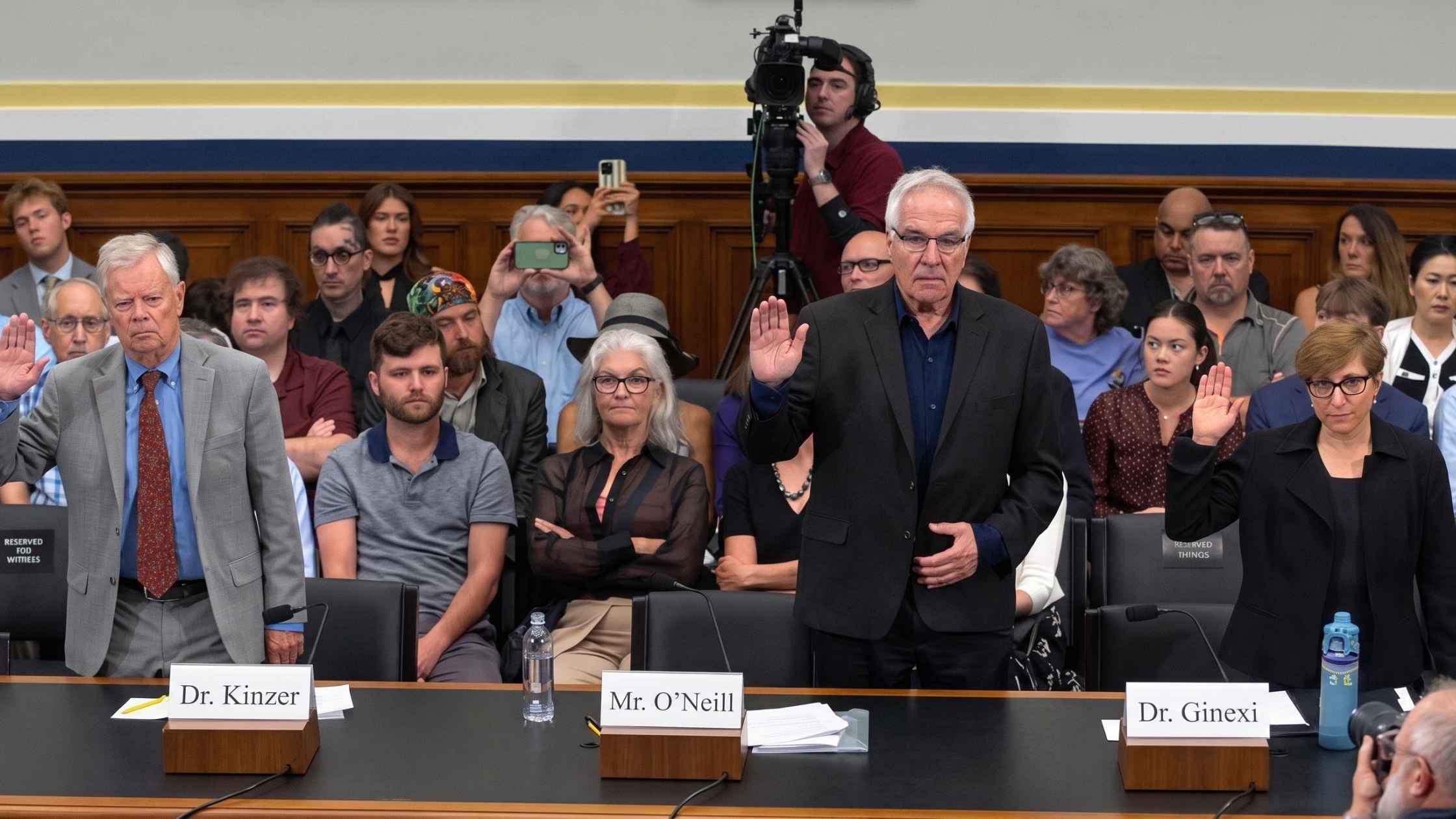
Stephen Kinzer is a historian, journalist, and author of Prisoner in Chief: Sidney Gottlieb and the CIA's Search for Mind Control. Tom O'Neill is an investigative journalist who authored CHAOS: Charles Manson, the CIA, and the Secret History of the Sixties, and Elizabeth Ginexi, did I say that right, ma'am? Ginexi is an independent consultant and former senior program officer at the National Institute of Health. We look forward to hearing what you have to say today on this important subject. Pursuant to committee rules 9G, the witnesses will please stand and raise their right hand. Do you solemnly swear or affirm that the testimony that you're about to give is the truth, the whole truth, and nothing but the truth, so help you God? Let the record show that the witnesses answered in the affirmative. Thank you. You may now take your seat.
(27:36)
We appreciate you being here today. Let me remind the witnesses that we have read your opening statements and it will appear in full in the hearing record. Please limit your oral statements to five minutes, however, if it does go over, we will not be gaveling you out. As a reminder, please press the button on the microphone in front of you so that it is illuminated and members can hear you. When you begin to speak, the light in front of you again will turn green. After four minutes, the light will turn yellow, and when the red light comes on, that means that your five minutes has-
Anna Paulina Luna (28:00):
...turn yellow, and when the red light comes on, that means that your five minutes has expired, and we'll ask you to please wrap it up. I would now like to recognize Stephen Kinzer for his opening statement.
Stephen Kinzer (28:11):
Thank you very much, Madam Chairman. Let me begin by expressing my gratitude to this task force for confronting the enormous issue of overclassification of government documents, and the culture of secrecy that enables it. I'm especially gratified by your interest in MKUltra. Well, the project the CIA carried out through the 1950s in an attempt to find the secret of mind control. MKUltra was one of the most secret government programs in American history. The chemist who directed it, Sidney Gottlieb, lived in total anonymity. My book, Poisoner in Chief, may be the most complete account of MKUltra that exists in public, but I'm painfully aware that I have discovered only a small portion of what MKUltra was, and what Sydney Gottlieb did. In 1951, the CIA hired Gottlieb, and directed him to launch what became MKUltra. Gottlieb believed that in order to find a way to implant a new mind into someone's brain, you first had to find a way to destroy the mind that was in there already.
(29:23)
In its search for ways to destroy a human mind, and body, MKUltra conducted the most extreme experiments on human beings that have ever been carried out by a US government agency. By any standard, they qualify as medical torture. These experiments took place in prisons, clinics, and safe houses in the United States, in Europe, in Asia, and even in Latin America. Officers of MKUltra were authorized to travel to foreign countries, preferably those under formal, or informal US occupation, and asked the local CIA station to provide them with expendables. Human beings who would not be missed if they disappeared. Gottlieb had what amounted to a license to kill issued by the US government. Neither the number of MKUltra victims, nor the number of those who were experimented to death is known. Gottlieb, as a result of this license to kill, might have been the most powerful unknown American of the 20th century. Some information about MKUltra spilled out during the 1970s, but senior CIA officers had intentionally let Gottlieb operate without supervision.
(30:48)
So, they were able to claim that they knew nothing about his excesses. This was a way for the CIA to deny its institutional role in MKUltra, and to portray it misleadingly as the product of one man's sadism, or excessive zeal. Investigating MKUltra is challenging because when Gottlieb, and his mentor Richard Helms left the CIA in 1973, they illegally ordered that its records be destroyed. Soon afterwards, under a DCI Stansfield Turner, a CIA analyst, as you pointed out, Madam Chairman, discovered a catch of MKUltra documents hidden among financial records. Turner credited that analyst with doing a very diligent job of Sherlock Holmesing. That same diligence I believe could bring results today. One of the great mysteries of MKUltra has to do with the death in 1953 of an MKUltra scientist, Frank Olson, who had announced his intention to quit the project. His plunge from a New York hotel room was described in the press as the suicide of an army scientist. He was not an army scientist. He worked for the CIA, and evidence suggests that his death may have not have been a suicide.
(32:06)
So, there could be hidden documents that could illuminate this case. I would also point out that in addition to searching for unknown documents, this committee could do a tremendous service by simply asking for the end of redactions on the documents that we now have. There are reams of documents about MKUltra that have heavy sections redacted. In the 1970s, this was justified by the argument that had only been 20 years since these terrible things had happened, and revealing details might affect national security. Now 70 years have passed. That argument can no longer be valid. So, I would urge this committee to try to fill out all the blank spaces in the documents that we have because we know that is there.
(32:55)
This task force could also consider trying to determine whether some new incarnation of MKUltra exists today. When the main phase of MKUltra drew to a close in the early 1960s, Sydney Gottlieb concluded that it had failed, that in fact, there is no such thing as mind control. Even if he was right, however, he may have been right only at that time. In the many decades since then, there have been enormous advances in cyber technology in artificial intelligence in neuroscience. Covert agencies may have access now to tools for mind control that Sydney Gottlieb could not even have imagined. It may well have been true in 1963 that mind control is a myth, but whether it's still true is uncertain.
(33:52)
And that question of whether mind control might now be possible under our new circumstances is something that has presumably occurred to scientists who work for Secret Services, including our own. This task force has a chance to connect the past to the future. A renewed effort to find MKUltra documents from the 1950s, and to fill out the redactions of those that have been released might shed new light on how the CIA operated during that period. It could also inform a new inquiry into whether any mind control projects are now underway inside the US security apparatus. That might help prevent the emergence of a 21st century MKUltra that could be even more destructive than the original. Thank you.
Anna Paulina Luna (34:42):
Thank you very much, Dr. Kinzer. I now recognize Tom O'Neill for his opening statement.
Tom O'Neill (34:57):
Thank you, Chairwoman Luna, and [inaudible 00:34:58] Oh, sorry. Should I start over? Thank you, Chairwoman Luna, and members of the committee. It's a privilege to be here today. Almost 50 years ago, the last congressional hearings into MKUltra took place just a short walk from here in the Dirksen Senate office building. At those hearings convened in August, and September of 1977, representatives of the CIA told Congress, and the American people that its 25-year effort to control human behavior had been a colossal failure, because I believe Congress was never told the truth about what this program actually achieved. In fact, I believe the agency misled Congress in 1977 when it characterized MKUltra as a failure. My name is Tom O'Neill, and in 1999, I accepted a magazine assignment to write a story about murders committed by a group of hippies called the Manson Family. For those unfamiliar with this horrific episode of American history, in the summer of 1969, four young people acting on the orders of a cult leader named Charles Manson went to the home of movie director Roman Polanski, and murdered everyone they found there, including his eight, and a half month pregnant wife, the actress Sharon Tate. The victims were complete strangers to their killers. The following night, Manson's followers murdered another couple in the same grizzly fashion. At the time I accepted the assignment, I'd never heard of MKUltra, and I wouldn't for another two years after I'd missed countless deadlines, lost the assignment, and fallen down a nightmarish rabbit hole trying to answer the question I couldn't quite shake. How had Manson, a barely literate ex-con, acquired the ability to persuade ordinary young people to murder complete strangers simply because he had told them to?
(36:59)
The pursuit of the answer to that question led me to Dr. Louis Jolyon West, known to his friends as Jolly. Wes was one of the most influential psychiatrists in America. During his career, he crossed paths with some of the most controversial events of the 20th century, including the Patty Hearst kidnapping case, and the aftermath of the John F. Kennedy assassination investigation. In 1977, West was one of seven academic researchers named in a front page New York Times story alleging that the CIA had used American universities, hospitals, and prisons as secret laboratories for experiments involving LSD, and other drugs on unwitting human subjects. West vigorously denied the allegations. He acknowledged that the agency had approached him but insisted he had refused because he said LSD was too dangerous, and unpredictable to be used on humans. He added that he limited all of his research with LSD to animals.
(38:03)
The revelations, and the times led directly to the congressional hearings held later that year. West denials, however, were effective. He was never investigated, and his name never came up at the hearings. I'll spare you the long, and tedious story of how my Manson reporting led to West, led me to West except to say that I eventually learned that in 1967 when Manson transformed into the cult leader we are familiar with today, he, and his followers were receiving free medical care at a clinic in San Francisco where West had established a base of operations for a research project he was conducting nearby. After becoming intrigued by the allegations against West, I learned that UCLA, his last academic home had inherited his paper following his death in 1999. Nearly two months, and more than 200 boxes later, I found the proverbial needle in a haystack. Correspondence between West, and Dr. Sydney Gottlieb, the architect of MKUltra.
(39:07)
The letters begin in 1953, just two months after CIA Director Alan Dulles authorized the program, and while West was stationed at the Lackland Air Force Base in San Antonio, Texas, where he was chief psychiatrist at the base hospital. In his first letter to Gottlieb, West proposed conducting experiments on unwitting human subjects, including military personnel, prisoners, and psychiatric patients at the base hospital. He then outlined the experiments themselves in six more pages that could have been written by Joseph Mengele. Using LSD in combination with hypnosis, Westprodos inducing confusion, amnesia, and specific mental disorders, and people who would remember nothing of their interaction with him afterward. He sought to develop techniques to extract true information, and implant false information, and unwilling subjects, and to alter the attitudes, and beliefs of quote "previously loyal individuals." In other words, to completely switch their allegiance from one group, or leader to another.
(40:15)
But it was another sentence at the end of that letter that stopped me cold. These experiments he wrote must eventually be put to test in practical trials in the field. Gottlieb's response could hardly have been more enthusiastic. " My good friend", he wrote, "I had been wondering whether your apparent rapid, and comprehensive grasp of our problems could possibly be real. You have indeed developed an admirably accurate picture of exactly what we are after." West replied that there was no more vital undertaking conceivable in these times. There was another document in West papers that had even more significant implications. It was a 14-page report that West wrote in 1956, just three years after he contracted with the CIA.
(41:02)
In the report, West described administering LSD, and other drugs in conjunction with hypnosis on unwitting human subjects, and then he made a remarkable claim. He announced that he had learned how to replace true memories with false memories, and people without their knowledge. In other words, he clarified, "It has been found to be feasible to take the memory of a definite event in the life of an individual, and through hypnotic suggestion bring about the subsequent conscious recall to the effect that this event never actually took place, but that a different fictional event actually did occur. If West's report was accurate, this was not the failure agency officials described in 1977, quite the opposite. It was in fact the central ambition of the MKUltra operation, the means of gaining the ability to seize the control of a person's perceptions, memories, and ultimately their behavior. But there was still one more discovery, and this time I found it.
(42:07)
In the National Security Archives at George Washington University, the official repository of the CIA's MKUltra records, which were released to Congress after the 1977 hearings. In those holdings was a different versions of West's 1956 report. The original paper had been replaced by a four-page summary that did not exist in West's files, and appears to have been written by someone else. His claims about replacing memories were gone, in their place was a theoretical discussion of LSD in disassociative states. The versions applied to Congress concluded that the effects of LSD, and similar drugs on disassociative states had, and I'm quoting, "never been studied, never been studied". In the original report, West discusses observations from his own experiments, including detailed descriptions of using LSD2 as he wrote, speed the induction of the hypnotic state, and deepen the trance in subjects. Those passages have been removed in the report turned over to Congress.
(43:16)
The discrepancy could not have been more stark. Nearly 50 years ago, another congressional committee believed it had been given the truth about MKUltra. It had not. In conclusion, I respectfully submit that these records, some newly available, and others that remained outside the government's disclosure for decades warrant a thorough reexamination of what the program accomplished, what Congress was told, and what may still remain hidden. I'm happy to provide the documents I've referenced today, and I've provided many additional details in my written testimony.
Anna Paulina Luna (43:57):
Thank you, Mr. O'Neill. I now recognize Elizabeth Ginexi for her opening statement.
Elizabeth Ginexi (44:04):
Chairman Luna, and distinguished members of the committee, thank you for the opportunity to testify today. I'm a health research scientist with a master's, and doctoral degrees in psychology from the George Washington University. I spent 22 years from 2003 to 2025 as a scientific program official at the National Institutes of Health, managing more than $132 million in health research grants, and co-authoring 18 federal funding programs. I left the NIH in April of 2025. I'm here today because what is happening to NIH right now is not reform. It is the replacement of scientific judgment with political control. For 80 years, US federal investment in biomedical research produced outcomes that no private market would have funded. Heart disease is the leading cause of death in the United States. NIH funded research on blood pressure, cholesterol, and smoking drove a 56% decline in heart disease between 1950, and 1996.
(45:12)
Cancer has been transformed. Treatments for breast, lung, prostate, and childhood cancers, along with immunotherapies that converted previously fatal diagnoses into manageable conditions traced directly to NIH funded research. HIV AIDS were a death sentence in 1981. No pharmaceutical company saw a profitable market for treatment. NIH ran the trials that no one else would run. The result was anti-retroviral therapy, and pre-exposure prophylaxis. Global AIDS deaths have fallen 54% since 2010. Rare diseases that affect 30 million Americans get studied at the NIH because no market will fund that research. Every dollar that's appropriated to the National Institutes of Health generates $2.46 in economic output. NIH supported work contributed to 354 of the 356 new drugs that the FDA approved between 2010, and 2019. Cutting the funding source of that pipeline does not slow it. It ends it. The proposed OMB Federal Financial Assistance Rule would give political appointees authority to terminate funded grants at any time without cause, including ongoing clinical trials with enrolled patients. This is not a hypothetical. NIH has already terminated, or frozen thousands of grants, including hundreds of ongoing clinical trials since January 2025, concentrated in infectious disease, vaccine, and health disparities research.
(47:01)
This proposed rule will make that authority permanent. The NIH director has eliminated the merit score thresholds that once protected peer review, and political appointees are right now overriding peer review outcomes to screen grants for alignment with administrative priorities. The proposed OMB rule will also severely restrict international research. We're managing an H5N1 bird flu outbreak that has more than 70 documented human cases. We recently concluded a antivirus response that required CDC scientists working alongside Argentine counterparts. The current Ebola outbreak in the Democratic Republic of Congo is now the third-largest on record, and is outpacing containment efforts. This rule will curtail exactly that kind of cooperation that we need. NIH lost 1,112 PhD trained workers from 2025 to early '26. More than half of the NIH institutes right now are operating without permanent scientific leadership. The majority of its advisory councils required by statute to provide independent oversight have lost more than half of their members.
(48:26)
The fundamental choice before this Congress is between a system where scientists make scientific judgments through accountable processes, and one where political appointees make those calls instead. That choice will determine whether the next breakthroughs in cancer, Alzheimer's, antibiotic resistance, and pandemic defense will happen here somewhere else, or perhaps not at all. I urge this committee to support a joint resolution of disapproval to block the proposed OMB financial assistance rule. That authority to replace peer review with political approval has not been granted by Congress, and should not be.
Anna Paulina Luna (49:12):
Dr. Ginexi, your time's expired. I'll be now going to myself for-
Elizabeth Ginexi (49:15):
Thank you very much.
Anna Paulina Luna (49:16):
...questioning. Thank you, ma'am. My first question is for Mr. O'Neill. MKNAOMI, the joint CIA Army program that ran parallel with MKUltra at Fort Dietrich appears to have been run with deliberate minimal documentation. Army records on special operations division have apparently been destroyed. In your investigation, what did you learn about MKNAOMI, and do you believe its activities were even more serious than what we know about MKUltra?
Tom O'Neill (49:49):
I'm sorry. I didn't learn anything about those operations. I kept my focus mostly on Dr. West, and his work. I do know that the only reason I found the documents I found was because Dr. West accidentally left them in his papers, and he probably did that because he corresponded with Gottlieb under Gottlieb's assigned alias, which was Sherman Grifford, and he addressed all his mail to a post office box here under Foss Corporation.
Anna Paulina Luna (50:21):
Thank you, Mr. O'Neill, I'm just going to real quick go to Dr. Kinzer. Are you aware of anything that exists with MKNAOMI in your research? And if you could please press the button.
Stephen Kinzer (50:31):
My understanding of MKNAOMI is that it was a joint project between the military, and the CIA. And there's a big difference because the MKUltra Project was aimed at seizing control of the minds of individuals. The army was interested in something different, which was trying to use biological agents in warfare against entire populations. So, MKNAOMI is the place where these two goals overlapped.
Anna Paulina Luna (51:00):
And that was the 1953 Frank Olson death. Was that in a way tied to that from some chatter that we had seen in...
Stephen Kinzer (51:09):
Exactly what the motivation was behind the decision about Frank Olson if there was such a decision is unknown.
Anna Paulina Luna (51:16):
My next question is also for you, sir. Operation Paperclip brought over 1,600 German scientists into the United States government after World War II, including individuals who had conducted human experimentation in concentration camps. The CIA military were aware of their backgrounds, and recruited them anyways. In your research, did you find direct documentation between paperclip scientists, and the development of MKUltra's experimental protocols, specifically the use of masculine hypnosis, and sensory deprivation, which were techniques also documented at Dachau?
Stephen Kinzer (51:46):
Absolutely. Kurt Bloma, who was the chief of biological weapons development for the Nazi government came to work for the CIA. So, did Walter Schreiber, who was the surgeon general of the Nazi army. I can just tell a brief story. When I was researching my book, I found what I think might be the first secret CIA prison, or black site. It's a nice chalet in Germany, and the guy who now owns it took me into the basement. He said these were the cells where the MKUltra officers working side by side with Nazis carried out those gruesome experiments, which were actually just continuations of the experiments that those Nazis had been conducting just a few years earlier, right down the road.
Anna Paulina Luna (52:36):
Just for timeline, and clarification, these experiments were happening after the Nuremberg trials, correct? So, the CI would've known that these were crimes against humanity.
Stephen Kinzer (52:44):
I looked for an episode in which the Nuremberg doctrines were posted on the wall in some MKUltra, or CIA office, and I was never able to find any indication that those Nuremberg principles ever were even consulted, much less obeyed.
Anna Paulina Luna (53:00):
Thank you. My next question would be for either witness to comment, Dr. Kinzer, or Mr. O'Neill. Both witnesses have written about the psychiatrist, Louis Jolly West. Sydney Gottlieb who ran MKUltra program for the CIA hired West as a contractor to conduct research for subproject 43, combining hypnotism, drugs, and sensory deprivation to create disassociative states in which to quote Mr. Kinzer in his book, Poisoner in Chief, "The human mind could be pulled away from its moorings." Following the assassination of President John F. Kennedy, West psychiatrically examined Jack Ruby then in prison for murdering the president accused of the assassination, the assassin accused of murdering President Kennedy Lee Harvey Oswald. A report emerged from West examination said that Ruby had suffered a acute psychotic break. Can you explain why Dr. West in particular was chosen to conduct an examination of Jack Ruby alone in his jail cell with no other psychologist present?
Tom O'Neill (53:57):
I'd be happy to. West inserted himself into the case. The day after the shooting, Wes approached the judge in the preliminary hearings, and asked to be assigned to the case. He was refused by the judge. After Ruby was convicted at his first trial, an associate of West, Dr. Hubert Winston Smith, who was a psychiatrist, and an attorney took over Ruby's defense for his appeal, and he had already discussed appointing Ruby to the case, or excuse me, West to the case. And as you said, West examined Ruby alone at the jail cell, and emerged to announce it in the preceding 48 hours, he had had an acute psychotic break from which he would never recover. He had been declared competent to stand trial the first time by a panel of, I think, eight psychiatrists. This psychotic break lasted until his death in 1967. Two months after West examined him, Ruby testified for the first time, and only time to the Warren Commission.
(55:08)
It was the first time he ever publicly was supposed to say what his reasons were for shooting Oswald. The testimony had to be halted because he was babbling incoherently, and as Arlin Spector, who was the counsel to the commission wrote in his memoirs, he pulled him aside, and said that they were cutting off the arms, and legs of children in Albuquerque, and El Paso, and he said he was making no sense whatsoever. West in his letters to Gottlieb from 1953 discussed experiments where he would induce specific mental disorders in people without their awareness. A year before the Kennedy assassination, he publicly spoke in Oklahoma City, and talked about his LSD experiments inducing psychiatric breaks in psychosis in people with the use of LSD, with, of course, later con-
Tom O'Neill (56:00):
... people with the use of LSD, but of course later contradicted what he told the New York Times when he said he never used LSD in animal experimentation.
Anna Paulina Luna (56:09):
What an interesting connection. I'm out of time, but I'll be now recognizing Mr. Burlison from Missouri for five minutes.
Eric Burlison (56:17):
Thank you, Madam Chair. Thank you for your diligent work on this, and hopefully we will hear back from the CIA on those boxes of documents that have so many questions about. Dr. Kinzer and Mr. O'Neill, the CIA recruit created MKULTRA in 1953, supposedly, out of fear that the Soviet Union and China had developed mind control capabilities. Let me go back a little bit further. One of my questions has to do with the event that happened in 1951 in August in France. There was a bakery that... I guess the people that lived in that community, over 250, some say 300, people were poisoned from the bread. It was determined that that was LSD that was causing all of these people to hallucinate. Some people died. Is there any connection, Dr. Kinzer, to that event? And was that something that either inspired the MKULTRA program or the MKNAOMI program? Or is that something that we were involved in even that early on?
Stephen Kinzer (57:36):
I would turn that question back to you. I don't think anybody really knows the full story of what happened in that town in France, that the United States could have been involved, that this could have been part of what was then called Operation Artichoke, the predecessor for MKULTRA. Seems to me not beyond the realm of possibility. There's a lot of overlap between the ergot enzyme that is the basis of LSD and certain rye and wheat funguses that can be used in breads. Was that something intentional? Was it something the Americans were involved in? I have my suspicions, but just based on my background as a journalist, I don't operate on suspicions. So I would love to see more investigation of that episode.
Eric Burlison (58:26):
My next question has to do with, once the program began, I think one of the most shocking things that we've determined is the Operation Midnight Climax that occurred in the early 1950s, '60s where the CIA had safe houses. I'd say, Dr. Kinzer, I mean, obviously this is extremely disturbing behavior that was happening where you had American citizens who were being lured into these brothels and then dosed with a hallucinogenic and then filmed during their sex acts. Was there anyone prosecuted for these crimes?
Stephen Kinzer (59:18):
No, there have been no prosecutions for any crime related to MKULTRA, as far as I know. To me, the remarkable aspect of that Operation Midnight Climax was that there wasn't even the pretense of scientific experimentation. The person watching behind the one-way mirror was a grossly overweight drug officer sitting on a portable toilet and drinking cocktails out of a pitcher. There was nobody there that was a scientist or somebody who understood sexual behavior or human psychology. So there was no science involved in it at all.
(59:55)
I can add a little footnote. When I was researching Poisoner in Chief, I came across a document in which one of the officers involved in setting up that program, Operation Midnight Climax, said that Sidney Gottlieb himself used to fly from Washington out to inspect the project regularly and always asked that women be provided for him.
Eric Burlison (01:00:18):
That was my next question.
Stephen Kinzer (01:00:19):
So it made me wonder.
Eric Burlison (01:00:20):
Do you think that the agents were involved in the sexual encounters?
Stephen Kinzer (01:00:23):
And could that have actually been the reason why the bordello was opened? There was no prospect of any serious scientific result out of that project, given the personnel who were overseeing it. So those CIA officers, particularly Gottlieb, involved in overseeing Operation Midnight Climax certainly were able to take advantage of what it offered.
Eric Burlison (01:00:50):
Thank you. My last question. First, I want to say thank you to Mr. O'Neill. The book Chaos, I checked it out from the Library of Congress, and greatly appreciate your work there. I was intrigued by one of the statements that you made based on your research that the MKULTRA program, they were actually successfully able to replace memories. And because of that, I'm wondering if, and Dr. Kinzer, you can chime in if you have any knowledge of this, did the program continue, and do you think that the program in some aspect is still continuing today?
Tom O'Neill (01:01:24):
You're asking if the program continued after 1973 when it was halted supposedly?
Eric Burlison (01:01:30):
That's right.
Tom O'Neill (01:01:33):
Honestly, that's a question I'm asked at almost every appearance I do. Is it happening today? Did it continue? I don't know. I can't imagine that it didn't though because the technology that they worked to establish over 20, 25 years and spent more money on than any operation the CIA had ever conducted was successful. I imagine it's being used. I have no evidence of it being used, so it's a complete assumption.
Stephen Kinzer (01:02:03):
I would just add that one of the letters to which Mr. O'Neill referred contains a quote from Mr. Gottlieb saying that these experiments were necessary "in these times." I think it's important to put yourself back in that mindset where the United States felt that it was under such overwhelming threat that the loss of a few lives or a few hundred lives was a small price to pay. Commitment to a great cause is one of the most fundamental justifications for committing immoral acts, and patriotism is among the most noble of causes. It can be twisted, and it can be used as an excuse to carry out research under the guise that this is simply research we're doing to protect ourselves against others. And I think that is a mindset that may still be active in some parts of our government.
Eric Burlison (01:02:54):
Thank you, gentlemen. Thank you, Madam Chair. My time has expired. I yield back.
Elizabeth Ginexi (01:02:58):
I'm so sorry.
Eli Crane (01:03:01):
Thank you, Mr. Burlison. I now recognize myself. Thank you to the witnesses for coming today to testify about MKULTRA. Dr. Ginexi, you said you worked for the NIH, is that correct?
Elizabeth Ginexi (01:03:17):
That is correct.
Eli Crane (01:03:19):
And you left in 2025?
Elizabeth Ginexi (01:03:21):
That is correct.
Eli Crane (01:03:23):
I noticed during your opening statement that you had nothing to say about the content of this hearing being about MKULTRA. Your statement seemed to be based more on your issues with this administration's attempt to reform and reign in the NIH. Is that a fair assessment of your opening statement?
Elizabeth Ginexi (01:03:45):
My opening statement was talking about the destruction of the NIH and cancellation of grants and political control of the NIH.
Eli Crane (01:03:58):
Would you deny that the NIH had involvement in the funding of the Wuhan lab?
Elizabeth Ginexi (01:04:05):
I don't have any knowledge about any funding related to the Wuhan lab.
Eli Crane (01:04:13):
So are you denying that the NIH funded the Wuhan lab?
Elizabeth Ginexi (01:04:17):
I'm basically here to talk about what's happening right now at the NIH and how we really should be letting science be driven by scientists and not by politicians, because that's how we fund cures and make health progress.
Eli Crane (01:04:35):
Well, with all due respect, ma'am, do you find it ironic that for years we were told to trust the science, and then in the aftermath, we've all found out that most of what we were told during COVID was a complete lie and it wasn't scientific at all?
Elizabeth Ginexi (01:04:51):
The number one thing that I think that we're doing to destroy trust in American science right now is canceling clinical trials. In the middle of those clinical trials, this does incredible harm to the patients who are receiving experimental treatments, and it really destroys the trust that we have and how do we recruit patients for future trials if they are knowing that their trials could just be simply canceled for political reasons.
Eli Crane (01:05:21):
Right. I don't think anybody up here would deny that there's never been anything good that's come out of the NIH and that you guys have done some good work, but you just brought up trust. Do you think the NIH has a trust problem based on how they handled COVID?
Elizabeth Ginexi (01:05:36):
No, I do not. I think that the NIH is beloved by the American people because we know about the advances in human health and cancer treatments and heart disease and diabetes, and all of the health gains that the research has produced.
Eli Crane (01:05:53):
Well, I think you're wrong, ma'am. I think that the public has a serious mistrust issue with the NIH. Do you deny that the NIH tried to cover up the origin of COVID?
Elizabeth Ginexi (01:06:09):
I'm not here to testify about that. That's not my area of science. I have no knowledge of that.
Eli Crane (01:06:17):
Do you believe that the NIH supported masking and social distancing when there was really no science to support that?
Elizabeth Ginexi (01:06:25):
What I'm more concerned about is what's happening right now to destroy the Biomedical Research Institute that has been the envy of the world. Right now we're seeding our leadership in biomedical research to China. That's what's happening right now.
Eli Crane (01:06:41):
What about covering up harmful side effects of vaccines and the role that the NIH has played in that? What do you have to say about that, ma'am?
Elizabeth Ginexi (01:06:51):
The US history of human subjects protection has evolved greatly. Numerous research improprieties from the '50s to the '70s in the United States, including the Tuskegee Syphilis Study, forced Congress to establish formerly federal mandated rules-
Eli Crane (01:07:07):
I'm not asking you about that. You know what I'm asking you about. I'm asking you about how NIH handled COVID. Obviously, this is supposed to be a hearing about MKULTRA, but when you gave your opening statement... And I don't even know why you were called to this hearing because you didn't offer anything about MKULTRA, but since you are here and you're going to defend NIH, I'm going to call you out on it. Do you see now what I'm talking about? When you say that the NIH doesn't have integrity problems and trust issues, did you hear the applause in this room? That should tell you right now that you're pretty tone-deaf to what the public thinks about how the NIH handled COVID and the coverup, not only the funding of it, but the coverup involved in the aftermath. Can you acknowledge that?
Elizabeth Ginexi (01:08:01):
I'm sorry, that's not my understanding.
Eli Crane (01:08:12):
Thank you. I want to acknowledge Ms. Boebert for the next round of questioning.
Lauren Boebert (01:08:19):
Thank you, Mr. Chairman, and thank you to two of our witnesses who are here to actually talk on our subject here today. Mr. Kinzer, in your book Poisoner in Chief, you describe how Project MKULTRA was authorized by CIA Director Allen Dulles in April of 1953 as an umbrella program for research into the covert use of biological and chemical materials for mind control and interrogation. What specific geopolitical and intelligence concerns particularly regarding alleged Soviet and Chinese "brainwashing" and Korean War prisoners drove this authorization? And how did Sidney Gottlieb's unique background and personality and worldwide view shape the program's direction and methods and ethical boundaries?
Stephen Kinzer (01:09:14):
Let me start by answering your second question about Gottlieb. He was a very different person from all of the other senior CIA officers of that era. Most of them came from silver spoon backgrounds. They went to the same prep schools and the same Ivy League colleges, and belonged to the same yacht clubs, and worked for the same law firms and international banks. Sidney Gottlieb was the son of Orthodox Jewish refugees from Central Europe. He had a limp. He had a stutter. He went to Hebrew school. He was so different from all of the other officers.
(01:09:50)
Upon reflection, I think this may not have been an accident. I think that people at the CIA understood that whoever had this job was going to be doing some awful, terrible things that would be very bloody, that they might become known, and it might be necessary to blame it all on somebody. They didn't want to have to blame it all on one of their own. So Gottlieb actually became the person on whom everything was blamed. In fact, when he testified in secret here in Congress in the 1970s, he complained that there were documents on which various signatures had been redacted, but his alone had remained. So this, again, is a way of diverting attention away from the institutional responsibility of the CIA and trying to blame it on one crazy person.
(01:10:43)
As for the international situation at the time, I think it's very important to understand this because there is a sort of a parallel to today. The CIA misinterpreted several key incidents in the world, including those to which you referred, the trial of the Cardinal Mindszenty in Hungary and then the return of Korean War prisoners. Neither of those episodes really had to do with mind control, but in the CIA, they were interpreted that way. This gave the CIA a reason to pretend that its research was purely defensive.
(01:11:20)
So I think when you consider the world situation and the sense in Washington that were surrounded by enemies, that becomes a very dangerous environment. Conspiracy theories stem from the growth of the covert sphere. There's a great contradiction in American life that we pretend to uphold certain principles at home and abroad, but it's evident to many Americans that we actually operate in opposition to those principles, and we operate via secret and anti-democratic means. That contributes to suspicion of government, and the very existence of MKULTRA proves that some of the wildest fantasies about secret government research are actually close to reality. That makes the paranoid mindset seem ever more rational.
Lauren Boebert (01:12:09):
Thank you. I'm going to have to cut off several of my questions now, but that was very intriguing. So I wanted you to continue. MKULTRA ultimately encompassed at least 149 subprojects, involving more than 80 institutions, universities, hospitals, prisons, pharmaceutical companies, often funded through cutout foundations to conceal CIA sponsorship. Can you detail how these funding and operational security mechanisms worked in practice? And then just another subset if I don't get back to asking a question, did the CIA or government or any of these entities ever say that what they were doing with MKULTRA and mind control were productive or for the betterment of humanity? Did they ever make those claims? Thank you.
Stephen Kinzer (01:13:00):
As for your second question, I'm not aware, other than in private communications, that the CIA ever claimed that it had made great advances under MKULTRA because it largely denied that MKULTRA ever existed.
(01:13:14)
As for the foundations, Sidney Gottlieb created a couple of bogus foundations. They're called cutouts in CIA slang. These are foundations that appear to be independent but actually are fully funded and controlled by the CIA. It was those foundations that approached hospitals and clinics and asked them to become involved in research, particularly into LSD. So many of the institutions where these experiments took place did not even realize that those foundations were actually covers for the CIA.
Lauren Boebert (01:13:49):
Thank you very much. Madam Chair, I yield.
Anna Paulina Luna (01:13:52):
Thank you. I now recognize Representative Mace from South Carolina for five minutes.
Nancy Mace (01:13:57):
Thank you so much. Dr. Ginexi, you work with the NIH, correct?
Elizabeth Ginexi (01:14:03):
No, I am no longer affiliated with the NIH.
Nancy Mace (01:14:06):
When did you leave the NIH?
Elizabeth Ginexi (01:14:08):
April of last year.
Nancy Mace (01:14:10):
April of last year. Did you ever speak with Anthony Fauci or any of your NIH colleagues when you were there about the NIH's role in funding the Wuhan Institute of Virology or the development of COVID-19 virus?
Elizabeth Ginexi (01:14:20):
No.
Nancy Mace (01:14:22):
Do you believe that the NIH or Dr. Fauci lied to the American people about COVID?
Elizabeth Ginexi (01:14:27):
No.
Nancy Mace (01:14:28):
Are you familiar with Dr. Fauci's statements to Congress about COVID?
Elizabeth Ginexi (01:14:33):
No.
Nancy Mace (01:14:33):
You worked at the NIH and you didn't watch any of Dr. Fauci's-
Elizabeth Ginexi (01:14:36):
No. I did not work at NIAID.
Nancy Mace (01:14:37):
Okay. Do you think the COVID shots harm American citizens?
Elizabeth Ginexi (01:14:48):
No, I do not.
Nancy Mace (01:14:50):
Do you think that the COVID shots caused turbo cancers?
Elizabeth Ginexi (01:14:55):
No.
Nancy Mace (01:14:58):
Do you know if the NIH or NIAID track COVID shot injuries or cancers or anything harmful from them?
Elizabeth Ginexi (01:15:08):
I am not aware of any harmful tracking. This is not my area of expertise, no.
Nancy Mace (01:15:15):
What is your area of expertise?
Elizabeth Ginexi (01:15:17):
I'm a research psychologist, and I did not work at NIAID.
Nancy Mace (01:15:23):
And you're here for what reason?
Elizabeth Ginexi (01:15:25):
I am here to testify about what is happening to the NIH right now.
Nancy Mace (01:15:32):
You're not here to testify about MKULTRA?
Elizabeth Ginexi (01:15:35):
I am not an MKULTRA expert.
Nancy Mace (01:15:37):
Why did the Dem send you here if you're not an MKULTRA expert?
Elizabeth Ginexi (01:15:40):
But I am an expert in human subjects protection, which is related and in the conduct of human subjects research.
Nancy Mace (01:15:50):
Okay. But you don't know anything about MKULTRA, which is the purpose of this hearing.
(01:15:57)
All right, so I have a couple questions for our witnesses who are here to talk about MKULTRA. Thank you, gentlemen, Dr. Kinzer and Mr. O'Neill. What are some of the worst abuses that you're aware of in the MKULTRA program?
Stephen Kinzer (01:16:12):
I can start by just naming... I'll talk about one in particular that always sticks in my mind. In the federal prison in Lexington, Kentucky, a group of African American inmates was segregated and fed what were described in the protocol as double, triple, and quadruple doses of LSD every day for 77 days.
Nancy Mace (01:16:36):
Did they all survive?
Stephen Kinzer (01:16:37):
We have no idea what happened to them.
Nancy Mace (01:16:41):
Okay.
Stephen Kinzer (01:16:41):
This has stuck with me ever since I wrote that book. What happened to them? Did they ever find out what was given to them? Did they think they were going crazy? Did they... I think if the-
Nancy Mace (01:16:50):
Do you think we're still experimenting on prisoners or people in prison today?
Stephen Kinzer (01:16:58):
I don't have any information about that.
Nancy Mace (01:17:00):
Okay.
Stephen Kinzer (01:17:01):
I'm hoping there'll be another book about what's happening now.
Nancy Mace (01:17:03):
Mr. O'Neill, what are some of the worst abuses in MKULTRA?
Tom O'Neill (01:17:12):
There were many. The Frank Olson case, which was referenced earlier, that was a murder. I don't believe that was a suicide. The motivation was because he was going to be a whistleblower. He worked at the CIA, he worked in the development of biological weapons, and he was planning to go public and announce that the United States government was using biological weapons in the Korean War. Also, he was going to talk or share what he knew about MKULTRA experiments, including lethal experiments. And there's a documented case that-
Nancy Mace (01:17:49):
Gentlemen, how many people do you think died through the MKULTRA program or were murdered?
Tom O'Neill (01:17:53):
No idea.
Stephen Kinzer (01:17:55):
If those who died largely were outside the United States. Many people were experimented to death in that safe house in Germany that I visited. People in the neighborhood told me they knew what was going on in that house and that people who were experimented to death are now buried in what used to be forest plots that are now covered with apartments plots.
Nancy Mace (01:18:14):
Do you think the German government knew what the US government was doing? Do you think there was a partnership there or knowledge?
Stephen Kinzer (01:18:18):
Yes. There is a memo that was written by the German Secret Service to Konrad Adenauer, the chancellor of Germany, telling him Americans are here capturing citizens, capturing people and conducting extreme experiments, which are in violation of German law. And Adenauer decided to put that aside and not to investigate-
Nancy Mace (01:18:39):
I have one more question because I have 15 seconds. Is this a massive coverup by the US government?
Stephen Kinzer (01:18:45):
It's certainly a coverup of what happened in the past.
Nancy Mace (01:18:48):
Mr. O'Neill?
Tom O'Neill (01:18:49):
Oh, absolutely, yes.
Nancy Mace (01:18:50):
Thank you. And I yield back.
Anna Paulina Luna (01:18:52):
Thank you, Representative Mace. I now recognize Mr. Perry from Pennsylvania for five minutes.
Scott Perry (01:18:57):
Thank you, Chair. Thanks to the witnesses for being here. To Dr. Kinzer and Mr. O'Neill, I want to focus on the information that we do have and things of that nature. Can you name the location, say, the prisons, the hospitals, other institutions, and the cutouts, as you described, either one of you folks described them, that would be familiar to us or the American people? Can you name-
Tom O'Neill (01:19:29):
Yeah. If I could begin just by saying, at the end of the 1977 hearings, Senator Ted Kennedy and Senator Daniel Inouye, who were the co-chairs, demanded that there be an investigation to find out who were the perpetrators, where were the experiments conducted, and most importantly, to locate victims, compensate them, notify them, because many didn't even know they'd been experimented on, and give them lifetime medical care. President Jimmy Carter and Attorney General Griffin Bell said the federal government will begin an investigation. That never happened. Instead, the CIA created something called the Victims Task Force to investigate itself. It was a two-man investigation to locate victims, and they only looked for people who had been experimented on in the safe houses. Because I interviewed both of them before they passed away, they completely avoided institutional experimental programs at the hospitals.
(01:20:32)
You're asking about the hospitals. The Oklahoma City Hospital, Lackland Air Force Base Hospital, the Lexington Addiction Center, which Dr. Kinzer referred to, the Holmesburg Prison, Vacaville Prison, universities all over the country, Yale, Ivy League universities, none of those records... A criminal investigation was also supposed to start into Gottlieb's destruction of the records. That had been announced by the Justice Department. And I interviewed Griffin Bell and asked him what happened to all those investigations and what happened to all those efforts to locate victims. He said it just must have fallen through the cracks.
Scott Perry (01:21:09):
So it was the DOJ that was supposed to investigate?
Tom O'Neill (01:21:12):
DOJ, the Department of Justice, and they just kept passing it off and passing it off.
Scott Perry (01:21:16):
Do you know if the DOJ and their investigation visited the places that you've named?
Tom O'Neill (01:21:21):
No, absolutely not from-
Scott Perry (01:21:23):
Wait, hold on a second. They didn't or you don't know?
Tom O'Neill (01:21:26):
Oh, no, no. I asked the two men who did the investigation, and they said, "All we did was look into what happened at the safe houses in San Francisco and New York City in 1962."
Scott Perry (01:21:37):
So is it possible that information and documentation remains at the prisons, the treatment centers, the universities where these things were conducted? Is that possible?
Tom O'Neill (01:21:48):
Yeah. Well, I found Dr. West's records at UCLA in his file. Hospital records are really hard to get because of HIPAA laws. And prison records, the Bureau of Prisons do have a lot. So yeah, it is possible there's still documents buried places.
Scott Perry (01:22:07):
What were the average ages, if you know, of the people that were experimented on? Were these children? Were these middle-aged? Were they-
Tom O'Neill (01:22:16):
Well, there were adolescent studies done in juvenile detention facilities and jails with kids who were 16, 17, 18 years old. Institutional schools for wayward kids, the National Training School for Boys here in Washington D.C. had them. So it ranged from, I think, adolescent, pre-adolescent through any age.
Scott Perry (01:22:47):
If you could describe, either one of you, the number of potential victims, if you could hazard a guess, is this hundreds?
Tom O'Neill (01:22:57):
There were 149 programs that we know of that were subcontracted outside of-
Scott Perry (01:23:03):
149 separate programs.
Tom O'Neill (01:23:05):
Yeah, outside. And that's what we know of. Again, everything we know of is minuscule compared to what was really going on. So I mean, that could have been into the tens of thousands, and I believe that's another reason that nothing was pursued. Because if those people were compensated, it could have bankrupted United States.
Scott Perry (01:23:23):
Has there been any recent attempt to find, locate, identify victims of this case?
Tom O'Neill (01:23:28):
Not that I know of.
Stephen Kinzer (01:23:29):
I would just add that there's been considerable progress in this regard in Canada. There was MKULTRA research going on at a psychiatric hospital in Canada, and the Canadian government has made a real effort to try to find out who the victims were and also to compensate them and to provide them with medical treatment. So if we're looking for an example of a place where it was done better, even though it was on a much smaller scale, Canada would be a place to look.
Scott Perry (01:23:55):
So other than embarrassment to the federal government, maybe agencies involved and particular individuals who are probably likely deceased at this point-
Scott Perry (01:24:00):
... particular individuals who are probably likely deceased at this point. What is the reason for the mass redaction of the information that we do have? Has any reasoning been given?
Tom O'Neill (01:24:17):
Shame.
Scott Perry (01:24:18):
I'm sorry?
Tom O'Neill (01:24:19):
Shame.
Scott Perry (01:24:20):
That's what I'm saying, other than embarrassment, but I think it stands to reason that probably the individuals involved in conducting and authorizing this activity are probably all deceased-
Tom O'Neill (01:24:35):
Sure.
Scott Perry (01:24:35):
... at this point. Is there any reason to believe otherwise?
Stephen Kinzer (01:24:39):
No.
Tom O'Neill (01:24:39):
I make those arguments in my FOIA requests, but it doesn't get me anywhere. I don't know about you, Dr. Kinzer.
Scott Perry (01:24:46):
All right. My time's expired. I yield.
Anna Paulina Luna (01:24:48):
Thank you, Representative Perry. I'm now going to go to a second line of questions, so I'll be recognizing myself followed by, I believe, Representative Boebert and either of the representatives if they'd like to join in. I wanted to elaborate further, Dr. Kinzer, what you had stated about potentially there being bodies. The locations, Germany, 'cause I'm going to reach out to the German government after this to get the ball rolling on that if that is indeed the case. Can you just elaborate further on what you were hearing from people in that area, what they were saying, and then also to potential locations of bodies?
Stephen Kinzer (01:25:19):
First of all, the memo that Chancellor Adenauer received is on the record. You can find that memo warning that these operations are going on. I did speak to people who lived in that area and they all understood. Some of them had cooperated with an investigation by a German magazine, Der Spiegel, that called that house the "CIA Torture Center." And in that article it said, "There were deaths, but the number is not known." So it was a secret to us, but what we were doing in that house was really not even a secret to the people in the neighborhood. It reminds me of the bombing of Cambodia. It was a secret to us, but if you were living in Cambodia, you would've known about it. So I think there is a fruitful ground for research looking into what happened in Germany and seeing what can be found out about these huge, hugely destructive and devastating projects that were essentially systematic torture going on in this house and who knows how many others.
Anna Paulina Luna (01:26:28):
Just to confirm too, when you found the initial transcript with the Chancellor or correspondence, was there a response from the US government to the Germans?
Stephen Kinzer (01:26:37):
No. The US government would possibly have advised Adenauer not to pursue it, but I don't think Adenauer would've even needed to be told that. He would see it. He would understand his close partnership with the United States made it impossible for him to criticize anything the US was doing. Don't forget this was not so long after the end of the Second World War. So no, there was no effort by the United States ever to reveal anything about what happened in Germany. And in fact, one of the FOIA requests that I made that was never fulfilled and on that I would urge you to pursue is, what was Sidney Gottlieb doing during two years in Germany? He went to Germany and went to live there as a case officer. I was never able to find out what did he do during two years in Germany. There were huge numbers of MK-Ultra experiments going on in Germany, including a number that were fatal. That would be a very interesting catch of documents to find.
Anna Paulina Luna (01:27:37):
We will definitely be following up. My next question would be for either Dr. Kinzer or Mr. O'Neill. Declassified CIA records have revealed that officers deployed overseas have used USAID funding as an official cover or USAID as an official cover for operational work that had nothing to do with the mission of USAID, i.e., humanitarian aid, medical relief, et cetera. In some cases, CIA officers operated under USAID cover engaged in lethal activity in places such as Vietnam running assassination missions during the war in-country from 1965 to 1975. And since MK-Ultra seems to have found its origin and drug experiments conducted on prisoners overseas and first by the SS in Nazi Germany and then by US intelligence and camps captured from the Germans, do you believe that USAID may have been used overseas to further influence or further the MK-Ultra, for example, on prisoners of war. Since part of USAID's mission was to administer drugs to the poor and needy populations, would the organization have abused its mandate by poisoning foreign populations or creating disassociated states for interrogation or torture?
Stephen Kinzer (01:28:42):
I can't speak directly to AID, but it's certainly true that during this period after the Second World War, the United States was using publicly announced and official US government agencies to carry out covert action. We now know, for example, that 5% of all of the money appropriated for the Marshall Plan was diverted for covert activities. A number of US agencies were used as cover by covert operatives and that AID could have been one of them sounds very likely to me.
Tom O'Neill (01:29:19):
And the NIMH admitted to allowing itself to be used for covert funding of MK-Ultra experiments in the 1970s, when the operation was disclosed.
Anna Paulina Luna (01:29:30):
Thank you. I now recognize Representative Burchett for five minutes.
Representative Tim Burchett (01:29:36):
Thank you, Chairlady. Thank y'all for being here. I remembered when all the talk about MK-Ultra broke and then they were talking about lawsuits and there were lawsuits and CIA and the federal government said that this didn't exist and then they came back and said, "Well, it does exist, but we're not doing it anymore." I guess my question to y'all first is which lie do we believe? Thank you.
Speaker 2 (01:30:04):
Woo. Woo. Woo.
Representative Tim Burchett (01:30:08):
Obviously there was an open bar before this thing started, so thank y'all. But Dr. Kinzer?
Stephen Kinzer (01:30:13):
I put myself in the-
Representative Tim Burchett (01:30:17):
Hit your mic, brother. You're not on the mic. It's an old CIA trick. I'm just kidding.
Stephen Kinzer (01:30:21):
I put myself in the place of one of those senior CIA officers and I'm thinking to myself like the ones back in the 1950s, "Well, other people must be doing this. We'd be falling behind if we don't do it. And nobody's looking over our shoulders," and that I think is your job. So I think there is a definite air of urgency and total secrecy. If any current research is going on and if it's conducted in any comparable level of secrecy to the original MK-Ultra, it's very deeply secret. But it seems though-
Representative Tim Burchett (01:30:57):
But one thing you said though, it's going to be hard for Congress to act when they're so dadgum compromised. Let's just be honest. I mean, y'all are in the business of twisting ears and telling us things that we've done and that sways a lot of people up here. Somebody doesn't want to wreck a marriage or their business or lose this glamorous job that we have. And so I suspect that has a lot of play into it. Sorry to interrupt you. I apologize.
Stephen Kinzer (01:31:31):
All I mean to say is that I think if there are such projects going on inside the US government, there might be a sense that we can do this without any hostile supervision.
Representative Tim Burchett (01:31:46):
What are the possibilities that what we've learned in MK-Ultra, now that it has advanced so much to algorithms and the computer and getting to loners, that some of these loners could through this just mass propagation of whatever you're doing could cause someone to maybe take a shot at a president?
Speaker 3 (01:32:10):
[inaudible 01:32:11].
Speaker 4 (01:32:11):
Yeah, yeah. [inaudible 01:32:18].
Tom O'Neill (01:32:17):
I know there's a lot of speculation out there about the Butler shooting, and I guess even the Charlie Kirk shooting. I just hate to speculate because I don't know. I have no firsthand knowledge whether those guys were programmed through radio waves or through their computer activity. So I would never hazard a guess except to say what I've already said, that they develop means that we've never been told about many, many years ago, and I imagine they've evolved to be much more effective now, so anything is possible-
Representative Tim Burchett (01:32:52):
Let me interrupt you one more time, and I apologize again, but don't you think that they could cast this broad net through these algorithms and other things, and maybe they don't know the exact person it's going to affect, but they know what type of person it's going to affect, and they know it's going to happen? And that way they can't predict when it's going to happen, but they think it will happen, and then that way they can sort of wash their hands of this whole thing and say, "Well, we didn't have anything to do with it," but in effect they really did because they put this out there and they continue to put it out there, to whatever method you're talking about? Go ahead, guys. I'm sorry. Ma'am, if you want to jump in.
Lauren Boebert (01:33:30):
She's with NIH.
Representative Tim Burchett (01:33:31):
Okay. Doctor, go ahead.
Stephen Kinzer (01:33:33):
It sounds to me like you're describing something like the Martin Luther King assassination. The FBI didn't carry it out, but it created such a climate, just denouncing King as the most dangerous man in America and putting out all this material about how he was helping communists, that they must have thought, "It's going to filter down. Somebody will take action and then we can say we didn't have anything to do with it."
Representative Tim Burchett (01:33:55):
And James Earl Ray was a third rate thief. He made an incredible shot, one foot on a commode, one foot in a bathtub leaning out of a window basically. And the next day or that afternoon, all the shrubbery was cut in front of the flop house he was staying in. There's a lot on that one that will never be discussed. I have some friends that were there, so I guess I'm on pretty close to firsthand knowledge, but yeah, I'm sorry. I'm probably going to get audited when I walk out of the room. I know it. So thank you. Chairlady, I yield back my four seconds.
Anna Paulina Luna (01:34:33):
Thank you, Rep Burchett. I would like to now recognize Representative Boebert for five minutes.
Lauren Boebert (01:34:39):
Thank you. And I would love to let you gentlemen just talk some here, but when we're bringing up operations like Naomi and MK-Ultra, there's Operation Mockingbird that was going on at the same time as MK-Ultra and it really ties into what Congressman Burchett was talking about with radio waves, where we have these, like, a Venn diagram of individual people and the military casting a broader net. So you have the radio waves, computer activity, the Operation Mockingbird, the programming that is taking place. So what do you see in relation to what was happening then and what we are seeing now that could be types of the same kind of programs and even using direct-energy weapons or the like? Mr. O'Neill, you can begin.
Tom O'Neill (01:35:35):
I would just like to say one thing. There was an objective outlined in the early proposals for MK-Ultra to do experimentation to see whether they could do mass conversion, you know, convert entire populations. I think that had something to do with the France incident that you were talking about earlier. Again, today it's all speculation, but back then they were trying to use psychological means to see how you could influence people's thoughts, and Mockingbird played into that, which, if people don't know, that was where they had CIA assets or co-opted people in the media who would write basically propaganda and try to control the thoughts and beliefs of the population to what the CIA needed. And is it still going on today? I would be surprised if it wasn't.
Lauren Boebert (01:36:36):
Sure. I think we saw it even during COVID with all of the NIH funding that went to COVID and the Wuhan lab and then everything that came out of that, trying to make people believe in something that wasn't there. Dr. Kinzer, do you have anything on this?
Stephen Kinzer (01:36:55):
I would say only that in the modern age, maybe radio waves and drugs are not necessary to control people's minds. We have such a great advertising propaganda, press, social media collaboration that certain opinions are marginalized and real debate is frustrated because people are not given access to full amounts of information. So that's a way of controlling minds of populations that doesn't even require sophisticated electronic or psychopharmacological means.
Lauren Boebert (01:37:31):
Anything else you'd like to add for our next two minutes here that we haven't ... Maybe you have answers to questions we haven't asked.
Stephen Kinzer (01:37:40):
I would just like to reiterate something that I said in response to your earlier question-
Lauren Boebert (01:37:44):
Yes, sir.
Stephen Kinzer (01:37:44):
... and that is that, there's a reason why conspiracy theories are so widespread in America. It has to do with the disassociation between what we say we are and do and what we really are and do. This has become more and more clear to more and more people. Therefore, they're suspicious of nefarious dealings by the US and they're also suspicious of other things that aren't nefarious at all, but there's just this mentality that is created by the covert sphere, and that is what makes people realize that things that used to seem really farfetched are not so farfetched after all.
Lauren Boebert (01:38:25):
Yes. Well, Congress, we create these agencies, and we even provide their funding. We appropriate that funding, and then they come before us often and are too big to even answer simple questions that we have and be held to account. So it does cause for a lot of deceit, a lot of doubt in the American people, and certainly within us as members of Congress, when these agencies refuse to answer to us, the branch of government that actually creates them and provides their funding. And then, of course, the American taxpayer whose money is being stolen to fund all of their programs and agencies. So I think that would be another reason how these conspiracy theories grow, because government has grown so big and won't answer to the people. Maybe they just think the people are too dumb to understand, but certainly, we want to get answers to the people. And I appreciate you gentlemen for being here today. Madam Chair, I yield.
Anna Paulina Luna (01:39:25):
Thank you, Representative Boebert. Representative Burlison, do you have any further questions? Okay. I now recognize Representative Burlison for five minutes.
Eric Burlison (01:39:33):
Mr. O'Neill, going back to Charles Manson and the Helter Skelter incident, can you explain how in the world someone who was an illiterate musician, that seemed to be not exactly the brightest person, somehow became a cult leader and was able to inspire all of these individuals to do crazy things?
Tom O'Neill (01:39:58):
Unfortunately, I spent 20 years trying to find out how that happened and what I was able to prove was that from the moment Manson was released from federal prison in 1967, he violated his parole, went to the Bay Area without permission, and was immediately put under the supervision of a federal parole officer who basically gave him leniency as he gathered his group of followers, gave them drugs, dominated them, turned them into, more or less, subservient robots who would do anything he said. All that happened under the watchful eye of a parole officer named Roger Smith, who was also doing drug research at the same clinic that Joly West had set up his operation to recruit subjects, all the way until 1969, when Manson finally ordered the murders that he was later convicted of. He had been arrested repeatedly for escalating crimes beginning with petty thievery, stealing cars, and then rape, attempted murder, drug possession.
(01:41:10)
Each time, not only wasn't he prosecuted, his parole wasn't violated. So, the federal government in some capacity enabled him to do what he did and flourish until these crimes happened. And in my book, I make a case, and it's a theoretical case, that it was part of an operation called CHAOS also with the CIA that we haven't talked about today 'cause it really doesn't have anything to do with drug research, but it was created to neutralize what the government believed was a revolution that was happening in America in the '60s, beginning with the anti-war movement, and then the Black Militancy movement and the Panthers. So it's kind of a big stew, a cauldron of possibilities that Manson emerged from all that, when I don't think he should have.
Eric Burlison (01:42:07):
Yeah. It's fascinating that you have an individual, Joly West, who was working with this parole officer ... You think the parole officer was making the connection so that the drugs were then flowing through?
Tom O'Neill (01:42:22):
Well, the parole officer was at the same time he was supervising Manson's parole running a research project called the Amphetamine Research Project out of that clinic and that was studying amphetamines and violence and drugs and group behavior in gangs in the Bay Area.
Eric Burlison (01:42:43):
And-
Tom O'Neill (01:42:46):
Again, I hate to speculate. I know it sounds like a cop-out, but when you see the tentacles that cross paths with Manson, when he got to Los Angeles as well, I believe that he was manipulated, and at the very least, given freedom to do what he did while he was being observed.
Eric Burlison (01:43:09):
And then the same individual, Joly West, ends up in Oklahoma, correct? So was he operating out of Oklahoma during this time with Mr. Manson?
Tom O'Neill (01:43:21):
When he contracted with the CIA, he was at Lackland Air Force Base. He was the chief psychiatrist at the hospital, so he began his experiments there. A year after the letter that I quoted in my statement where he was describing what he wanted to do a year later on July 3rd, 1954, a three-year-old girl was abducted and found later in a gravel pit, murdered next to a car that had been abandoned. And the search party that found the little girl's body was approached by a man who was an airman at the base, and he asked them where he was and how he had gotten there. He was arrested for the murder and described by the military officers who had him in custody as being in a trance or daze. He didn't have any drugs in his system. He didn't recognize his wife when she was brought to see him, and at his trial, where Joly West was his advising psychiatrist who examined him-
Eric Burlison (01:44:26):
Of course. Of course.
Tom O'Neill (01:44:27):
... it emerged that he had actually been treated at the hospital at Lackland in an experimental program to cure his chronic, debilitating migraine headaches, and he was executed four years later.
Eric Burlison (01:44:40):
And then years later, he ends up volunteering to handle Jack Ruby?
Tom O'Neill (01:44:48):
West does, yeah.
Eric Burlison (01:44:49):
All right. Thank you. Thank you, Madam Chair.
Anna Paulina Luna (01:44:52):
So just before we wrap up, is it in your expert opinion that Jack Ruby and Manson were assets of the intelligence agencies specifically pertaining to MK-Ultra? Were they MK-Ultra [inaudible 01:45:03]?
Tom O'Neill (01:45:03):
Yeah. Theoretically, Manson, I've never been able to prove absolutely. Jack Ruby, I believe this is something else. The Warren Commission investigation on the Warren Commission was Alan Dulles, the former CIA director who authorized and ran MK-Ultra until he was fired by President Kennedy. The liaison to the committee for the CIA, who handled the information coming from the CIA back and forth to the Warren Commission, was Richard Helms, who was a direct supervisor of Joly West. They knew who West was. They knew that what West was capable of, and what they had paid him to do, and what he had reported to them that he could do, including inducing mental disorders in people, that was never disclosed to the commission as far as anyone knows. So I believe that West was put in there to keep Jack Ruby from telling his story.
Anna Paulina Luna (01:46:00):
Wow. In closing, I just want to thank you all for being here today, and we will be following up, Dr. Kinzer, on your request to fully redact. I'll be following up personally with the director of the CIA, the MK-Ultra files that we do have. Also, as I noted earlier, there will be more that will be declassified, specifically pertaining to newly found records that were located in what we were discussing earlier. I did also want to just state that for the record, in regards to what statements were made earlier regarding the German government, we will also be following up on that. If there are indeed people that were victims of this that have been buried, we would like to know who those people are and who their families are as well, in order to correct the historical wrongdoings of this government. Without further ado, I would like to state that all members have five legislative days within to submit materials and additional written questions for the witnesses that'll be then forward to them. If there are no further business, without objection, the task force stands adjourned.