

Congressman Aderholt (04:30):
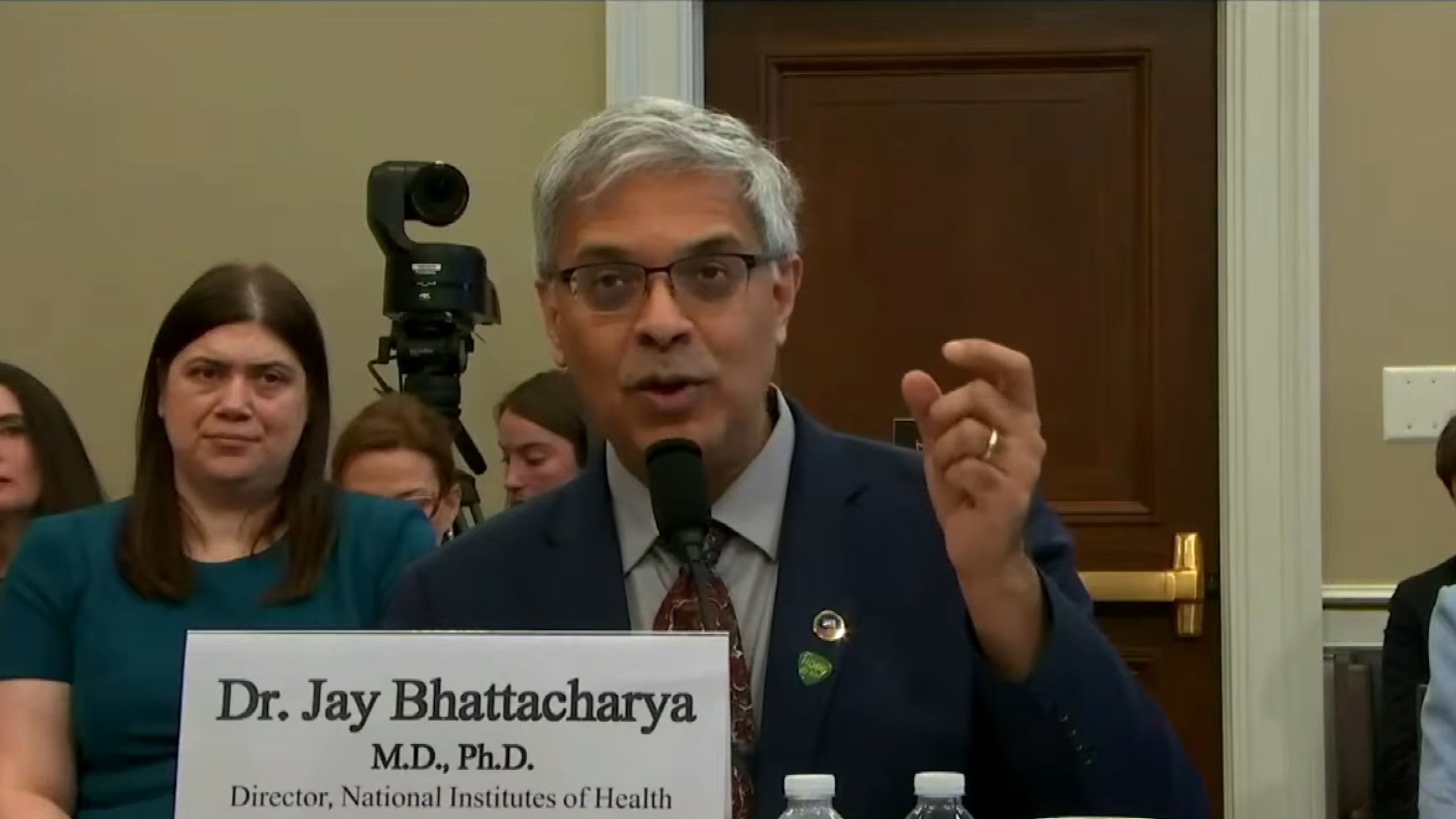
Okay. Good morning everyone. We'll get started and we'll gavel in officially. Happy St. Patrick's Day. Today, we have the honor to welcome Dr. Bhattacharya, the director of the National Institute of Health, known as the NIH, to this subcommittee. Dr. Bhattacharya was confirmed as the NIH director almost a year ago and since that time has been very busy implementing the administration's priorities to advance NIH's mission of conducting basic research and applying these discoveries to the improved human health.
(05:43)
Dr. Bhattacharya took the helm of the NIH at a very interesting time, inflection point. NIH funded research has made the United States the world leader in biomedical scientific research. And over the decades, this research has resulted in breakthrough cures, treatments, and other advancements that have saved or have improved countless American lives.
(06:09)
Unfortunately, however, the American public's trust in scientific institutions such as NIH was eroded significantly during the COVID pandemic. Restoring this trust has been a key goal under this administration and under Director Bhattacharya. Part of this is ensuring that Americans see the tangible benefits of the investments the federal government makes in the NIH supported research, rather than research findings that just sit on a shelf somewhere never to be seen or utilized. I look forward to hearing more about the NIH efforts to ensure that at the end of the day, NIH funded research is leading to measurable improvements in American's health. Science can be incremental, but in keeping when NIH's distinguished record of biomedical advancements, our research investments must ultimately translate to better health outcomes, such as new treatments, therapies, and cures that improve overall health.
(07:14)
Another part of restoring that trust is establishing trust in the research itself. So it is encouraging that NIH has been exploring ways to encourage the scientific community to validate or replicate scientific findings. In line with this, the administration's goal of making America healthy again, NIH has also renewed its focus on addressing chronic illnesses that affects Americans. We all know someone who is affected by heart disease, cancer, diabetes, or Alzheimer's. These diseases are costly for our overall health system, and they take a tremendous toll on individuals as well as their families. Increasing our understanding of these illnesses and advancing these new treatments and preventive medicines and cures will have a profound effect on every American.
(08:09)
As stewards of the American tax dollar, we have the responsibility to ensure the NIH funding supports rigorous science that produces meaningful research. In the FY26 year appropriations, Congress increased NIH's budget by $415 million, including important areas of research such as cancer, diabetes, and Alzheimer's.
(08:36)
We look forward to hearing from you, Dr. Bhattacharya, and working with NIH as it implements this funding in accordance with congressional intent. Dr. Bhattacharya, I look forward to continue to work with you personally and how you can work with us to productively advance our shared priorities that we have in NIH investments that will lead ultimately to better health outcomes for all Americans.
(09:06)
At this point, I'd like to yield to the ranking member, the gentlelady from Connecticut for her opening remarks. So Congresswoman DeLauro. Thank
Congresswoman DeLauro (09:15):
You so much, Mr. Chairman, and happy St. Patrick's Day to everyone. I think I've done my part in green today. I think worn everything in my closet that was green.
Speaker 1 (09:25):
Love your glasses.
Congresswoman DeLauro (09:27):
Thank you. Thank you. Thank you. Thank you. Well, I should have done the hair. You're right. Okay. That's what they said. I marched in the St. Patrick State Parade in New Haven, Connecticut, which is unbelievable. Thousands and thousands of people.
(09:40)
I want to welcome you, Dr. Bhattacharya, to your first House Appropriation Subcommittee hearing. I know you've testified before the Senate in the past. We appreciate you taking the time to be here and to answer our questions. I'm extraordinarily proud of the work that this committee was able to accomplish earlier this year. When we passed the full labor HHS and Education Funding Bill for fiscal 2026, we were able to come together on a bipartisan basis. Democrats and Republicans, we forged an agreement that passed with an overwhelming majority in both chambers. In that bill, we provided $48.7 billion for the NIH. That's an increase of $415 million above 2025. That includes 128 million more for cancer research, redoubling our efforts to treat, to prevent, and ultimately cure a class of diseases, which claimed the lives of over 1,600 Americans every single day, and which nearly took my life as well.
(10:44)
As so many of you know here, I am a survivor of ovarian cancer. I was diagnosed at the beginning of my career in Washington when I was chief of staff to Senator Christopher Dodd. It was a frightening moment, one that put my entire life into doubt. And I am alive today thanks to the grace of God and early detection, and the kind of advanced biomedical research that this funding makes possible.
(11:09)
Additionally, we were able to secure a $100 million increase for research on Alzheimer's disease, Alzheimer's related dementias, a $15 million increase for ALS research, and an additional $30 million above 2025 for the Office of Research on Women's Health. That is a 40% increase in funding.
(11:29)
While we in Congress were able to come to an agreement on our priorities and even include various provisions to strengthen our bills and ensure the money is spent in the manner that we prescribe, there still have been challenges. And over the last year, the Trump administration and Secretary Kennedy terminated hundreds of research grants simply because they related to racial health disparities or gender minorities or vaccine research. The administration seems to view these topics as dirty words and has sought to withdraw their funding not because of the actual impact of the research, but because of their own ideology, their own willingness to score political points. The research, this research which you do, is a public good. It must not be manipulated as a political weapon to serve a partisan goal. They fired thousands of NIH personnel, decimating our research capacity, interrupting, stalling or completely derailing crucial research into cures and treatments for deadly diseases, shaking down universities, freezing billions of dollars in life-saving research, projects with the potential to uncover cures and develop treatments that would benefit millions of Americans in order to extract ideological concessions.
(12:56)
In addition, this administration has sought to reshape grant making at the NIH by front-loading payment for multi-year research grants. The change in funding resulted in 2,000 fewer grants in 2025. If NIH continues to front load payments for multi-year awards, the number of new research grants in 2026 and 2027 will continue to be thousands below historical levels, despite the increase of $415 million in the 2026 Labor HHS bill.
(13:31)
The drop in new research grants dramatically reduces the success rate for research who apply for NIH grants. Across the NIH, the success rate fell from 18.5% in 2024 to 13% in 2025, a drop of 5.5 percentage points, or 30% in 2025. At the National Cancer Institute, less than 10% of research grants applications were funded in 2025. This research environment will force young scientists to abandon careers in research or move abroad to continue their important work. We can't allow those great minds to go elsewhere. We need those minds and the work to be done here and to deal with the discovery to cure.
(14:23)
In my own district in Connecticut, Yale University has 8% fewer students pursuing post- doctorate research. This is a reflection of both of the shrinking number of students choosing this line of work and will only be compounded in the future by the university's decision to admit fewer graduate students. It's a vicious circle that we are all the worst off for.
(14:47)
Even as this administration has chosen to overhaul its grant making progress, they have pushed out more than a dozen NIH institute and center IC directors, the very people who are responsible for implementing these changes. Removing qualified career officials and replacing them with, quote, "Acting directors." As we sit here today, there are 16 acting directors, meaning that more than half of the institutes are led by an acting director, and the combined annual budget of those institutes is nearly $24 billion.
(15:23)
This is one more example of the chaos and disarray that comes from the Trump administration and from Secretary Kennedy. It does not inspire confidence that HHS is working on behalf of the American people.
(15:38)
And lastly, NIH grant funding for fiscal year 2026 has dwindled to a trickle. NIH awards for this point in the fiscal year are at a historic law. I have heard from researchers across the country that over the last six months, there has been a marked slowdown in awards going out. The pace has diminished substantially, and many researchers are love to wonder how they can plan for the future.
(16:01)
Now, I understand that OMB finally approved NIH's apportionments last night. Yes, that is good news. I find it disconcerting that it took a congressional oversight hearing to prompt OMB to do what it should have done weeks ago. We are nearly halfway through the fiscal year and NIH's grant making is well behind schedule.
(16:25)
I'm asking you here today, Dr. Bhattacharya, to commit to accelerating that pass, I know where your heart is, on grant making at the NIH. You are a researcher, you are a scientist, you understand the value here, to reassure this committee that NIH grants will be awarded on scientific merit and not political ideology.
(16:45)
And now Dr. Bhattacharya, I recognize you are here today in your role as director of the NIH, but you're also director of the CDC. And I'll be honest, I don't believe it's possible to do both of the jobs at the same time. NIH and CDC are too important for part-time leadership. CDC is essential to the health of our communities, childhood immunization, food safety, chronic disease prevention. CDC experts work with state and local officials to make our country healthier and safer.
(17:15)
CDC has been hollowed out by Secretary Kennedy. He fired the last CDC director because she refused to rubberstamp his ideological anti-vaccine agenda. And he placed hundreds of CDC personnel on administrative leave, including staff who work on tobacco prevention activities, as well as staff who lead public health programs for individuals with disabilities.
(17:39)
I would just say with regard to vaccines that I applaud the ruling by the court yesterday, and that there is no authority to do what has been done and that we can turn it around.
(17:54)
I do not doubt your work ethic. I do not doubt all that you believe in. You are working overtime every single day. But I think you know, as we do, that CDC needs a permanent director whose sole priority is to restore the agency to being part of the crown jewels of research and medicine in this nation. And that's the NIH and it's the CDC and it is the FDA. And it's about public health in this country. And I thank you for what you do for public health in this country, your work now, but your past work as a scientist and researcher.
(18:32)
We'll have questions as we get into the hearing, but thank you for being here today. And thank you, Mr. Chairman, for convening this panel.
Congressman Aderholt (18:39):
Thank you, Madam Ranking Member. Dr. Bhattacharya, we look forward to your testimony.
Dr. Jay Bhattacharya (18:43):
Great. Well, thank you, Chairman Aderholt, ranking members DeLauro, members of the subcommittee. Have had the chance to meet with most of you. If I haven't, let's get together. And I want to thank you all for your continued support for biomedical research.
(18:58)
The NIH's mission is straightforward. It's to turn scientific discovery into better health outcomes for the American people. Over the past year, the NIH has capitalized on past investments and discoveries leading to concrete advances for human health. And I thought I'd just spent a couple minutes talking about some of those big advances.
(19:16)
In 2019, President Trump announced the Ending the HIV Epidemic initiative, where he predicted that we could essentially eliminate HIV from this country by 2030. I confess as a professor outside, I was skeptical about the timeline because I've been hearing promises for ending the HIV epidemic for 40 years. But what I found over the last year or two is that decades of HIV investments and basic sciences laid the groundwork for developing lenacapavir, a long acting antiretroviral agent, a new one. A single injection of lenacapavir, it lasts six to 12 months and offers near total protection against getting HIV, even if you're exposed. With that, plus the whole host of other widely used antiretroviral agents, we now have a real pathway to eradicating HIV from this country.
(20:07)
Last year, 40,000 people got HIV. By 2030, that number should be zero. And it's the result of NIH funded research, and that's something I'm working on across HHS to make that a reality.
(20:19)
Gene-based therapies have never ... A second, let me go to second examples. Gene-based therapies have never shown more promise than they do now. CRISPR-based editing gene editing has led to not just one, but two treatments for sickle cell disease, a painful condition that's burdened families for generations, especially African American kids. NIH funded research is built upon the same gene editing technology to deliver a personalized treatment to a child with a rare previously fatal disease. You might have heard about baby KJ. He has a disease that normally would have led to his death, and instead he has the promise of a long, healthy life thanks to NIH funded research. This treatment is catalyzed by the NIH Common Fund Somatic Gene Editing program, and it was administered through an IV, edited the genes in baby KJ's own liver to correct a lethal mutation.
(21:07)
Technologies that have recently been considered science fiction are leading to incredible advances. NIH supported investigators developed computer systems that can convert electrical signals in the brain to audible speech in real time, providing real hope for stroke patients. Other groups have developed tiny electrodes can be implanted in the spinal cord following an injury to both restore movement and touch. In ophthalmology, digital models of retinal cells now allow researchers to test therapies to simulate age related macular degeneration to model conditions before vision is irretrievably lost. We have real hope for patients as a result of these investments.
(21:45)
While novel cutting edge research is exciting, the treatments are often costly for patients. One lever the NIH can use to develop more cost effective treatments is drug repurposing. With an existing FDA approved medications found to have new therapeutic use, development timelines shorten and cost reduce. That's the NIH way to address the drug price problem in the United States. Recent NIH supported research suggests that a shingles vaccine, Zostavax, that I suspect many of you have already had, I had, is associated with reduced incidence of dementia. Even a 20% reduction in the incident of dementia can result in hundreds of billions of dollars of savings for this country. So you not only save patients, you also save the fiscal future of the country.
(22:28)
Another example is terazosin, a longstanding treatment for benign prostatic hyperplasia with emerging evidence suggesting that has a therapeutic potential for Parkinson's disease.
(22:37)
By building on existing therapies, applying gold standard science, research can accelerate patient benefits while using resources efficiently. And these are just a few of the examples of what can happen with sustained NIH investments in basic and clinical science.
(22:51)
While the promise of the NIH is strong, we must reflect upon policies and evolve with changing technology, and reform is already underway. A new office within the director will support rigorous analysis of the NIH portfolio to strengthen performance management, accountability, and promote reproducibility of our research. Because as Chairman Aderholt, you said, it's vital that the research that we do is reproducible, that independent teams looking at the same result find the same answer.
(23:15)
In concrete terms, I expect these efforts will lead to more value for every taxpayer dollar that the NIH is trusted with. Another example is new human-based models and emerging technology that will improve the translatability of research into human health and responsibly reduce animal research where scientifically appropriate.
(23:31)
One of my primary goals is to modernize how the NIH funds science drive innovation. Under my leadership, the NIH has implemented a unified funding strategy to empower institute and center directors to make clearer most consistent award decisions across our extramural funding portfolio. So many of my colleagues at the NIH, including in every single institute, have embraced this because they have empowered them to make scientific decisions to make the portfolio advance health for the American people rather than just produce papers that sit on the shelf. The new way of operating will reduce variability in funding practices and ensure that research investments are aligned with NIH priorities and a scientific opportunity, meeting the urgent health needs of the country.
(24:13)
We'll also develop strategies for greater geographic distribution of funding, which I hope to have a chance to talk about some of these ideas. I think I've talked with many of you already about them, and I would love to work with you all to make them a reality, because it's important for the scientific vigor of the country. The strength of American biomedical research lies in its rigor, its openness, its ability to deliver research results that endure. The NIH's responsibilities to ensure that federal investments in biomedical research produce reliable knowledge, measurable health gains, and lasting public benefits. I, and we at the NIH, remain committed to scientific excellence and careful stewardship of the resources and trusted to us.
(24:51)
Thank you all, and I'm looking forward to your questions.
Congressman Aderholt (24:56):
Thank you, Dr. Bhattacharya. I will begin. In January of this year. I was very personally pleased to see that NIH announced its new policy to end the funding of human fetal tissue from elective abortions NIH supported research. Instead, NIH will be shifting to supporting other promising research models. Can you talk about the potential of some of these cutting edge research platforms that have been developing, such as the tissue chips and the computational models and helping us effectively model research about human disease?
Dr. Jay Bhattacharya (25:36):
Chairman, so I should say when we made that decision to end fetal tissue research, we did a study of how many researchers were actually using the technology. And what we found is it was actually declining very sharply. And the reason is exactly as you said, the availability of alternatives. The new organoid technology is absolutely ... Frankly, it looks like science fiction to me. I went into a lab where they made a heart organoid that beats on its own. There was just a story about ... I don't know if any of you played the video game, Doom, you probably haven't played the video game, Doom. I used to play it. They made a brain organoid that can play the video game Doom. I confess I played it a long time ago, but I have not had ... I honestly, I wanted to go beat the organ, see if I could beat the organoid, but I'm old now. I probably wouldn't be able to beat it anymore.
(26:29)
But yeah, the point is that we have tremendous advances in biological technologies that can replace some of the older technology that were so ethically controversial. Instead of having a science that divides, we now have a science that unifies and also produces better outcomes for scientific advance and for the American people.
Congressman Aderholt (26:49):
Good. Well, that's good to hear. Well, thanks for doing that. And you've commented before about how concentrated NIH research how that is, and it's a large share goes to a readily small group of research institutions. And of course, it's critical that we continue funding those research that are meritorious, but we know that there are brilliant minds across the country at numerous research institutions. Can you talk a little bit about barriers in the existing system that prevent them from successfully competing for NIH funding and what opportunities you believe there are to expand access to NIH funding for those with proposals to conduct high quality research?
Dr. Jay Bhattacharya (27:35):
The key issue is about a third of our portfolio of extramural research goes to about 20 institutions. Amazing institutions, including the institution I used to teach at. But the problem is that there are so many great scientists across the country with great ideas that have, frankly, less of a chance of getting their research funded. I've now been across the country. I've been to Oklahoma, I've been to Alabama, I've been to Iowa, I've been to Wisconsin, to Arizona. I've seen the promise of biomedical research across the country. The reason this happens is the way that we support facilities in this country, so in order to get facility support, the indirect costs, you have to have great researchers at your institution that can win the grants. Then you get the facility support. But you can see the problem because in order to attract rate researchers to your facility, you have to have great facilities. It's a catch 22 that guarantees that we're going to underinvest in research across the country.
(28:34)
I can tell you from all of these talks I've given across the country and all these institutions, we have a country that is just poised to make the leap into the 21st century, to stay the leading biomedical research country in the world. But we have to make investments in those places outside of the top 20.
(28:56)
And I'll tell you just a few, like the Parkinson's treatment I talked about, I found from a visit to Iowa. There's a researcher there that's been focused on using a existing cheap drug for use for prostatic hyperplasia that potentially can prevent Parkinson's disease. Ideas that will fundamentally transform medicine. We need more than just a couple of biohubs in this country where all the activity happens. We need it across the country.
Congressman Aderholt (29:26):
Very good. Well, I commend you for doing that and thanks for your work on that and paying attention to others across the country.
(29:36)
In your testimony and in public comments, you've talked about the need to rebuild America's public confidence in public health and our scientific institutions, including NIH. I would argue that this is critical to maintain a broad lasting support for invaluable research supported by NIH. Can you elaborate a little bit more about any of the agency's recent efforts to restore trust in NIH mission and the scientific research it conducts and supports through other institutions?
Dr. Jay Bhattacharya (30:10):
I think you mentioned a couple of things that I think really are directly online with this. First, we have focused on reproducibility, to make sure that people, everyone, including scientists, doctors, clinicians, understand that the science we do actually is valid. The independent teams looking at it find the same answer. But ultimately what will restore trust is if we deliver research results that translate over to better health for people. Because I saw, during the pandemic, the trust in science dropped and trust in public health drop. It's because there was a sense that the science wasn't working for people. That was really the fundamental problem.
(30:48)
The long run solution is to restore trust, is to deliver better treatments, better cures, better ways to prevent disease, to solve the chronic disease crisis. And that to me is the main focus that I have at the NIH and also at the CDC while I'm still acting director.
Congressman Aderholt (31:05):
Thank you. Ranking Member DeLauro.
Congresswoman DeLauro (31:09):
Thank you very, very much, Mr. Chairman. And thank you for your testimony, Doctor. I just would say in terms of building confidence and trust in the NIH, in your remarks, you talked about HIV and where we are. We are on the cusp of eradicating. That is because of NIH and funded research. mRNA, the work that and the funding that we put in all of those years back allowed us to be able to move rapidly and quickly to deal with the pandemic. Immunotherapy, sickle cell. And you probably got more to add to the list. That is trust and the American people need to understand what you do and the remarkable, remarkable discoveries and cures you have that are there. They're there now. And that we shouldn't allow a view that we can't trust the NIH to prevail when the NIH is really saving lives and dealing with the therapies that are in front of us and being used to save lives.
(32:17)
Let me adjust. I did get this single shot. My arm was in desperate shape after that, but it's worth doing guys. I've heard from research institutions, as I said, about competitive grants as a trickle coming down. So you're a scientist. You have received NIH grant funding throughout your career. You know as well as anyone that researchers need confidence that funding is going to be there. Now that OMB has finally approved NIH's apportionments, can you commit to this committee that NIH is going to accelerate its grant making? And how long will it take for NIH to return to its normal level
Congresswoman DeLauro (33:00):
... of grant making?
Dr. Jay Bhattacharya (33:02):
We did this last year. The colleagues that I have at the NIH that accomplished really a remarkable task of, even despite all the disruptions, getting grants out the door, spending the entire allocation of the fiscal year 2025 money-
Congresswoman DeLauro (33:16):
You did that.
Dr. Jay Bhattacharya (33:16):
... that team is the world's best. I've been just honored to work with them. And direct answer to your question, yes, we will spend the allocation on excellent sciences here. And scientists that are listening, don't pay attention to the hype. We are in the process of identifying the excellent projects. The grants are already going out the door. I just got an email from the new NCI director, National Cancer Institute director, saying that they're accelerating their grant approvals and that scientists need not worry. We will get the grants out the door this year.
Congresswoman DeLauro (33:52):
Yes. Thank you. Thank you for that guarantee. Let me also ask a question about CDC and staffing, if you will. You heard my opening statement about the Secretary Kennedy hollowing out the CDC. Susan Monarez's gone because she refused to rub a stamp an anti-vaccine agenda. What are you going to do to return CDC experts from administrative leave? What actions can you take to retain CDC staff so that the recently enacted 2026 appropriation can be implemented again according to congressional intent and that CDC does not become just a grant making agency?
Dr. Jay Bhattacharya (34:39):
Congresswoman DeLauro, I've taken very seriously, the second hat that the president asked me to take as acting director of CDC. I've spent a lot of time the last several weeks since I've been appointed in Atlanta trying to assess what works working while CDC, what isn't working well, including revisiting potentially the hiring plan that's there at the CDC to address some of the gaps I think you're worried about. What I found is that there's a tremendous amount of professionals at the CDC that care deeply about public health.
(35:13)
I've sent this message to the CDC that I'm open to working with them. I was frankly very critical of the CDC during the COVID pandemic. And what I found was that there was a real openness to discuss things where there are disagreements within public health. Again, a real sense of professionalism there. I have, in the last several weeks, I started out in despair having to wear two hats that you're right. We shouldn't have the same person wear for all that long. But I've come out of it with this increasing sense of hope.
(35:46)
A concrete signpost of this is the way that the CDC has responded to the measles outbreak in South Carolina. So I've gave a message to the folks in South Carolina that it's really important to get their kids vaccinated for the measles vaccine. I've seen the folks in South Carolina welcome CDC aid and support for an epi aid there. It's just been partnering to watch how the CDC, when it's acting operating at full capacity, can work. And so I'm committed to making sure that whoever the next director is has a CDC that's working well.
Congresswoman DeLauro (36:20):
I have a quick question. I've got... Well, I don't have time, but I'm going to ask it. Dr. Bhattacharya, can you assure this committee that the decisions about how NIH research funding and awarding that funding will be based on scientific merit?
Dr. Jay Bhattacharya (36:36):
That alone. Scientific merit and the potential to actually improve the health and wellbeing of the American people.
Congresswoman DeLauro (36:46):
Thank you. And I yield back. Thank you, Mr. Chairman.
Speaker 2 (36:47):
Dr. Harris.
Dr. Harris (36:47):
Thanks very much. Good to see you, Jay. I'm just brief. Just make one comment about CDC and vaccines. Look, the bottom line is the COVID epidemic destroyed Americans' acceptance of vaccines because they were told things as absolute scientific truth that weren't absolute scientific truth. That's all I can say. So you got to look back at the last group for that, not the current leadership, the last leadership. With Anthony Fauci as the spokesperson for the NIH saying things that demonstrably were not true and sometimes contradicting things he said if you... That's where it came from.
(37:28)
Let me go to the NIH and one topic I've been talking about for 10 years. I was at Hopkins. You're at Stanford. We're two of the institutions with some of the highest indirect costs and some of the largest endowments. The announcement last year of the 15% level, you and I disagree. I think it should be around 30. The median, I think is 27 to 28% indirect costs. So if the median institution can do it with 27, 28, everybody should be able to do it with that. And I think we have to develop techniques to get to that. As I've mentioned before, I chair the agriculture subcommittee, and the agricultural resource service, statutory limit of 30%.
(38:07)
Obviously, there are plenty of grants, plenty of people, plenty of institutions who want to write a grant that can get 30% indirect costs. And as you all point out, the private foundations, including some of the largest ones like the Gate Foundations for academic institutions, 10%, and yet almost every academic institution loves to get those grants. So we have to solve the indirect cost because what I've suggested, we should take those savings from those institutions and work with them. They've come visited me and said, "Oh, we have some ideas at how we can decrease our..." "Good. I hope they've visited with you." No, they took you to court instead.
(38:43)
Stanford, which claims they were going to lose $160 million going to the 15%, actually had a $6 billion, yes, with a B, increase in their endowment last year. Their solution to this was not to work with you, it was to go to court. Shame on them. Shame on them for that because we could've taken all those dollars and channeled them into new young investigator grants, something I've been interested in for years, but we have to find a source for that because we can't just arbitrarily increase the NIH budget. We're at a $2 trillion deficit, $37 trillion debt. We have to get smarter at how we muster our resources. So I hope we can work together and I hope the institutions will work together so that we don't have to statutorily limit or put a limit on, again, similar to the limit that we have at the Agricultural Research Service.
(39:40)
We talk a little about nutrition research because this is very important. There's new data came out last week from the Nurses' Health Study II, which showed a 45% higher risk of early colon cancer adenomas associated with processed foods. That's pretty dramatic. And we've been scratching our heads saying, "Well, how come there's so much more early colon cancer that we're seeing, again, demographically, epidemiologically?" And here's a study that goes, "Oh, by the way, in that nurse's study, those are very good longitudinal studies, usually pretty good data." These are health professionals. They remember things pretty well. It's recall pretty well. 45% increase. And it's simple. They said it's sugary, drinks, processed snacks, and fast food. Okay, let's have at it because the childhood obesity rate, which is now 20%, same list of bad things.
(40:35)
What are we doing at the NIH? Because the nutrition research, and as some people said, it should be called the National Institute of Disease, not National Institute of Health, because we haven't done the research to promote health. And one of the ways we can promote health in this country, and thank goodness the USDA has taken a position on this with the SNAP waivers in many states that actually limit these processed foods. What is the NIH doing to augment the, or a plan or strategy for nutrition research to deal with these issues as soon as possible?
Dr. Jay Bhattacharya (41:05):
I mean, that's personal to me. Actually, the governor of Arkansas, when she applied for the SNAP waiver, cited a paper I published in 2010 that I thought everyone had forgotten. What we're doing at the NIH is we have a common fund program on ultra-processed food to investigate nutrition. We have a office of nutrition research that's coordinating our investments across the NIH. I mean, I think there's excellent science that still needs to be done. Our nutrition research doesn't have a great track record of reproducibility, but I agree with the entire league congressman there. It's the idea that we should give our kids sugary foods and that... I mean, it just doesn't... As a parent, you know it doesn't make sense. As a doctor, you know it doesn't make sense. I think science has backed that up. At the NIH, we're fully committed to make sure that science is as high quality as possible.
Dr. Harris (41:52):
Well, thank you very much. And yield back.
Speaker 2 (41:53):
Mr. Hoyer.
Mr. Hoyer (41:59):
Thank you very much, Mr. Chairman. And Doctor, welcome to the committee. I've been on this committee a long time, and there was a time when we took a week or two to hear from NIH. It's my understanding the only person we're going to hear from is you, and therefore, difficult to plumb each one of the directorates, which are now headed up by, as I understand it, by 16 acting directors, as opposed to permanent directors. Is that undermining their ability to do their jobs in a way that the American people would want?
Dr. Jay Bhattacharya (42:41):
No, sir. I mean, I've now worked closely with every single director at the NIH, including the acting directors, and they're world-class scientists, each and every one of them. But I'll say this, I have put in a process as rapidly as possible while still having a scientist lead the way and identifying the next directors, a process to hire in each of those slots. You're going to start seeing people being hired starting actually this month and moving forward. The key to me is making sure that it's really scientific merit and leadership ability that determines who those directors are going to be. And so it's scientists, the institute of directors themselves that are leading the charge. We have external groups. We heard from you all about the external groups being involved in that process. And then the scientists at the office of director, and then finally me. The secretary, of course, is statutorily the one who appoints it, but the recommendations I'm going to make are based on scientific leadership and scientific capacity for hiring each of those positions. You'll start to see a promise. Those are hired in.
(43:47)
But I do want to say-
Mr. Hoyer (43:48):
Local positions... Political inclinations will have no part in that selection?
Dr. Jay Bhattacharya (43:55):
Not as far as I'm concerned, the process I put in at all. I mean, for me, those institute directors, they're making their scientific judgment about with the research directions in their field for the country. It's too important to lead to politics.
Mr. Hoyer (44:07):
Thank you, Mr. [inaudible 00:44:09]. Mr. [inaudible 00:44:10], there's been a reduction of 22% in the compliment of personnel at NIH. What adverse impact has that had on NIH and its abilities to protect the health of the American people?
Dr. Jay Bhattacharya (44:22):
Well, I'll just say, if you look last year where the cuts were the biggest, the NIH identified an amazing portfolio of science. We spent all the entire allocation of funds for 2025. We have a hiring plan to make sure that we are even... We have all of the holes we identified or filled this year, and we're working as hard as we can to fill them. I have to say, it has been amazing to watch my colleagues at the NIH step up in very challenging times to do the work that their mission in life is to do, which is to identify.
Mr. Hoyer (44:54):
Is it your position that the NIH, as you found it, have analyzed it, was 22% overpopulated in terms of personnel?
Dr. Jay Bhattacharya (45:02):
I mean, I'd never been NIH director before last year, so it's been a learning experience for me, but I'll say I have found professionalism across the NIH to address this. The hiring plan that we have, I think whatever turbulence we had last year, is designed to fill that turbulence so that we don't have the turbulence in the future.
Mr. Hoyer (45:18):
Well, I agree with that. Thank you very much for trying to eliminate DOGE's catastrophic actions that happened in the federal government. NCI had a total of three opportunities, this posted three opportunities this year, down 96% from the previous average. It has funded two grants so far, $2.6 million out of the $7.352 billion that this committee set aside for NCI research grants. What impact is that going to have?
Dr. Jay Bhattacharya (45:54):
Well, Congressman, I have to say that I talked with the NCI director just this morning asking, just because I'd heard about that, of course. And what he told me is that, first, that report is lagging. It's not true. Right now, I think he said there's 22 new grants that are out the door, 150 grants that are about to be out the door, a full portfolio of 1,100 continuing grants that are, again, about to be out the door, that he assured me that we are on track to spend all of the NCI budget. And he expects that the success rate this year will be at least 10% on grants. It's unfortunate-
Mr. Hoyer (46:33):
My time is very limited. I apologize for that. The success rate, what is the average pay line for the institutes at this point in time?
Dr. Jay Bhattacharya (46:43):
I mean, we fund roughly about eight to 10% of the grants that we used to do.
Mr. Hoyer (46:46):
When I was first on the committee, Doctor, it was somewhere in the neighborhood of 25 to 35%, and all the scientists that testified before our committee indicated that that was about the right pay level for good science, which you referred to in your-
Dr. Jay Bhattacharya (47:03):
Congressman, I say the... Last year, before I got in, actually, the previous year, there were people that were putting in 60 grants, grant applications. The denominator-
Mr. Hoyer (47:13):
I'm talking about the pay line across all of the-
Dr. Jay Bhattacharya (47:15):
No, I'm saying the total number of applications includes a lot of AI-generated content. We've taken action to try to address that. The pay lines are, of course, a numerator and a denominator. So I think the 35% was a different era for what the denominator looked like. It's a little harder now to say the pay line determines exactly if we got all the opportunities. I mean, what you're suggesting, and it's true, that there's a lot of great ideas that don't get funded, but it's not because, by looking at the pay line, you determine that. It's by looking at grant application, by grant application, doing the scientific review, which is what the professional staff of the NIH does.
Mr. Hoyer (47:51):
My time has expired. Thank you, Doctor.
Dr. Jay Bhattacharya (47:53):
Thank you.
Speaker 2 (47:53):
Mr. Moolenaar.
Mr. Moolenaar (47:59):
Thank you, Mr. Chairman. Dr. Bhattacharya, thank you for being with us this morning. And I appreciated your comments about the scientific research leading to better health outcomes for the American people. One thing I wanted to bring to your attention, that in 2023, dozens of patients across seven states contracted tuberculosis from infected cadaver bone grafts. And a constituent and a sister of one of my own staff members, Shandra Eisenga, passed away as a result. At the funeral, the family asked me to be sure this never happened again and that their family member's death wouldn't be in vain.
(48:43)
What I'm asking is, could the NIH research TB testing for cadavers... It appears that there's not a good test available. And so when someone gets a bone graft, it could be contaminated with TB and it could be a dental treatment. It could be a back surgery in this case. I don't think the American people are aware of this vulnerability, and it appears there's not a good test.
Dr. Jay Bhattacharya (49:12):
Congressman, thank you for bringing that to my attention in our conversation yesterday. First, we have a great set of researchers who do work on TB and I would love to offer to the constituent that you have to come talk with us so that they understand what the problem is. There are a lot of actually potentially viable tests that could be used, I think, again, funded by NIH research to validate them. I'd be very, very happy to work with you to make sure that we do that.
(49:45)
Just broadly, I think for... It's really important that NIAID, the National Institute of Allergy and Infectious Diseases, work on diseases that people actually have that pose threats to Americans. And you're absolutely right, the TB is not gone. It still poses threats to Americans, and we're working very hard on antimicrobial agents to address TB that avoid the resistance problems. There's a whole host of suites of investments we made. Delighted to work with you and your staff to get these folks together.
Mr. Moolenaar (50:18):
Thank you very much. I appreciate that. Now, just to shift gears a little bit, what has the NIH done to stop Chinese Communist Party linked or the People's Liberation Army, the Chinese military linked entities from benefiting from taxpayer funded biomedical research?
Dr. Jay Bhattacharya (50:39):
When I joined the NIH, I found a GAO report concerned very much about exactly this, that the NIH investments for foreign collaboration didn't have sufficient oversight. So we've implemented a system where foreign collaboration, not with countries of concern, but with other countries can still happen, but where the NIH has much more direct oversight and auditing responsibilities over the foreign entity. So if you're working with a UK researcher, wherever the UK researcher is, their institution has to have some... We have to have the capacity to work to audit that institution. That's a new system that was a lot of brouhaha over at the beginning, but now we can have a much more secure foreign collaboration than we had before.
(51:19)
As far as countries are concerned, I don't think we should be funding research collaboration concern at all. I'm working with OSTP at the White House to make a formal policy, but the NIH, we reduce those investments substantially, because I think if you can't trust and you can't do the auditing that we are able to do with domestic institutions, you shouldn't be funding those institutions at all, especially countries that are not particularly friendly to the United States.
Mr. Moolenaar (51:45):
Do you think that universities and research institutions should have to certify that they've in some ways screened for ties to the PRC military or sanctioned entities before getting NIH funding?
Dr. Jay Bhattacharya (51:58):
I think that universities should have much stronger policies, absolutely. Whether certification exactly is the right way, I'm happy to work with Congress, and the administration is really quite focused on this as am I. I think we're still working a process so that we could be... I mean, the trade-off is we want research to continue. We don't want burdensome regulations to stop research, but we have to make sure that we don't fund research that's budgeting the capacities of our enemies.
Mr. Moolenaar (52:28):
One of the other areas I wanted to ask you is the supply chains for our medicines. It seems that a lot of the medicines now have APIs from China, the starting materials from China and India, and there's a certain vulnerability there. And I know that China is also focusing a lot on their biomedical research and they're enhancing their capabilities. What can we do to stem this tide to make sure we aren't dependent on other countries, as well as we continue to be the leader in biomedical research?
Dr. Jay Bhattacharya (53:06):
Well, the administration at large, this is a major, major focus to make sure that American manufacturing for all those elements of the supply chain exists in the United States. What the NIH can do is we can support research to reduce the technical cost of production of some of these elements. I'll give you one example. The cell-based therapies, including one that I talked about earlier for baby KJ, a lot of that manufacturing happens in China, right? So you have a cell that's taken out of a patient, the ship to China, the gene editing happens in China and the ship back to the US, and Lord knows what the intellectual property protections are there. We're investing in research for reducing the manufacturing costs so that it's possible to do it in the United States and be competitive for these cell therapies. The NIH's role in this is to invest in research to make that possible.
Mr. Moolenaar (54:03):
Thank you very much. And Mr. Chairman, I yield back.
Speaker 2 (54:05):
Pocan.
Mr. Pocan (54:09):
Thank you very much, Mr. Chairman. And thank you, Doctor, for being with us. I just want to echo what Mr. Hoyer said when we had an event recently and met a bunch of the institute heads. It was very interesting. They're also excited about the research they're doing and have them come before the committee or some other venue would be awesome, I think, to do that. Thank you so much for coming to my office and coming by previously. I'm glad you're in the position you're at and I like you. If you need me to rescind those remarks, I will, but I mean them. I want you to know that because I think you're doing a very good job and NIH is really important to my district with a big University of Wisconsin, Madison, a world-class research university.
(54:54)
I want to share something this morning. I had a meeting. It wasn't related to NIH and someone mentioned that their grandchild, seven years old, has a rare unidentified disease. They went to Madison, they went to the Philadelphia Children's Hospital, and the NIH even had them come by. So I just want you to know, I'm getting feedback that wasn't even intended to be there about what the NIH is doing. So thank you for that.
(55:16)
I ask this of every NIH director, and if you don't have the answer, get back to me, but was there a single drug in the last year that was approved that did not have NIH support?
Dr. Jay Bhattacharya (55:27):
If there is one, [inaudible 00:55:28] stunned the heck out of me. I mean, NIH research is the basis of almost every single important biomedical advance in this century and much of the last century. Can I just talk about cystic fibrosis? There's a treatment for cystic fibrosis now, an effective one, again, based on NIH-funded research. Again, it looks like science fiction to me because when I was a medical student, cystic fibrosis was a death sentence. You die of respiratory disease at some point in your 20s. Now they're going to live long lives. We're going to start having to worry about aging cystic fibrosis patients. We turned it into a manageable disease. It's amazing.
Mr. Pocan (56:08):
No, that's awesome. Is there anything we can do to help you when OMB or DOGE after last week... I couldn't been more upset watching the DOGE bros videos online about how stupid how they did everything on cuts. The fact that they take this long, it does affect some folks back home when the money maybe isn't coming as quick or they don't know it's for sure coming. Anything we can do to help you? Some of us are on FSGG, because I'd rather have you in charge than those two idiots I saw on videos.
Dr. Jay Bhattacharya (56:39):
I mean, Congressman, I'm trying to stay out of politics as much as I possibly can because I think science is what the NIH should be always about. I think watching over the last year, Congress and the administration, you all together decide what the investments in the NIH are. My job is to make sure that whatever the process ends up with is spent on good things for the American people.
Mr. Pocan (57:01):
We'll try to keep getting that message out to us vote, but I'd rather have you making these decisions and getting this taken care of.
(57:08)
You talked about the really great progress with the new drug on HIV. However, I'm concerned because of shutting down USAID, we're not getting that around the world. And as much as this optimistic goal is to get rid of it by 2030, if we're not getting rid of it worldwide, there's going to be a problem. Are you concerned at all about, by leaving the World Health Organization, by getting rid of USAID, what does this mean about that 2030 deadline and maybe for other pandemics as well?
Dr. Jay Bhattacharya (57:36):
Yeah. Let me just talk about WHO because with my CDC hat, I've started to have some involvement and learn about this. A lot of what the WHO does is actually what the CDC does. We have relationships with 60 different countries where we have teams on the ground managing epidemics in different countries. And so, really, the WHO relies on CDC. I know the State Department... This is not something I've been involved with. I know, but that they've been involved in developing more bilateral relationships with other countries. The WHO, we can get into this, but I think for many reasons, it actually is healthy in many ways for the United States to say, "Look, we're going to build an alternative," because I think it challenges the WHO to do better. Ultimately, I think the goal is a better world health public health system.
Mr. Pocan (58:26):
Sure. So the specific question, are you concerned, though, without having USAID on the ground in these countries, the drugs aren't getting out there, is 2030 still realistic? I mean, there's something good on the horizon, but not if you don't get it out there.
Dr. Jay Bhattacharya (58:39):
Yeah. Congressman, I think first, at the NIH, I've been focused on the US because I think just 40,000 people had got HIV last year. That's too many, right?
Mr. Pocan (58:48):
But are you concerned that if we don't have something around the world, that that could delay that timeline?
Dr. Jay Bhattacharya (58:54):
I think most of the transmission is domestic. It's not imported in the US. I'm concerned, of course, about HIV transmission outside the US as well. And I think there's been a lot of progress already made. I think my understanding is that the US State Department is still operating some of those programs for USAID. This is not my area. And I think that there's still a desire to do that, to make those countries, but to have those countries more able to do this for themselves rather than relying just on the American expertise. Americans will always help. We are responsible for the investments that led to lenacapavir, for instance. I know there's a lot of desire to make these drugs available. So it's hard to say 2030 for the world, but I think it's feasible in the United States and we should try to aim at that.
Mr. Pocan (59:45):
No, thank you so much, and I yield back.
Dr. Jay Bhattacharya (59:46):
Thank you. Thank you so much.
Speaker 2 (59:47):
Ms. Bice.
Mr. Pocan (59:48):
Thank you.
Ms. Bice (59:48):
Thank you, Mr. Chairman and Ranking Member. And thank you, Dr. Bhattacharya, for being here today and also for your visit to Oklahoma. We had an incredible opportunity to spend the day together and you were able to see what's happening in Oklahoma at OU Health, as well as the Oklahoma Medical Research Foundation. So thank you and your staff for taking the time to come out and see the great work that's happening.
(01:00:10)
I wanted to first start by asking you about the current status of NIH grant awards. Are there any outgoing bottlenecks that you're seeing? And if so, what are we doing to try to address that?
Dr. Jay Bhattacharya (01:00:22):
I mean, I don't see a bottleneck now. I mean, I think we have our funding for the year. You all are very generous actually with the NIH last year. My job is to make sure every single dollar goes out, and it will go out by the end of the year on excellent science. A lot of the concerns, it just seems like political noise to me. It's not reality. The reality is my colleagues at the NIH, some of them are behind me, they're working very hard to make sure that they identify excellent research and that we spend every dollar on research that will advance the health of the American people.
Ms. Bice (01:00:54):
Speaking of excellent research, you and I have talked a lot about how those grants are actually given and that we wanted to try to look at funding projects that are not on the East and West Coast, that are in the Midwest, in the middle part of the country. And so can you talk a little bit about the changes that you would like to see to grant funding from NIH and how it could impact states like Oklahoma?
Dr. Jay Bhattacharya (01:01:16):
Well, first, we want research funded with good ideas, no matter where they are. It's not right to let great ideas wither on the bind just because they're in Oklahoma rather than in Boston, right? I want great ideas funded in Boston. I want great ideas funded in Oklahoma. The system as we currently have it essentially puts a thumb on the scale that hurts places like Oklahoma. In order to get the facility support, to build the facilities, all the investments I saw at Oklahoma, they should be multiplied, but it's hard because it's harder to get the NIH facility support unless you have scientists that win the grants. The facility support is tied to winning the grants, but in order to attract the excellent scientists, you have to have great facilities. It's a catch 22 that guarantees a concentration of funding.
(01:02:04)
The solution is competition for the facility support separately from the grant project ideas, essentially introduce competition that would address Congressman Harris's concern about what the right level of indirect funding should be because you have competition. If Oklahoma can provide an excellent square foot of lab space morning expensively to some other institution, they should have a leg up in getting it and then fund the researchers so that ... Essentially, have like a portal where institutions compete to get the researchers that have the grants.
(01:02:37)
You would superstar science around the country. Wherever the ideas are, we'd fund it and the facilities would compete for researchers. They'd be like NCAA athletes, where they'd be competition for scientists. You know the name of the scientists that are doing this, not just the name of the footfall, not that you should know the names of footfall, they're pretty amazing, but you should also know the name of the scientists as well.
Ms. Bice (01:03:00):
I think we have our own concerns about NIL and the transfer portal, but we can talk about that in a later meeting.
Dr. Jay Bhattacharya (01:03:05):
I probably shouldn't get into sports economics. That's another thing.
Ms. Bice (01:03:08):
Let me ask, what new initiatives does NIH have to address the greatest health challenges of the nation right now?
Dr. Jay Bhattacharya (01:03:15):
Well, I think the biggest health challenges have to do with the chronic disease crisis, type two diabetes, obesity, a whole host of conditions that Americans are all too familiar with. Some of the research on ultra processed foods, some of the research on putting nutrition research on a rigorous, reproducible basis, a whole host of research on simple questions. So many Americans are now using GLP-1s. How do you use them appropriately? Is it possible to get off of them without regaining the weight? There's a whole host of nutrition-related questions. Metabolic health-related questions I think are at the center of why Americans life expectancy is flatlined and we're investing in all of that.
Ms. Bice (01:04:04):
Fantastic. And is there a plan or a timeline in place to begin filling the open director positions at NIH? I know you've been very busy trying to get around the country, visit our states, engage with us, but talk a little bit about the open positions you have currently.
Dr. Jay Bhattacharya (01:04:16):
I mean, I've been working really hard at that. We've had two to four interviews of... When the interviews reach my level, they've gone through this long process of scientific vetting. Normally, that takes years. We've accelerated it. Scientists across the NIH, especially leaders of the NIH, have identified the best candidates. They reach my level. I'm frankly the bottleneck. I can only interview two to four candidates a week. But you're going to start to see people appointed this month and you're going to start to see a steady flow of those. So hopefully the next time I come in front of you, won't be 16... And I'll tell you, many of the acting directors, I just want to speak up for them. They've done heroic things and they are amazing, excellent scientists in their own right. I think many of them will have a chance to apply and if they're the best candidate to move the acting from their role. I'm taking it very, very seriously.
Ms. Bice (01:05:09):
Thank you. And thank you, Mr. Chairman. With that, I yield.
Speaker 2 (01:05:13):
Frankel.
Ms. Frankel (01:05:13):
Thank you. Get a little closer here. Mark's helping me. Thank you, Doctor. And I know we had a conversation. I wanted not to ruin your reputation. You do sound thoughtful, like a thoughtful scientist. I hope you don't prove me wrong. But a couple things I wanted to go over. We talked about Florida had 75 grants totaling $700 million canceled. It included grants... We have an older population, but the grants, Alzheimer's, dementia, fall prevention, those were canceled, some of the vaccine prevention. I'm going to get back to you. You gave me a list. Just to let you know, I want to get back because I still don't understand why
Ms. Frankel (01:06:00):
... And they were canceled. I'm going to go to the next question. That wasn't a question. I understand this. You believe in vaccines. What you don't believe in, I guess, is mandates. And I think what you told me was that there are many countries around the world where there's very good vaccine rates, but they're not mandated. And so, I did my own little research on that. And here's what I discovered, which is somewhat different than what's going on in this country, which was that vaccines are free and offered in routine care. They're given in convenient locations. You have reminder systems reducing missed opportunities. And it's basically you have a healthcare system, where people actually get coverage. So that is... I was just wondering your comment on that.
Dr. Jay Bhattacharya (01:07:00):
I mean, I think the routine childhood vaccinations are tremendously important for childhood health. The US has, of course, a very different, sort of a little more fragmented healthcare system. I think about half of our kids are on Medicaid. The CDC helps Medicaid systems to have access to the vaccines, for childhood vaccines. To me, the key thing is not... I mean, those access problems, of course, are things we ought to address, but the key reason why we're seeing drop in vaccination uptake by children is because of public trust, drop in public trust and public health. The reason why you see high vaccination rates in places without vaccine mandates outside the US is because public trust and public health is just very, very high. That's the thing we have to address in this country. And I believe mandates are counterproductive for that. I think you might work in a short run, but in the long run, ultimately, you build groups that say, "I don't know why you're forcing me to do this."
(01:08:02)
Instead of reaching out to people and saying, "Look, this will be good for your health of your children."
Ms. Frankel (01:08:09):
I think one thing is confusing is that some doctors in high places seem to throw a doubt on actually vaccines themselves. But let me move to something else. I hope that's something you could work on, because I think our system of delivering healthcare makes it, especially we're going to see more Medicaid cuts. We've lost the Affordable Care Act tax credits. It's going to make it harder and harder. And we have crazy immigration policy that thousands of kids are not going into clinics. So it's making it very hard for kids to get vaccines. There has been a history in this country of underinvestment in women's health research. I'm a little concerned with this anti-DEI craziness, and I just want to make sure that this isn't going to result in a loss of research for women health.
Dr. Jay Bhattacharya (01:09:05):
I mean, I don't know how you make America healthy again, unless you make American women healthy again. So I just was at a great event, HHS event, essentially reiterating the commitment that the HHS has to women's health. I'll tell you personally, it's absolutely vital that the NIH investments in women's... I know you worked on, for instance, representation in trials. NIH is making sure that every trial has women enrolled in it. Prostate cancer aside, but every single trial has women enrolled in it. That's not DEI. That's just how you answer basic biological questions to make women healthy. The focus on research on menopause, on research on... Actually, even diseases that are common to men and women, heart disease, right? Often manifest differently in women. NIH research identified that, identified ways to address that. I mean, I personally am deeply committed to women's health. I have a daughter. I have my wife.
Ms. Frankel (01:10:09):
I have one more question. This is a women's problem and it's probably a men's problem too. Any research on sleep? How do people get to sleep?
Dr. Jay Bhattacharya (01:10:21):
Yes. The answer is yes. We have a lot of research on sleep. I wish I could apply that to my own life, but that's another matter.
Ms. Frankel (01:10:28):
Well, I think the rest of us would like that too. But is there anything promising?
Dr. Jay Bhattacharya (01:10:33):
I mean, I think there is. So there's lots of advances in understanding sleep apnea and getting better answers to people about sleep apnea, for instance. That's a major cause of poor sleep. There's a whole host of sort of basic biological investments in understanding circadian rhythms, the biology, underlying sleep disorders, basic science there, huge amounts of investments across, and as well as there's something called the Brain Initiative at the NINDS that maps the human brain. In detail that, again, seems like science fiction to me, that's going to lead to huge advances in our knowledge about sleep.
Ms. Frankel (01:11:12):
All right. Thank you. Yield back.
Speaker 3 (01:11:13):
[inaudible 01:11:15]
Dr. Jay Bhattacharya (01:11:17):
They are. How could they not be?
Mr. Simpson (01:11:23):
Thank you, Mr. Chairman. I apologize for not being here for your opening statement. We've all got hearings going on. I'm chairing the Interior Appropriations Committee. We've got a hundred tribes coming in and testifying today and tomorrow and stuff, but I stepped out for a few minutes, because I did want to come up and talk to you for just a second. I've been a longtime supporter of NIH and I always tell people that it's the nation's best kept secret. Over the years, I've learned so much about the exciting and groundbreaking research NIH scientists are doing to improve the health and quality of life of all Americans. As you know, and we talked about this when you came into my office, and thanks for coming into my office and having a discussion. The Institutional Development Award program, and I apologize if you've already gone through this in your testimony or if someone's asked the question, was created to help build research capabilities in states that historically received lower levels of NIH funding and helps ensure that it is not limited to a handful of well-funded institutions on the coasts, essentially.
(01:12:17)
And I was excited about your comments on what we're doing to try to make sure that those institutions can build the research capabilities, so that they can apply for these grants and spread it out across the country. Do you want to talk about that for just a minute?
Dr. Jay Bhattacharya (01:12:32):
Sure. First, the IDEA program is a fantastically important program, and for making sure that I think there's 23, 24 states get access to NIH money that traditionally it's been more difficult. But it's compared to the scale of the opportunities in those states, I think is smaller than ought to be. The key thing is fundamental structural reform, so that we have competition across institutions in different states, essentially introduce a market for those facilities supports separately from the grants, and then have the grants funded, the researchers funded, and the institutions then compete to bring the researchers to their institution to do the research. Essentially create a much more sort of competition friendly approach to where the research gets done. I've been across the country, I've talked to researchers all across the country. There're great scientists everywhere, and we just need to make sure we have a mechanism that they have a chance of having NIH support for their research ideas.
Mr. Simpson (01:13:33):
Thank you. [inaudible 01:13:35] country and actually improve research by spreading it out across all of our institutions. You might guess that my second question has to do with something called fluoride, having been a dentist for like 23 years. The National Institute of Dental and Craniofacial Research has pioneered the use of epidemiology and preventative approaches to demonstrate that dental cavities are an epidemic disease and community water fluoridation is a safe, effective, equitable, and economical way to prevent and reduce tooth decay. In your recent comments on a podcast episode you hosted with the acting director of the NIDCR, you highlighted balancing fluoride's proven caries prevention benefits with emerging data on exposure variability and potential risks. What specific research agenda has NIH established to objectively assess those exposures and which institutes are leading and coordinating that work?
Dr. Jay Bhattacharya (01:14:37):
Well, it probably wouldn't surprise you, it's NIDCR that's leading that work. The dentistry is a tremendously important part of the NIH. The key thing that's there, the key policy issue is fluoride is essential for oral health, but too high level, there's been... And it was actually NIH funded meta-analysis suggested this, that too high level exposure can have impacts, neurological impacts and developmental impacts. So the key thing then is making sure the right dose is delivered in the right way. That's the key public health thing. The NIH's equity, and this is identifying what those two high doses are. It's a small part of the country, very, very small fraction of the country, but we want to make sure that that part of the country isn't overexposed, if you will.
Mr. Simpson (01:15:24):
And in some parts of the country, we have naturally fluoridated water that's too high.
Dr. Jay Bhattacharya (01:15:28):
Yeah.
Mr. Simpson (01:15:28):
And so, we got to reduce the fluoride in the water supply.
Dr. Jay Bhattacharya (01:15:32):
Exactly. So let's bring the fluoride sort of policy in line with what the data is starting to show. And the NIH equity, and this is not to pass legislation, but to make sure that whatever that we end up deciding is based on excellent science. What's too high a dose? What impacts are there? How do you mitigate them?
Mr. Simpson (01:15:53):
I look forward to working with you. I think you're going to do a great job there. And I agree with the previous speaker. If you can find a way that I could sleep more than two hours at a time, I'm on your side, man. Whatever we do.
Dr. Jay Bhattacharya (01:16:02):
Nice to meet you.
Mr. Simpson (01:16:03):
I appreciate it.
Dr. Jay Bhattacharya (01:16:04):
I'll do my best.
Mr. Simpson (01:16:04):
Thank you.
Dr. Jay Bhattacharya (01:16:05):
Thanks.
Congressman Aderholt (01:16:06):
Mrs. Watson Coleman.
Mrs. Watson Coleman (01:16:08):
Thank you, chairman. And thank you, Mr. Secretary. I appreciate your answers. I appreciated the discussion that we've had. Federal law requires the NIH to increase diversity in biomedical workforce. This includes increasing recruitment of women and other members of disadvantaged communities, underserved communities for NIH training grants. Do you agree with Congress that diversity in the scientific workforce is essential to your mission?
Dr. Jay Bhattacharya (01:16:40):
I mean, I think it is absolutely essential to our mission that we do research that improves the health and wellbeing of minorities populations, and minority scientists and female scientists are a fundamental part of that.
Mrs. Watson Coleman (01:16:51):
Thank you. Thank you so much. Do you have any concrete steps that you're employing now that would help to recruit more diverse scientists?
Dr. Jay Bhattacharya (01:17:01):
I mean, I think the key thing is empowering early career scientists with great ideas to have access to NIH funds, so that they can do their work. A lot of those will have a-
Mrs. Watson Coleman (01:17:11):
Do you all have any kind of a program that's sort of identifying where the underserved are and trying to get them on board? That's really what I'm looking for.
Dr. Jay Bhattacharya (01:17:22):
Yeah. I mean, so for instance, American Indian native communities, I think that there's a big demand or desire for the native communities to be included in the research projects themselves. I mean, I think the key thing is we have to address the health needs of the country with the very best ideas, wherever they come from.
Mrs. Watson Coleman (01:17:41):
Right. Thank you, sir. I just have so many questions, because you do support healthcare, access to healthcare at every level, to every community. And so, what I'm concerned about is this whole issue of DEI. What is the NIH's definition of DEI and how exactly does it recognize this when you recognize at the same time that there's a diversity in need of workforce? I believe you would think that there's a diversity in need in clinicals. Even though you talked to my colleague here about women, we do recognize, I believe, and you're a scientist, so you know better than I, that certain things don't work for certain different races the way you intended them to. So it's important that minorities of all kinds are included in clinicals and experimentations, and things of that nature. So exactly how do you sort of reconcile this, what you believe is scientific and necessary with this whole issue of DEI and the administration's disrespect for it, just devaluing of it.
Dr. Jay Bhattacharya (01:19:03):
I guess I want to make a distinction, right? So the NIH, if we don't do research that improves the health of minority populations, we're not accomplishing our mission. It is vital. We're not accomplishing our mission. We have to do research that improves the health of minority populations, right? So I don't think there's anybody that disagrees with that. Research that is not rigorous, not as overly politicized, that doesn't actually have a chance of improving minority health, I don't want to fund it. I just want to-
Mrs. Watson Coleman (01:19:29):
I don't want you to fund it.
Dr. Jay Bhattacharya (01:19:29):
Yeah.
Mrs. Watson Coleman (01:19:31):
Because I don't think that that's the issue and folks like me who are concerned about diversity, equity and inclusion, we're assuming that the entity that's coming before you or any other secretary has value, that the people who are bringing it have been educated and prepared. We don't understand why it's summarily dismissed when we decide what we're going to award grants to and how do you reconcile that in your field, in particular, recognizing that diversity is essential for saving lives.
Dr. Jay Bhattacharya (01:20:15):
I think that the key thing is, to me, is I don't want to fund... The line. You want a line between DEI and not DEI. My line is research that has no chance, politicized, and has no chance of actually improving human health. I don't want to fund that.
Mrs. Watson Coleman (01:20:31):
Yeah, I agree with you.
Dr. Jay Bhattacharya (01:20:32):
So that's my line though.
Mrs. Watson Coleman (01:20:36):
Let me just ask you this question, because this is a very interesting response. Since you believe that, and I honest to God believe you believe it, how does that put you instead, in good stead with this administration, that doesn't understand what you are presenting as an issue of whether or not something is of value, that they are assuming that it isn't a value if it includes diversity, equity, and inclusion? So how does... Are you welcomed to the White House these days?
Dr. Jay Bhattacharya (01:21:12):
I've had nothing but like... I mean, the president appointed me. Let me put this way, not everybody's a scientist. Not everybody understands these kinds of distinctions when it's applied to scientific projects. I've gotten tremendous amount of support and trust within the administration to make this distinction, because actually I think science actually unites us. That's really the fundamental thing, right? Everybody wants research that improves everybody's health. We don't want to leave people behind in the research, right? And I found that on the Republican side, I found that on the Democratic side. It's the one thing that should unite us. A lot of the concern about DEI at the NIH has been over politicized things that I don't think have a chance of improving health. So I've drawn the line as best I can in a non-political way. Does the research have a chance of improving the health of people? If yes, then it has a chance of being funded.
Mrs. Watson Coleman (01:22:10):
I thank you for that, because I believe what you're saying, and I appreciate it. I also want to say one thing about the whole NIH, the old HIV issue. I believe that we can eradicate HIV. I think that we're making a big mistake when we say to a country like Zambia, "I give you the HIV medicine if you give me access to the minerals."
(01:22:33)
Doctor, I don't think you can eradicate HIV unless we do it worldwide, because people travel and they're exposed and don't even know it. So I just need to place that on the record, how disgusting that even notion is. But I really appreciate having this time with you today and thank you, Mr. Chairman.
Congressman Aderholt (01:22:54):
Ms. Dean.
Ms. Dean (01:22:57):
Thank you, Mr. Chairman. I thank you, Chair Aderholt. I thank the ranking member DeLauro for convening this timely hearing. And I thank you, Dr. Bhattacharya for being here today and for your work and for... I can see many of your able team behind you. To begin, I am excited to see what progress our nation scientists can make with a strong FY26 appropriations bill passed earlier this year. That is something we need to do. As you have written in your testimony, one of the things you want to do is to restore trust in science at NIH. I'd like to talk to you specifically about restoring trust in regards to your other role at CDC. What I'm getting at is, unfortunately, OMB still has CDC on a short term appointment that will expire literally Thursday. Are you working to release CDC's funding, so that full activities can be initiated? What are you doing about that?
Dr. Jay Bhattacharya (01:23:58):
Yes, I've been at CDC for about three weeks. So it's been education for me personally. I've gone down to the CDC Atlanta a whole bunch of times to meet with CDC staff. As I said, tremendous amount of professionalism. We're working with folks to make sure that the CDC's activities continue without any interruption. I mean, I personally am committed to making sure that happens.
Ms. Dean (01:24:21):
I thank you for that. I'm worried about political interference in grant making and the agenda setting, and some of the conversation here has touched on this. I want to focus on the role of the administration in NIH's decision making process. I understand, we understand that OPM is revising performance management criteria to include elements like, "adherence to administration priorities." Job postings for roles at NIH are asking applicants to describe how they would, "help advance the president's executive orders and policy priorities." I don't know about you, but I'm pretty sure you swear an oath to the constitution, not to any one president's executive orders, like the executive orders that came across January 25th of last year that would have shuttered PEPFAR, USAID, and all the rest, and did shutter many, many things. Doesn't it worry you that those are becoming hiring criteria?
Dr. Jay Bhattacharya (01:25:22):
Well, I think as far as I'm concerned, what the president has tasked me to do is make sure the United States is the single best country in the world in biomedical research.
Ms. Dean (01:25:29):
I'm asking you about the criteria that people applying are reading. Doesn't that concern you that the chilling effect that that would have, the lawlessness that it would have? Anybody working in this government, we swear to the Constitution, not to any one man.
Dr. Jay Bhattacharya (01:25:44):
I mean, I agree with you. I'm not swearing to any man. I'm telling you what the-
Ms. Dean (01:25:48):
Can you push back on that kind of language and applications?
Dr. Jay Bhattacharya (01:25:50):
So let me just tell you empirically what I've seen. I've seen a lot of great people apply to the NIH for the physicians. The president's priorities are to make sure that... And this is what he tasked me with, is to make sure that we have the very-
Ms. Dean (01:26:04):
Literally, it says his executive orders. Not just his priorities.
Dr. Jay Bhattacharya (01:26:07):
I mean, we're implementing his executive orders, but I don't think that's inconsistent with excellent science.
Ms. Dean (01:26:14):
Shuttering of USAID. I wish we could-
Dr. Jay Bhattacharya (01:26:16):
That's not the NIH.
Ms. Dean (01:26:18):
... get you a third hat, and maybe you'd go into state-
Dr. Jay Bhattacharya (01:26:19):
I only get one hour sleep.
Ms. Dean (01:26:21):
... and you could open USAID. Yeah, we have that sleep study that we got to work on also. So I just hope you will push back on that. And I hope you will encourage this administration in this next go round to not only reopen USAID funding, but to improve it and to increase it. I find it ironic that we started this conversation today around eradicating HIV here by 2030. Well, this is a global problem. It is not isolated to any single continent and the administration doesn't share your dreams.
Dr. Jay Bhattacharya (01:26:52):
I don't know if that's true actually. I mean, just I think that the idea of getting rid of HIV in this country, that's President Trump actually articulated 2019.
Ms. Dean (01:27:00):
That's America first.
Dr. Jay Bhattacharya (01:27:02):
But then also-
Ms. Dean (01:27:02):
I want HIV to be eradicated around the world and we were well on our way to it. Let me move to something else. Last thing, because this involves a dear friend of mine. Parkinson's disease, which I think illustrates some of the broader disorganization happening across the agency. I have a friend with Parkinson's disease. His father suffered from Parkinson's disease and ultimately died of it. He was diagnosed in the last couple of years, and we haven't really improved too many measures around research and cure, and treatment of Parkinson's disease. And it affects 1.2 million Americans and their families. In 2024, Congress passed the National Parkinson's Protection Project. One element of this initiative is the Parkinson's Advisory Council. Its report to Congress was due January the 2nd. We've not received it. I'm particularly troubled by the fact that the advisory council hasn't even been announced yet. So Dr. Bhattacharya, when can Congress expect the report and when will you announce members of the council?
Dr. Jay Bhattacharya (01:28:10):
Parkinson's disease is major priority for the NIH and for me also. I mean, I think as I said earlier about Terazosin, there's a whole host of real scientific opportunities. I know the report's delayed. We're working on it. It should be sometime in the next couple of months, I think. I mean, I can't promise the exact timeline, but it's a priority mine to make sure that that's... I think that's a CDC report I think you're talking about though.
Ms. Dean (01:28:32):
I believe it is.
Dr. Jay Bhattacharya (01:28:33):
Yeah, not NIH, right?
Ms. Dean (01:28:35):
Maybe you could take a look at that and give us an actual timeline. And how about announcing members of the council? When would you do that?
Dr. Jay Bhattacharya (01:28:42):
Yeah, I'm working on it. So this is one of those things, where I just arrived at the CDC three weeks ago. I'm trying to figure out what the backlog is. So that's something I'm focused on.
Ms. Dean (01:28:49):
All right. I pray for your health and your sleep. Thank you very much. I yield back.
Congressman Aderholt (01:28:54):
Mr. Harder.
Mr. Harder (01:28:56):
Thank you so much, Mr. Chair. And Director Bhattacharya, thank you so much for being here today. The NIH has long been the engine of American biomedical research, driving discoveries that have saved millions of lives, affected all of our loved ones. And I think what you've heard today is a bipartisan consensus that the work you are doing is incredibly important. I think that there's increasing threats to our dominance in biomedical research as we look internationally. We've seen China really rise in their scientific research over the last couple of years. They're now leading in more highly cited scientific publications than we are. Their leadership share in a lot of really exciting, innovative areas is growing. And I think there's an opportunity to improve on some of the NIH processes to try to make sure that groundbreaking, transformational research is happening in the United States first.
(01:29:52)
I think about trying to make sure that we are moving beyond some of the constraints of the typical NIH process to do things like use large interdisciplinary teams, use ample funding to really curate data sets and computational resources that are maybe greater than any one lab would be able to do, and give sustained funding over a really long time horizon. I've worked on a bill that we've discussed on this topic called the Launching X-Labs for Breakthrough Science with Congressman Obernolte to do that, trying to give the NIH the ability to give long-term large grants to interdisciplinary teams advancing transformational research. I'd love to get your take on if you think there's a role for that and what we can do to try to make sure we're advancing priorities like this.
Dr. Jay Bhattacharya (01:30:41):
Congressman Harder, I mean, I really enjoyed our time to talk about this, because I think those kind of innovative ideas in accelerating the NIH's investments in early career researchers in the high risk, high reward science, it's going to take a different way of doing things than we normally do things. And I'm delighted to work with you and your staff, and others who are similarly minded, because as I've said to folks, the opportunities are incredible. There are so many American scientists with great ideas, great training. And I also agree entirely with your characterization of the Chinese challenge, right? The Chinese biomedical research capacities have grown tremendously, in part because of American investments. So working on making sure that the United States remains at the forefront of biomedicine is going to take a lot of new thinking. I know you're working on X-Labs, on early care researchers. I'm very, very interested to work together on all of those opportunities.
Mr. Harder (01:31:38):
Well, thank you. Appreciate your leadership on that. Another thing that I want to talk about is AI. There's enormous amount of fear on AI in many communities, data centers coming in that folks are concerned about, potential job losses. When you talk to a lot of the labs, sometimes the response you'll get is it's all going to be worth it, because we're going to cure cancer. Whatever you think of the costs, I want to focus on how do we cure cancer? How do we actually make sure that we're getting the benefits from this AI revolution to try to make sure that we're harnessing it towards curing Alzheimer's and cancer, and all these other diseases? Talk a little bit about the state of AI research at NIH or using AI to further biomedical research at NIH, and specifically whether or not an office coordinating those efforts would be important at NIH and what we can do to help further those coordination attempts.
Dr. Jay Bhattacharya (01:32:31):
I mean, if you want to go inspired and excited, go talk to some NIH scientists about AI. I mean, every single aspect of the biomedical research process, you're seeing AI investments that are just incredible. Everyone's heard about protein folding in AI, but there's like gene annotation, drug discovery where you look for drug targets based on using AI predictions that are just accelerating the process of discovering and testing new drugs at scale. Clinical investments to make sure that when you go talk to your doctor, they're looking at you and not at the EHR, because the AI is like doing the summary, helping the AIs to help radiologists do better at interpreting images. All of these require research investments. How do you make sure the AI is doing it as well as you can? And the NIH is making research investments for a while on these.
(01:33:24)
You're absolutely right. The coordination of them, that's the hard part. We have investments all across the NIH and you can go... I mean, I've had the great fun of going and talking to all these scientists, telling me about their investments. It's like great geeky fun. It makes me want to have a third hat as a AI scientist, but that's another thing.
Mr. Harder (01:33:43):
Would an office be helpful or what could be helpful?
Dr. Jay Bhattacharya (01:33:45):
I do. I think office would be tremendously helpful. Something to coordinate across. I've been looking at what DOE is doing in Project Genesis. It's inspiring actually, but a lot of that we actually have at the NIH. We just need to make sure that the scientists are talking to each other and that we're putting the investments in the right place.
Mr. Harder (01:34:01):
What could we do to make it go 10 times faster than it's going today? Knowing that it's already going quickly and there's lots of great efforts, how do we move faster?
Dr. Jay Bhattacharya (01:34:07):
I think working together on how to get that coordination to work well across the NIH, get scientists to talk to each other, get access to sort of high capacity computing. Again, we make a lot of investments that already, but making sure that if a scientist is sitting there with a great idea, they have access to a computer, a supercomputer, so they don't have to like wait. I think that things like that would really, really, really supercharge our investments.
Mr. Harder (01:34:35):
Well, thank you. We'll make a request for that office in the appropriations process and look forward to working with you, and thank you for the work you do.
Dr. Jay Bhattacharya (01:34:42):
Thanks.
Congressman Aderholt (01:34:45):
Okay. Thank you. What we'll do is we're going to go a second round, but we're going to limit to one question just so, because I know the hour's getting late. We're going on our second hour now. So I will go ahead and start, but we'll just do one question and we'll go on down the line. So Dr. Bhattacharya, I want to ask about situations that I, and I think a lot of my colleagues are also concerned about, and it's in situations of the past which Congress has provided increases in one institute for a specific initiative, but NIH use only some of that new funding for the initiative and took the rest of the money from the budgets for their initiatives. Two examples of this was with the implementing of maternal health and pregnancy outcomes vision for everyone, which is called in the IMPROVE Initiative, and the Undiagnosed Diseases Network under the National Institute of Neurological Disorders and Stroke.
(01:35:49)
Cross-agency collaboration is important, but this practice of using multiple institutes budgets to meet the funding level provided to one one institute for a specific activity is not what Congress actually intended. Can you commit to ensuring that NIH in the future carries out funding provided for specific activities based on both the letter and the spirit of the congressional direction?
Dr. Jay Bhattacharya (01:36:20):
Absolutely, Congressman. But I will ask of you all also on that. So when there's a great scientific opportunity arising for that collaboration, then we can work together to make sure that whatever language you have doesn't stop that from... Encourage that has to happen regardless. I mean, I'm absolutely committed to following the directives of Congress, because you all get to decide what we spend. You're all elected, not me, but let's work together to make sure that we don't miss any opportunities.
Congressman Aderholt (01:36:51):
Yeah. Okay. Thank you for your commitment on that. Ms. DeLauro.
Congresswoman DeLauro (01:36:56):
Thank you, Mr. Chairman. Dr. Bhattacharya, the concern about the loss of new research, '25, '26, '27, due to the decline in research grants. The loss of young scientists in early stage investigation who see success rates of 13% are opportune... They're looking at how they change their careers or where they go with this. What's your concern about that phenomenon? And let me just say this committee added a new general provision to limit the amount of funding that can be obligated through this front loaded funding mechanism. Do you commit to abiding by the limitation that we've done? But your view as well as... It's real. The loss of young scientists and early stage investigations.
Dr. Jay Bhattacharya (01:37:52):
So let me start with the second. So yeah, I'm committed to following exactly what you all told me to do. So whatever that limit is. For just very quickly on early career scientists and on front loading grants. Sometimes for early career scientists, what you need is a front loaded grant, because they're building their lab and so they can't wait till year two or three to get the money to build the labs. So it's scientifically justified to have it front loaded. And I've been focused on when we're front loading to make sure that it has that scientific justification. I share your concern about early career scientists. I think I've been watching the data now for 20 years, 30 years. It's been harder and harder for early career scientists to get their grants funded. Once upon a time, in the 1980s, you were in your mid 30s when you got your first large RO1, large first grant, and now you have to be in your mid 40s.
(01:38:42)
You have to do one, two, three postdocs. And I'm thinking of how to fix that as NIH, because the NIH has undertaken lots of activities to try to fix that. It just hasn't worked. There's a few ideas I have, and I'd love to talk with you and the rest of
Dr. Jay Bhattacharya (01:39:00):
... folks on the committee for how to do that, that I think can finally address that, because it's ultimately a science culture issue, right? You have people unwilling to take risks on really promising ideas just because someone's an early career scientist. We have to change that. We have to say, and I've done some things at the NIH already, like this unified funding strategy that allows institute directors to say, "I don't need to make sure that every single grant produces a paper." I don't care if it produces a paper. But, the portfolio as a whole has to advance health, and that means that they have to take scientific risks, intellectual risks, including on early career scientists in order to fulfill my directive to them to make a portfolio that can advance health.
Congresswoman DeLauro (01:39:47):
I suspect we need to have the resources to do that as well, which is what the purpose of this committee is.
Dr. Jay Bhattacharya (01:39:52):
Of course, I'm very happy with the resources, but to me, even whatever the resources are, we have to have policies in place, incentives in place to solve this cultural problem that's led to the position where early care scientists feel like they don't have a chance. It's vital to the future of this country that we do that.
Congressman Aderholt (01:40:08):
Dr. Harris.
Dr. Harris (01:40:11):
Thank you very much. Yeah. And I'll follow on a little bit along with that because I'm reminded by my staff that back in 2014, when I was on this committee for only a year, I wrote an opinion piece in the New York Times called Young, Brilliant, and Underfunded.
Dr. Jay Bhattacharya (01:40:25):
I read that piece.
Dr. Harris (01:40:27):
Well, they're still young, brilliant, and underfunded.
Dr. Jay Bhattacharya (01:40:30):
I know, but I was younger then.
Dr. Harris (01:40:31):
But, it's 12 years later. Perhaps we need a new way to look at these things. And again, I was an NIH funded researcher. I know how it goes. I'm going to particularly ask you, the Howard Hughes research is totally different. You fund the research, you don't fund the project. And in a rapidly advancing technology age, that makes a lot of sense, because you'd spend months writing a grant, and then it goes through the review process, might take a couple ... By then, technology is totally different. Has there been any thought to go along that line to say, "Look, we're going to fund the researcher, because" ... And if you identify, and I know I had them when I was doing work, you know who the really smart young people are, who if you just gave them a leash long enough and funded them, they had the potential to be a Nobel Prize winner at some point.
(01:41:26)
Are we stuck in this ... Like you say, average RO1 age is 44 now. That's just to remind people, that's the average age at which someone makes a Nobel Prize research discovery. We're not even funding them until that age. You got to start earlier if they're going to peak at age 44. And again, and I've talked about this. I'm a little older than 44. I don't have ... These younger folks have brilliant ideas. They don't have the blinders on you get, and you know you've done research. You get blinders after a while, like, "This is the way we're going to solve this problem." And then, a 25-year-old, and the guy's name could be Steve Jobs comes along, and says, "No, no, no, there's a different way." And the NIH bureaucracy doesn't recognize that right now. How do you get around it? Is it a method of funding a researcher, instead of a institution, and things like that?
Dr. Jay Bhattacharya (01:42:23):
I think that's a really good idea. We have some mechanisms like that, the NIH, like this MIRA grant, and I've talked to folks at Howard Hughes, having that idea where you fund early care scientists and give them an open warrant to follow their ideas. But then, the flip side of that is if it didn't work out at the end of the five, seven years, or whatever, then you have to go on to the next person. I'm looking at how we might be able to do more of that. The intramural program at the NIH has the capacity to do that, and some degree already does that.
(01:42:59)
The broader problem really is, and I think the, I'm sorry, the broader solution to this problem is that we have to have a culture where intellectually risky projects are, people feel like they can fund them, they can take a flyer on them because it tends, as you say, Congressman Harris, it's early career scientists that tend to have those challenging new ideas that don't look like they're going to work, but my God, if they do, you cure type two diabetes, right?
(01:43:24)
And so, I think if we start giving the institutes a warrant, and this is something I've done with this unified funding strategy, a warrant to identify and fund high risk, high reward ideas, just as a matter of natural course, we'll automatically get the early care scientists invested and supported. Happy to work with you on any of that. I remember the reading that 2014 op-ed, because I wrote on science to science. I thought I was really delighted that there's folks in Congress that were focused on the issue. And I see lots of folks are.
Dr. Harris (01:43:57):
Well, thank you.
Dr. Jay Bhattacharya (01:43:58):
Yeah.
Congressman Aderholt (01:43:58):
Okay, Mr. Spokane.
Mr. Pocan (01:44:00):
Thank you, Mr. Chair. Director Bhattacharya, I'm going to be the third person then to talk about young researchers, because this is a big issue. And certainly, with the university, we had a UW sophomore come to talk to my staff about the importance of biomedical education support for the NRH. And they said that they're considering changing their major because quote, "The STEM field is just not a stable career path right now." We also have a friend who does brain research, gets NIH grants. She's thinking about getting out of the field completely, and this is all directed at what happened last year. I got my record number of calls, 500 a day when DOGE and OMB were just stealing funds that Congress had approved. It wasn't NIH's fault, but they were stealing funds, and people have this opinion. What can we do about the policy, instability, and funding uncertainty that's driving so many of these young researchers to reconsider a path in what they're doing?
Dr. Jay Bhattacharya (01:44:53):
Well, I've been going around the country again, and everywhere I've gone, I've told people, and especially I've been talking to young researchers, that the United States is still, and will remain into the 21st century, the single best place to do biomedical research in the world. I think 85% of all public funding for biomedical research, if you include all of the other countries and all the foundations, is NIH funding. If you want to try your ideas out, you're early care researcher and you have amazing ideas, this country is still the single best place to have any chance to try it out. And for young researchers who are listening, there's no policy instability that's going to affect your career. You can hear in all the members of Congress you heard today, a real commitment to make sure that we remain the leading nation in the world in biomedicine. And for ocular researchers, you're going to have much more opportunities than you have had in the past.
Mr. Pocan (01:45:46):
I hope you can get on the field and talk about this more, just because last year, we did see funds being stolen, and stopped, and frozen, and it had an impact on those researchers, so it's out there, and that's only a couple stories I'm sharing. I wish you were the face instead of Russ Vote or some DOGE bro, because that really has hurt us, but I yield back.
Congressman Aderholt (01:46:08):
Christine?
Ms. Dean (01:46:09):
Thank you, Chairman, and thank you for indulging a second round of questions. I want to go back to the notion of restoring trust, trust in our institutions, trust in the things that you are leading. I want to note for the record that just yesterday, a federal judge blocked Secretary Kennedy's cutting of vaccines schedule recommended for every child, that he likely violated federal procedures in reducing vaccines, whether it was flu, rotavirus, hepatitis A, hepatitis B, meningitis, RSV. I was glad to see the court's ruling. I assume it will be appealed. But, what my constituents want, and what I want as a grandmother to seven children is to be able to trust in our institutions. Right now, we have to tell people, "Go to your pediatrician, because we are in such a shakeup." My question for you goes back to where we were talking before. Can you confirm that political ideology is not being used to screen or evaluate new institute and center directors, that you are in the process of hiring?
Dr. Jay Bhattacharya (01:47:20):
Absolutely. I can confirm that. For the NIH hiring process, it is science first. It's scientists at the institutes that are doing the first level of interviewing. It's along with external groups. It's career scientists at the office of director that's doing the second level screening, and I'm doing the third level of screening. The people I recommend, my personal interview screen is, are they scientifically capable? Are they demonstrating real leadership in their field? And do they have a vision, a passion for new ideas in their field?
Ms. Dean (01:47:59):
Thank you.
Dr. Jay Bhattacharya (01:48:00):
Those are the three criteria I'm using.
Ms. Dean (01:48:09):
I thank you for that commitment. I yield back.
Congressman Aderholt (01:48:09):
All right. Before we close, let me recognize Mrs. Darwin to make any closing remarks.
Congresswoman DeLauro (01:48:12):
Thank you so much, Mr. Chairman. Several comments today about lack of confidence in the NIH or CDC. I just want to say very, very clearly, I have the utmost confidence in the NIH and CDC, and I ticked off some of the areas in which you have led the way, and then you added to that, cystic fibrosis. And I've had very close friends who lost two children to cystic fibrosis, so I have confidence in the scientists, and the career staff at the NIH and the CDC. I thank you particularly for your commitment to this committee to accelerate the NIH grant making. This committee is going to be vigilant. And if you run into resistance in following the committee's guidance, let us know. You need to let us know. This committee will be champions for NIH research, but I'm also focused on NIH's new unified funding strategy, and I'm going to be following very closely to ensure that funding is awarded for the highest quality of science.
(01:49:11)
And we repeated that over, and over, and over again today. It is not awarded based on politics or political ideology, so thank you for your commitment and that effort. We expect the President's budget proposal will be released in about two weeks. My hope is that the President's budget does not repeat its proposal to cut NIH's budget by $19 billion. We've rejected that cut. The Congress did, this committee did. We will continue to reject cuts to NIH research, because what you do is life-saving. It is that lifeline to Americans in the world people have mentioned. We need more investment in NIH research, and that was my commitment. And I think that this committee has demonstrated, and historically has demonstrated that. I can go back to John Porter of Illinois who chaired this committee, whose goal was to double the funding for the NIH so that you can do that work. We all deal with a lot of things. In my case, it's infrastructure, roads, bridges, helicopters, airplane engines, but nothing that we do is more important than what you do in terms of saving lives. Thank you. Thank you, Mr. Chairman.
Congressman Aderholt (01:50:27):
Thank you, Ms. Darwin. And I want to thank you, Director for coming before us today. And I commend your efforts, and of the Trump Administration to address longstanding issues that have been at the National Institute of Health. Limiting the use of animals and research, focused on building the research base across the nation's universities, and replicating studies are not controversial, and reforms that are overdue. Bold actions under the Trump Administrations are making necessary reforms to grow and to build on biomedical infrastructure. Thank you for your work. I think it's been a very good hearing today. I think your comments were very well-received, and we look forward to working with you to advance these efforts, and moving forward. Thank you very much.
Dr. Jay Bhattacharya (01:51:15):
Thank you.
Congressman Aderholt (01:51:16):
We're dismissed.