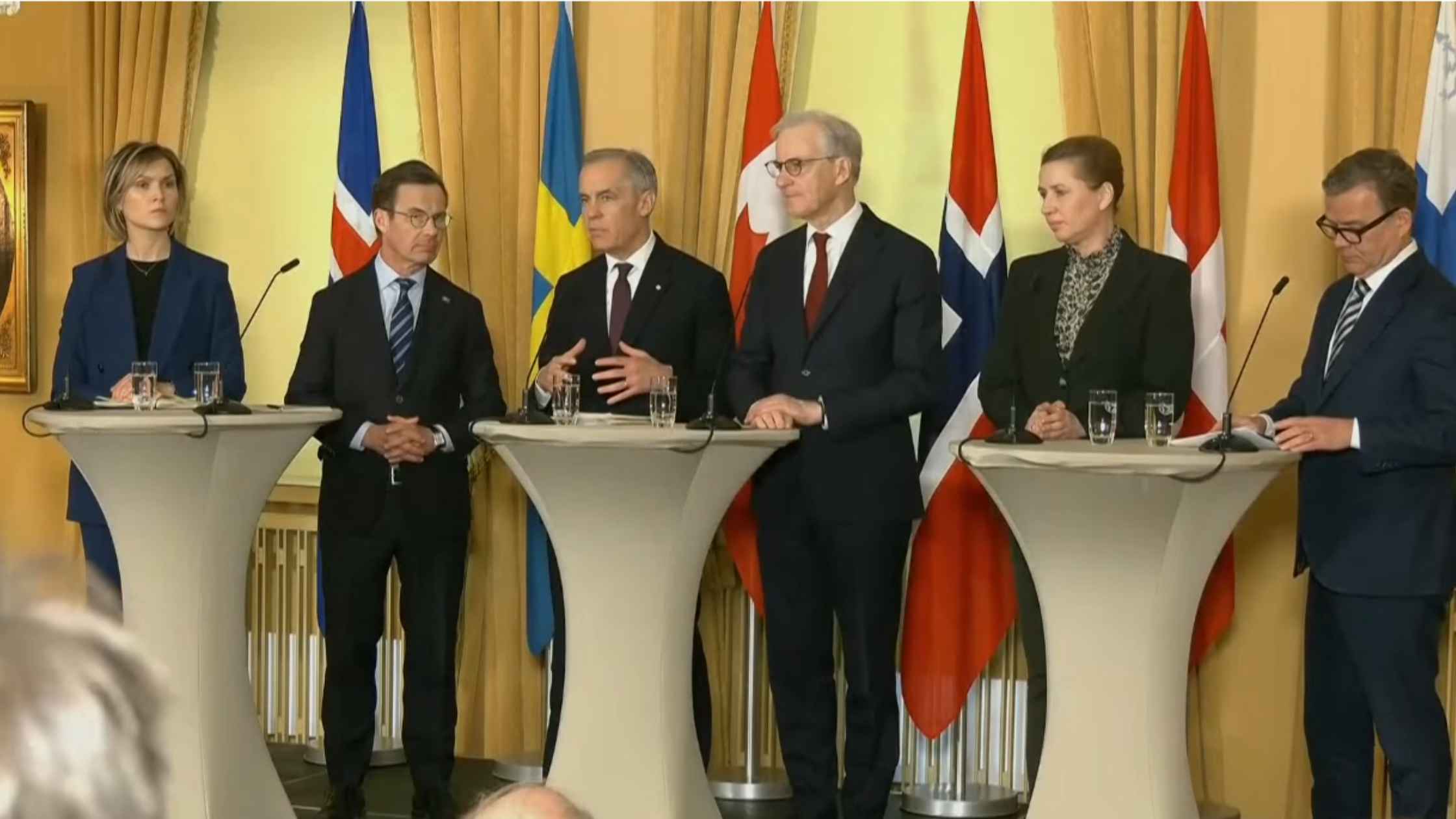
Jonas Gahr Støre (00:00):
... Work going on in WTO in the United Nations. And we believe that these six countries are not weak countries. They are strong countries in terms of their values, in terms of their determination. And we are ready to follow up from discussion you have seen in our common statement today. These are also critical issues for developing modern green economies that take advantage of new technologies, development in space, artificial intelligence. So we have a lot we can do together. So thank you colleagues for being here. And Prime Minister Carney, for you.
Mark Carney (00:34):
Prime Minister Støre, colleagues, [French 00:00:41].
(00:56)
It's been a very effective group, and I thank you for bringing us together. A group of countries that share common purpose, shared values, and a capacity to work with others. The capacity to work with others, this grouping, informal grouping, but also in more formal groupings such as the Arctic Council, in NATO, in the Coalition of the Willing. And this is important because we are all facing a growing list of challenges, challenges to Arctic security, challenges that come from the changing nature of warfare, challenges which interact with changing technologies and conflicts, both actual and virtual that are moving closer to all of us.
(01:43)
As Prime Minister just said and as our discussion reflected, security is moving beyond traditional areas of energy security, food security, and of course defense security into core strategic capacities driven by the changing nature of our economy. So critical minerals, artificial intelligence, space, all aspects of digital infrastructure. And what we see as our economies is, and our expertise is a large degree of complementarity between us. And so what we've been discussing is how we can work together in order to increase our own strategic economy, increase our resilience, but also to solve immediate issues in terms of jobs, employment, and do so in a way that is consistent with our values on sustainability. So it's core to Canada's strategic interests to work together with this group. [French 00:02:54]. Thank you very much. I'll pass to colleagues.
Speaker 1 (03:16):
The next speaker is the Prime Minister of Denmark, Mette Frederiksen.
Mette Frederiksen (03:18):
Dear Mark, it's great to have you among us, the Nordic leaders. And I have to say to you that you have a lot of supporters in our countries. The speech you gave in Davos, I have never experienced anything like this. I mean, people in Denmark, and I guess the same goes for the rest of the Nordic countries have been talking about, they have been reading your speech. And I don't think I have ever heard so many reflections on a speech from a colleague, as I have heard about your speech in Davos. And it is because you show leadership. You were talking about how democracies can work together and that we have to connect even closer, in this world where the old world order is gone and it will probably not come back. So we have to build something new and it has to be a world order that is built on the values that we represent, the leaders standing in front of you today.
(04:14)
I am very grateful, I have to say this, for all the help we have received in the Kingdom of Denmark, Greenland and Denmark. We have had a totally unacceptable pressure from U.S. and the U.S. president. It has been very difficult for the people in Greenland to experience this. And one of the reasons why we have been able to stand firmly on very common values that you have to respect sovereign states, that you have to respect a people's right for self-determination is because of our good friends in the Nordic countries, in Europe, but also with partners outside, especially you, Mark. So from the bottom of my heart, thank you for that.
(04:59)
Now we have to continue our work. We are deepening our corporation in the Arctic region. It is important. We are deepening our corporation also militarily in our own region, not only the Arctic, but also more locally in the northern part of Europe. It's going in, I think, in the right direction. But with everything going on now, with the war going on in Ukraine, U.S. unfortunately lifting up sanctions on Russia, a war in Middle East, countries like ours have to stand together. We have to stick together and we have to work together. And that is what we have committed ourselves to do once again. So thank you Jonas for convening this meeting today.
Speaker 1 (05:44):
And the next speaker is the Prime Minister of Sweden, Ulf Kristersson.
Ulf Kristersson (05:48):
Thank you so much. And I do agree. And it's really great to see the most Nordic country outside the Nordics in a meeting in the Nordics. So really great to see you here. I think it's a sign of our time, honestly, that the Nordic Five and Canada is working so well together. It proves your case. Middle powers make big difference. And it goes for geography, obviously, the Arctic not least, Ukraine, the rules-based, world order, technology and trade. So I think we have so many similarities and we need to be more proactive and be more forward leaning. And I think that has been the theme for this meeting today. So thank you so much.
Speaker 1 (06:27):
The next speaker is the Prime Minister of Finland, Petteri Orpo.
Petteri Orpo (06:30):
Thank you very much. And thank you, Jonas, for hosting this excellent meeting. And Mark, great that you are here today among friends. It is important for Finland to further deepen cooperation with Canada and our fellow Nordic countries. We are committed to building our partnership. This meeting is an important step on that path. We are united by our shared values and our northern location. We are committed to supporting Ukraine. We are committed to strengthening Arctic security. We need to have a strong NATO in the Arctic. Canada and the Nordic countries have made significant investments in our capabilities in the Arctic. With our shared Arctic expertise, we can also support our allies to develop their capabilities. Thank you very much.
Speaker 1 (07:24):
The next speaker is the Prime Minister of Iceland, Kristrún Mjöll Frostadóttir.
Kristrún Mjöll Frostadóttir (07:29):
Thank you very much. So nice to be here on a Sunday morning. And I would like to echo what the previous prime ministers have said. I think there's a lot of not just leaders out there, but also general publics and a lot of different countries around the world that are very thankful for the leadership Canada has shown over the past few months. I think definitely there has been sort of a void that has to be filled when it comes to global leadership. These are obviously difficult times in a way, but there are also opportunities that come from this. It's not the first time in history where shifts have taken place. And I think this is a strong group of countries that can show that we can do this from a position of strength, build sort of new communities of investments, but also opportunities. And I think Arctic is a very important region in that aspect.
(08:27)
Iceland has obviously felt the pressure and felt the sort of shift in action around us. We've been worried about Greenland. We're obviously worried in general about the situation in Europe when it comes to Ukraine, but we're not afraid. We see this also as a way to sort of shift alliances in the sense that even though we're not closing anyone off, we're also just sort of broadening our scheme. And I think this group joining together with Canada shows that there are great
Kristrún Mjöll Frostadóttir (09:00):
Great opportunities out there. There are silver linings to these types of events. The focus for NATO, for example, has been brought up north. The discussions about Arctic security, Arctic opportunity, economic integration is also more relevant today, and Iceland is going to be a big player in that area. So we welcome any type of cooperation. And I think this group shows that you can show up with a calm and collected front through times like this. We don't always have to be reactionary and this is one of the things that we discussed, and I'm looking forward to seeing some concrete measures coming out of this and deliverables.
Speaker 2 (09:38):
And now we'll open up for questions. And the first question comes from Stoll Talznez Tevatu.
Stoll Talznez Tevatu (09:44):
Thank you very much. My question is on a war situation in Iran and Middle East, and I ask it's in principle to all of you prime ministers. Have you discussed or reached a Nordic Canadian alignment regarding how to end this war? And what are your respective countries analysis and contributions to such a solution? Or whose war is this really?
Jonas Gahr Støre (10:11):
Well, I think we are not part of this war. We did not initiate it, but we are all affected by it. So I think there's a clear call here that the international law must be respected and it should be the responsibility of the concerned parties to find ways of ending the hostilities that now have great impact around the world.
(10:33)
We are concerned to see that there is still an escalation. There are still worries about how the world of economy will be affected by the energy situation around the Gulf. And for our part, we will use any channel we have, any opportunity we have to urge the parties to find a way that will not escalate this war. I think that's what we can say. It is not our war. It seems to us that the plan for how it will develop is pretty unclear. And that's the danger with initiating wars that they rarely follow a script.
Speaker 2 (11:13):
The next question comes from Canada and Judy Weng CTV.
Judy Weng (11:15):
This question is to all the prime ministers. As Arctic nations with valuable resources that President Donald Trump wants, do you feel the US threat to Greenland sovereignty and Canada's sovereignty is over? And what specific actions can you as middle powers take together to defend each other against threats to your nation's self-determination?
Mark Carney (11:42):
Okay. Well, maybe I'll start since it comes from Canada. It's a very fundamental question. And I think that give a sense of the spirit of the discussion and how we move forward. This is a very positive discussion. So it's how do we take more responsibility, even more responsibility for Arctic security? How do we work together in pooling our resources, resources that we're increasing as part of our NATO pledges? How do we pool those and be more effective? Operation Cold Response, all of us involved in that with a number of other nations is an example, a practical example of that. There are many others.
(12:21)
So that's the first thing. The second, Judy you reference resources and there are considerable resources, both physical, critical minerals, and for example, in Norway, as well as other economies, Canada included. So how are we going to develop those ourselves with partners at speed and scale that are there?
(12:43)
And then the last point I'll make and then hand over, which is, of course, security is much broader. The capabilities in space, the capabilities in AI, in quantum and others, again, where we have quite complimentary skills, what we're doing is discussing, is how do we pool those, cooperate, again, positively take more responsibility. And we're solving issues for our citizens, that's our jobs. And in that regard, it reduces the threats.
Jonas Gahr Støre (13:16):
Can I follow up briefly on that question? Prime Minister Frederickson gave praise to the speech that Prime Minister Carney gave. Let me give praise to the way the Danish prime minister has stood up for some principles, which are absolutely key. For Denmark, for the Kingdom of Denmark, for the people in Greenland, it's for them to decide on what happens in the Kingdom of Denmark.
(13:40)
But what she has stood up for is much more than that. It is for basic principles of international law, national sovereignty and territorial integrity, which is not simply language in school books. This is hardcore realities of how we preserve freedom, democracy. And we have stood by these principles because we are close to Denmark in this Nordic family, but also because it really matters to all of us.
(14:06)
And I'd like also to say that this is responding to threats which are unacceptable in general, but even more unacceptable among allies. But I would say what follows from this is also a great range of opportunities, which we have discussed around the table today, that our countries have things that we can do together, that we will do together because it's really beneficial for our populations, for their work, for their income, for their security. And meetings like the one we've had today is really helping us to launch on that path.
Speaker 2 (14:39):
And the next question comes from Maria O Madsen, Danmark's radio.
Maria O. Madsen (14:43):
Yes. And I have a question for Prime Minister Mark Carney, but also for the foreign Nordic leaders, of Denmark's neighbors. Here you are side by side talking about the importance of unity. If a country within the NATO Alliance tries to take over Greenland, would Canada then be ready to contribute with military forces and actually put up military resistance to protect Greenland?
Mark Carney (15:10):
Well, the first thing I'd say, thank you for the question. We stand four square behind the principles of sovereignty, territory, and integrity. It is for the people of Greenland and Denmark to decide their futures. And first point, being absolutely clear about that, being clear that we will back that with measures as necessary as a partner.
(15:36)
And I think the fact that we and others have been clear, I don't want to put it on Canada, but European Union and others have been clear about these fundamental principles and the principle of solidarity, has helped to create the space which always should have been there, to be clear, to develop a better security umbrella in the Arctic, but also including Greenland. So we're clear on where we stand and we will continue to stand with Denmark and Greenland. Thank you.
Jonas Gahr Støre (16:06):
If I were to respond on behalf of Norway, we are part of an alliance based on collective security. And what we have done over the last year, the Arctic 7, is to develop the script on how NATO will look after security in all of Arctic. We have our more geographic close parts of the Arctic where NATO has been present, has the strategy and regional plans for a couple of decades. And now we are broadening that. So I would approach that question by saying that NATO allies stand together and we have developed plans to deliver on that.
Speaker 3 (16:38):
And I think it's fair to say that we quite recently fully and firmly proved that we stand behind Denmark.
Petteri Orpo (16:45):
Yes, we stand fully behind Denmark and we will. And I'm proud how united we were a few months ago and we need to continue. But what is important now is strengthen Arctic security together. And from my perspective, Arctic securities is one of our biggest concerns. Arctic starts from our Eastern border and continue to the Greenland and Canada. That's why we need to work together and strengthen Arctic security.
Speaker 2 (17:19):
The next question comes from the Swedish news agency, Theta [foreign language 00:17:24].
Theta (17:25):
Yeah. This question is mostly for Prime Minister Carney, but also for Prime Ministers Gustafsson and Store. There's been reports in the last few days about intensifying Canadian interest in acquiring submarines from Norway, Germany, and fighter jets from Sweden. Can you say if this was discussed at all today? And also the significance of this type of military hardware operation in this new security, global security environment of today?
Mark Carney (17:56):
Okay. Well, let me answer this specific, but
Mark Carney (18:00):
Let me make a couple of general points, which is that we have a procurement process, particularly for the submarines, which is at a stage where the final bids are two final bids for those submarines. Those are in and they're being studied and worked through by an independent process. So it's not for me to comment on that. And we're not having discussions about the specifics of that. But your question is very well motivated and it's part of the spirit of what we've been discussing, which is that we are all making significant additional investments in our defense and security to protect our peoples, given the threats that have gone up immeasurably. Well, measurably, but significantly. We all agree that if we individually spend that money or we spend it in an uncoordinated way, it's not going to be value for taxpayers. It also will not protect our people as much as we should. And it will not have spillover economic benefits to create good jobs and better futures for our citizens.
(19:08)
And this is where the complementarities come in. So expertise in aerospace, expertise in maritime, expertise across here in just a whole range of domains, including all aspects of artificial intelligence, material science, and beyond. And so we're looking for specific opportunities in order to develop in a way that is mutually beneficial. I'll finish with this fact, which is historically, when Canada has made defense procurement, more than 70 cents on the dollar has gone to the United States, not just to American companies, but gone to the United States. That's not an effective way to build our industry or to protect our people. And so what we've been doing, we will still do a lot of procurement with the United States, to be absolutely clear, but in all cases, looking to procure much more in partnership and it's a much broader range of countries with whom we can partner. Last, last point, particularly given the maritime and Arctic nature of the security needs we have plus the virtual, the Nordic countries are natural partners for Canada, the short answer.
Jonas Gahr Støre (20:22):
If I may just, I have 100% respect for that process that Canada is now undertaking when it comes to submarines, that's a big undertaking. But for Norway's part, when we are doing these kind of maritime cooperations as we do with frigates with the United Kingdom and submarines with Germany, it is a big industrial adventure. But beyond security and industry, it is really also creating a unity of purpose when it comes to security because you are in a way integrated in a way you work together, which is linked to geography, the way you are operational, and you'll basically have the same equipment, the same standards. And that, of course, is also important from a security perspective.
Petteri Orpo (21:05):
Good example on cooperation in military industry and security is our cooperation to build icebreakers with Canada.
Moderator (21:14):
And the next question comes from Iltalehti in Finland, Anni Emilia Alentola.
Anni Emilia Alentola (21:23):
Thanks. This is about the nuclear weapons and it's for all of you. What are your thoughts about opening a discussion in your own countries about loosening restrictions or policies when it comes to nuclear weapons, even during the peace time? Thanks.
Petteri Orpo (21:42):
Maybe I can start. I want to say that Finland does not seek to have nuclear weapons to our territory and nor is NATO making any such plans. What we are doing at this moment in Finland is, our purpose of the government is to remove legal barriers, which do not exist in this form in the other Nordic countries. On nuclear weapons, the initiative to adapt the French nuclear deterrence to increase wider European security, it was positive, but Finland has not had similar discussions as some other countries who are also presented here, but we are interested to hear more because we need to strengthen European deterrence.
Mette Frederiksen (22:44):
I think the most, and following up on what Petteri just said, I think the most important thing is to build a stronger NATO and Europeans nuclear deterrence. It is a part of our overall deterrence of Europe and NATO. And therefore, from a Danish perspective, we are now doing two things at the same time. We are deepening our engagement in NATO when it comes to nuclear deterrence. And at the same time, we have accepted an invitation from France when it comes to deepen our cooperation with them. And I think it's positive from a European and from a Danish perspective also to be stronger in this area, but it has to go alongside with many other capabilities and many other investments as we are doing at the same time.
Jonas Gahr Støre (23:37):
Well, for Norway's part, we are not changing legislation. We don't have to. We have our clear policy. There will be no stationing on nuclear weapons in Norway. We are member of an alliance, which has a key nuclear deterrent, which was confirmed at the recent NATO summits, and that is there. The French initiative, we have not been involved in the early stages of that, but we are ready to talk to France as we develop a strategic partnership with France on defense to hear more about how their plans are. And obviously that is something which will go on for some time, but the key thing here is not to weaken what is already the nuclear deterrent of NATO, upon which we all depend.
Mark Carney (24:25):
Canada does not seek nuclear weapons. There's no change in policy there. We, as others, do, benefit from our membership of NATO alliance, which does have a nuclear deterrent at as hard as you know. I'll make two final comments. One is commend President Macron's initiative to provide a layered element to that deterrence, the modalities and the breadth of that, of course, to be worked out. But we commend that initiative from a NATO perspective, from a European security perspective. It's not directly affecting Canada. And then the last thing, which is not nuclear per se, but I just underscore in terms of the changing threat environment, the risk to Canada from new missile systems, hypersonic missiles and others is necessitating big investments, including in over-the-horizon-radar and beyond in order to have a deterrence there.
Ulf Kristersson (25:20):
And I can easily echo what Mette Frederiksen just said that we stand fully behind NATO's common nuclear deterrence. We have no plans at all to change our own doctrine regarding nuclear weapons, and that does not exclude in any way our future potential cooperation with France when we now initiate this dialogue with France.
Kristrún Mjöll Frostadóttir (25:49):
On Iceland's part, we don't see any changes coming up. We only just recently said yes to nuclear-powered submarine stocking in our waters. That was a big step for us. So we are still and are ongoing strong partners of NATO and we don't see any changes to that nuclear umbrella.
Moderator (26:13):
The last question today comes from Gwladys Fouché, Reuters.
Gwladys Fouché (26:18):
Good morning. My question is about Arctic Century and is for each of you. What is the number one challenge, whether short term or long term, that you want Arctic Century to help you solve?
Mark Carney (26:40):
I'll start. Look, the biggest physical security threat in the Arctic is Russia, and there are various aspects of that. There are other layered threats in there, but first and foremost, and consistent with many of the other aspects of NATO
Mark Carney (27:00):
So security development is ... Unfortunately. It is a common thread, and that is the case in the Arctic, first point. Second, I'll just underscore that it is welcome, arguably overdue but welcome, that now NATO is focusing increasingly on Arctic security, and Arctic Sentry obviously is a manifestation of that. It needs to be fully developed. What you're hearing from all of us is the commitment in order to do that. Heather?
Mette Frederiksen (27:31):
Can I just add, I totally agree with Mark. What we have seen until now has been different kind of training activities and so on. I think what is most important about Arctic Sentry is that we now want to be permanent present in the Arctic region. By the way, as everybody knows, in the Arctic region, it's enormous and there are a lot of differences in the region, but to be permanent present and to also have the support from the rest of NATO, because as Arctic states, I mean we have been aware about the security situation, of course, for many, many years, and, as Mark just said, it is changing because of Russia.
(28:14)
But now we have the support from the rest of NATO. We need to be permanent present. We need to be strong on surveillance. We need, of course, together to invest in the needed capabilities. By common procurement, by common investments, and by this framework that has been decided on, I think we are in a much better and in a much stronger position now to protect the Arctic region.
Jonas Gahr Støre (28:40):
Can I say that if you think about NATO's presence in the Arctic and you go 20 years back in time, it was very little.
Mette Frederiksen (28:45):
Yeah.
Jonas Gahr Støre (28:46):
We have worked on Arctic nations to bring the Arctic to the center of attention on NATO, because NATO should matter to all of NATO territory. So I would say that this initiative should respond to security and stability. Right now, as we speak, we have 34,000 troops exercising in Northern Finland and Northern Norway. That's NATO exercising, exercise being led for the circumstances in that part of the Arctic. Now we are also developing capacities tailored to the challenges in broader parts of the Arctic.
(29:20)
So this is the right thing to go. You don't need the same response at every place, but I agree with Prime Minister Carney that Russia is a defining threat. On the longer horizon, you can see China, you can see all the dimensions, and we should prepare in time for that.
Mette Frederiksen (29:35):
Mm-hmm.
Kristrún Mjöll Frostadóttir (29:36):
Can I comment on that? I think this is exactly what we were discussing at the beginning of sort of ... I hate to call this a silver lining, but I mean the countries in this region have for a while been talking about increased presence. For NATO, we discussed this, and JEF, with the Joint Expeditionary Forces. Even for a country like Iceland that doesn't have a military, we have a lot of personnel and support capacities that need to have training, need to have oversight, and at the end of the day, need to understand their own backyard. I think this is something that does create a sense of security for the people who actually live in that part of the world, that they see that there is active training, there's an active presence.
(30:17)
And so, even though we've wanted to keep the Arctic a low-tension zone, we need to be in touch with reality. This is the reality we are living in. So it is a positive development, even though obviously the environment that we're operating in might not be positive.
Speaker 4 (30:33):
Yeah. I fully agree with my colleagues, so I don't have so much to add to that. Thanks.
Petteri Orpo (30:37):
Maybe I can add that, from my point of view, we are on the right track now on the question of the Arctic security. We all need to take care in the NATO that we continue our work together to strengthen Arctic security. That's why Arctic Sentry is so crucial. What we need is more Arctic capabilities and what we need also to do, we need plans, we need to practice together like we are doing now in north.
(31:11)
Actually, we need to understand that Russia is our biggest threat, and it will remain to be a threat for Nordic Arctic countries, and that's why we have to go forward to strengthen Arctic security together.
Speaker 5 (31:31):
On that note, we need to wrap up this press conference. Thank you all.
Mark Carney (31:34):
Thanks.
Mette Frederiksen (31:35):
Thank you.
Mark Carney (31:35):
There you go.
Speaker X (31:35):
Thank you.
(31:35)
[inaudible 00:31:37].