


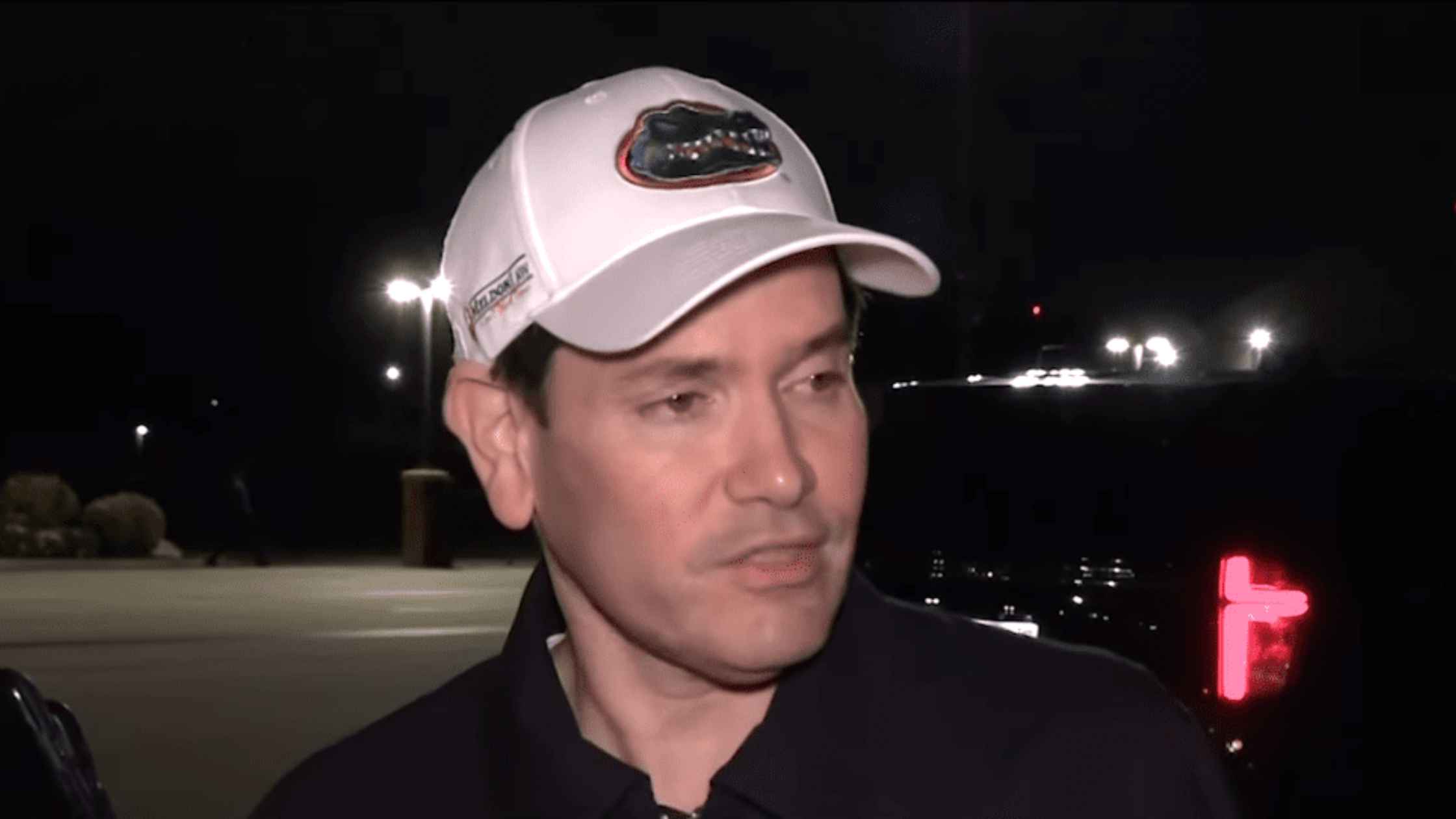
Marco Rubio (01:34):
All right. Well, we'll have a good trip here. You guys are sticking with us through Israel, right?
Forbes (01:37):
Yeah, at Israel.
Marco Rubio (01:39):
Well, we want to go see the Civilian Military Coordination Center they're just standing up. We'll be assigning some career-experienced state department personnel, who ought to be there to help coordinate all these efforts. It's important in particularly for the next couple of weeks that we keep the ceasefire together. The Vice President is there now, he'll be returning to the tomorrow, and he has great reports on the progress we made. But there's more work to be done, and we know that. So the first couple of weeks are going to be key. And then the work will begin building out the permanent process going to the UN, potentially, and getting the international mandate, building the international defense security forces. There's a lot of work to be done, but we certainly… We wanted to make sure that we were there and ensuring that we have the right people in place at the coordination center, which is key to this altogether.
Forbes (02:29):
Why did you feel the need to go on the heels of the Vice President so quickly, sir?
Marco Rubio (02:30):
Well, I'm connecting with the President in Qatar on the way to the Middle East, so it was probably the last opportunity I would have for the next 10 days. The coordination center just opened, but our state department personnel that are going to be assigned, and we'll have an announcement tomorrow about who that is, will have somebody there as Admiral Cooper's counterpart at State, an experienced career foreign service officer that is highly regarded. And we'll be there tomorrow and the next day on Friday to launch that.
(02:59)
I also want to personally meet with the people that are at the center and get a real sense of how it's working. We think it's important for the first seven to 10 days over the next week that we had senior-level administration officials on the ground working to make sure this was all coming together. Obviously Steve and Jared have been there for most of the week. They've now moved to some other countries they've been meeting with in the region. The vice President will be there tomorrow. And then I'll have a chance to be there, but this is a big priority.
(03:24)
This is a historic peace deal that President Trump delivered on, and now we have to make sure that it continues and that we continue to build upon it. This was just the first phase. There are multiple phases to this and they all have to be successful for us to achieve what we want.
Forbes (03:37):
What do you think of the Israeli parliament moving forward on potential annexation of the West Bank? Writers in the administration-
Marco Rubio (03:38):
That's a vote in the Knesset, but the President's made clear that's not something we'd be supportive of right now and we think is potentially even threatening to the peace deal. They're a democracy. They're going to have their votes. People are going to take these positions, but at this time it's something that, especially, we think might be counterproductive.
Forbes (04:01):
And you're concerned with moves like that in the Knesset, but also settlers on the ground in the West Bank. There's been quite a lot of violent people.
Marco Rubio (04:06):
I think it's all going to work out. Ultimately, there are a lot of… This is a complex part of the world. I think every day is going to bring opportunities, and it's also going to bring some challenges. We're dealing with decades and decades of this stuff that every day is going to bring challenges. Every single day, something's going to pop up that we need to fix or it could harm this effort. But every single day, I think we're also seeing things we never thought we'd see before, like the number of countries willing to participate in this effort, be it through money, or personnel, or both, or expertise. We've never seen this sort of international cohesion behind something. So we have to be pursuing those opportunities, because they're really great, historic, and important.
(04:44)
We also have to be in a position to deal with these challenges, because they're going to come up every day, and that's why it's so important that we have someone like Admiral Cooper there to coordinate the Civilian Military Coordination Center, but also to have someone from the State Department on the ground who understands the region and understands diplomacy.
Forbes (05:02):
Are you concerned, though, with the violence over the weekend in Gaza that the ceasefire is at risk of falling apart?
Marco Rubio (05:07):
Well, every day there'll be threats to it, but I actually think we're ahead of schedule in terms of bringing it together. And the fact that we made it through this weekend is a good sign, but there's going to be challenges every single day. Understand Hamas remains a terrorist organization. Hamas remains a violent group of people. Hamas remains a danger not just to Israel but to the people of Gaza. That's why we need an international security force on the ground to stabilize that and prevent them from doing some of the things we've seen. So every day is going to bring challenges like that, but it's also going to bring opportunities. So we've got to deal with the challenges and make sure they don't unravel this. So I'm not worried about it, but we're aware that these are challenges that we have to confront. But, yeah, if this was easy, it would have been done 30 years ago.
Forbes (05:47):
And in terms of the sanctions announced by Treasury on Russia today, what changed the President's mind from last week from looking for a Budapest meeting to imposing sanctions?
Marco Rubio (05:56):
Well, we'd still like to meet with the Russians. I had a good call with Foreign Minister Lavrov, and we'll follow up on that. We're always going to be interested in engaging if there's an opportunity to achieve peace. I think the President has said repeatedly for a number of months now that at some point he will have to do something if we don't make progress on the peace deal. Today was the day he decided to do something.
Forbes (06:16):
On the settler violence, a lot of it is targeting the town of Turmus Ayya where there's a certain amount of Americans who think that and they've expressed a lot of concern. Is that something that's on your radar?
Marco Rubio (06:29):
Of course. Look, we're concerned about anything that threatens to destabilize what we've worked on. The President has achieved something very important here, which is bringing international partners to the table to find something that's enduring in Gaza so we never have another October 7th, but also so the people of Gaza can have a better life, so the people of Israel can be secure, so no Israeli's ever taken hostage or murdered again the way they were on October 7th. And we want to make that work, and we're going to do everything we can to make it work. And it's important for both the Israeli side but also the Palestinians on the ground in Gaza to do their part and for our international partners to meet their commitments as well.
(07:04)
These are things that are challenges. It's the kinds of challenges we face in this region. That's why it's complicated. We know that. That's why multiple administrations in the past have tried and failed to get to the point we are today. But we understand there's more work to be done, but we feel very positive about the trajectory it's on, even though we are well aware that there are going to be some real tests ahead. We feel good. We have a real opportunity to confront and solve those challenges and take advantage of the historic opportunities that this peace deal presents.
Forbes (07:34):
What about the strike that was just announced that was in the Pacific?
Marco Rubio (07:36):
The second one?
Forbes (07:38):
Yeah, that really seems to be expanding and involving more and more countries in the region.
Marco Rubio (07:42):
Look, this is an operation against narco-terrorists, as the Department of War characterizes them, the Al-Qaeda of the Western Hemisphere. These are well-funded, dangerous, violent drug cartels that operate as terrorists, who are flooding our country with drugs. The United States is going to deal with it. The President's made a decision to deal with it.
(08:08)
They come on boats, as we've seen. They come through the Caribbean with the full assistance and cooperation of illegitimate government of Venezuela, the Cartel de los Soles, which is run by Nicolas Maduro. And they also operate in the Pacific. I think the difference between the Pacific and Venezuela is we have partners in the Pacific that are helping us, that are assisting us in counter-drug operations. We have people that we can work with over there in Ecuador, in El Salvador. I think we've had historic cooperation from the Mexican officials on counter-drug. There's more to be done, but we think they're doing more than they've ever done in cooperation with the United States.
(08:39)
So I think that's a big difference between the Pacific and the Caribbean base. And the challenge with the Caribbean base is you have a narco-state in Venezuela run by the cartel. And I remind everybody, Nicolas Maduro, it's not just me saying it, people think I'm just calling the guy names, he's indited by the Southern District of New York. The Southern District of New York indited Nicolas Maduro and a bunch of other people in his regime for being… They're a transshipment organization. They are facilitators. They say, "Well, they don't grow cocaine." That's not what they're saying. They allow drug traffickers to use Venezuelan territory.
(09:14)
Not only do they allow them, they assist them. For a fee, they get paid, but they're a transshipment cartel, and they need to be dealt with. And that's the challenge in the Caribbean. In the Pacific, fortunately, we have allies like Ecuador that's facing a very tough time right now that are cooperative partners in counter-drug efforts.
Forbes (09:32):
If you have allies, then why do you need to strike a vote?
Marco Rubio (09:34):
Well, the United States has unique capabilities that others don't have. I'm not going to get into the details of the intelligence that we gather, but I can assure you that every one of these strikes involves boats and shipments that were tracked from the very beginning. From the moment these things were put together, the moment they were coordinated, we know where they're headed, we know what their drop-off points are, we know what organizations they're involved in. These things are tracked very carefully. There are hundreds of boats out there every single day, and there are many strikes that we walk away from, and that the Department of War walks away from because it doesn't meet the criteria. This goes through a very rigorous process.
Forbes (10:05):
Are these Colombian nationals or Ecuadoran nationals?
Marco Rubio (10:07):
They are everywhere, as you've seen. We've seen Ecuadorian nationals. We've seen Venezuelan nationals.
Forbes (10:11):
On the Pacific side.
Marco Rubio (10:12):
Well, I can't comment on the Pacific side in specific. That's the Department of War to make that announcement.
Forbes (10:18):
Just one follow-up. The President keeps saying that there's fewer and fewer boats because it's working, and that he's considering land strikes. What does he mean by land strikes when he says that?
Marco Rubio (10:24):
Well, I don't have anything to announce on our strategy with regards to that. Suffice it to say that there are drugs on the ground as well. We're aware of that. And the good news about that, too, is that we have officials in Ecuador, in El Salvador, in Guatemala, in these countries in the region, in Panama, and historically, by the way, with Colombian authorities. I think the Colombian authorities, when it comes to their military and their police, are still very pro-American. The only problem in Colombia is a lunatic president. The guy's a lunatic. He's a lunatic, and he's not well. And everybody knows. He's very unpopular in Colombia.
(10:58)
I don't know if you saw today the Colombian Congress voted, I think it was, 72-20 to designate the Venezuelan regime as a narco-terrorist organization. So it just shows you it's unfortunate the people of Colombia have to deal with this guy until May of next year. But nonetheless, I don't have any news for you on exactly what our strategy's going to be. We wouldn't announce that on the ground, but I can tell you we have partners on the ground that are very capable and cooperative from Mexico on through Central America and down. And as I said, the President's very serious about knocking out these narco-terrorists, the Al-Qaeda and of the Western Hemisphere.
Forbes (11:41):
On the Middle East, the envoys have gone to other Gulf nations. Is there some progress?
Marco Rubio (11:41):
They were in Saudi Arabia and in Qatar over the last 24 hours.
Forbes (11:45):
Is there some progress on getting together an international force?
Marco Rubio (11:46):
Sure. We're making progress on that, and it's a combination of things. Putting together a force like that requires a lot of work. It's not just countries willing to offer forces. You've got to have life support. Where are they going to live? How are they going to get there? What is their mandate? How is that force going to be commanded? What are they allowed to do? What are they not allowed to do? All of that work is happening, which is why we have the civilian military structure set up, to coordinate all of these things. And it'll involve… Potentially, we're going to need… Some of these countries are going to require an international mandate in order to send forces abroad, but we have been very pleased at the number of countries that have offered to train police officers, that have offered to send forces, that have offered to send money, that have offered other expertise. And we're working through all of that now. That's why it's important for me to go see this center on Friday, to make sure we have the right pieces in place to continue to execute on all this.
Forbes (12:38):
What else do you see as running ahead of schedule? You mentioned that some aspects of it, of the peace plan and the ceasefire are ahead of schedule?
Marco Rubio (12:44):
I just think the amount… I mean, one thing is for countries to sign onto a paper and say, "Yeah, we're willing to help. We'll be involved." I think we're seeing specific pledges now. And I think both Jared and Steve had very positive meetings in both Saudi Arabia and in Qatar and in the UAE. I think they're going to UAE, but very positive meetings with all of our partners in the region about what they're willing to contribute. And countries outside the region as well. We're not ready to announce those, but countries outside the region, including majority Muslim countries outside the region that are prepared to offer things that you really wouldn't have thought any, but they've never done before.
Forbes (13:19):
Are you planning to meet with any [inaudible 00:13:20] leadership in the following week?
Marco Rubio (13:20):
I'm not sure yet what our agenda is. I think we do have some communications happening with the civilian military, some presence there. And that's one of the things we want. Look, as we build this thing out, we most certainly will have… Look, we'd like to see Palestinian civil authorities in Gaza eventually. That's what we're aiming for. We'd like to see Palestinian police forces in Gaza that are not Hamas and that are going to do a good job. But they'll still have to be trained and equipped, so absolutely. I don't know if it's part of this trip or another trip, but that is part of the plan that's been outlined and everyone's agreed to.
(13:53)
Obviously, that's going to take some time. I mean, you don't just hire people. Police officers, you've got to vet them. You've got to train them. You have to make sure that the infrastructure's in place. This thing's only seven, eight days old, so there's a lot of work to be done, but we're really committed to making sure we see this through.
Forbes (14:07):
Are you concerned about Hamas' repression of Gazans and reprisals against Gazans?
Marco Rubio (14:11):
Oh, yeah. I think we've seen what they've done. They've gone out. They've gone after… They've tried to make sure that everybody knows that people perceive that they're in charge, and they did it with brutal force. These images were out there. They were putting the images out there. I think it exposes a little bit of hypocrisy here. There are plenty of countries and people all over the world going crazy and condemning Israel, but where are they now condemning Hamas for the violence that's being committed against Palestinians by Hamas? That said, it's revealing, but we already knew that about Hamas.
(14:41)
And I think every time you see these videos of people being executed or having their legs broken with a lead pipe, it reminds you why Hamas can never be in charge of Gaza and why we need an alternative for Hamas or there'll never be peace and the people of Gaza will never have a better future as long as Hamas is in charge. Okay? Let's go.
Forbes (14:58):
Thanks so much.
Marco Rubio (14:58):
Thank you.