

Pete Hegseth (00:01):
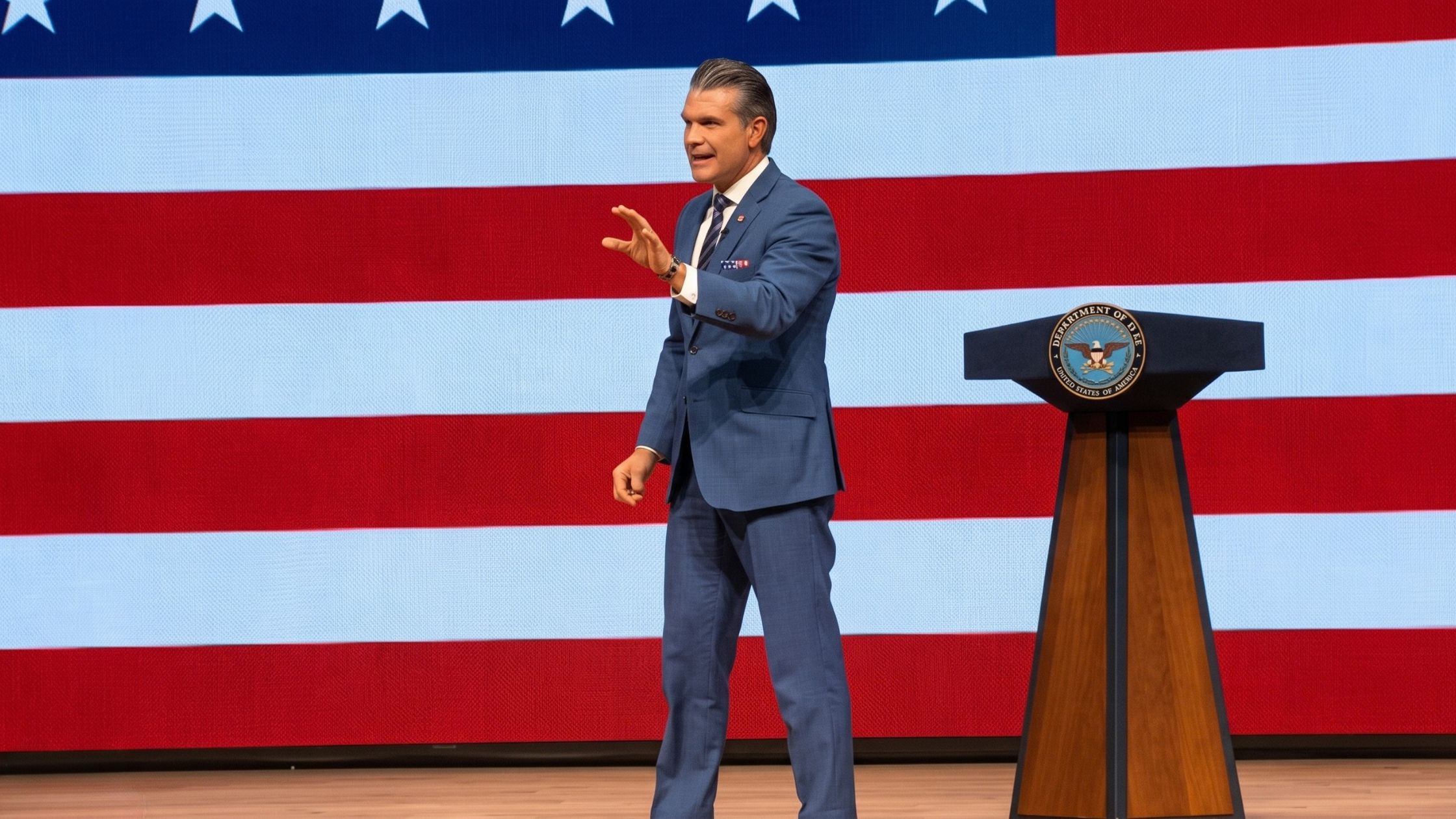
My warriors, good afternoon. One year ago today, I stood right here on this very stage and addressed generals and admirals and sergeants major. Now, the hyperventilating media thought it might be an impromptu PT test, maybe it should have been. Instead, the speech was a declaration of independence for the war department, marking a clean break from the defense department of old. The speech reestablished a singular mission for this department, war fighting. Preparing to fight and preparing to win, unrelenting, unapologetic, and uncompromising in that single pursuit. Now, I think the generals heard the message. Those who responded positively, which is most of them, are leading newly focused and newly empowered and disciplined formations. Those generals who did not, who clung to the woke department or seem to think civilian control of the military is simply a suggestion, well, they no longer work here.
(01:17)
You see, the number crunchers say we've fired 10% of the generals and admirals across the force, and that number sounds about right. And I know because I directed it that we've also reduced the overall number of general officer slots by an additional 10%. So yes, 20% reduction across the board. Now the media calls that a purge. I call it accountability and long overdue, and frankly, the bare minimum. As usual, what the media levels as an accusation, I wear as an accomplishment. You see, you can't change a culture with the same people who enabled it. Personnel is policy at every single level.
(02:07)
But today, I'm talking to an even more important group of Americans. The top E6s, staff sergeants, first class petty officers and technical sergeants, and the top O3s, captains and Navy lieutenants across the entire military. E6s and O3s. Now, it could have been E5s or E7s or O2s or O4s, but I've got a sweet spot, a special thing for E6s and O3s, and I'll share why later. The best of the best. You see, last year's speech was not for those generals. It was for you, the backbone of our force, the current and future leaders on the front lines.
(02:54)
Now, later in this speech, I'm going to make six brand new announcements that will transform the future of the force you serve in. Today's speech is entitled State of the Force, and it's intended to be a new annual tradition where the secretary gives an update and casts the vision for the future of the department. Now, for almost two years, you've heard me talk over and over and over about three core priorities, reviving the warrior ethos, rebuilding the military, and reestablishing deterrence. And I'm proud to stand on this stage and report that the warrior ethos has been revived. Our military is being rebuilt, and American deterrence is back.
(03:43)
Simply put, thanks to the courageous and common sense leadership of our commander-in-chief, President Donald J. Trump, the state of our force today is stronger than it's ever been in our nation's history. I'm looking out at the most capable, the most focused, and the most lethal in American history. You see, I like to think last year's Quantico speech was Liberation Day for leaders, for you to be the apolitical, hard charging, common sense, no nonsense constitutional leaders that you joined the military to be. You see this stuff, it's not rocket science, but it is a revival. The power is back in the hands of commanders and NCOs, not lawyers and HR reps. Telling someone to get in shape or shave or fix their uniform or start busting their ass, that's not discrimination, that's leadership. We've ended the poisonous culture of risk aversion and empowered leaders at every single level to simply enforce standards.
(04:51)
The only focus, as you know, in your formations should be training, readiness, accountability, discipline, and lethality. And when you pursue those things, you don't have to walk on eggshells. No more social engineering, no more weaponized IG policies. The complainers, the ideologues, and the poor performers are no longer in the driver's seat. No more silly PowerPoint trainings or drag queen shows. No more diversity quotas, no more gender pronouns, no more identity months, only the warrior ethos. And I know you feel it because I've been to your units and met with your troops. It has transformed entire formations as it was intended to do. But it's worth saying again, so that the fake news understands it. We are no longer the woke department or the weak department. Simple translation of that, no fatties, no trannies, no beardos, no weirdos, no wimps, no radicals, just warriors, just tough, ready, committed troops. The war department, as you know, is colorblind, gender-neutral, and merit-based. Or as the president likes to say to me, Pete, central casting. I want central casting.
(06:17)
The ideological clowns are out. The patriotic cowboys are in with testosterone testing on top. Diversity is not our strength. Unity is our strength because that's all that really matters when the missiles are flying. You see, the delusional media will downplay all of the progress of the past year, but this group right here, and I look forward to hearing from you all tomorrow morning as well, knows how real and how important cultural change is and has been. But allow me to digress briefly to address that delusional media. You're all here and I'm here to talk to you, but for a moment I'm going to talk to them and through them to the fake news.
(07:11)
To start, there's a few headlines that they could run that they just haven't gotten to. Guess what? In today's war department, military sexual assaults are down. In today's war department, military suicides are down. In today's war department, Black and female recruitment are up even though all the quotas are gone. Shocking. How could that be? Quite an inconvenient truth that doesn't quite fit their narrative, does it? Not only is our force more ready and more lethal, but it's healthier than ever. Colorblind, gender-neutral, merit-based. Everyone of all shades loves that. Instead, you read disingenuous headlines about deployment lengths, patently false claims of low troop morale or flat out propaganda as if it's written by our adversaries. And frankly, sometimes it is.
(08:17)
Take Iran, for example. Allow me to lay it out simply for the anti-American losers in our media. These Americans right here and their peers, these, have destroyed Iran's Navy, destroyed Iran's Air Force, destroyed their air defense systems, their leadership and their military industrial capacity, their entire defense base. Iran's conventional shield has been crippled and their nuclear ambitions laid bare for the world. You, this group, are ensuring that Iran never gets a nuclear weapon, courageous and historic operations that every red-blooded American is proud of.
(09:03)
But as you know, the information space, it's a battle space, yet our so-called press makes Iranian state media look reasonable. Our media's shameful lust for political retribution blinds them to the consequences of reckless so-called reporting. So-called journalists juiced up on Trump derangement syndrome, think they're fighting against our president, but they're really undermining you, our war fighters. Bottom line, too many of them hate the president more than they love the country. You see, it's your movements and bases that they reveal to the enemy. It's your operations that they jeopardize when they leak classified capabilities. And ultimately it's your lives they put directly at risk when they lie about munition stockpiles, all for a banner that will scroll on TV for 30 seconds. And I know a little bit about banners scrolling on TV for 30 seconds.
(10:11)
A free press is of course important, but partisan activism that intentionally smears the troops and the historic mission that they're undertaking is fundamentally anti-American. It's sick. It's a national betrayal. It's treason, actually. I mean, I hate to have to say it, but it has to be said, especially in defense of the great Americans right in front of me. But you, nonetheless, continue forward because you love the country more than they can fathom. The haters, as I just illustrated, don't understand the stakes of your profession, but you do, which is why one year ago we launched three leadership litmus tests, some of which I talked about this morning that we live by every day in this department. The war department golden rule, the 1990 test and the E603 test. First and most importantly, the golden rule. My sons, all of my kids are no more important than yours. All precious souls made in the image and likeness of God. Every parent in this country deserves to know that their child that joins our ranks is entering exactly the kind of unit that the secretary of war would want his son to join.
(11:44)
Jesus said, and you know it, "Do unto others as you would have done unto yourself." It is the simplest test of truth. Well, the new war department golden rule that we put into practice is this, do unto your unit as you as have done unto your own child's unit. Would you want them serving in a unit where standards were lowered to meet quotas or a unit where leaders were promoted for reasons other than merit, performance or war fighting? The answer is not just no, the answer is hell no. We live this golden rule now and standards have responded accordingly. And that means for every combat MOS, none of this should be new to you because we've been doing this over the past year, we now have gender-neutral standards set at the highest male standard only because combat doesn't care. That means for every combat MOS, we now have a combat field test again, set at the highest male standard only because combat doesn't care.
(12:46)
That means two PT tests every year for every unit and the same for height and weight standards. And soon in every service for those PT tests, and I'm looking at the army guys here, guys and gals, it's a PT test that can be done with only a stopwatch and a clipboard. Stay tuned. No more mobile gym needed. That means PT every duty day at every level from corporal to commandant. That means not treating combat arms and non-combat arms as the same thing, both very important, but not the same. And that means basic training is back to basic training, drill sergeants being drill sergeants. The same goes for how we pick senior leaders. We got rid of the DEI based social emotional evaluations known in the army as BCAP and CCAP, you won't have to endure them. They were Milley and Austin specials intended to create politically correct quotas for race and gender. Under the guise of double-blind psychology assessments, the previous administration forced out so-called toxic leaders in favor of promoting risk averse-
Pete Hegseth (14:00):
... toxic leaders in favor of promoting risk averse, get along to go along conformists. It was the true politicization of our military, stupid and dangerous. Instead, now we have instituted a performance-based joint war fighter evaluation. Every colonel who wants to be a general will have to pass and excel in a merit-based, performance-driven assessment of commander's ability to solve complex military problems and win on the battlefield.
(14:37)
All of you deserve senior leaders who know how to war fight, who will employ you like the War Department, not like the State Department, who will think outside the box, bold and violent. The previous administration wanted politically correct generals. We only want the top performing generals. And it's not just pass or fail, it's racked and stacked one to end. The best move on, the worst do not. Common sense.
(15:09)
We also apply every day the 1990 test and the E603 test. Standards that existed in say 1990 now once again apply today. We have restored dozens. Turns out we were right. Standards over time had dropped for all the wrong reasons. And everything we do is in service of making your jobs, the jobs of E-6s and O-3s easier, the E603 test, because you're the ones that make everything happen.
(15:45)
Now it turns out this turnaround, because that's what it is, it's a turnaround, is wildly popular both inside our ranks and with young Americans looking from the outside. Retention rates, and you all know this, meaning troops who are staying in are at record rates, including over 80% of the force on the USS Abraham Lincoln on their historic mission. And it's all merit based. Our best O-3s and our best E-6s are choosing to stay in, which says everything and sets the tone for the entire force. And recruiting for every branch has been record setting ever since President Trump won in November of 2024. Army, Navy, Marine Corps, Air Force, Space Force, National Guard, reserves, pilots, Special Forces, all setting decades long recruiting records. You see, Americans want to serve when they are led by strong patriots, not by weak weirdos. Makes sense.
(16:53)
And all of this matters because ... You know why it matters, because it translates to the battlefield. Our enemies know we will act decisively. Our allies know that it's time for them to step up. Drug cartels, the terrorist organizations of our hemisphere who've previously run our hemisphere are now on the run in our hemisphere, courtesy of our new Counter Cartel Coalition, the ACCC.
(17:22)
You heard on the film right behind me, Maduro said, "I'm right here. Come and get me." So we did. FAFO in action. And from Midnight Hammer to Epic Fury, Iran will never ever have a nuclear weapon. Peace through strength, deterrence in action on behalf of the American people. We will fight to win, clear missions, full hearts, hands untied. It's all I ever wanted as a platoon leader and it's all my E-6 squad leaders ever wanted back again to the E603 test.
(18:02)
We let our leaders fight their formations and then we have their backs. It's simple, yet you know in your business that's incredibly powerful and liberating. In fact, the greatest compliment that I have received in this job by far has come from battlefield commanders. From Rough Rider to Maduro to Epic Fury, commanders have told me point-blank over and over and said the same to the chairman, "We've never in our 10, 20, even 30 years in service felt this supported with authorities, capabilities and backing like never before."
(18:46)
Unleashed. Our boys come home, the enemy does not, whatever it takes. Ask DUDE 44 Alpha and DUDE 44 Bravo. Not only are we a new department, however, on the battlefield, but also in the halls of the Pentagon, that big old building you looked at this morning. We are rebuilding the military, but not at the speed of government, not at the speed of this town or that town, wherever it is, but at the speed of business.
(19:15)
We've thrown out the failed bureaucratic playbook and replaced it with an unrelenting focus on speed, scale, and rapid innovation. We are in a war of attrition against the Pentagon bureaucracy every single day and it is a war that we intend to win. We've traversed the country in an Arsenal of Freedom Tour, igniting our defense industrial base that was long ignored and President Trump has revived with American manufacturing.
(19:43)
We are open for business as a department, but not just for the big prime contractors, but for the new, nimble, innovative companies that have had to fight their way into the department in the past. And the historic $1.5 trillion budget that the president demands, which we will deliver, will ensure that we are equipped to win and fight every future fight. That's what we owe you.
(20:08)
But the new money that we get, we spend it differently. Our great deputy secretary, Steve Feinberg, he's here somewhere, a patriotic billionaire. There he is. He is a patriotic billionaire of turnaround specialist. He's our secret weapon. He's cutting new deals that will revolutionize our department forever. Defense companies now have to spend their own money, imagine that, to expand their plants, their factories and their manufacturing lines in exchange for predictable multi-year deals that allow them to invest and plan and save taxpayers billions of dollars. We're now getting weapons faster than ever before. And for this reason and many more, it's imperative that Congress pass a $350 billion reconciliation package for our warriors. President Trump has promised a generational investment in the War Department and we're going to deliver. We must fund the future fight. That I know is imperative.
(21:22)
We have the most powerful and the most prepared military on the planet. Nobody can touch us. It's not even close. My job, your job, our job is to keep it that way, which brings us to today's six announcements, which taken together with historic efforts already underway like the Golden Dome for America or the Golden Fleet to protect the seas and the F-47 will ensure our military stays on top for generations to come. So let's go.
(21:56)
First, today at my direction, we are announcing the creation of Autonomous Warfare Command or AutoWarCom, a new four-star combatant command with service-like authorities built to scale autonomous and robotic capabilities across the Joint Force in the fastest peacetime shift in modern military history. Drone warfare supercharged by SI-enabled targeting is the biggest battlefield revolution in generations. You already know that.
(22:29)
Yet when I was sworn in at the Department of Defense, there was scant urgency in this domain. That changed as soon as we took the helm. We immediately launched the Drone Dominance Program to cut through red tape and move authorities out of the Pentagon and place it with commands. And we established Task Force 401 led by Army Brigadier General Matt Ross, a phenomenal leader, now the leading counter-drone unit across the entire government.
(22:58)
To accelerate purchasing and fielding of these technologies, we fused the Defense Innovation Unit, DIU, with a Direct Report Program Manager called a DRPM. That team has shipped thousands of autonomous systems of drones to the Middle East and around the world, delivering lethal capabilities and outcomes in days and weeks rather than months or years. That's the normal speed of the Pentagon, months or years.
(23:24)
It's a good start, but it's certainly not enough. The pace of war is changing faster than the process to support it. Cheap compute, super intelligence, and advanced commercial manufacturing have enabled the proliferation of low-cost, high-precision strike. You see, for 40 years, the United States relied on expensive weapons only ... Not only, but primarily on expensive weapons that placed quality over quantity. Now that approach gave us a lot of enormous advantages and we need to preserve those capabilities, but today we need both quality and quantity.
(24:02)
The term you know is high-low mix. An analogy is a thunderstorm. We need bolts of lightning high, our existing high-end kill chains capable of striking unexpectedly and decisively. We also need steady wind and rain, mass drones and other autonomous attritable systems that flip the cost exchange and impose unrelenting pressure on an adversary on the battlefield.
(24:29)
Ukraine's lesson is not that one type of drone wins wars, but rather the need for a purpose-built system that maximizes the ability to adapt. We will fuse procurement with operations at scale and then allow war fighters and engineers and entrepreneurs to learn, adapt, and rapidly iterate on their domain and their mission. And that's why I'm directing an interim step as well.
(24:57)
Today, the unmanned systems DRPM becomes Project Agincourt. Project Agincourt. Now the name means something. In 1415, many moons ago, the outnumbered English army defeated a numerically superior French force in their legacy armor with a new technology, the longbow. The English had to look outside their traditional recruitment pools to find skilled archers. Now to maximize the rate of fire that you need to be effective, they integrated fletchers, the craftsmen who made and repaired the arrows for the longbows, and they moved them close to the front lines to sustain the rate of fire. We face a very similar moment. Project Agincourt is not just a procurement vehicle, it's applying our commercial first Drone Dominance playbook to DIU, and now it gets two brief additional missions. First, it will prototype a new construct called war fighting acquisition, not just acquisition that happens at the Pentagon. This model fuses operators with entrepreneurs in rapid adaptation cycles while distributing decisions and dollars closer to frontline units to combatant commands. Realistic training exercises and when possible, the crucible of combat will be used to compress innovation timelines and scale what works. Now, this audience of any across the country understands why this formula unlocks advantage for the United States. You know the single greatest comparative advantage of the US military. It's not a program, it's not a platform, and it's certainly not a program office. It is our frontline combat leaders. By removing unnecessary layers, reducing the distance between our war fighters and our world leading innovators, and then giving the right people the authority to act, Project Agincourt will pilot innovation at the edge in a way that only Americans can do.
(27:08)
And second, the culminating mission of Agincourt will take place over the course of months, clearing the path for autonomous warfare command. The autonomous and robotic revolution has enormous implications for equipment, doctrine, organization, and the assumptions that have governed warfare for decades. Civilian leaders can provide direction and urgency, but lasting change must be anchored in military command structures and operationalized by leaders across our Joint Force.
(27:44)
Now, any major institutional change like this one, it is a major institutional change, has always met resistance. Goldwater-Nichols faced opposition from the secretary of defense, the chairman of the joint chiefs and the military services. US Special Operations Command, SOCOM, triggered a Pentagon revolt.
Pete Hegseth (28:00):
... OCOM triggered a Pentagon revolt. Secretary of Defense Bob Gates had to fight his own building to fast track MRAPs to the front lines. And President Trump's space force was opposed by the then secretary, the Air Force, and the chairman. Yet when the final order was given, the military executed and the force was better off as a result.
(28:27)
Today, I am giving a similar order with the full support of President Trump, a man that understands leading from the front and on the edge. We will soon have a four-star commander to raise the AutoWarCom flag. And to prepare the way, I'm appointing two leaders to guide Project Agincourt during the next year.
(28:49)
Owen West and Navy SEAL Senior Chief Max Straser. Theirs is going to be a CEO, COO partnership. Owen focused on strategic risk, resources and scale, and Max focused on operational problem solving and the realities of employment in combat.
(29:09)
Now, this is no theory, it's no one-off, which is why also today we are phasing in new MOS frameworks within each military department to support our shift to autonomy. We need institutional knowledge and career paths for a new generation of autonomous war fighters. So today with Autonomous War Command, AutoWarCom, we institutionalize and we supercharge the era of SI, robotics and autonomous systems all in order to win.
(29:42)
Now next, and second, even as we build the systems on the edge, we need to be thinking even further ahead, years and decades even, into the future to ensure America's military supremacy. So as we scan that horizon of an unknown future, we should have the humility to recognize that the best forecasters of future conflict do not solely reside inside the Pentagon. There are obvious biases and risks to asking ourselves to both ask the questions and answer them. So today we are leveraging a unique source of American advantage, one our adversaries do not have, our innovators, our senior leaders, and our technologists, big thinkers and doers who will forecast the creative solution for tomorrow's conflicts.
(30:36)
And that's why today at my direction, I'm announcing Project Meridian, an effort led by America's best minds to study the future of warfare. Under the leadership of the department's chief technology officer, Emil Michael, Project Meridian will be co-led by three of our nation's best minds. Elon Musk, Palmer Luckey, and Newt Gingrich, all of whom are up in the audience with us today. Please stand if you would. Thank you. Thank you.
(31:24)
Those three great Americans are going to be joined by a team of senior leaders, handpicked private sector leaders, and subject matter experts from across our nation's unmatched innovation, academic and policy ecosystems. Project Meridian, the future of warfare is not about developing new strategies or new policies. We already do that. Rather, its purpose is to creatively look to the future and identify the domains that we must conquer and capabilities we must master. We should have been thinking about Autonomous Warfare Command 10 years ago. We need to be looking forward into the future to achieve technological and military dominance on the battlefield for decades to come. It is futuristic on purpose. Their work will be focused on discovering, developing and fielding the weapons and systems that our children and our grandchildren will need in their lifetimes without any creative limitations or restrictions. On any future battlefield from under the earth to beyond the moon, our American warriors will be armed with absolute technological superiority because we will have the foresight to prepare today for tomorrow.
(32:42)
And we're going to do so rapidly. And that's why I'm directing Project Meridian's findings to be completed and submitted within 120 days, culminating in a full public rollout, of course a classified annex to ensure this is not just another endless Pentagon study that is outdated before it is finished. In fact, our first meeting with those three great Americans and a small group of us is happening in a skiff about 200 yards away right after this speech. We are going to hit the ground running. And in that time, Project Meridian will ruthlessly map the trajectory of wars, domains, and technologies to ensure this war department, your war department dominates the future.
(33:26)
Now, the future is where we will fight, but there we need to maintain what we have as well in the process and make it impenetrable. For decades, we built the most powerful military in the world and then we quietly we made it, and regrettably, made it dependent. Dependent on foreign minds for rare earths, on overseas factories for microchips, on foreign supply chains for weapons, and on a civilian power grid to keep the lights on at our bases. Well, that ends today with my third announcement.
(34:03)
Today at my direction, we are launching FORTRESS America, a national insurance policy for the American homeland. Now FORTRESS stands for federal operations for resilience, troop resources, energy, supply and survivability. And here's what FORTRESS calls for, every major military installation in America is going to generate its own power, independent of the civilian grid. If an adversary takes down the grid by cyber attack, by sabotage or by any means, our bases stay lit. Our aircraft keep flying, our command centers never go dark.
(34:42)
We're bringing our critical supply chains home. The rare earth, the specialty metals, the semiconductors, the propellants mined in America, refined in America, built in America by American workers. We are building long overdue strategic reserves, deep enough to fight through disruption. Think munitions, fuel, medicine, blood, deep enough that if the world's supply lines break and in a real war, they're going to break, America keeps fighting anyway.
(35:16)
We're hardening every installation on American soil against cyber intrusion, sabotage and drones. And we're securing the high ground and the airwaves, our satellites, our spectrum, our ability to see, to navigate, and to talk to one another. Previous administrations may have traded away our resilience, one job, one factory, one town, one base at a time. FORTRESS America is how we get that back. No matter the circumstance, this department will have the power, the equipment, and the supplies you need to take the fight to the enemy. The Department of War, and the chairman alluded to this, the Department of War will be the insurance policy for the entire nation.
(36:03)
Now, insurance is not pessimism. It's what serious people do when the stakes are too high to simply gamble. We're not looking for war, but we will be prepared if one comes. We'll make certain that America cannot be starved out, shut down or cut off. A fortress is not a place where you hide from. It's a ground you stand on, the foundation you fight from, the strength that lets you reach anywhere in the world precisely because you are fully prepared at home. We're going to build FORTRESS America, and that starts again today.
(36:44)
Now speaking of bases, for too long, and you know this, our military has been bogged down by the same old tired Washington playbook. Spend trillions on exquisite weapons systems while our troops live in aging bases, outdated barracks. Now we're getting after it with the barracks task force, but it's not enough outdated barracks and inadequate infrastructure. That era needs to end.
(37:13)
Under this commander-in-chief's leadership, we are bringing tens of thousands of our finest warriors home from overseas. We are growing our joint force by tens of thousands of service members and we're pivoting our focus to where it belongs, to defending our homeland and our hemisphere while outmatching any global threat.
(37:35)
Now to back up our war fighters, when we bring those troops home, we won't just reshuffle troops into legacy posts. We're going to build them beautiful new bases from the ground up. And that is why today at my direction, the fourth announcement is the next great American base. We haven't built a new base in this country in 40 years. That ends now. President Trump is a builder, and this project is about doing something bold, beautiful, and world-class for the great Americans who wear our nation's uniform.
(38:13)
We're calling on every governor in the country and adjutant general, every tag across this great republic to step up to the plate and bring us their best sales pitch. If your state wants the honor of hosting 15 to 25,000 of America's great troops, show us why and how you're going to do it. Cutting through the red tape, offering up the land, and rolling out the red carpet for our military families.
(38:40)
Now this is not going to be a soulless government installation. We will plan out and chart out a dynamic self-sustaining power projection platform. We're talking hundreds of thousands of acres with organic power generation, modern air defenses and cutting edge technology. Think a fortress. Just as importantly, we are restoring pride and standards to how our troops live. In line with the president's executive order on beautiful civic architecture, this base will be a proud FORTRESS of our republic built with timeless classical architecture. Our soldiers, our sailors, our airmen, Marines and guardians will have clean, first class barracks, world-class training facilities and thriving communities with top-tier housing, school, childcare, and healthcare for families. We owe our warriors nothing less than the gold standard.
(39:37)
Now, this entire selection process will be transparent with the deliberation process recorded for the American people to see. Governors and their tags and their leadership teams will come to the Pentagon to pitch their plans to myself, to the deputy secretary, to the chairman of Joint Chiefs of Staff, maybe even the president himself. No back from Washington deals, no political favoritism, just a straight-up merit-based contest to see which state will partner with us to build the most modern, beautiful, and lethal military installation on the planet. And to those states, I say may the best pitch win.
(40:20)
Our fifth announcement, like the sixth that will follow, is about people. In an era defined by rapid change and shifting global threats, the demand for grounded, strong, and honorable leaders has never been more urgent. Tomorrow's leaders can't simply manage crisis. They have to thrive within it while maintaining their true north compass heading. Only leaders of character who cherish our constitution and love our country should lead our great military.
(40:54)
Now thankfully, our military academies at West Point, Annapolis, and Colorado Springs, especially with the new leadership, the new admissions criteria and new curriculum, they're heading back in the right direction, back to the basics from the classroom to field training. These three institutions are critically important because as you know, they commission the most officers in our force.
(41:21)
The next largest source of future offices is our six existing senior military colleges and their cores of cadets. I'm sure many of you attended one of them. Thankfully, the core of these institutions for the most part have not wavered. I had a chance to see a great one at Texas A&M a couple of weeks ago. And in fact, places like that have doubled down on American values. The patriotic and selfless service being taught at places like Texas A&M, VMI, the Citadel Norwich, Virginia Tech, and the University of North Georgia are exactly what our nation needs. But after that, we rely on a wide variety of commissioning sources, many from institutions that have-
Pete Hegseth (42:00):
We have commissioning sources, many from institutions that have drifted, in some cases have careened away from founding values. Now, I don't need to give a sermon about the failings of higher education. You get it. I once wrote a book about it. From the Ivy Leagues to most liberal arts colleges, our colleges and universities have become anti-American, DEI worshiping woke factories. Qualities like grit and courage replaced with political correctness and social justice. God and country traded for Che Guevara and critical theory. What do we need? We need students of Western civilization and the pillars of our republic, leaders who understand the faith of Jerusalem, the philosophy of Athens, the power of Rome, and the freedom of Philadelphia, circa 1776. Officers of the republic, proud of our country, proud of our heritage and proud of our history and those who serve it. We need more officers from academic institutions like our military academies and senior military colleges. And today we're going to make that happen. Enter a new core of cadets.
(43:23)
To meet this critical need, we're partnering with a new crop of premier higher ed institutions, including Louisiana State University, LSU, Liberty University, Tuskegee University, Mississippi State University, and Hillsdale College. These schools have stepped forward to answer the call to duty and establish new cores of cadets in partnership with the Department of War. So today at my direction, we are formally establishing a program to assist these universities and colleges. It's called America's Core of Cadets. This flagship effort is central to our goal of increasing the number of patriotic leaders of character who are commissioned into our joint force. Each member school is designated a distinguished military college, reviving a category previously used in our department. And in this status, these institutions will maintain exceptionally high standards of cadet discipline, tactical instruction, and military organization.
(44:33)
Additionally, these schools earn a prestigious honor school status, which grants priority in officer commissioning, which you all know is a big deal. We're grateful to these initial five institutions for stepping forward, and there are a number more that we plan to announce soon. The status quo of our officer pipeline is pretty good, but the future will be even better. By embedding continuous military discipline and leadership development into new institutions, by growing our cores of cadets, the war department will ensure our republic is defended by even more officers of unwavering character and patriotism. Finally, cutting edge technology, which we've talked about, new basing and bases, which we've talked about, and a better educational pipeline are still incomplete without the most essential component of our republic, faith. Faith in something greater than us. When an American warrior raises their right hand to defend our nation, you sign away a lot more than just time. You miss births, you miss first steps, you miss final goodbyes, you miss other civilian careers.
(45:56)
But one of the costs that is rarely thought about or talked about is the loss of your religious community. Every time we issue orders to move a warrior to a new location, they leave behind the faith community, the church that grounds them. For people of faith, that community isn't just a nice to have. In many ways, it's an extension of their family, it's their moral foundation or their personal and spiritual accountability, the very bedrock of their warrior ethos. When you actually look at the numbers, and this will be good for the press, less than 5% of our force identifies as non-religious, less than 5%, meaning 95% of our force recognizes an almighty God. Accordingly, our department therefore has a sacred duty, first class religious support wherever we send our warriors.
(46:48)
Now for far too long, we didn't prioritize that duty at all. It was an afterthought. Political correctness and secular humanism got a vote, chaplains did not. Budgets were cut, resourcing and manpower needs were ignored, base chapels fell apart. Decisions about faith and religion were made by secular careerists in cubicles and lawyers running around with red tape. Now we don't put non-lawyers in charge of the JAG Corps or non-doctors in charge of military surgeons, yet for decades we let people with no expertise in faith or religion dictate the spiritual life of our warriors. The people who actually practice faith and religion, our chaplains, were buried echelons deep waiting for permission. We asked chaplains to serve and sacrifice and then sideline them with paperwork and process. And that ends now. Today at my direction, I'm establishing the Office of Religious Affairs. Starting today and for secretaries of war after me, the Office of Religious Affairs will report straight to the top. No staff filters, no bureaucratic dilution, a direct line to the secretary.
(48:03)
This is not going to be a paper pushing shop. It's going to have real teeth. It'll protect budgets, demand infrastructure and strengthen religious support. The experts, our chaplains, will finally have an advocate at the highest levels. Policy and resources will serve the mission, not smother the mission. As Psalm 33:12 extols us, "Blessed is the nation whose God is the Lord." 250 years ago, we rejected an earthly king an ocean away, appealing instead to a heavenly king above. George Washington made sure that the continental army had chaplains back at the beginning, back in 1775. That force appealed to heaven, and we still do today. Our national motto is, after all, "In God we trust." Today we reaffirm that trust. We're placing spiritual health at the same level as physical health. Our department is, you might say, putting on the full armor of God. Because while we wage physical war, we all know the real battle is spiritual.
(49:22)
God is good, evil is not, and America's military must understand the difference. To our incredible chaplains and religious support teams, live your calling, stand firm, preach truth, minister to the flock, fear no man. Or as the psalmist put it, "The Lord is on my side. I will not fear. What can man do unto me?" Amen to that. So six announcements, all charting the course for our department. Autonomous warfare, the future of warfare, the nation's insurance policy, the next great American base, a new corps of cadets and the office of religious affairs, all for you. Each of you swore an oath to the constitution ending with, "So help me God." When I raised my right hand in this job and made the same solemn pledge, we sealed a shared covenant up to and including the price of the lives of our best Americans, our absolute best. Each of us committed to the nation with the sentiment of the sixth chapter of the book of Isaiah. Lord, here I am, send me. Send me to fight the Red Coats. Send me to fight the communists. Send me to fight the Islamists. Send me.
(50:51)
You see, the Ivy League faculty lounges, they'll never understand you, and that's okay because they could never ever do what you do. The media will mischaracterize you, and that's okay, because deep down they know you're the reason they live free. They envy you because you do real things every single day. You are the real 1% in the middle of the profession of arms. You feel comfortable inside the violence so that our citizens can live peacefully. Lethality is your calling card and victory your only acceptable end state. The outside world can't understand this so stay true to this department. You don't want to look like civilians because you're different. You're set apart. You are warriors. With that title comes great expectations. So go forth this day and do good things. Do hard things. President Trump has your back and so do I. We are the war department and we will never back down. Godspeed. Thank you very much.