

How AI Tools Are Transforming Law Enforcement and Criminal Justice
From bodycams to predictive policing, learn how AI is transforming the criminal justice system and helping law enforcement work smarter.

Technology continues to transform modern life in profound ways, especially its impact on the justice system. The boom in digital evidence has created an avalanche of work for both prosecutors and defense attorneys. Meanwhile, the increasing adoption of AI tools is creating a new normal, rewriting legal workflows from the ground up.
To help criminal justice thrive in the age of AI, it’s not enough for its facilitators to simply understand their own evolving roles in the system. They also need to understand the roles of their peers, and that all officers of the court share this new normal.
We’ve talked, and will continue to, about what AI tools can do for criminal defense attorneys and their client's trust. But what do they mean for the larger system in which those attorneys operate?
Criminal defense attorneys enter into the justice system at a critical juncture—and a distinct disadvantage. By the time they take a case, law enforcement and the prosecution have already begun slotting the evidence into a narrative against their client. Only in the discovery phase can the defense begin to get its bearings and figure out how best to push back, ideally with the assistance of powerful AI tools.
That’s why it’s so critical for defense attorneys to understand how AI has changed not only their own work, but also the work of law enforcement officers (LEOs). AI technology is changing the game for LEOs, as well, whether by enabling the use of data analytics for predictive policing, automated speech recognition (ASR) for bodycam transcription, or advanced drones for evidence collection.
Defense attorneys who understand the ways in which these tools are being deployed by LEOs can position themselves to better advocate for their clients. So with that in mind, let’s take a closer look at AI-assisted law enforcement, the effects it’s having on criminal defense, and what a better future through legal AI might look like.
The Evolution of Law Enforcement
More often than not, a LEO is a defendant’s first contact with the justice system. LEOs are the entry point into the criminal justice world, and criminal attorneys depend on LEOs to do their own jobs.
In the course of fulfilling their duty to uphold the law, LEOs are faced with many of the same challenges as other officers of the court. They have too much work to do, and not enough bandwidth for it, struggling with efficiency and accuracy. And the stakes are always high: Any mistake can come at a human cost.
It’s with all that in mind that LEOs have embraced AI solutions, enlisting the technology as an ally in the daily work of keeping the peace. Here are a few key examples:
Predictive Policing
Don’t worry, Minority Report is still fiction. But by leveraging machine learning tools to analyze crime data, law enforcement agencies are able to forecast criminal activity with increasing accuracy. For example, in 2022, a group of social and data scientists in Chicago built a machine learning tool that predicted crimes up to a week in advance with roughly 90% accuracy.
These systems, which can be either place- or person-based, “may help more efficiently direct resources—including non-law enforcement resources, such as social services—preventing crimes and decreasing response times,” the U.S. Department of Justice noted in a December 2024 report.
Bodycam Transcription
AI has enabled significant advancements in audio transcription, offering law enforcement agencies a powerful tool for processing body camera videos. It’s not just bodycams, either: ASR tools can also be used to transcribe dashcam footage, 911 calls, jail calls, and much more.
Advanced legal ASR solutions like Rev are quick, easy, secure, and accurate, converting interactions between LEOs and the public into verbatim transcripts. These transcripts can serve not only as material for LEO performance reviews and training sessions, but also as a potential foundation for the creation of admissible evidence used in court.
Enhanced Surveillance
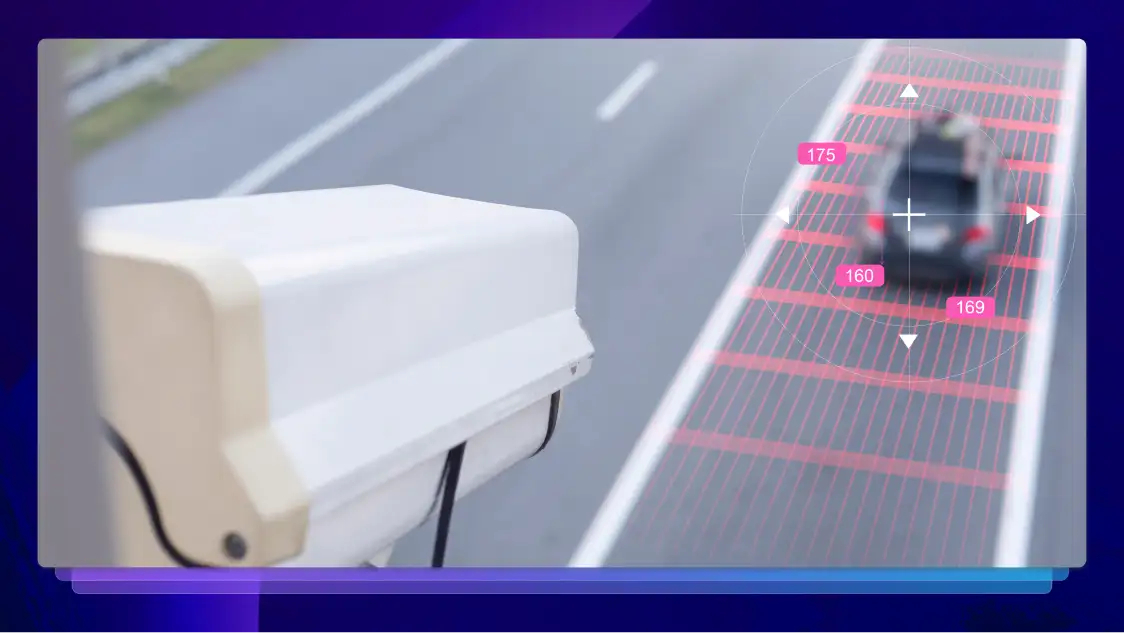
With AI, surveillance systems are more powerful than ever. License plate readers, whether stationary or drone-based, can automatically gather key data about passing vehicles.
Tracking algorithms can follow suspects across multiple security cameras or video files, stitching together a picture of their whereabouts. Gunshot detection systems can use acoustic sensors to identify and locate gunfire, then notify LEOs. And weapons detection systems can leverage computer vision to automatically detect firearms, alerting LEOs in seconds.
These AI-powered systems are designed to close the critical gap between criminal incidents and law enforcement response times.
That cross-section is hardly comprehensive. Law enforcement AI adoption also encompasses natural language processing, autonomous robotics, and process automation technologies, as a January report by the National Conference of State Legislatures summarizes.
The Effects on Criminal Defense
Defense attorneys need to be aware of all of the above—and more. The use of AI tools among LEOs complicates criminal defense, presenting new and pressing issues.
Again, many of these challenges are shared. More and more is asked of both LEOs and defense attorneys in terms of technical expertise. New tools mean new training, ethics, and oversight. Defense attorneys must hold law enforcement accountable in the course of advocating for their clients, ensuring that any evidence against them is lawfully obtained and accurately interpreted. That takes rigorous analysis and effort.
On an average day, criminal defense attorneys must confront:
1. The “Black Box Problem”
One of the most difficult challenges to overcome with AI in general, including in a legal context, is the so-called black box problem. Complex deep learning models accept inputs and provide outputs, but they don’t offer any window into their inner workings, remaining a black box even to their creators.
When LEOs deploy proprietary or otherwise technically opaque AI tools to collect evidence and monitor suspects, the resulting lack of transparency can make it extremely difficult for defense attorneys to understand their function and potential for misuse, let alone challenge the admissibility of their results.
2. Data Bias
Another major concern surrounding AI in law enforcement is the data those tools are trained on, which has the potential to perpetuate and even intensify preexisting biases. AI tools, like the humans who created them, are susceptible to prejudice, from predictive policing to facial recognition.
And data that reflects systemic discrimination risks exacerbating it: “The use of variables such as socioeconomic background, education level and location can act as proxies for race and perpetuate historical biases,” said UN Special Rapporteur Ashwini K.P. Defense attorneys must understand this to combat it.
3. Rights Infringements
Safeguarding a client’s rights is part and parcel of their defense. That means ensuring that LEOs did not violate a client’s Fourth Amendment rights, as well as their right to privacy—no small feat in the age of AI, a tool so powerful that it can easily lend itself to law enforcement overreach.
As LEOs equipped with this technology continue to redraw the boundaries of privacy and Fourth Amendment protections, defense attorneys are in a critical position to push back and assert their clients’ rights.
Defense attorneys have to stay informed about law enforcement’s uses of AI, understanding how these tools are used against their clients in order to better defend them. And as the Electronic Frontier Foundation summarizes, AI in law enforcement “has important implications for the application of the law, the protection of civil liberties and privacy rights, and the integrity of our criminal justice system.”
Building a More Just Future
Both LEOs and defense attorneys are just individual parts of a larger whole. Ultimately, the work of building a better justice system doesn’t fall to any one group. It’s the responsibility of all involved to ensure that AI tools serve justice rather than distort it. But experts and stakeholders agree that this work is worth it: “Responsibly managed, AI has the potential to enhance both safety and justice.”


.webp)
.webp)
.webp)
.webp)