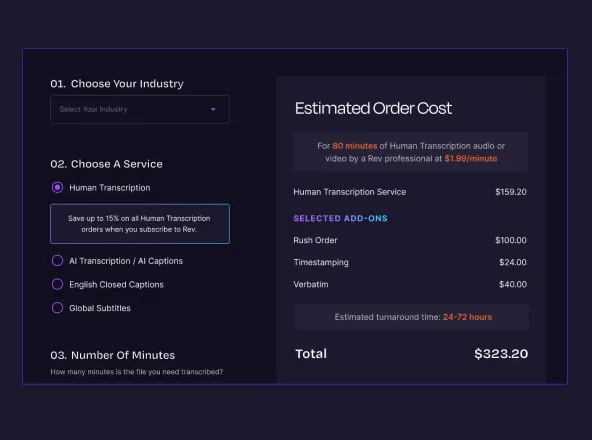
See exactly what you'll pay — no surprises. Estimate costs for human and AI transcripts, captions, and subtitles in seconds, and find out how much a subscription can save you.
49 AI In Law Statistics: How Tech Is Changing The Industry
49 AI In Law Statistics: How Tech Is Changing The Industry
Check out over 48 key stats about AI in the legal industry, including how lawyers are using AI right now, public opinion, and where the tech is headed.
Legal AI is no longer just a buzzword. From small solo practices to large law firms, AI tools are actively reshaping how legal professionals research, draft, and manage cases. And the data tells a compelling story.
Below is a roundup of key AI in law statistics that cover everything from how lawyers are using AI right now to what the public thinks about it, and where the tech is headed.
General Data On Legal AI
The legal industry has entered a genuine AI inflection point. Adoption is rising, investment is growing, and the use cases are multiplying. Here is a snapshot of where things stand right now.
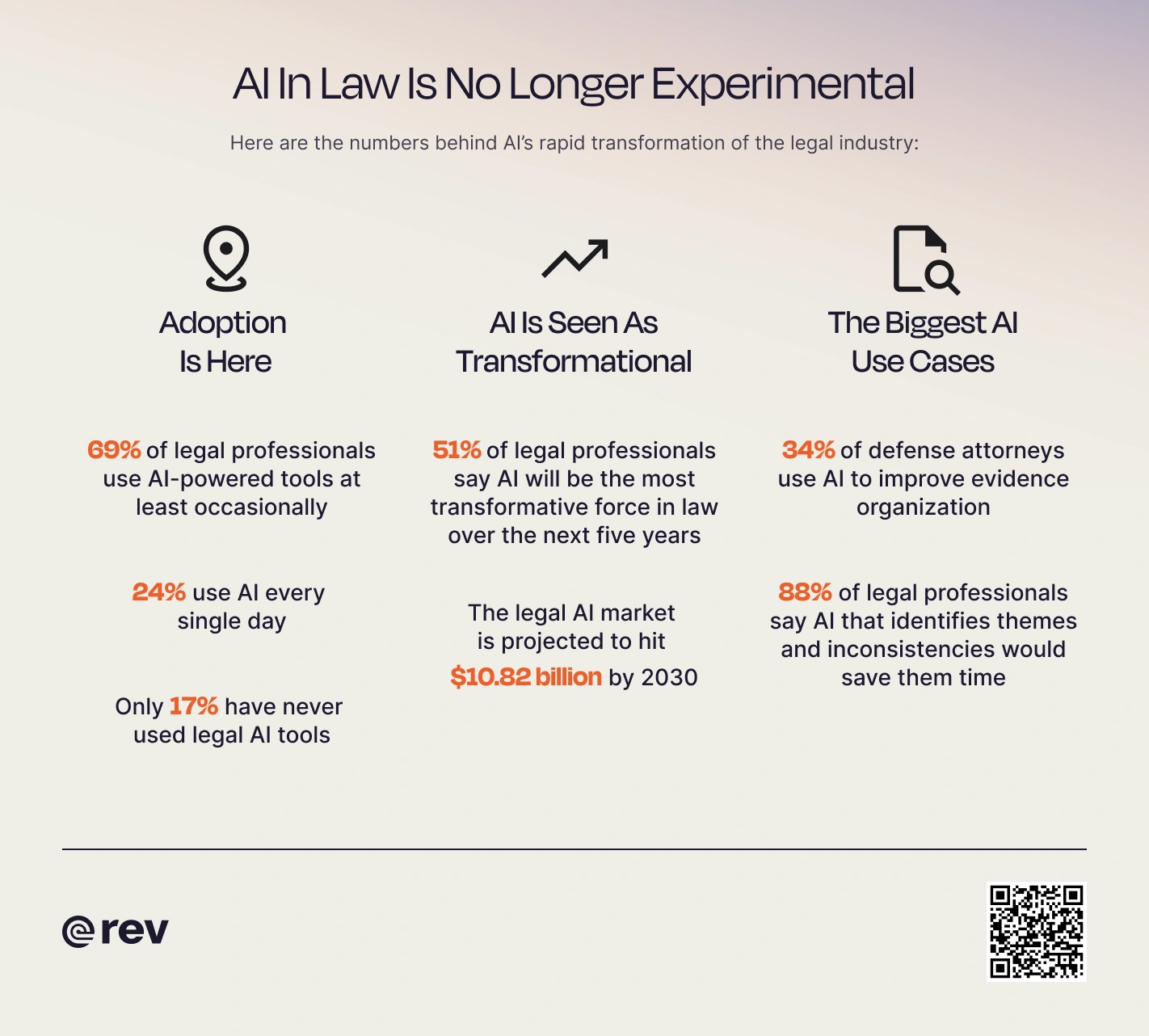
51% of legal professionals now recognize AI as the single most transformative force for their industry over the next five years. (1)
The global legal AI software market is projected to grow from $3.11 billion in 2025 to over $10.82 billion by 2030. (2)
The North American legal AI market owned 46% of the global revenue share in 2024. (3)
48% of legal professionals have already incorporated AI-powered legal research into their daily practice. (1)
60% of firms currently lack specific AI usage guidelines. (1)
69% of legal educators and students say AI makes education more efficient, including 23% who see major time savings. (8)
Stats: Law Firm Artificial Intelligence Usage
When it comes to lawyers and artificial intelligence, adoption is no longer optional for competitive practices. AI is being integrated into a wide range of legal sectors, with great results to boot.
69% of legal professionals use AI-powered tools in their work at least occasionally.
24% of lawyers use AI-powered tools on a daily basis.
17% of legal professionals have never used legal AI tools.
71% of criminal defense attorneys report having already used AI in their work.
37% of defense attorneys say AI has enhanced accuracy when reviewing documents or transcripts.
34% of defense attorneys use AI to improve evidence organization.
88% of legal professionals say AI that identifies themes and inconsistencies across multiple case files would save them time.
54% of lawyers expect AI to help them reclaim up to 20 hours per case through faster evidence review.
Law firms are prioritizing AI for technological improvement in:
Document management and e-discovery (26.4%)
Transcription and testimony capture (20.7%)
Matter management and client onboarding (13.8%)
42% of legal education professionals trust legal-specific AI platforms most for summarizing complex legal transcripts.
39% of criminal defense attorneys report that AI has already reduced total case preparation time.
Public Opinion On Legal AI
How does the public feel about AI in their legal system? The answer is nuanced. Most Americans welcome AI as an efficiency tool — but they draw firm boundaries around human judgment in high-stakes decisions. Here’s a closer look.
53% of Americans believe AI offers concrete benefits to the justice system, including case organization, faster case resolution, and lower legal fees.
33% of Americans value AI for its ability to quickly search through case information.
51% of Americans support AI for court scheduling and logistics, while 27% oppose this use.
55% of Americans back AI transcription when it includes human oversight.
65% of Americans have already used an AI chatbot for legal help, though most view it as a research tool rather than a replacement for professional counsel.
41% of American adults say they would only rely on a lawyer — not AI — to navigate serious legal matters such as criminal accusations, divorce, or immigration.
75% of Americans believe disclosure should be required when AI is used in a legal setting (63% for any use, 12% only for high-stakes tasks).
10% of Americans believe AI should recommend prison sentences or predict recidivism, while 72% actively oppose this use.
3% of Americans believe there are no risks at all to using AI in courtrooms.
46% of people who have not used AI for legal advice cite concerns about accuracy and misinformation as their main reason for avoidance.
Generational And Gendered Legal AI Data
Attitudes toward AI in law are not uniform. Age and gender both influence how legal professionals and the public relate to AI tools.
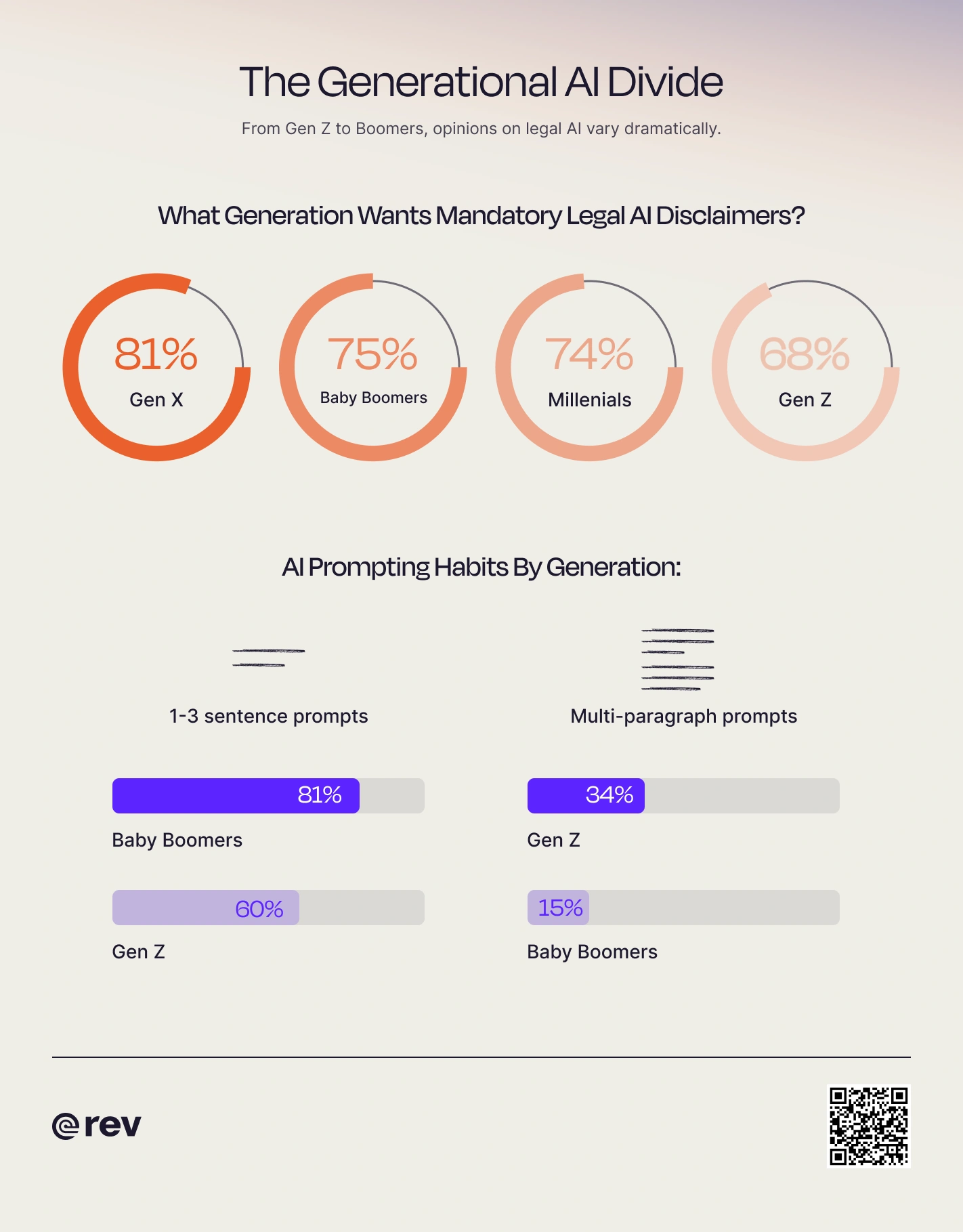
Support for mandatory AI disclosure in legal settings is highest among Gen X (81%), followed by Baby Boomers (75%), Millennials (74%), and Gen Z (68%).
Men express greater concern than women about AI making mistakes in courtroom settings (65% vs. 57%), highlighting gender differences in technical skepticism.
48% of people involved in legal education say AI access gives today's students a significant professional advantage over previous generations.
46% of lawyers with less than 10 years of experience are burned out, while only 40% of those with 10+ years of experience report the same feelings.
81% of Baby Boomers use one to three sentences for their AI prompts compared to 60% of Gen Z.
AI Hallucination And Accuracy Data
Legal accuracy cannot be overemphasized enough. A hallucinated citation in a court filing can mean sanctions, damaged credibility, or worse. The data on AI error rates in legal settings paints a picture that's encouraging for careful users — but sobering for those who skip verification.
37% of general counsel (GCs) report relatively low confidence in using advanced contract analytics, due to issues in accuracy.
86% of legal professionals have already noticed errors in AI transcripts used in their work.
35% of legal professionals say their biggest concern is inaccurate or incomplete information in their legal AI tools.
The most common AI errors in legal work include:
Nuanced or firm-specific language (18%)
AI hallucinating case law (17%)
Complex legal terminology (15%)
Errors caused by multiple speakers (14%)
58% of legal professionals say overreliance on AI is a greater risk to legal integrity than under-reliance.
17% of all AI users say they never have to revise AI outputs to correct false or inaccurate information.
Power users of AI tools face 3x more hallucinations than casual users.
Users who feel they are improving at AI prompting are 64% more likely to report never experiencing hallucinations compared to those who feel it's getting harder.
60% of the general public has concerns about legal AI errors, hallucinations, and overreliance.
Over 1,400 cases have involved some version of legal AI hallucinated content.
The Future Of Generative Legal AI
The trends in legal industry data make one thing clear: generative AI is not a passing experiment. It is becoming embedded in how law is practiced — and the expectations for its role just a few years from now are ambitious.
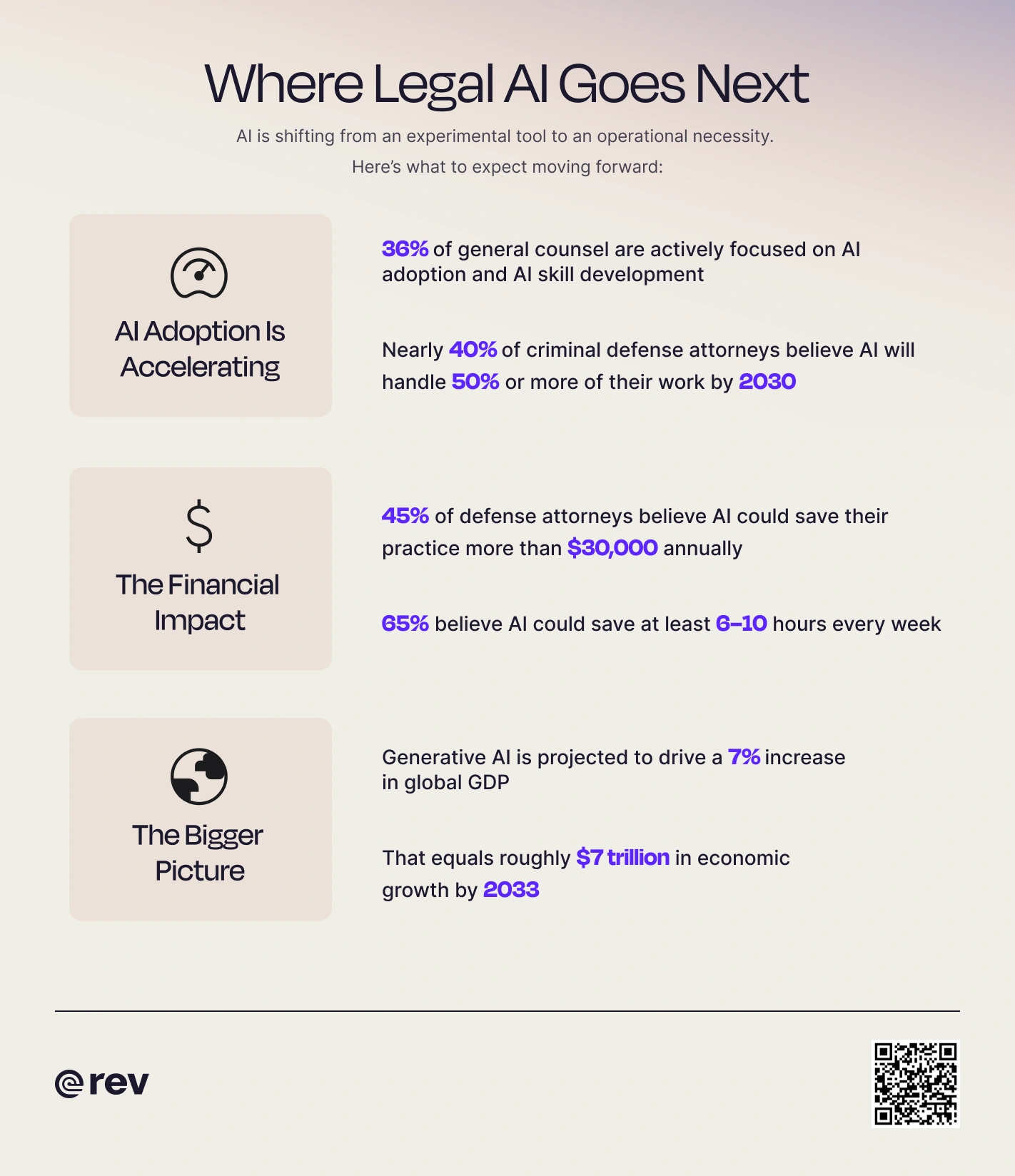
36% of GCs are focused on adopting AI, building AI skills in their department, or improving AI risk management in their organizations moving forward.
9% of GCs said they want to use advanced contract analytics tools to manage contract risks and reduce costs.
Nearly 40% of criminal defense lawyers believe 50% or more of their work will involve AI by 2030.
45% of criminal defense attorneys estimate that AI could save their practice more than $30,000 a year.
65% of criminal defense attorneys believe AI could save them at least 6–10 hours per week in their practice.
Generative AI will drive a 7% increase in global GDP (roughly $7 trillion) by 2033.
The Asia Pacific region is expected to have a 20% CAGR by 2030, the fastest-growing market in the legal AI sector.
AI Law Industry Trends Aren’t Going Anywhere
The evidence is overwhelming. AI is already embedded in how lawyers research, how courts operate, and how the public seeks legal guidance. But the most significant shift may still be ahead. As purpose-built legal AI tools mature (and as training, guidelines, and safeguards improve), the productivity, cost, and accuracy benefits will only become more pronounced.
For law firms that want to stay competitive, adopting AI-powered transcription and evidence management is a critical first step. Rev's legal transcription and evidence analysis platform is trusted by thousands to deliver 99% accurate transcripts, searchable evidence libraries, and secure workflows that protect attorney-client privilege.