

Cybersecurity For Law Firms: How To Avoid A Breach
Learn how to improve your law firm’s cybersecurity with key threats, compliance rules, and 10 practical strategies to protect sensitive client data.


Cybersecurity for law firms is the practice of protecting sensitive client data, legal communications, and case management systems from unauthorized access and breaches. This has become a pressing concern for law firms of all kinds. According to the American Bar Association’s (ABA) most recent Cybersecurity TechReport, 29% of legal firms reported experiencing a security breach — a number that’s steadily increased in recent years.
Data safety and privacy matter anytime sensitive personal information is involved, which is to say, most of the time in law. And a mistake in this area represents more than a minor mishap or embarrassment; it could have serious consequences for your client and the firm as a whole.
Whether you represent a large firm or a small court reporting agency, your legal data security practices must be up to snuff. Here’s what you need to know about cybersecurity for law firms, from the biggest risks to the steps you can take to stay protected.
Why Do Law Firms Need To Invest In Cybersecurity?
Law firms need to invest in cybersecurity because they handle highly sensitive client information, making them prime targets for cyberattacks. Firms without strong safeguards are especially vulnerable. That’s particularly true in a field like personal injury law, where teams routinely collect and store large volumes of personally identifiable information.
“Law firms lacking adequate IT safety measures or staff who understand secure email practices become prime targets for cyber attacks,” says Chaile Allen, attorney at The Law Firm of Chaile Allen.
“PI firms are entrusted with every aspect of sensitive data a person can have: medical records, tax returns, bank records, Social Security numbers, and anything else you can imagine, making their database a treasure trove for cyber criminals.”
When that volume of sensitive information is exposed, the consequences can be severe. According to IBM’s 2025 Cost of a Data Breach Report, the average cost of a data breach is now $4.44 million, factoring in downtime, recovery efforts, legal exposure, and reputational damage.
In a law firm, a single incident can compromise attorney-client privilege, disrupt active cases, and lead to serious consequences — from lost client trust to malpractice claims and even disciplinary action from the state bar. These risks create ethical and regulatory obligations around data protection and breach notification — areas we’ll explore in more detail below.
Common Cyber Threats + Challenges For Law Firms
Understanding the most common cyber threats is the first step toward building an effective defense. While no organization is immune to cyberattacks, law firms are uniquely vulnerable due to the sheer volume of data and the number of systems and vendors involved.
What’s more, the risk landscape has become much more complex than simple malware or spam emails. Law firm cyber threats now include everything from phishing attacks to third-party breaches. Here’s an overview of the most common cybersecurity challenges any firm should be prepared for:
Phishing And Social Engineering
Attackers often pose as clients, opposing counsel, or court officials to trick attorneys and staff into sharing sensitive information, clicking malicious links, or approving fraudulent requests. AI tools are making it even easier for these messages to closely mimic real communication.
While they may seem innocuous, phishing attacks can be extremely damaging. Because legal work relies so heavily on email and document exchange, even a single successful phishing attempt can expose confidential client data or grant an attacker broader access.
Ransomware And Data Extortion
Ransomware attacks often lock teams out of critical systems while demanding payment. Sometimes, attackers go further, stealing sensitive files before encrypting them and threatening public exposure to pressure firms into paying.
This brings together multiple risks at once — operational downtime, financial loss, and reputational damage — making ransomware one of the most disruptive threats to law firm cybersecurity.
Insider Risk And Human Error
Not all law firm cyber threats originate from outside attackers. Many breaches stem from simple human error, such as sending sensitive documents to the wrong recipient or misconfiguring access permissions.
With so much confidential information spread across multiple systems, even small mistakes can expose client data or create entry points for more serious attacks. Without clear protocols and ongoing training, these everyday missteps can quickly turn into significant security incidents.

Cloud, Remote Work, And Access Vulnerabilities
Ensuring law firm information security has become much more challenging in the era of cloud technology and remote work. Sensitive data is no longer confined to in-house file boxes — it’s constantly moving between unsecured home networks, personal devices, and cloud servers.
Weak or overly broad access permissions can allow employees, vendors, or attackers to access more information than necessary. Misconfigured cloud storage and limited visibility into user activity can also allow unauthorized access to go undetected until significant damage occurs. To reduce these risks, firms should enforce strict access controls, monitor user activity, and regularly audit cloud configurations for vulnerabilities.
Third-Party Vendor And Supply Chain Risk
Law firms increasingly rely on third-party vendors for everything from case management to transcription and document sharing, and each of these relationships creates potential exposure.
A single vulnerability in a vendor’s system can open a direct path into a firm’s data, even if internal defenses are strong. Without careful vetting, access controls, and ongoing monitoring, these external nodes can quickly turn into an invisible threat.
Cybersecurity Strategies In The Legal Field
Implementing robust cybersecurity for law firms is a multilayered task. Consider the following strategies to cover your bases.
1. Conduct Routine Risk Assessments
Routine risk assessments are the foundation of any cybersecurity program. Conducting a detailed vulnerability check of all systems involved in information storage is one of the most effective ways to prevent an attack before it happens.
In general, data security audits and risk assessments should be a regular practice at any legal firm. Many organizations also incorporate penetration testing, which simulates real-world attacks to uncover weaknesses that standard audits may miss.
When you’re getting started or reevaluating your current systems, it’s best to bring in a third-party security provider to conduct a thorough, independent review. Some clients may even demand proof of an external audit before committing to your firm’s services.
2. Create A Cybersecurity Policy
With a full cybersecurity review in hand, you can establish a clear set of policies for all employees and vendors. This includes guidelines around email and computer use, remote access, social media, and more. Firms should also develop an incident response plan that outlines how to detect, contain, and respond to a potential breach.
The ABA’s 2023 report noted that only around half of firms have clear policies in place. That means establishing guidelines — and a plan for when something goes wrong — puts you ahead of the competition.
3. Limit Access
Implementing strict protocols and procedures around user access is one of the most important practices for law firm cybersecurity. It starts with MFA, which requires layers of verification from any employee or partner before granting access. This is especially critical for remote court reporters who take depositions or record courtroom proceedings.
Besides MFA, it’s also vital to be conservative about granting access, following the “principle of least privilege.” Staff and vendors should only have access to the minimum amount of information and documentation required to do their jobs — and nothing more. Make ongoing law firm compliance in this area part of your routine audits.
4. Train Employees On Law Firm Cybersecurity
Of course, policies and access rules are no good if employees don’t understand them or know how to use the relevant tools. During training, staff should be required to learn the rules — and consequences for violating them — both when they’re hired and anytime changes are made.
Ongoing education is also integral, with regular refreshers, phishing simulations, and basic security testing to help employees recognize and respond to real-world threats.
This also applies to situations where an employee moves from in-person to remote work. For example, a court reporter who begins working on remote depositions should be trained on the security requirements for this setup before making the transition. In addition, if your firm has begun integrating AI into your workflow, then training on AI law is a must for the wider team.
5. Vet And Monitor Third-Party Vendors
Treat third-party vendors as an extension of your firm’s security perimeter. Before sharing any sensitive data, verify that vendors meet baseline security standards, such as SOC 2 compliance, encryption protocols, and strong access controls. Contracts should clearly define how data is stored, accessed, and protected, as well as expectations for breach notification.
Security shouldn’t stop with onboarding, though. As attorney Jennifer Duffy of Duffy Law notes, “Hackers are entering through third-party vendors as well as through databases that practices maintain. Confirming and using MFA with vendors and training employees about scam emails are the top two ways to prevent a system hack.”
You should also limit vendor access via role-based permissions — and reassess regularly to ensure it’s still necessary.
6. Employ Data Encryption
Encryption is the process of making data unreadable to anyone without a special key. It’s a fundamental way to protect sensitive data, whether it’s stored locally, pushed to the cloud, or transmitted over the internet. Firms should ensure data is encrypted both at rest (when stored on devices or servers) and in transit (when sent via email, file transfer, or other communication channels).
Encryption is crucial anywhere online communications and data storage transmission are involved, whether at a large legal firm or a small court reporting agency. Yet, the ABA reported that only half of firms use file encryption, and just over 40% use email encryption tools. These are striking numbers in an industry that involves so much sensitive information.
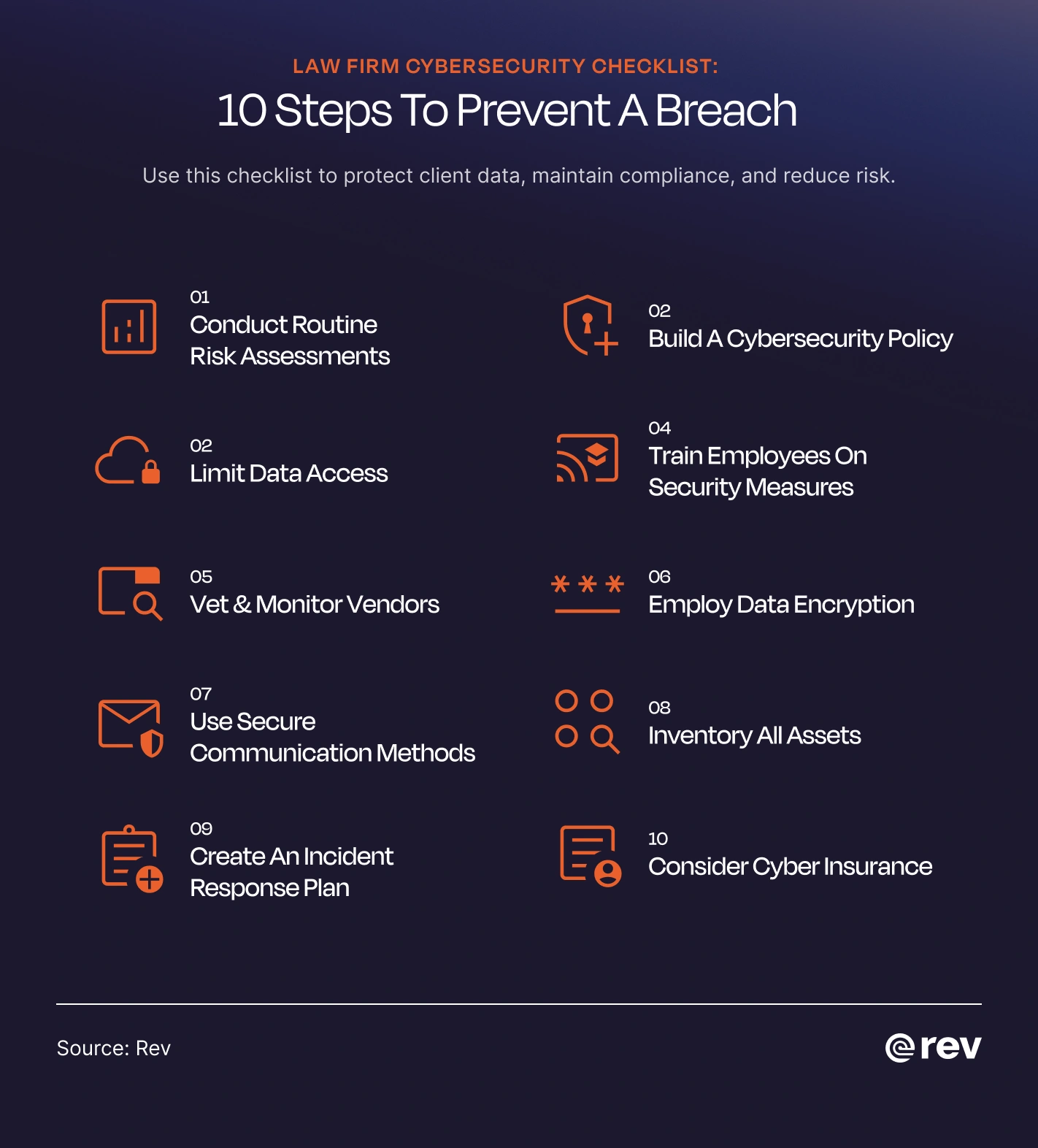
7. Practice Secure Communications
Encryption isn’t the only way to secure firm communication channels and prevent access. Firms can use a range of strategies, such as a secure messaging system instead of email or a private file transfer portal for sending and receiving documents.
Remote court reporting or client video conferencing — both increasingly common — introduce special cases that weren’t an issue in the past. In these instances, meeting rooms should be locked and password-protected, screen sharing limited, and live captions secured.
Even with traditional mail, security is important. Firms should send sensitive documents via registered or certified mail to verify delivery and ensure they reach the intended recipient.
8. Maintain A Complete Asset Inventory
You can’t protect what you don’t know you have. That’s why maintaining a full inventory of all hardware, software, data systems, and user access points is crucial for ensuring complete data security for law firms. This includes everything from laptops and mobile devices to cloud platforms, case management tools, and backup systems.
An up-to-date inventory makes it easier to identify vulnerabilities, apply security updates, and control who has access to sensitive information. It’s also vital for incident response, so teams can quickly assess what systems may be affected and take action. As your firm adopts new tools and workflows, review and update this inventory regularly to ensure no point of exposure goes unseen.
9. Plan For Incident Response And Business Continuity
All of these steps are designed to prevent the worst from happening. But as many firms have learned, even strong defenses can’t eliminate risk entirely. That’s why it’s critical to plan for how your firm will respond to a cybersecurity incident.
An effective plan should outline how to detect and contain a breach, communicate with clients and stakeholders, and quickly secure affected systems. It should also include clear steps to restore access to critical data and minimize operational downtime. Preparing for the worst-case scenarios can help prevent them from becoming a reality.
10. Consider Cyber Insurance for Your Law Firm
With the growing threat of cyberattacks, it’s no surprise that cyber-insurance premiums have risen rapidly in recent decades — Q4 2024 saw the first decline in rates following seven consecutive years of increases, according to data from the National Association of Insurance Commissioners. Still, the cost of coverage is pennies compared to what your firm will pay to deal with a cyberattack.
Cybersecurity insurance can help offset the expenses of handling a data breach, including loss of income during downtime, forensic investigations, and crisis management. Cyber-liability insurance, meanwhile, protects firms and court reporting agencies from liability claims in the event of a data breach. Both are worth considering as you plan for legal data security.
Rules, Regulations, And Compliance
Many regulations and recommendations are already in place to guide law firm cybersecurity best practices.
For instance, the ABA’s Rule 1.6 instructs that firms must “make reasonable efforts to prevent the inadvertent or unauthorized disclosure of, or unauthorized access to, information relating to the representation of a client.” Similarly, Formal Opinion 483 concludes that firms “have a duty to notify clients” of any data breaches that may involve their personal information.
Beyond ABA guidance, law firms must also navigate a growing web of data security frameworks and regulations. Standards like NIST Special Publication 800-63B offer guidance for creating secure access policies and implementing controls like multi-factor authentication (MFA).
Industry-specific and regional laws — such as HIPAA for firms handling medical records, the GDPR for firms dealing with international data, and state-level laws like the California Consumer Privacy Act (CCPA) — can impose additional requirements around data handling and breach disclosure.
These are just a few examples, but the overarching point is clear: lawyers and legal firms should give more than just a passing thought to their cybersecurity practices. Firms are expected to protect client data and demonstrate that protection through documented policies, secure systems, and a clear incident response plan.
Best Tools For Legal Cybersecurity
Achieving law firm compliance and mitigating cyber threats is no small task — especially since most legal professionals aren’t trained on the topic. Robust security practices require a variety of tools and resources.
Here are some key cybersecurity solutions for attorneys and their firms:
- Antivirus, malware, and endpoint detection: Traditional antivirus is a baseline, but modern firms should use endpoint detection and response (EDR) tools to monitor devices in real time. Examples include VIPRE, Symantec, and Sophos.
- Data encryption software: Encryption should protect data both at rest and in transit to prevent unauthorized access. Common standards include AES and RSA.
- Multi-factor authentication tools: MFA adds a critical layer of protection by requiring extra verification beyond passwords. Popular options include Okta, IBM Security Verify, and JumpCloud.
- Identity and access management (IAM) platforms: IAM tools enforce the principle of least privilege by managing user roles and access across systems. Common solutions include Microsoft Entra ID, Okta, JumpCloud, and Duo.
- Virtual private networks (VPNs) and secure access tools: VPNs encrypt internet traffic and protect remote connections, but they should be paired with strong identity controls. Examples include NordVPN, Private Internet Access, and Encrypt.me.
- Secure communication and file-sharing platforms: Use encrypted messaging tools and secure portals — not standard email — to share sensitive information. Examples include ShareFile, Box, OneDrive, Signal, and Microsoft Teams.
- Backup and disaster recovery solutions: Regular, tested backups — ideally offline or immutable — are essential for recovering from ransomware or data loss. Common options include Veeam, Acronis Cyber Protect, and Datto.
- Security monitoring and threat detection: SIEM tools provide visibility into network activity and alert teams to suspicious behavior in real time. Popular choices include Splunk, Microsoft Sentinel, and IBM QRadar.
- Meeting and transcription tools: Secure platforms for recording and transcribing legal proceedings help protect sensitive audio and video data. Rev offers SOC 2–compliant transcription with encrypted file handling and controlled access.
Aside from these tools, it’s important to stay aware of the latest trends and best practices for cybersecurity and law. The ABA’s cybersecurity resources are a good place to start, as well as this set of cybersecurity resources for lawyers from America’s Cyber Defense Agency.
Enhance Your Law Firm’s Cybersecurity With Rev
A law firm’s role as a hub of extremely sensitive client information makes it uniquely vulnerable to cyber threats. Now, more than ever, cybersecurity and law practice must go hand in hand.
Rev provides simple, streamlined cybersecurity for lawyers and court reporters. We are SOC 2 Type II Security Compliance Certified and HIPAA-compliant, and our industry-leading AI-powered transcription services are built to keep your sensitive information secure.
Ready to lock down your data?