Speaker 1 (07:26):
Dallas, whose leadership and commitment made it possible to bring the secretary to Dallas for this important conversation. On behalf of everyone here, I would like to thank the secretary for his leadership, his service, and for spending time with us. It's a privilege to welcome him today.
Scott Bessent (07:46):
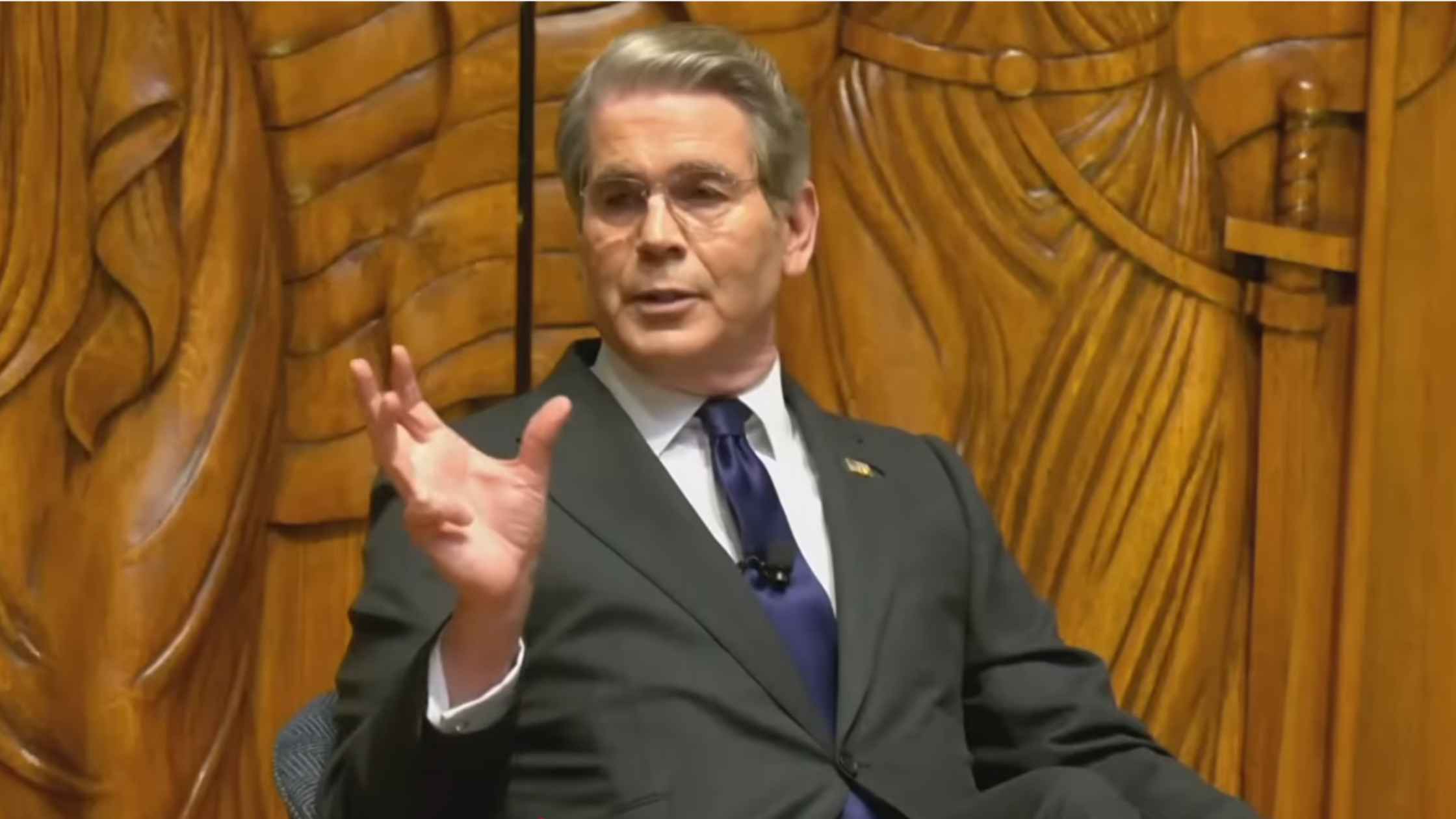
Good afternoon and thank you. I'd like to thank Ray Washburne, Michael Levy, and the entire leadership of the Economic Club of Dallas for hosting me today. And as the business leaders of this community, you all know better than anyone that Dallas is a city built by risk-takers created by a hydrocarbon base, now stacked with Fortune 500 headquarters and sustained by the simple conviction that prosperity follows production. Texas reflects what a diversified economy looks like with strength in sectors, ranging from advanced manufacturing to technology to finance. We need to look no further than Y'all Street to see that parallel prosperity is alive and well right here in Dallas, one of the fastest growing financial hubs in the country.
(08:48)
In many respects, Texas embodies what this administration is working to build nationally, economic security rooted in production, resilience, and long-term durable growth. And in that sense, Texas can serve as a model for the rest of the United States. Economic security is the foundation that allows a country to fulfill its most basic obligation of safeguarding its people. For a nation to be economically secure, it must possess the productive capacity to withstand shocks, deter adversaries, and deliver rising prosperity to its citizens. Unfortunately, past administrations lost sight of this fundamental truth, allowing faux efficiency gains and short-sighted profit obsession to eclipse security resilience and long-term value.
(09:45)
President Trump saw the points of failure decades ago, and he has made clear that we cannot compromise on economic sovereignty except structural vulnerabilities or allow strategic industries to erode as a result of outdated or misguided assumption. At President Trump's direction, our administration has therefore made economic security the centerpiece of our economic policy. Today, I will share our strategy for putting America first by re-prioritizing economic security which rests on three pillars. First, industrial and technological dominance. Second investment in America. Third, preparedness. From the earliest days of the republic, our founding fathers understood that independence required economic security. The ability to produce essential goods, sustain public credit, and foster domestic industry was seen as the foundation of sovereignty by Alexander Hamilton and it still is.
(10:56)
After the World Wars, the United States made deliberate concessions and trade and industrial policy to help allies rebuild and defend against the threat of communist expansion. Those decisions contributed to decades of global stability and growth, but with a trade-off. As markets became freer, they did not become fairer. With the China shock of the 21st century, strategic industries were hollowed out, supply chains consolidated overseas, and we became wholly dependent on single foreign suppliers within certain sectors. In just over a decade, between 1999 and 2011, the United States lost nearly 6 million manufacturing jobs that led to not only employment loss and wage depression, but also to diminish productive capacity and importantly resilience.
(11:53)
A nation that cannot produce the critical goods and resources to sustain itself is exposed and vulnerable to coercion. The COVID-19 pandemic fully exposed these vulnerabilities on the world stage for our own people, our adversaries to witness. This administration is encouraging American companies to reduce single points of failure by diversifying their production, and importantly, bringing critical outputs back to the United States. Our policies have compelled firms to reassess their sourcing strategies and pour trillions in new investment back into American manufacturing and strategic sectors. Historic trade agreements have begun resetting the global trade paradigm, and over time, diversified supply chains also reduce inflationary volatility by lowering the risk of sudden disruption.
(12:53)
One year into the president's second term, we are already seeing and will continue to see results. Industrial might and technological dominance are mutually dependent and reinforcing, which is why the US must maintain its technological edge. The global economy is undergoing a period of rapid transformation with breakthrough advances and AI, quantum computing and advanced manufacturing. The countries that adopt and deploy these technologies most effectively will shape the next era of growth and the world is counting on America to lead as we always have.
(13:36)
For 250 years, American innovation has been our decisive advantage. We are in an existential battle to maintain and accelerate technological dominance. The production and development of AI infrastructure will be crucial to both economic growth and national security in this next industrial revolution. Beyond production, leadership in AI adoption is another crucial component of economic security. At Treasury, through this Financial Stability Oversight Council, we are working with regulators and industry leaders to further responsible AI usage in the financial system. We are optimizing regulation for growth, moving away from a posture solely focused on constraint toward one that recognizes that failure to adopt productivity enhancing technology is itself a risk.
(14:35)
Stablecoins represent another area where leadership matters. A well-regulated dollar-based stablecoin market can reinforce the global role of the US dollar and extend its network effects into emerging digital systems. The GENIUS Act provides Treasury with oversight tools to ensure transparency and confidence in this sector. Industrial capacity, technological leadership, and a strong dollar policy taken together formed the backbone of US economic sovereignty, which is why they are all fundamental to our strategy. To deliver industrial, technological, and currency strength requires confidence and capital, which brings us to pillar two, investment in America. The United States holds a unique position in the global economy with the dollar as reserve currency. A key factor in enabling economic security. Reserve currency status anchors our borrowing costs, deepens our capital markets, and strengthens sanctions actions, and reinforces American leadership and global finance. This rests on our confidence in our institutions and critically in the health of the US Treasury market.
(15:54)
The Treasury market is the foundation of the global financial system as the benchmark risk-free asset serving as collateral across markets and the channel through which global capital flows into the United States. Preserving the strength, liquidity, and credibility of that market is central to economic security and is not something that can be taken for granted. Investment in America also means ensuring that capital flows to sectors that enhance long-term productivity and strategic resilience. To do so, we are focused on tailoring fit-per-purpose regulation.
(16:35)
Over the next six months, Treasury will engage industry, academia, and national security experts to evaluate how supervisory frameworks can better mobilize capital toward sectors critical to national strength, advanced manufacturing, energy infrastructure, semiconductors, and defense innovation. Economic security also depends on broader participation in wealth creation. Almost 40% of Americans today have no exposure to the US equity market. This means they participating in the world's greatest economy as workers and producers, but not as owners.
(17:17)
Trump accounts represent a fundamental rewriting of that arrangement. Under this initiative, every eligible American child will receive a thousand dollars Treasury funded seed investment at birth invested in a diversified index tied to the long-term growth of the US economy. Additional contributions can come from philanthropists, families, employers, and state governments. The objective is simple, give every child a stake in the American dream from day one. Texas has already demonstrated leadership in advancing this vision. In fact, Texas Senator Ted Cruz authored the precursor to the Trump accounts provision in the One Big Beautiful Bill and Texas natives Michael and Susan Dell led the way in philanthropic giving with their historic 6.25 billion, with a B, donation to top up Trump accounts for 25 million American children.
(18:20)
The president has called on business leaders and philanthropists all around the country to get involved in the initiative, and today I'm calling on the men and women in this room to do the same. Everything is bigger in Texas and that should also be true for Trump accounts because economic security is strongest when it is broadly shared. The final pillar is preparedness. Economic security requires not only strength, but resilience in the face of disruption, which means proactive measures to limit disruption from occurring in the first place. The 1973 Arab Oil Embargo is a cautionary
Scott Bessent (19:00):
... tale and historic lesson. A geopolitical decision thousands of miles away triggered drastic energy shortages, inflation, economic chaos, and market turmoil here at home. American consumers felt that shock acutely when the price of oil jump by nearly 300% before the embargo lifted. Equally significant as the pocketbook effect was a geopolitical reckoning: the fact that if foreign power could so fundamentally disrupt the US economy with a stroke of a pen. This is the very definition of a single point of failure.
(19:42)
Today, in my opinion, there are two significant risk frontiers. The first is a major cyber incident disrupting banks, payment systems, or other financial market infrastructures. The second is that even despite reassuring efforts, more than 90% of advanced chips are still manufactured in Taiwan. Creating physical and digital safeguards therefore underpins economic security by preventing geopolitical or operational shocks from mutating into economic disequilibrium, and a broader loss of confidence. In today's environment, preparedness must also include deterrence. Preparedness means ensuring that no adversary believes it can hold the American economy hostage or disrupt the well-being of American citizens.
(20:37)
Geopolitical risks must be a key factor considered in policymaking across agencies, and not treated as an afterthought. Economic statecraft remains central to our strategy. As our administration has reinforced repeatedly, America first does not mean America alone. Our economic security is strengthened when the Western Hemisphere is aligned around free market principles and the rule of law. We are deepening cooperation with partners committed to these principles while working constructively with long-standing allies such as the UK, Japan, and the EU as they modernize regulatory frameworks and pursue growth.
(21:22)
As the US hosts the G20 this year, we reject the premise of weakened global growth, and intend to advance a results-oriented growth and economic security agenda, promoting deregulation, competitiveness, and reciprocal opportunity. This will further our own economic security, and we stand ready to support allies who share these goals. On the eve of our great nation's 250th anniversary, we recognize that economic security is foundational to our ability to thrive for the next 250 years. Under President Trump's leadership, we are restoring industrial capacity, reinforcing technological leadership, expanding economic opportunity, and strengthening resilience. We are fundamentally resetting the framework in which the United States participates in the global economy, recognizing that economic security above all else is the foundation of sovereignty, and thus the grantor of prosperity.
(22:27)
Treasury's mission is clear: to act swiftly and decisively to put America and America's security first. I would also like to take a moment to address today's Supreme Court ruling, and I would note that I did not change a single word in my speech via post the ruling. President Trump will always put our national security and Americans first. And as I have said before, the president has multiple tools in his toolbox. Let's be clear about what today's ruling was and what it wasn't. Despite the misplaced clothing from Democrats, ill-informed media outlets, and the very people who gutted our industrial base, the court did not rule against President Trump's tariffs. Six justices simply ruled that IEEPA authorities cannot be used to raise even $1 of revenue. This administration will invoke alternative legal authorities to replace the IEEPA tariffs. We'll be leveraging Section 232 and Section 301 tariff authorities that have been validated through thousands of legal challenges.
(23:42)
Treasury's estimates show that the use of Section 122 authority combined with potentially enhanced Section 232 and Section 301 tariffs will result in virtually unchanged tariff revenue in 2026. And with that, I look forward to chatting with Ray Washburne, and taking your questions. Thank you.
Host (24:10):
Please welcome Ray Washburne to the stage.
Ray Washburne (24:16):
Scott. Well, Scott, first of all, thank you for coming. I want to thank Harlan Crow and Michael Levy for hosting us here today, because you're always so generous in hosting here today. And so, what a beautiful room.
Scott Bessent (24:31):
I feel like this is the warm up for the State of the Union.
Ray Washburne (24:33):
Yeah. Come on, walking through these doors.
(24:37)
Before we get started, let's talk about Y'all Street real quick with Dallas. JP Morgan's huge operation here, Goldman Sachs, Morgan Stanley. We had the now the Texas Stock Exchange, New York Stock Exchange, NASDAQ. What's a chance we can get Treasury to move here?
Scott Bessent (24:57):
I wouldn't mind coming for the next 18 months because they're building the ballroom next to my office.
Ray Washburne (25:02):
Okay. On a construction.
Scott Bessent (25:04):
And one thing I can guarantee you is it's going to come in on time, it's going to come in under budget, but that means starting at 6:00 AM and going to midnight. But look, I'm an economic historian, not an economist. And movements of capital, capital goes where it's treated the best. And we got to face it. I had 30 great years in New York, then I moved back to my home state of South Carolina. You could see Texas has the most by numbers, new residents coming. South Carolina has highest as a percent of the population just because low cost of living, low taxation, pro-business environment. And as an economic historian, many of you would remember the First Bank of the United States was in Philadelphia. Philadelphia was the economic capital of America, and it moved to New York. So, things can change. Florida...
(26:05)
I think 2009, 2012, I moved to Miami. Everybody said, "Oh, you've gone to the beach."
(26:12)
And I said, "No, I just didn't want to pay any state income tax."
Ray Washburne (26:16):
Right.
Scott Bessent (26:17):
And now, everyone's in Florida now. Florida now has more assets under management than Connecticut. So, I think it'd be good for Dallas and Texas just to take in productive private capital rather than government agencies.
Ray Washburne (26:34):
All right. Well, good. We said pay property taxes, isn't so? This morning, we all woke up and came in, and you just addressed it on the tariffs. It was a 6-3 vote. When you initially saw that, were you surprised? Were you...
(26:51)
Is that something you were anticipating that the vote would go the way it did, or... I know you mentioned a lot of the things that they didn't vote on, but did it go the way you thought?
Scott Bessent (26:59):
I was a little surprised because I was in the Supreme Court hearing. Mercifully, I am not a lawyer. When people say, "How do you like DC?" I said, "There are too many lawyers." But I think that what we saw was just a very narrowing of the definition of a president's ability to use IEEPA powers. So, for those of you who saw the president earlier, or have been following this closely... And I always found, when I was in the private sector, in my investment business, it was very good to separate signal from noise. And a lot of the noise is what Trump tariffs defeated. The only thing that was defeated is the ability for IEEPA to collect even a dollar of revenue. President, and I was at the hearing, and the justices agreed, and even the plaintiff agreed, that under IEEPA, the president can install a full embargo. He just can't collect a dollar of revenue.
(28:12)
So as I said before, there are 232 and 301 tariffs that have withstood more than 4,000 lawsuits since the first Trump term. There is something called Section 122, which grants president five months to install, to put a global tariff on. So president announced today he is going to put a global tariff of 10%, and then a number of 232 and Section 301 tariff investigations will be started. Those take a number of weeks and months to implement. So, I can tell you that the total amount of revenue that Treasury will collect this year will be a little changed, if changed at all.
Ray Washburne (29:08):
So, you've already collected around 175 billion or something.
Scott Bessent (29:11):
Well, that's under the IEEPA tariffs.
Ray Washburne (29:16):
But is that going to be in dispute? Who gets it back, or what-
Scott Bessent (29:20):
Yeah, it's in dispute. Supreme Court did not rule on that today. They pushed it back down to the International Tax and Trade Court. And my sense is that could be dragged out for weeks, months, years. So, we'll what happens there.
(29:38)
But the look forward, no one should expect that the tariff revenue will go down. And roughly, last year, the existing revenues under the 232s, under the 301s, and some other collection mechanisms were roughly equal to the IEEPA tariffs.
Ray Washburne (29:57):
That's going to be a food fight going after $175 billion, isn't it?
Scott Bessent (30:02):
I got a feeling the American people won't see it.
Ray Washburne (30:06):
Yeah. Okay. Let's shift real quick and talk about kind of the shadow banking economy that's happened, because in the country right now, Blue Owl, people like that that have come along. That there are a lot of commercial bankers in here that are now having to compete with unregulated capital out there.
(30:23)
What's your view on how that's grown so much in, really, the last really five years or so? And that's unregulated outside of your roots.
Scott Bessent (30:34):
Yeah. So, it's really been about 10 years. And I think a lot of it... And again, I was also a financial institutions' analyst in the early part of my career. So I followed the regulated banking system, the insurance companies, SNLs, when there were SNLs. And I think private credit developed as a regulatory arbitrage, because post-Dodd-Frank, the regulatory straitjacket around our regulated institutions was so tight. Making loans became very difficult. The big got bigger. We lost more than 50%, 50 of our small and community banks, because it went from too big to fail to too small to succeed. And I think this growth outside the system, at Treasury, we have been pushing for loosing of the regulatory straitjacket. Oliver Wyman's words of not Treasuries. They believe that our changes in regulation, that I don't change the regulations. I guide them through a convening mechanism as the chair of the financial, the Stability and Oversight Council.
(32:07)
But OCC, control of the currency, FDIC, and the Fed, that's probably created 2.5 trillion of new borrowing capacity. So, 2.5 trillion of new borrowing capacity for the regulated industry. So now, private credit has a competitor. What we are concerned about and/or what our focus is, doesn't have to be a concern, is what is the relationship between private credit and the regulated sector? So, our private credit funds borrowing from the regulated sector. You saw there was a transaction yesterday where Blue Owl sold a tranche of their loan portfolio to three pension funds and a captive insurance company. So, that's moving it into the regulated industry. And you see almost every one of the private credit companies has a regulated entity. So now, Treasury gets involved.
(33:15)
So, we are concerned. I am concerned with watching how does this get to the regulated financial system. I, as maybe some people in this room did successfully predicted, and unfortunately successfully predicted the subprime crisis that then turned into a banking crisis. And you could see these CDOs and exotic instruments on bank balance sheets. So, our job is to make sure that the regulated system is not affected by private credit. And we'll see. I think the private credit has been an exciting new feature. I think it bridged the gap, especially during the tough and tight regulatory times. I think that they were there during COVID, when some of the banks were frozen, and I hope that they've been prudent in their loan portals.
Ray Washburne (34:23):
But a lot of the private funds are doing extend and pretend. We see that a lot in the real estate industry, where a commercial bank would have to call a loan and they're pushing out. And then even in the private equity side, the continuation funds that they have that aren't sunsetting, they continue them on. Isn't that just pushing problems off into the future that as a secretary of the Treasury, you have to look at it and go, "What is really going on behind the curtain?" That you don't really get a chance to look at.
Scott Bessent (34:51):
We have the ability to peel back the curtain. And-
Ray Washburne (34:53):
Even on a private equity deal?
Scott Bessent (34:55):
Oh, sure. I wouldn't... They had...
Ray Washburne (34:57):
Be careful. A lot of them are out here. [inaudible 00:34:59]
Scott Bessent (35:02):
When you get a call, "The secretary of the Treasury wants to come and see you," you can return the call. But again, that we want to gauge, could it have any effects on the overall economy? Thus far, it's been very additive. But again, how does it affect the regulated system? We want to prevent contagion. The other thing that I would say, and everyone in private credit/private assets should listen to this, because at Treasury, we are part of the rulemaking process for private assets going into retail. And this administration, led by Treasury, is committed that the individual investors will not become the dumping ground for residual.
Ray Washburne (36:03):
You're talking about the 401(k) plans. So, specific.
Scott Bessent (36:06):
The 401(k) plans specifically. That if there is something rotten, it is not going to be handed to the individual investors. And we are a hundred percent with my colleagues at the Department of Labor committed to that.
(36:23)
And look, it's everyone's advantage that should individual investors be able to diversify into private assets, definitely. But if the timing is bad, if there are a set of mal actors, if intentions are bad, then it will be one of these things that it will be blocked for a generation. So we want to do it in a safe, sound, and smart way, both for the private equity firms and most importantly for the American investing public.
Ray Washburne (37:01):
Wall Street's looking at this at trillions of dollars going to be unleashed into things that normally, they weren't able to invest in real estate and things like that. So there is a thought that valuations in hard assets are going to go up because now, people have access to the small dollar investors can go in there. But you're right is are the fees laid on it so heavy by the big firms and things like that? But you can't really regulate that.
Scott Bessent (37:25):
We can't regulate that. But what we can think about, some things to think about, perhaps private investors shouldn't get a continuation fund. If you weren't in the original fund, then a private equity firms shouldn't put 401(k)s into a continuation fund. If there's a credit that's already in your private equity business and you do a follow-on loan, then maybe that's not appropriate.
Scott Bessent (38:00):
... It may be just de novo loans to new entities would be more appropriate. So again, we want to make sure that the 99% of good actors do not get polluted by a couple of bad actors that it seems to happen every couple of decades.
Ray Washburne (38:23):
So let's go back to banks for a second. I've served on the board of some smaller regional banks here, and so many in the past have been rolled up and then really mergers until the Trump administration came along, had pretty much died for four years and people doing de novo banks. That's kind of gone away in a sense. What's your view on the banking system in the United States? Do you feel like it should consolidate around a few very, very large banks or do we need to have a lot of regional community banks that really have kind of built a country?
Scott Bessent (38:57):
Yes on B. What's happened? Again, I think the regulatory morass just got too big to fail, too small to succeed. One of the things that I've been working on, and it is both sides of the aisle and it's Senator Hagerty from the Tennessee Senator also broke for Maryland are pushing for small and community banks to be able to have an enhanced non-interest bearing account. Each depositor could have one, and where there's a much higher level of deposit insurance, let's pick a number because it seems like $10 million right now because what happened-
Ray Washburne (39:53):
Where is it today? It's like a hundred thousand?
Scott Bessent (39:55):
250.
Ray Washburne (39:56):
Do you want to take 250 to 10 million for a single account?
Scott Bessent (39:59):
For a single account non-interest bearing. And I'm informed by this, by what happened with the deposit volatility during 2023 when we had the second, third, and fourth-largest bank failures despite Senator Warren's regulatory morass. I always say she's a financial agoraphobic. How do you not get hit by a car and never come out of your house, but this high level of regulation, don't make any loans, you'll never lose money. But somehow with all these regulations, all this, the overbearing supervision, we had these bank failures. But what happened during those bank failures was the money ran to the very largest banks. And I'm saying that even US Bank Corp, which I think is the fifth-largest bank, lost deposits to JP Morgan, like this moral hazard of the biggest banks or the public believing that the biggest banks have unlimited insurance in a crisis and then the money leaves the smallest banks and the money that leaves the smallest banks.
(41:18)
For any of you who have small businesses, for any of you who are on the boards or own smaller community banks, it's usually a payroll account. It could be a lawn service company, it could be a restaurant, but payroll account can be several million dollars. And that moves to, let's pick on, it moves to Wells Fargo because they believe that government would not let anything happen to Wells Fargo. And payroll account then ends up there and Wells Fargo are smart bankers. So they said, "We don't like just having the payroll account bring your other accounts over." And then all of a sudden a community bank that's had the same client for a hundred years, it's gone. So we think that this is a very smart and effective way to allow the small banks to retain business borrowers or high net worth individual or depositors over a long period of time. And these small banks are important that up until December 12th, I was a farmer.
(42:31)
I was involved in the agricultural business and I had to divest my holdings. And that sometimes a Saturday morning I turn on Farm Radio and you listen to Farm Radio and I remember listening after all the bank failures in 2023. And it's exactly as you would expect. These farmers are saying, "Look, these out-of-state bankers, they don't go to your church. They don't play little league baseball with your son. They don't play softball with your daughter. You didn't go to high school with them. They're not in the local community." And I think there's nothing like these local community banks. They drive the, I think it's 70% of real estate lending. They drive ag lending, they drive small business lending. And when you think Wall Street versus Main Street, it's really time for Main Street to do better. And I think Main Street can only do better when the small banks do better.
Ray Washburne (43:37):
Well, we're fortunate. You're probably the first treasury secretary we've ever had that listens to Farm Radio. So I very much appreciate you understand what's going on in the rest of the country. Now real quick, this is subject we could have had the entire hour to talk about, but I'm going to break into two parts and that's AI. One is the investment AI and the other is the effect of AI. And so I'm going to start first with the effect of AI and the kind of slow fire, slow hire we're going through in this country right now. Because if you're graduating from college, the biggest unemployment bubble right now is 19 to 28 year olds really not being able to find a job.
(44:12)
And then people are holding on to people longer wondering what the effect of AI. So that's kind of, I think a lot of people in this room, our businesses are like, "What is this AI really going to do?" And then secondly, maybe we can talk about this huge investment that's going into AI by Oracle and these companies that different than the internet time when money went into stuff like Pets.com that really didn't have a market. I mean these are real companies putting the money up. So you can take either one of those you want.
Scott Bessent (44:41):
Yeah, so I'll take both of them is one, I think it is very hard to disaggregate what's the effect of AI and what's the effect of the COVID employment trends hold over. Because I'm sure anyone in this room, employee retention during COVID was dire. My firm, we started paying quarterly or mid-year bonuses the first time ever for employee retention. When I left just over a year ago, we'd stopped that. But I think that, as you said, slow to fire, slow to hire. I am very optimistic about the overall labor market right now. I'm very optimistic about the economy that historically when I used to have to analyze economic data to make market bets, I always found that you were going to see an acceleration in the employment market when the temporary staffing companies did well.
(45:51)
And temporary staffing companies are now reporting very good earnings, a very good demand. And historically that morphs into long-term demand. We've also seen about a 12 or 14% CapEx boom in 2025. Traditionally CapEx booms were followed by labor booms. So we'll see what the effects are of AI. You'll probably be able to figure out who I'm talking about. When I give the breakdown, I had a major credit card company at Treasury about a month and a half ago, and I asked the CEO, "What is the effect of AI on your business?" And he said, "Well, on our collections and billing department, we're definitely taking down employees, but we're moving them all to the travel department." So it may be a reallocation and maybe in a different world travel would've been hiring. But just with that particular anecdotal example, the employment's flat.
Ray Washburne (47:08):
How about on the investments? Does that worry you at all this big massive amount of capital that's being allocated to that? Because if you look at it as part of our GDP, it's a massive percentage, probably more so than any other industry that's as a startup in history.
Scott Bessent (47:22):
Well, I think a very good way to frame it is approximately every $300 billion is 1% of GDP. So every time when you read that there's going to be, make it easy on me, 600 billion of AI, that's too-
Ray Washburne (47:40):
But is that a disproportionate share?
Scott Bessent (47:42):
If you go back and you look at railroads, electrification, no, internet, it's probably more compressed. And I think the reason it is more compressed is the hyperscalers with Google, Microsoft, Oracle, Meta, probably leaving out a couple, OpenAI. Well that's a de novo company, but these are big companies with big balance sheets and for them to do big CapEx doesn't strike me as speculative. Even for Microsoft, $120 billion checks a big check, but they've got the balance sheet. They can hold the leverage.
Ray Washburne (48:36):
Okay, well we have about five minutes left, so you are gracious to take a couple questions from the audience. So anybody, we have the microphone here. Rob Walters over here.
Speaker 2 (48:48):
I could stand here. I want to ask you about our national debt. I think the received wisdom is there are three ways out. Growth, austerity, inflation. I'm no economic historian, but I don't think there's ever been a nation that has grown their way out of very high national debt austerity. I can tell the direct Republican like officials are not too enamored of austerity is the right way out. Is inflation the only way out? And my question is, where does that fit within our hierarchy of priorities? And is inflation the only way out?
Scott Bessent (49:25):
Sure. So I do think there is the ability to grow our way out, but I think it has to be a combination of A and B. And I would add there is a D, repudiation, but that's not on the table. So just to put some real life numbers around things. In 2024, the deficit to GDP was the highest it had ever been when we weren't at war or weren't in a recession. And that was one of the reasons that I came out from behind my desk. I had known the Trump family a long time, went to see candidate Trump then, told him I wanted to be in the economic team because I was worried that the other side wanted to go into a kind of European style, economic malaise, higher debt, higher taxes, lower growth, lower growth, higher taxes, more debt and rinse and repeat. Go into that doom cycle, which we're seeing in some of the European countries right now. So 2024, 6.9, 7% deficit to GDP. 2025 by restraining spending and growing the economy, 5.4% deficit to GDP. I've stated that I would like to get back down to 3% deficit to GDP by the time the president leaves office. And at that point, not only is the debt stable, but you start reducing the debt to GDP. So it is possible that if you restrain spending and grow the denominator, then you do de-lever. And I think we've seen that for the American people, inflation is not an option.
Ray Washburne (51:30):
With the entitlement programs too, we got to get that.
Scott Bessent (51:33):
I think this administration needs to get current spending under control. And then the entitlement programs, you got to do the short term before you can do the long term.
Ray Washburne (51:50):
Okay. Yeah, right here. Mr. secretary, hang on just a sec because they're recording this.
Speaker 3 (51:54):
Sorry. Mr. Secretary, the AI has been the topic of this conversation and most conversations about the future. You've talked about the several effects of AI, give us your view of the background impact on our economy.
Scott Bessent (52:14):
I think we don't know yet. I think that you've got to have an open mind that my three AI whisperers all called me within the past 10 days and said that the acceleration with AI agents from December to February had been the same, so in two months had been the same that it was in the past two years. So the capabilities, it's really, when you think about a hockey stick, I don't even know what this would look like. And I have an open mind and I think obviously productivity growth and we'll see what the implementation is. And then I think we also don't understand what it means for the US vis-a-vis the rest of the world.
(53:08)
That's why in my talk, that imagine a world where the US is so far ahead of AI. There's China, there's the US, and then there's everybody else with AI. What's a call center in India worth? What are other countries going to do if we have this productivity boom? Because keep in mind, European Union and the US, in 200, 2005, we had the same size GDP. We are more than 50, I don't know whether it's 100% bigger than the EU. So I mean, we've just passed them. So could you see the US pull away? Maybe.
Ray Washburne (54:04):
So the secretary's going to have to leave. He is going to a rally for Trump accounts, which he spoke about earlier, and I don't know how much y'all took of that, but I went to the kickoff in DC about, I don't know, three weeks ago or something when they kicked it off. But it really is amazing that the Dell family stepped up for, as you said, six and a quarter billion dollars to help fund these things at a thousand dollars. And employers can match it. And so any of you with a company that want to match it with your employees, that's something, as he said, is, I'm doing a sales pitch for you here, but there really is an interesting deal. I didn't know anything about it until I went to DC and saw it, but I think that's going to be a major for President Trump, his major legacy.
Scott Bessent (54:46):
Look, I think when we see Mayor Mamdani in New York, part of that is disaffected, mostly younger people who have given up on the system. And when you see the exact number is 38% of American households have no exposure to the equity market. So for the next four years, every child born is going to get a Trump account, a thousand dollars from Treasury, it's going to go into an S&P fund. It is locked up for 18 years. We're going to do a ton of financial literacy. But I think more importantly, it's going to be a real time experiment because now every family is going to be able to look on their phone and they will care what the stock market's doing.
(55:42)
Is it going up or down? And all those accounts can be topped up. Any child under age 18 family can open one. They won't get the thousand dollars, but Susan and Michael Dell are actually giving the money to the bottom 80% of income zip codes. And it's for the kids who aren't getting the thousand dollars. It's an amazing amount. When the president announced it, he looked at Michael and said, "You know Michael, 250 millions a lot, but you did 6,250 million." And so it's about $250 for every child in America who is not in the top 20% zip code. So you can adopt a school district, you can adopt a zip code. There are lots of ways to do it. They're going to launch.
Ray Washburne (56:44):
But the things for a company, if the government's giving you a thousand dollars, a company can match it. Put a thousand dollars in the compounding ... is that right?
Scott Bessent (56:51):
The company could put up to 5,000.
Ray Washburne (56:53):
Okay, well, the compounding effect over that period of time for a company, if they just put a thousand on top of the 2000,
Ray Washburne (57:00):
... and it ends up being worth hundreds of thousands of dollars at that point.
Scott Bessent (57:04):
So, it's available to the children when they turn 18, or you can roll it into a retirement account and then let it roll to 60 or 65. We hear a lot about food deserts, of families not being able to have access to good nutrition, there's also a financial services desert. And if you think about 25 or 30 million of these accounts being open, then all of a sudden Christmas, birthdays, relatives can just drop in $20 each month.
(57:44)
And I just think this is a game-changer. I think it is going to get everyone interested in the markets. And my experience studying financial history is people who own part of the system don't want to bring down the system. And I think it just does create this new enthusiasm. I think this is going to be the most important program since Social Security in terms of financial security, because for working Americans, social security is the bedrock of their retirement, it's the defined benefit plan, guaranteed monthly payments.
(58:25)
But then, on the other side, you'll be getting this lump sum at age 60, or if you want to take it out, whether it's $5,000, $10,000 from just the original $1,000 and compounding, use it to start a business, to purchase a car, part of a home down payment. Because I had the Mortgage Bankers Association in the other day, and they said that they have a 70% fall-off rate from people who start a mortgage application and don't finish it, one of the biggest impediments is $2,000.
Ray Washburne (59:02):
Wow.
Scott Bessent (59:03):
Families can't do the $2,000, whether it's for title insurance or some other payment. So I think that these things can be leveraged. I look forward to working with you all. And again, financial literacy has been one of our family's charitable endeavors over the past 10 years, so this is kind of a dream for me.
Ray Washburne (59:31):
Well, thank you for coming. You're doing a great job and [inaudible 00:59:36].
Scott Bessent (59:33):
Thank you. Thank you.
Speaker X (59:33):
[inaudible 00:59:51].