


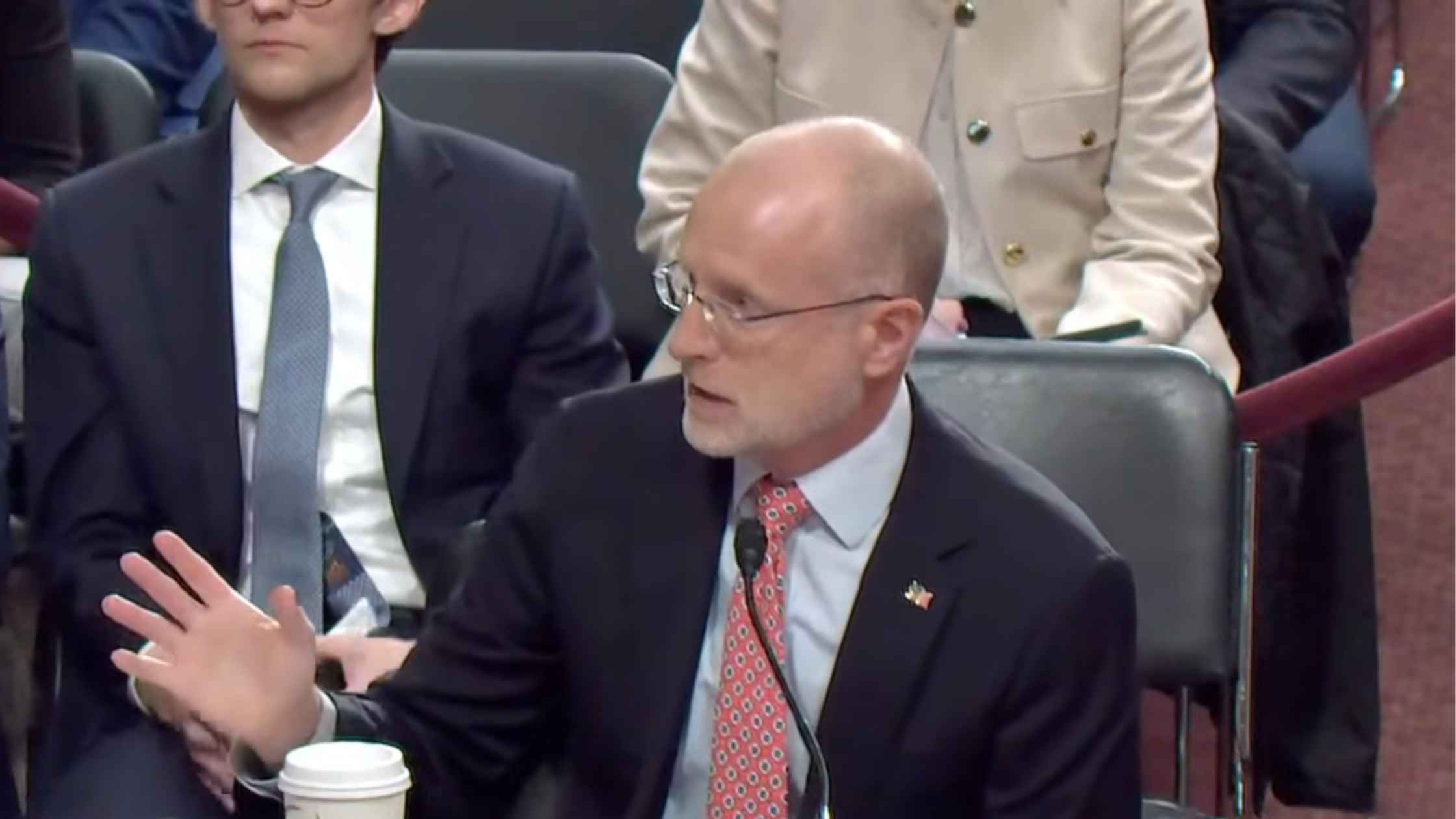
Mr. Cruz (09:45):
Good morning. The Senate Committee on Commerce, Science, and Transportation will come to order. Welcome to today's hearing, Oversight on the Federal Communications Commission.
(09:56)
The FCC plays a critical role in the lives of everyday Americans. From TV and radio broadcasting, to cellular and satellite communications and internet connectivity, the commission sits at the center of the services and technologies that power Americans' daily lives, that project American leadership and influence across the globe, and that form the backbone of our national economy. In other words, the commission's work is kind of a big deal.
(10:31)
So I am pleased that we are joined today by our witnesses, Chairman Carr and Commissioners Trusty and Gomez for this important hearing, and especially pleased that they agreed to be here and that this is the first FCC oversight hearing this committee has held since 2020. I believe Commissioner Trusty was sitting right here staffing then Chairman Wicker at that hearing. And so Commissioner, it is nice to see you have moved 30 feet to the other side of the dais.
(11:07)
We have a lot of important ground to cover today. The pace of change in just the last year, let alone since the last FCC oversight hearing by this committee, has been astounding. We've seen the deployment of 5G and early groundwork for 6G, major advancements in the satellite industry, particularly the growth of low earth orbit, high speed internet, AI, and seismic shifts across the media landscape. And we've seen the enactment of President Trump's Working Families Tax Cut Act, which not only reinstated spectrum auction authority for the FCC for the next decade, but contained the largest single spectrum pipeline, 800 megahertz, ever enacted into law. This will raise billions of dollars for the taxpayer. It will stimulate billions more in private sector investment, as US companies bring faster and cheaper internet to more Americans, and it will lay the foundation for countless technological innovations. These benefits will be felt nationwide, and indeed worldwide, across multiple generations of Americans.
(12:23)
On day one of the new administration, the FCC, under Chairman Carr, hit the ground running and already has an impressive list of accomplishments to show. These include the Delete, Delete, Delete docket, which continues to clear out the regulatory underbrush, ensuring the integrity of the universal service programs and preventing fraud by illegal aliens, reforming the FCC satellite licensing regime to help bolster America's position as the global leader in space commerce, streamlining permitting to speed broadband build out, and moving at lightning speed to implement the new spectrum pipeline, already teeing up 100 megahertz of valuable C-band spectrum to be auctioned for commercial use in the near future.
(13:17)
But there is plenty more work to be done. Given the rapid pace of evolution and technology and telecommunications, it is a wonder that the legal regime governing these issues and the commission's role in regulating them has largely not been updated since 1996. And there are any number of issues, from the utility of the so called public interest standard in the modern era, to retransmission consent rules in the streaming era, to the current media ownership caps where a statutory update might be worthwhile. The world of today with mobile computers in every pocket and artificial intelligence becoming exponentially more capable is markedly different from the time when cell phones were the size of footballs when Gordon Gekko walked on the beach holding a brick to the side of his head, and from the time when AOL was the leading edge of internet connectivity. We live in a different world, and it is worth considering whether Congress should revisit the Communications Act and update it for the modern age.
(14:33)
On the public interest standard in particular, if my colleagues across the aisle do what many expect and hammer the chairman over their newfound religion on the First Amendment in free speech, I will be obliged to point out that those concerns were miraculously absent when the Biden administration was pressuring big tech to silence Americans for wrongthink on COVID and election security. It will underscore a simple truth, that the public interest standard and its wretched offspring, like the news distortion rule, have outlived whatever utility they once had and it is long past time for Congress to pass reforms.
(15:17)
I'm grateful to our witnesses for being here today to talk about what the FCC is doing and how to address some of these important issues. The energy and focus Chairman Carr has brought to this commission in just the first year has been productive and refreshing. I'm excited for what the next several years will bring.
(15:36)
Now turn to Ranking Member Cantwell.
Ms. Cantwell (15:38):
Thank you, Mr. Chairman. Thank you for convening this important oversight hearing, and I thank our witnesses for being here. The FCC's independence is central to protecting free and diverse press, strengthen our national security, and bringing down the cost of telecommunications and media services. However, what we've seen this year and costs that Americans are facing, prices are rising. The question is, what is the chairman of the FCC and the FCC doing to bring down costs for consumers? The American people deserve an FCC that protects them from hidden fees and promotes affordability. The FCC though is, in my mind, doing just the opposite in allowing consolidations that reduce competition and can help drive up costs. Americans are paying more than ever for streaming, cable, wireless services. Streaming costs are up 13% this year alone. Basic cable costs have more than doubled in the last 10 years. And Americans are paying more than almost any other country for wireless.
(16:47)
And what is the FCC doing to help drive down those costs? Congress passed bipartisan legislation to ensure transparency and billing, but Chairman Carr has proposed to punch holes in those rules to implement that. He's making it easier for big corporations to tack on hidden fees to your internet bills. I've even heard consideration by some groups saying that we should take away spectrum from broadcast television stations because maybe they're not getting as enough use and maybe we should have even less competition.
(17:20)
So it's clear to me that the FCC, we need to do everything to protect consumers, including protecting them from the harms of AI. So instead, I see an FCC that is not focused enough on affordability. That is why today we are releasing a snapshot report from the minority here, talking about why consolidation and reduced competition is driving up cost. So hopefully we can ask some questions about that today and focus on what we need to do to keep local journalism, to keep broadcasting, and to make sure that we don't have undue influence.
(17:57)
We now know that this issue, as related to Jimmy Kimmel, "The easy way or the hard way," is just an example. And I certainly appreciate Chairman Cruz's word saying it was dangerous as hell and right out of Goodfellas, but I also appreciate Leader Thune and former majority leader McConnell agreeing that this went too far. The question is, how do we now make sure that we continue to have not so much consolidation, because I know Chairman Carr, you have supported consolidation that makes it easier to have influence and to have less competition. Local news and independent voices matter and consolidation undermines that independence and drives up cost. What happens if a merger does take place and CBS and CNN are in the same boat? Are they going to continue to be in the same competitive environment or what will we do to make sure that consumers still have choice?
(18:57)
Earlier this year, Chairman Carr greenlit the Skydance acquisition of Paramount, but not before Paramount agreed to pay 16 million in a lawsuit. Using the FCC process should not be used in this kind of extortion process, but to focus on what will drive down cost and help consumers in this process. People across the political spectrum agree there's too much control in a few hands. Chris Ruddy, CEO of Newsmax, has spoken about how corporate consolidation threats local news. Chairman Carr, what are we doing to make sure that you are going to continue to protect local mediaship ownership and grow this opportunity? We do not want to see content that is produced nationally for local broadcast.
(19:46)
I'm, right now, suffering from an unbelievable flood that has gone on for days and days. Today's latest challenge will be a blizzard. They are wall to wall with news for the safety of the citizenry of Washington. I would hate to see broadcast content interrupted or a station undermined to the point that they can't do their job in covering this unbelievable flood, which is affecting every corner, almost every corner of our state.
(20:15)
But beyond bringing down costs and protecting independent media, I am also concerned about safety. Chinese intelligence orchestrated Salt Typhoon attacks, which then Senator Rubio, Vice Chair of the Senate Intelligence Committee, described as, quote, "The most disturbing and widespread incursion into our telecommunication system in the history of the world," end quote. That should have led the FCC to strengthen our defenses. Instead, Chairman Carr, you rolled back the FCC's Salt Typhoon rules, the only major regulatory response to those attacks.
(20:49)
And the rush to auction off critical spectrum, I believe, could undermine military readiness and aviation safety. Earlier this year, we wrote to Secretaries Duffy and Hegseth outlining those concerns about safety.
(21:01)
So I hope that today's hearing can have the proper oversight on these important issues. What are we doing not only to protect consumers from cost, but protect them on their safety and security. Mr. Chairman, it's an important time. Not all of these issues have happened in the last year, but clearly we need to do our job in continuing to help the American consumer get information in a competitive landscape and also drive down costs.
(21:29)
I thank the chairman. Look forward to hearing from the witnesses.
Mr. Cruz (21:33):
Thank you, Senator Cantwell. I will now introduce our witnesses. Our first witness is Brendan Carr, the chairman of the Federal Communications Commission. He was designated as chairman on January 20th, 2025 by President Trump, and he has served on the commission since 2017. Our second witness is Olivia Trusty, commissioner at the FCC. She was nominated by President Trump and confirmed by the Senate this past June. Our final witness is Anna M. Gomez, commissioner at the FCC. She has served on the commission since September 2023.
(22:08)
Chairman Carr, you are recognized for your opening statement.
Chairman Carr (22:12):
Chairman Cruz, Ranking Member Cantwell, distinguished members of the committee, thank you for the invitation to testify. It has been a busy and productive year at the FCC, with the agency focused on delivering great results for the country. So I welcome the chance to join with my commission colleagues today and discuss the agency's important work.
(22:36)
While this is not my first time testifying before the committee, it is my first time appearing before you as chairman of the FCC. So I want to thank President Trump for the honor of leading this exceptional agency. I also want to start by saying how proud I am of the FCC's dedicated staff in everything they've accomplished for the American people. In my view, the FCC's public servants are simply the best in government.
(23:02)
At the outset, I'd also like to applaud the important work that this committee has accomplished this Congress. For instance, thanks to Chairman Cruz and many of his fellow committee members, the FCC's spectrum auction authority has now been restored through President Trump's Working Families Tax Cut Act, a historic legislative accomplishment.
(23:26)
In terms of the FCC's work, the agency has been following President Trump's strong leadership, and we've moved quickly to execute on an ambitious set of reforms. We're advancing a Build America agenda, a concrete plan to unleash high speed infrastructure builds, drive down prices for consumers, and restore US leadership in wireless. We're reinvigorating the agency's consumer protection work, including new efforts to crack down on illegal robocalls. We're strengthening America's national security with work underway that tracks Senator Fischer and Senator Lujan's leads on the FACT Act, and we're empowering broadcasters to meet their public interest obligations.
(24:16)
Lost my page for a second there.
(24:20)
Much of this represents significant change from the Biden years. Indeed, when I took over as chairman, the FCC faced several challenges. For one, the Biden administration allowed the US to fall behind when it came to one of the most important features of our economic strength, spectrum. The FCC's spectrum auction authority had lapsed two years earlier. The Biden administration had failed to tee up a single new spectrum band for auction. And the prior administration's spectrum strategy committed to freeing up exactly zero megahertz of spectrum. On top of this, permitting reform was going nowhere. The Biden administration was layering on heavy-handed regulations that only inflated prices and made it harder for broadband builders to start turning dirt. We had to turn things around and fast.
(25:11)
Thanks to President Trump's leadership, we're doing exactly that. As I detail in my testimony, the FCC's Build agenda focuses on unleashing our nation's construction crews by advancing several core goals. For one, we're modernizing permitting rules and cutting red tape. For another, we're freeing up the airwaves that are necessary for America to lead the world again. Indeed, we now have a massive new spectrum pipeline and are working on multiple new spectrum auctions. In fact, the FCC just voted on a proposal to auction up to 180 megahertz in the Upper C-band. For still another, we're boosting America's space economy, and in all of this, we're already seeing results. One carrier alone just announced that they lit up spectrum they gained access to this year to over 23,000 cell sites in record time, boosting 5G speeds by up to 80%.
(26:10)
President Trump and the FCC's Build agenda are also delivering for America's workers. Providers are now adopting faster payment cycles and fairer pricing. They're closing loopholes that allowed foreign groups to swoop in and undercut US workers, and they're improving safety.
(26:29)
Finally, the FCC is now pursuing the largest deregulatory effort in the agency's history. To date, we've teed up for removal over 1000 rules or regulations and terminated a record 2000 inactive proceedings. Eliminating those costly regulations is part of our affordability work too. For instance, we shut down a Biden era plan that could have spiked the price of internet for millions of Americans living in apartments by up to 50%.
(27:02)
And in many ways, we're just getting started. I look forward to continuing to deliver on this important agenda. And in closing, I want to thank you again for the opportunity to testify. I look forward to your questions.
Mr. Cruz (27:16):
Thank you. Commissioner Trusty.
Commissioner Trusty (27:20):
Chairman Cruz, Ranking Member Cantwell, and members of the committee, thank you for the opportunity to appear before you today. It has been nearly six months since I was sworn in as a commissioner at the Federal Communications Commission. In that time, I've had the privilege of working on policies to expand access to high-speed connectivity, enhance the resilience of the nation's communications networks, and restore US leadership in next generation communications technologies. Critical to my work has been the opportunity to travel across the country and around the world, to hear directly from broadband providers, tower engineers, fiber splicers, consumers, and our international partners and allies. Whether in Jackson, Mississippi, Eek, Alaska, or Baku, Azerbaijan, I heard about the state of the communications marketplace and how access to fixed mobile and satellite connectivity is delivering on the promise of job creation, technological innovation and economic prosperity.
(28:23)
In Jackson, Mississippi, I saw how broadband is delivering quality, lifesaving care straight into the homes of Mississippians across the Magnolia State. Doctors at the University of Mississippi Medical Center are treating chronic illnesses, managing high-risk pregnancies, and delivering mental healthcare by video to rural communities that would otherwise go without these essential services.
(28:47)
In Bethel and Eek, Alaska, I saw how access to broadband is transforming lives. These Alaskan towns are home to some of the most rugged and hard to reach terrain, and broadband is enabling Alaskan natives and non-natives alike to contribute to and benefit from the global digital economy while maintaining their treasured culture and way of life.
(29:09)
And this fall, I traveled to Baku, Azerbaijan to represent the United States at the International Telecommunication Union's World Telecommunication Development Conference. There, ministers and regulators from around the globe highlighted their progress on closing the digital divide within their nation's borders. They also used this forum to seek US guidance and leadership on maximizing spectrum efficiency, building trusted networks and secure supply chains, and creating a regulatory environment that invites continued innovation, investment, and competition, while protecting consumers and enhancing public safety.
(29:48)
These are issues we confront at the FCC in almost every proceeding. They also inform the three priorities guiding my work, universal connectivity, network resilience, and US leadership. Ensuring that every American has access to communication services has been the FCC's core mission since its founding. Following my confirmation, the Supreme Court affirmed the constitutionality of the Universal Service Fund. I commend the bipartisan bicameral Congressional USF Working Group for taking the initiative to identify reforms to ensure the program's sustainability and continued support for the operation and maintenance of communications networks in rural and remote areas.
(30:32)
In an era of growing digital hostility, however, achieving universal connectivity requires increased focus on the deployment of trusted and resilient network infrastructure. Our communications networks are the backbone of both our economy and our defense, from robocall scams to foreign made network components, to infrastructure vandalism and copper theft, the threats are evolving rapidly. Recent commission actions to remove foreign adversary owned labs from our equipment authorization process, to block illegal robocalls from exploiting American consumers, and to garner commitments from broadband providers to harden their network infrastructure will enhance network integrity while allowing us to maintain agility and responding to new and emerging threats.
(31:18)
US leadership in next generation technologies, 6G, AI, emerging commercial services in space, and more, hinges on our ability to deploy high speed and resilient communications infrastructure to every corner of the country. Thanks to President Trump and the leadership of Chairman Cruz and the members of this committee, the commission's general spectrum auction authority has been restored along with the creation of a long-term spectrum pipeline. This positions America to lead in wireless innovation and beyond. Our continued success in technological advancement will ultimately be determined by a domestic and international regulatory environment that emphasizes innovation, competition, and global cooperation.
(32:05)
Importantly, US leadership isn't inevitable, it must be earned. I look forward to working with members of this committee and our interagency partners to ensure the United States is positioned to capture first mover advantages in the technologies that will define the future of our economic and national security.
(32:24)
Mr. Chairman, thank you again for this opportunity to testify. I look forward to answering your questions.
Mr. Cruz (32:30):
Thank you. Commissioner Gomez.
Ms. Gomez (32:32):
Thank you. Chairman Cruz, Ranking Member Cantwell, and the distinguished members of this committee, thank you for the opportunity to appear before you today. As commissioner, my priorities have centered on expanding reliable and affordable connectivity to every community, maintaining US leadership through smart spectrum policy, preserving localism in a vibrant media ecosystem, and ensuring first responders have the tools they need to reach the public when it matters most. These priorities reflect longstanding bipartisan goals, and they are the areas where I had hoped we would be spending our time and energy with a shared commitment to serving consumers. Instead, over the past 10 months, the commission has taken a markedly different approach, one that has undermined its reputation as a stable, independent, and expert-driven regulatory body.
(33:24)
Nowhere is that departure more concerning than in its actions to intimidate government critics, pressure media companies, and challenge the boundaries of the First Amendment. It is precisely because of these concerns that I launched a First Amendment tour earlier this year, traveling across the country to hear directly from communities. My goal was simple, to listen, engage, and to reaffirm that the FCC's work must remain grounded in constitutional principles and public trust. And I have found myself aligned with voices across the ideological spectrum, united by a shared belief that the First Amendment is fundamental to our democracy and worth defending, even when doing so is politically inconvenient. In that spirit, I want to thank Chairman Cruz for speaking out in defense of the First Amendment and for his continued engagement on this critical issue.
(34:15)
One thing I learned during these conversations is that when the FCC strays from its core mission, consumers pay the price. That reality results in higher costs, fewer voices and choices, and missed opportunities to expand access across communications ecosystems.
(34:32)
One clear example of where Congress and the commission have been aligned is spectrum policy. I want to thank Congress for restoring our spectrum auction authority. This is an important step toward expanding capacity, promoting competition, and maintaining US leadership and wireless innovation. When spectrum policy is done properly, it lowers costs for consumers and it fuels economic growth.
(34:56)
Yet spectrum is only part of the story. Millions
Ms. Gomez (35:00):
… of households have faced rising broadband costs following the lapse of the Affordable Connectivity Program with little action from the commission focused on affordability or consumer relief. These missed opportunities reflect a troubling lack of focus on the everyday challenges consumers face in accessing and affording essential communication services.
(35:23)
Beyond missed opportunities, the FCC has taken affirmative actions that have raised costs and reduced the choice for consumers. FCC actions contributed to the loss of a potential fourth competitor on national wireless front, weakening competition and increasing the risk of higher prices. At the same time, the commission reversed the work it had previously done under congressional mandate to lower the cost of prison communications and chose to increase the cost of phone and video calls, leaving some of the most vulnerable families paying excessive rates to stay connected with loved ones. These affordability concerns are especially acute in the media landscape.
(36:04)
The FCC has advanced plans that would allow billion dollar media companies to grow even larger at the expense of local news and community-driven reporting. This push comes at a time when major media companies are already consolidating across broadcasting, streaming, and content production, raising serious questions about market power, editorial independence, and the future of community-based journalism. The national television ownership cap is established by law and reflects Congress's judgment about the importance of competition, localism, and viewpoint diversity. Efforts to sidestep that statutory limit presents significant issues concerning the scope of the FCC's authority and the consequences for those it regulates and serves. Whether in broadcasting or streaming, media consolidation should not erode the independence of the press or diminish the voices of local communities. I've always believed that the FCC does its best work when it honors the needs of the people it serves. When the agency focuses on lowering costs, expanding opportunity, and protecting the ability of communities to communicate and to be heard, it builds public trust and produces real benefits for consumers.
(37:19)
I look forward to working with this committee to ensure the FCC returns to that mission and continues to serve the American people with integrity and independence. Thank you, and I look forward to your questions.
Mr. Cruz (37:33):
Thank you to each of you.
(37:35)
Chairman Carr, let's start with free speech. I think you would agree that the FCC's public interest standard has been weaponized against conservatives in the past.
(37:46)
In 2018, Senate Democrats tried to pressure the FCC to use the public interest standard to stop Sinclair Broadcasting Group from acquiring Tribune Media.
(37:58)
In 2023, leftists sought to stop a routine renewal of a Fox-owned broadcast station over complaints about 2020 election coverage. Do you agree that that was wrong?
Chairman Carr (38:15):
Yes, Your Honor. I agree. And those are cases, in fact, where rather than following FCC precedent, the agency broke from it and did so in a weaponized way.
Mr. Cruz (38:24):
Now, another area of agreement between you and I is that Jimmy Kimmel is angry, overtly partisan and profoundly unfunny. That sadly is true for most late night comedians today who seem to have been collectively broken by President Trump's election. Jimmy's remarks about Charlie Kirk were tasteless and ABC and its affiliates would have been fully within their rights to fire him or simply to no longer air his program. That was their choice. But what government cannot do is force private entities to take actions that the government cannot take directly.
(39:10)
Government officials threatening adverse consequences for disfavored content is an unconstitutional coercion that chills protected speech. This is why it was so insidious how the Biden administration jawboned social media into shutting down conservatives online over accurate information on COVID or voter fraud. My Democrat colleagues were persistently silent over that scandal, but I welcome them now having discovered the First Amendment in the Bill of Rights.
(39:50)
Democrat or Republican, we cannot have the government arbitrating truth or opinion. Mr. Chairman, my question is this. So long as there is a public interest standard, shouldn't it be understood to encompass robust First Amendment protections to ensure that the FCC cannot use it to chill speech?
Chairman Carr (40:18):
Yes, Senator. I agree with you there. And I think the examples you laid out of weaponization during the Biden years are perfect examples. The Fox case you mentioned was a renewal for a broadcast TV license and petitioners sought to have the FCC not renew it based on content that aired on a separate cable channel.
(40:37)
In the cable context, it's entirely different. There's no license, there's no public interest standard. So first and foremost, we have to make sure the FCC is hewing to precedent. Similarly, we saw Democrats in Congress write letters to cable companies pressuring them to drop Fox News, OAN, and Newsmax because they disagree with the political perspectives of those cable channels. And there, again, it's cable. No broadcast license, no public interest standards. So the FCC has to write within the four corners of our precedents to be consistent with the Communications Act and the First Amendment concerns as well.
Mr. Cruz (41:12):
All right. Let's shift to spectrum. One of the biggest economic and national security wins in the Working Families Tax Cut Act was restoring the FCC's auction authority and creating the largest spectrum pipeline, 800 megahertz of spectrum in U.S. history. It won't just bring faster and cheaper wireless to consumers, but it will keep the United States competitive in the global 6G race against communist China. I'm encouraged that the FCC has already begun the process of freeing up potentially as much as 180 megahertz of C-band spectrum.
(41:52)
Chairman Carr, is the commission on track to meet the law's spectrum deadlines and to fully deliver on the bill's obligations?
Chairman Carr (41:59):
Yes, Senator. Again, thank you to you for restoring the FCC's Auction Authority. We had fallen into a deep spectrum malaise during the Biden years. We were losing our leadership position. Right now, we're very actively working with our partners across government, Department of Transportation, FAA, NTIA, and we're all aligned to deliver on the statutory deadline of July 2027 for that auction.
Mr. Cruz (42:22):
What will the benefits to consumers be of 800 megahertz of spectrum being made available for auction for the private sector?
Chairman Carr (42:30):
First of all, this will allow us to catch back up to China. When President Trump left at the end of his Trump 45 administration, we had leapfrogged China and were set up in a very good position, but then we didn't move forward with any new spectrum bans and China moved ahead. So this is important for national security, but also for prices for consumers.
(42:48)
The data shows when we free up more spectrum, we can allow providers, for instance, to compete for in-home broadband. When they do that with fixed wireless, we've seen that cable modem prices drop by 37% where they used to have a monopoly. So it's good for our economy, for innovation, and for prices for consumers as well.
Mr. Cruz (43:06):
Commissioner Trusty, how does the spectrum auction pipeline and the Working Families Tax Cut help position the United States for success at the 2027 World Radio Conference?
Commissioner Trusty (43:18):
Yes. Thank you so much for the question, Senator, and thank you again for your leadership in restoring the FCC's General Spectrum Auction Authority and creating this long-term spectrum pipeline.
(43:28)
I think these spectrum provisions are foundational to developing a unified strategy going into the next World Radiocommunication Conference, where we can focus on key U.S. interest. We can work with our international allies in advance to preempt those who are seeking to undermine U.S. interests at the conference in Shanghai, China.
(43:47)
In 2023, at the last World Radiocommunication Conference, we didn't have this kind of legislative backing our support. We didn't have auction authority, we didn't have a long-term spectrum pipeline, and so we were sidelined on very important conversations. Now that we have this authority, thanks to your leadership, we can constructively and meaningfully engage in these conversations that I think position us better to come out of this conference with wins that are essential for economic and national security and global leadership in next generation communications technologies.
Mr. Cruz (44:18):
Terrific. Thank you.
(44:19)
Ranking Member Cantwell.
Ms. Cantwell (44:20):
Thank you, Mr. Chairman. Commissioner Carr, Chairman Carr, obviously, Salt Typhoon was a major attack on the United States infrastructure, government espionage by them, specifically exploiting the wiretap system built by law enforcement to track millions of Americans, their location real time, phone calls, text messages. And according to senior officials, breached largely because the telecom companies didn't implement basic cybersecurity measures, like not putting a patch in place or router vulnerabilities.
(44:57)
At the beginning of the year, the FCC issued a ruling to hold the FCC companies accountable, but the FCC rolled that back last month. So are these Chinese hackers still in the American telecom system?
Chairman Carr (45:12):
Thank you, Senator, for the question. I agree with you that the Salt Typhoon incident should never have been allowed to happen. At the beginning of the year, the Biden administration put forward a declaratory ruling, but no rules themselves were adopted at the time and the FCC's decision itself didn't go through the agency's normal review process.
(45:33)
When I spoke with the career intel officials then, they were urging me not to move forward with a rulemaking, but instead to work collaboratively and directly with the carriers to make sure they were taking real time actions to address and remediate. In fact, that's what we've been doing. We've worked directly with the carriers-
Ms. Cantwell (45:50):
Do you think there are still hackers in the system?
Chairman Carr (45:54):
Well, recently over the summer, the FBI's cyber director, I'll refer you to his remarks that are very specific on this, and the cyber director for the FBI said that the hackers behind Salt Typhoon are, "Largely contained and dormant in the networks, that they're not actively infiltrating information." So again, refer you to sort of the FBI, which is the lead spokesperson on this issue. But we've done-
Ms. Cantwell (46:15):
I mean, I know what the FBI and CISA recommended. They said that you should use Signal, that everybody in America should get off of these systems and use other messaging services that had encrypted calling. So I don't think this issue is solved. I think rolling back the rules that protect Americans, I think in this information age, you need to have robust, robust security measures, and you need to make sure that the telecom industry is implementing them. Otherwise, we will continue to have this kind of hacks on the system. And so I don't agree with the rolling back of these issues.
(46:51)
I do want to bring up a second issue, which is on cost. And Ms. Gomez, you articulated this as it related to EchoStar Dish, I think, but I think it's bigger than that. We're seeing this massive amount of consolidation in the marketplace. I think we have a chart back here, somebody could just hold it up for a second, about how we pay the most in wireless costs or second in the world, or second most in broadband costs writ large. And so the question is, what are we going to do to drive down costs for consumers and how are these consolidations basically making it more challenging for us to give consumers real choice in the marketplace without costs?
(47:32)
And while I love spectrum and I want good international competition, I'm more impressive with spectrum that doesn't interfere with DOD. I'm more impressed with spectrum that basically helps expand into rural areas and drives down costs and more impressed with a spectrum policy that basically takes that low end of the market that doesn't have affordable costs and basically does something to help them participate in the market.
(47:57)
Why give more spectrum if the telecom companies float and decide not to do the rules on security and then just become basically richer while the American consumer becomes poorer. Again, this is just one example of how the United States is one of the most expensive in the country, but could you help explain a little more on your thoughts about what we do to increase competition and lower costs?
Ms. Gomez (48:23):
Thank you, Senator. I'm a firm believer that robust competition results in benefits for consumers, including lower costs. And I am concerned that the level of consolidation in this country is actually reducing the incentives that lead to lower costs for consumers.
(48:40)
Since you raised affordability, I'm so glad you raised that because one of the things that I'm very concerned about is the lack of a program to provide affordable access to connectivity for consumers throughout this country. We are spending billions of dollars in order to deploy networks in the hardest to reach areas, but we're not going to make sure that they are sustainable if people can't afford to actually purchase that service. So we need-
Ms. Cantwell (49:07):
Isn't that what's been wrong with spectrum policy writ large is we sell the spectrum, we give it to the telco industry, they basically expand to the areas that they can have customers, but not to the hard-to-serve areas or figuring out a price point that will allow them to deliver a service so we can expand to the whatever it is, 20 million Americans that don't have broadband?
Ms. Gomez (49:28):
Yes. That's exactly right. I mean, it's an incentive as your economic incentive is where the profits are. So that's where government steps in.
Ms. Cantwell (49:34):
Well, I don't think that's where the FCC is stepping in. Thank you, Mr. Chairman.
Mr. Cruz (49:39):
Thank you.
(49:40)
Senator Fischer.
Mrs. Fischer (49:42):
Thank you, Mr. Chairman, and thank you to our commissioners for being here today. Congress codified the Universal Service Mission three decades ago. It has been a fundamental building block in providing reliable communications and internet across this country and in the hardest to reach places. However, communications in the '90s looked a lot different than they do in 2025.
(50:07)
Chairman Carr, given this reality and ongoing legal challenges to the fund, would you agree that Congress has a vital role in modernizing the USF?
Chairman Carr (50:18):
Thank you, Senator, and thanks for your longtime leadership on these Universal Service issues. I've enjoyed the chance to visit with you in your state and see the important work that the Universal Service Program has done. I commend the working group that's ongoing in the Senate looking at this issue, and I think you're right. I think it's time for Congress to take a fundamental look at the program to make sure it's fit for service in the coming years.
Mrs. Fischer (50:39):
And Commissioner Trusty and Gomez, do you have anything you'd like to add to that?
(50:44)
Commissioner Trusty.
Commissioner Trusty (50:47):
Thank you for the question, Senator. I agree. Thank you for your leadership on these issues. You've been a long time leader on making sure we can meet connectivity needs in these areas.
(50:56)
I do agree that reforms for USF are very important. This is the cornerstone of the FCC's mission in connecting Americans across the country, and USF is a part of that effort.
Mrs. Fischer (51:08):
And Senator Gomez, anything to add? Any comments about reforms?
Ms. Gomez (51:13):
Yes. Thank you, Senator. And again, also thank you for yours and Senator Luján's leadership on this issue. I think it's very important for the Senate to help us to make the Universal Service Fund a sustainable program that insurance affordable access for all Americans. I'm really hopeful that what you are able to provide is that sustainable affordability program as part of the reforms that you put forward.
Mrs. Fischer (51:44):
Thank you. As co-chair of the working group, I sent the commission a letter with Senator Luján earlier today, and it requests a briefing to help inform Congress's efforts in this regard.
(51:58)
Chairman Carr, will you commit to getting a briefing on the books in January for our staff and the appropriate commission personnel?
Chairman Carr (52:05):
Yes. I look forward to working with you on this issue.
Mrs. Fischer (52:07):
Great. Thank you.
(52:09)
The U.S. role in shaping global communications policy is vital for countering foreign threats to our networks and all the assets that they connect and add into an element to this challenge is the upcoming World Radiocommunication Conference that will take place in China.
(52:32)
Commissioner Trusty, what will be the biggest risks that this adds to a complex process?
Commissioner Trusty (52:39):
Thank you for the question, Senator. I think security is a business risk that adds to this process. We're working at the FCC to ensure that providers uphold their commitments to patch outdated equipment, to update their access controls, to make sure they're improving threat intelligence sharing to further harden our networks. I think a part of this process will mean more public-private partnerships so that we can share information, educating providers about how they can harden their networks as well as we travel over to Shanghai to participate in this conference. I think there needs to continue to be whole of government conversations about how to protect our assets in this forum.
Mrs. Fischer (53:18):
I would imagine that those are many of the things that you'll take into account as the United States develops its positions at this conference, correct?
Commissioner Trusty (53:28):
That's absolutely right.
Mrs. Fischer (53:29):
Thank you. Senator Cantwell brought up spectrum. I can't let it go by without also chiming in. There are a lot of decision making ahead for the commission as it charts out spectrum resources for both licensed and unlicensed use. I believe that balance needs to be the key here. We know that unlicensed and shared spectrum technologies carry up to 90% of the U.S. communications each and every day.
(54:04)
Commissioner Trusty, moving forward, how should the commission ensure that shared technologies can continue to flourish and innovate, and how do you preserve value between the different types of spectrum licensing in striking a balance?
Commissioner Trusty (54:21):
Thank you for this very important question, Senator. I think the FCC has an all-of-the-above approach to looking at spectrum to accommodate a variety of users, use cases, and technologies. Our immediate priority is the upper C-band, which will result in exclusive license use, but we also need more spectrum foreign license uses for Wi-Fi 7, Wi-Fi 8 to support the internet of things and other forms of connectivity that's benefiting all Americans.
(54:47)
We also need spectrum for satellite and space uses. We have the satellite spectrum abundance proceeding where we're looking to make upward of 20,000 megahertz available for satellite and space reasons, and we are looking more intensively at bands above the 24 gigahertz band for fixed satellite services.
(55:04)
So the whole thing is we need an all-of-the-above approach so that we can accommodate a variety of users and use cases and advance U.S. leadership in these technologies.
Mrs. Fischer (55:14):
Thank you very much. I look forward to having conversations with all of you on this in the future. Thank you.
Mr. Cruz (55:22):
Thank you.
(55:22)
Senator Klobuchar.
Ms. Klobuchar (55:23):
Thank you. I would prefer to be asking questions about the bipartisan work that needs to be done on universal service and broadband and spectrum, and I'll ask that in writing, but the event of this year moved me to focus on free speech and our democracy.
(55:40)
Chairman Carr, in 2022, you tweeted, "Political satire is one of the oldest and most important forms of free speech. It challenges those in power while using humor to draw more people into the discussion. That's why people in influential positions have always targeted it for censorship." Yes or no, do you still agree that political satire should be protected speech?
Chairman Carr (56:02):
Yes, Senator. And whenever that satire or any other program is over the public airways for broadcasters, there's a public interest standard and there's a news distortion rule, a broadcast hoax rule-
Ms. Klobuchar (56:14):
You answered it yes.
Chairman Carr (56:15):
… a political opportunity rule.
Ms. Klobuchar (56:16):
I'm going to go on.
Chairman Carr (56:16):
That particular instance too had to do with speech on social media where Biden administrations were trying to shut down political speech. Again, an area where there is no license, there's no public interest standard-
Ms. Klobuchar (56:26):
We'll get to that in a minute.
Chairman Carr (56:27):
… [inaudible 00:56:27] robust, wide-open speech.
Ms. Klobuchar (56:28):
I believe too, that there is no place in chilling political satire, but after Jimmy Kimmel's monologue, you went on a podcast and suggested that ABC should take Kimmel off the air saying, "We can do this the easy way or the hard way." Those were your words. You think it is appropriate to use your position to threaten companies that broadcast political satire?
Chairman Carr (56:52):
I think any licensee that operates on the public airwaves has a responsibility to comply with the public interest standard, and that's been the case for decades.
Ms. Klobuchar (57:00):
I asked if you think it's appropriate for you to use your position to threaten companies. And this incident with Kimmel wasn't an isolated event. You've launched investigations into every major broadcast network except Fox; is that correct?
Chairman Carr (57:18):
I don't know if that's true or not. We do have investigations going on NPR and PBS. We have a number of investigations that are ongoing. I think if you step back over the years, I think the FCC has walked away from enforcing the public interest standard, and I don't think that's a good thing.
Ms. Klobuchar (57:32):
Okay. You brought up social media. So do you think it's appropriate for after a horrific murder and the stabbing, the stabbing of Rob Reiner and his wife, do you think it's appropriate for someone to say that it happened, when they know better, reportedly due to the anger he caused others through his massive unyielding and incurable affliction with a mind crippling disease known as Trump derangement syndrome? He was known to have driven people crazy by his raging obsession of President Donald J. Trump with his obvious paranoia reaching new heights.
(58:06)
Do you think that's appropriate for the President of the United States to do that? And if Jimmy Kimmel would've said that, would you have threatened to take him off the air?
Chairman Carr (58:14):
Senator, look, Democrats on this dais are accusing me of engaging in censorship. And now, you're trying to encourage me to police speech on the internet. I'm simply not going to do it.
Ms. Klobuchar (58:23):
Oh, I'm just asking you.
Chairman Carr (58:24):
Broadcast television is-
Ms. Klobuchar (58:25):
These kinds of words, I think they are cruel. I think they hurt President Trump to say that kind of thing. I think it hurts him with trust from the American people, but this is the kind of stuff that's going on right now, and yet you are going after broadcast stations except for Fox and making threats.
Chairman Carr (58:42):
Senator, we are applying the law. Let's step back. Broadcast TV is fundamentally different than any other forms of media, whether it's cable or podcast or soapbox or man on the street. There's a public-trustee model that Congress has set up. When you were on a podcast-
Ms. Klobuchar (58:55):
So you think there should be no rules in place when it comes to tech platforms then?
Chairman Carr (59:01):
There's no public interest obligation. There is no license. There's no-
Ms. Klobuchar (59:04):
Do you think we should change the law? Here's one. Last week, President Trump came out with this dangerous and likely illegal AI rule that preempts all the states from doing anything to try to save people, whether it is kids that are being exposed to content they shouldn't see or fentanyl or political videos that are lies.
(59:26)
So do you think Congress has the authority to preempt state laws or do you think President Trump and the agencies, like yourself, have the authority to preempt state law when it comes to the internet and safety with AI?
Chairman Carr (59:39):
Well, when it comes to AI in particular, there's an executive order. It asks the FCC to initiate a proceeding. We're going to initiate a proceeding. We're open-minded on where that goes. But look, if you want to step back and talk about weaponization, we saw that for four years in the Biden mission. Senate Democrats, including Democrats-
Ms. Klobuchar (59:53):
Joe Biden is no longer president. You are head of the FCC and Donald Trump is president and I'm trying to deal with this right now.
(01:00:00)
So I would ask you, Ms. Gomez, what are the risks of the commission trying to preempt state laws, particularly when there are no federal guardrails because our colleagues, despite some good efforts, refuse to pass any kind of even minimal rules when it comes to AI? What are the risks of the commission or a president then trying to preempt state laws that can legally put state laws in place?
Ms. Gomez (01:00:23):
Thank you, Senator. I believe that the FCC has very dubious authority to actually preempt state laws in this case because without a comprehensive federal framework, there is nothing for the FCC to preempt. The Communications Act did not actually talk about artificial intelligence or provide authority to the FCC to do this preemption. So I'm very dubious of our authority to do so. That said, we have sought comment on this.
Ms. Klobuchar (01:00:50):
Okay. Thank you very much.
Mr. Cruz (01:00:59):
Senator Moran.
Mr. Moran (01:01:00):
Chairman Cruz, thank you. Thank you and Senator Cantwell for this hearing. Welcome, commissioners.
(01:01:05)
Chairman Carr, I sent you a letter in May urging the FCC to modernize broadcast ownership rules "to enable local broadcasters to compete with today's media giants." And it is my local broadcasters that are at significant risk from competition from media giants, traditional and otherwise. In that letter, I described the impact of applying legacy media rules to a fundamentally changed media landscape on local broadcasters versus national players.
(01:01:38)
There's no question that follows my statement this morning, but I want to reiterate this to you today in this hearing. I firmly believe that local broadcasters are best suited to deliver local journalism. And as a small town, print journalism has succumbed to even stronger headwinds. The importance of local broadcasters is increased by orders of magnitude. Across Kansas, local broadcasters are hugely important and provide the news, the weather, the sports, and we need to make certain that their viability is enhanced by ownership rules that the commission has talked about and considering.
(01:02:15)
I also want to highlight broadband mapping seems like deja vu, a conversation we've had since 2017. When the maps were first provided to Congress and the country, it was clear that they were desperately or damagingly flawed. More than five years ago, Congress passed and the president signed the Broadband Data Act, which required the FCC to update its approach to broadband data collection verification reporting. I appreciate the FCC's work to implement that legislation, including operationalizing the broadband data collection platform, the broadband serviceable location fabric, and the national broadband map. But I noticed on the occasion I get a compliment, it's usually followed by a word but, and that's what I'm doing here. But everything that I know from Kansas providers is that while the maps themselves have been improved, providers still face an arduous and outdated challenging process that makes it difficult to update the maps with the most recently available data.
(01:03:19)
This circumstance is particularly concerning given that NTIA makes use of the FCC's data in adjusting the eligibility locations for services under broadband. So I would encourage you to, again, continue your efforts to recover from the mapping process that includes improvements in the ability for those in Kansas and across the country to make changes in the maps based upon actuality and the reality of what we actually provide in service to Kansas. This is true in cellular coverage and telephone service and certainly in broadband.
(01:03:59)
The Telecommunications Act of 1996 provided the statutory basis for the Universal Service Fund that Senator Fischer has talked about. I serve on her task force, her working group, to make certain that we better empower the FCC to deliver on its universal service mission, and I appreciate the answers that you provided to Senator Fischer about your willingness to work with us to accomplish that goal.
(01:04:29)
Earlier this year, my colleagues and I sent you a letter encouraging the commission to take a balanced approach to implementation of spectrum requirements. I described that protect current uses and certain uses of spectrum bands, especially unlicensed users in the 6 gigahertz band. Again, you've addressed this previously in answers to questions from my colleagues, but again, highlight the importance of that balance approach. I know in my conversation with you, Commissioner Trusty, and what you said this morning, again, that balanced approach involving unlicensed spectrum remains an important issue for you. I assume that's true. Commissioner Gomez, you and I have not had this conversation, but I'd be happy to have you confirm that you agree with me.
Ms. Gomez (01:05:19):
Apologies. Happy to have this discussion with you.
Mr. Moran (01:05:23):
Thank you. Finally, the federal broadband programs are encumbered by inconsistent coordination between entities on the myriad of programs that offer broadband services to America, provide the support for broadband services to America.
(01:05:42)
In April, a GAO audit noted that just that and lamented that the lack of a national strategy on coordinating administration of these programs, major federal investments in broadband like BEAD, which is administered by NTIA, will require a focus coordination to make certain that these programs are delivering appropriate levels of service.
(01:06:04)
Chairman Carr, what specific actions is the FCC taking to coordinate with NTIA in the run-up to the broadband deployment under the BEAD program?
Chairman Carr (01:06:14):
Yeah. Thank you, Senator, for the question. This is a really important issue. As you indicated, there was a GAO report not that long ago that said there was over 100 different broadband funding programs. They were spread out over more than a dozen different agencies and they were entirely uncoordinated. Right now, we've got a great working relationship across the FCC, the NTIA, the NEC, and many other agencies that have broadband funding to make sure that we're addressing some of this coordination issue that's been a challenge before.
Mr. Moran (01:06:41):
When you say making certain we address, you are addressing them and there will be a different outcome than what we would expect in the absence of that addressing those problems, true?
Chairman Carr (01:06:49):
Yes, sir. Yeah.
Mr. Moran (01:06:50):
Thank you very much.
(01:06:51)
Thank you, Chairman.
Mrs. Capito (01:06:52):
Senator Schatz.
Mr. Schatz (01:06:55):
Thank you to all the commissioners. Thanks to the committee for conducting this hearing.
(01:07:02)
Chairman Carr, you and I have actually known each other for maybe 10 years now. We've had several meetings in our office and it's usually, I don't want to say mundane, but it's technocratic, it's technical, it's nonpartisan and all the rest of it. And so I'm hoping-
Chairman Carr (01:07:15):
We can do that again right here. It's fine.
Mr. Schatz (01:07:17):
I'm hoping we can do that again right here, but it is a more sensitive topic. So I'm just going to ask you a couple of yes or no questions. I don't mind a quick explanation. I'll make a promise to you not to hector you for three or four minutes if you can give me quick yes or nos or at least quick explanations.
(01:07:33)
Chairman Cruz said, "I think it is unbelievably dangerous for the government to put itself in the position of saying we're going to decide what speech we like and what we don't, and we're going to threaten to take you off the air if we don't like what you're saying." Do you see this issue the same way as the Chairman?
Chairman Carr (01:07:50):
Well, my position on this is pretty clear. We have a public interest standard that Congress has put into the law and there's a number of very specific rules and doctrines that flow from that. The broadcast hoax rule, the news distortion rule. My position, and I think the Trump administration position is that we should be enforcing those rules and policies. If Congress wants to change it, you're free to change it.
Mr. Schatz (01:08:11):
So you think you have jurisdiction over political satire under the public interest standard and the news distortion standard? Just to put a fine point on it.
Chairman Carr (01:08:19):
My position is that-
Mr. Schatz (01:08:21):
That one is a yes or no. Do you have jurisdiction or not?
Chairman Carr (01:08:24):
We have jurisdiction with respect to the broadcast airwaves uniquely to ensure that their operations are in the public interest. And there's very specific rules there. Broadcast folks and news distortion.
Mr. Schatz (01:08:34):
So if there's a determination by the Federal Communications Commission that satire is not in the public interest, you believe you have the authority to revoke the license of the broadcaster?
Chairman Carr (01:08:51):
That's not my position at all. My position is if the use of the facilities is in public interest-
Mr. Schatz (01:08:56):
Hold on. Then let me clarify the question.
Chairman Carr (01:08:58):
Satire that's not broadcast hoax, that's not news distortion policy is perfectly fine. But I also don't understand the conversation about what satire are we talking about? Where was their satire?
Mr. Schatz (01:09:09):
We're not doing the questions in this direction.
Chairman Carr (01:09:12):
Okay.
Mr. Schatz (01:09:12):
What is the FCC standards for making this kind of evaluation about whether news has been distorted? My understanding is that this has been used eight times. The Chairman, and I think he's right, is saying this is rarely invoked, and there's a reason for that. Because yes, we have a statute that governs what the FCC is supposed to do, but basically the FCC has decided we need to get out of the business of refereeing what is offensive. And if something is indecent or obscene, that's one thing, right? If they're violating the terms of their broadcast license, that's another thing. If they just say an awful thing on the air, it seems
Mr. Schatz (01:10:00):
It seems to me, Chairman, that's not your jurisdiction. I know you're quick and you understand this law backwards and forwards. I understand. I remember you when you were counsel for Chairman Pai. So I don't doubt your ability to race right into how the architecture of the originating statute, but I'm asking you, do you think it is appropriate for you to have an opinion at all in your official capacity about what a comedian says as offensive as it may have been?
Chairman Carr (01:10:34):
Senator, my job is to implement the law passed by Congress. And Congress has said that broadcast is fundamentally different, that there's a public interest standard. There is decades of precedent on this.
Mr. Schatz (01:10:46):
Do you think there are any conservative commentators or conservative comedians or conservative satires that ever say anything offensive that you would consider investigating?
Chairman Carr (01:10:56):
I'm not looking at things that are offensive or awful, to use your words. I'm looking at things that are consistent with our public interest rules and regulations. That's the full scope we're looking at.
Mr. Schatz (01:11:07):
So I'm a little confused because it seems to me that in subsequent conversations I forgot after Ted and John Thune and Dave McCormick and others said, "Oh, this seems like a little much for you, Chairman," that you went out and you said, "That was fake news. I didn't do that. This is fake news. I am not doing that. I'm not going after Jimmy Kimmel." And now you're saying you have a perfect right to go after Jimmy Kimmel, and I'm wondering which one it is.
Chairman Carr (01:11:30):
No, two different things. Democrats at the time were saying that we explicitly threatened to pull a license if Jimmy Kimmel wasn't fired. That never happened. That was nothing more than projection and distortion by Democrats. What I am saying is any broadcaster that uses the airways, whether radio or TV, has to comply with the public interest in it. And licenses are not sacred cows. Yes, you can do things to lose a license. But if we want to change that, that's up to Congress. And one idea, for instance, is why don't we put all the broadcast TV licenses up for auction? And if people want to buy them without the public interest obligation, they can do that. But look, there was a bargain here.
Mr. Schatz (01:12:06):
I mean, you're kind of tiptoeing through the tulips here, right? Because what you actually said is they have a license granted by us at the FCC that comes with an obligation to operate in the public interest. We can do this the easy way or the hard way. These companies can find ways to change conduct and take action, frankly, on Kimmel, on Kimmel, or there's going to be additional work for the FCC ahead.
(01:12:35)
Chairman, my final comment is, I have actually enjoyed our relationship. I have praised you behind your back as someone I disagree with, but solid, knowledgeable person. This stuff, at least up until the last year, has been out of character and it will not age well. And it'll not age well on the conservative side of the aisle and the liberal side of the aisle. This is not American FCC behavior and I'm hoping we can recalibrate.
Chairman Carr (01:13:02):
Let me try to understand this. Did you have an issue when Senator Markey told the FCC to investigate Sinclair for their news activities? Was there any issue raising it-
Mr. Schatz (01:13:10):
I'm going to allow this because I was tough on you. You did ask me a question. This is the first time I'm ever going to respond to a question from a witness. I did not sign that letter.
Mrs. Capito (01:13:21):
All right. Thank you. I'm going to continue with the questioning and I appreciate all of you all being here and your good hard work at the FCC. A lot of my interests are really along the same lines as Senator Moran representing a rural state, an underserved state in terms of connectivity and some of the challenges that we've had trying to get us to close the digital divide in a small state like West Virginia.
(01:13:47)
So Chairman Carr, he did talk about the mapping issue and the issues of small providers alleviating the barriers that they have and then the possible penalties that they might accrue if some of the maps are inaccurate or if they're unable to failing to serve locations that do not actually exist and are not residential or their business. Do you have the necessary data from agencies to be able to have more accurate maps? And as we get down to the nitty gritty here where we are actually going to get to the last house, the last home, this is going to really be important. So where are you with the maps and what kind of formulations for improvements have you considered and all of you?
Chairman Carr (01:14:37):
Oh, thank you, Senator, for your leadership on this issue. I think we've actually been making some real significant progress on the mapping issue. The fabric itself, the locations are starting to stabilize. You're seeing less than 1% change in terms of iterations of the map. We've solved a lot of issues.
(01:14:51)
One that's popping up recently and that I've heard from you is the challenge process. And it's difficult because some could argue that the original provider would have an incentive to overstate and then others would say that the challenging provider would have incentives to overstate their challenge and we have a regulation of that process, but perhaps we need to do a little bit better job at streamlining that and I'm open to looking at that.
Mrs. Capito (01:15:12):
Great. Commissioner Trusty, did you have something to say on that issue, on the mapping?
Commissioner Trusty (01:15:16):
Sure. One of the issues that I've heard about on mapping is just this year testability. How do you test whether or not broadband is available in a particular area? And I know that FCC staff is working very closely with providers to try to make this a more efficient process and less costly.
Mrs. Capito (01:15:31):
Thank you. Commissioner Gomez, do you have anything to add there?
Ms. Gomez (01:15:35):
No, I agree with my colleagues. We still hear complaints, of course, both of where areas are so served that are actually not served, which is problematic. So the SAP continue to update and update and update the map. And every iteration makes it better, but it still needs improvement.
Mrs. Capito (01:15:53):
Right. And a lot of these areas are the smaller providers, capacity's an issue to be able to help verify. So anything that can smooth that process would be very much appreciated.
(01:16:05)
Chairman Carr, I appreciate the work. And it's interesting to listen to the debate over the broadcasters in terms of consolidation and everything. I mean, I have a view similar to what Senator Moran expressed in that in the rural areas our local broadcasters are so essential, and he even mentioned the top three, weather, sports, local government and they're to try to preserve that local news as we've seen what's happened to our newspapers, our broadcast is so very important.
(01:16:42)
We just had a food drive and our local television providers did this and publicized it so that it was much broader and bigger than it would have been without that local flavor and that local input and involvement. So a number of senators wrote to you to ask what you're doing to ensure that our local broadcasters are able to compete in this changing landscape. And I think he mentioned that as well, and he mentioned the letter. What is the update on the ownership rule proceedings that the commission has started since we sent the letter over?
Chairman Carr (01:17:16):
Well, thank you, Senator. We are very open-minded as to how to resolve that proceeding. We haven't made a final decision yet. I think this is actually one area where I heard some strong alignment between me and Ranking Member Cantwell on this. She talked about the importance and value of local news, particularly when there's natural disasters. One of the things I'm trying to do with our media policy as a general matter is to re-empower those local broadcasters to invest in local news because what's happened over the years, we've had a consolidation of power into what are national programmers, Comcast, Disney and others, and effectively a lot of local broadcast stations are just mouthpieces for that national programming made in New York and Hollywood. And I'm not sure that's going to be consistent with the public interest. Again, when it comes to a natural disaster like in Washington State right now. So one of the lenses that we're looking at this media ownership proceeding is that consistent with our goal of constraining the power of some of those national programmers, but we haven't made a decision there yet.
Mrs. Capito (01:18:12):
Thank you. I'd be interested to hear what happens there. I will say as a compliment, when I first started in this role and got very active with rural broadband, there was a lot of confusion in a state such as mine as, who's covering this area? Can RDOF go, can ReConnect go? Can BEAD go? And you mentioned more programs than I even had concept of that are still trying to, as I said, connect that last home and last mine. We're hearing less about the lack of coordination between all these different entities. And I think that's particularly at the federal level. And I think that's extremely important because number one, we don't want to overbuild, but we don't want to under-build too, and we don't want to squash innovation. So I thank you all for your efforts in that. I think it's been very helpful and I appreciate that we can keep working on that because I think that'll make the dollars go quicker and make the connectivity come faster as well.
(01:19:10)
So with that, I will recognize Senator Markey.
Senator Markey (01:19:13):
Thank you. Chairman Carr, you are not reinvigorating the public interest standard. You are weaponizing the public interest standard. That is what the Carr FCC is doing every single day. Behind me are your past tweets declaring your commitment to the First Amendment. You even defended political satire saying in 2022, it challenges those in power and that's why people in influential positions have always targeted it for censorship. That's why your threats against ABC and Disney over Jimmy Kimmel's political monologue were so outrageous.
(01:19:55)
And here's what you said, "In September of 2025, as the chairman of the FCC, we can do this the easy way or the hard way. These companies can find ways to change conduct or take action, frankly, on Kimmel or there's going to be additional work for the FCC ahead." Now, that statement was roundly condemned across the political spectrum. Chairman Cruz called it dangerous as hell.
(01:20:22)
Chairman Carr, do you regret making that statement yes or no?
Chairman Carr (01:20:28):
Senator Markey, thank you for the question. My job is to enforce the law as passed by Congress that includes a public interest standard and broadcast TV is fundamentally different than any other medias. We have a news distortion rule-
Senator Markey (01:20:40):
Do you regret making that statement?
Chairman Carr (01:20:42):
Senator, my job is to enforce the law.
Senator Markey (01:20:44):
So you don't regret making that statement? Well, that's a refusal to take accountability for your language, for your use, your abuse of power. You will not say that you made a mistake. For example, in your response to my oversight letter in September on the Kimmel incident, you repeatedly stated that the media companies made their own decisions in preempting and suspending Kimmel. You seem to think that your words, the most powerful communications regulator in America, especially your threats, don't matter.
(01:21:22)
So just to be clear, your position is that your mafia threats had nothing to do with Nexstar and Sinclair and Disney's decisions to preempt and suspend Kimmel. Is that your position? Is that your point that you had nothing to do with the suspension of Kimmel?
Chairman Carr (01:21:42):
Senator, you look at the evidence, the express statements by every single company involved from Nexstar of Sinclair to Disney as recently as last week is that they made these business decisions on their own. The record is clear on this.
Senator Markey (01:21:55):
And again, you're refusing to take accountability for your own words. You intimidate the companies, they do what you want, and then you say, "Well, it was up to them." You're the chairman of the Federal Communications Commission. Actually, you're now the chairman of the Federal Censorship Commission. And these broadcasters, they feel that censorship. Your broad authority over the media industry, especially broadcasters, your words and actions matter. Now I'm going to give you another chance to take accountability for your actions. In 2022, you said, quote, "A newsroom's decision about what stories to cover and how to frame them should be beyond the reach of any government official not targeted by them, by government officials." Do you stand by that statement?
Chairman Carr (01:22:45):
This was a letter written by Senate … I'm sorry. House Democrats to cable companies pressuring them to drop Fox News, OAN, and Newsmax simply because those Democrats thought they were right wing.
Senator Markey (01:22:59):
Do you stand by your statement?
Chairman Carr (01:23:00):
Yes, I do. I think it's inappropriate what the Democrats did there.
Senator Markey (01:23:03):
Okay, good. I just want to get your own views out here on the record for people to hear. So in February, under your leadership, the Federal Communications Commission opened an investigation into a San Francisco radio station over its coverage of a federal immigration raid. A FCC investigation is a big deal for a local station. In a worst case scenario, the FCC could shut down the station by revoking its license. In fact, you have repeatedly suggested over the past year that the FCC could revoke station licenses, yet this investigation was based solely on the news content of the radio station's coverage of an immigration raid. I have the entire news statement that they put out that day. This happens every day, everywhere across the country for broadcast journalists. This investigation was based solely on this very brief statement that is an everyday coverage, and I have that transcript.
(01:24:04)
And the anchor was literally reporting on the information that was released by the mayor, by the local city council member, and a community group. So you're telling me that reporting on statements from public officials and a community group is grounds for an FCC investigation?
Chairman Carr (01:24:22):
Senator, the concern there in the report was that there may have been interference with lawful ICE operations and so we were asking questions about what happened. This was a period of time. Remember, when ICE agents were being attacked, their undercover locations were being disclosed-
Senator Markey (01:24:38):
There is nothing in here that discloses anything. There's no risk to anyone except-
Chairman Carr (01:24:44):
And they can provide that to us.
Senator Markey (01:24:45):
No, no. The risk that is exposed here is to you, to the broadcast journalist coverage. That's what really happened. The news journalists were just covering an important news story, and some conservatives were upset by the coverage. So you use your power as FCC chair to hang a Sword of Damocles over a local radio station's head. And that's precisely what you warned about in 2022, the government targeting a newsroom's editorial decision. Well, guess what happened? The station demoted the anchor who first read that news report over the air and pulled back on his political coverage. You got what you wanted. One former journalist at the station said, "Chilling effect does not begin to describe the neutering of our political coverage." That's what you wanted, that's what you got, but it affected stations everywhere. So just let me say again, the neutering of our political coverage. This is government censorship, plain and simple.
(01:25:44)
Was it a mistake in retrospect for you to say that, to instigate a investigation of that San Francisco radio station? Was that a mistake?
Chairman Carr (01:25:54):
Senator, broadcasters understand perhaps the first time in years that they're going to be held accountable to the public interest, to broadcast hoax rules, to the news distortion policy, I think that's a good thing. I don't have a poster board. But listen, in 2018, you signed this letter right here to the FCC. You signed a letter to the FCC asking us to investigate Sinclair's news activities. You said investigate Sinclair's news activities. And you know what happened after that?
Senator Markey (01:26:18):
You are here right now. Madam Chair, please-
Chairman Carr (01:26:19):
Over 227 licenses, we're up for renewal due during the Biden years-
Senator Markey (01:26:23):
Have the witness-
Mrs. Capito (01:26:23):
[inaudible 01:26:23]-
Senator Markey (01:26:23):
Have the witness respond the question.
Chairman Carr (01:26:24):
… almost none of them were renewed after your letter. Your letter produced the results that we're speaking-
Mrs. Capito (01:26:28):
Chairman Carr. Chairman Carr.
Senator Markey (01:26:30):
Madam, Chair.
Mrs. Capito (01:26:30):
Well, you're well over your time here.
Senator Markey (01:26:32):
Well, a lot of it is because of the-
Mrs. Capito (01:26:35):
Well, no, it's not because I looked at the clock and you were already two minutes over.
Senator Markey (01:26:37):
All right. So I'll just finish, Madam Chair. He is turning the Federal Communications Commission into the Federal Censorship Commission. It's a betrayal of the FCC's mission. You should resign, Mr. Chairman. You are creating a chilling effect. [inaudible 01:26:49]-
Chairman Carr (01:26:48):
Do you regret sending a letter in 2018 asking the FCC to investigate-
Mrs. Capito (01:26:48):
I would ask you … Senator Markey, please.
Senator Markey (01:26:48):
[inaudible 01:26:51]
Mrs. Capito (01:26:48):
There's a lot of people on this committee.
Chairman Carr (01:26:51):
… Sinclair news activities. Do you regret sending a letter in 2018 asking the FCC to investigate Sinclair news activities?
Mrs. Capito (01:26:58):
Chairman Carr, please [inaudible 01:26:57] Chairman Carr. We'll move to the next question. Senator Sullivan.
Senator Sullivan (01:27:01):
Thank you, Madam Chair. And Mr. Chairman and the other commissioners, I'm going to turn back to the topic that Senator Capito, the Chair, was talking about, and that's rural broadband, which is really important to so many of us.
(01:27:19)
There's rural broadband, Mr. Chairman, as you know. And then there's Alaska, which is super rural. So I want to commend you in particular on your sustained focus on my state during your tenure first as a commissioner now as chairman. As you know, you, Commissioner Trustee, Commissioner Gomez, all the FCC commissioners have come up to Alaska and I just want to give some statistics here, which I think are important. The Alaska Connect Fund order from the FCC through 2023, this is according to the fund order that was in front of the commission, the Alaska plan helped deploy and upgrade broadband to more than 96,000 previously unserved locations, delivered new or improved 4G LTE or better wireless services to roughly 65,000 Alaskans and laid the groundwork for the Alaska Connect Fund to carry that success forward with added flexibility.
(01:28:27)
So I want to thank the FCC's leadership, in particular you, Mr. Chairman, who has enabled this strong coordination with other federal programs and to help what is in the law, which is to be able to connect all Americans to broadband and internet connectivity, regardless of if you live in a city in the lower 48 or a rural native village in Alaska. So can you speak to how this Alaska specific approach has helped drive these outcomes, which have been very positive and why continuing this model is so important for connecting rural and remote Alaskans. And again, Mr. Chairman, I know you've taken a lot of incoming here. I want to compliment you on the good work that you've done as chairman and as a commissioner on the issues of focusing on my state, who are Americans who have very challenged communications issues because our state is so big and remote, and I think you've done an exceptional job.
(01:29:28)
So can you talk to those issues?
Chairman Carr (01:29:32):
Yeah, thank you, Senator. And frankly, I don't think people understand the change in trajectory that you have brought to Alaska in terms of connectivity. I remember the very first time that you had me come up to Alaska, which again, I agree with you. It's the only really way to understand the challenges that are up there. Frankly, in my view, I don't think the FCC had been taking the appropriate lawful approach with respect to Alaska [inaudible 01:29:55]-
Senator Sullivan (01:29:55):
By the way, this is not some earmark. It's in the law, right?
Chairman Carr (01:29:58):
And you brought that to-
Senator Sullivan (01:29:58):
This is what is required for all Americans and my constituents are Americans.
Chairman Carr (01:30:04):
And you brought that to my attention and others. And when I went up there in 2018, I had a chance to visit Unalaska, Dutch Harbor. It's an island parked the way out the Aleutian chain. And there have been some talk about maybe bringing an undersea fiber cable across the Aleutians, but the plans were getting scuttled because of uncertainty caused by the FCC's, in my view, sort of missed application of the Communications Act. And you worked with the agency over a period of time with diligence and corrected that. And that created the stability to be able to see that investment. In fact, the phase one of that undersea cable is now complete. Unalaska is getting connected to next gen, high speed internet. Thanks to that, there's a phase two that's coming. It's just not there.
(01:30:44)
On a subsequent visit, you took me to a small village Napakiak, which you could only reach by boat, and it was a place that had been long left behind in terms of the digital divide, and we had a multi-billion dollar effort to close the divide, but Napakiak was not even on the national broadband map.
Senator Sullivan (01:31:02):
Yes.
Chairman Carr (01:31:02):
The FCC acted and Commerce Department back then, the Biden years acted like it didn't even exist. And after you took us there-
Senator Sullivan (01:31:08):
From their perspective, it didn't exist. It was not on the map. You and I were in there. We did a town hall, 600 people, and we looked at everybody saying, according to the maps back in DC, this town and all of you people from Alaska don't exist. So I'm glad you mentioned that one.
Chairman Carr (01:31:24):
Look, there's obviously a long ways to go still, but the digital divide has been closing in Alaska. And again, Senator, I don't think we'd be in the position where we are in Alaska right now with connectivity, but for the leadership you've had on this committee.
Senator Sullivan (01:31:36):
Well, look, it's been your leadership and others. I want to thank Commissioner Trusty. I'm glad you were up in Alaska, Commissioner Gomez. It is an issue. I think that unites the FCC, all the commissioners.
(01:31:48)
Can you very quickly, maybe each one of you very quickly speak to how the FCC's Alaska specific funding frameworks, including the Alaska Plan and the Alaska Connect Fund will help ensure that projects like the one you just mentioned, the Unalaska Project. And again, if you look at a map, this is the Aleutian Island chain. It goes way out in the Pacific, actually crosses the international dateline, which a lot of people don't know, but these are Americans out there. It's very strategic part of our country, very close to China and Russia and Japan and our allies. But can I just very quickly, because I'm running out of time here, to just help these specific programs to continue delivering reliability in terms of connectivity in rural, remote parts of the state.
(01:32:33)
Can I just get your commitment to continue to work on that, all of you?
Chairman Carr (01:32:36):
Yes, Senator.
Commissioner Trusty (01:32:38):
Absolutely.
Senator Sullivan (01:32:38):
Commissioner?
Commissioner Trusty (01:32:39):
Yes, Senator.
Senator Sullivan (01:32:40):
Okay, great. Thank you, Madam Chair.
Mrs. Capito (01:32:42):
Certainly. Senator Baldwin.
Senator Baldwin (01:32:44):
Thank you, Madam Chair. I need to echo the concerns of my Democratic colleagues. Chairman Carr, in September, you used your position within the federal government to take Jimmy Kimmel off the air in a clear attempt to chill free speech. You told ABC we can do this the easy way or the hard way. The FCC is not a political weapon to be used against the president's critics, and yet you've also used it to go after 60 Minutes, Saturday Night Live, and Seth Meyers, all because the President did not like their criticism or because they gave airtime to his opponents.
(01:33:35)
Your Twitter account before 2025 would seem to align with what I'm saying. It is filled to the brim with statements defending freedom of speech, as well as stating that the FCC does not have a roving mandate to police speech in the name of public interest. Sadly, those principles seem to have evaporated into thin air. There are many things that Chair Cruz and I do not agree on, but when he said that your actions have been quote, "Dangerous as hell," that I can agree with.
(01:34:12)
So your attempts to coerce private companies to censor speech that you and the President did not want to hear is really a blatant attack on the First Amendment, a foundational principle of American democracy. The Trump administration has been attacking free speech across the government since day one. President Trump and Secretary Hegseth have expelled all legitimate journalists from the Pentagon. President Trump and Secretary McMahon have curtailed academic freedom in research and stifled lawful protest. President Trump and Attorney General Bondi have rolled back protections that allow journalists to protect their sources. President Trump and Senate Republicans defunded the Corporation for Public Broadcasting and NPR. You've become a parrot for President Trump and diminished the independence of the FCC.
(01:35:16)
So the FCC has an incredibly important role in reviewing market consolidation in local broadcasting, cable, broadband, telephone, and wireless industries. We know that consolidation in any industry often results in a bad deal for consumers, higher prices, fewer choices, and reduced incentives for companies to compete. Chairman Carr, you have repeatedly signaled your desire to use merger reviews to force companies to enact policies favored by the Trump administration. This summer, the FCC approved the merger between Paramount Global and Skydance Media. This approval only came after Paramount agreed to pay the President $16 million to settle a frivolous lawsuit and Paramount agreed to change its news editorial policies.
(01:36:18)
And then just this month, the FCC approved AT&T's purchase of US Cellular's wireless license just one day after AT& T terminated their diversity, equity, and inclusion, or DEI, policy. If the timing of this announcement was not suspicious enough, Chairman Carr, you took to X to boast about AT&T's decision.
(01:36:48)
Commissioner Gomez, you voted against both of these mergers. Can you share why you opposed them?
Ms. Gomez (01:36:57):
Thank you for your question, Senator. I have had strong concerns about the strong arming by the FCC of these companies using its power over these merger approvals and transactions in order to delve into what's really private employment matters completely unrelated to the transactions themselves.
(01:37:23)
Traditionally, when the FCC has concessions as part of a merger review, it does so to address a harm that is caused by that particular transaction. The Paramount transaction had this voluntary concession to appoint an ombudsperson reporting to the president of Paramount to police concerns about bias and content. That is completely unprecedented.
(01:37:51)
And I know what my colleagues would say, there was an ombudsperson in the Comcast merger. That ombudsman's job was to make sure that the corporation did not interfere with news decisions of the news division. That's completely different than saying you're going to become a bias monitor. So I had strong concerns about us using our authority in order to demand these types of concessions from the companies.
Senator Baldwin (01:38:20):
Thank you. I yield back, Mr. Chairman.
Mr. Chairman (01:38:24):
Thank you. Senator Blackburn.
Senator Blackburn (01:38:26):
Thank you, Mr. Chairman. Chairman Carr, I want to chat with you for a minute about the new form of Payola or Showola as some of our entertainers in Tennessee call it. And what has happened is broadcast stations use events in exchange for airplay. And they particularly like to couple this with threats of reduced airplay if the band or the artist cannot give them these free events. Now, in the opinion of so many of our musicians, that violates the FCC's Payola rules. And I know that you have looked at this coerced performance issue and wanted to know if you have any update and if you could speak to that for a moment.
Chairman Carr (01:39:23):
Well, thank you, Senator, for your leadership on this. Historically, there's been a law on the books that prevents radio stations from accepting or seeking unreported payment of money or any other compensation to influence airplay, the time that music is played on the stations. One concern that you brought to my attention early on, including through a letter earlier this year, is that a lot of radio stations are holding music festivals. And the concern that's been raised is that they are effectively pressuring musicians that could be ones that are well off or ones that are just getting started to perform for free under threat that they may suffer a Airplay on radio stations if they don't do that. I think that's a concern. We issued an enforcement advisory right after being aware of this from you and we are going to be and are investigating some issues around this.
Senator Blackburn (01:40:12):
Thank you very much for that. Ms. Trusty, thank you so much for your time. Yesterday we talked a little bit about the World Radio Communication Conference and Ms. Gomez, I know last year you kind of struggled. You had two jobs on your plate and it was hard to prepare for that.
(01:40:32)
But Ms. Trusty, I know that it's going to be essential to prepare for it because it's going to be in China. So give me a minute about what you're going to do in preparation for that conference.
Commissioner Trusty (01:40:45):
Sure. Thank you so much for the question, Senator. Thank you for your leadership on spectrum policy. The WRC is a really important forum for the United States to promote American values, our economic competitiveness, and our national security. And thanks to the spectrum provisions in the Working Families Tax Cut Act, we now have the ability to develop a unified strategy where we're working and focusing on key US priorities, and we can work with our international allies in advance to preempt those seeking to undermine US interests in Shanghai, China.
(01:41:17)
As I mentioned a little bit earlier, in 2023 at the previous World Radio Communications Conference, we didn't have this kind of legislative support. We didn't have auction authority, which really set us back. And so I think with the restoration of auction authority and a long-term spectrum pipeline, we are positioned to emerge from that conference with wins so that we're the leader in the next generation of communications technologies.
Senator Blackburn (01:41:38):
Thank you. Staying on spectrum, Mr. Chairman, coming to you. Looking at midband spectrum, about 60% of our midband is held by government agencies and about 5% is licensed commercial users. And of course, with 5G and 6G, we absolutely cannot afford this. So I have advocated for years for a full inventory of government spectrum licenses, and Senator Moran and I have had the Spectrum Inventory Act. And I think it's important for the record for you to speak about the importance of freeing up this spectrum, getting it in the hands of commercial users, and then also talk a little bit about how the FCC and NTIA, which is responsible for the inventory, can work together and move this auction forward, that 800 megahertz that the Big, Beautiful Bill allowed for.
Chairman Carr (01:42:50):
Well, thank you, Senator, for your leadership on this. I agree that we have to have a balanced spectrum policy. And if you step back though, particularly over the Biden years, we sort of walked into a bit of a cul-de-sac where we are over-leveraged to some extent with respect to unlicensed spectrum, with respect to shared spectrum, and to some extent government spectrum as well, because we have a very small sliver of spectrum that's truly exclusive use, high power, the type of stuff you want to build 5G and 6G on. So that's what we're addressing in the near term, particularly in the CBAN and working very well across the administration. The NTIA administrator, Arielle Roth is doing a fantastic job. They're going to be identifying some additional bands for us to move on. But I also think to your point, we have to make sure we have intensity of use of spectrum, not just build out.
(01:43:35)
One of the things we push for is to encourage providers to make sure they're actually loading their spectrum up. And again, I think that's part of why you see AT&T now quickly putting new spectrum on 23,000 cell sites. And I should say, I mean, in terms of the wireless services, I was a bit surprised to see some of the remarks earlier. If you look at the data, the prices for wireless phone services are actually down 2% year over year. In fact, they're down 5% over Biden error highs. It's not where we want to keep driving down by eliminating inflationary prices, but we're heading in the right direction. We just have to keep at it.
Senator Blackburn (01:44:11):
Thank you. Thanks.
Mr. Chairman (01:44:11):
Thank you. Senator Luján.
Senator Luján (01:44:12):
Thank you, Mr. Chairman. Chairman Carr, yes or no, and please yes or no, is the FCC an independent agency?
Chairman Carr (01:44:21):
Senator, thanks for that question. I think that-
Senator Luján (01:44:23):
Yes or no is all we need, sir. Yes or no, is it independent?
Chairman Carr (01:44:25):
Well, there's a test for this in the law in the key portion of that test.
Senator Luján (01:44:29):
Just yes or no, Brendan.
Chairman Carr (01:44:30):
The key portion of that test is-
Senator Luján (01:44:31):
Okay. I'm going to go to Commissioner Trusty. So just so you know, Brendan, on your website, it just simply says, man, the FCC is independent. This isn't a trick question.
Chairman Carr (01:44:40):
Okay. The FCC is not.
Senator Luján (01:44:42):
It's yes or no.
Chairman Carr (01:44:42):
Is not.
Senator Luján (01:44:42):
Okay.
Chairman Carr (01:44:42):
Is not an independent-
Senator Luján (01:44:43):
So is your website wrong? Is your website lying?
Chairman Carr (01:44:46):
Possibly. The FCC is not an independent agency because-
Senator Luján (01:44:48):
Okay. Can I read this to you? The FCC's mission on the homepage of the FCC, man, an independent US government agency overseen by Congress. Is that factual or is that a lie?
Chairman Carr (01:44:59):
The FCC is not
Senator Luján (01:44:59):
Is
Chairman Carr (01:45:00):
… formally, an independent agency.
Senator Luján (01:45:01):
Is this true or is this a lie?
Chairman Carr (01:45:04):
I'm happy to answer your question. The sine qua non of independence-
Senator Luján (01:45:07):
Thank you, Chairman.
Chairman Carr (01:45:07):
… is being removable by the President.
Senator Luján (01:45:10):
Chairman, I have a little bit of a time. I'll get back to you here.
Chairman Carr (01:45:11):
The FCC is not an independent agency, formally speaking.
Senator Luján (01:45:13):
Appreciate you saying that and being honest with the American people. Commissioner Trusty?
Commissioner Trusty (01:45:19):
Senator, thank you for the question. The President is the chief executive vested with all executive power in our government and FCC Commissioners are not… We do not have for cause removal protections, which means that we aren't independent.
Senator Luján (01:45:31):
So is your website lying?
Commissioner Trusty (01:45:32):
I can't speak to the website. I've not seen that.
Senator Luján (01:45:34):
You all are the Commissioners in charge of this place, right? So this stuff has to be approved by one of you. If this is lying, then you should just fix it. Let me just say that. That wasn't even my gotcha question. I'm surprised that I've burned up three minutes talking about this damn thing. Commissioner Gomez?
Ms. Gomez (01:45:49):
Yes, and we should be.
Senator Luján (01:45:50):
I appreciate that. Well, Mr. Chairman, if I could just submit the printout of the homepage of the FCC into the record matter that says it's an independent agency. And if it's not true, then change it.
Mr. Cruz (01:46:02):
Without objection.
Senator Luján (01:46:03):
I appreciate that, sir. Chairman Carr, with that being said, does Congress need to clarify that the FCC is an independent agency?
Chairman Carr (01:46:11):
Well, it's up to Congress to pass any legislation. The Constitution is clear that all executive power is vested in the President and Congress can't change that by legislation.
Senator Luján (01:46:22):
Yes or no, is it appropriate for the FCC to revoke broadcast licenses based on the viewpoint of the licensee?
Chairman Carr (01:46:28):
It's appropriate for the FCC to take action under our public interest standard and hold broadcasters accountable to things like broadcast hoax, news distortion, localism. Those are things that we should be taking action on and enforcing.
Senator Luján (01:46:39):
Commissioner Trusty, same question to you. Is it appropriate for the FCC to revoke broadcast licenses based on the viewpoint of the licensee?
Commissioner Trusty (01:46:48):
Senator, my job is to enforce the law as it relates to broadcasters. Broadcasters have public interest obligations and it relies on a case by case basis. As you know, the FCC does have the authority to revoke licenses and the conditions for which are spelled out in section 312 of the Communications Act.
Senator Luján (01:47:06):
Commissioner Gomez?
Ms. Gomez (01:47:07):
Absolutely not. The First Amendment applies to broadcasters regardless of whether they use Spectrum or not. And the Communications Act prohibits the FCC from censoring broadcasters. We should not be revoking licenses based on their viewpoint. In fact, what we should be doing is ensuring more viewpoints. Because if you don't like speech, the answer is more speech.
Senator Luján (01:47:29):
I appreciate that. I think that's something that this body would agree with. Chairman Carr, you supported the broadband label that the FCC adopted back in 2022. Is that correct?
Chairman Carr (01:47:38):
Yes, Senator.
Senator Luján (01:47:39):
Even though broadband providers, as you're aware, they've been displaying these broadband labels for over a year, you recently proposed changes to making it harder for consumers to understand what plans they're subscribed to or what they're paying for at the end of the month. As you know, it's hard to understand why this action would've been taken. You also want to eliminate the requirement that broadband labels be translated in the languages in which the providers are already marketing their services. Is that correct?
Chairman Carr (01:48:07):
That's not correct, sir.
Senator Luján (01:48:10):
So you will reverse the notion that these labels will be not done in English and other languages?
Chairman Carr (01:48:16):
No. What I'm saying is consumers want clear, concise, accurate information. I think we agree on that. We have started a proceeding to make sure that they're not overwhelmed by irrelevant information. We have not made any decision to eliminate any particular feature of this. We're open-minded. We've sought comment on different portions of the existing process.
Senator Luján (01:48:35):
So Chairman, just to be clear, there will be no action taken by the Commission that prevents these companies from putting that information…. The same language as used in marketing, those languages can be used in other ways.
Chairman Carr (01:48:48):
Yeah, we will not take any action to prevent them from doing that.
Senator Luján (01:48:49):
I appreciate that clarity. Do you think consumers benefit from seeing the full price they pay at the end of the month with no hidden fees?
Chairman Carr (01:48:59):
Yeah, we want clarity. We want transparency. We want just like nutrition labels. Again, the concern is did we strike the right balance or did we add information that effectively put in wheat and chaff. We want to separate the wheat from the chaff and it is clear for consumers.
Senator Luján (01:49:12):
Mr. Chairman, I hope you keep your word there and that there's more information, not less information in these labels.
Chairman Carr (01:49:17):
We want clarity. I don't know if it's more or less.
Senator Luján (01:49:19):
Amen, brother. I just hope that it's more, better information, however you want to talk about it, that whatever the Commission, the action that you all take, that you just don't make it harder. Mr. Chairman, I have other questions that I was hoping to get to, but my little back and forth on this webpage got me stuck, sir. Just so you know, I'll be submitting some questions into the record about caps. I have a question associated with if it's Congress or if it's the FCC that can change those caps on consolidation.
(01:49:49)
I have questions about USF. I was proud back in May of 2023 with Leader Thune to introduce the framework around the bipartisan bicameral working group. And I certainly hope that the word that was given to Senator Fisher to work together, that we just commit to do this one together and that we all work together to get this done. It's too important not to get right. So I appreciate the time today. Thanks, Mr. Chairman.
Mr. Cruz (01:50:13):
Thank you. Senator Young.
Senator Sullivan (01:50:16):
Chairman Carr, earlier this month during a telecommunications subcommittee hearing, I raised the growing challenge of the illegal cutting of subsea cables and the danger that it poses to our mini critical infrastructures. In response, we were told the best way to ensure our subsea cable infrastructure is more resilient is by creating more cables. Makes sense to me, but more redundancy in the system. That would foster a more diverse ecosystem of cables, increasing the number of American owned cables, expanding the capacity of American ships to fix and repair any damages, which without deviating too much, that's the focus of my Shifts for America Act. And lastly, by sending a message to our adversaries at such cuttings, again, of our undersea cables will be treated as an attack on our critical infrastructure. So in line with this, can you speak, Mr. Chairman, to why accelerating and streamlining subsea cable deployment is important to US economic and national security and how the rule that you adopted earlier this year helps move the process towards clear, timely decisions?
Chairman Carr (01:51:33):
Thank you, Senator. And thanks for your work on all of those important legislative efforts that you're working on. Undersea cables are sort of the unsung hero of global communications. They carry roughly 99% of all internet traffic. They can be vulnerable to disruption. One of the things that we've taken as part of our Build America agenda is put new policies in place to invest in additional build out of undersea cables. As we do so, making sure that they're secure as well, including looking at foreign ownership issues related to undersea cables, to make sure we're not introducing risks. And again, we're going to lead the world in AI and many other vectors. We have to have that infrastructure to carry it, and so I think we're heading in a good direction now.
Senator Sullivan (01:52:16):
Thank you, Chairman. Commissioner Trusty, do you have any thoughts on this?
Commissioner Trusty (01:52:21):
Absolutely, Senator. Thank you for your leadership on undersea cables. I do think that streamlining permitting processes can help with redundancy, resiliency, and efficiency, and I think that goes to support economic growth, our technological leadership, and secure communication. So I think we're all headed in the right direction on this regard.
Senator Sullivan (01:52:38):
Thank you. I wish Congress could learn from the leadership of the Commission in streamlining the permitting process of critical infrastructure. Perhaps we will in coming months. Commissioner Trusty, in that same rule, the FCC established requirements for applicants and licensees to create a cybersecurity and physical security risk management plan. How can that create a more resilient subsea cable network, and what else should we as Congress be doing to secure this infrastructure?
Commissioner Trusty (01:53:10):
Senator, thank you for the question. I think with respect to these risk management plans, we can identify threats, we can help reduce vulnerabilities, and to the extent there's sabotage or some kind of compromise, we'll have ready-made response plans in place to address these types of issues. In terms of what more Congress can do, I think Congress can promote more US-led cable projects. I think that will be helpful to get foreign adversaries out of these types of networks. I also think we should look to diversify traffic patterns so we don't have a single point of failure in the event there is compromise or sabotage, and I think we can strengthen emergency response plans and disaster recovery initiatives so that we can have more secure critical infrastructure.
Senator Sullivan (01:53:55):
Thank you. Good answer. Chairman Carr, the media marketplace has evolved drastically since its early days in the 20th century. And as a result, we have seen legislative and regulatory reforms advance to keep pace with the market. Over the past year, I've heard from many different stakeholders, including small and local broadcasters in Indiana regarding potential action by the FCC to modify the current broadcast ownership cap. Can you explain to the committee what the impact to local broadcasters will be should the broadcast ownership cap be expanded?
Chairman Carr (01:54:31):
Thank you, Senator. We're looking at these issues and haven't made a decision, but there's a couple of potential guide stars here. One, if you look at local newspapers, they've been shutting by the thousands all across the country. And so if we care as a public interest matter about local news and local reporting, I think we have to start to look at policies that can create more incentives for investment there. And so one of the concerns that I have in media policies at general matter is you've got the national programmers, Comcast, Disney, and others that are increasingly dominating with respect to those local broadcasters. So we want to make sure that they do have the ability to invest in local news-gathering because it's also more trusted. Local news is more trusted than the national media that's out there. And so we're balancing a couple of different policies there and we'll see where we land.
Senator Sullivan (01:55:19):
I completely agree with you. It's not just a matter of trust, however, it's also a matter of content. I think most everyone would agree. When seemingly every issue gets nationalized, when national issues get far more play than local issues, and when we have an electorate, a citizenry who have absolutely no idea what's happening in the local council meetings and in school boards and all the rest, because the information's not being circulated for whatever reason, you have to question whether some of the fundamental predicates for having a democracy, a functioning democracy and voting for local officials are being laid.
(01:56:07)
I could not tell you in little Bargersville, Indiana where I live, and I'm probably more active than most in terms of my citizenry and my attentiveness to the news, but I could not tell you what's happening at the local school board and all the rest, yet I still show up to vote for these local offices. My own approach is to skip those that I know nothing about, but it's, I think, an indictment on our news ecosystem and it may take some intentionality to fix it.
Chairman Carr (01:56:40):
Senator, this is one issue we're looking at too. As you look at to turn the TV in the evening hours, again, a huge percentage of that time now is programmed by the national programs, again, out of New York and Hollywood. So one idea that we're looking at is how do we empower those local TV stations to reclaim more of that nightly news time for actual local news and programming, and we're looking at ideas for that.
Senator Sullivan (01:57:00):
Count me interested. Thank you, Chairman, for indulging me well over my time.
Mr. Cruz (01:57:05):
Thank you, Senator Young. And I will say I'm glad the Senate does not follow your philosophy on voting. If senators did not vote on things we know nothing about, there might be a number of votes without a single yay or nay cast. Senator Kim.
Andy Kim (01:57:19):
Thank you, Chairman. Thank you to the three of you for coming out here. Chairman Carr, I guess I just wanted to start with you. I was confused after hearing your response to one of my colleagues about the status of the FCC. I want to read you a quote here and see if you agree with it. Congress long ago determined that the FCC an independent expert agency. Is that correct or not?
Chairman Carr (01:57:43):
Senator, there's been sort of a sea change in sort of the law and the approach since I think I wrote that sentence-
Andy Kim (01:57:49):
Yes, you did.
Chairman Carr (01:57:49):
… I'm assuming because you gave it to me.
Andy Kim (01:57:50):
You said it in front of Congress.
Chairman Carr (01:57:51):
Right. The view has been that the Communications Act was passed in 1934, one year before Humphrey's executor. And so Congress did not include in the Communications Act for cause removal of FCC Commissioner. So I can be fired by the President for no reason or any reason at all. The theory had been that courts would read for cause removal into the statute and that was the basis for that viewpoint. I think now it's clear that that's not the case. And so formally speaking, the FCC isn't independent because we don't have that key piece, which is for cause removal protection.
Andy Kim (01:58:25):
So when you're talking about all power of vested in the President… I mean, I just want to read this a little more because you're saying not just that it is an independent agency, but you're saying that Congress did not want these technical decisions to be made in a haphazard manner or based on misinformation or short-term political interests. You specifically said it placed the authority outside of the executive branch for a reason. So you were not just stating what was the law at the time. You were stating the benefit that comes with the independence. So I guess I'm just trying to get a sense from you. If you don't think that the FCC is independent, then is President Trump your boss?
Chairman Carr (01:59:04):
President Trump has designated me as chairman of the FCC. I think it comes as no surprise that I'm aligned with President Trump on policy. I think that's why he designated me as chairman, but ultimately-
Andy Kim (01:59:14):
Do you consider him your boss?
Chairman Carr (01:59:16):
Ultimately, well, the President designated as chairman, I can be fired by the President. The President is the head of the executive branch. The decisions of the Commission-
Andy Kim (01:59:23):
So he's your boss?
Chairman Carr (01:59:25):
Look, the decisions of the Commission are going to be based on a vote of the three of us right here. So there are some things that are different about that and our decisions are going to be based on the facts and the law and the record.
Andy Kim (01:59:36):
You swore an oath when you came into your job, right? Does the oath have the word President in it?
Chairman Carr (01:59:43):
Senator, again, I'm not tracking this line. What I'm saying is every decision we make-
Andy Kim (01:59:47):
Do you remember the oath that you took?
Chairman Carr (01:59:48):
Yeah.
Andy Kim (01:59:48):
You swear an oath to protect what?
Chairman Carr (01:59:51):
Sir, every single decision made-
Andy Kim (01:59:53):
What is it that you're protecting?
Chairman Carr (01:59:54):
… in this job were based on the facts of law-
Andy Kim (01:59:56):
The Constitution of the United States.
Chairman Carr (01:59:58):
… consistent with the Constitution.
Andy Kim (01:59:59):
This is not a test here. I'm just trying to get a sense of how you're trying to operate here. So I guess I'd just like to be a little bit more direct here. Have you ever had a conversation with the President or senior administration officials about using the FCC to go after critics?
Chairman Carr (02:00:14):
Well, first of all, Senator, I don't get into the specifics of conversations that I have with the President.
Andy Kim (02:00:19):
Okay. Well, let me reframe it then. Would it be appropriate for the President or senior administration officials to give you direction to pressure media companies?
Chairman Carr (02:00:28):
Look, sir, I'm not going to get into hypotheticals. What I can tell you again is decisions by the Commission-
Andy Kim (02:00:32):
The easy answer is no.
Chairman Carr (02:00:33):
The decision of the-
Andy Kim (02:00:34):
It's not a hypothetical. It's literally just trying to determine whether or not you are understanding your job being belonging to the American people. Trump is not your boss. The American people are your boss. And here's just one example I want to give you. These are the-
Chairman Carr (02:00:47):
The basis for the Commission decisions are going to be based on a vote of the three of us.
Andy Kim (02:00:47):
Let me finish my comment here. Okay? The reason I raise this is because whether or not you had that conversation in the Oval Office or on a phone call, what we do is we see it all out in front. On August 24th, Trump wrote, "ABC and NBC fake news. They are simply an arm of the Democratic Party and should accordingly to many, have their licenses revoked by the FCC. I would be totally in favor of that because they are so biased and untruthful and an actual threat to our democracy."
(02:01:20)
So this is not hypothetical, like you said. He did intentionally try to pressure you and direct you to be able to use your power in the FCC against media companies that he thought were biased against him. So that's why I just want to say this is not hypothetical. This is not theoretical. This is real. And I was trying to get a sense of whether or not you thought this behavior was appropriate or not. And your failure to be able to directly dictate a line and show that there's integrity in this process concerns me because before the FCC comes all of these decisions, all of these decisions. And when you cannot tell me directly that Trump is not your boss, that the American people are your boss, I do not trust you that you can make these decisions with the independent mind that is needed and by directed by Congress. And with that, I'll yield back.
Chairman Carr (02:02:19):
When we make decisions at the Commission, it's a vote among the three of us. It's a product of the three of our votes and we all can suggest edits and change items. And you can see for yourself the bases and reasoning for it. That's subject to [inaudible 02:02:30].
Andy Kim (02:02:30):
So would it be appropriate then for the President to try and remove and replace any Commissioner because he disagrees with the decisions made by that Commission?
Chairman Carr (02:02:37):
The President can remove any member of the Commission for any reason or no reason at all.
Andy Kim (02:02:41):
I know that, but do you think that's appropriate?
Chairman Carr (02:02:43):
It's up to the President to decide.
Andy Kim (02:02:45):
Okay. Well, then we got your answer. With that, I yield back.
Mr. Cruz (02:02:51):
Thank you. I would note Senator Kim asked multiple questions about whether it is appropriate for politicians to try to pressure the FCC to silence their critics. My answer to that is unequivocally no, but that happens to be my answer whether those politicians are Republicans or Democrats. And I'd like to now enter into the record a letter dated April 11th, 2018, and it was directed to the then Chairman of the FCC, Ajit Pie. And it says, "We write to express our grave concerns regarding Sinclair Broadcasting Group's conduct. This conduct affects its fitness to hold its existing broadcast licenses and its fitness to inquire even more broadcast licenses through the proposed merger with Tribune Media Company."
(02:03:38)
And what the signatories of this letter was concerned about is that Sinclair had their local anchors warn the populace of the dangers of "one-sided news stories plaguing our country." In other words, Sinclair spoke out against bias in journalism. Apparently our Democrat colleagues did not like that. And in writing, they urged the FCC to strip the licenses and block the merger. And this letter is signed by Maria Cantwell, by Patty Murray, by Ron Wyden, by Richard Blumenthal, by Bernie Sanders, by Tammy Baldwin, by Tom Udall, by Elizabeth Warren, by Ed Markey, by Tina Smith, by Jeff Merkley, and by Cory Booker. And so I'm going to enter this letter into the record. Without objection, it is so entered. And I would point out the principles ought to apply to both sides evenly.
Andy Kim (02:04:35):
I appreciate your comments. Can I say a quick rebuttal here?
Mr. Cruz (02:04:38):
Sure.
Andy Kim (02:04:38):
I just want to say this is another attempt to muddy the waters. Chairman Carr's threats to companies he directly regulates are not the same thing as a letter from Congress requesting an agency examine a matter of public concern. Members on both sides of the aisle frequently write similar letters. That's the proper oversight role of Congress. As one example, now Secretary of State Rubio and other Republican senators wrote to the FCC in 2022, urging the agency to thoroughly scrutinize a proposed sale of Spanish language radio stations concerned it would quote silence political viewpoints. So I hope my colleagues, we stop trying to distract from the clear and present attacks right now upon our First Amendment. Chairman Carr has targeted threats against the licensees. He directly regulates and we can hear from Chairman Carr without further delay.
Mr. Cruz (02:05:27):
So Senator Kim is factually incorrect. This letter is calling for the FCC to block the licenses, to block the merger because the Democrats who signed this disagreed with the content on that station. And the difference… I was on that committee then. When this happened, I spoke out against it at the time. And you know what? Not a single Democrat on this committee had a word to say about it. I was also on this committee at the time that Democrats tried to go after Fox and deny a routine license renewal again because Democrats didn't like what Fox News says.
(02:06:00)
You know what? I don't like what MSNBC says, but I'm not urging the Commission to take away MSNBC's license. And so suddenly, when the current administration and FCC makes comments about Jimmy Kimmel, comments that, as you know, I disagreed with and spoke out against, suddenly Democrats have discovered the First Amendment. And my request would be maybe remember it when Democrats are in power, that the First Amendment is not simply a one way license for one team to abuse the power and the other not. Instead, we should respect the free speech of all Americans regardless of party.
Andy Kim (02:06:37):
I agree with that statement you made, a lot of what you just said. I was not on the committee at that time. And I hope going forward, as I am on this committee with you, that we can work together to show that we do this regardless of who is violating, that we try to show that integrity to the process.
Mr. Cruz (02:06:51):
That would be a wonderful development. I hope so as well. Senator Curtis, I believe.
John Curtis (02:06:58):
Thank you, Mr. Chairman. I'm sure everybody will be disappointed. I'm actually going to change subjects. Chairman, you were good enough to come to my office a few days ago and we talked about section 230. And in that meeting, I tried to bifurcate. I know a lot of people when you hear 230, think of censorship. And for a minute, just set that aside. I'm not going to try to solve that. That's a very complex issue, but you and I talked about algorithms. And for those who weren't there, the analogy that kind of comes to mind is the digital billboard. Originally, social media companies were to provide the venue for a digital billboard. Somewhere along the line that model changed. We compared it to the post office. If the post office is delivering a letter from you to me, we obviously don't hold them responsible for that content. But if the post office opened that letter, read it, and then said, "We're actually going to send this to a hundred million people," that's a different conversation. So my question for you is, from your perspective, are we underestimating the dangers of algorithm driven content?
Chairman Carr (02:08:06):
Well, Senator, thank you for the question. I've gone back since our meeting and taken a look at your legislation again, and I'm happy to continue to sort of meet and discuss with you on that. I do think I've expressed concerns over the years about how courts have sort of misinterpreted and given expansive new readings to section 230 that aren't in the statutory text. And I think there's some of those issues in your legislation as well that are worth looking at.
John Curtis (02:08:28):
Thank you. And to kind of hear again, bring everybody else up to speed that hasn't had the chance to do that. The question is, should section 230 protections apply to social media companies that employ harmful recommendations or cause harm by their recommendations going beyond just the digital billboard, but actually taking those now and sending them out to hundreds of millions of people?
Chairman Carr (02:08:54):
Yes, Senator, there's a debate to some extent in the courts as well about part of section 230 that talks about platforms being liable if they've contributed even in part to the development. And this is sort of a live issue is how does algorithms play into the contributed in part portion of that analysis.
John Curtis (02:09:09):
Yeah. And as everybody here knows, the section 230 goes decades and decades back and I think it's clear to say we didn't really see the world that we're in today. And so I just introduced that to you and to others as something that we need to start thinking about. Also, when you were in my office, we talked about permitting reform and would love to ask you. You've had a chance to think about this, what's the role of Congress in assisting you in your permitting reform goals and what can we be doing on our side to make sure that we can actually complete these projects in a responsible way that are so important to you to complete?
Chairman Carr (02:09:48):
Well, thank you, Senator. Look, I think there's no question that it costs too much and it takes too long to build out not just broadband infrastructure, but almost any infrastructure in this country. And I think that's probably one of the most significant economic development efforts that this Congress can do is to continue to codify and streamline permitting regulations. We have a proceeding underway at the FCC. We're looking at NEPA, the environmental regulations, and how perhaps they've been misapplied in onerous ways over the years. We're looking at state and local requirements where potentially their fees and permitting structure might not align with the cost-based approach that we've used before, but we have to get back to turning dirt. And this is going to be an important work stream for us.
John Curtis (02:10:30):
Commissioner Trusty, how do you see permitting reform and how important is it that we figure this out?
Commissioner Trusty (02:10:36):
It's essential. It's essential to meeting our universal connectivity goals. As the Chairman mentioned, we've been working on simplifying rules, reducing regulatory burdens on businesses and streamlining licensing and permitting processes to better advance broadband providers build out efforts. So we're looking at poll attachments, making those processes more cost-effective and transparent. He mentioned environmental and historic reviews, making sure that those reviews are more predictable and efficient. And we're also looking at opening up access to rights of way. Another barrier to deploying broadband and connecting homes and businesses across the country.
John Curtis (02:11:13):
Commissioner Gomez, do you agree with your colleagues?
Ms. Gomez (02:11:16):
Senator, I think getting access to affordable broadband is as quickly as possible is very important.
John Curtis (02:11:23):
I'm pleased that on our side, this seems to be a bipartisan issue. There are still some hurdles moving forward, but figuring out here again, how to do it responsibly. Nobody's suggesting we should be irresponsible. Chairman Carr, in the few seconds I have left, can you maybe educate us on what happens if we don't figure out permitting reform?
Chairman Carr (02:11:46):
Well, communities that have been stuck on the wrong side of the divide are going to remain there. The cost of building is going to be higher, that could raise prices, and it'll slow down the build out of these bead infrastructure projects that I think are going to be really important to the country. So we got to get going.
John Curtis (02:12:02):
I would agree. I think we all agree. I would also point out this is not just in your world. In the energy sector, we have the same problem. And we're really struggling as a country figuring out how to be able to allow things to move forward in a responsible way. And I hope that here in the Senate, we can figure out a path forward for everybody that needs this. Thank you, Mr. Chairman. I yield my time.
Mr. Cruz (02:12:24):
Thank you, Senator Blunt Rochester.
Ms. Klobuchar (02:12:27):
Thank you, Mr. Chairman, and thank you to the witnesses. I come from the state of Delaware. Like many of my colleagues, we're urban, we're suburban, we're rural, and we're also coastal. For me and a lot of members here, we've been working on the digital divide for a very long time, and that's everything from investing in connectivity to looking at modernizing our maps. We have places in Delaware where you will drive and your call will drop. You know exactly where that spot is going to be. But the bottom line is, if you have access but you can't afford the services, then you really don't have it. And so we are in the midst of an affordability crisis.
(02:13:12)
Everything from rent to groceries to broadband internet has gone up and it's clear that we have to be laser focused on affordability. So my first question is for you, Commissioner Gomez. Commissioner Gomez, Democratic leadership at the FCC in the past has emphasized affordability, competition, transparency, and closing the digital divide. Commissioner, from your perspective, how do affordability policies under the previous Democratic-led FCC compare to the current administration's affordability policies and how specifically it relates to consumer outcomes?
Ms. Gomez (02:13:56):
Thank you, Senator, for that question. This administration has really lost its focus on consumer issues, and particularly on affordability. We have not seen any action to address affordability. When we lost the Affordable Connectivity Program, millions of consumers lost their service and lost their support for their service. We are spending billions of dollars to deploy networks, but we're not going to have sustainable networks if people cannot afford to actually subscribe to the service. We need seniors to have access so that they can get healthcare services.
(02:14:35)
We need students to have access to broadband so that they can prepare themselves for this AI economy that is coming. We need people to be able to access the internet for jobs. I was just listening this morning to the head of the National Economic Council who said, "We're not going to have a problem with finding jobs because they can be found on the internet." And my thought at the moment was, if you have access to the internet. Schools and libraries need to have access to the internet. Instead, this Commission took back the ability to provide hotspots through libraries so that people could have internet at home and so that students could have hotspots through their schools. Same thing with wifi on school buses. We are not ensuring that people who cannot afford to be connected can get access to the internet.
Ms. Klobuchar (02:15:22):
So not only will people not be able to afford the services and the tools that they need, but more people will be left behind?
Ms. Gomez (02:15:31):
Correct.
Ms. Klobuchar (02:15:32):
Commissioner, as connectivity expands through the internet of things, AI, the future 6G networks, cybersecurity risks to consumers grow significantly. Do you believe the FCC has taken the appropriate steps to future-proof the cybersecurity of everyday Americans in an increasingly complex telecommunications ecosystem and why? And Commissioner Trusty, I'm going to ask you a similar question.
Ms. Gomez (02:16:01):
So this Commission has had a lot of focus on security, but at the same time, it also has taken away the regulatory backstop to ensure that the companies actually have cybersecurity policies. This just happened with regard to the response to Salt Typhoon. This administration has been very concerned about Chinese equipment and it has looked for every opportunity in order to make sure that we do not have Chinese equipment and insecure equipment in our network.
(02:16:35)
But when China actually hacks our networks, this administration took away the rulemaking that would have actually required carriers to make cybersecurity front of mind. I'm also concerned that we have put a pause on the cyber trust mark, which is a way, a market driven mechanism, which I would think my Republican colleagues would actually really appreciate a market driven mechanism in order for consumers to have information about whether the devices they're using come from businesses that use good cyber hygiene. So I'm hopeful that we'll be able to get that going again because that's a really important public private partnership in order to ensure security.
Ms. Klobuchar (02:17:17):
I have very limited time. Commissioner Trusty, I'm going to ask you this question for the record, which is you spoke about the need for the US to keep pace with international telecommunications trends, including cybersecurity. And I was going to ask if you agree with Commissioner Gomez on her assessment and what else you'd like to add. So I will follow up with you on that. But I do, in the interest of time, want to spend a moment because I'm very, very concerned about Chairman Carr, your focus on ending the… Was that you, Mr. Chairman?
Chairman (02:17:56):
It was.
Ms. Klobuchar (02:17:57):
Mr. Chairman, if you will give me a point of personal privilege because every single member before me went over time, like every single-
Chairman (02:18:04):
Briefly, please.
Ms. Klobuchar (02:18:05):
Thank you.
Chairman (02:18:05):
I think you'll submit that for the record.
Ms. Klobuchar (02:18:06):
Thank you. And so I want to make sure that I say this on the record because I think when Commissioner Gomez talked about private companies doing employment matters, these are employment matters and your focus on diversity, equity, inclusion, and celebrating the real withdrawal of that, I think has had an impact on women, veterans, people with disabilities, religious minorities. And I will ask of the record for Commissioner Gomez to explain how conditioning FCC approvals on the elimination of DEI programs undermines job opportunities, weakens our economy, and our competitiveness. With that, I will yield back.
Chairman (02:18:54):
Thank you. Senator Schmidt.
Eric Schmidt (02:18:58):
Thank you, Mr. Chairman. I have to say, every so often in this place, it almost feels like you're having an out of body experience where you're watching something happen and you can't believe it's happening. So the idea that my Democrat colleagues are so offended that the First Amendment may be or may not be violated by some comment you made, I think is just extraordinary given the last four years that we lived through. I happen to know something about it. I filed the Missouri versus Biden lawsuit that a federal judge, a federal judge ruled was the most massive attack against free speech in US history. Where entire agencies, and we sat through the depositions, were weaponized against the American people on the instruction of the federal government, and not just one agency, but a leviathan of agencies that had words and phrases that you shall not utter in the United States
Eric Schmidt (02:20:00):
… Of America or you are censored. So you don't get to censor speech, you don't get to outsource that censorship to universities, or social media companies, which is exactly what was happening. And go so far as to actually create. And I would challenge anybody on this committee if they raised an objection to this, literally a disinformation governance board in the United States of America, that you remember the Mary Poppins character who was singing? That's what I'm talking. In the United States of America, not like in 1898, not in 1799, three years ago. And so to sit here and listen to all this stuff about wearing the white hat on free speech is laughable. Laughable. So anyway, I can't help myself sometimes. I wanted to get to these questions first, but just listening to this is incredible. So anyway, Mr. Carr, I do want to ask you about something that's I don't think it's been asked about.
(02:21:04)
Currently, there is a draft piece of legislation currently being considered by the European Commission. The European Union Space Act, which as currently drafted, would impose a regulatory framework that would apply not just to EU firms, but also US satellite operators providing services to European customers. It appears specifically targeted at US companies due solely to their size and their success that they've had. From the FCC's perspective, what concrete impacts would these proposed requirements have on US licensed systems operating globally, particularly where the EU rules may duplicate or conflict with current US requirements?
Chairman Carr (02:21:53):
Senator, thanks for the question. We all know that for years, Europe has been engaged in protectionist conduct. They've been going after US technology companies simply for being successful US technology companies. What we're now seeing is the specific application of that same approach into the satellite sector. European regulators are using the rubric of European satellite sovereignty to suggest that you effectively have to be a European satellite company to do business in Europe. Unlike the technology space, there actually are national champion satellite providers in Europe that do business in America. And so if Europe continues to go down this protectionist path, we're going to have to make sure that there's reciprocal and fair treatment, but it ultimately is holding back Europe itself, and it's harmful to these US businesses that are trying to have global operations. So there is significant pushback right now on this sovereignty effort taking place in Europe.
Eric Schmidt (02:22:46):
Well, and it is, I think part and parcel of something much broader that's happening in Europe right now, which is under the NATO flag, the United States is supposed to have sort of unconditional support no matter what. We're partners, and this is an alliance, but when the EU flag goes up, all of a sudden it's a very, very different story. And I hope you do sort of push back on this idea, very, I think ill-timed and likely illegal, but we have levers in the toolbox too. It shouldn't be the case, but if they're going to go down this road, hopefully you all will make it clear to our European friends that this isn't appreciated. I do want to, briefly in the time I have left, Mr. Carr, the US already has a, for that licensing framework that we currently have in the US, what's the status of securing a kind of equivalence decision, if equivalency isn't granted, staying on the European track here, how would overlapping EU requirements affect FCC licensed systems operating globally?
Chairman Carr (02:23:57):
Well, for one, we're always going to look out for the interests of America and our consumer. So for instance, we're looking at power level issues where perhaps Europe is in a different position than America. Europe may hold back on power levels in Europe, but we can authorize them here in America so that our consumers at least continue to get better, faster satellite services, including high speed internet. We're also working inside the building to go much faster on processing satellite applications. When I took over as Chairman, we had a massive backlog. We've already cut through about half of that backlog and we're changing our approach inside the building to be much more assembly line- like. Clear, bright line rules. If you hit those, you're going to get a green light from the FCC pretty quickly. And again, I think that's going to set us up to lead the world in these next generation satellite technologies.
Eric Schmidt (02:24:40):
Thank you. Thank you, Mr. Chairman.
Mr. Cruz (02:24:42):
Thank you. Senator Peters, you're recognized.
Mr. Peters (02:24:44):
Thank you, Mr. Chairman. And to our witnesses today, thank you all three of you for being here today. Chair Carr, in 2019, you tweeted, I'm just going to quote your words directly from the tweet. You said, "Should the government censor speech it doesn't like?" Of course not. The FCC does not have a roving mandate to police speech in the name of the public interest." That was your tweet in 2019. And I'll say I agree with that. I think that was a good tweet in 2019. I think government censorship is absolutely dangerous to our democracy. In fact, according to a book which you may have read, How Democracies Die, written by two eminent political scientists. Historically, one of the key markers of a slide towards authoritarianism is attacks on freedom of the press. Part of the playbook, we've seen it over and over again.
(02:25:43)
And that's why I was concerned about your actions this year, this fall alone. You have suggested that the FCC go after broadcasters that do not punish comedians. We've heard that here in the hearing. That do not punish comedians who make comments that President doesn't like. In one case, you specifically mentioned the broadcaster's public interest obligation. You said, in this instance, "We can do this the easy way, or we can do this the hard way." That may have been a line I saw in The Godfather, I'm not sure, but that sounds pretty similar to that. When you threatened to use the FCC to do the very thing you said in 2019 that the FCC shouldn't ever do via a roving censor. So I hate to say this, but ensuring broadcasters are operating "in the public interest", I don't believe that means ensuring that no one on TV is ever mean to the President or says something the President may not like.
(02:26:52)
To act otherwise is to basically take a leaf out of the authoritarian playbooks that we've seen around the world. Vladimir Putin comes to mind as someone who openly intimidates and threatens the folks in a similar manner. And this can't happen, not in our democracy. So I'm just going to ask you just a simple yes or no question. Will you commit here today that you will not move to revoke any media license for broadcasters, or retaliate in any way against broadcast companies merely for choosing to host content that is critical of the President or says something that he may not like? Yes or no? Very simple.
Chairman Carr (02:27:33):
Senator, any broadcaster that complies with the public interest standard is not in any risk at all. If a broadcaster is engaging in broadcast hoax or violation of news distortion policy or political equal opportunity, there's going to be work for the FCC potentially there.
Mr. Peters (02:27:48):
So, but this should be a pretty easy question. Do you think the FCC should protect free speech?
Chairman Carr (02:27:54):
Yes.
Mr. Peters (02:27:55):
Okay. So you will not revoke licenses. So we can go back that you will do that. You won't revoke licenses or retaliate if they're simply engaging in free speech.
Chairman Carr (02:28:05):
Senator, first of all, the Supreme Court has expressly said there is no First Amendment right to an FCC license. And the Supreme Court has said that the FCC enforcing the public interest standard on licensees is not a violation of the First Amendment or censorship.
Mr. Peters (02:28:22):
And you get to determine what is the public interest? So if the president is offended, you think, "Wow, that's the public interest. No one should ever offend a President." That seems to be countered to our whole history in this country. People are always critical. I don't care who the President is, a Democrat or a Republican. We should be able to make fun of them. That's what a healthy democracy is. You can make fun of your leaders. I just got to speak truth to power. So I don't understand that. This should be fairly easy.
Chairman Carr (02:28:49):
When you say make fun of the President, you're talking about the Kimmel issue?
Mr. Peters (02:28:52):
I'm talking about any President. If you have somebody as a comedian. You can use his example.
Chairman Carr (02:28:56):
Kimmel was making fun of the president. What Kimmel said is we hit some new lows over the weekend with the MAGA gang trying to characterize this kid who killed Charlie Kirk as anything other than one of them. It appeared to be an effort to mischaracterize the motivations of one of the most significant politicalist assassins [inaudible 02:29:16].
Mr. Peters (02:29:15):
We also know that the President does not like that kind of… And I don't want to make just the issue of the community, because it's broader than that.
Chairman Carr (02:29:21):
That had nothing to do with the President.
Mr. Peters (02:29:22):
Public interest is a lot broader than that, and it shouldn't be you that determines that. That's called… What is in a democracy, people are free to, they're free to say things that you may not like, I may not like. But that's way we always defend that. I'm running out of time here.
Chairman Carr (02:29:38):
Congress passed a law charging the FCC of enforcing-
Mr. Peters (02:29:38):
Commissioner Gomez… I'm running out of time. Commissioner Gomez.
Chairman Carr (02:29:42):
… Public interest standard. If they want something different, then they need to change the law.
Mr. Peters (02:29:45):
I've got limited time here.
Mr. Cruz (02:29:46):
Senator's time.
Mr. Peters (02:29:46):
Commissioner Gomez… Can I have a few moments Chair, given the filibuster here? Commissioner Gomez, it's true that the FCC has not actually followed through on threats to revoke broadcasters licenses over content that the Trump administration disagrees with, despite the Chairman's threats to do so. Could you discuss how public comments and actions taken so far by the FCC related to major broadcaster editorial choices have been received by the media, and do you think the FCC actually needs to revoke licenses in order to have a chilling effect?
Ms. Gomez (02:30:21):
Thank you for that question, Senator. This administration has been on a campaign to censor content and to control the media. And others, any critics of this administration. And it is weaponizing whatever levers it has in order to control that media. That includes using the FCC to threaten licensees, and broadcasters are being chilled. We are hearing from broadcasters that they are afraid to air programming that is critical of this administration because they're afraid of being dragged before the FCC in an investigation. It'll be costly. It's still unconstitutional to revoke licenses based solely on content that the FCC doesn't like. And let's be clear, we need to define what we mean by operating in the public interest if we're just going to use it as a means to go after any content we don't like. Broadcast hoaxes, that rule was put in place because of Orson Wells and the war of the worlds.
(02:31:18)
And our news distortion policy does not mean any content we don't like. It requires a very specific circumstance in order to be used, which is why it's really never used. The First Amendment governs what we do as does the Communications Act prohibition on censorship, and this commission is abusing that.
Mr. Peters (02:31:43):
Thank you, Senator.
Chairman Carr (02:31:44):
Look, if broadcasters are hesitating today before running broadcast hostesses or news distortions or [inaudible 02:31:50].
Ms. Gomez (02:31:50):
It's my time.
Chairman Carr (02:31:51):
I think that's a good thing.
Eric Schmidt (02:31:52):
I didn't direct the question to you.
Mr. Budd (02:31:53):
Thank you. I'm going to recognize myself. Thank you.
Ms. Gomez (02:31:57):
Wait.
Speaker 1 (02:31:57):
I'm sorry.
Mr. Budd (02:32:03):
Thank you. Let's talk about robocalls. I don't think you've talked about that today. Your testimony mentioned the work that you're and the FCC are doing to protect the integrity of the robocall mitigation database, Chairman. And at nearly every telephone town hall that I do, and including one last week, the folks always bring up robocalls. They feel overwhelmed by them. They feel that they perpetrate real harm. They give examples. As I'm around the state, people talk about robocalls, huge concerns, especially as we have things like AI generated, personalized voices, and the scams become more and more sophisticated and easier to carry out. So Chairman, again, thank you all for being here. Chairman, what can the FCC do to proactively protect folks and how can you stay ahead of the curve with these changing criminal tactics?
Chairman Carr (02:32:52):
This is the number one consumer complaint we get at the FCC. Historically, it felt like a game of whack-a-mole. We'd put a technology solution in place. We'd go after a single bad actor, but this would just pop up in another way. What we're doing right now is we're taking an approach where we're tackling illegal robocalls at every single portion of the call lifecycle. We're making it harder to get access to telephone numbers. We're making it more difficult for foreign robocalls to enter the US. We're looking at potential loopholes, including ones for non-IP networks. And one issue we've recently teed up is taking a look at any robocall, legal or otherwise, that originates from a call center overseas. And right now, when that comes to your phone, it can show up with a US area code to fool you into thinking the call center or the call is here in America.
(02:33:39)
And so we're looking at changing that so it would accurately display that it's a foreign call center. If United or any of the business wants to put a call center abroad, then they should be able to disclose that to the consumer. And if this helps with onshoring, then that might be a good thing as well. But we're taking a real new approach, including kicking out over 1,200 providers from our robocall mitigation database, which effectively cuts them off from the systems. We're trying to really tackle this at every portion of the call.
Mr. Budd (02:34:06):
Thank you for that. I think you're talking about the SIM farms that we've seen recently. A lot of that's foreign originated, but is there any specific limitations that prevent your agency from doing more in this area?
Chairman Carr (02:34:20):
As of right now, we have a fair amount of legal authority in this area. It's simply about tracking down every single loophole that folks are exploring. We're working increasingly with state AGs on this. We are deepening our partnership and collaboration with FTC, the nation's premier consumer protection agency, and we're going to keep at this issue.
Mr. Budd (02:34:40):
Thank you. Shift gears a little bit, Chairman. One of your first stops when you were confirmed was to Western North Carolina after the devastating Hurricane Helene about 14 months ago. And it devastated communications infrastructure. So one of the most difficult aspects of the immediate response was that folks, they couldn't get a signal out to reach loved ones. They couldn't reach emergency services when they need. Can you highlight some of the work that you and the FCC are doing to enhance communication resiliency during and after natural disasters, please?
Chairman Carr (02:35:15):
Well, thank you Senator. As you noted, my first trip as Chairman was to Western North Carolina, which was still hit hard. And engaged in recovery, went to Chimney Rock and that portion where it was total devastation. We're doing a couple things. One, we put in a place before, a new mechanism where carriers can more easily roam on each other's networks. So if one provider does have service, more people can connect that way. We're also looking at recovery efforts. What you see is oftentimes the telecom networks will survive the initial storm, but as power and road crews come in to clear the way, they can cut lines. And so we've been working to make sure that those different portions of the recovery crews are collaborating better and communicating so that they don't step on each other as much. And there's a range of additional actions we're taking too to harden the networks.
Mr. Budd (02:36:02):
Commissioner Trusty, how will the FCC's Build America agenda increase network resiliency? I think we talked about that in the office a little bit. If you'd like to elaborate, please.
Commissioner Trusty (02:36:11):
Sure. Thank you for the question, Senator. We're doing a lot through the Build America agenda to enhance network resiliency. We're embracing new technologies like satellite connectivity. So we're doing a lot to overhaul our earth and space station licensing framework to expand access to satellite connectivity, which can help enhance redundancy and resiliency. We're also pushing forward the IP transition. So we're streamlining copper retirement processes and legacy service discontinuance requirements to make room for IP based networks that are more reliable and more resilient. We're also doing a top to bottom review of our emergency alert systems to make sure we can get Americans the information they need that's potentially lifesaving in emergencies and disasters. I think all of that is covered under the Build America agenda.
Mr. Budd (02:36:55):
Great work. Is there any way that Congress can be a better partner in that mission that you're working on so diligently right now?
Commissioner Trusty (02:37:01):
Sure. I think it all goes back to permitting reform. When networks are destroyed or when they're compromised, not having to work through permitting delays and other bureaucratic issues is really helpful when trying to restore these communication services for Americans.
Mr. Budd (02:37:14):
Yeah. Thank you all. Senator Rosen, you're recognized.
Ms. Rosen (02:37:17):
Thank you, Mr. Chairman. I want to remind the witnesses here today that the Constitution stands. The Constitution overrides regulatory bodies. The First Amendment is what we base our communications on. The Constitution and the Bill of Rights stands above all. I'm going to build a little bit upon what Senator Peters talked about and others did too, because I am worried about a threatening environment for our media. And so I will say following Jimmy Kimmel's monologue on September 16th, Chairman Carr, you publicly said this. "We can do it the easy way or the hard way." No, maybe you like movies, maybe you don't, maybe you've never seen The Godfather, but we all have. So I'm going to just ask an additional question and I want you to clarify yes or no, please, because my time is limited here.
(02:38:08)
Was this an implicit threat to ABC and its affiliates to take Jimmy Kimmel off the air or ABC and its affiliates face consequences such as losing broadcasting license or having proposed mergers blocked? Is this how government works now? The threat of losing your license, yes or no please, because I have more questions.
Chairman Carr (02:38:27):
Senator, thank you for the question. I was very clear. There was no threat in there to revoke a license.
Ms. Rosen (02:38:32):
Yes or no, please. Was it a threat to revoke the license? Was it an implied threat to invoke?
Chairman Carr (02:38:38):
There was no threat to revoke a license there. What I'd been talking about was the [inaudible 02:38:43] news distortion policy.
Ms. Rosen (02:38:43):
I'll take that is a no, please. Thank you. Thank you. Thank you. I appreciate that. I'm going to move on to another question about edited interviews. Earlier this year, you reinstated a closed FCC inquiry into CBS News for alleged edits of an interview with Kamala Harris that Donald Trump claim was done to help her. Many interviews are edited to fit in a timeframe of the news program, this is nothing new. CBS News ended up paying Donald Trump millions in the settlement over its dispute. Earlier this year, it came to light that Fox News, Fox News also edited an interview that Donald Trump did last year in the middle of a presidential campaign in which he was asked if he would release the Epstein files. The edited interview ends after Trump says, "Yes, I would." But the unedited version shows Trump hedging his support for releasing the files.
(02:39:35)
So Chairman Carr, yes or no, please, given that this edit by Fox News was clearly meant to make Donald Trump look good right in the middle of a presidential campaign, will you commit to opening an investigation into Fox News for its deceptive editing of this clip? Again, yes or no please, because I have questions for the other witnesses.
Chairman Carr (02:39:53):
No.
Ms. Rosen (02:39:56):
No. So you're an elected bureaucrat. You're deciding that some investigations should go on and others shouldn't. And are you basing this solely on the target or are you basing this… What are you basing this on? Can you answer that question? This was clearly edited. Why is one edit fine and one edit not in the middle of a presidential campaign?
Chairman Carr (02:40:19):
Senator, it's based on the law. The Fox News interview was on cable. There's no public interest standard. There's no broadcast hoax rule. There's no news distortion. There's no role for the FCC there.
Ms. Rosen (02:40:30):
Well, I think there is a rule for fairness and the American public understand what's fair and just in that the same rules apply.
Chairman Carr (02:40:38):
You think there's a broad fairness rule that we should apply at the FCC to cable companies?
Ms. Rosen (02:40:42):
I'm going to go on to merger threats then Chairman Carr. Is there a law that directs the FCC to consider editorial conduct when reviewing mergers? Yes or no, because I have a follow-up question there.
Chairman Carr (02:40:54):
The FCC's job under the Communications Act for reviewing mergers is to make sure that they're in the public interest and that's the standard that we apply.
Ms. Rosen (02:41:01):
And so can you clarify for us the lens through which you review public interest? Is there a set of principles? Is there a set of something that is applied the same equally and to every single merger that you look at? Are you using the same template? Because if you're not, then I have concerns with that. So can you share with us how you consider editorial conduct when you're looking to approve the mergers that, well, maybe they'll get them, maybe they won't, based on what, your personal opinion?
Chairman Carr (02:41:40):
Well, again, the standard is the public interest standard. And the FCC's decisional document approving mergers walks through all of the standards, it applies them, and it's right there in black and white for everyone to do when we apply normal presses. So for instance, we have accepted commitments on…
Ms. Rosen (02:41:54):
I'm going to ask Commissioner Gomez. So if Congress passed a law, so if we passed a law based on this, directing the FCC to consider editorial conduct in a merger review, would that law violate the First Amendment and be considered unconstitutional?
Ms. Gomez (02:42:09):
In all likelihood, yes, the law would violate the First Amendment, because the First Amendment protects against government interference with editorial decisions.
Ms. Rosen (02:42:18):
And do you think that Nexstar made decisions regarding its editorial comment because it was concerned that the FCC might not approve its merger with TEGNA if it aired content that the Trump administration opposed?
Ms. Gomez (02:42:30):
I think that it was trying to concur a favor with the administration by preempting Jimmy Kimmel when it did.
Ms. Rosen (02:42:40):
Do you think the FCC used merger approval? They use merger approval as a lever to exert pressure on media corporations to threaten free speech in our democracy?
Ms. Gomez (02:42:50):
Without a doubt, the FCC is leveraging its authority over mergers and enforcement proceedings in order to influence content.
Ms. Rosen (02:43:00):
Thank you.
Chairman Carr (02:43:00):
So if I just add real quick to that answer.
Ms. Rosen (02:43:05):
For a witness here, sir, we ask the questions. Thank you. My time is up. I think it's on to Senator Hickenlooper.
Mr. Cruz (02:43:11):
Thank you. Senator Hickenlooper.
Senator Luján (02:43:13):
Thank you, Mr. Chair. Thank you all for your time and your service. The United States is remaining a global leader in innovation, including AI. I think that's a goal that is broadly bipartisan. As a former governor in Colorado, I recognize that states are rightfully the laboratories of democracy. The President's recent executive order on AI directs the FCC to consider withholding funds to states that have AI laws that could be in conflict with stated goals. Obviously, I think the FCC does have a role in how AI is involved in managing communication networks or blocking robocalls. I think it's questionable at best whether the FCC can regulate how AI models are used or developed. So let me start with Commissioner Gomez. Does the FCC have explicit jurisdiction under the Communications Act to preempt state AI laws? Why or why not?
Ms. Gomez (02:44:21):
The Communications Act does not grant explicit authority to the FCC to preempt AI laws. I'm dubious of our authority simply that to be able to preempt AI laws simply because telecommunications carriers use AI in their networks. I think that what we would need in order for the FCC to have preemption authority is for there to be a comprehensive federal framework of AI regulation that grants that authority to the FCC.
Senator Luján (02:44:52):
Exactly. Chairman Carr, do you state or perceive AI laws that have been enacted in states like Texas or Utah? Did these raise concerns for you?
Chairman Carr (02:45:08):
Thank you for the question, Senator. I agree with you that I think we want the United States to continue to be the global leader when it comes to AI. In terms of the FCC, there's an executive order that asks us to initiate a proceeding to determine whether or not to adopt federal reporting in disclosure standards for AI models and whether that would preempt conflicting. And we'll start that proceeding and we'll take comment on all sides of the issue.
Senator Luján (02:45:33):
Well, would that mean that the FCC could withhold universal service fund funds from states that are… These are the funds that are meant to help low income consumers and rural hospitals, schools, with their connectivity. Could those funds be interrupted as a consequence of this?
Chairman Carr (02:45:50):
Well, the issue I've heard raised there is with [inaudible 02:45:53] funds, which are going to be administered by commerce. I have not heard that with respect to FCC USF funds at this point.
Senator Luján (02:45:58):
Okay. And this year we've seen a wave of tariffs on various imports in the United States. And while trade negotiations may continue to reduce tariffs, that doesn't necessarily mean that the economic uncertainty that they create doesn't continue to impact manufacturers, including those who manufacture electronics and communications equipment. So Chairman Carr, is the FCC in the process or have they evaluated whether escalating tariffs on information and communications technology hardware has either lengthened timelines to build modern communication networks or raised operating costs for providers or consumers in rural areas?
Chairman Carr (02:46:43):
I think Senator, in terms of hardwares, BLS CPI data shows that prices for smartphones themselves are down 7%. I'm sorry, are down over 7% year over year. And so we're not seeing a negative impact in that sector at this point.
Senator Luján (02:46:59):
So I was seeing more of building out the networks, the towers and the other communications equipment.
Chairman Carr (02:47:06):
I think if we'd see it there, we potentially would've seen it in all forms of equipment. That's the dataset that I've seen. But look, generally, we are trying to find ways to drive down the prices for these services.
Senator Luján (02:47:16):
Good. Glad to hear that. And then the last question for you Chairman Carr. In 2021, the Marshall Fire really devastated Boulder, Colorado. Forced countless number of families to evacuate their homes. The Marshall Fire and numerous other disasters across the country has really shown a bright light on the key role that the federal government and first responders play in distributing key information during these types of emergencies. Oftentimes that information saves lives. A lot of this includes, or should include, has included, the National Weather Service and the FCC. The Marshall Fire spurred action at the FCC, which we appreciate to improve the location accuracy for how wireless emergency alerts, WEAs, are delivered to Americans. And I think that action is welcomed, more work needs to be done, but just to make sure our communities receive timely information during disasters, what message would you share, Chairman Carr, with Americans on the FCC's work to improve these wireless emergency alerts?
Chairman Carr (02:48:27):
Thank you, Senator. This is important, and we are pushing hard to always increase location accuracy. And one related issue to this actually has to do with GPS, and this is an issue where Chairman Cruz has been leading for a long time. A lot of the location data, some of it is cell site, but some of it is GPS, and it's a great system, but it's vulnerable. And so we've been taking actions at the FCC to look up standing up either complimentary or alternatives or secondary ways of getting that precision navigation and timing information that today is displayed by GPS. And so we're going to look at potentially next steps in trying to invigorate that work.
Senator Luján (02:49:04):
I appreciate that. Thanks to all three of you again for your service. I yield back to the Chair.
Mr. Cruz (02:49:11):
Thank you very much. Thank you to all the commissioners for your testimony here today. Senators will have until the close of business on December 19th to submit questions for the record. The witnesses will have until the close of business on January 7th to respond to those questions. This concludes today's hearing. The committee stands adjourned.