


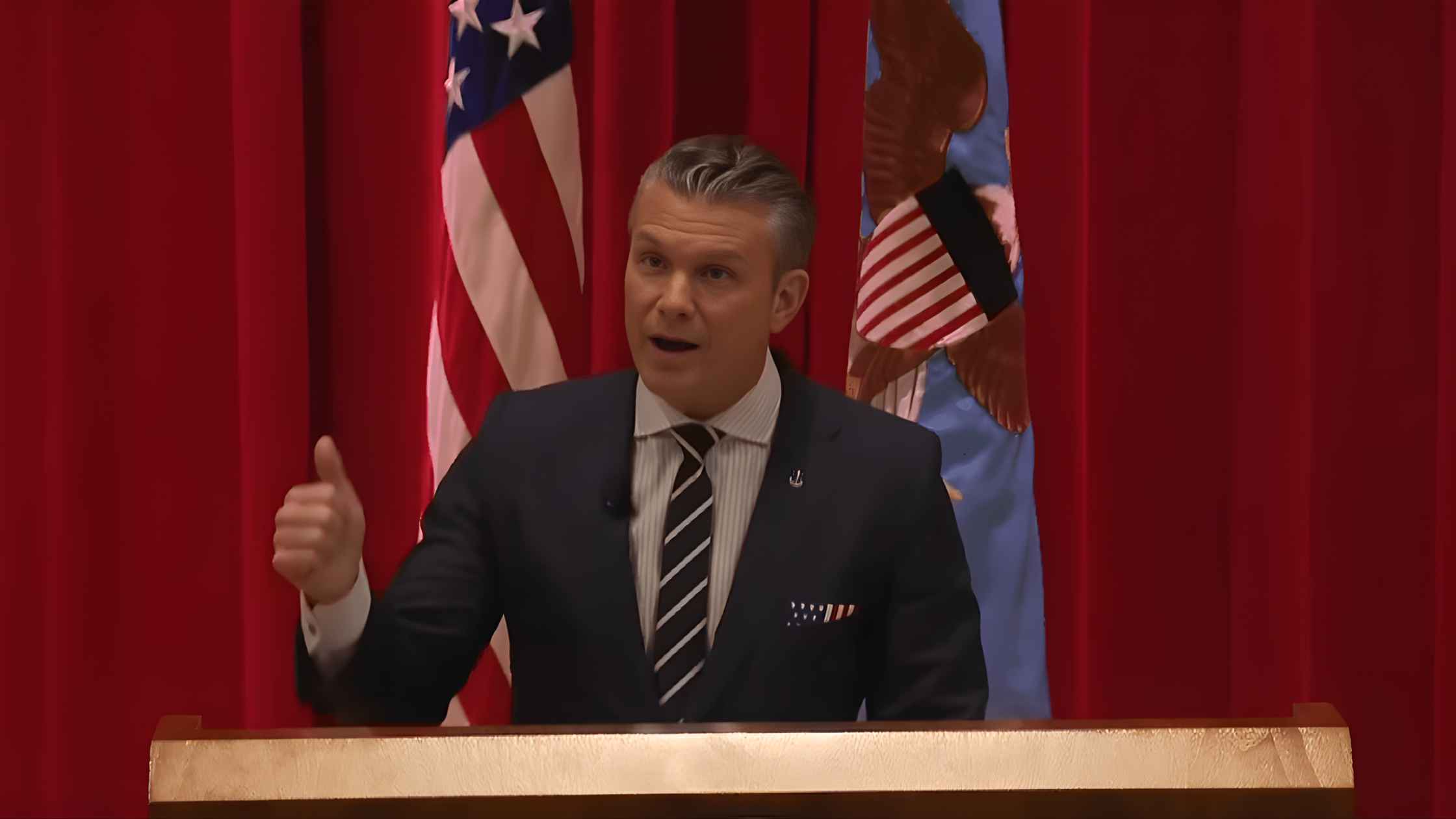
Speaker 1 (00:00):
Today he's going to talk about how he's going to lead us in the transformation of the Pentagon, how we do things there. I'd also like to thank our great president, President Trump, for giving me the opportunity to serve our great nation. I mean, he's incredible. [inaudible 00:00:25] and all the amazing things he's doing so quickly. And in that spirit, he has set the tone for all of us. And our secretary from day one has set such a great tone, a tone of warrior ethos, launching our goals to transform our department from the Department of Defense to the Department of War, to really substantially improve our readiness, our fighting capabilities, our culture, all of our capabilities, and to really be exceptional. Now, servicemen under the secretary's leadership are really driving towards that goal. And now it's time for the Pentagon, for our civilian employees, and for our contractors to do the same. To take on this fight with a wartime philosophy, with the same culture and urgency, both on acquisition, programming, and capabilities.
(01:42)
It's super really important for our success. We're in the fight of our lives. We're against competition that's never been stronger, who are advancing rapidly, who are advancing urgently, and already have possessed great capabilities. We simply got to do better on our side of it. The secretary will talk today about this transformation. He has set the tone of a change culture in the Pentagon. It's through his, quite frankly, inspirational leadership that's enabled us civilians to really be able to do something different, to change, to be better. And that's our job. It has to come from the Pentagon, our people, as well as the contractors. The Pentagon is run well. Leadership is solid. The culture is good. The teamwork and partnership is exceptional, but we do things in a very old manner, in a slow manner, in a bureaucratic manner, and we must change that. Similarly, our contractors often mirror us with some of the same issues and problems. Our contractors need to change and do better. The contractors are willing to change with us. We'll prosper and grow. Those who don't and resist it will be gone.
(03:18)
I think that I can't emphasize how much and how important it is for us not to fall behind. I'm 65 years old, so I've seen a few things. And I can tell you after that experience, it's an absolute honor to serve underneath, working for the secretary. It's an honor to serve under his command, and I think he's setting the tone as you'll hear today for the changes that we need to make and that we will make and will succeed with. Our military, all of our service people, everyone around it, Americans need us at the Pentagon and our civilians and our contractors to do better. We can't fail. We can't make excuses. We must succeed. Let's get at it. With that, Mr. Secretary, can you please come and speak to us?
Pete Hegseth (04:20):
Thank you, sir. Please take your seats. Well, members of Congress, Deputy Secretary Feinberg, this would not happen without you, without him, without what he's led. Today's not possible and the reforms you're going to hear about today are not possible. Mr. Chairman, members of the joint chiefs, secretaries of our military departments, under Secretary Duffy as well, without what has happened at A&S, this is not possible either. Acquisition professionals, corporate leaders, distinguished officials from the Department of War, defense industry officials, good afternoon and welcome. A lot of you came a long way for this, and we are grateful that you took the time to be here with us right now. We think this topic is that important for the future of our nation. Today, I'd like to talk to you about an adversary that poses a threat, a very serious threat to the United States of America. This adversary is one of the world's last bastions of central planning.
(05:25)
It governs by dictating in five-year plans. From a single capital, it attempts to impose its demands across time zones, continents, oceans, and beyond. With brutal consistency, it stifles free thought and crushes new ideas. It disrupts the defense of the United States and places the lives of men and women in uniform at risk. Perhaps this sounds like the former Soviet Union, but that enemy is long gone. The foe I'm talking about is more subtle and implacable. You may think I'm describing one of the last decrepit dictators of the world, but their day too is almost certainly passed. And they cannot match the size and strength of this adversary, nor am I talking about the Chinese Communist Party. The adversary I'm talking about is much closer to home. It's the Pentagon bureaucracy. Not the people, but the process, not the civilians, but the system. Not the men and women in uniform, but the uniformity of thought and action that is too often imposed on them.
(06:39)
In the Pentagon, despite this era of scarce resources taxed by mounting threats, money disappears into duplicative duties and bloated bureaucracy, not because of greed, but because of gridlock. Innovation is stifled, not by ill intent, but by institutional inertia. Just as we must transform America's military capability to meet changing threats, we must transform the way department works and what it works on. We must build a department where each of the dedicated people here, especially the true entrepreneurs and innovators from our industrial base, can apply their immense talents to defend America, where they have the resources, access, information, and freedom to perform. Our challenge is to transform not just the way we deter and defend, but the way we conduct our daily business. The modernization of the Department of Defense is a matter of immense urgency. In fact, it's not an exaggeration to say that it's a matter of life and death, ultimately, of every American.
(07:51)
Now, I'm going to let you in on a little secret. The speech so far is not my own. Those words are practically verbatim from a speech given by Secretary of Defense Donald Rumsfeld on September 10th, 2001, a near carbon copy 24 years later. Now, the world changed the day after he gave that speech on 9/11, and the wars in Iraq and Afghanistan began. As a result, Secretary Rumsfeld never quite had the full opportunity to implement many of his reforms. To quote him or paraphrase him again, we went to war with the army we had, not the army he or we wanted. Today, the need for Pentagon transformation, not just reform, is even more urgent than it was when Secretary Rumsfeld spoke those words nearly a quarter-century ago. And his words are just as true now as they were then. The threat environment we face is advanced and multifaceted. Technology is evolving at an accelerated pace. The information landscape has become increasingly segmented and personal and exploited by our enemies.
(09:13)
Many of our adversaries, as you know, don't wear uniforms and use civilians as human shields. Our enemies often activate under the threshold of armed conflict, the gray zone, and intend to destroy us from within. The world seems smaller and more familiar, yet at the same time, more complex. As I alluded to in my Quantico speech a few weeks ago, today we're undertaking a department-wide transformation of requirements, acquisition, and foreign military sales. Addressing a core function of what we do at the War Department, identifying what our war fighters need, how we buy those capabilities, and then how we share those capabilities with our allies and partners, all in service of decisively winning any war that we must wage. For too long, our department has been hampered by a bureaucracy bogged down by burdensome and inefficient processes, paralyzed by impossible risk thresholds and distracted by agendas that have nothing to do with war fighting.
(10:20)
Naturally, such a system gives rise to a certain culture within the organization and people adapt to that culture in order to thrive within it. The institution shapes the individuals as much as the individuals shape the institution. It becomes mutually reinforcing, and over time, the prevailing pattern becomes more and more entrenched, risk averse and immovable, to the point that the whole psychology of the department is stuck in a system in which process, not outcomes matter the most. Previous administrations have tried and failed to address these issues seeking to go around the process rather than confront it head on, leaving our military and our industrial base weaker as a result.
(11:06)
The department's perversed process has in turn fostered a culture in today's defense industrial base that makes it, unlike any other American market, uniquely tailored to the Pentagon in the worst way. Unstable demand signals, uncertain projections and volatile customer base has caused the defense industry to adapt… Adopt, excuse me, the same entrenched risk averse and lethargic culture that we have in government. The result, an absence of urgency, a fear of innovation and a fundamental lack of trust between the military customer and our limited, more limited than it should be defense industrial base. What's worse, the defense industry financially benefits from our backwards culture. Schedule overruns, huge order backlogs, and two predictable cost increases become the norm. Our military and our taxpayers need a defense industrial base that it can count on to scale with urgency in a crisis, not one that is content to wait for money before taking urgent action.
(12:19)
This relates to the whole industrial base, and most importantly, to the large primes that we do business with today. These large defense primes need to change to focus on speed and volume and invest their own capital to get there. If we do that, the Department of War is, of course, big time supportive of profits. We are capitalists after all. But if they do not, those big ones will fade away. We've all heard this sort of talk before. Transformation of our acquisition process is a war of attrition, a war that we intend to win day by day, week by week, month by month, year by year. I'm telling you, Feinberg and Duffy won't stop.
(13:11)
It's been the department's fault for far too long that we're in this predicament, and it will take a focused and sustained effort to succeed and succeed, we must. We will no longer ignore the plank in our own eye. The goal of this speech is not to name and shame people or companies or departments. Many of you have done important and patriotic work for our nation and this department for years, many for decades. But rather I wanted the opportunity to look you, my fellow patriots, straight in the eye and tell you how important you are. You will determine whether we deliver for our war fighters. You will determine whether we win our next war. Either you, our companies, our industries, our defense industrial base deliver or we fail. It is literally life or death. Every dollar squandered on redundancy, bureaucracy and waste is a dollar that could be used to outfit and supply the war fighter.
(14:17)
We must wage an all out campaign to streamline the Pentagon's process to unshackle our people from unproductive work and to shift our resources from the bureaucracy to the battlefield. Our objective is simple. Transform the entire acquisition system to operate on a wartime footing. To rapidly accelerate the fielding of capabilities and focus on results, our objective is to build, rebuild the arsenal of freedom. American industry and its innovative spirit are begging to be unleashed to solve our most complex and dangerous war fighting Problems. We need to get out of our own way, out of your way, and enter into real partnership with you rather than over-prescribe and decelerate your natural progress. In turn, industry needs to perceive business with the Department of War from the perspective of growth and assume risk to partner with the United States. Speed and a focus on outcomes are fundamental to successful deterrence. Our war fighters require the depth of capabilities to deter any aggression and if necessary, decisively defeat any enemy that dares to challenge America. We're talking here about transformation, not toothless reform and we're seeking it fast. Now, some will say that any effort to reform the Pentagon bureaucracy is punishment for real or perceived slights. We think that's nonsense. I'm not here to punish. We're here to liberate. I'm not here to reform, but to transform and empower. We mean to save the bureaucracy from itself because the chairman and I talk about this all the time. This is a 1939 moment or hopefully a 1981 moment. A moment of mounting urgency. Enemies gather, threats grow, you feel it, I feel it. If we are going to prevent and avoid war, which is what we all want, we must prepare now. Our adversaries are not sitting idly by.
(16:39)
They're moving fast. They're developing and delivering new capabilities at a rate that should be sobering to every American, especially those who work in the Pentagon and in the defense industrial base. Their ambitions and intentions are bold. Their actions speak volumes and frankly, at times we've been too damn slow to respond. But before we get too far along, when it comes to transformation, let me give some credit where credit is due. President Trump has led on this issued four executive orders directing transformation to defense acquisition, spurring innovation of the defense industrial base in particular, and the entire federal procurement process and foreign military sales in general. That's because the president recognizes one simple fact. America's military is the greatest in the world by far, and we must keep it that way. Our commander-in-chief is leading the way affording us… This is what is so key in any effort like this, affording us the top cover to do big, hard, and necessary things quickly.
(17:49)
Members of the House and Senate Armed Services Committee on a bipartisan basis have advanced proposals to reform Pentagon procurement through the SPEED Act and the FoRGED Act. Through their close collaboration and extensive exchanges with Congress, much of what we are planning and announcing directly reflects the insights and reform ideas that have emerged from those ongoing partnerships. Many of the changes we're implementing today are the direct result of those congressional engagements, and we look forward to continuing this vital collaboration as we transform the department.
(18:24)
So I want to thank Chairman Wicker and Chairman Rogers, especially for their leadership on these issues. Together, these executive orders, the congressional reforms, and the efforts by the services and department leadership, many of which are already underway, will enable five broad transformations.
(18:45)
One, inspire American industry to become a wartime industrial base that focuses on speed and volume, through reliable demand and adaptable business practices for current partners and new entrants alike.
(18:59)
Two, unleash the defense, industrial and government workforces by incentivizing progress over process.
(19:07)
Three, bias new acquisition and requirements processes for speed, flexibility, and efficiency.
(19:13)
And four, championing technical excellence and higher risk thresholds to accelerate high performance production.
(19:21)
And five, provoke war speed or warp speed by procuring rapidly and sustaining readily cost effectively as the default, not the exceptions.
(19:32)
So in short, those are broad principles. We mean to increase acquisition risk in order to decrease operational risk. Let me say that again. We mean to increase acquisition risk in order to decrease operational risk. By taking greater calculated risk in how we build, buy, and maintain our systems, we will gain speed
Pete Hegseth (20:00):
Speed to more quickly provide capabilities to the battlefield. An 85% solution in the hands of our armed forces today is infinitely better than an unachievable 100% solution, endlessly undergoing testing or awaiting additional technological development. These are of no use to troops in harm's way.
(20:22)
So to the men and women of this department, both military and civilian who work on acquisition and our industry partners, let me say this, you are not our enemies in this effort, but you are our allies. You are Obi-Wan Kenobi, you are our only hope. I hear the frustrations of the senseless bureaucracy, the constraints. I hear it every day. You know there is waste. You know there is abuse. You know there are outdated, useless and silly regulations that squander taxpayer money. You also have ideas to help us defend the United States better. To reform our processes for the better, to make our processes more responsive to the needs of the warfighter. As we move forward, we need your help and your help as we transform this effort. As I said at Quantico, consider yourself hereby liberated.
(21:17)
In transforming the acquisitions process within the Pentagon, we will build on the tenants of restoring the warrior ethos, rebuilding the military and reestablishing deterrence. We cannot achieve the last two without infusing the first throughout the acquisition's ecosystem, including the boardrooms, the labs, and the factories of our indispensable industry partners. The first step in achieving the warrior ethos, as I emphasized at Quantico, requires that we expect the same from our partners. It's imperative that industry focus on hiring and promoting individuals based on merit and not on some garbage ideological standard. DEI has failed at every level of every organization.
(22:04)
In our system of acquisition, we all serve the men and women in uniform and are accountable to the American taxpayer, but we all have a specific role. The Pentagon establishes expectations and outcomes and accountability. Industry provides the talent, the innovation, and the agility, and the capacity that allows us to meet our goals. As with our warriors, the performance standards that industry needs to meet must be high and unwavering. Tolerance for underperformance and failure, low. And the imperative for continuous improvement, relentless.
(22:41)
To achieve these goals, it's paramount that human capital decisions across the entire warfighting acquisitions enterprise are predicated upon merit and optimally enable the recruitment, retention, and mobility of America's our nation's best talent. Just as I told the uniform ranks personnel is policy, so too in acquisition. Human capital decisions focused on hiring, promoting, rewarding, and accountability will directly determine the success of acquisition's reform. And more importantly, whether or not we save our republic. That's how important it is.
(23:25)
The time for half measures, it's been over for decades. As Secretary Rumsfeld's speech reminds us, we're taking bold and swift action to transform requirements, development, overhaul our acquisitions process, and enhance foreign military sales. But we're not just doing this in silos. The development of this transformation has prioritized civil military collaboration at every step, ensuring both our civilian and military leaders across the services and the joint staff directly contributed to the development of the coordination of this overhaul. This was not OSW sitting in a room thinking up ideas. This was collaborative across the Pentagon with the services and the joint staff to figure out how we can make this happen. This is a team effort at the Pentagon, not a hostile takeover.
(24:15)
Here are the five overarching transformative pillars that form the foundation on the procurement process. First, we will stabilize demand signals. We will award companies bigger, longer contracts for proven systems. So those companies will be confident in investing more to grow the industrial base that supplies our weapon systems more and faster.
(24:39)
Second, we will prioritize the purchase of industry-driven solutions, commercial solutions first that meet our needs faster, even if that means bids do not meet every requirement. It means that we will be open to buying the 85% solution and iterate together over time to achieve the 100% solution. It also means there will be no non-compliant bids.
(25:03)
Third, we will empower our program leaders with the control, expertise, and authority to direct program outcomes, to move money and quickly adjust the priority of required system performance to deliver on time and under budget.
(25:19)
Fourth, we will inject urgency and excellence into the DIB. The Department of War will only do business with industry partners that share our priority of speed and volume above all else. Who are willing to surge American manufacturing at the speed of ingenuity to deliver rapidly and reliably for our warfighters.
(25:40)
And fifth, regulatory reform. We will remove excessive and burdensome FAR and DFARS rules, reporting requirements, accounting standards, excessive testing oversight, excessively long studies and analysis. Anything that unnecessarily slows down government contracts will be eliminated. So the bottom line is this. These changes will move us from the current prime contractor dominated system defined by limited competition, vendor lock, cost plus contract, stressed budgets, and frustrating protests to a future powered by a dynamic vendor space that accelerates production by combining investment at a commercial pace with the uniquely American ability to scale quickly. Taken together, we will rebuild the defense industrial base into a new arsenal of freedom. What we're doing today marks a new horizon for how we acquire and deliver warfighting capabilities. We are prioritizing speed, flexibility, competition, and calculated risk taking. We will buy commercial solutions to the maximum extent possible, practical, and we'll ensure our systems can produce at scale and relentlessly focus on delivering modern lethal weapons to our warfighters, end of story.
(27:02)
To fix this entire process, we need to fix the heart of it all, which is requirements. For decades, our requirements process under the name, and you know it well, Joint Capabilities Integration Development System, or JCIDS, has become an inefficient bureaucratic system in need of a complete overhaul, which is why today, at my direction, we are transforming the department's process for joint requirements determination. Re-envisioning the requirements process is a decisive step in rebuilding the nation that once led the world in turning ideas into combat power, thoughts into lethality. I am canceling JCIDS, which moved at the speed of paperwork, not war. To put it plainly, JCIDS became a years long bureaucratic anchor that dragged us down while our adversaries surged ahead with purpose and precision.
(28:04)
JCIDS was focused on defining systems requirements, staffing them through countless oversight boards, and then locking them down while threats and technologies continued to evolve. To validate requirements documents, JCIDS often took over 300 days. Yes, 300 days to close to one whole year just to approve a single document. By the time it got stamped, and it probably was stamped, the threat had changed and the warfighters needs had shifted. The process was so complicated that there is a 400-page manual, instruction manual, just to understand it, imposing endless templates and layers for review.
(28:49)
JCIDS had dozens of reviewers and sign-offs and hundreds of comments to approve a single document. It's its own ecosystem, most of which added little to no value. We tried to please everyone, so we chased consensus instead of clarity. It became a go along to get along process. The result, over-specified requirements that satisfy everyone and serve no one. A process built to serve the process. Our industry partners know the biggest obstacle isn't technology, it's our processes. Requirements are unclear or overly prescriptive and even contradict themselves like that last sentence. They're either so rigid that they strangle innovation or so vague that nobody knows what done actually looks like.
(29:38)
Contractors waste time guessing instead of building. The result cost overruns, frustration on both sides, and delayed delivery to the warfighter. What industry is asking for is simple. Clear, stable, problem statements, provided early enough to plan, hire and train the workforce, and then invest in capital modernization. We rarely engage innovators early, and when we do, the process tries to retrofit their ideas into outdated formats. Existing industry partners who understand the cumbersome process don't even bother to innovate. They know there is no upside to innovation. Rigid standards and archaic templates choke the agility that we need. That's why innovation groups exist to bypass JCIDS entirely and deliver faster.
(30:32)
The lesson is obvious. If we want innovation and we desperately do, we must build a requirement system that welcomes it instead of smothers it. You can catch a glimpse of where we're moving when it comes to our commitment to acquiring critical munitions and the Golden Dome. Secretary Gates, for example, circumvented the Pentagon process to quickly develop and field the MRAP. Now we're already moving at wartime speed on both of those Golden Dome, ammunitions working outside the slow, bureaucratic process, but we shouldn't have to go outside the process to make it work. Urgent needs are met by circumventing it. We can't rely on that. Instead, the entire process must move at the speed of critical munitions, Golden Dome and the MRAP. In short, we can't continue making big promises we can't keep. The people who define what we need aren't linked to the people who control the money or build the systems. So requirements move forward on paper, but the funding and execution don't follow.
(31:38)
By the way, if folks are watching this on Fox, their eyes are rolling over. But everyone in this room understands exactly what I'm talking about.
(31:50)
The result, plans without resources, programs without liftoff and warfighters waving for capabilities that arrive late or never arrive at all. No feedback loop, no shared priorities, and no accountability. Until we connect need, money, and delivery under one roof, we keep producing wishlists instead of weapons. President Trump recognized the reality and challenged our department to adopt a wartime mindset to confront the bloated and inefficient bureaucracy. And that is why today at my direction, we are undertaking a series of actions that immediately and fundamentally change how we develop requirements to get capabilities into the hands of our warfighters at speed. We're ending a system that was built for paperwork, not mission. JCIDS is dead and it was slow and bloated and disconnected from reality and we will do better.
(32:43)
I'm directing the Joint Requirements Oversight Council, the JROC, to stop validating service requirements and to kill the paperwork culture that buries ideas before they ever reach the field. In its place, we're building a new model focused on speed, alignment, and action. We're also reorienting the JROC to start identifying and ranking the joint forces' toughest problems, what we call joint operational problems. The problems will drive the priorities for the entire department. That is why today at my direction, we're standing up three new decision forums in place of JCIDS.
(33:21)
The first is the Requirements and Resourcing Alignment Board, or RRAB, a new decision forum co-led by the Deputy Secretary of War and the Vice Chairman of the Joint Chiefs of Staff to tie money directly to those top warfighting priorities. We will ensure the joint forces' top problems are funded. We're also creating the Mission Engineering and Integration Activity, or MEIA, to bring the best minds, government, industry, and labs together early to experiment, integrate, iterate, and prototype solutions instead of watching good ideas die at the hands of a worthless process. And to make sure good ideas don't die in the infamous valley of death. We're establishing the Joint Acceleration Reserve, or JAR, a funding pool set aside to move promising solutions straight into the fight.
(34:16)
Finally, each military service will review and reform its own requirements process, cutting red tape, engaging industry earlier, and aligning internal priorities to the new joint system. So what do we believe this new process will achieve? Speed replaces process, money follows need, joint problems drive action, experimentation accelerates delivery, and the services move faster and smarter. Take contested logistics, for example. When we fight our ability to move weapons, supplies, and reinforcements to the front lines and back, it's critical. We can stay in the fight only as long as our logistics sustain us. Our adversaries know this and they will attack our supply routes, ports, airfields, depots, and information systems in order to disrupt us.
(35:04)
We must be able to fight in this contested environment and these reforms will ensure that we can. We'll start by elevating contested logistics as a key prioritized operational problem. We're going to work side by side with our industry partners to come up with innovative solutions through experimentation and rapid prototyping and ensure that it's properly funded. Logistics will be prioritized, integrated, and delivered as quickly and as long as our warfighters need it. See, we're moving from process to purpose and for paper to power projection. And this is not a minor requirements reform, it is a transformation. A change that allows us to outpace our adversaries and restore deterrence. Field capabilities quickly and welcome new entrants, a chance to achieve President Trump's vision of peace through strength.
(35:55)
Every leader, every program, and every dollar will face one simple test. Are we delivering real capability to the warfighter faster than we were before? If the answer is no, we will adapt. We will not stop and we will not back down. That was requirements onto acquisitions. Hand in hand with requirements is acquisitions transformation. Which is why today at my direction, the Department of War will immediately begin implementing a comprehensive overhaul of our acquisition system. President Trump did not send us here to nibble at the edges. He sent us here to fix it, and that's exactly what we planned to do.
(36:42)
As mentioned earlier, President Trump's executive orders direct the department to modernize acquisition for speed, flexibility, and efficiency, to revitalize the defense industrial base and leverage America's commercial innovation to incentivize our acquisitions workforce, encourage risk taking, and cut red tape, promoting efficiency and enhancing competition. That is why today at my direction, the Defense Acquisition System, as you know it, is dead. It's now the Warfighting Acquisition System.
(37:18)
And this isn't just a name change, it's a fundamental shift in how we view and practice acquisition. General Omar Bradley once noted that amateurs talk about tactics, but professionals study logistics, and of course he's right. Wars are won and lost not only by warriors on the battlefield, but by acquisition and industry professionals who shape the fight years before it ever takes place. That's all of us and all of you. Acquisition is a warfighting function, and it must enable and encourage continuous adaptation and improvement of our warfighting capability. We need acquisition and industry to be as strong and fast as our warfighters.
(38:02)
The Warfighting Acquisition System will dramatically shorten timelines, improve, and expand the defense industrial base, boost competition, and empower acquisition officials to take risks and make trade-offs. We're leaving the old failed process behind, and we'll instead embrace a new agile and results oriented approach. What used to take sometimes when you added up with requirements, three to eight years, we believe can happen within a year. That old approach had three systemic challenges. First, fragmented accountability where no single leader could make trade-offs between speed, performance, and cost, no one to charge. Second, broken incentives that reward compliance with rules and regulations, ignoring scheduled delays and cost overruns, resulting in our warfighters operating with old, unreliable legacy systems. And third, a chaotic requirements, budgeting, and contracting environment that disincentivized industry investment, leading to constrained capacity that cannot surge or adapt quickly without government intervention, and of course, more and more funding.
(39:14)
The core principle of the acquisitions transformation we are unveiling today is simple. Place accountable decision makers as close as possible to the program execution, eliminate the layers of bureaucracy that hinder them, and then empower them with the authorities and flexibility to drive timely delivery. Eliminating the layers of bureaucracy mean every program, every process, every board, and every review must justify its existence by demonstrating value in a timely manner of capabilities to the warfighter. Those that are of low or no value will be eliminated so we can continue to accelerate our speed of delivery to the warriors.
(39:55)
Here's what you can expect. Today at my direction, we are transforming and reorganizing
Pete Hegseth (40:00):
… the existing program executive offices or PEOs into portfolio acquisition executives or PAEs. The acquisition chain of authority will run directly from the program manager to the PAE. Each PAE will be the single accountable official for portfolio outcomes and have the authority to act without running through months or even years of approval chains, and they'll be held accountable to deliver results.
(40:33)
Now, these PAEs will be empowered with the authorities to make decisions on cost, schedule, and performance trade-offs that prioritize time-to-field and mission outcomes. That means less time identifying what our war fighters need, releasing solicitations to industry, and finalizing contracts to get production running at scale.
(40:56)
Our war fighters, as you know, can't wait decades for the tools they need to deter and fight our wars and to win them. The current pace of technological innovation is unprecedented. The services deal with it every day. By the time we field new capabilities, they need to be upgraded and then upgraded repeatedly to maintain edge over our adversaries, and it's not just software that needs regular updating, but the critical components as well.
(41:21)
But the time to make those updates in production, let alone putting them in contract, is delaying schedules by years. Everyone in here knows it, years, and we're done with that status quo. Which is why today, at my direction, the Department of War will issue guidance within the next 180 days for portfolio acquisition executives to implement several game-changing practices.
(41:47)
We will establish adaptable test approaches that enable rapid certification, evaluate multi-track acquisition strategies to allow third-party surge manufacturing capacity, maintain a standard to carry at least two qualified sources through initial production. And lastly, we will establish module-level competition through modular open systems approach.
(42:13)
The department's Office of Research and Engineering, led by Under Secretary of War, Emil Michael, along with Mike Duffy, will issue these revised guidelines, A&S and R&E. No more standing by and talking about the benefits of modular capabilities. We're making this a reality.
(42:36)
Portfolio acquisition executives will now have the authority to enact the modular open system approach, a technique that commercial industry has been practicing and using for years. Imagine being able to swap parts or software of a critical munition without needing to, I don't know, completely redesign the missile. It's common sense, but we're not doing it.
(42:59)
Updating our lethal capabilities in real time should be the norm, not waiting years to redesign, produce, and field the platform just to have it just in time for it to undergo another round of updates. Around the clock software updates should be a given, just like on your smartphone, to improve performance and critically protect our infrastructure against rapidly evolving cyber threats.
(43:23)
It's all about empowering innovation and not stifling it. It's about the defense industry leveraging practices the commercial sector has already perfected, things like computer-aided design, digital processes, building virtual models, and 3D printing. We will break down monolithic systems and build a future where our technology adapts to the threat in real near time.
(43:52)
Contracting officers will be embedded within program teams and accountable to program leaders, shoulder to shoulder with our engineers, operators, and war fighters, the ultimate end users who can provide critical real-world user feedback to the engineers. Contracting officers' performance will be judged not on mindless compliance with thousands of pages of regulations, but on mission outcomes.
(44:18)
The portfolio chain of command are the ones in charge. They're responsible for mission success. If the mission is not successful, there will be real consequences. We will ensure accountability by extending PAE tenure to be longer than the current PEO service times. We will leverage taxpayer dollars in a more accountable, flexible, and deliberate manner to maximize their value across capability portfolios.
(44:45)
We will shift funding within portfolios' authorized boundaries swiftly and decisively to maximize mission outcomes. If one program is faltering, funding will be shifted within the portfolio to accelerate or scale a higher priority. If a new or more promising technology emerges, we will seize the opportunity and not be held back by artificial constraints and funding boundaries that take months or even years to overcome.
(45:12)
We will partner with Congress at every step of the way for seeking maximum flexibility empowered by transparency. Instead of each program acquiring its own infrastructure, portfolios will invest in common platforms, interfaces, and test ranges. No more endless delays or bureaucratic gridlock. No more customized acquisition pathways. The battlefield doesn't work that way and neither should our capability development.
(45:40)
Programs will be schedule-driven with fixed delivery cycles that embrace learning through iterative development. Our combatant commanders will get operational capabilities years earlier on mature technologies before the threat window actually closes. We will require rapid fielding dates with clear goals for unit-cost ceilings and reasonable mission effectiveness standards. All other attributes must remain tradable.
(46:11)
We will be agile and respond to rapidly changing threats and battlefield conditions, empowering the PAE to seek deviations, waivers, and delegation authorities to deliver a highly responsive acquisition capability. We will eliminate unnecessary technical standards and compliance requirements that add little or no value to fielding lethal capabilities. We will create lean technical advisory processes to inform accelerated decision making.
(46:40)
We want technical rigor without sacrificing speed. Technical rigor will only come from people most engaged in the program, and they should have a large voice in the process. No more lengthy, inefficient reviews by people who are out of the loop and add nothing but time to the process.
(47:02)
We will focus on the operational problems that material solutions are intended to address. We will prefer alternate proposals or solutions that deviate from stated requirements, but more effectively achieve operational objectives. Evaluation criteria will focus on mission effectiveness, not specification compliance.
(47:24)
We're not just buying something. We are solving life and death problems for our war fighters. We're not building for peace time. We are pivoting the Pentagon and our industrial base to a wartime footing. Building for victory should our adversaries FAFO. That's why today, at my direction, the Department of War is delivering a plan to streamline test and evaluation requirements.
(47:53)
Testing early and often is essential at certain stages of development, but testing for the sake of testing inhibits progress and delays delivery. We will shine a light on performance standards as well, which is why today, at my direction, we are mandating portfolio scorecards with primary performance measures focusing on what truly matters, the time it takes to put weapons in the hands of our men and women who use it if and when necessary.
(48:22)
We'll also continue to focus on operational availability and mission capability rates of our current weapon systems. Far too many of our systems are not available to fight right now as they languish in depots and shipyards for repairs and maintenance or wait years for parts in the prime contractor to repair the system.
(48:42)
We will maximize the number of weapon systems that are available for conflict. The faster we can deliver modern weapon systems, the faster we can retire decades-old legacy systems. We will tailor other measures to each portfolio's specific needs, no hiding, no excuses. Results will be clear and drive improvement, and everyone is responsible for raising opportunities for improvement.
(49:08)
Speed and volume will rule. We will foster competition, embrace modularity, and pursue multi-source procurements at every opportunity, moving fast to contract, test, scale, and deploy when a solution is clear. We will strive to maintain at least two qualified sources for critical program components. We will minimize getting ourselves into single-source situations where contractors have monopoly power over a key war-fighting capability.
(49:39)
We will enable third-party integration without prime contractor bottlenecks. Success will be measured by the ability of qualified vendors to independently develop, test, and integrate replacement modules at the component level throughout the system life cycle. There's no more complacency and no more monopolies.
(50:02)
To make competition easier, we will increase incentives for component-level competition. This is about more than optics. It's about delivering better components at lower cost. Multi-track acquisition is the future. Now, I'm not talking about two sources that were bought out by the same prime to give the illusion of choice.
(50:24)
I'm talking about meaningful choice, where quality and speed matter and where prices go down. Moreover, today at my direction, commercial products and offerings will be the default policy. We will enhance the presumption of commerciality. Within 90 days, we will issue guidance that demands a commercial first and alternative proposals policy to enhance flexibility.
(50:50)
We will harness more of America's innovative companies to focus their talent and their technologies on our toughest national security problems. We're leaving too much on the cutting room floor. We want to deliver novel solutions to our war fighters so that we have an overwhelming advantage in future wars. Our goal, as you know, is to never enter a fair fight.
(51:13)
The bottom line is we're buying solutions, not specifications. We will evaluate results, not paperwork. If a better solution exists outside the traditional channels, we will find it and we will acquire it. That is why as part of this transformation today, at my direction, we are establishing the Wartime Production Unit or WPU at the Department of War.
(51:37)
This new unit has been redesigned from the existing joint production acceleration cell and will focus on transforming how we accelerate the delivery of critical capabilities to our war fighters. We will accomplish this by leveraging a dedicated deal team empowered to forging groundbreaking business deals that revolutionize production capacity and completely overhaul contract execution.
(52:05)
The deal team will reinforce our contracting workforce, enabling them to work with newly empowered PAEs to negotiate with vendors based on a broader perspective of the vendor's total book of business within the department rather than through the lens of a single program, creating leverage and incentives not previously applied.
(52:26)
This deal team will craft financial incentives that drive contractor performance, demanding on-time delivery of the weapons our war fighters desperately need. It's about faster negotiations, better results, and a commitment to complete transparency and cooperation between the government and our industry partners.
(52:46)
The Wartime Production Unit will manage and execute direct support for our top acquisition production priorities. To ensure that we have the best minds in the business, we will bring in a wide variety of the nation's most talented experts to advise on industrial production optimization. We have already been doing this. We are doing it. It's been led by the deputy secretary of war, and the results thus far have been fantastic. We plan to scale it and scale it quickly.
(53:18)
Many talented operators are already on board at the Pentagon, former industry executives who are serving our country to drive success. We call them Business Operators for National Defense or BOND. I encourage those listening who are interested to reach out if you have the skills to contribute to the defense industrial renewal we are embarking on.
(53:39)
This may seem like an obvious change, but it's new for our department to empower world-class operators to help drive necessary change from the Pentagon to industry. This initiative is not a pilot program. It's a fundamental shift in how we arm our war fighters. We are committed to dominating the modern battlefield, and that domination starts with a wartime industrial base focused on execution and operational success.
(54:12)
As you know, everyone in this room knows, building the arsenal of freedom will not happen overnight, and it will require considerable investment and resolve to expand the department's buying power. As you're all familiar, the cycle of annual budgets limits the department from providing long-term demand signals to industry.
(54:32)
However, there's a world of opportunity with alternative investment strategies to expand our industrial base, and that is why today, at my direction, the Department of War will publish new guidance to ensure that there are clear incentives for contractors to deliver on time, increase production capacity, and have the demand signal needed to attract private investment.
(54:54)
We will encourage and accelerate creative strategies in investment contracting and procurement to scale production, expanding the DIB with new entrants and incentivizing companies to spend more of their own capital to revitalize our DIB and supply our warriors. We will drive strategies that create stable, clear, and consistent demand signals for industry to invest and scale production of lethal capabilities.
(55:19)
This includes partnering with Congress to secure legislative authorities and appropriations, flexibility needed to make the department a more predictable partner for industry, enhanced multi-year procurement authorities, guaranteed purchase orders, and stable funding mechanisms that will be the foundation for unleashing unprecedented private sector investment in defense production capacity. This will build on the great work already done to improve the PPB&E process and how CAPE and Comptroller interact with Congress.
(55:54)
We commit to doing our part, but industry also needs to be willing to invest their own dollars to meet the long-term demand signals provided to them. Industry must use capital expenditures to upgrade facilities, upskill their workforce, and expand capacity. If they don't, we are prepared to fully employ and leverage the many authorities provided to the president, which ensure that the department can secure from industry anything and everything that is required to fight and win our nation's wars.
(56:33)
Our national security comes first. You, our friends among industry, must realize that we appreciate your need to make a good margin and a profit as capitalists, but you must invest in yourselves rather than saddling taxpayers with every cost. For those who come along with us, this will be a great growth opportunity and you will benefit.
(56:59)
To industry not willing to assume risk in order to work with the military, we may have to wish you well in your future endeavors, which would probably be outside the Pentagon. We're going to make defense contracting competitive again, and those who are too comfortable with the status quo to compete are not going to be welcome.
(57:19)
To the majority of American industry who enjoy steady demand signals, to the major manufacturers who have built our country and our incredible exquisite systems, to those of you who are not in this room today because you don't currently do business with the Pentagon, the Department of War wants any and all of you to be in part of our industrial base.
(57:40)
We want all comers who are prepared to go at wartime speed. We're committed to being better customers and this acquisition transformation demonstrates our commitment. The deputy secretary of war has already reached out to many of you to gauge your interest. I've talked to a lot of folks. We've never had a deputy like this man who has the business background and experience that he has, and we're leveraging the hell out of it.
(58:06)
On behalf of the department and our country, I encourage you to answer his call when it comes. None of this transformative effort would be possible without a massive culture change amongst our acquisitions workforce. The Defense Acquisition University is obsolete. It must become an incubator of acquisition excellence and urgency.
(58:29)
That is why today, at my direction, we're immediately transforming it into a competency-based educational institution named the Warfighting Acquisition University. It will be the launching pad of our acquisition workforce imbued with a transformative and warrior mindset.
(58:48)
The same warrior ethos I invoked in Quantico must extend across the acquisitions ecosystem to contracting officers, program managers, systems engineers, and requirements developers. The patriotic men and women in this audience who architect, develop, and procure the world's most lethal and capable technology must be unleashed to deliver the arsenal of freedom faster than we ever have before.
(59:16)
The Warfighting Acquisition University will prioritize cohort-based programs, combining experimental and project-based learning on real portfolio challenges, industry government exchanges, and case method instruction that develops critical thinking and rapid decision making. No more sitting in classrooms learning about failed processes of the past.
(59:39)
Our acquisition system is only as good as our workforce. Trust me, I understand the challenges of the workforce. Portfolios and programs can't succeed when leaders rotate out every two years. Greater stability ensures deeper insights into technology, relationships with companies, personnel development, and accountability to
Pete Hegseth (01:00:00):
Deliver outcomes, and that is why today at my direction, the department is developing policies to create blended career paths of key portfolio and program officials, extending their tenure by requiring four year minimum terms with two year extensions and tying their incentives to competition, capability delivery time, and mission outcomes. This will ensure accountability for strategies and decisions with continuous improvement throughout execution phases. Again, we're not just making tweaks. We're fundamentally changing the way we do business. These are not just words, we've already done a great deal of the work. In fact, the new acquisition transformation strategy is being released today, and for many of you in this room, it's hitting your inboxes right now, as are all of the directives that we're announcing today, you will have them before you leave this room. It's a great read. I encourage you to check it out. I read more than the executive summary.
(01:01:09)
Speed to delivery is now our organizing principle. It is the decisive factor in maintaining deterrence and war fighting advantage. If our war fighters die or our country loses because we took too long to get them what we needed, we have failed. It is that simple. That is the business we are in. And we've talked to a lot of people that have been this building a long time, the sense of that urgency has slipped too much. And when you look at what we face, we have to recapture it.
(01:01:45)
Finally, foreign military sales. Transforming requirements and acquisition alone, not enough. We must also improve the way our department and the industrial base supports weapon sales to our allies and our partners. This is a top priority for my team in partnership with Secretary Rubio and Secretary Lutnick. Thanks to the efforts of President Trump, we have reached an all time high in our foreign military sales. President Trump is securing deal after deal to bring cold, hard cash to American manufacturers, but our processes are too slow and our industrial base is too inefficient to keep up and deliver on time to our allies and partners. Believe me, I hear about this on every foreign trip and every conversation I have with every president, prime minister, and minister of defense is what is wrong with your foreign military sales. We ordered it in 2014. It's 2025 and it's scheduled to deliver in 2032. And I sit there going, "I don't know. What the hell." We didn't break it, but we're going to fix it.
(01:02:53)
Not only are foreign military sales and defense commercial sales important to our American industrial base, but they're also critical to our strategic vision on the global landscape. Burden sharing has been a key pillar of President Trump's and the Department of War's agenda. And to accomplish this, our allies and partners must be armed with the best and most interoperable weapons systems in the world. Foreign military sales allow our war fighters to stand shoulder to shoulder with our allies to face dangerous global challenges. We're solving it.
(01:03:26)
Hundreds of billions of dollars annually in foreign military sales and defense commercial sales, for American-made weapon systems will provide our companies with the fuel to invest in new manufacturing plants, hire engineers, and source components and materials from thousands of subcontractors and suppliers. More effective FMS and DCS will help revitalize the industrial base, you know this, create tens, if not hundreds of thousands of American jobs, lower the cost of deterrence to the U.S. taxpayer and accelerate capability delivery to our partners that want to buy American-made. They don't want to buy Russian, they don't want to buy Italian, they don't want to buy French, they want to buy American, but they don't want to wait a decade for it.
(01:04:10)
So what's been the issue? Red tape, inefficiency, and a lack of investment in our defense industrial base. While we're sitting on a massive opportunity to supercharge our defense sales and industrial might, to add the surge capacity we need to increase volume for American stocks. The key lies in cracking the code on process efficiency and aligning sales with our efforts to revitalize the defense industrial base. We need to eliminate the backlogs and strengthen the critical supply chains that contribute to delivery delays. When we promise to supply our partners with critical capabilities, we must deliver on time every time. Our success ensures their ability to fight and win and we can and must do better.
(01:04:53)
We're taking decisive action to resolve it. We've worked to bake exportability into the acquisition lifecycle from the very beginning, and we're investing heavily in making that a reality. We're modernizing our IT systems and establishing clear performance metrics to track progress and identify bottlenecks. At the operational level, some of our combatant commands have seen it firsthand, have similarly begun moving out to remove FMS processing efficiencies at the tip of the spear in theater.
(01:05:25)
But the next step is a crucial one, and that's why today at my direction, I'm directing the realignment of operational control of Defense Security Cooperation Agency, DSCA, and the Defense Technology Security Administration, DTSA, removing it from under the Secretary of War for policy to the Under Secretary of War for Acquisition and Sustainment. So from policy to A&S.
(01:05:51)
Now you might ask yourself, how does an internal Department of War shift in reporting structures make any difference? It makes a huge difference. In delivering defense articles and services to our allies and partners, it's a complex process and success demands a unified approach across the entire acquisition lifecycle. From the first dollars invested in research and development, all the way through maintenance and delivery of spare parts. When a foreign partner or ally needs to acquire a new capability from the United States, we need to ensure that the department's own processes are efficient, effective, and prime to rapidly review those capabilities for transfer or place them on contract and then deliver it as quickly as possible without impeding deliveries to the U.S. war fighter.
(01:06:39)
By planning against a total aggregated picture of global demand against our industrial might, we can achieve breakthrough results, rapidly equipping our allies, bolstering global stability and projecting American strength. That's exactly what this realignment gets after. By aligning DSCA and DTSA under A&S, we provide leadership focus and establish clear lines of accountability. We're better integrating FMS with our war fighter acquisition system and our defense industrial base activities. What you get is stronger cohesion of our acquisition, security cooperation, and technology security enterprise. U.S. operational and industrial readiness are maximized and interoperability with allies is increased. And if it's done well, continued year-over-year, growth in sales of American-made systems will skyrocket. You should all love that.
(01:07:35)
Starting today, we will now manage our defense sales enterprise with a single integrated vision from initial planning to contract execution to delivery. It was staggering when we tried to get our arms around just one particular system and who we were giving it to, how many we were giving it to them and when we were giving it to them. It was a multi-week exercise just to understand that system, that was not a complex system. That system, who it was going to, how long it would take, how it traded off of ours, we had no idea. So half of this is just totally understanding that process top to bottom. At the end of the day, unifying defense sales under a single roof in the Department of War ensures that we aren't making promises that we can't keep and that our allies receive the capabilities they need when they need them.
(01:08:26)
But this is just the beginning of transforming our approach to defense sales. There's much more to come in the months ahead because this is about more than selling weapons. It's about building partnerships, strengthening our industrial base, and ensuring that American-made military equipment remains the gold standard for defense around the world.
(01:08:50)
We believe that what we've announced today is a total transformation of how we do business at the War Department. Not simple reform, but a fundamental shift in how the War Department operates. This transformation is, as I stated earlier, a war of bureaucratic attrition, and it is one that we intend to win. This is not a speech, this is not a fire and forget. This is the beginning of an unrelenting onslaught to change the way we do business and to change the way the bureaucracy responds. We will not relent and we probably won't sleep because we believe it's that important for our war fighters in the field.
(01:09:38)
We're moving away from a culture of bureaucracy and risk aversion and embracing a culture of agility, innovation, and results. We will revitalize our defense industrial base by changing how we do business with our current defense contractors, fostering competition and embracing commercial solutions. By the way, some of our services have already done great work in these spaces. So this is not to say there hasn't been a running start with some of our services on this, and I want to acknowledge that. This is building on top of that, frankly, taking some of those lessons learned and accelerating into what we're doing department-wide. We will reform our requirements process to ensure that our war fighters get the capabilities they need when they need them, and they're not bogged down by bureaucratic delays.
(01:10:23)
We'll modernize our acquisitions process to shorten timelines, send consistent demand signals, and empower our acquisitions officials to make swift informed decisions, not handcuffed by the processed, accountability to make decisions. Slashing the barriers to entry for companies in the defense industrial base to encourage rapid innovation, competition, and expansion. And we're slashing the barriers to innovation for companies already in the [inaudible 01:10:50] to empower them to grow within the Pentagon. We're making it easier to do business, not just for defense contractors, but for commercial companies. We're leveraging the untapped American manufacturing base to new heights. Small, mid, and large businesses alike, all welcome.
(01:11:11)
And we're instilling a culture of accountability tied to results, not process. More jobs, faster delivery of lethal capabilities, and an industrial base that can surge if called upon. It's not just a pipe dream. We're driving toward that pace. We won't do incremental improvements. This is about fundamentally reshaping our approach from concept to delivery. We're injecting speed and agility into every facet, ensuring that we can outpace our adversaries and maintain our technological edge in places like AI, cyber, and space. It's not about building a military that is not only strong, but it's how to be adaptable, resilient, and ready to meet any challenge with a magazine depth that makes sure that any fight we choose or that which is thrust upon us is an unfair battle. So much of this is about magazine depth. Not just about what we can make, it's how much of it can we make and how quickly and how quickly can we deliver it.
(01:12:09)
We're not just building a stronger military today. We are laying the foundation for continued dominance in the decades to come. We intend to build a dynamic and responsive system that can adapt to emerging threats and leverage new technologies. We're ensuring that future generations of war fighters have the tools and the capabilities to defend our nation. The War Department will be ready when the time comes. We will have and we will be the arsenal for freedom. The world is watching. Our adversaries are watching. Our allies are watching. We must show them that America is back stronger and more determined than ever to defend our interests and uphold freedom. Our war fighters are depending on us and we cannot fail. Let there be no question. The 2.1 million Americans who wear our nation's cloth, active guard and reserve, and the hundreds of thousands who support them in suits, in coveralls, in welding helmets, they comprise the finest military in the history of the world. No doubt. They stand ready to face down any threat, anytime, anywhere. President Trump says it all the time and he's completely right. We have the best, strongest, most lethal military in the world. Our job is to liberate them from any antiquated systems and incentives of the past, delivering them the military of the future at speed. We know the threat, I know the threat, you know the threat. We know the environment. This is our moment. May we leave here with a renewed sense of purpose and a shared commitment to action because you're definitely leaving with a full inbox. If we must, we will go to war with the military and equipment we have and we will win. We have the best and the strongest.
(01:14:08)
But today let's build on the vision of what Secretary Rumsfeld aspired to in his September 10th, 2001 speech. Building the military we want and the military we need, the arsenal of freedom. That, my friends, is what we owe our warriors, present and future. So thank you all for what you do. May God bless you and may God continue to bless our great republic. Thank you. Thank you. Thank you.