


Dan Caine (00:02):
Audio check one, two. This is the Pentagon Briefing Room. We're doing a final mic check for the pool camera as well as the cut camera. Check one, two. Audio check one, two. Check one, two. This is the Pentagon Briefing Room. We're doing a final mic check. This is the chairman's mic. Check one, two. Check one, two. Pool good? Is pool good? Check, check, check one, two. This is the secretary's mic. Check one, two. Check one, two. We're doing a mic check for the pool camera as well as the cut position. Check one, two, three, four. Everybody good? Standby. We got about 17 minutes.
Pete Hegseth (19:16):
Well, to our fellow Americans, brave warriors, and steadfast allies, good morning. As someone who led troops, led soldiers in the streets of Baghdad and Samarra, Iraq, and who trained counterinsurgents in Kabul, Afghanistan, and who still carries the weight of brothers lost to Iranian terrorist proxies, many backed by the same Iranian regime we're confronting now. This fight, Operation Epic Fury, it hits home. Our generation understands this fight. For 47 years, these barbaric savages in the Iranian regime have murdered our brothers in arms, my guys, your guys, our guys, through their terrorist proxies and cowardly attacks. Now they race toward a nuclear bomb to hold the world hostage. The Iranians have targeted and killed thousands of my American brothers.
(20:20)
That race to a nuclear bomb, President Trump will never allow it. Not now, not ever. Not on our watch. The Mullahs are desperate and scrambling. Like the terrorist cowards they are, they fire missiles from schools and hospitals, deliberately targeting innocence because they know their military is being systematically degraded and annihilated. Iran's neighbors, and in some cases, former allies in the Gulf, they've abandoned them, and their proxies, Hezbollah, the Houthis, and Hamas, either broken, ineffective, or on the sidelines. Iran stands alone, and they are badly losing.
(21:11)
On day 10 of Operation Epic Fury, we are winning with an overwhelming and unrelenting focus on our objectives, which are the same as the day I gave my first briefing here on Operation Epic Fury. They're straightforward, and we are executing them with ruthless precision. One, destroy their missile stockpiles, their missile launchers, and their defense industrial base, missiles, and their ability to make them. Two, destroy their Navy. And three, permanently deny Iran nuclear weapons forever. It's a laser-focused maximum authority mission delivered with overwhelming and unrelenting precision, no hesitation, no half measures.
(22:03)
As President Trump declared yesterday, we're crushing the enemy in an overwhelming display of technical skill and military force. We will not relent until the enemy is totally and decisively defeated, but we do so on our timeline and at our choosing. For example, today will be, yet again, our most intense day of strikes inside Iran: the most fighters, the most bombers, the most strikes, intelligence, more refined and better than ever. So that's on one hand. On the other hand, the last 24 hours have seen Iran fire the lowest number of missiles they've been capable of firing yet, just the bifurcation, just the trend lines that we talked about on our first briefing.
(22:58)
You see, this is not 2003. This is not endless nation-building under those types of quagmires we saw under Bush or Obama. It's not even close. Our generation of soldier will not let that happen again, and nor will this president, who very clearly ran against those kinds of never-ending nebulously scoped missions. Those days are dead. Instead, we're winning decisively with brutal efficiency, total air dominance, and an unbreakable will to accomplish the president's objectives on our timeline. We stay locked on the target because here at the Department of War, that's our job.
(23:44)
Now, the chairman and I having just returned from Dover last night, our troops and their families, and the enormous sacrifice that they made is certainly heavy on my mind, so I'll close with scripture, drawing strength from Psalm 144. "Blessed be the Lord, my rock, who trains my hands for war and my fingers for battle. He is my loving God and my fortress, my stronghold and my deliverer, my shield in whom I take refuge." May the Lord grant unyielding strength and refuge to our warriors, unbreakable protection to them in our homeland, and total victory over those who seek to harm them, and amen. God bless our troops and this mission. Mr. Chairman, over to you.
Dan Caine (24:38):
Thank you, Mr. Secretary, and good morning, everyone, and thank you for being here. I'm here today to continue the updates to the American people and to those in the room on Operation Epic Fury. First, let me start with honoring our fallen. As the secretary said, on Saturday and again last night at Dover Air Force Base in Delaware, our nation's leaders honored our returning fallen as they arrived home for their final time. Last week, I shared a few of the names, and today, I want to share the rest. Major Jeffrey O'Brien and Chief Warrant Officer Three, Robert Marzan, were the final two fallen to return home, and members of the US Army Reserve's 103rd sustainment command out of Des Moines, Iowa.
(25:22)
Last night, as the news has been reporting, we honored the return of Staff Sergeant Benjamin Pennington of the US Army's first space brigade from Fort Carson, Colorado. When I met Ben's family last night, his mom, his dad, and his sister, they showed me a picture, a drawing that Ben had made when he was in kindergarten. It was clear all the way back then that Ben wanted to do one thing in his life, and he wanted to serve his country and be a soldier. And to the Penningtons, just know how Ben was absolutely a great one.
Dan Caine (26:00):
And finally, Major Sorffly Davius, who returned home this weekend after sadly passing away from a medical condition while on duty in Kuwait. We welcome him home as well and mourn with his family. To the families and the families of all of our fallen, we share in your profound grief. The Joint Force remains eternally grateful for your sacrifice and the gift of a great example that your service members have given all of us. I want you to know that their names will never be forgotten and you and your family are part of our Joint Force family forever. Let me talk a little bit about the progress thus far. Acknowledging that Admiral Cooper will likely continue to give updates from CENTCOM. As the secretary said, we're in the 10th moving into the 11th day of Operation Epic Fury. The Joint Force remains focused on three military objectives.
(26:57)
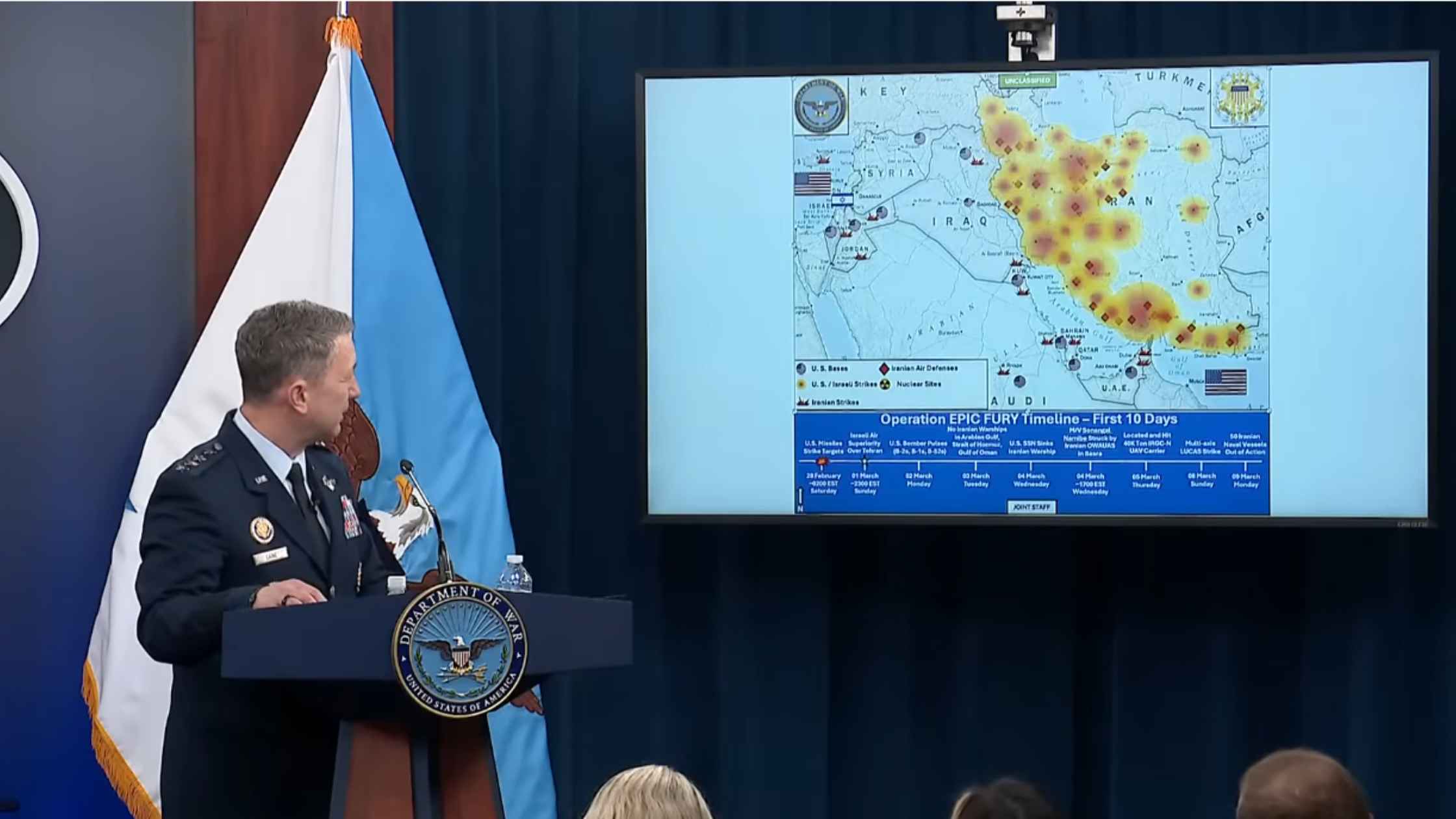
Continue to destroy Iranian ballistic missiles and drone capability in order to prevent attacks on the U.S. and others throughout the region. And this means attacking launch sites, command and control nodes, stockpiles before they can threaten our personnel, our facilities, and our partners. Second, we continue to strike the Iranian Navy and their capabilities in order to do things like sustained movement through the Straits of Hormuz. And third, we continue to start working on and going deeper into Iran's military and industrial base in order to prevent the regime from being able to attack Americans, our interests, and our partners for years to come and project power outside their borders. This means servicing production facilities, research and development sites, and infrastructure. Let me turn to the map. We're going to try digital today to prevent laser injury. Since our last update, CENTCOM continues to make progress across the southern flank. To date, they've struck more than 5,000 targets. U.S. strategic command bombers recently dropped dozens of 2,000-pound GPS-penetrating weapons on deeply buried missile launchers across the southern flank. We also have struck several one-way drone factories to get at the heart of their autonomous capability. And of course, alongside our regional partners along the southern flank, we continue to execute intercepts against one-way attack drones using fighters and attack helicopters. Our strikes mean we've made significant progress in reducing the number of missile and drone attacks out of Iran. Ballistic missile attacks continue to trend downward, 90% from where they've started, and one-way attack drones have decreased 83% since the beginning of the operation. A testament to our air defenders and our air defense systems, and as I said, our partners in the region continue to do great work as well.
(29:06)
Second: we're making substantial progress towards destroying the Navy. In the first 10 days of the conflict, we're more than 50 Iranian naval ships into the campaign using a combination of artillery, fighters, bombers, and sea-launched missiles. As Admiral Cooper noted last Thursday, we struck and sank an Iranian drone carrier ship, and U.S. CENTCOM continues today to hunt and strike mine-laying vessels and mine storage facilities. This work will continue. Third: against our objectives, we've begun to target Iran's military and industrial complex, again, focusing on centers of gravity to get upstream of the shooters out in the field in order to deny them the ability to continue to generate those one-way attack drones. Let me spend a minute talking about the Joint Force. Across the area of responsibility, this is gritty and tireless work, and I cannot begin to explain how incredibly proud I am of the extraordinary courage, tenacity, and grit and professionalism within the Joint Force.
(30:15)
Last time I had a chance to talk about the army's incredible logisticians who are out there sustaining the fight. Today, I want to highlight a few groups of sailors. First, I want to thank the men and women of the Ford Carrier Strike Group and their families and let all of them know how grateful I am for their leadership and service. The crews on board this strike group have already endured months at sea, only to get their deployment extended. These exceptional Americans, rogered up, all supported by their families, continue to stand the watch, taking the fight to the enemy over and over again, night after night. Aboard ships like the USS Ford and the Abraham Lincoln are a special group of sailors I want to highlight today. These are the men and women, the sailors up on the roof, running operations on the flight deck.
(31:09)
With an average age of the early 20s, these are the unsung heroes of naval aviation. These young sailors known for wearing yellow shirts are in charge of the catapults, taxiing jets around on the flight deck, shooting jets off the front end, and recovering jets off the back end. They are literally involved with every single movement on the roof on an aircraft carrier. They are the last ones that a naval aviator sees before getting shot off the front end and the first one that a naval aviator sees after safely trapping on the back end. And just for a minute, imagine you're standing on that aircraft carrier flight deck. There's 30 knots of wind in your face. The deck is slippery, covered in grease. It's noisy. There are propellers spinning. There's jet blast everywhere. The helicopters are running. Your head is on a swivel, and you're trying to direct a multimillion-dollar fighter into a one-foot square box so that those naval aviators can be shot off into the black of night to go do America's work.
(32:15)
Those jets are fully loaded with missiles and bombs, and they are a world-class team combined with the naval aviation and the aviators in those jets. This beautiful symphony of American spirit is the definition of perfectly organized chaos, and these crews do it every single time the carrier is at work. Oh, by the way, in the middle of the night, and oftentimes in the pouring rain. These are dedicated young people who take the road less traveled to serve their great nation, doing the deeds that we need them to do. America's enlisted force is the pride of every nation's military, certainly ours, and the envy of every other one as well. Each and every one of them out there across the Joint Force are extraordinary, and in particular today, I want to highlight the yellow shirts.
(33:10)
Ladies and gentlemen, our work continues. It'll continue to be difficult. I ask every American to keep our deployed force and their families in our thoughts. Combat deployments can be tough on the force and the families, and it's important that we continue to remember that. I remain deeply humbled by the 2.8 million members of the Joint Force, and I'll end where I started, and that's remembering our fallen and their families whose sacrifice will be felt forever. And with that, I'll take some questions with the secretary.
Pete Hegseth (33:40):
A beautiful symphony of American spirit. Well said, Mr. Chairman.
Dan Caine (33:43):
Thanks, sir.
Pete Hegseth (33:44):
And I will just note that no other country in the world is capable of executing what the chairman just described, day after day, night after night, unrelenting. Well said. Thank you.
Dan Caine (33:56):
Yes, sir.
Alexandra Ingersoll (33:57):
Alexandra Ingersoll, One America News. Mr. Secretary, you talked at the conference in Florida on Thursday that there was a 90% missile capabilities degradation and 83% drone degradation. And I know the chairman just repeated those numbers. We've seen the most amount of fighting these past five days. Is there any update to those percentages? And also, are you able to give any quantification of degradation to the enemy's nuclear capabilities yet?
Pete Hegseth (34:32):
What those numbers represent is a persistent low ability to respond, which is what we're looking for. If the enemy can simply wait and then project power, that's problematic. And we've seen some spurts here or there, but ultimately the trend lines, if you look at the charts that we look at every day, have gone like this down to a flat... It doesn't mean they won't be able to project. It doesn't mean they... Our air defenders still don't have to defend. They do, but that is strong evidence of degradation along with the battle damage assessment that the joint staff does, which takes time. You've got to look at imagery and recognize whether something's been simply degraded or it's been destroyed or whether an underground facility has been collapsed or completely obliterated. So there's differences in how you evaluate that, but the numbers staying that low is a demonstration of the efficacy for sure. Yeah, here.
Speaker 1 (35:24):
Thanks, Mr. Secretary. There's been reports that the new leader of Iran has been wounded. Do you know if this is true and what his condition is? And then another one: President Trump said he had a really good call with President Putin yesterday. Will Russia be aiding us in this conflict? And can you share anything on that?
Pete Hegseth (35:39):
Well, the president, as I've said before, maintains strong relationships with world leaders, which creates opportunities and options for us in very dynamic ways. So the president said it was a good call. I was not on it, but those that were said it was a strong call reaffirming, hopefully, the opportunity for some peace in Russia and Ukraine, and also a recognition that as it pertains to this conflict, they should not be involved. The first question was...
Speaker 1 (36:08):
On the new leader of Iran, there's reports that he's been wounded.
Pete Hegseth (36:09):
Oh, the new leader of Iran. He would be wise to heed the words of our president, which is to not pursue nuclear weapons and come out and state as such. As far as his status, that's not something I can comment on right now. Yeah, right here.
Eric Schmitt (36:24):
Great. Mr. Secretary, Eric Schmitt with the New York Times, a question for you first. Last week, you talked about this being the beginnings of an air campaign that could last three to eight weeks. Can you give us your assessment on where we are now? And Mr. Chairman, in any conflict, the enemy or the adversary adapts to the tactics it faces. Can you talk about the most challenging adaptation the Iranian military has made to the U.S. military? What challenges are you facing most right now? Thank you.
Pete Hegseth (36:51):
I appreciate the question. Where we are is in a very strong place, giving the President of the United States maximum options. And from the beginning, from this podium, we haven't stated how long it will take. Our will is endless. Ultimately, the president gets to determine the end state of those objectives, right? But what he's said continually, I want the American people to understand, is this is not endless. It's not protracted. We're not allowing mission creep. The president has set a very specific mission to accomplish, and our job is to unrelentingly deliver that. Now, he gets to control the throttle. He's the one deciding; he's the one elected on behalf of the American people when we're achieving those particular objectives. And so it's not for me to posit whether it's the beginning, the middle, or the end; that's his, and he'll continue to communicate that. What we serve him as is we give him updates on a daily basis of exactly where we are so he can make that determination on the throttle. Mr. Chairman.
Dan Caine (37:49):
Thank you for the question on adaptation. As you're right, no plan survives first contact with the enemy or Murphy. They're adapting, as are we, of course; we have very entrepreneurial war fighters out there. I'd rather not, for operational security reasons, tell them what's working. So I'm going to not answer that question based on that, but we are watching what they're doing, and we are adapting faster than they are.
Eric Schmitt (38:13):
Are they more formidable than you anticipated, General?
Dan Caine (38:16):
I mean, I think they're fighting, and I respect that, but I don't think they're more formidable than what we thought.
Jordan Conradson (38:22):
Secretary Hegseth, thank you. Jordan Conradson from The Gateway Pundit. Axios reported, citing U.S. and Israeli sources, that the U.S. was not happy with strikes on 30 fuel depots in Iran. While this is anonymous sourcing, it seems kind of congruent with what President Trump said yesterday, that there's certain spots they don't want to hit relating to energy infrastructure that would take a long time to rebuild. And whether this reporting is true or not, what's your message to Americans, those who supported the president and those who aren't really in favor of this war and who
Jordan Conradson (39:00):
... Worry that Israel might be taking advantage of the U.S.'s backing. And then for Mr. Chairman, for you, I wanted to ask, when you say that we're moving inland, what capabilities does Iran have to shoot down jets over their land? And would that trigger some kind of rescue operation that could risk a bigger ground operation?
Pete Hegseth (39:23):
Well, I would just state by saying Israel's been a really strong partner in this effort. Where they have different objectives, they've pursued them. Ultimately, we've stayed focused on ours. But what Iran has felt is the power of the world's two most powerful air forces. In that particular case, those weren't our strikes or that objective, or that wasn't necessarily our objective. But the president has made it clear to those concerns that we're not getting pulled in any direction. We're leading. The president is leading. He's determining where we want to go, what the outcome will be, what the end state is, with a very keen eye. And I understand those concerns because I've heard from a lot of people who went through ... I went through 20 years of those wars myself, worried about getting dragged in, worried about mission creep, worried about nation building or democracy expansion.
(40:14)
That's never the perspective the president has pursued on this. Just because previous presidents and previous secretaries have decided to just pour more resources and more people in toward some unguided end state, it doesn't mean that's the way the world needs to look today. In fact, the American people voted for a different approach, but what the president also stated from the beginning was Iran can't have a nuclear weapon. And it's one thing to say it. It's easy to say. Anybody can say that. I mean, Barack Obama said that. But to do something about it takes courage and resolve. But in that courage and in that resolve, you can also be very scoped in what you're trying to execute to ensure that the sacrifice of Americans, American treasure, American lives, all of those properly meet the objective that you're trying to accomplish. And certainly as someone I talked out front about what the Iranians have done to our generation, yes, we're clear-eyed about it, but my job is to keep it scoped, given the directive to the president to accomplish the mission.
Dan Caine (41:17):
Thank you for the question. Most of their higher end surface air missile systems are not factors at this point in time. We're able to move around fighters that are moving deeper with relative impunity. Always some risk out there. I don't want to say that there isn't. And we'll always maintain and retain capability of doing search and rescue type of things, but I don't want to get into the details, but thank you for the question.
Pete Hegseth (41:44):
Julie.
Julie (41:45):
Thanks, Mr. Secretary. President Trump told our team on the ground early this morning that the thing that has surprised him the most during the course of this operation so far has been the Iranian regime attacking countries that are not attacking them. I'm curious if that surprised you as well. And General, I'm curious if you are open to the possibility of escorting vessels to the Strait of Hormuz, and if you could describe some of the challenges of doing so.
Pete Hegseth (42:21):
Big mistake by the Iranian regime to start targeting its neighbors right away. Exposing who they are and what they're all about, indiscriminate targeting, flailing recklessly at the beginning. I can't say that we anticipated necessarily that's exactly how they would react, but we knew it was a possibility. And I think it was a demonstration of the desperation of that regime then and that regime now, that they still think their pathway out is to try to alienate their Arab partners even more, who've instead decided to come to us and have been willing to go on the offense, have been giving us access basing and overflight in a new partnership that will continue to remake the region the way that President Trump did with the Abraham Accord. So you're pushing those countries in our direction to support this effort, further alienating Iran.
(43:08)
And I think it's worth underscoring, I see in the media banners that say war expanding or war spreading. It's actually the opposite. It's actually quite contained and more allies or more of those countries are coming onside recognizing that you can't live under a conventional umbrella with nuclear ambitions, with a radical regime like that. Again, properly scoping the objectives in the process. And then you want to talk about the strait?
Dan Caine (43:32):
Sure. On the potential, if tasked to escort, we'll look at the range of options to set the military conditions to be able to do that. And then like we always do with every potential mission, come to the secretary and the president with both what are the resources required, what is the command and control required, and what are the risks, and how do we mitigate those risks? So we're looking at a range of options there and we'll figure out how to solve problems as they come to us.
Pete Hegseth (44:03):
But I would reiterate also to add to what the chairman said, the truth the president posted last night about that, saying if Iran does anything to stop the flow of oil within the Strait of Hormuz they will be hit by the United States of America 20 times harder than they have been hit thus far. He goes on to say, "Death, fire, and fury will reign upon them." You've seen the truth and read it, but he takes very seriously the condition of that straits. We have capabilities that no other nation on earth has, and we're certainly working with our energy partners across the administration to control for that. That's part of that scoping of this. The world needs to understand this doesn't have, this isn't intended to be, nor is it something that will expand. We know exactly what we're attempting to achieve here, scoped properly and the American people can count on that for sure. Right here.
Speaker 2 (44:51):
Secretary Hegseth, President Trump has long said that he wants to minimize the loss of life and war, wherever it occurs in whatever country, which so many people obviously appreciate. Can you detail the specific measures the Pentagon is taking to minimize civilian casualties and strikes inside Iran? And secondarily, is the Pentagon prioritizing replenishment of precision guided munitions, long-ranged strike weapons or air defense interceptors? And can you share any details on which systems are being prioritized?
Pete Hegseth (45:23):
Yeah. Seeing it from the inside, every single day, including this, no nation takes more precautions to ensure there's never targeting of civilians than the United States of America. From the boat strikes in the Caribbean, where every single strike is assessed, to this campaign here, no nation in the history of warfare has ever attempted in every way possible to avoid civilian casualties, and frankly, that's a point that just isn't appreciated enough. Where things happen that need to be investigated, we will investigate to the question shouted in the back that open source is not the place to determine what did or did not happen. We take things very, very seriously and investigate them thoroughly, which takes time, which is why it does take time. But ultimately, unlike Iran who targets civilians indiscriminately, who we've seen in the intel moving rocket launchers into civilian neighborhoods, near schools, near hospitals, to try to prevent our ability to strike.
(46:26)
That's how they operate. And then they set the targeting of drones and missiles toward civilian targets, hospitals, hotels, airports. We've sent comms been very good about putting that information out. That's how terrorist regimes fight. They target civilians. We do not. And I can tell you this administration and this Pentagon focuses on that very, very closely.
(46:48)
Here.
Speaker 3 (46:54):
Thank you. Sir, This morning, the Iranian government is saying a lot. They continue to say they're prepared for a long war. If that's the case, what could you tell the American people as far as the steps the Department of War is taking to make sure our troops have the protection and the resources they need as the mission continues?
Pete Hegseth (47:10):
I think there's one thing I can sleep quietly at night knowing is that we're giving every resource humanly possible to our troops on the front lines to ensure they're protected. In fact, as I said in that first press briefing, even before we set the offense, we set the defense. We made sure we had the ability to defend and then we moved as many Americans off the bases and into other places as possible. So as this progresses, the chairman or the question was asked to the chairman about how the enemy adapts. Well, of course, we adapt too in real time. And to watch our warriors iterate on air defense and interdiction on drones and missiles and how we get after it, it's incredible how they refine the tactics, bring in new assets to find different ways of getting at emerging technologies. So that is one of the things we're laser-focused on every day.
(47:58)
Yes, we're going on offense more effectively than any country in human history, but we're also ensuring that at every way possible, we're defending the best Americans we have who wear our uniform, no doubt. Let's do one more.
Speaker 4 (48:11):
Thanks, Secretary Hegseth. The president has indicated that maybe the operation will wrap up sooner than he thought it was going to. What's the plan once the U.S. stops military action? Will the U.S. play a role in the aftermath or will they leave Iran to sort it out?
Pete Hegseth (48:27):
Ultimately, the aftermath is going to be in America's interests, our interests. We won't live under a nuclear blackmail scenario of conventional missiles that can target our people, which is why the objectives have been scoped from the beginning. Missiles, missile production, defense industrial base, Navy, all in service of ensuring they don't have nuclear power projection capabilities. That's what matters to President Trump. That's what matters to the American people, and ultimately that's why we're so laser focused on ensuring those objectives and those objectives alone are met. Thank you. Appreciate it.