Reporters (02:09):
Which pool line is it on?
(02:11)
Fox.
(02:12)
Oh, like D.C. pool one, two? We were looking before we came over.
(02:15)
Oh, we just got it up five minutes ago.
Jeanine Pirro (03:50):
Just the numbers, right? Okay. Hi, everybody. Hi, everybody.
Reporters (04:00):
Hello.
Jeanine Pirro (04:00):
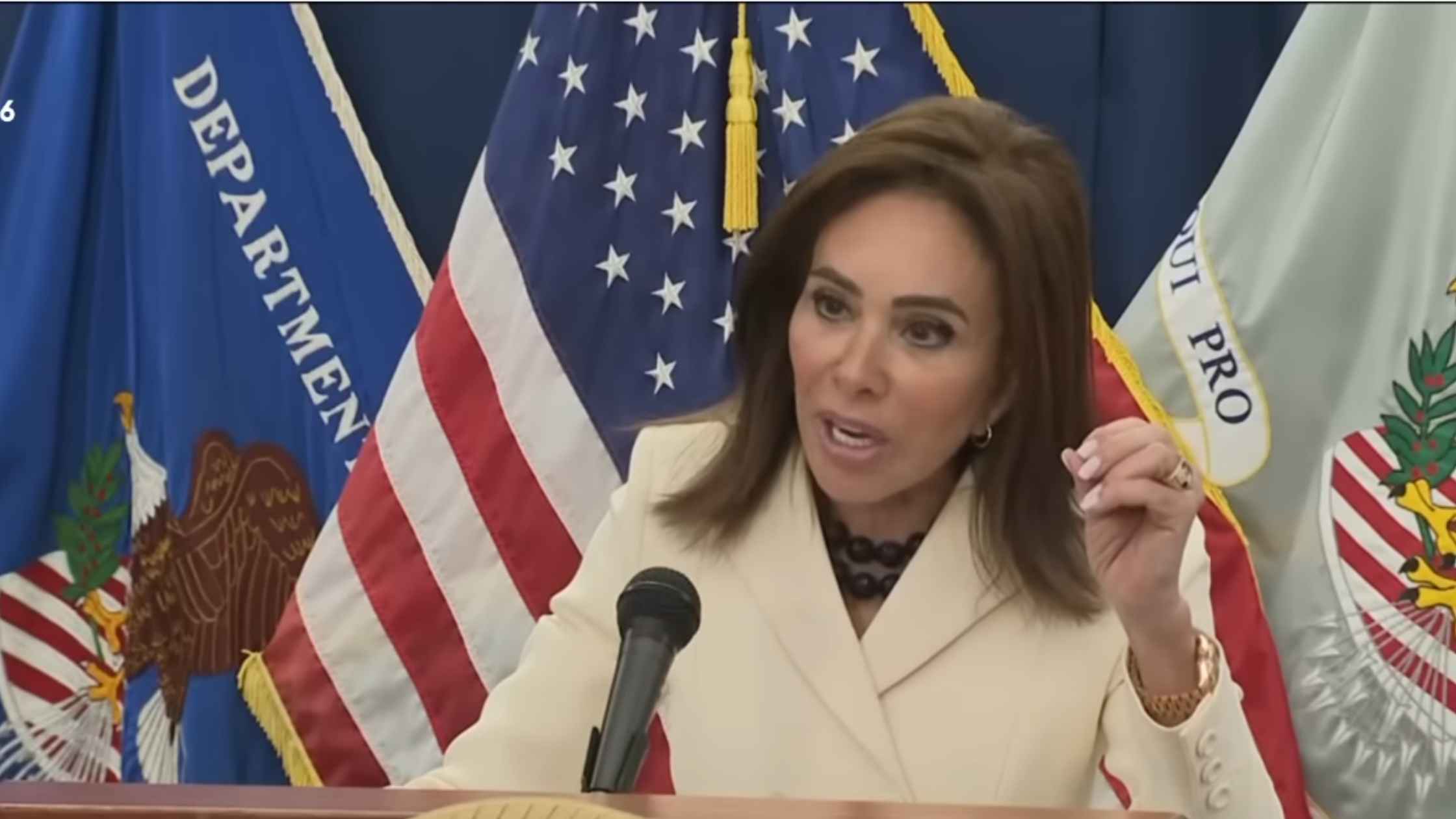
All right. So I'm here to speak about the decision that has been rendered in the case involving the Board of Governors of the Federal Reserve System.
(04:25)
Now, the American public is fed up with public monies that seem to go into a black hole, especially in D.C. where no one is held accountable. One of the age old tools that all prosecutors have to investigate any crime, including cost overruns, is a grand jury subpoena.
(04:53)
Today, however, in Washington, an activist judge has taken that tool away from us. By inserting himself and preventing the grand jury from even obtaining, let alone hearing evidence, he has neutered the grand jury's ability to investigate crime.
(05:18)
As a result, Jerome Powell today is now bathed in immunity, preventing my office from investigating the Federal Reserve. This is wrong and it is without legal authority.
(05:37)
In June of 2025, Jerome Powell testified before the Senate Banking Committee, making "questionable" statements that did not comport with publicly available documents, and that was regarding the atrocious cost overrun of more than $1 billion.
(06:00)
I didn't say million. I said billion in renovations to his headquarters. This from the man who says that he is the steward of our public funds.
(06:16)
In November, the United States Attorney's Office began an inquiry. Prosecutors from my office gathered information for months before we served two grand jury subpoenas.
(06:29)
On December 19th, we sent an email to the Federal Reserve to have a conversation, a meeting, or even a phone call to discuss our concerns. There was no response.
(06:45)
On December 29th, we sent an email to have a conversation, a meeting, or even a phone call to discuss our concerns. Again, we were ignored. We, in fact, asked to meet the first week in January. We were ignored.
(07:08)
It was at that point that two grand jury subpoenas were issued to the Federal Reserve, not even to Jerome Powell. Again, no response, no compliance.
(07:23)
But instead, a woe is me video by Mr. Powell, falsely claiming that he was being threatened with criminal indictment and claiming victim status, Powell proceeds to call his political friends in D.C. and around the world to gin up support for himself, all the while refusing to produce simple documents.
(07:54)
Now, enter local District Court Judge James Boasberg, whose written decision on its face makes clear his antipathy toward President Trump and this administration. He quashes both subpoenas, thereby prohibiting us from reviewing any records and precluding us from submitting records to the grand jury.
(08:22)
That grand jury, of course, comprised of ordinary people. Ladies and gentlemen, no one is above the law. But for the first time a judge is ruling that a grand jury subpoena, on its face, legal in all regards, can be ignored because a judge thinks the subject is beyond reproach.
(08:53)
This is a decision that is untethered to the law. It creates chaos where any defendant who wishes to evade an investigation, guilty or not, can allege, "I'm a victim, I'm being targeted, and therefore you cannot investigate me." And if you find the right judge, he'll buy it.
(09:21)
This is the antithesis of American justice. Exonerating anyone without any records, without an investigation, or question is not how our criminal justice system works. This judge has put himself at the entrance door to the grand jury, slamming that door shut, irrespective of the legal process and thus preventing the grand jury from doing the work that it does.
(09:59)
So what is the law? What is the law? According to the United States Supreme Court, the highest court in the land, certainly higher than the court that Boasberg is on, a grand jury, every grand jury has broad discretion to quote, "Investigate merely on suspicion that the law is being violated, merely on suspicion the law is being violated, or because it wants assurance that the law is not being violated."
(10:41)
In fact, the court says, "A grand jury may act on tips and rumors." Right here are the cases and the citations from the highest court in the land. And yet this judge is shockingly requiring the government to show something akin to probable cause.
(11:07)
And those are his words, probable cause, in order to justify the issuance of a grand jury subpoena. Folks, probable cause is not and never has been the standard that prosecutors in this country need in order to go into a grand jury. This is not and has never been the law of the land.
(11:36)
And so this decision today by Judge Boasberg runs directly afoul of our highest court's admonition that courts and judges must not and cannot saddle grand juries with many trials and preliminary showings that impede a prosecutor's investigation and thus frustrate the public's interest in the fair and expeditious administration of justice.
(12:11)
No one folks, is above the law, and this outrageous decision will be appealed by the United States Department of Justice. Go ahead, sir.
Reporters (12:25):
Do you think that your office's failure to attempt to prosecute six members [inaudible 00:12:32]?
Jeanine Pirro (12:31):
I'm not here to talk about six members of Congress. I'm here to talk about the fact that the grand jury has a job. They look at evidence. They decide whether they want to indict. If they don't indict, so be it. And if you want to know what the judge thinks, go ask him. Next question.
Reporters (12:52):
Can I get your reaction to statements from Senator Tom Tillis, who you know has been blocking and vowed to continue blocking [inaudible 00:12:59]-
Jeanine Pirro (12:59):
You know, honestly, I don't know and I don't care, and I'll tell you why. I am in a legal lane. All of the rest is white noise. I don't care what they say. I have a job. I have the ability to go into a grand jury. There are questions that the American public and people in D.C. are entitled to know where a billion dollars has gone, and that's my focus.
Reporters (13:27):
But he is asking for an assurance that the investigation into Powell has, this has ended it. Are you willing to concede?
Jeanine Pirro (13:34):
Did you hear what I just said? I just said that this decision will be appealed by the United States Department of Justice. That's the answer to your question.
Reporters (13:45):
What crimes exactly are you investigating?
Jeanine Pirro (13:46):
We're looking at 1,001, and we're also looking at a statute having to do with fraud, but it's up to the grand jury to make that decision. We're a billion dollars in cost overruns. Are you kidding? A billion dollars. We're not talking about huge buildings here. Go ahead.
Reporters (14:06):
Kevin Warsh is Trump's pick though, President Trump.
Jeanine Pirro (14:10):
I don't even know who he is.
Reporters (14:11):
So isn't this just essentially holding up President Trump's pick or any forthcoming picks since Senator Till has said he will not vote?
Jeanine Pirro (14:20):
Okay. I don't know how to explain this, but I'm going to try. I've been a prosecutor, a judge, a DA, and now a United States attorney for well over three decades. Politics is not the lane I'm in right now. And I have a charge and an oath to the Constitution.
(14:41)
And my job is to present evidence and I can do so when I can merely on the suspicion that the law is being violated or even just because I want assurance that it's not. I'm not in those lanes and I will not allow myself or my staff to be in those lanes.
(15:03)
And that's why we brought crime down in this jurisdiction. We are focused on the law. We are focused on the people of the district. We are not focused on politics. Go ahead.
Reporters (15:15):
Judge Boasberg, in his opinion, said that you quote, "Promptly complied with President Trump's apparent direction to prosecute Powell." Can you just state for the public record, how did you have the idea or the impetus to start this inquiry?
Jeanine Pirro (15:26):
First of all, he's totally wrong in his assessment of the dates, and that's why we're doing a motion to reconsider because he got his dates wrong.
(15:36)
And as far as I'm concerned, this was something that was a public interest. It was something that the Senate Banking Committee wanted information on, and it is something within my jurisdiction and my charge.
(15:50)
But I want to tell you a story. When I was a young prosecutor, I was one of the first people to investigate child abuse as a crime. Everyone thought it was a social problem and not a criminal justice problem. "The kids are better off with their parents."
(16:08)
There was an organization, and that organization didn't have a very good reputation, and it was one of the societies that was out there trying to prevent cruelty to children. And I set up a relationship where they would bring me cases. And people were outraged that I would deal with this organization.
(16:31)
And my answer to them, 30, 40 years ago, "I'll deal with the devil. I'll take a case from the devil. If you can give me information that will lead me to possibly find a crime." It doesn't matter where a case comes from. It doesn't matter.
(16:56)
I can have a suspicion. I can read the newspaper. I can just want to make sure he didn't commit a crime. So don't make... The judge is wrong on his dates. He is wrong. That's why we're not only appealing, we're making a motion to reconsider.
(17:13)
Okay. I want to say one more thing, and I think it's important that you guys hear this from me. That there's another way of looking at this, and that is that it's not just the public being fed up with this stuff. It's the fact that what we've got are grand jurors who are supposed to hear this, and they haven't been able to hear any of this because someone has decided that they're not entitled to hear this.
(17:45)
Can you take this? Thanks. This process has been arbitrarily undermined by an activist judge. We have a process. We have been asking for information about a matter that has raised questions in many people's minds. Senate banking, the public, the papers, it doesn't matter.
(18:11)
So give me the information so I can assess it. Give me the information so the grand jury comprised of regular Americans can say, "There's nothing here." And I'll accept it the way I accept other cases. Okay? Whatever it is, we'll abide by it.
(18:27)
What we don't accept is a judge standing in front of the door of a grand jury blocking our access, a role that has never been envisioned. A role that will now be used by other defense attorneys around the country who's going to come in with a client and say, "Oh, my client is being targeted. Don't you dare go in the grand jury."
(18:50)
A judge says, "Yes, the guy's bathed and washed in immunity, and you can't go after him." The process should have been allowed to run its course and it wasn't. And shame on them.
Reporters (19:03):
[inaudible 00:19:06].
Jeanine Pirro (19:06):
Oh, cut it out. Do you know how many convictions we've got? Cut it out. You're in one lane. We have cleaned up this city. Yeah, historic, really? I'll tell you what's historic.
(19:16)
What's historic is that I prosecute everything other than 10% of the cases where the United States attorney before me didn't prosecute 67% of the cases. That's what's historic.
(19:28)
I'm willing to take a not guilty. I'm willing to take a no true bill because I'll take all the crimes and put them in. Thank you.
Speaker 3 (19:38):
Thank you. That's all the time we have.