


Chairman (11:37):
I will call this hearing of the Senate Judiciary Committee Subcommittee on the constitution to order. Hearing for today is on politically violent attacks and the threat to our constitutional order. I'll give my opening statement, then we'll go to the ranking member and then after we might do a second round of opening remarks, introduce the witnesses, swear you guys in and to get rolling with questions. For the past 15 months, political violence has been a constant fact of American life. We've seen arsons and bombings, armed ambushes and assaults, sniper attacks, and mass shootings, riots and violent mobs on our city streets. We've seen assassinations, we've seen murder, we've seen death. None of this is random. It's organized, coordinated political terror. The people behind this violence are not common street criminals. They're not driven by money or drugs or gangland turf disputes. They're determined, militant extremists who wield violence for political ends. They know that their vision would never win at the ballot box, so they've chosen terrorism instead. They know their ideas could not win in the marketplace of ideas, so they shoot up the marketplace.
(12:53)
Last year, President Trump survived not one but two assassination attempts. In Butler, Pennsylvania he escaped a sniper's bullet by a centimeter in a split second. Only weeks later in West Palm Beach, another would-be assassin camped out for 12 hours in the brush outside of Trump International Golf Club armed with a loaded rifle, burner phones, a GoPro hoping to finish the job. Less than two months later, a healthcare CEO was gunned down in cold blood on a New York street by a left-wing extremist who called his victim a parasite who had it coming. Within days, left-wing activists had made the murderer a folk hero. In California, they pushed a ballot measure named in his honor. A poll taken 10 days after the murder found that nearly half of very liberal Americans had a favorable view of the killer, whereas just 8% of very conservative Americans felt the same.
(13:51)
Then came an all-out war on immigration and customs enforcement. Across the country, federal officers were hunted like prey. They were attacked, surrounded, ambushed, and shot at, their facilities were firebombed. There were arrests for arson, for assault, for violent threats and doxing, but the violence continued to escalate. On July 4th, 11 members of an Antifa terror cell carried out a coordinated ambush on an ICE facility in Texas. They arrived in two vehicles loaded with semi-automatic rifles, handguns, Molotov cocktails, body armor, and encrypted radios. Their gear was painted with a circle A for Antifa. They detonated fireworks to lure officers out into the open and then opened fire and kept shooting until their guns jammed. One cop was struck in the neck and critically wounded while racing to respond.
(14:45)
Just three weeks later, a transgender shooter entered a Catholic elementary school in Minneapolis and opened fire on hundreds of children while they prayed. Dozens were wounded. Two little children, a 10-year-old girl and an 8-year-old boy were killed. The shooter marked as guns with slogans like, "Where is your God now?" And posted videos using an image of Christ for target practice. Two weeks after that, Charlie Kirk was murdered while speaking to students in Utah. The killer told friends and family he did it because Charlie was full of hate. Social media exploded with gloating celebration. Thousands upon thousands of people, journalists, professors, and government employees could not contain their glee that a father of two young children had been gunned down in broad daylight. When Americans gathered to mourn him, they were attacked there too. In El Paso, an arsonist set fire to a church holding a vigil in his memory.
(15:50)
A week later, a man opened fire into an ABC News station in Sacramento. Just days after the network suspended, Jimmy Kimmel's show. Police found anti-Trump writings in his car and handwritten note that read, "Patel, Bongino and Pam Bondi, they're next." And just last week, an anarchist radical was arrested for placing a $45,000 bounty on Pam Bondi, posting an image of the Attorney General with a sniper dot on her head. The caption read, "Wanted dead or alive, preferably dead." A week after the ABC shooting, a sniper opened fire on an ICE facility in Dallas, killing multiple people. Investigators recovered shell casings etched with the words, "Anti-ICE." And this month, a man who flew across the country to murder Justice Brett Kavanaugh received a sentence of just eight years. He brought a gun, ammunition, a knife, duct tape, and zip ties to kill a sitting Supreme Court justice in his own home while his wife and kids were present because he didn't like the way he might rule on gun control or abortion.
(17:10)
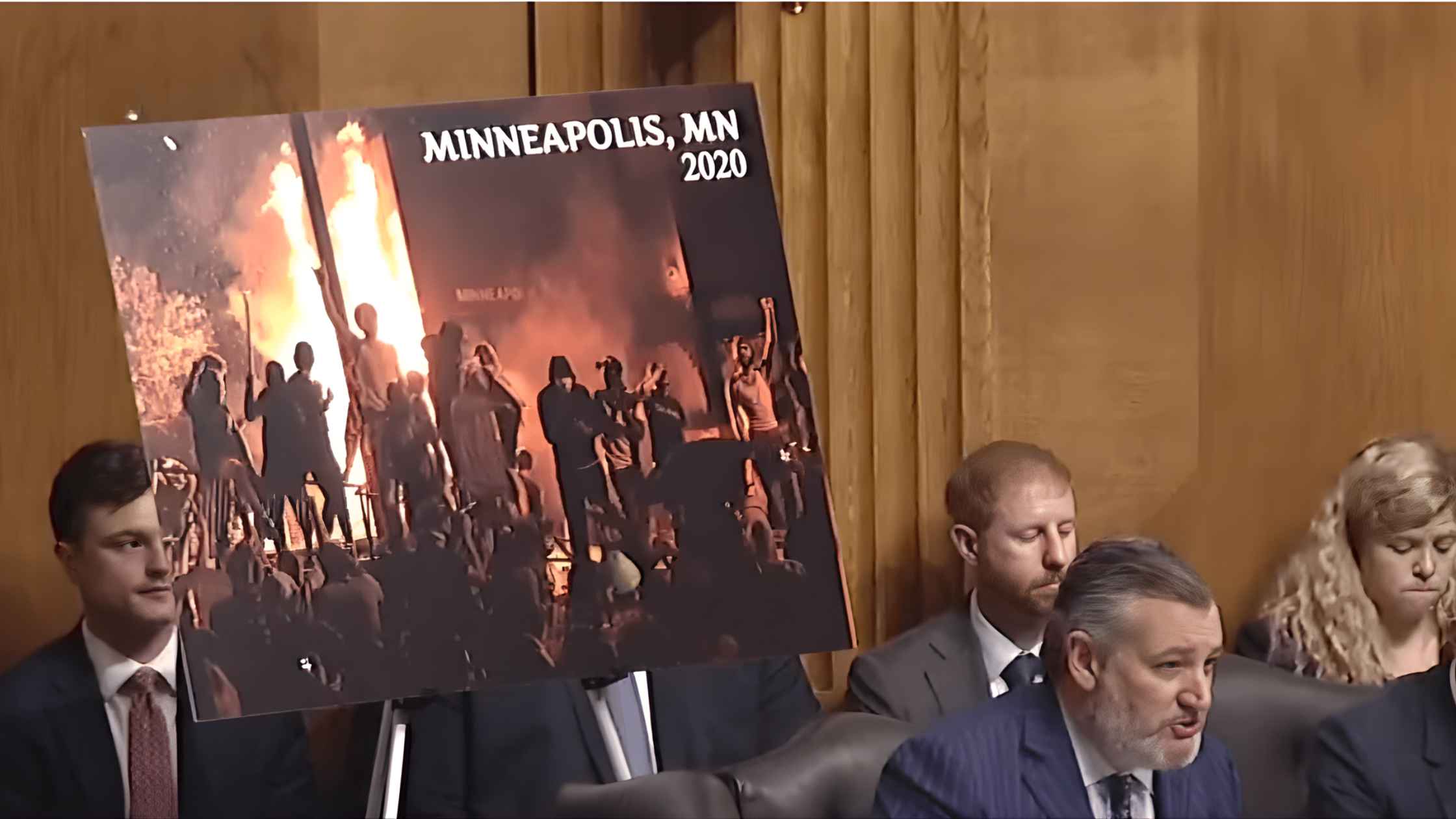
This is the nature of political violence in America today. It's driven by a system far larger than the people who commit the act itself. We've seen this system in action. We have not forgotten what happened in 2020. Five years ago, violent mobs burned and looted their way through our cities. The press called the riots mostly peaceful though. Ivy League academics celebrated them as righteous acts of resistance. The wealthy corporations in the world donated billions to keep them going. Vice presidential candidates bailed rioters out of jail. Prosecutors declined charges. Judges released arsonists and anarchists just hours after their arrests. The same public health experts who banned funerals and shut down churches declared mass protests justified because racism is a public health crisis. Politicians reserved their outrage not for criminals torching police precincts, but for the officers trying to defend them.
(18:13)
The largest cities in the nation slashed their police budgets by hundreds of millions of dollars, unleashing a deadly wave of violent crime on a scale not seen in decades, the largest single year increase in murders in more than a century. The activists on the ground claimed to be revolutionaries fighting the powers that be, but the truth is they were backed by the full force of the ruling regime. The mobs that torch cities, the radicals who ambush ICE agents, the activists who terrorize judges at their homes, all of them are foot soldiers in the same regime. A regime whose foundational ideology is that we're born either as victims or oppressors and is the duty of revolutionaries to impose their vision of equity upon us all. This sustained campaign of violence is explicitly and specifically political. It is motivated by a distinct and fanatical ideology, rabidly anti-American, anti-Western and anti-civilization itself. It is a world view that indicts the United States as an illegitimate nation born in evil. By now, most Americans have heard this language. It has dominated our public life for years. These are not fringe ideas any longer. They have not just been tolerated but actively embraced, repeated and amplified through the largest megaphones in our country.
(19:39)
To my friends on the other side of the dais who may take offense with these categorizations, how often have we heard Democrats praise these radicals for their idealism? How many elected officials have called riots the language of the unheard? The violence stalking our streets today is a feature, not a bug. There is an evil but consistent logic to it. It's the natural and logical result of the ideology itself. If the violent elements ideals were so praise worthy, then the system which obstructs their fulfillment is to blame and why work within a blame worthy system for praise worthy ends? To these people in this movement, the only acceptable goal is the destruction of the system and its leaders.
(20:28)
The central idea of every revolutionary project is that utopia must be achieved through any means necessary. If you truly believe that Charlie Kirk is an existential threat to your safety and you've bought into the nonsense that words are violence, then silencing him by any means could seem necessary. If you believe that mass migration is an inalienable right, then opening the floodgates to uncontrolled immigration, tearing down the border and attacking those who defend it might look like justice to you. If you believe that America was conceived in murder and built on stolen land, then you feel no moral obligation to respect and obey its laws. If you truly believe the police are the armed enforcers of racist oppression who indiscriminately murder innocent victims in the streets, then you might see violence against an officer is an act of brave resistance.
(21:22)
When Charlie Kirk was murdered, one of his killer's bullets was engraved with the message, "Hey fascist, catch." But who taught him that Charlie Kirk was a fascist? Who conceived him, who convinced him, I should say, that Charlie's hate made his murder a righteous act? Who told him over and over again that people who believe what Charlie Kirk believe are threats to our democracy? He didn't invent that world view, he learned it, as did each and every one of the arsonists, assassins and militants who came before him. Perhaps the people in power who said these things didn't really believe them, but clearly some of the people who listened to them did, and now they're taking those ideas to their final logical conclusion. Enough. We are faced with only two paths. Either we confront this political violence and end it or it will end us, and I can think of no better person to introduce this topic than the late Charlie Kirk himself. I'm going to show a quick video before we go to the ranking member of him speaking on this precise subject, and I hope everyone would listen closely and heed his warning.
Sean (22:40):
Now on Thursday, more violence from the radical left, this time directed at Turning Point USA and their group on the campus of UC Davis. Here with more Turning Point USA founder, CEO Charlie Kirk. It's interesting, we were texting what about a week ago, and I kept saying "It takes a lot of courage for you and your group and these young kids to be setting up in these hostile environments on college campuses." And lo and behold, it's not the first time it's happened, but we'll show the video as you're speaking. Tell us everything that went on.
Charlie Kirk (23:13):
Yeah, it's shocking stuff and it's a pattern now. We're seeing this happening on more and more campuses. So at the University of California Davis, our brave Turning Point USA chapter was set to host Brandon Tatum as a prove me wrong event. Goes up, sets a table, anyone can go and have free speech and dialogue if they disagree. Antifa showed up full masked, black outfits, they came and took our gear, destroyed our tables, basically many of the students had to flee and the police did nothing to intervene, nothing whatsoever. Our courageous students had such resolve and fortitude that after this incident happened, they regathered and tried to do the event still about an hour later, but it wasn't the same, of course. This is after one of our Turning Point USA students at University of Texas Dallas had a bike lock thrown at her and actually had to be hospitalized for this treatment.
(24:00)
Sean, we are seeing a disturbing pattern from the radical left and we have data to now support it. According to the National Contagion Research Institute, 48% of left of center respondents say that it's justified to murder Elon Musk, 53% say that it would be justified to murder President Donald Trump. There are ballot measures in California that are being measured by far-left activists that are being named, I should say, after Luigi Maggioni. We have to take a step back here and ask our question, what's really going on here? There's a deeper thing than just political disagreement. If you are on the front lines like our Turning Point USA students, you are potentially putting your safety, your well-being, and God forbid your life in jeopardy for simply being a conservative on a college campus.
Chairman (24:46):
Ranking Member Welch.
Peter Welch (24:48):
Thank you very much, Mr. Chairman, and I want to thank the witnesses for being here today. I just want to make it clear, I am absolutely horrified by political violence in this country. And Senator Schmitt, today, just now, but did a hearing last week or last month. He said, Political violence is always wrong. It doesn't matter which side in the name of any ideology or cause it's wrong." And Senator Schmitt, I agree with you. All of us must condemn every act of violence that tears at the fabric of our society and is absolutely totally corrosive to our democracy. And I think us as elected officials on both sides of the aisle, we have a significant duty to engage and disagree, but with respect unmotivated by hate. Our rhetoric matters and we can reflect our commitment to representing our constituents aggressively, assertively, but without the kind of hatred that foments bad, bad, bad behavior.
(26:01)
And political violence touches all Americans regardless of their political affiliation. I got involved in politics when I was involved in the civil rights movement, and two of the people that I most admired in politics, Martin Luther King and Bobby Kennedy, were both assassinated and I unequivocally condemn Mr. Kirk's assassination unequivocally. I know Mr. Knowles, I know you're very, very close to him. I know Senator Schmitt was very, very close to him, and I know millions of Americans were inspired by him. I condemn that. Let me be clear. I condemn that killing.
(26:46)
Just want to say this, the stakes are really too high for the American people in the health of our democracy to use this hearing as an opportunity to demonize one side of the other. If all violence, all political violence is wrong, is evil, is corrosive, the debate about where there's more on one side or the other, I don't see how that helps us get anywhere. Politicizing violence with inflammatory rhetoric has real consequences, so all of us have to turn that temperature down. Those of us who are in public office, those of us who are in public life. One of the things that happens when we have a reaction that's political and demonize it as being one side or the other is there can be governmental action that then starts suppressing the rights of all of our citizens, whether on the right or on the left.
(27:45)
And we've got that history in our country. The Alien and Sedition Acts made it illegal to criticize the government under the guise of national security. My predecessor, Matthew Lyon, Vermont Congressman, in 1797 went to jail because he criticized President Adams. That was wrong. He ran for re-election and Vermonters responded by re-electing him from jail, standing up for his free speech rights. In the 20s we saw the Palmer Raids and what happened there with illegal searches and seizures without arrest and without warrants and other constitutional attacks on the rights of the organized labor and of everyday citizens under the name of going after, "The far left." And of course in the 50s McCarthyism fueled a campaign of fear and prosecution against left-wing, "Groups," and I put that in quotes, until the Supreme Court stepped in to ensure civil rights and civil liberties were guaranteed. I was listening to Mr. Kirk and I do believe what he did going on campuses to encourage dialogue was a good thing to do. That's what we should have and there should be a civil reaction to that,
Peter Welch (29:00):
But I'm worried that if we're just going to use the violence that we all abhor to get into an argument about whether it's more left or more right, we kind of lose the point that it's all to be condemned. So I'm willing to work with any and all of us to condemn political violence and renew our commitment to civility. And Mr. Chairman's not here, but I sent over to his office a resolution about civility that is just basic agreement to disagree, but not to use invective or hate at all in our discourse. So my view, we can't stop the discussion by having it focus on whether it's left or right wing. Not to leave that unexamined, but it has to be wholly and completely condemned. And I look forward to hearing from our witnesses about your suggestions and how we as a country can do better. Are you going to go? And I yield to Senator Lee. Thank you.
Mike Lee (30:10):
Thank you. I want to thank each of you for being here. I look forward to hearing your testimony. I'm also very grateful to Senator Schmitt, Ranking Member Welch, and those who put together this hearing, working with them. Violence for the purpose of achieving political ends in the United States of America is itself un-American. It's something that is anathema to who we are as a people. And it must be universally condemned and should be regarded as an unthinkable relic of societies that manifestly lack the rule of law because it is. Our republic has regrettably become infected by a type of ideological cancer, one that tends to excuse even the most heinous acts so long as they can be said to achieve or somehow advance politically favored causes. Now, because of the way our news media tends to lean and a number of factors, those are often leftist causes that are embracing this.
(31:19)
If they weren't, if it happened the other way, the media would serve as a check on that. The media doesn't always serve as a check on that when it comes from the left because very often, a number of voices within the media tend to agree with those odds. And I think that's part of how we get to the point where such a high percentage of those who identify themselves as part of the left are willing to say that murder of President Trump is morally justifiable. And other polls have come out since Charlie Kirk's assassination that show that trend getting worse, not better, just in the last few weeks. For examples of this alarming trend, one need look no further than the mostly peaceful burning of various American cities throughout the so-called Summer of Love in 2020, or the coddling of pro-Hamas and anti-Semitic mobs by university administrators just in the last year or two.
(32:13)
And even the disgusting attempts to rationalize, excuse, and in many cases even praise the cold-blooded assassination of Charlie Kirk through grotesque distortions of his past public statements and otherwise. This must end. Today, this hearing gives us a real chance to reflect upon and confront this very disturbing and building trend within our society. It's not enough to state that political violence is wrong. We must expose it, call it out where exists, and root out the forces that tend to enable it. Now, to those who would cite the First Amendment somehow in defense of actions that cannot be defended on their own merits, let us be very clear. Violence is not protected speech, neither is incitement to violence or funding of violence or facilitation of violence, any more so than a conspiracy to commit violent acts would be protected by the First Amendment. These things are not.
(33:15)
They are analytically distinct, legally, constitutionally distinct from speech. They're not covered by the First Amendment. Indeed, the preservation of free speech itself depends on our ability to shield peaceful discourse from those who would silence dissent through any form of violence. Look, modern Americans' society is the greatest civilization the world has ever known. Many on the other side of the aisle have decided that they ought to repeatedly engage in inflammatory, sometimes irresponsible rhetoric that creates permission. Sort of establishes a permission structure, you might say, for violence directed at our civil institutions. As the Trump administration works tirelessly to safeguard Americans from this wave of criminal illegal aliens that have come through over the last four and a half years, many Democrat leaders have fought back, tooth and nail, describing federal law enforcement as a, quote, "Modern-day Gestapo," as slave patrols, as thugs, and as a collective terror force. Despite multiple assassination attempts against Trump, it was and remains today fashionable in leftist circles to compare President Trump to Hitler and smear his reporters, his supporters as fascists. What has been the result of this? Well, across the country, ICE agents have been under attack personally, not just as a group. At an ICE facility in Texas, officers were attacked, with one even being shot in the neck. Investigators later found evidence of left-wing anarchist and anti-government ideology, anti-ICE slogans, Antifa imagery, and online discussions specifically targeting federal agencies. And yet again, much of the left either ignored the story altogether or blamed the government for provoking the attack. And leftists in the media, meanwhile, did at best nothing to stop it, and in other cases tended to foment it. This violence toward the executive branch is not itself isolated.
(35:36)
In 2022, a California man boarded a plane to Maryland with a pistol, with ammunition, and with a fairly distinct plan. His goal? To assassinate Supreme Court Justice Brett Kavanaugh because he disagreed with the leaked ruling in the Dobbs case that would go on to overturn Roe versus Wade. He disagreed with that ruling. Therefore, he decided he had to kill this Justice. He was consumed by far-left ideology and the belief that violence is justified somehow when our system does not result in the outcomes desired by the left. He later told investigators that he wanted to, quote, unquote, "Give his life by killing Brett Kavanaugh himself."
(36:25)
That is not activism. That is radicalism. That is extremism. It is driven by the same ideology that caused violent protest resistance and dressing it up in as many euphemisms as people can find. Shockingly, some leftists suggest almost as a matter of routine that daring to question their misguided beliefs is akin to perpetuating violence against certain favored groups or disfavored groups. I hope we can find bipartisan consensus in condemning all political violence without reservation and without regard to the ideology of the person at whom the violence might be directed. To overcome the very worst instincts of human nature's somewhat natural tendency toward violence, although it's a tendency that can and must be suppressed in any free civilization, we must first remember that we are one nation and one people under God united by bonds far stronger than any passing political moment or cause. Political violence, regardless of the alleged justification, regardless of the political beliefs of those embracing it or opposing it, will never and must never be tolerated by this body or by the United States of America. Thank you, Mr. Chairman.
Peter Welch (37:51):
Thank you, Senator Lee. Would the witnesses please rise? I will now administer the oath. Would you raise your right hand please and answer this question? Do you swear that the testimony you are about to give this committee will be the truth, the whole truth, and nothing but the truth, so help you God?
Group (38:13):
I do.
Peter Welch (38:14):
Thank you. Thank you very much. And I want to introduce our first witness. It's Mr. Wolf. Thank you for being here, Mr. Wolf. And understand that you have a very distinguished career. You serve as America First Policy Institute's Executive Vice President, Chief Strategy Officer and Chair of AFPI's Homeland Security & Immigration. And I also understand prior to that, you were acting Secretary of the US Department of Homeland Security. And during your time at DHS, you successfully navigated incredible number of global and domestic challenges to the nation's security, including COVID-19, civil unrest, numerous border and immigration crises, and historic natural disasters, and threats to global aviation security. And understand too that you serve now as President and founder of Wolf Global Advisors. Welcome. You may proceed.
Chad Wolf (39:17):
Thank you, Chairman Schmitt, Ranking Member Welch, members of the subcommittee, for the opportunity to testify today. Political speech and violence should never go hand-in-hand. I'm here today because I've seen this play out firsthand over the last several years and certainly during my time in government service. Let me be clear. I support those who lawfully exercise their constitutional rights, but when speech turns to violence, we must hold those committing violence accountable. The increase in politically motivated violence over the last several years has been driven largely by radical left-wing extremist groups and individuals that believe violence is a legitimate means to achieve political goals. A recent analysis by the Center for Strategic and International Studies shows that, quote, "Left-wing violence has risen in the last 10 years. And left-wing incidents in 2025 are on track to reach 30-year highs." A recent Rutgers University poll found that 55%, over half of the respondents of left of center said it would be somewhat justified to murder President Trump, and 48% said the same about Elon Musk.
(40:23)
According to another recent poll, one in four people on the far left believe that violence can be justified. That is one in four. The data paints a disturbing picture that some on the left, especially younger adults, are increasingly supportive of violence as a form of protest. In 2020, as acting Secretary of Homeland Security, I witnessed 100 consecutive nights of violence in Portland, Oregon. Every night, hundreds of violent anarchists surrounded the Hatfield Federal Courthouse. They hurled commercial-grade fireworks, sledgehammers, concretes, and even IEDs at our federal officers. They set fire, they vandalized property, and assaulted law enforcement. Their goal was not peaceful protest. It was destruction, coercion, and intimidation. At the time, I pleaded with local officials, including the governor and the mayor there in Portland, to help protect our officers. And time and time again, they refused to act. They chose politics over public safety. The result was more than 280 injuries to law enforcement officers and millions of dollars of damage to federal property and to local businesses.
(41:32)
Back then, we saw public figures attacking federal law enforcement officers, calling them Stormtroopers, Gestapo, and thugs. Comparing American law enforcement to Nazi Germany was irresponsible, reckless, and dangerous then as it remains so today. Unfortunately, this disgusting rhetoric and behavior has only intensified. Once again, we're seeing violent attacks against law enforcement officers. And again, public figures are describing them as Nazis. The difference between 2020 and now, however, is that the Trump administration knows what to expect and is fighting aggressively to hold these violent offenders accountable. The administration has rightfully designated Antifa as domestic terrorists, has began a whole of government investigation into the financing and resourcing of this group, and has charged Antifa members with providing material support for terrorism. And despite what the mainstream media insists, groups like Antifa are not disorganized. They are increasingly organized, funded, and networked. They plan online, they operate anomalously, and execute in ways that make detection difficult.
(42:39)
Make no mistake, their lack of structure is not a feature. It is a feature, sorry. Not a bug. And it is designed to evade accountability and prosecution. Critics argue because they have no formal leadership, they shouldn't be treated as domestic terrorists. I believe this completely misses the point. This decentralized model mirrors what we have seen from jihadist networks, cyber criminals, and other criminal groups. Their lack of a hierarchy makes them more dangerous. This past summer, the American people witnessed multiple anti-fascist-inspired attacks and threats on law enforcement, journalists, and civilians. This includes threats against ICE officers, other government officials, and even Attorney General Bondi just yesterday. Tragically, this also includes the sickening assassination of Charlie Kirk. I want to state this as plainly as I can. Enforcing immigration law, laws passed by Congress almost 60 years ago, is in no way, shape, or form fascism. Every sovereign nation has a right to choose who is allowed to legally enter the country.
(43:47)
Throwing around words like fascists and Nazi not only cheapens history, but it fuels increasing hostility towards law enforcement, journalists, and ordinary citizens. The rise in political violence presents a grave threat to our constitutional order and rule of law. The federal government has a duty and a responsibility to respond. We must continue to give law enforcement the tools and the resources they need, allow ICE to operate safely in courthouses and jails across the country, increase penalties for those that dox federal officers, and expand joint task forces to dismantle. We owe it to the families who have lost loved ones, including Erika Kirk and others who continue to grieve, to ensure that their calls for accountability are answered and that our nation restores respect for law and order. Thank you, again, for the opportunity to testify.
Peter Welch (44:37):
Thank you, Mr. Wolf. By the way, our Chairman has had to go vote. And I'm going to have to go do that after I introduce Mr. Braniff. Mr. Braniff is the Director of Polarization and Extremism Research and Innovation Lab at American University, where he's working on research and programming to prevent violent extremism, targeted violence, and the drivers of polarization in American society. I also want to note that he's a graduate of the United States Military Academy at West Point and served as a Company Commander in the US Army. Mr. Braniff.
William Braniff (45:18):
Chairman Schmitt, Ranking Member Welch, distinguished Senators, thank you for your leadership on this critical issue, the opportunity to testify today. 26 years ago, I took an oath to support and defend the Constitution. I've spent my career honoring that oath as an army officer, terrorism researcher, and leading prevention programs at the Department of Homeland Security. It's a lifelong commitment to protect kids and schools, families and faith communities, public spaces and workplaces, and the democratic institutions and freedoms our founders gave us. This isn't about politics or party for me. It never has been. I'm here representing a community of like-minded practitioners, law enforcement, mental health educators, veterans, who work every day to prevent violence before it destroys families and communities. We're united by a simple belief. Targeted violence is preventable. And American communities deserve better than waiting for the next attack. We should all condemn targeted violence. It's tragic, unethical, and illegal. I want to start by acknowledging the threats, the loss, and the fear that too many Americans and too many elected officials have experienced. But we should also not mistake the blame game for advancing solutions. Solutions must be based on data and evidence.
(46:35)
Solutions must focus on preventing political violence in the first place instead of reacting after the damage has been done. And solutions must reinforce our constitutionally protected freedoms, not erode them. To inform policymaking, Congress legislated that the executive branch provide data on terrorism and targeted violence. DHS contracted with START at the University of Maryland to produce the T2V dataset, although the administration abruptly canceled funding in March. START data demonstrate clearly that violent events do not fit neatly into any one ideological category and that there has been an alarming increase in attacks and credible plots in the United States, including over a 2000% increase in mass casualty plots since the early 1990s. We average more than two and a half attacks and credible plots per day in the US, and over 50% of them succeed. They occurred in over 1,200 US towns and cities. This year, compared to last year, terrorism events are up 67% and fatalities are up nearly 150%.
(47:40)
Americans are dying from ISIS-inspired, white supremacist, anti-Semitic, anti-government, anti-vax, anti-law-enforcement, and nihilistic attacks. So these data highlight three challenges that we need to solve for. The volume problem. With 2.6 events per day, we're at risk of accepting targeted violence as inevitable. It is not. It is preventable. The structural gap problem. These plots succeed 55% of the time. The structural gap is due to appropriate limitations placed on criminal justice investigations to protect privacy, civil liberties, freedom of speech, and freedom of association. So we can't fill the structural gap with criminal-justice-only solutions and maintain the freedoms enshrined in our Constitution. And third, the reality is that targeted violence manifests in many different forms of terrorism, hate crime, and school shootings. Any approach that only addresses one manifestation will be both operationally ineffective and fiscally inefficient. At DHS, I led prevention programs that partnered federal resources with local teams, sheriffs who knew their counties, schools who knew their students, mental health professionals who knew their patients, pastors who knew their congregations. Local Americans protecting local communities.
(48:58)
This allowed us to engage in early interventions that addressed all of the challenges I mentioned. Volume. We supported nearly 1,200 interventions for people on the pathway to violence. Zero committed violence while in the program. We filled the structural gap and bridge to public safety. In 94% of the cases, the individuals received support from mental health professionals, social workers, or other helping professionals. 6% were referred to law enforcement. Most of the individuals, 70%, were not yet self-medicating on any one specific ideology when they came to us. Just angry, isolated, and struggling. And yet, without indexing our programs on any one ideology, the intervention succeeded across all ideologies, making this approach both effective and cost-effective. Nearly 1,200 people at risk of hurting themselves and others. But before families had to bury loved ones, we invested in prevention instead. Political violence threatens our constitutional order, but not just the violence, also how we respond to it. Whether we choose to do what works, quietly investing in scaling up prevention efforts, or we feed political polarization that makes Americans less safe and erodes our Constitution, Americans deserve and the Constitution demands the former. Thank you.
Chairman (50:19):
Thank you. Next up is Michael Knowles. Michael Knowles is the celebrated host of The Michael Knowles Show on The Daily Wire, as well as The Book Club on PragerU. He has published two number one national bestselling books, including Speechless, a history and analysis of the American free speech tradition. Michael has received numerous awards, including the Conservative Mind Award from the American Conservative Magazine, an honorary doctorate of Humane Letters from Ave Maria University. Michael is a graduate of Yale and has lectured at universities and research institutions around the world. Floor is yours.
Michael Knowles (50:53):
Thank you, Chairman Schmitt, Ranking Member Welch, and all the members of this committee. The Ranking Member suggested that we condemn political violence, which surely we must all do. But then he suggested that we not try to pinpoint exactly which side the violence comes from. This seems, to me, confusing and misbegotten as one cannot solve a problem if one does not know where the problem lies. In light of the murder of my friend Charlie Kirk by a leftist assassin, I am gratified to see that at least some members of our federal legislature are now confronting the consistent and escalating pattern of left-wing terrorism in the country. Lest I be accused of partisan invective, on September 23rd, no less an emblem of American liberalism, then the Atlantic Magazine published an article citing a recent study from the Center for Strategic and International Studies, admitting that the left is more violent today than the right.
(51:49)
Less honest liberals, including members of Congress, continue to deny this fact. Democrat Congressman Seth Moulton, for example, reacted to Charlie's assassination by blaming the right. Congressman Moulton claimed that three quarters of political violence in the United States comes from the right, while only 4% comes from the left. That claim struck me, as it probably does many of you, as suspect. So I looked into just a few recent examples that came to mind of prominent left-on-right violence. The Covenant School massacre in Nashville, in which a trans-identifying shooter murdered Christian schoolchildren after outlining her ideological motivations. According to authorities, there was no ideological motive there. Go figure. The Black Lives Matter riots, overtly leftist demonstrations that left dozens of people dead and over a billion dollars worth of property damage. Likewise, those fail to show up on registers of left-wing political violence. Even an attack by Antifa that targeted me personally, as well as conservative college students, for our political views appeared in official records and datasets as nothing more than obstructing law enforcement. It turns out the left commits relatively little political violence when you don't count the political violence that the left commits. I am here today to speak about that single illustrative incident. On April 18th, 2023, I was invited to participate in a debate at the University of Pittsburgh on the topic of transgenderism. Before the debate, several hundred left-wing protesters gathered outside the student center, many dressed uniformly in black with face coverings. They lit the street on fire while burning me an effigy with a little Hitler mustache painted on my face. All because I hold the view, as most Americans do, that men cannot become women. Buildings in the area were placed on a soft lockdown. As the Pittsburgh Bureau of Fire put out my burning effigy, an Antifa operative named Brian DiPippa, hiding behind his wife, Krystal, rolled two smoke bombs under police barricades. Attendees scattered while demonstrators chanted, "Fascists go home." DiPippa then threw a lit firework into a group of police officers protecting the building. The explosion injured several officers, including severe and life-altering injuries to a female officer. The debate was forced to end early after campus police determined that the protests outside were becoming even more destructive. The campus issued a safety emergency notification. Despite popular efforts to deny the existence of organized left-wing terrorism, Brian and Krystal DiPippa were not merely two citizens protesting a speaker with whom they disagreed. Things just got a little out of hand. No. They are members of an extremist cell, a cell that meets at an anarchist bookshop, the sort of venue that operates as training grounds for left-wing terror attacks. Brian DiPippa repeatedly set off TSA screeners for explosive material on his body. The Torch Antifa Network has claimed the DiPippas as members and raised money for them through a tax-exempt non-profit organization.
(55:04)
Imagine. Thanks to a courageous FBI agent who happened to be on the scene, the Department of Justice was impelled to bring charges. Unfortunately, our justice system gave them only a slap on the wrist. I think we should all be able to agree that throwing an explosive at a group of people is no mere minor indiscretion. That is a very serious crime. That's attempted murder. The kind of crime that merits life in prison. Instead, our justice system sentenced Brian DiPippa to minimal jail time for obstructing law enforcement. His wife got off with probation. The federal government must act now to stop the consistent and accelerating trend of leftist terrorism. For a legislator to deny the threat and neglect the remedy might once have been chalked up to ignorance. Today it is nothing less than complicity. Thank you.
Chairman (55:58):
Thank you.
Senator Durbin (56:06):
Mr. Chairman, I'd like to introduce the next witness. Daniel Hodges was born in Winston-Salem, North Carolina. Studied at George Mason University. Currently studying at the University of Virginia. Joined the Virginia National Guard in 2012, and was honorably discharged after a six-year contract. He joined the Metropolitan Police Department in 2014 and has served the city of Washington DC as a police officer, since earning awards, citations, and commendations. On January the 6th, 2021, Officer Hodges responded with his colleagues to the US Capitol to help defend against the mob who was attempting to stop the transfer of power. Officer Hodges was injured during the attack, but returned to full duty weeks later. In 2022, he testified before the House Select Committee to investigate the January 6th attack. And has since been honored with the Presidential Citizens Medal by President Joe Biden for his heroic service to the nation during the assault on the Capitol. Thank you, Mr. Hodges.
Daniel Hodges (57:10):
Thank you. I'm speaking in my personal capacity. However, I draw upon my experiences as one of the few police officers in this country who has policed both the protests and riots of 2020 as well as the insurrection of January 6, 2021. I'm intimately familiar with political violence as when I fought to defend the United States Capitol and many of your very lives, I was beaten, bloodied, crushed, with my eye gouged and my skull smashed with my own baton. Political violence is a worthy topic for discussion. However, the press release I saw from the subcommittee Chair made it clear this was not going to be an honest consideration of various causes and effects, but rather a ham-fisted attempt to propagate the unsupported notion that liberal ideology is the greatest origin of modern political violence. This is particularly galling to me since every single member of the majority on the subcommittee has
Daniel Hodges (58:00):
Either contributed to one of the most infamous examples of conservative political violence of our age or the protection of its perpetrators. Every majority member who could do so voted to acquit Donald Trump during a second impeachment and now we find ourselves in a new horrific age of political violence. One word is carried out by the state itself. A permanent resident was arrested without a warrant and is being threatened with deportation simply for his politics. A Tennessee man was arrested and is being held on $2 million bail for sharing a Trump meme on social media. Members of Congress have been denied access to is facilities, despite the law granting them unannounced oversight rights. These attentions and prohibitions are all grounded in the threat of deadly force and violence are absurd or outright illegal and politically motivated by right-wing ideology. The fact that these actions are carried out by agents of the state doesn't make them acceptable, it makes them far worse.
(58:52)
The current administration is doing whatever it can to downplay the threat that right-wing violence presents to the United States, including literally erasing data. Between September 12th and the 13th of this year, the Department of Justice deleted their own study from their website, which came to the conclusion that right-wing extremism poses a much greater threat than left-wing extremism. I quote now the opening paragraph of this National Institute of Justice report published just last year. Quote, "Militant nationalistic white supremacist violent extremism has increased in the United States. In fact, the number of far-right attacks continues to outpace all other types of terrorism and domestic violence extremism. Since 1990, far-right extremists have committed far more ideologically motivated homicides than far-left or radical Islamist extremists, including 227 events that took more than 520 lives. In the same period, far-left extremists committed 42 ideologically motivated attacks that took 78 lives.
(59:51)
A recent threat assessment by the US Department of Homeland Security concluded that domestic violent extremists are an acute threat and highlighted a probability that COVID-19 pandemic- related stressors, long-standing ideological grievances related to immigration and narratives surrounding electoral fraud will continue to serve as a justification for violent actions. There will always be those who seek to further their own political agenda through extralegal violence, and that is what law enforcement is for. But to reduce the risk of the population at large from falling into radicalization, the solution is simple, it's unfettered democracy. One of democracy's greatest assets is how when unsullied, it provides a mechanism for everyone to have their voice heard. And when people believe their government speaks for them in some manner, they're less apt to seek violent means to accomplish their political agendas. So make voting easier, not harder. Stop gerrymandering people into oblivion. Stand on the strength of your ideals, not the depth of your donor's pockets.
(01:00:50)
Stop shopping for judges and start seeking ideas that withstand scrutiny from any political ideology. When you tell the people that an election was stolen from them, they will take up arms against their neighbors without a shred of evidence, I know. But if you tell them brilliant political rhetoric is their birthright and civic engagement is their privilege, they'll instead take up the book in the pen and we'll all be richer for it. And just so you know that this is the helmet that US Capitol police officer Brian Sicknick wore on January 6th, 2021, and he died the following day. The family member just got back that today. Thank you.
Chairman (01:01:31):
Thank you. Thank you for your service. Next up is Kyle Scheidler, is the director and senior analyst for Homeland Security and Counterterrorism at the Center for Security Policy where he conducts research and analysis on domestic threats to the US homeland and an emphasis on the doctrines which fuel terrorism and shape the variety of kinetic and non-kinetic threats to America's security. He's briefed senior US government officials, members of Congress, federal, state and local law enforcement officers, and testified before the US Senate Judiciary Subcommittee on the Constitution and the Canadian Senate Standing Committee on National Security and Defense. He is the author of Understanding Black Identity Extremism: Considerations for Law Enforcement and editor of Unmasking Antifa: Five Perspectives on a Growing Threat. And a contributing author to Saudi Arabia and the Global Islamic Terrorist Network. His writing has appeared at the Federalist, the Hill, FoxNews.com, and the Claremont Review of Books, amongst others. He's a graduate of Boston University and a Lincoln Fellow with the Claremont Institute. The floor is yours.
Speaker 1 (01:02:40):
Thank you, Mr. Chairman, Ranking Member Welch, distinguished senators. I would like to thank you for the invitation to testify today about the threat our country faces from growing political violence. In my capacity at the Center for Security Policy, one of the things I'm most proud of is our program to provide educational briefings to law enforcement officers at the federal, state and local levels. And for the five years of this program's operation, the number one most requested briefing topic that we have been asked to provide has been on the topic of Antifa and related left-wing extremist groups. The reason it has been the most requested topic is not because contrary to media reports, Antifa does not exist. America's law enforcement knows it exists because they see the effects every day. The reason it is the most requested topic is because they cannot get accurate and quality information about the threat.
(01:03:31)
Until recently, the federal government has failed to define the extensive nature of this threat and has demonstrated a history of dismissing or reducing charges against left-wing extremists. But despite this failing, we have seen convictions for acts of political violence by Antifa members who were identified by as such. In 2021, officers and citizens were injured in a violent pre-planned riot carried out by Antifa. The San Diego district attorney successfully secured convictions against 11 Antifa members, including charges of conspiracy to riot. In 2023, the state of Florida successfully sued Antifa members under the Face Act, securing civil fines and felony pleas for their attack on pregnancy crisis centers. This is just one case, but in the five months after the DAB's decision was leaked, more than 100 churches, pregnancy resource centers and pro-life organizations across the country were attacked.
(01:04:26)
Mr. Knowles has already mentioned the case against Brian DiPippa, and the federal government's guilty plea, but I think it is worth adding that Mr. DiPippa was also the web creator for ItsGoingDown, an Antifa website, which has for years published both ideological manifestos and tactical instructions for aspiring Antifa members, including a 2007 forming an Antifa group manual, which I first brought to the attention of this committee when I testified before it in August of 2020. But what is Antifa? Well, as a recent Department of Justice indictment accurately describes, quote, "Antifa is a militant enterprise made up of networks of individuals and small groups ascribing to a revolutionary anarchist or autonomous Marxist ideology, which explicitly calls for the overthrow of the United States government, law enforcement authorities and system of law. Antifa adherents have espoused insurrection and advocated violence to affect the policy and conduct of the US government by intimidation and coercion. That's a good working definition, which would bring US law enforcement into line with the definitions which are utilized by other Western governments, which also have an Antifa threat, that would include Germany and Sweden.
(01:05:37)
These networks of small direct action groups are connected through ideologically aligned organizations, online platforms and support networks, which provide significant amounts of materials support. But much of this material support is in the form of services rather than financial transactions. One example, the website Abolition Media posts communicates from the PFLP, the ELN, the PKK, and the MPA, all of them designated communist terror groups. That alone is actionable material support for terrorism, but it also post claims of responsibility for anarchist arson attacks and propaganda on behalf of Antifa members currently in prison for violent attacks in the United States, Germany, Chile, Greece, and Hungary. The site distributes calls for actions and organizes efforts for Antifa groups across international borders and even posted an anarchist manual discussing the value of complex coordinated terrorist attacks. If this site were promoting and advocating violence for Al-Qaeda, there would be absolutely no question in the minds of US authorities that it serves as a media arm for a terrorist organization.
(01:06:42)
According to a recent article by journalist Hudson Crozier, Abolition Media is just one of 100 such websites hosted on NoBlogs, a blogging suite provided by the Italy-based Autistici Inventi Collective, which provides websites, emails, digital encryption tools to Antifa and related left-wing extremist groups, all while hiding their personal data from law enforcement. Very similarly, the International Antifa Defense Fund has distributed over a quarter of million dollars to 800 Antifa members across 26 countries, including not just for legal support, but up to 20% has gone to security improvements and emergency relocation costs for Antifa members. It would be a reasonable avenue of investigation to determine if funds have gone to help fugitive members avoid arrest. I look forward to working with the committee on ways US policy and legislation might address the threat posed by Antifa and related left-wing extremist groups.
Chairman (01:07:33):
Thank you. The chair recognize a Ranking Member of the Judiciary Committee, Senator Durbin for his opening remarks.
Senator Durbin (01:07:39):
I thank Senator Schmidt for that courtesy. At the outset, I want to recognize law enforcement who are here today, including those who defended the US Capitol on January 6th, 2021, and the family members of those who are no longer with us. Ken Sicknick, brother of fallen officer Brian Sicknick is here. He reminds us and I quote, "The simple act of not letting the events of that day be whitewashed, revised, or forgotten is more important than anyone can ever know." That statement by Mr. Sicknick rings painfully true today. This hearing examines a critical issue, political violence in America. I've said it before over and over from this podium, and we'll repeat, violence is not acceptable, whatever the source or origin. I do not believe that one party owns the right to say it's the other party's fault. It is the fault of both parties in differing degrees, and it's our fault if we try to whitewash that reality.
(01:08:45)
To seriously address this problem, we must be honest. We must start with the facts, not with partisan conclusions. To claim, as the chairman of the subcommittee has, and I quote, "Political violence comes predominantly from one side of the aisle, and don't give me this both sides BS, is not supported by the facts. In fact, those facts tell a different story." For more than a decade, for more than a decade, data from the FBI, DHS, and nonpartisan experts show that far right extremists have been responsible for most domestic terrorism, including most deaths by far. On this chart, which you can see behind me, from the Center for Strategic and International Studies, also known as CSIS. Terrorist attacks from the right are in red and attacks from the left are in blue. CSIS found that since 2016, 112 people have been killed as a result of right wing attacks, while three have died as a result of left-wing attacks.
(01:09:49)
These are not partisan talking points. They are the facts by federal law enforcement and national security experts across numerous administrations, both Democratic and Republican. Indeed, one of today's majority witnesses, Mr. Chad Wolf, and his confirmation hearing before Congress act as acting DHS secretary during President Trump's first term testified, and I quote, "White supremacist extremist from a lethality standpoint over the last two years are certainly the most persistent and lethal threat when we talk about domestic violent extremists." Far-right extremists were responsible for the January 6th, 2021 attack on the Capitol. I lived through it. And they've been responsible for a string of hate fueled massacres, targeting ethnic and religious minority communities, including the 2012 Godwark shooting in Oak Creek targeting Sikh Americans killing seven. The 2015 Mother Emanuel AME church shooting in Charleston, targeting black Americans, killing nine. The 2018 Tree of Life synagogue shooting in Pittsburgh, targeting Jewish Americans, killing 11. The 2019 Walmart shooting in El Paso, targeting Latino Americans, killing 22. And the 2022 top supermarket shooting in Buffalo, targeting black Americans, killing 10.
(01:11:18)
Political violence has continued to rock the nation in recent months, from the assassination of Mr. Kirk, to the assassinations of Minnesota House, speaker Emerita Melissa Hartman and her husband. And the attempted assassination of Minnesota State Senator John Hoffman and his wife. Just last week, a man was arrested after allegedly offering $45,000 for the killing of Attorney General Pam Bondi. And a January 6th rioter who was pardoned by President Trump, full and unconditional pardon was arrested for allegedly threatening to kill the House Democratic leader, Hakeem Jeffries. I've said it before and I'll say it again, there's no room for political violence in America ever, ever, not from the right or from the left. I'm deeply concerned by the Trump administration's response to the political violence crisis. On the one hand, the administration's threatening a crackdown on constitutionally protected speech based on false claims that in the words of Stephen Miller, there is, quote, "A vast domestic terror movement on the left."
(01:12:23)
At the same time, the administration is gutting programs that have proven effective in combating domestic terrorism. For example, the administration has slashed their budget of DHS Center for Prevention programs and partnerships by more than 30%. Cut the center staff by 80, employees to fewer than 20. And appointed a 22-year-old Trump campaign official to run the center. We honor our constitution and serve our country not by rewriting history or weaponizing tragedy, but by telling the truth even when it's uncomfortable because democracy cannot survive selective outrage or deliberate amnesia. To the officers and families here today and watching at home, we will never forget January 6th, our duty is to protect the truth, to defend the rule of law and to be an American that rejects violence in every form. Thank you, Mr. Chairman.
Chairman (01:13:17):
Thank you, senator. I want to point out that the CSIS study that's been mentioned here and repeated ad nauseam excluded violence at protests from their study, allowing them to systematically ignore Antifa and Black Lives Matter riots, but they did make an exception for Charlottesville, interestingly. Even using their flawed methodology, CSIS recently reported that left-wing violence in 2025 outpaces right-wing violence. Imagine how much bigger that disparity would be if they actually weren't cooking the books. So without objection, I'd move to enter into the record an article by Tim Carney explaining CIS's biased methodology. Without objection it will be entered into the record.
(01:13:55)
We'll start with questionings, Mr. Knowles, I want to start with you. You're not going to have any bigger proponent of free speech than me given especially what I did in my last job in this one, I believe in it wholeheartedly. I think the first amendment is the beating heart of our constitution. But what we're really talking about here is conduct, of course, violent conduct, and you've talked about you can't really have this competition in the marketplace if the marketplace is being destroyed and shot up in many instances. How do we get at this problem? What's the road forward in your view?
Michael Knowles (01:14:30):
We might be able to find a little bipartisan agreement if we acknowledge something that both parties at different times have acknowledged, which is that of ideas or any other kind of marketplace only function when there are rules and when we abide by those rules. You can't have a marketplace if bandits keep shooting up the marketplace. And this is why it's so important to identify where the threats to the marketplace have really been coming from. Have we seen left-wing speakers shout it down on campuses? Have we seen left-wing events interrupted by terrorists? Rarely. So if ever, I can't think of an occasion.
(01:15:07)
I am amused that Senator Durbin began by warning against pointing to one side or the other, making this a partisan issue before beginning one of the most partisan invectives that I have ever heard. But I'm not even opposed to a partisan invective here because I think it is very important that we identify where the threats are. I think any honest Democrat even would have to acknowledge as the Atlantic magazine did, as even CSIS has acknowledged that the threats today to the free marketplace of ideas come from the left. And so in order to restore the open marketplace of ideas, the healthy exchange of ideas essential to our self-government, we must regulate where the problem is. And today the problem lies on the left.
Chairman (01:15:49):
Thank you. Mr. Wolf, I want to ask you, and thank you for your service. A common refrain is that Antifa is an ideology, not an organization. Could you talk about in your experience how that is complete and utter nonsense, that this is actually a pretty well-coordinated organization with safe houses and money that's laundered internationally, quite frankly, not just domestically?
Chad Wolf (01:16:13):
Yeah. Well, I think we've seen that across the country. I think the indictment by the Department of Justice in Texas talks about the Antifa cell there in North Texas about how they do coordinate, how they do pool their resources. I saw it firsthand in Portland, although it was very difficult to prove at the time. Those types of anarchists and others there are being well-organized, being well funded, being resupplied daily. Not that they were doing that themselves, but that they had help. And so as you look across the spectrum here, is Antifa like other organizations, does it have a hierarchy and an org chart and everything else? No, it's very different. But that doesn't make it any less dangerous. And that shouldn't mean from a law enforcement perspective, well, let's not actually investigate. Let's not actually start to look at who these individuals are, how they're organized, how they're funded, how they're financed. Just because they're decentralized doesn't make them any less threatening.
Chairman (01:17:11):
Thank you. I'm going to go to you and pick up on that point because you alluded to it in your testimony. Understanding what Antifa is and its connections and organization, what are some suggestions you might have of how we could get at this problem of this radical organization hell-bent on destroying America? This is their stated mission, how do we get about that?
Speaker 1 (01:17:34):
Well, I'm a firm supporter of the president's recommendation to target Antifa as a foreign terrorist organization. There are a number of Antifa organizations that operate across Western Europe and Latin America, which we would be justified in designating as a foreign terrorist organization. There are also a number of networks which provide material support, including the one that I mentioned in my testimony. And that is a very common method in which Antifa receives support. Much like for example, Islamic State or Al-Qaeda, where they host media outlets like Dabiq and Inspire, which will give you both ideological instructions as to how to become Antifa, what you need to believe and how you need to believe it.
(01:18:19)
They also provide instructions on what you should do if you wish to be Antifa, including how you should organize, how you can avoid arrest, what encrypted apps to use, what websites to use. They'll also provide instructions on how to destroy critical infrastructure, including 5G wireless communications and how to derail trains as, for example, the website ItsGoingDown did in a case that was related to two anarchists in the Pacific Northwest derailed a number of trains in which the federal government was able to achieve a conviction. So these networks can be targeted for engaging in material support for terrorism. We are not talking about speech, we are talking about manifestos, describing how to overthrow the government and how to do that with violence.
Chairman (01:19:06):
Thank you. And President Trump has designated Antifa as a domestic terrorist organization. And I've written to Secretary Rubio for the foreign terrorist organization, and we'll see what happens with that. Ranking Member Welch.
Peter Welch (01:19:23):
Thank you very much, Mr. Chairman. I want to ask Mr. Hodges, you were here in duty, in uniform on January 6th. Can you tell us just what you went through and what the size of the crowd was that was attacking the Capitol?
Daniel Hodges (01:19:43):
Certainly, I'll try to be brief, but it's a very long day. Started at 7:00 in the morning on Constitution Avenue, as everyone filed into the ellipse to hear Trump give his rally, so to speak. And then afterwards they started heading back towards Constitution Avenue towards the Capitol. I heard on my radio that they discovered bombs. I heard on my radio that the capitol is becoming under attack. The commander who was on scene at the Capitol is getting overwhelmed and called for my platoon to reinforce them. So we did. We got on our pads, made our way down to the Capitol.
Peter Welch (01:20:24):
So you went to where the trouble was?
Daniel Hodges (01:20:26):
Correct, yes. We got as far as the edge of the western property, but the crowd was so dense we couldn't get any closer than that in the vehicle, so we got out on foot. Started making a way towards the western terrace itself. While we were walking through the crowd, all Trump supporters, Trump flags, Trump gear. They started yelling at us, calling us Stormtroopers, telling us to remember our oaths, calling us traitors, and we hadn't done anything yet.
Peter Welch (01:20:57):
You were uniformed officers, right?
Daniel Hodges (01:21:00):
Yes.
Peter Welch (01:21:00):
No mask.
Daniel Hodges (01:21:01):
Correct.
Peter Welch (01:21:02):
And you were insulted with those terms?
Daniel Hodges (01:21:05):
Yes. Stormtroopers, to remember our oaths, all that nonsense. And then eventually when we were making our way through the crowd, we were attacked, cutoff from our leadership. I was hit over the head from behind, lurched forward. Then someone tried to steal my baton. I was able to retain my weapon, and I tried to forge a path through the crowd. Unfortunately, I looked back and saw that the rest of my colleagues were under attack from more of the mob. I went back and I succeeded in pulling some of the assailants off my colleagues until I was attacked again. Someone tried to steal my baton again. We wrestled for control. Went to the ground with it. He kicked me in the chest. I went to my hands and knees and the medical mask I was wearing at the time got pulled up over my eyes, so I was blind surrounded by the mob. But thankfully, my colleagues were able to free themselves from their attackers and came to my defense. I got up and I forged another path through the crowd.
(01:22:04)
There was chaotic explosions going off, smoke grenades, bike-rack barriers being broken down into poles to use as weapons. Then eventually we made our way to the west terrace itself where police line was being held. We joined the defense there where we held the line as long as we could. Unfortunately, we were comically outnumbered, 175 officers, to I think it was like 10,000 insurrectionists. I remember looking out over the crowd and I couldn't see the end of it. I couldn't see the end of their numbers. And they broke through. About three or four of them attacked me, pushed me into a waist-high barrier. One of them reached underneath my visor, gripped my face with his hand, and tried to gouge out my eye with his thumb. I was able to shake him off before any permanent damage was done, but we lost the line. We had to fall back to the building itself, and that's what we did.
Peter Welch (01:23:12):
Thank you very much. And I understand that the brother of Officer Sicknick is here. I just want to acknowledge him. He's the officer who died, one of your fellow Capitol police officers. I want to ask a question of the panel. As you know, everybody who was involved and convicted was pardoned. Raise your hand if you believe that those pardons were appropriate. All right. So that includes pardons for folks who were involved in attacking Officer Hodges? It does. Mr. Chairman, I have to say-
Michael Knowles (01:23:50):
Are we being invited to speak or is-
Peter Welch (01:23:52):
Pardon me?
Michael Knowles (01:23:53):
Was that an invitation to speak or were you-
Peter Welch (01:23:55):
No.
Michael Knowles (01:23:55):
Oh, understood.
Peter Welch (01:23:57):
It was not. But you said, and I said, and I agree with you, political violence is to be condemned, whether it's on the right or the left. We just heard a pretty frightening description of political violence on a sustained basis against this Capitol police officer. And there's a view that he should be pardoned. I guess I'll just say I disagree with that. I yield back.
Chairman (01:24:26):
Senator Cornyn.
Speaker 2 (01:24:30):
Thank you for being here. I'm glad at least we can agree on one thing, that political violence is unacceptable no matter where it comes from. But I want to talk about the leadership and what some leaders have said, which I believe has contributed to that political violence. In 2018, when Nancy Pelosi was asked about policies she disagreed with. Instead of saying she would do her job and legislate or try to persuade people to the contrary, she replied, "I just don't even know why there aren't uprisings all over the country, and maybe there will be." About that same time Kamala Harris was asked about being stuck in an elevator with President Trump, Mike Pence, and Jeff Sessions, and she replied, while laughing, "Does one of us have to come out alive?" And then there's this. Mr. Schumer. In March 2020, the majority leader of the United States Senate, Chuck Schumer said about Supreme Court Justices the following. I want to tell you, Gorsuch, I want to tell you, Kavanaugh, you have released the whirlwind and you will pay the price. You won't know what hit you." In August 2020, Representative Ayanna Pressley said, "There needs to be unrest in the street, encouraging rioters." Then Maxine Waters said in 2021 that Democratic rioters should quote, "Get more confrontational." Close quote, "With police." She said, "If you see anybody from Trump's cabinet at a restaurant, in a department store, at a gas station, you get out and create a crowd and you push back on them and you tell them they're not welcome anymore, anywhere." And then in 2023, delegate Stacey Plaskett said on MSNBC that President Trump needs to be shot. In 2024, President Biden told Democratic donors that it was time to put Trump… This is the President of the United States,
Speaker 2 (01:27:00):
… told Democratic donors, it was time to put Trump in the bullseye. And recently Alexandria Ocasio-Cortez posted in an Instagram story that people should resist ICE. And then Jasmine Crockett, a member of the House of Representatives from the state of Texas, Kayla Hamilton was a young woman who was sexually assaulted and strangled to death by an illegal alien, an MS-13 member. I lead a bill named in her honor here in the Senate. Representative Jasmine Crockett called Kayla Hamilton a, quote, "random dead person". We've talked about the person that would be assassin that was going to kill Justice Kavanaugh and of course the assassination attempts on President Trump. Does everybody on the panel feel like or believe that the individuals who actually commit acts of violence should be held accountable? Please raise your hand. So we agree acts of political violence are unacceptable and the individual who commits those acts should be held accountable. But I want to talk about the political leadership that I think has a greater responsibility. People who serve as the elected representatives of the American people. Is there anybody believe that they bear no responsibility for inciting or encouraging acts of violence? Well, we've always had in our course of our nation's history, people who are ideologically driven to violence, anarchists, maybe the historical antecedent of Antifa. People motivated by ideological reasons. But I believe that leaders elected to Congress should not say or do things which suggest that political violence is acceptable. And the examples I read to you just now I think should be condemned.
Chairman (01:29:38):
Thank you. Thank you Senator. Senator Durbin.
Senator Durbin (01:29:40):
Thanks, Mr. Chairman. Mr. Braniff. You previously served as director of the Center for Prevention Programs and Partnerships, our or CP3 at DHS, an initiative created under the Biden administration to take a comprehensive approach to combating domestic violent extremism. CP3 prioritized public and community health programming to identify people before they commit acts of violence in coordination with federal, state and local law enforcement. In your experience, how have these investments in public health led to identifying at-risk individuals and stopping violent acts before they occur?
William Braniff (01:30:18):
Thank you, Senator. I'm actually perhaps the one person who has something to offer in terms of solutions today, and I'm really excited to talk about that. At CP3, we learned from the violence prevention community, the same people who for 30 to 40 years have been studying suicide prevention and violence against children prevention, intimate partner violence prevention. And we started to apply those methods and that evidence to targeted violence prevention to try to prevent terrorism, hate crime school shootings. And the great thing about this approach is that it's upstream, right? Violence is a universal human phenomenon. It just manifests differently When someone starts to struggle, they might go answer seeking online and they might fall down one rabbit hole or they might fall down another rabbit hole and after time if whatever underlying crisis goes unaddressed, they might decide that violence is a solution to their problems.
Senator Durbin (01:31:15):
Sorry to interrupt you, but we've heard allegations from both sides of the table as to whether there's more violence on the right, more violence on the left. What I hear you saying is that certain persons are predisposed toward-
William Braniff (01:31:30):
No senator, actually, thank you for the question. All of us have vulnerabilities and if those vulnerabilities go unaddressed, we could wind up being manipulated into engaging in violent extremism. We did 1,172 interventions. Think about that. 1,172 interventions for individuals who were exhibiting risks of violence. They were making veiled threats of violence. They were socially isolated and those interventions were across the ideological spectrum. Some people were flirting with white supremacy, some people were flirting with anti-government extremism. Some people were just flirting with violence for violence sake.
(01:32:05)
The point is we didn't wait until something terrible happened and then blame the ideology behind it. We actually did a therapeutic intervention and in 94% of those interventions, the individual got help and there was no violence in 6%. They had made a threat to public safety that was imminent or they had crossed a criminal threshold and they were referred to law enforcement. So we supported those individuals averted nearly 1200 potential acts of violence and never sacrificed public safety. We have a solution that's cost-effective, that does not violate civil rights, civil liberties, and protects our constitution, and I would encourage us to look at that as a potential solution.
Senator Durbin (01:32:44):
As you know, the Trump administration significantly cut the staff at CP3, which you worked with, which led to your resignation. Is that true?
William Braniff (01:32:53):
Senator, there is no more office at all. The entire thing was dismantled. The final two people left on September 11th and 12th.
Senator Durbin (01:32:59):
So the prevention effort you're describing to us is now no longer funded?
William Braniff (01:33:04):
That is correct.
Senator Durbin (01:33:05):
Are you concerned about the potential rise in attacks that we may see without similar level of inquiries taking place under this administration?
William Braniff (01:33:13):
Senator, I've given my life to protecting American people. I'm incredibly worried about the rise of targeted violence and terrorism across the ideological spectrum at the same time that we've dismantled the very apparatus that can prevent it, and we've seen 150% increase in fatalities from terrorism last year to this year. We've seen about a 70% increase in terrorist incidents from last year to this year. We've seen an increase of violence across the board, and I would encourage us to think about investing in prevention going forward because I know that it works.
Senator Durbin (01:33:45):
An ounce of prevention as they say.
William Braniff (01:33:47):
Yes, Senator.
Senator Durbin (01:33:48):
Well, I think that's an important lesson for us to take. The Republican members of this committee believe they're right. The Democrats believe they're right. The American people want to see less violence. I hope we all want to see less violence. This is one agency with an agenda directed toward reaching that goal and unfortunately it's virtually been shut down if we're sincere about this on a bipartisan basis. Let's do something to revive that effort. I yield.
Chairman (01:34:15):
Thank you. Senator Lee.
Mike Lee (01:34:18):
Thank you very much. Mr. Chairman. Mr. Knowles, I'd like to start with you if that's okay. I hardly need to expand upon the violence that has recently been committed on campuses across the country. Most notably and prominently of late Charlie Kirk was assassinated not too far from where I live in Utah at Utah Valley University. That assassination occurred amidst many of the developments that you've referred to in your opening testimony, and it arose in the context of a public debate he was holding in a public forum specifically about some political issues. Now while that conversation, that investigation remain ongoing, there is a lot of circumstantial evidence suggesting a political motivation for this attack. Can you help this body understand the violent tendencies inherent in some of these ideologies that are prompting a lot of this violence?
Michael Knowles (01:35:19):
I certainly can thank you, Senator. Charlie was probably the most prominent proponent of civil and gracious dialogue in the entire country, and they killed him for it. Because there is in a certain type of left-wing ideology, the belief that ideas don't really matter and that we're really just warring groups that must clobber each other over the head, which is why you're seeing the increased violence there. I think you saw this not only in the horrific assassination of Charlie, but in the reactions that came afterward. As the scene was unfolding. A Democrat analyst, Matthew Dowd on MSNBC, the left-wing cable outlet blamed Charlie Kirk.
(01:36:01)
He said quote, "Hateful thoughts lead to hateful words, which then lead to hateful actions." The New York Times reacted by publishing the assassination-related musings of Hassan Piker, a prominent left-wing streamer who has suggested the assassination of Senator Tom Cotton and who has said, quote, of conservatives, "Kill those mother-effers, murder those mother-effers in the street, let the streets soak in their effing red capitalist blood." I could go on and on with the reactions. We all saw it and there reflected in other public opinion surveys relating to approval of violence. So it would appear that this is not merely a matter of some fringe actors, some extremists who simply have an emotional problem as has been suggested here today. This would seem to be clearly an ideological issue at every level of the American left, which needs to be addressed accordingly or else we're just twiddling our thumbs. We are not doing anything to solve the problem.
Mike Lee (01:36:56):
Now, if those things arose in the context of someone in the right-of-center universe, what would be the reaction? Would there be a self-correction set in motion as a result of the media response?
Michael Knowles (01:37:07):
There is no question, Senator. When I think of right-wing political violence, the clearest example we can think of in recent memory goes back about 30 years. It was the Oklahoma City bombing and it was a little confusing, but we could place it on the right. What would happen after an attack like that? It was universally uniformly condemned on the right. That is true anytime there is some fringe attack, a shooting. And yet on the left what happened after President Trump came within one 20th of an inch of being assassinated? You saw jokes, you saw minimizations, you saw comments throughout social media saying Maybe we'll get him next time. What happened after Charlie's assassination? We could be here all day reading the excuses and the celebrations from normal and even mainstream figures on the left. There is no equivalence whatsoever. If we're to solve the problem, we have to acknowledge that.
Mike Lee (01:37:57):
There are a few tells that go along with it perhaps without some of these people realizing it. Every time someone refers to a conservative, it's always far right. I don't ever hear the same publications using the term far left to describe someone who believes deeply and fairly consistently in the political ideology of the Democratic Party. But far right is the consistent mantra going the other direction. It almost seems like an homage to ad Hitlerum and the frequent invocation of ad Hitlerum attacks tend to prompt other operation Valkyrie moments, and perhaps that's some of what's behind the 55% figure that you referred to earlier. Now you are someone who gets around to a lot of college campuses, you do a lot of public speaking. How has this impacted you personally and what measures have you had to take if you're comfortable sharing some of that with us to ensure your own personal safety when all this is happening?
Michael Knowles (01:38:58):
We have dramatically had to increase security of course, and there is appropriate concern, the kind of concern that one would never have on the left because they don't face any threats on college campuses. College campuses are key though here, Senator, because when some fringe right-winger does something awful, he's castigated thrown into prison as he should be. When a fringe left-winger commits terrorist attacks, sometimes he's given university positions as happened with the Weather Underground, an organization which blew up part of this very building and they were rewarded with sinecures at universities.
Mike Lee (01:39:31):
For you and for others in the movement, this means that it's more expensive and from a personal security standpoint, a preserving your own life standpoint, far more risky than it would be for someone else. I can't help but wonder whether that is a feature and not a bug. Thank you.
Chairman (01:39:51):
Thank you. It's also worth noting that a member of the Weather Underground, Bill Ayers, actually hosted Barack Obama's first fundraiser when he ran for state senate. Senator Booker.
Senator Booker (01:40:03):
I find hearings like this frustrating and they deepen to me what is a problem in our country, which is a growing tribalism and our inability to come together and work on issues where we have so much common ground. It's not a senator of the United States and I know them well and have friends on both sides of the aisle that does not condemn political violence. But when we hold hearings that come at this issue that reflects the partisanship of our time and the tribalism of our time, we don't get to a solution. We are in a crisis right now and there is growing political violence and a glowing justification for it, but I find it stunning that the way we talk about it seems more about grievance politics and trying to score points than actually getting to the root of what is an American problem.
(01:41:04)
And it frustrates me when that is so transparent and clear, especially when we don't talk about people on our own side of the aisle. Chuck Schumer was very wrong in what he said and my colleague held up the quote. I've actually seen that quote. I've lost count of how many times my colleagues have raised that quote. But you know what they never say is that he came out and apologized for it, that Chuck Schumer using self interrogation said, "I was wrong." I've never seen the President of the United States who has spoken about punching people in the face who has said a lot of violent rhetoric has never given that type of self interrogation. I don't understand how we could be having a hearing right now at a time when threats on the Senator sitting up here of going through the roof where we can't have a constructive conversation. But instead are pitting witnesses against witnesses, many of whom like Mr. Hodges have had to sit there and relive his trauma over and over again in hopes that something would be done about the problem.
(01:42:25)
And God, we should just tell the truth. There is political violence, extremists who have left-wing ideologies and right-wing ideologies to say it's just one and not the other is to deepen the problem. But we have administration right now who is eviscerating the people that should be keeping us safe. And who was pulling down from the website as they did early as this year when the Department of Justice removed from its website a government-funded a report published last year that found that the number of far- right attacks continues to outpace all other types of terrorism and domestic violence extremism. If we can't accurately describe a problem and do it without partisan rhetoric or seeking to score partisan points, we will not solve this problem. I have a lot of colleagues that are wiser and more full of grace.
(01:43:21)
I'm a big believer about faith that before you tell me about your religion first, show it to me in how you treat other people. If you ascribe to the beliefs of my faith of Jesus Christ, God show grace. And I still remember bemoaning to Tim Kaine about the problems we have in our growing hostile, degrading, and demeaning political climate. And he said, the only way this is ever going to be cured, he said to me was by each of us showing every single day a relentless commitment to ideals of extending grace to one another. I haven't heard any of that rhetoric in the little bit of this hearing that I've listened to. I've heard finger pointing, condemnation, demeaning and degrading that reflects our partisan divide. This is the American problem.
(01:44:10)
I am so frustrated to sit before members of our law enforcement who have suffered in our house trying to protect us, violence that I never imagined could happen. And yet we have an inability to name it and condemn it and commit ourselves to doing something about it. I'll do my best to call it like it is to hear quotes that I've even said that need to be tamped down because the only thing that's going to save our country now is not more political posturing and partisan finger pointing. The only thing that's going to get us out of this condition is for courageous leaders in both parties to start standing up and extending grace and self-introspection. It's a lot easier when I call out Chuck Schumer's comments to make a difference. And God, I wish I'd see more of my colleagues being willing to call out the President of the United States for his outrageous comments as well. Thank you.
Chairman (01:45:27):
Senator Blackburn.
Senator Blackburn (01:45:28):
Thank you Mr. Chairman. Thank you to each of you for being here today and to our law enforcement that is here. We thank you for your service. Mr. Knowles, I do want to come to you and it is wonderful to have you here with us today and we appreciate that you're a Nashville resident, have been there for several years now. And I want to return to the topic of the assassination of Charlie Kirk. And one of the things that was quite disturbing to me was quotes that came from activist professors. And we had in Tennessee three professors that made just horrendous statements. Two have been terminated, one is going through a termination hearing at this point. An assistant dean at MTSU posted on Facebook, "Looks like old Charlie spoke his fate into existence, hate begets hate. Zero sympathy."
(01:46:41)
There was an assistant professor at the University of Tennessee and their post referenced Charlie Kirk, and it was, "The world is better off without him in it. Even those who were claiming to be sad for his wife and kids. His kids are better off living in a world without a disgusting psychopath like him and his wife. And then an English professor at Cumberland University posted on Facebook, "Crying about a Nazi getting shot while staying silent about the school shooting in Colorado today is peak Republican." Now, I believe that people that praise violence should not be anywhere near our children. I do not know of a parent that wants their child to be receiving instruction from an individual who glorifies and applauds brutal murder and the murder of a husband, a father. The murder of someone who believes like me, that our nation has been kept free because we believe in robust, respectful by bipartisan debate. And I would like for you to talk for just a minute about what is happening in higher education and the role that seems to be playing in some of this violence and violent rhetoric.
Michael Knowles (01:48:22):
I think you make a marvelous point, Senator. You cannot possibly expect a parent to send their children to a school where the professors might endeavor to kill half the students. It would be like going to a restaurant with the assumption that the waiters want to poison half the customers or something like that. You can't go to a hospital where the nurses want to kill half the patients. It's just you cannot operate a society that way. That is obviously beyond the pale. And if you are to permit that kind of speech into the marketplace of ideas, it doesn't have the effect of expanding the marketplace of ideas. It actually shrinks the marketplace of ideas. This is why the First Amendment obviously prohibits things like direct threats or obscenity or fighting words because these are forms of speech that actually undermine rational discourse.
(01:49:10)
I think Senator Booker made a good point just a moment ago when he said, we have to self-examine, we have to be introspective. And I can't help but think of a line today. "Jay Jones has the vision, commitment, and integrity to keep families safe and make sure every Virginian gets a fair shake in the justice system. I'll be working every day to ensure Jay wins this race." That's the endorsement of Senator Booker for a man who would seek to be the Attorney General of Virginia. This is a man who, if people have not been reading the news, has called for a Republican to be murdered, for his children to be murdered, for the children to die in their mother's arms in order to persuade the Republican to change his policy views.
(01:49:49)
And a man who says that he would urinate on the graves of multiple Republicans. Senator Booker in this spirit of introspection is standing by this endorsement. So I suppose I would invite, perhaps I should have looked because Senator Booker has left the room and I think I can guess why. Senator Booker I think should practice what he preaches because this is the kind of moment. You cannot have a professor who wants to teach students and is going to desire to kill half of them. You certainly cannot have law enforcement officers who would engage in this kind of violent rhetoric against half of their constituents. So long as anyone stands by an endorsement such as that their words are meaningless. They're shedding crocodile tears on the topic of political violence.
Senator Blackburn (01:50:33):
I find it just so astounding that we have professors that continue to be in classrooms and hold such views as I put on the posters behind me, and that parents are then having to address those issues with their kids. Thank you, Mr. Chairman.
Chairman (01:50:59):
Thank you. Senator Padilla.
Senator Padilla (01:51:00):
Thank you Mr. Chairman. I just want to join all of my colleagues in the stance that political violence is never acceptable and should be denounced at every turn regardless of where it comes from. We've seen what happens when violence becomes a political tool. It's not protests. It becomes an attack on our very democracy itself. And it strikes at the principle that political change in this country should happen through healthy, rigorous debate and at the ballot box, not through fear or intimidation. And while political violence is rare, its impact is profound.
(01:51:45)
Now, I want to ask a question specifically in the context of threats and intimidation that becomes aimed at public officials. And those are more than just personal attacks. They are attempts to make people too afraid to serve. We've seen that dangerous spread, not just from members of Congress and state officials, local elected officials, but to judges and election workers now too. Now, protecting those who uphold our democratic system should not be controversial. Mr. Braniff, what does current research show about the surge in threats to members of Congress since 2017? And how can Congress strengthen threat assessment capacity without chilling legitimate speech?
William Braniff (01:52:45):
Thank you, Senator. Individuals who wind up fixating on elected officials or the integrity of our election system are clearly espousing anti-democratic sentiment, right? And often those are observable, right? These individuals leak their intent or express things that others can pick up on. So in other contexts, 80% of school shooters leak their intent. About 50% of mass casualty attackers leak their intent, right? So there's often these indications that someone is starting to self-medicate on the idea of violence, and that's an opportunity to do an intervention. And fortunately, the US Secret Service is of course an exceptional organization when it comes to behavioral threat assessment and management. There are other entities in the US government that still train behavioral threat assessment and management.
(01:53:36)
This is becoming a normal practice across the country. Some states have mandates for behavioral threat assessment and management, but we need to invest in nationalizing these programs. I don't mean in having one national program, I mean having them scale nationally, ensuring that those individuals are trained, that those programs are resourced so they can operate with fidelity. But there's a really important opportunity to do non-punitive interventions for individuals before they get to the point of criminality, but have a handoff mechanism there in case they have crossed that criminal threshold so that we can ensure our democracy remains intact, and these individuals receive accountability if that's what the situation calls for.
Senator Padilla (01:54:16):
Thank you. And just as a follow-up, two follow-ups, if you don't mind. One, we've seen doxing of federal judges and attacks on elected officials. Which protective measures have proven most effective at deterring or preventing these types of threats?
William Braniff (01:54:34):
Senator, I don't know that I have a great answer on the prevention of doxing. We live in a very online world. There's a lot of information available for all of us. We can all do the best we can to protect our personal information. I think that at the end of the day, a lot of what we've been talking about is important and that are norms. What are the norms that we allow for that we think are acceptable in our nation, in our community, in our households, among our friends? Norms actually really do matter, norms and culture shape behaviors. And we right now are really struggling with the power that the online world gives us without a lot of norms that work against our worst impulses.
Senator Padilla (01:55:14):
Thank you. And one question for Mr. Hodges. And again, appreciate your service and all you've been through and your willingness to be here today. Based on your experience, Mr. Hodges, what operational or resource gaps must be addressed to safeguard democratic processes and better protect public servants?
Mr. Hodges (01:55:40):
That's an excellent question. I'm just a regular old patrol officer. I'm not in the meetings of management. I don't have the bird's eye view. I don't know. I don't know what resources we can dedicate to
Mr. Hodges (01:56:00):
… stemming this problem. I believe the other witness here had a great point earlier about intervention. I had never heard of that before from a scholarly point of view, and that sounded very promising. I think that we should look towards funding that if it gets the results that he spoke of.
Senator Padilla (01:56:16):
Right. Thank you. And I know my time is up, Mr. Chairman. I'll just offer and invite in closing that we as members of the committee, members of the Senate as an entire body, can do a whole lot of good by leading by example.
Chairman (01:56:29):
Thank you. Senator Hawley.
Speaker 3 (01:56:34):
Thank you very much, Mr. Chairman, thanks for calling this hearing on such an important topic. Sadly, it's very, very timely. Mr. Braniff, can I just start with you? I actually just want to follow up on something you were just saying to Senator Padilla. I wasn't quite clear from your answer to him or pro-doxing?
William Braniff (01:56:52):
Anti-doxing senator.
Speaker 3 (01:56:54):
And you were talking about norms that we're struggling with norms now around the internet and what is public and whatnot. Did I hear that correctly?
William Braniff (01:57:02):
Yes, Senator.
Speaker 3 (01:57:03):
So, what would you say about elected officials who are actively doxing federal law enforcement agents?
William Braniff (01:57:11):
Senator, I'd say that's problematic behavior.
Speaker 3 (01:57:14):
Yeah, I'm glad to hear you say that. Let's just be a little more specific. The doxing of ICE agents, the doxing of border patrol agents that elected members of Congress have engaged in. Do you think that's a norm that ought to be encouraged?
William Braniff (01:57:25):
No, Senator.
Speaker 3 (01:57:26):
Would you condemn it here today?
William Braniff (01:57:29):
I condemn anti-democratic behavior that puts individuals at risk when there are alternatives.
Speaker 3 (01:57:35):
Well, I'm sorry, what does that mean? Does that mean no, not really or what? You're saying it's wrong to dox these people or not?
William Braniff (01:57:42):
Yes, Senator. I'm saying it's wrong to dox individuals instead of using normal order policy debates, civil discourse, voting to address differences in a democracy.
Speaker 3 (01:57:53):
Good. Okay, good. Well, I'm glad to hear to say that. I think that's important and I think that your point about norms is well taken, but I've been shocked, just on the doxing question, I've been absolutely shocked to see elected members of this body and of the House of Representatives actively advocating for the doxing of federal law enforcement officers and then doing it, some of them posting information about ICE agents, trying to post their pictures online, trying to post where they live online. That's unbelievable. I don't want that to happen to anybody, judges, sure. But let's start with our federal law enforcement, who are out there doing a terrific job and literally putting their lives on the line. I think of our brave police officers, there's some in this room here who currently are not getting paid by the way. The idea that these folks would be doxed is I think just unbelievable. I would plead with my colleagues on the other side of the aisle to stop this.
(01:58:45)
Mr. Knowles, while I've got you here, welcome. Great to have you here. Can we just drill down a little bit on the political violence question and maybe just do even a little more truth-telling because I feel like we talk about political violence generally? We talk about violence against conservatives generally, but let's just be real specific. A lot of the violence that we're seeing is actually against people of faith and more particularly it's against Christians. Isn't that fair to say?
Michael Knowles (01:59:08):
That's certainly fair to say, Senator.
Speaker 3 (01:59:09):
Charlie Kirk, what he said just a month before his death, and I heard it, he said it to me. Charlie was a friend. I knew him for almost a decade before his assassination. What he said was the legacy he wanted to leave was a legacy of faith. What he wanted to be known for was his faith in Jesus Christ. And I thought he was just incredibly bold about saying that publicly all the time when he could be talking about politics. And sure, he talked a lot of politics of course, but what he really talked about was his faith. And you can't tell me that that did not play into the reason that he was killed.
(01:59:43)
Let's look at some numbers though. Here's the Center for Religious Liberty. These are some recent stats, the most recent stats that we have for the year 2024, for 415 separately reported instances of acts of violence against churches in the United States. We're talking now about arson, bomb threats, firearm incidents and shootings as well as vandalism more broadly. The Biden administration prosecuted about zero of these particular threats in their time in office. What do you think it says that we're seeing this massive uptick in violence against people of faith, against Christians? What's the reason for this, do you think?
Michael Knowles (02:00:24):
Cardinal Manning wisely observed that all human conflict ultimately is theological. A lot of our big policy debates in recent years have really been anthropological and religious in nature. What is a man, what is a woman? These kinds of questions, and there is no doubt, Senator, that the attacks widespread and increasing on churches has been underreported and ignored in some cases entirely. There has been a lot of dispute over where the violence lies on the left or on the right, and we've observed now it seems, I think indisputable that it's mostly on the left, but in earlier years it has been observed that a lot of incidents just don't appear on the registers.
(02:01:03)
And two of the most prominent that come to my mind recently, the Covenant School shooting in which a trans-identifying killer massacred Christian children when they were at school and of course, the Annunciation School shooting another coincidentally trans-identifying shooter killing school children. The fact that these were shootings related to churches related to faith is no coincidence at all. And the fact that Charlie Kirk said that what he most wanted to be remembered for was his faith is no coincidence either. He was absolutely right and that's the heart of the matter.
Speaker 3 (02:01:32):
I'm almost done, Mr. Chairman. I know my time is nearly at an end, but I just want to press on this point. What message do you think it sends, Mr. Knowles, when our own government implicitly encourages this kind of anti-Christian animus? And I'm thinking in particular of the infamous FBI memo in which the Biden DOJ and FBI attempted to recruit informants into Catholic parishes, in particular traditional Latin Catholic parishes. This is our government now effectively telling the world, we think these believers are kind of crazy. I mean, we think they need to be spied on. These people need to be watched. We need informants in the choir, we need them in the pews, we need them at mass on every Sunday. We kind of a message do you think that that sends when our own government is attempting to spy on people of faith and put spies into pews in churches?
Michael Knowles (02:02:24):
Four words, Senator. The message is don't go to church. And coincidentally, I'm here today to testify about this event at the University of Pittsburgh when Antifa threw an explosive during one of my events. The FBI reached out to me afterward, they asked if I would speak and I said no because the story had just come out that the FBI had been infiltrating Catholic parishes under the Biden administration. We know that the DOJ had been prosecuting nuns, had been going after pro-lifers, had been going after Christians broadly, and I couldn't take that risk. A damning fact about how our government has operated and the position of Christians in the United States.
Speaker 3 (02:03:00):
I just want to leave everybody in the room and watching this with one more picture of Mark Hauck. Speaking of pro-lifers, Mark Hauck is a devout Christian. He believes in the right to life of every American. Here he is with his beautiful family. Our own government sent an FBI SWAT team to this man's door at five in the morning to arrest him with guns drawn in front of his children. He was later acquitted. I might add. They charged him with ridiculous crimes, what amounted to essentially praying in front of an abortion clinic. I think it's time for our government to do some soul-searching. You talk about soul-searching that needs to go on. How about the fact that our own government in the last four years use the FBI against pro-lifers, use the FBI against Christian parents, attempted to recruit spies into Catholic churches. When our government is doing this, is it any surprise that we see deranged lunatics out there shooting people like Charlie Kirk? Thank you, Mr. Chairman.
Chairman (02:03:51):
Senator Cruz.
Speaker 4 (02:03:53):
Thank you, Mr. Chairman. Welcome to each of the witnesses. Mr. Knowles, welcome to the swamp. I will say I'm very confused being in a room with you and there are no cigars and no scotch. I cannot recall the last time that transpired. I appreciate the testimony of everyone here.
(02:04:12)
The topic we're considering is, I think, of exceptional importance. There is an epidemic of politically motivated violence and the politically motivated violence in this country is overwhelmingly emanating from the left. We saw that during the Black Lives Matter and Antifa riots across the country, as cities across America burned. We saw that during the anti-Semitic protests on college campuses as Jewish students in particular were threatened and feared for their lives. We saw that with the pro-open border riots in Los Angeles and other cities. And we saw that tragically with the murder of Charlie Kirk, someone who was a good friend to many of us at an extraordinary leader. Mr. Knowles, you too were targeted on a college campus. What does it say about the state of our universities that holding a debate on a public campus now requires police barricades, bomb squads and body armor?
Michael Knowles (02:05:29):
My question is, what are the universities for? Aren't the universities for educating students? Aren't the universities for pursuing truth? If the universities are not advancing those goals as manifestly they are not, then I think we need to strongly consider defunding those universities. I think we need to strongly consider not sending our children to those universities because they have been perverted against their very purpose. And this is so apparent in much of the left-wing discourse. To me, it seems, hearing even mainstream Democrats on this, that for them their violence is speech and our speech is violence. There was no more gracious or generous or charitable debater on college campuses than Charlie Kirk. He always endeavored to hear out the other side, to steelman their arguments to give them the benefit of the doubt. And he was killed for it. He was killed for ideological reasons. And that has to be an inflection point. And as far as I'm concerned, if the universities in the political order cannot shore up a healthy marketplace for debate, they're useless.
Speaker 4 (02:06:38):
I think you are absolutely right. I think our universities are failing profoundly in that regard. At Columbia University, during the anti-Semitic protests, the Orthodox rabbi on campus sent a email to the Jewish students on campus and said, "Do not come to campus because the university cannot and will not protect you." That is a fundamental abdication of their most essential responsibility, which is to protect their students. And Columbia refused to protect them because ideologically, they sided with the violent protesters. Now let me ask, the attack on your event, was that a spontaneous protest or was it organized, planned and well-funded?
Michael Knowles (02:07:21):
It was the latter, Senator. And we can point to the specific networks. We can point to the anarchist bookshops. We can point to the email addresses for the tax-free, nonprofit organizations that were funneling the donations to these people. This is organized, left-wing crime.
Speaker 4 (02:07:40):
I'm not the only person who noticed in the anti-Semitic protests that the tents all matched. There is real money. There is real money and it many of the same networks, unfortunately, whether they are open border radicals, whether they are anti-capitalist communists, whether they are jihadists, the funding is steady and significant. Mr. Wolf, in 2020, under your leadership, DHS officers stood on the front lines in Portland facing more than 100 consecutive nights of siege against the Mark O. Hatfield Federal Courthouse. Officers were assaulted with commercial-grade fireworks, lasers and Molotov cocktails. Were those random outbursts or were they coordinated, resourced operations with strategy, logistics and financing behind them?
Chad Wolf (02:08:50):
Oh, without a doubt, Senator, they were coordinated. I had the chance to visit Portland during the middle of that 100-day period and from the Hatfield Courthouse where I was, you could see into the park below, tents, a lot of them, a lot of tents. And I asked my federal officers at the time, what's in the tents? They said, "Well, we don't know. We can't go over there. The Portland Police won't help us understand what's going on over there." We eventually sent an undercover agent there and his response was, it's weapons, it's munitions. It's a variety of different things that get resupplied almost on a daily basis.
Speaker 4 (02:09:30):
Wow.
Chad Wolf (02:09:31):
So, yes, organized.
Speaker 4 (02:09:35):
These same checkbooks are funding the chaos in Minneapolis, in Portland, in Los Angeles. It's why I've introduced the Stop Funders Act. The Stop Funders Act adds rioting as a predicate offense to RICO, to enable the Department of Justice to use the full tools that have been directed at the Mafia to go after the corrupt enterprise because at the end of the day, the thug who is engaged in violence is committing criminal acts, but the billionaire who is trying to tear down this country by writing checks to fund it bears in many ways far greater responsibility. Mr. Wolf, in your judgment, would passing the Stop Funders Act, adding rioting as a predicate act to RICO, assist DOJ in going after and stopping these coordinated, politically motivated acts of violence?
Chad Wolf (02:10:28):
Yeah, absolutely it would. And happy to say that America First Policy Institute has endorsed that piece of legislation as well because you have to understand where they're getting their finance, where are they getting their backing. And if you can't use the resources that the Department of Justice should be using, it's going to make it very difficult. In 2020, we simply ran out of time before we left office in '21. It's my understanding, the Department of Justice and FBI are looking into this financing, so giving them additional quivers in their bag, I think, would be very good.
Speaker 4 (02:11:00):
Thank you.
Chairman (02:11:02):
Thank you, Senator Cruz. I want to thank all the witnesses for being here today and for your testimony. Written questions for them may be submitted for the record until Tuesday, November 4th at 5:00 p.m. And with that, this hearing is adjourned.