
Stéphane Dujarric (10:42):
We're going to start.
(10:42)
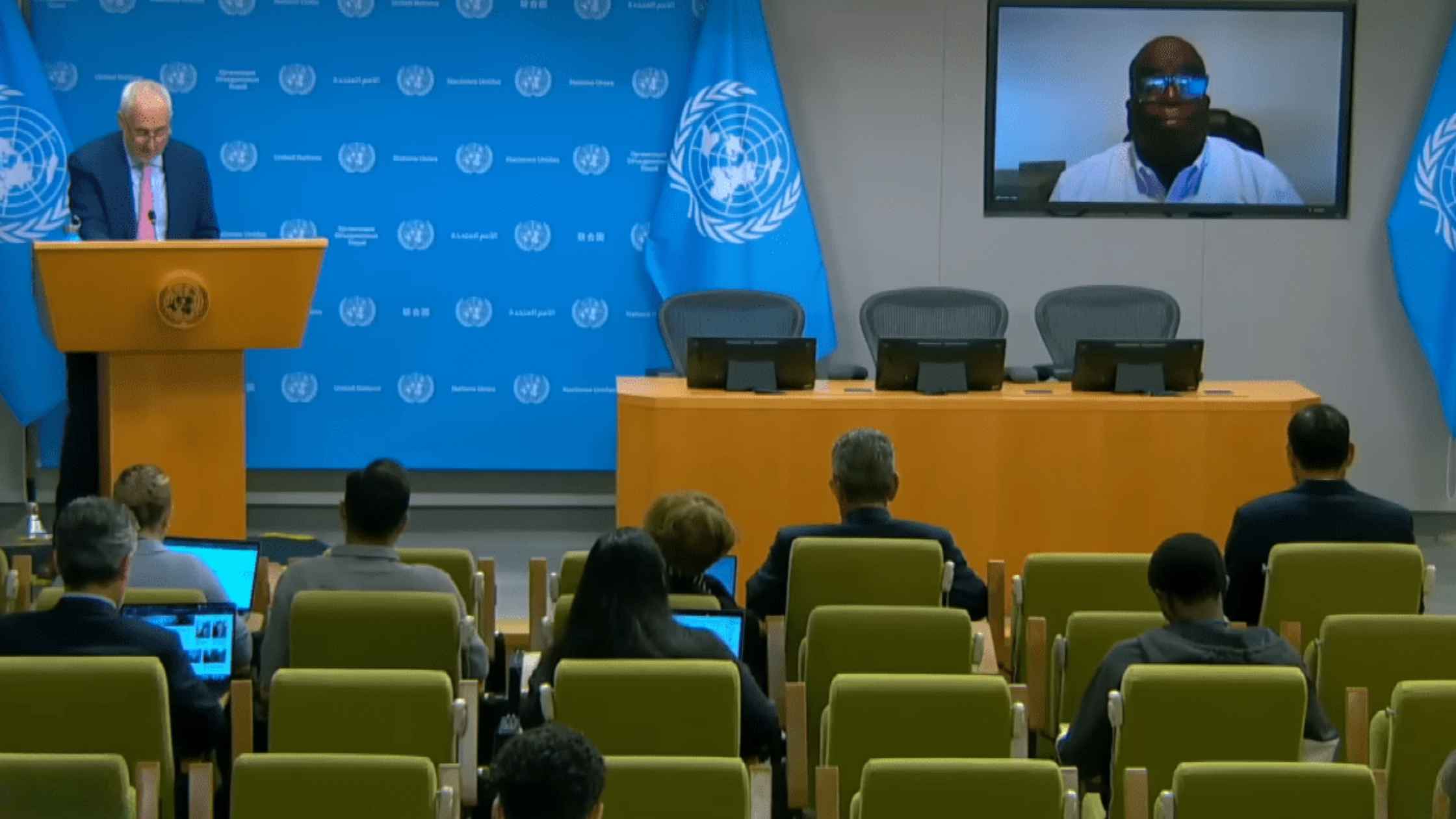
All right. Good afternoon. Thank you for your patience. We're going to start with our guest, if we could put him on the screen. Excellent. And I'm delighted to welcome Dennis Zulu, who is the UN resident coordinator in Jamaica, covering The Bahamas, Bermuda, Cayman Islands, Turks and Caicos. We obviously asked him to come in and brief you regarding the situation with Hurricane Melissa.
(11:08)
So Dennis, first of all, thank you for taking the time. We'll let you make some opening comments, and then take a few questions. Please, go ahead, Dennis.
Dennis Zulu (11:17):
Thank you so much, and thank you for giving me this opportunity to address the media in what really is a very difficult situation for us in Jamaica.
(11:25)
As you know, Hurricane Melissa made landfall as a Category 5 yesterday, just around lunchtime, through a place called Black River in St. Elizabeth, which is one of the parishes in Jamaica, and really went across the island and exited about six hours later. From what we know thus far, there's been tremendous, unprecedented devastation of infrastructure, of property, roads, network connectivity, energy has been lost across its path. But what is very unique is that the impact of Melissa, though very dire in this area, has actually spread across the country. We know very well that there's been massive dislocation of services, we have people living in shelters across the country, and at the moment, what we are seeing in preliminary assessments is a country that's been devastated to levels never seen before.
(12:29)
So at the moment, the United Nations is working in partnership with the national authorities, and indeed other partners, both bilateral and multilateral partners, to really undertake the first assessment of the extent of the problem, and see how we can respond expeditiously to alleviating those who are in need at the moment, which is a huge number, though we don't actually have actual figures, but we estimate to be a very large number. We have therefore working close with the government and the Caribbean Disaster Emergency Management Agency, CDEMA, putting together a response, and immediately, some of the actions that will be taken is really around life support initiatives, or life-sustaining initiatives, making available water, food and other resources that are immediately needed by the people who've been affected. We are also working with the government to provide and support the shipment of vital supplies from our hubs in Barbados, so there's quite a lot of work going around shipping supplies from Barbados, as well as shipping into the country several specialists who might be needed to support the response effort.
(13:45)
As of now, we are seeing that there's movement towards some sort of semblance of normality, although this will take a bit of time, given the destruction around the country. The airports, it is thought, at least one of them in Kingston will open tomorrow, all things being equal, and hence facilitate an inward flow of resources that are badly needed in the country at the moment. So the UN, working very closely with partners, is studying the situation at the moment, and really looking towards how we can support the process of supporting those who've been adversely affected. We have, at the moment, some teams out already, although it's quite dangerous in some parts of Jamaica, just really to get an initial feeling of what has happened and how we can make that difference for those affected at the shortest time possible. So the UN is also coordinating the support of other bilateral partners at [inaudible 00:14:49] and hopefully we should be able to get all of us working in tandem, which is critical in situations such as the one we're in.
(14:56)
So devastation, extensive, and really calling upon all partners and goodwill wishes across the world to support Jamaica. Jamaica had been making tremendous progress towards sorting out its economic situation, it was upward-looking, sorted out its debt issues. But now, with what has happened, it will take a lot of resources to be able to reconstruct and get it back on the upward trajectory. So the country of Jamaica and the government, the people of Jamaica, need the support of all of us really to get them back to some state of normality. And this, we have no doubt, will take a bit of time. When you look at the level of devastation, it's very different to what we experienced last year with Hurricane Beryl, which affected Jamaica, but did not land. This time around, we had Hurricane Melissa landing and really devastating the country to levels never seen before.
(15:58)
So thank you so much
Dennis Zulu (16:00):
… for this opportunity and willing to take on any questions if there are any.
Speaker 1 (16:06):
Dennis. Ifrahim, please.
Ifrahim (16:11):
Thank you so much Mr. Zulu for this briefing. Quick question, I know you said you don't have the numbers yet of people affected, but can you give us any sort of estimate please? That's one. Second, what can you tell us about the plans that were put in place by the government? The authorities are saying that they did everything possible to prepare for Melissa landing. What can you tell us about those plans and how much have they been helpful? And are people who are affected in touch with their governments, they know what to do, where to go, and where the help is? Thank you.
Dennis Zulu (16:50):
Thank you so much. So as you know, this is an island of approximately 3 million people and Hurricane Beryl hits the Southwestern parishes, which account for a significant number of people. So I can't really give you a figure, but we are obviously looking at, and this is a rough ballpark figure, a million affected. We are going to get much more accurate as we look at and sent out the assessment teams across Jamaica. But let me just say that I don't think there's any single soul on this island was not affected by Hurricane Melissa, whether it was their roofs being blown out or their gardens. And I might just want to mention this, the area where Hurricane Melissa struck is also the breadbasket of Jamaica. So not only were food crops and fields destroyed, but we'll also see a very likely possibility that Jamaica will have some issues in terms of food security for the coming months as the farmers go back to getting their fields planted again.
(17:53)
Well, in terms of preparation, yes, I think we've known for a while now that over a week that Hurricane Melissa was going to pass through Jamaica, although there were some certainties as to the actual path. And government went out of its way, I must say, in terms of prepping. Shelters were opened, information was shared across the different media, alerting people to the forthcoming hurricane. Government even made available transportation to move out those who might've been considered to be in very vulnerable areas, to move them to safe locations. The government reached out to development partners, such as ourselves in the UN, working together to see how we could have a coordinated response. I'm saying that government did its very best. And the fact that Hurricane Melissa was moving very slowly gave government and ourselves adequate time to prepare. Obviously in situations such as the ones we're in, nothing works according to clockwork. So we are really trying to see how we can help government remedy those situations. But the devastation is huge and the government did its best to prepare for what we saw in the last few days.
Speaker 1 (19:13):
Thank you very much. We'll go online to Jackie Charles in the Miami Herald.
Jackie Charles (19:19):
Hi. Thank you. Right now we're not hearing much in terms of any casualties, and I'm wondering if it stays this way, what would you credit that to? Jamaica's always struggle with getting people to move into shelters, so what are your thoughts? Then in terms of the rebuilding process, given where Jamaica has been, what do you see in terms of rebuilding? How much of a struggle is this going to be?
Dennis Zulu (19:48):
Right, yes. So casualties, I think so far we only know of three deaths, and these deaths occurred prior to the landing of Hurricane Melissa. I think one of them was attributed to somebody who was making preparations, so they were cutting down trees and unfortunately got hurt and eventually died from those injuries. The other two were involved were electrocuted because of loose lying wires. As I said, we've had some fairly heavy rains prior to Melissa, so there was already some fairly precarious conditions around. So in terms of that, only three reported thus far. Obviously right now we are seeing, and I did speak to my WHO Power colleagues, some injuries coming through. But again, given the level of devastation, flooding, we do not necessarily have accurate information beyond the three deaths reported and number of people having some injuries. So that respect.
(20:51)
But I'm sure we'll be able to get some more. We have the people in the field and talking directly with the Minister of Health now to ascertain if at all there's any additions to the death numbers, but as of now, it remains at three, and this happened prior to Melissa. In terms of rebuilding, yes. As you know, the government of Jamaica has in the past years done absolutely well in trying to manage its economy and we were seeing Jamaica on an upward trajectory. The challenge that happens that we'll see now, is how does Jamaica finance this unprecedented devastation to the country? This will definitely need additional resources, financial resources, but also in terms of its impact on the various sectors of the economy.
(21:38)
I mean, tourism has been impacted negatively. So we're obviously going to see reduced arrivals because the facilities, the resorts that were accommodating the tourists have been affected. It didn't affect Montego Bay, which is a principal destination here in Ocho Rios. So it'll take a bit of time before these facilities are restored, hence reduction of incomes coming from tourism. I did mention earlier on the fact that agriculture be seriously affected. So we are bound to see a spike in agriculture products and that obviously is not good for the economy. So there will have to be a lot of source searching around how we can get this economy back on its feet and how we can finance the devastation that has been caused by Melissa going forward.
Speaker 1 (22:23):
Thank you. Abdul Hamid in Islam.
Abdul Hamid (22:26):
Thank you Mr. Dennis, this Abdul Hamid Sayan from the Arabic Daily, [inaudible 00:22:31]. According to CNN, just came in report says 30 casualties. So I don't know if you can confirm that. And my question is how the impact of this hurricane on countries like Cuba and The Bahamas. Thank you.
Dennis Zulu (22:46):
Thank you so much. Once again, we do not have direct confirmation of the casualties. And casualties this time, I don't know if they're referring to deaths or injuries. So as far as we know, and this is information from government, we have confirmed three deaths and these deaths were prior to the landing of Melissa. We have a number of people coming into hospitals with injuries, cuts and bruises and things like that. And that's all we have at the moment. So I cannot confirm CNN's number of 30 casualties. And the second question… Sorry sir, could you just repeat that again?
Abdul Hamid (23:25):
The impact of the hurricane in Cuba and Bahamas and in the other Caribbean islands?
Dennis Zulu (23:33):
Yeah. The hurricane hit Jamaica as a Category five hurricane. And once it's… Obviously we understand that it weakened as it left Jamaica into Category four. And it's also thought that by the time it gets to… So it probably hits Haiti as a Category four. And as it gets to The Bahamas, this morning I was speaking to my colleagues in The Bahamas, it's anticipated that should be a Category two. So evidently it's envisaged that there might be less damage, but again, we can never know given… Because even a Cat two hurricane is a fairly serious one. So my colleagues in Haiti, as well as in Cuba, are really putting forward already support interventions to help the government and the people of those countries concerned.
Speaker 1 (24:24):
Thank you. Islam, Anadolu Agency.
Islam (24:27):
Thank you. Mr. Zulu. Cuban officials stated that almost 750,000 people were evacuated due to Melissa. What is the situation in Jamaica? You mentioned that 1 million people were affected out of 3 million population, is a pretty big number. What is the figure people evacuated and when they may go back to their houses?
Dennis Zulu (24:56):
Just to clarify, first of all, the 1 million is just an estimate. It could be much more. As I said, we're still getting figures across from the different parts of Jamaica to really come up with a substantive figure. So it could be more, it could be less, but we anticipate it to be much more. Prior to the hurricane, the government of Jamaica did establish almost 881 shelters, which were made available to those who might… Especially those living in low-lying areas of Jamaica so they could move and evacuate from their homes. And we've seen a substantial taking up of those facilities by people who moved onto these facilities. But we did see that there was a bit of hesitation by some sectors of the communities in terms of moving away. Hence the government did issue prior to, I think this was the day before yesterday, on the Monday, a mandatory evacuation notice and provided appropriate transportation to get those people who were deemed to be very vulnerable as a result of where their homes were located to move to these shelters.
(26:03)
So as of today, I don't necessarily have the figures, but I do know that 881 shelters were made available and a lot of them were activated where food, water, and sanitation as well as bedding facilities are being provided by government. And these will continue to be provided until such a time that the areas from which these people were drawn from are deemed safe for them to return. In some cases might take a long while because the houses really have been devastated. It's just really… Especially along the pathway of Hurricane Melissa, so there might not be house to go back to, so they might have to stay in these shelters for a long while until some alternative arrangements can be done. The UN, with its agencies is hoping to support government in repairing shelters so that we can also help alleviate government's responsibility and its spend on this particular item.
Speaker 1 (26:59):
Great. Xinhua and then CBC.
Yun Chao Pan (27:07):
Thank you, Mr. Zulu, for your briefing. This is Yun Chao Pan from Xinhua News Agency. A lot of your agencies have provided assistance to Caribbean nations to prepare for Hurricane Melissa. Do you have the number UN personnel on the ground and the resources that UN has provided? Thank you.
Dennis Zulu (27:30):
Thank you so much. So as I just said in the meeting, hurricane Melissa gave us some notice, so we did mobilize resources in UN personnel to come to Jamaica, pre-Hurricane's landing. But of course looking at devastation, we'll need much more capacity. We already have resources and staff and technical equipment lined up in Barbados. We're trying to ship this to Jamaica at the moment. And as you know, all the three major airports were shut down prior to Hurricane Melissa. We have heard that government is working seriously to getting the airport here in Kingston opened as soon as tomorrow. I believe they're doing some inspections at the moment. Because it'd really be important to establish a corridor within which we can facilitate external resources and staff and all that to come in. In terms of the numbers, again, I think we need to be very alert to the fact that we are working closely with the government. So we will have to identify the gaps in which government needs both technical and financial support so that we can respond to that specifically. We do want to be seen to be imposing. The Jamaican government has been very clear and I've really worked out to provide an avenue within which Goodwillers and those of us who want to support can channel their commitments or their resources too, so that government has a hand in being able to coordinate the arrival of these goods. Because I think one of the things that the Jamaican government doesn't need at the moment is a huge number of people coming in uncoordinated, which might lead to further problems in terms of being able to support and get the needed support to the areas that need it the most. So at the moment, in short, we are expecting some resources from outside Jamaica, predominantly Barbados, where we have a hub. And also some support in terms of technical staff who work on the emergency telecommunications and helping government to restore the services in the country.
Speaker 1 (29:50):
Thank you. Kris, Canadian Broadcasting,
Kris Reyes (29:53):
Thank you for this. Thanks Steph. Thank you for this briefing. Mr. Zulu, Kris Reyes with Canadian Broadcasting. If you could just focus a little bit on today's details and what are some of the challenges that you're dealing with today, and what does the timeline look like in the next few days as you deal with these challenges, right down to how many UN staff are currently on the ground, how much aid is waiting to get in? I understand that yesterday the UN was trying to helicopter in some aid, but because the airports were closed, you were having trouble. Is that still the case today?
Dennis Zulu (30:31):
Indeed. The media challenge we have at the moment is that, of course those devastation, those floodings, some of the areas really remain unreachable in terms of getting resources there. We have serious challenges in terms of connectivity, so we can all get the reports from those areas. We have challenges in terms of energy. The grid is down in a substantive part of the country, so electricity is not there. So the electricity not being there, it cannot necessarily power the water installations. We still have some rain in some parts of Jamaica at the moment. And really the debris also that has been scattered as a result of this devastation of infrastructure really has meant that some of the roads have been cut off so we can't reach these areas going forward.
(31:22)
This impacts us quite badly because we can't undertake the needed assessments that we need to do. And secondly, we can't get the resources that these people need in those areas that are affected. And also very, very significantly, there's still some fear of some landslides because the soil is wet. And as you know, Jamaica is a fairly hilly country, so that fear is still there. So at the moment what we're trying to do is trying to see how safe it is to get to these areas, and we'll have to assess this using drones for instance, but also some satellite imaging, which some of the UN agencies are providing, as well as other development partners, to be able to ascertain
Dennis Zulu (32:00):
… the level of damage because this will really help us determine the level of support.
(32:05)
And as I said, the Jamaican government is very keen on being able to control what type of resources come in, because these resources must be appropriate and these resources might be those resources that are needed by those affected immediately. So, yes, the airports still remain closed, and as I did say, the government has indicated that we're trying to get the airport in Jamaica open as soon as tomorrow. This will indeed provide a very good opportunity for all of us who have resources outside the country to be able to reach in.
(32:38)
Obviously, we understand the caution by government because they can't just open up these airport facilities as they have to be inspected and viewed to be ready to accommodate incoming resources, but we are also working with other partners to bring in the resources by sea. As I say, this might take a few days, but already we're getting some support from partners to ship in some of the things by sea, which is somewhat easier, because then we don't have to wait for facilities that handle airborne vehicles to come in.
(33:11)
So, the immediate outlook, very difficult, but we're trying as much as possible given the restriction, the constraints that we have to open up and support government in getting the resources into the country.
Speaker 2 (33:24):
Mr. Zulu, just a quick follow-up. Are you aware of any rescue operations happening at this moment?
Dennis Zulu (33:32):
Yes. I know that the government has already sent some teams out, especially in areas that have been flooded because some people are marooned in those areas, so trying to move people who may have been marooned in those areas, which are flooded to safe areas is ongoing. Given that now there's a bit of calm in terms of weather patterns, so there are actually some work going on and moving those who are marooned to shelters.
(33:58)
Of course, I did say earlier on that there could have been some families who had resisted at the time for moving to shelters, but now given the circumstances, have no other choice but to be moved and the government is facilitating this by providing transport.
Stéphane Dujarric (34:14):
Dennis, thank you so much. We're going to let you go. We hope you and all our UN colleagues are safe and sound. Thank you for everything you're doing, and we hope you come back soon to give us an update, but really appreciate your time. Take care, Dennis.
Dennis Zulu (34:31):
Thank you so much and my pleasure.
Stéphane Dujarric (34:32):
Thank you. All right. If you didn't have enough work to do today, you're going to have more. Just as a reminder, after I'm done at 1:30, there'll be a briefing here by Annalena Baerbock, who is our president of the General Assembly. She will be joined by Ambassador Alya Ahmed Al-Thani, the permanent representative of the State of Qatar. They will brief you on the Second World Social Summit, which kicks off in Doha next week.
(35:01)
2:15, briefing here by Rafael Grossi, the director general of the International Atomic Energy Agency, here in person.
(35:10)
3:30, there'll be a briefing by Tom Andrews, UN Special Rapporteur on the Situation of Human Rights in Myanmar. As you know, this is Special Rapporteur Week. He's just briefed the General Assembly's third committee.
(35:23)
Tomorrow at 1:00 PM, there'll be a briefing by the Independent International Fact Finding Mission for the Sudan. They'll be presenting their findings to the third committee tomorrow morning, but that briefing will be here at 1:00 PM.
(35:37)
And at 2:00 PM, there'll be a briefing by a group of human rights experts on Nicaragua, after they brief the third committee.
(35:47)
Earlier today, you saw that the Secretary General issued a statement in which he said he was gravely concerned as Hurricane Melissa unleashes widespread devastation across the Caribbean. The Secretary General stands in solidarity with the government and the people impacted by Hurricane Melissa. The Secretary General conveyed his heartfelt condolences to the families of those who have lost their lives and wishes a speedy recovery to all those injured.
(36:16)
Also, just to note that tomorrow and Friday morning, the Secretary General will be chairing the bi-annual session of the UN System Chief Executive Board for Coordination, otherwise known by its acronym CEB. The CEB brings together the heads of UN system organization. This session, the fall session always takes place in New York, and it will take place in New York again.
(36:40)
The CEB members will reflect on current world affairs as they affect and are related to the UN system, and will engage in deliberations of the impact of the present disruptions in the global economy on the sustainable development goals, as well as the state of play of the UN AD initiatives.
(36:59)
Turning to the horrific ongoing situation in Sudan, I can tell you that we condemn the continued violations of international humanitarian law and the violation and abuses of human rights taking place in Al Fashir. That includes the indiscriminate attacks and targeting of civilians and civilian infrastructure.
(37:19)
Today, we were horrified by reports of the tragic killings of more than 460 people, both patients and their companions at the Saudi Maternity Hospital in Al Fashir. This follows recent attacks and the abduction of health workers. Prior to this latest attack, our colleagues at WHO verified 185 attacks on healthcare in Sudan, with 1,204 deaths and 416 injuries of health workers and patients since the start of the conflict in April of 2023. 49 of these attacks occurred this year alone, and they killed 966 people.
(37:58)
Our humanitarian colleagues tell us that people are continuing to flee Al Fashir, and the International Organization for Migration tells us that more than 36,000 people fled between Sunday and yesterday. Most have sought refuge within the outskirts of Al Fashir, as well as the locality of Kabkabiya, Mellit, and Tawila, where families, as you can imagine, are living in open spaces with no shelter, no sanitation, and no protection. Women and girls, as they always do in these circumstances, face heightened risks of violence and abuse.
(38:33)
In Al Fashir, local sources are telling us that thousands of people, including the elderly and those with disability, as well as the wounded, remain stranded and unable to flee the area due to insecurity and the lack of transport options. We and our partners are on the ground coordinating vital assistance in Tawila, where displaced families are being hosted at overcrowded sites. Urgent needs for the people in Tawila and other localities include shelter, food, water, healthcare, and protection.
(39:08)
Today, our emergency relief coordinator, Tom Fletcher, approved a $20 million allocation for Sudan from the UN Central Emergency Response Fund. This will support the scaling up of emergency support in Tawila and other locations in Darfur and the Kordofan region. This adds to $27 million already allocated from the CERF for Sudan this year alone. The situation in North Kordofan is no better. Fighting continues to devastate communities. IOM reports that between 24,000 and 27,000 people have been displaced from the locality of Umm Dam Haj Ahmed, that was yesterday.
(39:46)
Still in North Kordofan, the International Federation of Red Cross and Red Crescent Societies said yesterday was horrifying after five Sudanese Red Crescent volunteers were killed, and three went missing while distributing food in the locality of Barah. 21 Red Crescent staff and volunteers have been killed since the conflict began. We can't stress enough that civilians, humanitarian workers, medical personnel must always be protected. And once again, we call on the parties to hold hostilities, guarantee the safe passage for civilians and aid workers, and ensure sustained humanitarian access wherever it is needed.
(40:31)
You saw that reports from Sudan that two of our colleagues from the World Food Program have been designated as persona non grata by the Ministry of Foreign Affairs and were asked to leave the country within 72 hours without any official explanation. The decision to expel the World Food Program's country director and its emergency director comes at a pivotal time, to state the obvious. Humanitarian needs in Sudan have never been greater with more than 24 million people facing acute insecurity and communities impacted by famine.
(41:05)
WFP and senior UN officials are engaging with authorities to protest this action, and we're seeking clarification for the decision taken. All parties in Sudan must prioritize the lives and well-beings of millions of people who depend on emergency food and nutrition assistance for their survival. The World Food Program and the whole UN family remains unwavering in our commitment to ensure that the people of Sudan can access vital assistance during this period of unprecedented hunger, unprecedented insecurity, and unprecedented humanitarian needs.
(41:44)
Turning to the situation in Gaza, and I've been asked this morning, so I will tell you that the Secretary General strongly condemns the killings due to Israeli airstrikes of civilians in Gaza yesterday, including many children. He condemns all actions that undermine the ceasefire and endanger civilian lives. He notes the importance of the parties and renewed assurances to implement the ceasefire and stresses that these commitments must be upheld in full. Any acts that risks, harms civilians, or obstructs humanitarian operations must be avoided.
(42:20)
The Secretary General commends the ongoing diplomatic efforts of Egypt, of Qatar, of Türkiye, and of the United States, whose engagements has been critical in sustaining the agreement, preventing further escalation, and enabling increased humanitarian access. The United Nations and our partners are rapidly scaling up our presence across Gaza, working intensively to deliver lifesaving assistance to communities in need. Our partners, as I mentioned, and ourselves are continuing to seize any opportunity presented to us by the ceasefire to scale up humanitarian assistance in Gaza.
(42:59)
Just looking back to Monday, our partners working child protection reach 1,500 children and 700 caregivers with mental health, psychosocial, and other types of support. Our partners working on food security tell us they're supporting the production of about 130,000 2-kilogram bread bundles every single day. That's as of Monday. Community sites, kitchens, shelters that we support continue to distribute bread for free, but our partners say that people struggle to access meat, vegetables, and fruit, with most families relying on cereal, pulses, and small amounts of dairy.
(43:35)
Yesterday, the UN Office for Project Services distributed more than 200,000 liters of fuel to our partners in Southern and Northern Gaza to keep critical operations going. Those operations included water, sanitation, hygiene, health, food security, logistics, rubble removal, telecommunications, and education.
(43:59)
OCHA says that while the humanitarian scale-up is underway, impediments remain to fully deliver on the 60-day humanitarian plan. We need the ceasefire to hold, but we also need more functional crossing, the lifting of bureaucratic hurdles, safe and viable routes inside Gaza, and unimpeded access, including for NGOs and of course continued funding. And just to add on the West Bank, our human rights colleagues said yesterday ongoing attacks by Israeli settlers are continuing to instill fear, destroy homes, livelihoods, and force Palestinians off their lands.
(44:38)
Turning to Ukraine, where our humanitarian colleagues tell us that attacks and hostilities across the country are continuing to kill and injure civilians, including children and damage civilian infrastructure. In Kherson City, a strike today severely damaged a children's hospital, including injuring child and medical workers. Humanitarian coordinator from Ukraine, Matthias Schmale, said the strike on a children's hospital is a matter of grave concern. Adding that attacks against civilians, health facilities are strictly prohibited under international humanitarian law.
(45:17)
Also today, a humanitarian convoy facilitated by our OCHA colleagues, delivered assistance to communities in Kutsurubska in the Mykolaiv region. This marks the third convoy to the region in 2025, reaching 4,000 people in hard-hit communities. And from January to September of this year, our humanitarian partners reached more than 4 million people across Ukraine with at least one type of assistance covering 42% of the people in need. More than 500 organizations provided support with the highest number of people reached in the Dnipro, Kharkiv, and Mykolaiv region. Three quarters of the way through the year, $2.6 billion humanitarian needs and response plan for Ukraine is 44% funded with 1.5 billion.
(46:06)
A number of you have asked me this morning of our reaction concerning the police raids that took place in Rio de Janeiro, and I can tell you that the Secretary General is gravely concerned by the large number of casualties during a police operation conducted yesterday in Rio de Janeiro. He stresses that the use of force in police operations must adhere to international human rights law and standards, and urges the authorities to undertake a prompt investigation.
(46:34)
To climate-related things to flag to you, today, the UN Environment Program released its Adaptation Gap Report. UNEP notes that while adaptation planning and implementation are improving, adaptation finance needs in developing countries by 2035 or over $310 billion per year, which is 12 times as much as current international public adaptation finance flows. In a message for the release of the report, the Secretary General said the report is a red alert. "Climate impacts are accelerating," he said, "and yet adaptation finance is not keeping pace, leaving the world's most vulnerable exposed to rising seas, deadly storms, and searing heat."
(47:16)
The Secretary General said this is not just a funding gap, it is a failure of global solidarity. He stressed that COP30 in Brazil must deliver a global action plan to ensure developing countries have the resources and capacity to protect their people, strengthen food and water security, and build resilience across everyday sector of development.
(47:38)
Also released today was the 2025 report of the Lancet Countdown on Health and Climate Change, producing collaboration with our friends at the World Health Organization in Geneva. That report warned that continued over-reliance on fossil fuel and the failure to adapt to a heating world are already having a devastating toll on human health. The report shows that the rate of heat-
Stéphane Dujarric (48:00):
Heat-related mortality has increased 23% since the late 1990s, pushing the total heat-related deaths to an average of 546,000 death per year. According to the report, droughts and heatwaves were associated with an additional 124 million human beings facing moderate or severe food insecurity in 2023. And they also point out that governments spent $956 billion on net fossil fuel subsidies in 2023, more than triple the amount pledged annually to support climate-vulnerable countries. The Department of Peace Operations together with Canada, the Central African Republic, the Republic of Korea, and UN Women just concluded a high-level event entitled Women, Peace and Security at a Crossroads, Rethinking, Reimagining, and Recommitting to Women, Peace and Security in UN Peacekeeping.
(48:55)
At the event, Jean-Pierre Lacroix, the Head of Peace Operations emphasized a critical role of UN Peacekeeping in advancing gender equality and implementing the Women, Peace and Security agenda. US Peacekeeping's report on 25 years of Women, Peace and Security is available online. Today is an international day that we could use every day. It is the International Day of Care and Support. Paid and unpaid care work from domestic labor and caring for loved ones is essential to sustainable societies, yet it remains undervalued and underpaid. We call for fair wages, stronger protection for care workers and recognition of care work's vital role in our economies and societies. Benny. You got to pay attention, Gab.
Benny (49:46):
All right, I made it. So you know there's a race.
Stéphane Dujarric (49:53):
The what, sorry?
Benny (49:54):
A race for the Secretary General of the United Nations.
Stéphane Dujarric (49:59):
I'm aware.
Benny (50:00):
So I wonder if the Secretary General has any opinion on the major issues rather than personalities as to, for instance, should it be a woman? Should it be somebody from a certain regional area?
Stéphane Dujarric (50:19):
I think I would refer you back to what the Secretary General has said in the past. I think given that the race is let's say much more real today than it was a year ago, the Secretary General I think is keen on ensuring that he does not interfere in any way, shape, or form in this contest in which he is not running.
Benny (50:44):
But on those issues, that's why I didn't ask about the personalities. But on those issues, women, Latin America.
Stéphane Dujarric (50:55):
Again, I think the Secretary General has spoken about this before. He stands by what he said, but I think we will not at this point in the calendar, speak to the race. Sir.
Speaker 3 (51:07):
Thank you, Stéphane. Maybe the new SG should be Kurdish given the fact that we don't have a country. So one question on the Iraqi elections, does the United Nations play any role in monitoring the elections in Iraq, which are scheduled for November 11th?
Stéphane Dujarric (51:25):
It's a very good question. I will check with our colleagues at the political mission in Baghdad.
Speaker 3 (51:29):
Just one more question, if you can check, we don't have an answer. Armed groups in Iraq are participating as coalitions in the elections. How does they even assess the risk to the integrity of the vote?
Stéphane Dujarric (51:42):
I have nothing to answer you off the top of my head, but we will get some answers for you.
Speaker 3 (51:48):
Thank you.
Stéphane Dujarric (51:49):
Gabriel.
Gabriel (51:50):
Thanks, Stéph. One on Sudan and then one on Gaza. What's the latest with Mr. Lamamra given the situation and his movements, who he's been talking to, any updates from him?
Stéphane Dujarric (52:03):
My understanding is Mr. Lamamra has been speaking to the different parties. I think he's doing this from his base. I know Mr. Fletcher has also been speaking to the various sides and others in this conflict. I think we're all working towards the same goal, which is to see an immediate halt to the fire, humanitarian aid being allowed to go in and the restoration of a long-term political process.
Gabriel (52:32):
And the UN's posture in Tawila is still the same given the fall of El Fasher?
Stéphane Dujarric (52:37):
Yes.
Gabriel (52:38):
And one on Gaza, more than a hundred people were killed with Israel's latest attacks according to local officials, 46 children, at least 20 women. Representative Marjorie Taylor Greene, a Republican in U.S. Congress posted on social media, and these are her words, "46 children. Are those not war crimes?" Would you answer that question?
Stéphane Dujarric (53:04):
I think it's not for me to answer Representative Taylor Greene with all respect to her. I think I was very clear in what I just said in expressing the Secretary General's condemnation of what happened. Islam, Abdul Hamid, then Alex.
Islam (53:23):
Thank you, Stéphane. My question is about international force on Gaza. According to the Israel media, Israeli officials, they're vehemently against any United Nations involvement in that force. Arab countries, they discussed that United Nations should be involved, especially considering the UN Chapter VII. But Israel officials opposes it. What is the international force situation? What you can tell us from the UN point?
Stéphane Dujarric (54:00):
My understanding is that the discussions on the makeup of such a force are ongoing. We as the secretary, are not involved in those discussions. They have also been, discussions very openly report in the press about a potential resolution to back such a force. Obviously that will be a decision taken by member states. It is clear that any force, whether it is peacekeeping force or an international force, has I guess more credibility, so to speak, backed by a UN resolution. What that resolution will look like, what's in it, what it invokes will be up to member states.
Islam (54:46):
Do you see any relation or do you relate Israel's latest attacks because of the delay of international force that hasn't been established?
Stéphane Dujarric (54:56):
I will let that kind of analysis to analysts and journalists such as yourself, Islam. Abdul Hamid.
Abdul Hamid (55:05):
Thank you, Stéphane. Yesterday, Francesca Albanese was insulted by the permanent representative of a member of state. And it was raised yesterday in the news conference, one of the press conferences that we don't know how much the SGE defended.
Stéphane Dujarric (55:26):
Which comments are you referring to?
Abdul Hamid (55:28):
When the Israeli representative called her witch. What is the position of the Secretary General?
Stéphane Dujarric (55:37):
I think that kind of language to be used in Official UN meeting to attack a UN official is shocking to say the least. As we said repeatedly, whether it's Ms. Albanese or any of the other special rapporteurs, they are independent. They do not work for the Secretary General. They do not report to him. However, we have always felt that special rapporteurs are an important part of the international human rights mechanism. They are UN officials when they do their work and they need to be respected when they do their work, whether it's legally or verbally. Alex and then Efraim.
Abdul Hamid (56:19):
I just have a question.
Stéphane Dujarric (56:20):
Oh, sorry, sorry, sorry.
Abdul Hamid (56:21):
It's all right. The attacks on the olive trees, this is the harvest of olive trees as you know, it's not just an incident here, it's a war. Why? I mean the 3,000 trees had been cut recently.
Stéphane Dujarric (56:40):
I mean we don't sweep it under the rug. We talk about it, we criticize it. We condemn it. I mean, I think we've been very clear on the situation. Alex.
Alex (56:57):
Thanks, Stéph. Firstly, quick follow up on Brazil. Has the Secretary General been in touch with local authorities or anyone from the United States?
Stéphane Dujarric (57:05):
No, I mean not at this point. Secretary just returned from Malaysia late last night and he's just back in the office.
Alex (57:11):
What about the UN personnel on the ground?
Stéphane Dujarric (57:15):
From what I know, all UN personnel is safe and accounted for.
Alex (57:18):
Secondly, if I may, any updates on the security staff issue?
Stéphane Dujarric (57:24):
No, I think it's getting progressively better.
Alex (57:27):
Thank you.
Stéphane Dujarric (57:28):
Anytime. All right. Yes. Sorry, Efraim.
Ifrahim (57:33):
Thank you, Stéph. Thank you. On the same press conference by Special Rapporteur Albanese, when she was asked about the Secretary General's role in addressing this sanctions issue with her, she said, "No comment." Does the Secretary General feel he has done enough to make sure that Ms. Albanese would be able to come to New York?
Stéphane Dujarric (57:54):
I think the issue of her visa issue and others has been raised with the host country. We've seen a number of officials who are covered by the privileges and immunities of the UN being sanctions denied visas and all those issues have been raised.
Ifrahim (58:15):
And one more. She issued a pretty strong indictment of the UN. She said that the UN allowed the dismantling of its humanitarian system in Gaza and she said the organization is becoming more and more irrelevant. How do you respond to-
Stéphane Dujarric (58:32):
I'm not going to get into a tit-for-tat with Ms. Albanese. I think I will say this, however, if you look at how the UN humanitarian system has been operated in Gaza, it has continued to do so in the most difficult circumstances. And just as important, it has continued its work unwaveringly based on our principles. We have never strayed from our principles on how we do our work, despite a tremendous amount of pressure to do so at different times. Let me get the questions as I saw them. Islam.
Islam (59:12):
Yeah. My question has been asked partially by Efraim, but I would like to follow up.
Stéphane Dujarric (59:16):
Has it been answered fully though?
Islam (59:17):
Not really. So I would like to follow up. Ms. Albanese also said some interesting things like messes on the street becoming more relevant regarding what's going on on Gaza. What's going on-
Stéphane Dujarric (59:33):
Sorry, what on the street?
Islam (59:35):
Messes, people on the street or just regular people. Perhaps she meant like protesting people becoming more relevant regarding the UN values like justice and peace, considering especially what's going on in Gaza and UN becoming more irrelevant. That's her word. You aren't really concerned about this since past two years sidelined what's going on with Gaza? Do we have any concern about this?
Stéphane Dujarric (01:00:13):
I'm not the analysis of other people's press briefings. I'm challenged enough to do my own press briefing. I think, as I said, to Efraim, the UN, and when I talk about the UN, I talk about the Secretary General and the UN staff. Whether she or others are referring to the UN membership, that's another issue. But the UN has conducted itself and will continue to conduct itself based on the unwavering principles that are in the charter. Evelyn then Pam.
Evelyn (01:00:51):
Thank you, Stéphan. You keep track of world news in such detail on a daily basis, and I'm wondering why the Russians keep killing civilians in Ukraine.
Stéphane Dujarric (01:01:10):
Evelyn, that's not a question to address to me. Pam.
Pam (01:01:16):
Thanks, Stéphan. Please forgive. I missed the beginning.
Stéphane Dujarric (01:01:19):
You missed everything. Let's be honest.
Pam (01:01:22):
All right. I missed everything.
Stéphane Dujarric (01:01:23):
Not just the beginning. I mean, even coming in at 12:55, you missed quite a bit, but that's okay. Go ahead.
Pam (01:01:27):
I have a reason.
Stéphane Dujarric (01:01:27):
Go ahead. I'm sure.
Pam (01:01:29):
It's not for public. My question is about COP30 next month in Brazil. You did mention it in the last few days, but as she has now said, 1.5 degrees centigrade will not be met. He'll be there, I assume?
Stéphane Dujarric (01:01:51):
Most definitely.
Pam (01:01:52):
And is there any proposal he has increasing the NDCs? What's he going to say at COP30? Thanks.
Stéphane Dujarric (01:02:03):
I'm not going to tell you everything he's going to say, but let's be clear. What he said is that an overshoot of 1.5 is inevitable, but there is time if there is the right effort and the right resources to bring it back down. So he did not say the one, and I think we need to be very clear on that.
Pam (01:02:21):
Thank you.
Stéphane Dujarric (01:02:23):
Okay. I see Gabe wants to leave. Class dismissed.