Speaker 1 (00:55):
Okay. Just one real quick last audio check. We are looking at having this begin right on time at 8:00, so. All right. We're good?
Crew (01:09):
All set. Sound's great.
Speaker 1 (01:24):
All right.
Crew (01:56):
Thank you.
Speaker 2 (01:56):
Can we talk? Check one, check two. Mic check. Good.
Crew (02:00):
One more time.
Speaker 2 (02:05):
Check one. Mic check, mic two. Anybody else need a mic check in the room? Maybe talk a different level. I don't know. Okay. Give thumbs up back there. Sweet.
Crew (02:30):
Can I count [inaudible 00:02:33]?
(02:32)
Yeah.
(02:32)
One, two, three, four, five.
(02:47)
Just one more. Just one more and then ...
(02:52)
Okay.
Speaker 1 (03:17):
It looks like we're starting right on time at eight o'clock, so about 10 minutes.
Tom Homan (09:03):
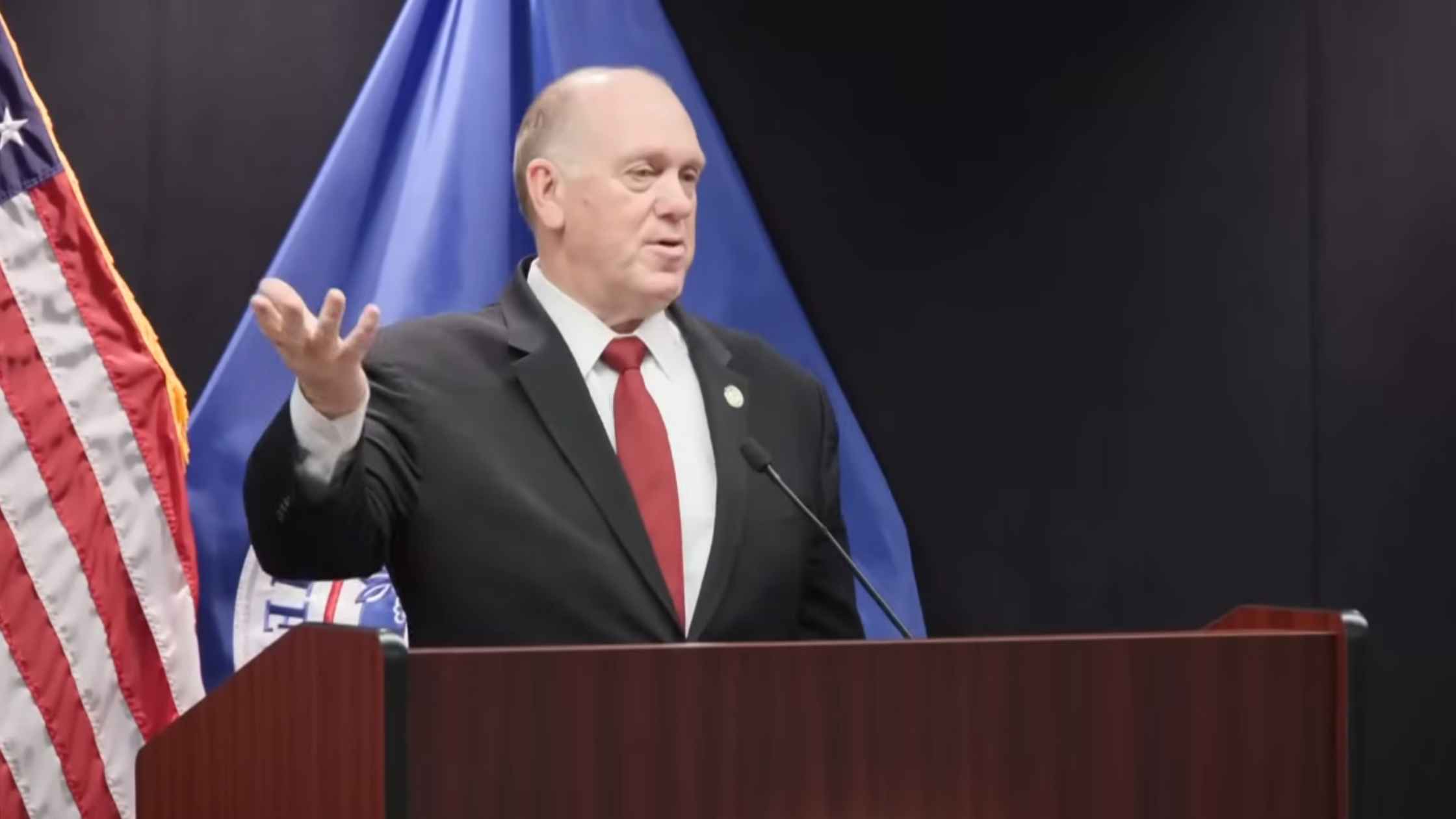
Good morning. I'm Tom Homan. I'm the border czar for President Trump. I'm here with Sam Olson, field office director for the St. Paul office, and Ronald Vitiello, senior advisor to the Commissioner of Customs and Border Protection, Border Patrol. Us three guys got just shy of 100 years in law enforcement, immigration enforcement. I've worked around 30 years ago in Dallas, Texas. He's been with the Border Patrol his entire career. During my press conference last week, I reported I had productive discussions with various state and local officials, including Governor, Attorney General, Mayor Frey, and law enforcement officials about increasing coordination in a lawful way between the county jails and ICE to avoid public safety threats being released back in the community. While we had our differences, one thing was clear. We all committed to public safety for all who live in the Twin Cities. We have made significant progress under the direction of President Trump working with state and local officials here in Minnesota, and I expect that to increase in the coming weeks. We continue to have discussions. I'll have discussions this afternoon. We currently have an unprecedented number of counties communicating with us now and allowing ICE to take custody of illegal aliens before they hit the streets. Unprecedented cooperation. And I'll say it again. This is efficient, requires only one or two officers to assume custody of a criminal alien target rather than eight or 10 officers going into the community and arresting that public safety threat. This frees up more officers to arrest or remove
Tom Homan (11:00):
... Criminal aliens. More officers taking custody of criminal aliens directly from the jails means less officers on the street doing criminal operations. This is smart law enforcement, not less law enforcement. It's safer for the community, safer for the officers, and safer for the alien. This coordination also makes it far more safe for the Twin Cities. Arresting a public safety threat and the safety and security of a jail is the safest thing we could do. Further, less public safety risks are being released back into the communities reduces recidivism so local law enforcement can direct their limited resources to other public safety matters in their community. This is another priority of President Trump. The state prisons already cooperated [inaudible 00:11:58] on this coordinated transfer of custody and we thank them for that partnership and we plan to do more with them. I also want to reiterate and emphasize, we are not requiring jails to hold people past their normal release time. For immigration purposes.
(12:18)
We're not asking anyone to be an immigration officer. We are not asking any state or local officials to do immigration enforcement activity. They are not. By merely notifying us before they release them. They don't hold them one minute past they normally would. Given this increase in unprecedented collaboration and as a result of the need for less law enforcement officers to do this work in a safer environment, I have announced effective immediately, we will draw down 700 people effective today. 700 law enforcement personnel. We have also fully integrated CBP personnel into the ICOR team structure under one unified chain of command. Not two chains of command. There'd be one chain of command here. Any large enforcement operation I've ever been involved with, there's one chain of command and that's where we're moving forward. During my press conference last week, I announced that moving forward, ICE will be conducting targeted immigration enforcement operations like ICE has traditionally done for decades based on reasonable suspicion to question and detain.
(13:41)
ICE will conduct these operations and transnational criminal organization investigations with a focus on national security and public safety. I want to be clear. Just because you prioritize public safety threats, don't mean we forget about everybody else. We will continue to enforce the immigration laws in this country. To help execute this, we have developed and implemented a multi-agency surge task force within an operational framework that clarifies lines of effort, integrated enforcement, investigative and special response efforts. A unified joint operations center has been established to manage all operations and ensure efforts aligned with priorities of the mission. This reorganization also enables ICE to leverage joint intelligence capabilities to effectively target threats, as well as to reduce the overall personal footprint and enhance public safety and confidence in the agency's capabilities and presence here. I've also ensured that officials from legal internal affairs offices remain on the ground as long as this operation continues.
(14:54)
During our efforts to identify and implement improvements of how operations are planned, conducted and managed, we identified a gap in regard to the use of body-worn cameras. And this was actually raised by the workforce when I started walking around talking to people here. Some officers and agents had them, some didn't. That inconsistency was unacceptable, so we moved immediately to prioritize full body cam deployment in the city. I discussed this with Secretary Noem a couple of days ago, and she made the decision to deploy them. The plan is to deploy them nationwide, but it's a priority for the city right now.
(15:37)
There's actually $20 million in the spending bill to further fund the deployment of body cameras. The president is supportive of this decision because we have nothing to hide. We want to be fully transparent in what we do. The American people seek and deserve professional and trustworthy law enforcement, and I and the president expect that any misconduct will not be tolerated and be swiftly addressed. The integration, structuring, and resources we have implemented will help ensure accountability and that targeted enforcement operations have a focus on national security threats and public safety threats, and they are conducted effectively, safely, and appropriately. Again, this is smarter enforcement, not less enforcement.
(16:33)
For those who are not a national security threat or public safety risk, you are not exempt from immigration enforcement actions. If you're in the country legally, you are not off the table. And let me be clear, President Trump fully intends to achieve mass deportations during this administration and immigration enforcement actions will continue every day throughout this country. President Trump made a promise, and we have not directed otherwise. I heard rumors we have. Untrue. Given that many public safety threats on our communities, many of which poured across the border during the Biden administration, it makes sense to prioritize public safety risk right now. Again, prioritization doesn't mean you forget about everybody else, but we have a criminal here and non-criminal here, the criminal has to be arrested first because they're the biggest threat to the community. My goal, with the support of President Trump, is to achieve a complete draw-down and end this surge as soon as we can.
(17:50)
But that is largely contingent upon the end of the illegal and threatening activities against ICE and its federal partners that we're seeing in the community. We will not draw down on personnel providing security for our officers. I will not let our officers be put at risk, so we will not draw down on personnel providing security and responding to hostile incidents until we see a change and what's happening with the lawlessness of impeding and interfering and assaulting of ICE and border officers. It is against the law to forcefully assault, resist, oppose, impede, intimidate, and interfere with federal law enforcement, including ICE officers and Border Patrol agents, doxxing law enforcement to threaten them and their families because they're executing their sworn duties to enforce immigration law, that Congress passed, is unacceptable. And it's shameful and incomprehensible to me that this unlawful and threatening behavior is being tolerated by anyone.
(18:58)
As far as what I saw yesterday with the roadblocks being set up, you're not going to stop ICE. You're not going to stop Border Patrol. The only thing you're doing is irritating your community that want to go get groceries or pick their children up or whatever. I talked to the chief of police and he committed to taking swift action on those illegal roadblocks. They're illegal and we shouldn't tolerate them. Again, a complete draw-down is going to depend on continued cooperation of local and state law enforcement, and the decrease of the violence, the rhetoric, and the attacks against ICE and Border Patrol. The federal law enforcement personnel, ICE, CBP, and other partner agencies are patriots.
(19:56)
They've carried out their duties patriotically, with integrity, with professionalism and compassion. I've said this many times. These men and women don't hang their heart on the hook when they come to work. President Trump and I strongly stand with them, in the critical work they do, to prevent harmful or otherwise dangerous people from entering or remaining in this country. As part of the surge operation here, numerous criminal aliens have already been arrested. We've arrested 14 people who had homicide convictions, 139 people with sexual related offenses. 28 gang members. Correct me. 139 assault convictions, 87 sex offenses, 28 gang members have been arrested, just to name a few. We're taking a lot of bad people off the street. Everybody should be grateful to that. Who in their right mind would want these dangerous criminals walking around their communities? Everyone has a constitutional right to peacefully protest. President Trump and I, we completely support that.
(21:06)
At the same time, professional law enforcement officers should and need to be able to perform their sworn duties without being harassed, impeded, or assaulted. I want everyone, anyone, to report instances of alleged misconduct or wrongdoing. There's a way to report that. The Trump administration is taking violations of 18 U.S.C. 111, which is assaulting, impeding, interfering. We're taking that seriously. If you violate the law, you will be federally prosecuted. In the past month, 158 people have been arrested for a violation of 111. 85 cases have been already accepted for prosecutions. The rest remain pending. We've had nine indictments of those who raided the church and additional cases are being worked. Additionally, I've been saying this for almost a year now, hateful,
Tom Homan (22:00):
... extreme rhetoric against ICE personnel is completely unacceptable. Please stop. I said back in March of this year, if the hateful rhetoric didn't stop, I was afraid there would be bloodshed. And there has been.
(22:26)
President Trump and I, Secretary Noem, none of us want to see any bloodshed. It is no doubt encouraging and inciting certain people to violate the law, want to do harm, and actually harm law enforcement and their families is unacceptable.
(22:53)
I want to say I appreciate the discussions had with the governor, Mayor Frey and the attorney general. We've had frank, honest discussions. We don't agree on everything, but we do agree on the need for public safety. And we do agree that ICE has a role to enforce the immigration laws of this country.
(23:19)
I would implore the governor and the AG and the mayor and other political officials to urge in the most strong, urgent way to ask for calm in the community and to end the resistance, the impediment, the interference.
(23:42)
Again, protest. Stop impeding. Stop interfering. Stop violating the law, because we will arrest you.
(23:58)
In closing, President Trump and I would like to thank the men and women of ICE, Border Patrol, and other federal agencies on the ground here for your dedication to the oath you swore to enforce the federal laws and promote public safety through the work you do. It hasn't been easy. I know the sacrifices you made. I know the sacrifices your families make. I know your families worry about you every day. I know you've been away from birthdays and anniversaries and holidays. I appreciate every one of you. I wore that green uniform. I love the United States Border Patrol. I was an ICE agent. I know the job you have. I know the tragedies you've seen. The president is with you.
(24:57)
Again, I want to thank Governor Walz, attorney general, and mayor for the candid, insightful, productive discussions we had. Again, I'm not saying we agree on everything, but I think we all already accomplished great things in Minnesota. I am optimistic we'll achieve even more in the coming days to make this city safer.
(25:20)
I would also like to thank numerous local law enforcement officials I was able to meet with the last nine days since I arrived here. I appreciate hearing from local law enforcement their perspective on what's happening. I appreciate the desire to enhance communications between their agencies and our agencies, and that communication has been vastly improved.
(25:40)
I truly appreciate your commitment to respond to federal law enforcement in a time of need. Every chief I talk to, every one of them promised to respond to any public safety issue when our officers out doing their sworn duty and people start crossing the line and they start impediment, interference. Every police chief has committed to doing their job and enforce public safety.
(26:14)
We talked to a lot of sheriffs throughout the nation. We have unprecedented cooperation. I've yet to talk to a sheriff that said, "No." There's still more sheriffs we are in discussions with and talking to, but I have not heard the word, "No." I think they want to do the right things for their communities too.
(26:38)
Lastly, I'd like to thank President Trump for his steadfast leadership and commitment to law enforcement, public safety, and prosperity. I've said it many times. I've worked for six presidents and 10 administrations. When it comes to public safety, border security, immigration enforcement, no one's done it better than President Trump. His success is unprecedented.
(27:01)
Later on today, Secretary Noem is having a press conference on our southern border. The most secure border in the history of this nation, because of the leadership of President Trump and the men and women over there wearing the green uniform.
(27:17)
The most secure border in the history of this country, which means less children are dying making that journey, less women and children being sex trafficked, less fentanyl getting in this country to kill our young people, less known suspected terrorists being released in this country. The most secure border in a lifetime gives us the strongest national security we've seen. You can't have strong national security without strong border security.
(27:45)
I wish I could be at that press conference, but the president has called me here. I just had a small part of it. The reason we had the most secure border is because of President Trump's leadership and the men and women wearing the green uniform, which I once wore.
(28:01)
I just reported, I was down there with Commissioner Scott, CBP Commissioner Scott, two weeks ago. We went through that border on boat, four-wheel drive, and in the air. We toured the border in California, Texas, and Arizona. I did not see one illegal alien. Think about that. The last nine months, no one's been released from that border. The most secure border in the history of this nation, so God bless the men and women of Border Patrol. God bless President Trump for his leadership, and God bless the United States of America. Now I'll take questions.
Speaker X (28:43):
[inaudible 00:28:44]
Question (28:46):
You said that you're getting unprecedented cooperation. Where's that coming from? Is it coming from the sheriffs? Have you signed agreements with them? Are Hennepin and Ramsey County part of that? And the 700 officers leaving Minnesota, are they Customs and Border Patrol or ICE or-
Tom Homan (29:01):
There's a mix, but that number is based on number one, the cooperation again, rather than having whole teams out looking for a criminal alien who was just released. Now we have one agent at that jail picking that person up. That and the operation has been successful under a number of arrests. So the target list is reducing.
(29:22)
With the efficiencies of the jails, with the efficiencies of the prison system working with us, and the target lists decreasing, we had a whole team looking at what makes sense without risking officer safety and security teams, and that number is 700.
(29:39)
Look, we want to get back to the original Minnesota footprint of what ICE officers looked like before this operation. Plus the additional hires through the Big Beautiful Bill. A lot of these people, they got agents here from LA, New York, from Portland. There's problems there too.
(29:57)
So we want to get people back to home stations and enforce immigration laws in those areas. But the vast majority of sheriffs, there's only a few that we were still in consultation with, but this is unprecedented cooperation.
(30:14)
So again, I want to thank the sheriffs, the governor, the AG. I think we're in a lot better place than we've ever been in. We never had this kind of cooperation at this level. And I'm not leaving until we get it all done, but I'm happy to say I'm extremely pleased with the leadership team and their outreach to the sheriffs, to the state, to the chiefs. I've talked to many of them. I didn't talk to all of them, but I plan on talking to everyone before I leave and thanking them for their cooperation.
Question (30:44):
Are you getting cooperation-
Speaker 3 (30:45):
[inaudible 00:30:46]
Question (30:45):
... from men at [inaudible 00:30:46] Radisson?
Speaker 3 (30:46):
... follow-up right here. Sorry.
Question (30:49):
With everything that you've mentioned here right now, do you think this operation was a success here in Minnesota?
Tom Homan (30:59):
Yeah. I just listed a bunch of people we took off the streets of the Twin Cities. So I think it was very effective as far as public safety goes.
(31:09)
Was it a perfect operation? No. No. And I just told you, we created one unified chain of command, make sure everybody's on the same page, make sure we're deconflicting targets, and making sure we follow the rules.
(31:23)
And I'm not saying anybody ... I don't think anybody purposely didn't do something they should have done. I'm saying that I brought a different set of eyes on this. I've done this for a long time. We made this operation more streamlined, and we established a unified chain of command, so everybody knows what everybody's doing.
(31:47)
And not that it wasn't done before, but we improved upon that. So in target enforcement operations, we go out there, there needs to be a plan. And I want to make sure everybody has a plan. But I'm not going to sit and point a finger to anybody that they failed. It was a great operation which took a lot of public safety threats off the street.
Question (32:05):
Right here.
(32:06)
Can I ask a quick numerical just clarification, and then get to my main question, please? So 700 leaving effective immediately, how many will that leave here once that group is out?
Tom Homan (32:17):
Right around 2000.
Question (32:19):
And what is the pre-operation footprint?
Tom Homan (32:22):
150. 150.
Question (32:24):
150 is normal.
Tom Homan (32:25):
Well, we got to remember now that we got special agents on detail here doing the fraud investigation. They're not going anywhere. They're going to finish their job. I'm talking about immigration enforcement efforts.
Question (32:37):
Understood. So then my main question is just, we've talked to people who say they're protesting not the arrests of people with criminal backgrounds, but things like broad ICE patrols, random citizenship checks of people of color, and the detainment but no charges of US citizens. So have you committed or will you commit to officers on the ground here ceasing those actions?
Tom Homan (00:00):
Tom Homan (33:00):
What I have made clear, we're doing targeted enforcement operation. When we leave this building, we know who we're looking for. We're most likely to find them, what their immigration record is, what their criminal record is. But as we continue before sending communities, when we go to arrest that criminal target, if we find an illegal alien there, they're coming. We're not going to turn a blind eye to illegal immigration. That's why this partnership and this coordination is so important. We'd much rather work in the safety and security of the jail. Look, I go to bed every night, wonder if every one of our officers go home safely. I also am concerned that every person we're looking for is taken into custody safely. The best way to do that is to have a target enforcement operation while planning the operation. That's what we've done for decades.
Speaker 4 (33:48):
So should we expect to see no more of that?
Tom Homan (33:51):
Pardon me?
Speaker 4 (33:52):
Should we expect to see no more of those citizenship checks-
Tom Homan (33:54):
I have directed targeted enforcement operations and we'll hold our officers to the highest standards. These are professionals. Again, these...
(34:05)
I wish every one of you could put that gun on your hip, put that Kevlar vest on, go out there and put up where they put up with. Considering the hate, the rhetoric, the attacks, I think they perform remarkably and I'm proud of them. We came here, President Trump sent me here. I didn't ask to come here. President Trump sent me here to help deescalate what was going on. We're not surrendering our mission. We're not walking away from our mission. We're just making this more effective and more smart. This is smart law enforcement. Smart law enforcement makes it safer.
Speaker 4 (34:41):
Great.
Speaker 5 (34:41):
Realistically, how much work is there left to do here? And with this unprecedented cooperation, how long could this take, best case scenario in your eyes to get the job done?
Tom Homan (34:54):
I said it. We want to get back to the normal operational footprint here. Well, that depends on the people out there putting up illegal roadblocks. That depends on people that want to intimidate and interfere and put hands on ICE officers. Tone down the rhetoric. Stop by laying the law and impeding and interfering with us and the drawdown will be quicker. I still got more discussions to have with some local law enforcement officers looking for their cooperation. The more cooperation we get, the less rhetoric and hate we see, and the less attacks means we can drawdown even more quicker. So a lot of this has to do with assistance from the community.
(35:36)
We want to get these men and women home. They got a job to do at home. And I think we come a long ways. I'm actually... Yesterday afternoon, I was sitting down my chief of staff. I'm actually amazed at the cooperation and agreements we already talked about and the willingness to work with us. We're doing better than we thought we would. Seriously. And I'm excited about getting back to the business of enforcing immigration law without arresting people for 1-11 for interference and impeding. We just want to do what we've done for 30 years. I've done this 40 years. We want to get back to doing the job. And that's what we're planning on doing. And we're not... I want to keep this because I keep hearing it and hearing it and hearing it. We're not surrendering the president's mission on a mass deportation operation. If you're in the country illegally, if we find you, we will deport you. But this is about targeted enforcement operation, and that's what we're going to be doing.
Speaker 6 (36:32):
Last question. Go ahead.
Speaker 7 (36:34):
You've been talking about these filter blockades. People, just regular people, protestors are checking IDs. They're running people's plates and they're not letting people who they think are ICE agents through. But we've seen Minneapolis Police Department roll by and ask these protesters, are they doing okay? And they let these things stay up for extended periods of time. What do you make of MPD's lack of action on this matter?
Tom Homan (36:58):
When I was away to were the roadblock shifts, I called the chief of police and he went and disbanded them after I got off the phone with him. He has promised to take enforcement action. It's illegal. You can't do that. And again, to message those folks, what are you doing? You're really thinking of stopping ICE and CBP from doing the job? It's a joke. Only people you're hurting is your own community who wants to go and get groceries, pick up the dry cleaning, or go to work, whatever. You're just a hindering them. Stop. Stop.
Speaker 5 (37:29):
All right. No more questions.
Tom Homan (37:30):
I Just want a quick clarification on the body cameras.
Speaker 5 (37:33):
No more question guys. Thank you.
Speaker 8 (37:37):
Mr. Homa, could you just talk about the targeted list? How big is that list?
Speaker 9 (37:41):
Report though it's only a misdemeanors?