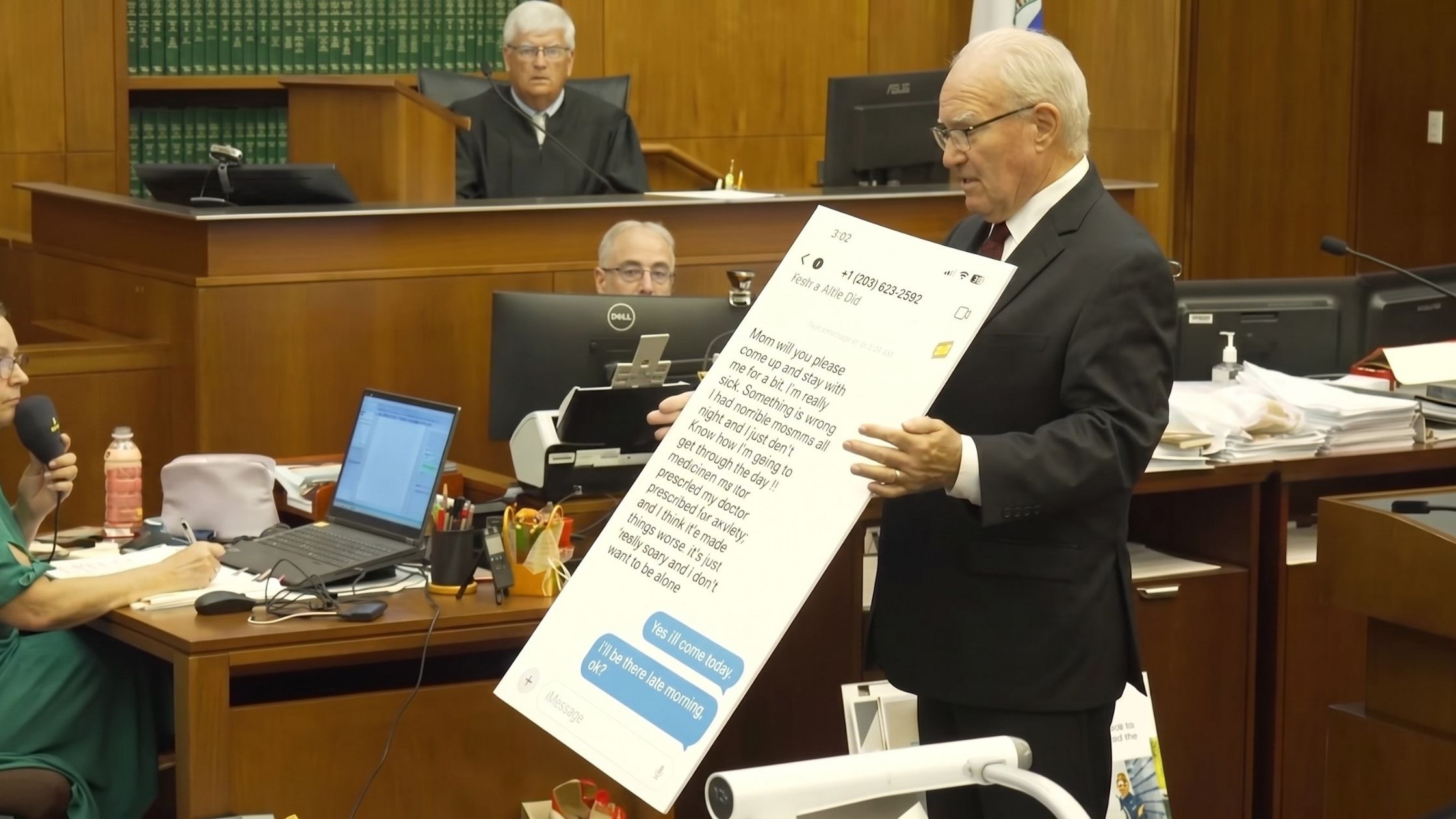
The Bailiff (00:00):
This court is now in session. Please be seated.
The Clerk (00:09):
Good morning, Your Honor. May I proceed?
Judge Sullivian (00:10):
Yes, please.
The Clerk (00:11):
Your Honor, before the court today, we have the matter of Commonwealth versus Lindsay Clancy. Ms. Clancy is present. She is represented by attorney Kevin Reddington. The Commonwealth is represented by Assistant District Attorney Jennifer Sprague and Assistant District Attorney Shanan Buckingham.
Judge Sullivian (00:23):
Well, good morning everyone. Good morning, counsel.
Speaker 1 (00:26):
Good morning.
Judge Sullivian (00:26):
Good morning, Ms. Clancy.
Ms. Clancy (00:27):
Good morning, Your Honor.
Judge Sullivian (00:29):
All right. Are the parties ready for the jury?
Mr. Reddington (00:31):
Yes.
Speaker 1 (00:31):
Yes.
Judge Sullivian (00:31):
All right. I'm going to bring them in.
The Bailiff (01:18):
Court, all rise. Jurors enter. Hear ye, hear ye, hear ye, all persons having anything to do before the Honorable William Sullivan, Justice of the Superior Court, now sitting in Plymouth within the [inaudible 00:01:26] Commonwealth. You're on the edge of your attendance, and you shall be heard. God save the Commonwealth of Massachusetts. This court is now in session. Please be seated.
The Clerk (01:35):
Good morning, Your Honor. May I proceed?
Judge Sullivian (01:37):
Yes, please.
The Clerk (01:37):
Your Honor, before the court today, we have the continuation of the jury trial in the matter of Commonwealth versus Lindsay Clancy. Ms. Clancy is present. She is represented by attorney Kevin Reddington. The Commonwealth is represented by Assistant District Attorney Jennifer Sprague and Assistant District Attorney Shannon Buckingham.
Judge Sullivian (01:53):
Thank you, Madam Clerk. Well, good morning, everyone. All right. Well, you know how we're going to start this? I'm going to ask you those questions. And just in case you're wondering, does this podium up here mean that I'm going to talk to you for quite a while this morning? It does. All right. So first, let me ask you the questions.
(02:13)
Has any member of the jury read, seen, heard, or overheard anything from any source about any aspect of this case that would affect your ability to be a fair and impartial juror? Secondly, is there any other matter or concern bearing on your service as a juror in this case that anybody needs to bring to my attention at this time? Again, as I've said for weeks now, thank you for following those instructions.
(02:39)
And so where we are now in the process is, I just want to explain a little bit to you. We're going to do what we call the arguments in charge, all right? And that just means I'm going to give the charges my instructions, right? I'm going to instruct you on the law that you are to apply in this case to the facts that you're going to find. And then the argument part is we're going to hear the closing arguments from the attorneys. And when we do it, the way I do it is I kind of split it up. So I'm going to give you... First half of my instructions we'll talk a little bit about the specific charges in this case. And then after the closing arguments, I'll come back and give you some more general instructions about the burdens of proof, and how you are to go forward and do your deliberations and handle the deliberations. All right? So they take a while, all right? And they can be, well, I was going to say rather dry, but they are dry.
(03:39)
And so what the parties and myself have agreed to do is I'm going to print out... We printed out the instructions that I'm going to read to you so you'll have those with you, all right, as we go through this morning. And so some people find that helpful to read along and comprehend. Some people don't. So if it's distraction, you don't have to read it, but some people find it helpful. So we thought we'd do that.
(04:07)
You also should know that you'll have these instructions. You can bring these with you in the deliberations. So you'll have this whole outline of what the law is so that you are to apply. All right? So at this point, if we could hand out the copies of the instructions. Oh, you already have those? I forget how efficient our court offices here are. So what I'm going to do is I'm going to start the instructions now. All right?
(04:38)
Now, so my instructions on the law are going to be delivered to you in two phases. As I said, first, I'm going to instruct you on the specific indictments that have been brought against Ms. Clancy. After I conclude my instructions regarding the charges, the Assistant District Attorney Ms. Sprague and Attorney Reddington will each deliver their closing argument. Remember, the arguments of counsel are not themselves evidence. They're provided to assist you in organizing and understanding the evidence that's been presented during the trial, and the conclusions that each party would like you to draw from that evidence.
(05:16)
At the conclusion of the attorney's closing arguments, I'll give you the second part of my jury instructions. And in that phase, I will give you and go over a number of very important principles that will guide your overall evaluation of the evidence, your deliberations, and your eventual verdicts. The instructions are to be taken and considered in whole, all right? So the first and second part are equally important. So you're to consider all my instructions as a whole.
(05:46)
You'll notice, as I said, I'm reading these instructions to you. Excuse me. I apologize for doing that, but I have to give these instructions clearly and accurately. So as I said, to assist you in your deliberations, I provided you with written copies of these instructions. However, those written instructions are not a substitute for the oral instructions I'm giving now. So please listen carefully. All of my instructions are equally important. You're not to overemphasize one portion of these instructions or ignore other portions.
(06:19)
These charges have specific factual elements that the Commonwealth must establish beyond a reasonable doubt, and I'll review those elements with you in detail at this time. Now remember that the law presumes the defendant to be innocent of the charges against her. This presumption of innocence is a rule of law that compels you to find the defendant not guilty unless and until the Commonwealth produces evidence from whatever source that proves that the defendant is guilty beyond a reasonable doubt.
(06:50)
Now I want to go into the instructions that are specific to this case. First, I'm going to have a drink of water. Thank you. Now, in this case, Ms. Clancy is charged with three counts of murder. I want to talk first about the issue of criminal responsibility, all right? Now, to prove the defendant guilty of any crime, the Commonwealth must first prove beyond a reasonable doubt that the defendant was criminally responsible at the time the alleged crime was committed. The Commonwealth bears the burden of proving beyond a reasonable doubt that the defendant committed the crime with which she is charged, and also that the defendant is criminally responsible for her conduct.
(07:36)
The defendant has no burden to prove a lack of criminal responsibility. Criminal responsibility is a legal term. A person is not criminally responsible for her conduct if she has a mental disease or defect. And as a result of that mental disease or defect, she lacks the substantial capacity either to appreciate the criminality or wrongfulness of her conduct or to conform her conduct to the requirements of the law.
(08:09)
The phrase mental disease or defect is a legal term, not a medical term. It need not fit into a formal medical diagnosis. The phrase mental disease or defect does not include any abnormality characterized only by repeated criminal conduct. It is for you to determine, in light of all the evidence, whether the defendant had a mental disease or defect. If the Commonwealth has proved you beyond a reasonable doubt that the defendant was not suffering from a mental disease or defect at the time of the killing, the Commonwealth has satisfied its burden of proving that the defendant was criminally responsible.
(08:53)
If the Commonwealth has not proved to you beyond a reasonable doubt that the defendant was not suffering from a mental disease or defect at the time of the killing, then you must consider whether, as a result of a mental disease or defect, the defendant lacked the substantial capacity either to appreciate the criminality or wrongfulness of her conduct or to conform her conduct to the requirements of the law.
(09:21)
To establish that the defendant had the substantial capacity to conform her conduct to the requirements of the law, the Commonwealth must prove beyond a reasonable doubt that any mental disease or defect that may have existed did not deprive the defendant of her ability to behave as the law requires, that is to obey the law.
(09:45)
The word appreciate means to understand rather than merely to know. Criminality means the legal significance of conduct. Wrongfulness means the moral significance. The Commonwealth must prove that the defendant knew and understood that her conduct was illegal or that it was wrong. It's not enough for the Commonwealth to show that the defendant merely knew or was intellectually aware that her conduct was illegal or wrong. Rather, the Commonwealth must prove beyond a reasonable doubt that a mental disease or defect did not deprive the defendant of a meaningful understanding of the legal or moral significance of her conduct.
(10:33)
The defendant must have been able to realize in some meaningful way that her conduct was illegal or wrong. In considering whether the Commonwealth has met its burden of proof, you may consider all the evidence that's been presented at this trial. You may consider the facts underlying the crime and evidence of the defendant's actions before and after the crime. You may consider the opinions of any experts who testified and give those opinions whatever weight you think they deserve.
(11:05)
Now in a moment, I'll instruct you on the elements of the offense that the Commonwealth alleges that the defendant has committed. Remember that the Commonwealth must prove to you beyond a reasonable doubt that the defendant was criminally responsible at the time that the crime was committed. That is that the defendant did not lack criminal responsibility at that time. Therefore, it is the Commonwealth's burden to prove at least one of the following beyond reasonable doubt.
(11:35)
One, that at the time of the alleged crime, the defendant did not suffer from a mental disease or defect, or two, that if the defendant did suffer from a mental disease or defect, she nonetheless retained the substantial capacity to appreciate the wrongfulness or criminality of her conduct and to conform her conduct to the requirements of the law. Now, as I previously instructed you, your decision should be based solely on the evidence and the law of this case.
(12:10)
If the defendant is found not guilty by reason of lack of criminal responsibility, the district attorney or another appropriate authority may, and generally does, petition the court to commit the defendant to a mental health facility or to Bridgewater State Hospital. If the court concludes that the defendant is mentally ill and that her discharge would create a substantial likelihood of serious harm to herself or others, then the court will grant the petition and commit the defendant to a proper mental health facility or to Bridgewater State Hospital.
(12:45)
Periodically, the court reviews the order of commitment. If the defendant is still suffering from mental disease or defect and is still dangerous, then the court will order the defendant to continue to be committed to the mental health facility or to Bridgewater State Hospital. There is no limit to the number of such renewed orders of commitment as long as the defendant continues to be mentally ill and dangerous. If these conditions do continue, the defendant may remain committed for the duration of her life.
(13:19)
If at some point the defendant is no longer mentally ill and dangerous, the court will order her discharged from the mental health facility or from Bridgewater State Hospital after a hearing. The district attorney must be notified of any hearing concerning whether the person may be released, and the district attorney may be heard at any such hearing. However, the final decision on whether to recommit or release the defendant is always made by the court.
(13:50)
Now, I'm going to go over, at this point, the specific elements of the charges against Ms. Clancy. So I want to talk first about murder in the first degree. The defendant is charged with three separate indictments charging murder, one count each relating to Cora Clancy, Dawson Clancy and Callan Clancy. The instructions I'm going to give now apply to each separate indictment relating to each child. There are two different degrees of murder. There's murder in the first degree, and there's murder in the second degree.
(14:25)
If you find the defendant guilty of murder, you shall decide the degree of murder. The Commonwealth alleges that the defendant committed murder in the first degree on the following theories: First, that it was murder with deliberate premeditation, and then second, and/or it was murder with extreme atrocity or cruelty. To find the defendant guilty on any of these theories of murder, you must be unanimous. That is all of the deliberating jurors must agree that the Commonwealth has met its burden of proving every required element of that theory beyond a reasonable doubt. You should check the appropriate box or boxes on the verdict slip as to each theory of what you agree unanimously. And I'll go over a little bit later the verdict slip and how that is going to be handled.
(15:14)
Now, so if you're unable to agree unanimously that the Commonwealth has met its burden to prove beyond a reasonable doubt either of these theories of first degree murder, you shall consider whether the Commonwealth has proved the defendant guilty beyond a reasonable doubt of murder in the second degree. So I'm going to begin by instructing you on the elements and the additional requirements of proof for each of these theories of murder in the first degree, and then I'll instruct you on murder in the second degree.
(15:45)
So number one, I'll first define the elements of murder in the first degree with deliberate premeditation. To prove the defendant guilty of murder in the first degree with deliberate premeditation, the Commonwealth must prove beyond a reasonable doubt the following elements: one, the defendant caused the death of Cora Clancy, Dawson Clancy and/or Callan Clancy. Two, the defendant intended to kill Cora Clancy, Dawson Clancy and/or Callan Clancy. That is, the defendant consciously and purposefully intended to cause Cora Clancy's, Dawson Clancy's and/or Callan Clancy's death. And three, that the defendant committed the killing with deliberate premeditation. That is, she decided to kill after a period of reflection.
(16:40)
I'll now discuss each of these requirements in more detail. The first element is that the defendant caused the death of Cora, Dawson and/or Callan Clancy. The defendant's act is the cause of death where the act in a natural and continuous sequence results in death and without which death would not have occurred.
(17:04)
The second element is that the defendant intended to kill Cora Clancy, Dawson Clancy and/or Callan Clancy. That is, the defendant consciously and purposefully intended to cause the death. The third element is that the defendant committed the killing with deliberate premeditation. That is, she decided to kill after a period of reflection. Deliberate premeditation does not require any particular length of time of reflection. A decision to kill may be formed over a period of days, hours, or even seconds.
(17:43)
The key is the sequence of the thought process, and it would be first the consideration whether to kill, second, the decision to kill, and third, the killing arising from that decision. There is no deliberate premeditation where the action is taken so quickly that a defendant takes no time to reflect on the action and then to decide to do it. In deciding whether the defendant intended to kill the deceased and whether she formed that intent with deliberate premeditation, you may consider any credible evidence that the defendant suffered from a mental impairment or was affected by her consumption of prescription drugs. A defendant may form the required intent and act with deliberate premeditation even if she suffered from a mental impairment or consumed prescription drugs, but you may consider that evidence.
(18:39)
Now, I want to talk about the second theory of first degree murder, which is murder with extreme atrocity or cruelty. Now, you shall consider this theory of murder in the first degree regardless of whether or not you find that the Commonwealth has proved murder in the first degree with deliberate premeditation, which I just discussed. To prove the defendant guilty of murder with extreme atrocity or cruelty, the Commonwealth must prove the following elements beyond a reasonable doubt: One, that the defendant caused the death of Cora Clancy, Dawson Clancy and/or Callan Clancy. The second element, the defendant either A, intended to kill Cora, Dawson and/or Callan Clancy. B, she intended to cause grievous bodily harm to Cora, Dawson and/or Callan Clancy, or C, intended to do an act which in the circumstances known to the defendant, a reasonable person would have known created a plain and strong likelihood that death would result.
(19:48)
The third element was that the killing was committed with extreme atrocity and cruelty... Extreme atrocity or cruelty. I'm sorry. I'll now discuss each of these requirements in more detail. The first element to this theory is that the defendant caused the death of Cora Clancy, Dawson Clancy and/or Callan Clancy. The defendant's act is the cause of death where the act is a natural and continuous sequence, results in death without which death would not have occurred. The second element is about the defendant's intent, which the Commonwealth must prove in at least one of three ways. These are that the defendant, A, intended to kill Cora, Dawson and/or Callan Clancy, or B, intended to cause grievous bodily harm to Cora, Dawson and/or Callan Clancy, or C, intended to do an act which in the circumstances known to the defendant, a reasonable person would have known created a plain and strong likelihood that death would result.
(20:58)
As you can see, to this intent element, the Commonwealth satisfies its burden if it proves the defendant's intent beyond a reasonable doubt in any one of those three ways. The first way of proving intent, that the defendant intended to kill, is the same as the second element of murder in the first degree with deliberate premeditation, which I discussed a few minutes ago. The second and third ways of proving intent are different from any element of murder in the first degree with deliberate premeditation. So the second way is that the defendant intended to cause grievous bodily harm to Cora, Dawson and/or Callan Clancy. Grievous bodily harm means severe injury to the body. The third way to prove this is that the defendant intended to do an act which, in the circumstances known to the defendant, a reasonable person would have known created a plain and strong likelihood that death would result. Let me help you to understand how to analyze this third way of proving the defendant's intent. You must first determine whether the defendant intended to perform the act that caused the death. So if you find that the defendant intended to perform the act, then you must determine what the defendant herself actually knew about the relevant circumstances at the time she acted. Then you must determine whether under the circumstances known to the defendant, a reasonable person would've known that the act created a plain and strong likelihood that death would result.
(22:40)
In deciding whether the defendant intended to kill, intended to cause grievous bodily harm, or intended to do an act which, in the circumstances known to the defendant, a reasonable person would have known created a plain and strong likelihood that death would result, you may consider any credible evidence that the defendant suffered from mental impairment or was affected by her consumption of prescription drugs. A defendant may have the requisite intent even if she suffered from a mental impairment or consumed drugs, but you may consider such evidence in determining whether the Commonwealth has proved this element.
(23:21)
Now the third element in this theory is that the killing was committed with extreme atrocity or cruelty. Extreme atrocity means an act that is extremely wicked or brutal, appalling, horrifying, or utterly revolting. Extreme cruelty means that the defendant caused the person's death by a method that surpassed the cruelty inherent in the taking of a human life.
(23:51)
You must determine whether the method or means of killing is so shocking as to amount to murder with extreme atrocity or cruelty. The inquiry focuses on the defendant's actions in terms of the manner and means of inflicting death and on the resulting effect on the deceased. In deciding whether the Commonwealth has proved beyond a reasonable doubt that the defendant caused the death with extreme atrocity or cruelty, you must consider the following factors: One, whether the defendant was indifferent to or took pleasure in the suffering of the deceased. Two, whether the defendant's method or means of killing was reasonably likely to substantially increase or prolong the conscious suffering of the deceased. Or three, whether the means used by the defendant were excessive and out of proportion to what would be needed to kill a person.
(24:49)
In considering whether the means used by the defendant were excessive and out of proportion to what would be needed to kill a person, you may consider A, the extent of the injuries to the deceased, B, the number of blows delivered, C, the manner, degree and severity of the force used and D, the nature of the weapon, instrument or method used. You cannot make a finding of extreme atrocity or cruelty unless it is based on one or more of the factors that I just listed.
(25:24)
You may consider the defendant's mental condition at the time of the killing, including any credible evidence of mental impairment or the effect on the defendant of her consumption of prescription drugs in determining whether the Commonwealth has proved beyond a reasonable doubt that the defendant committed the killings with extreme atrocity or cruelty. The defendant may have committed the killing with extreme atrocity or cruelty even if she suffered from a mental impairment or consumed prescription drugs, but you may consider such evidence in determining whether the Commonwealth has proved this element.
(26:03)
Now I want to talk about murder in the second degree. In order to prove murder in the second degree, the Commonwealth must prove the following elements: One, that the defendant caused the death of Cora Clancy, Dawson Clancy and/or Callan Clancy. Two, that the defendant A, intended to kill Cora Clancy, Dawson Clancy and/or Callan Clancy, or B, intended to cause grievous bodily harm to Cora Clancy, Dawson Clancy and/or Callan Clancy, or C, intended to do an act which in the circumstances known to the defendant, a reasonable person would've known created a plain and strong likelihood that death would result.
(26:50)
The requirements of proof for murder in the second degree are the same as for murder in the first degree with extreme atrocity or cruelty, but without the element that the killing was committed with extreme atrocity. All right? And I discussed those elements earlier when I discussed the charge or the theory of first degree murder committed with extreme atrocity or cruelty. So they're listed in that other section.
(27:18)
All right. Now I want to talk about manslaughter. If you find that the Commonwealth has not proven the charges of first degree or second degree murder, you shall consider the lesser offense of manslaughter. Now, manslaughter is an unlawful killing unintentionally caused by wanton or reckless conduct. Wanton or reckless conduct is intentional conduct that creates a high degree of likelihood that substantial harm will result to another person. An omission or failure to act may constitute wanton or reckless conduct only where the defendant has a duty to act.
(27:54)
To prove that the defendant is guilty of manslaughter because of wanton or reckless conduct, the Commonwealth must prove the following elements beyond reasonable doubt: One, that the defendant caused the death of Cora, Dawson and/or Callan Clancy. Two, that the defendant intended the conduct that caused the death of Cora, Dawson and/or Callan Clancy. And three, that the defendant's conduct was wanton or reckless. I'll now discuss each element in more detail.
(28:27)
The first element is that the defendant caused the death of Cora, Dawson and/or Callan Clancy. As I've said before, the defendant's act is the cause of death where the act, in a natural and continuous sequence, results in death and without which death would not have occurred. The second element is that the defendant intended the conduct that caused the death. The Commonwealth is not required to prove that the defendant intended to cause the death.
(28:56)
And the third element is that the defendant's conduct was wanton or reckless. Wanton or reckless conduct is conduct that creates, excuse me, a high degree of likelihood that substantial harm will result to another. It is conduct involving a grave risk of harm to another that a person undertakes with indifference to or disregard the consequences of such conduct. If the defendant realized the grave risk created by her conduct, her subsequent act amounts to wanton or reckless conduct, whether or not a reasonable person would have realized the risk of grave danger.
(29:35)
Even if the defendant did not realize the grave risk of harm to another, however, the act constitutes wanton or reckless conduct if a reasonable person, knowing what the defendant knew, would have realized that the act posed a risk of grave danger to another. It is not enough for the Commonwealth to prove the defendant acted negligently, that is in a manner that reasonably careful persons would not have act. The Commonwealth must prove that the defendant's actions went beyond negligence and amounted to wanton or reckless conduct as I've defined that term.
(30:12)
So in deciding whether the defendant knew or should've known her conduct created a high degree of likelihood that substantial harm would result to another, you may consider any credible evidence that the defendant suffered from a mental impairment or was affected by her consumption of prescription drugs. A defendant may have the requisite knowledge even if she suffered from a mental impairment or consumed prescription drugs, but you may consider such evidence in determining whether the Commonwealth has proved this element. All right. So that's my instructions on the specific elements of the charges in this case.
(30:52)
So at this point, I'm going to ask the attorneys to deliver their closing arguments. I just want to remind you, as important as they are, the closing arguments are not evidence.
Speaker 2 (31:00):
As important as they are, the closing arguments are not evidence, all right? And I'll go over that a little bit later, but I just wanted to remind you of that. And so after we go through the closing arguments, I'll come back and give you the balance of my instructions on the law. All right. And so counsel.
Speaker 3 (31:33):
Jurors, about five weeks ago that we met like this, and I indicated to you that thank you for incredible service. And all of us mean that sincerely. You took literally more than a month out of your lives and sat here. That's simply incredible. Through some of the toughest, most gut-wrenching things that any person can be subjected to. And I indicated that sadly, jurors carry this trauma with them for years. And the service that you have performed, I have never seen before.
(32:28)
You have listened to evidence. You have been fair. You have been objective. You've listened to the judge's instructions, and you've carried them into your heart, consistent with your oath, which is a very, very solemn oath, passed between government and Lindsay, who has placed herself on her country, which country you are as a jury of her peers. When you consider what's at stake here in the sense of what we've been dealing with, Cora, Dawson, Callan. [inaudible 00:33:29] She knows loss, and that's why we think of Cora, Dawson, and Callan for a minute.
(33:56)
They are the victims of this case. They are the victims of the horrible, horrific act that has been laid at your feet as jurors to decide whether or not Lindsay is guilty beyond a reasonable doubt, as His Honor instructed you and will instruct you. What that means, that standard of proof that we as citizens in this country are so blessed to have, proof beyond a reasonable doubt. Before the government charges any citizen with a crime. I don't care how many cops you have in here, how many DAs are sitting here, how many people are sitting in the front row, and they're all going to sit here and be proud of this prosecution. I told you in the opening statement that this is a prosecution that has ripped the soul out of this girl.
(34:59)
This is what they had. This is their family. How does [inaudible 00:35:14] this turn into this? How? Because of the damned medicine and the lousy medical care that she got. You can troop as many paid experts as you want to come in here and tell the jury, "Oh, well she didn't say that she heard voices inside her head. She said she heard voices from outside her head. She said she was making Chicken McNuggets. There was a bowl on the sofa. She wasn't making Chicken McNuggets. She said something, as I think, and I muse, and I try real hard to tell you what my opinion is, that this woman was acting in her right mind when these children were killed."
(36:11)
And so when you consider the evidence in this case, you consider the person who is in front of you, who is the defendant as the government refers to her. As His Honorable wouldn't like me to tell you, even though a person is a defendant in that system of justice, you don't have to defend against anything. The government has the burden of proof. When the DA decides to charge someone with a crime, he has the burden of proof. His assistants have the burden of proof, to prove, number one, that Lindsay is guilty of this offense beyond a reasonable doubt, and then prove, number two, that Lindsay, at the time, killed her children, was not suffering from a mental disease or defect that caused her to have a lack of substantial capacity to appreciate, to know, to realize that what was being done while she was in a psychosis.
(37:29)
But we'll laugh about that. It's just another woman, I guess that's just going to make an excuse. She's depressed. GAD, general anxiety. Give her a couple of pills. She'll be all right. You know from looking at the objective evidence in this case, this young lady, believe me, I don't have many clients like that. This young lady did nothing wrong in her life. She was a nurse, a daughter, a wife, and a darned good mother. You can see from the objective evidence. You can see, and you'll have all the exhibits for you to look at, and you can see by looking at these photographs, which you will have in the jury room. You can see the Facebook postings. You can see what she indicates about, for example, I just randomly grabbed this one, on, "A son, my prince," that they would have you think she killed him first, cruelly, because she didn't like him. That is repulsive.
(38:53)
So she's living her life with Pat, her kids, having a great time that summer. Life is good. She had to go back to work. And in the opening statement, I told you. I said, "Watch the evidence. Watch the manipulation," because that's what this case was built upon originally and how it developed as the case progressed until it's in front of you. And how does that happen? Well, at the very beginning, going all the way back to when the first 911 call that you had to suffer through was made. You could hear in the voice, Pat Clancy, the horror of what he had obviously experienced.
(39:53)
You can see from the evidence that's before you, the injuries that she suffered. You will have in the jury room, the exhibits that indicated the extent of the injuries from... I don't have to go through all of them, the extent of the injuries to slitting her throat, to slashing her wrists, throwing herself out a window, blood all over the bed and the floor, window open, screen slashed. Oh no, the screen wasn't slashed. My bad. That's what she thought. It's called a delusion. She was in a psychosis when she thought, probably right here, sitting here, believes that she slashed the screen. She didn't. That's objective evidence.
(40:50)
And why did we spend almost a week showing you the extent and the severity of that suicide attempt? The reason that we had to do that is because they were arguing that it was a fake suicide. Dinky little cuts, no bleeding. "She didn't mean to kill herself." She was going to throw herself out the window, I guess, and slide down the house. You remember that one? Hanging off of the window, sliding down the house. And Lindsay screwed up, and she hurt herself bad. You know that's not what happened. You know that she made, the testimony of Dr. Vulfovich, that she made a very, very significant suicide effort, slashing her wrists and slitting her throat. And isn't it interesting when you consider objective evidence? Googling slitting your throat, Googling suicide, Googling drugs, Googling side effects, Googling ketamine treatments, Googling all of these drugs, Googling the effects of Tufts' medications, lorazepam, sertraline, hydroxyzine, lorazepam, buspirone, lorazepam, buspirone, trazodone, fluoxetine, zolpidem, mirtazine, clonazepam, quetiapine, diazepam, diazepam, quetiapine. It goes on and on and on and on and on. You'll have the chart and you'll have the prescriptions to see.
(42:47)
And obviously, she wasn't consuming all of these at the same time, because one thing this kid did was try to do what she was supposed to do. She took the drugs as she was told to take them. She was religious in her obligations to take care of her health. She went to Dr. Tufts when she was a young lady living in a house with her husband and her babies, respected nurse, wife, friend, mother. Should've kept drinking, huh? That was a big deal, wasn't it? Remember that? "We're just going to assassinate this young lady in every which way we can." Remember that evidence? "I was concerned. She was drinking five drinks a day. She was worried about..." You heard the evidence. The evidence up to 2019. What are they talking about? She wasn't drinking while she had her kids. She wasn't drinking while she was breastfeeding. She would have a couple of beers with her friends. That's bad. Let me put that over in the bad pile, right here.
(44:06)
We spent all that time showing, through Dr. Laposata's testimony, that this was a legitimate, dreadful, horrific suicide attempt. When you think about this beautiful young girl throwing herself out a window. That's a quarter. I don't know if you ever played quarters. I challenge you to tell this jury why we spent a week showing, as she committed-
Speaker 2 (44:37):
Counsel. Counsel.
Speaker 3 (44:37):
... as you have witnessed-
Speaker 2 (44:38):
Counsel, address the jury, please.
Speaker 3 (44:39):
... said, their witnesses, serious suicide attempt. Remember that? Tried to kill herself. So now they'll back off on that, and they'll agree, a serious suicide attempt. That's why I say, watch the evidence. Watch the manipulation. Remember the argument with the bands. She took the bands out of the bag, put the gloves on, touched the Dr. Laposata on the Zoom, slams the bands down out of the paper bag. Does the moving of the bands and yells at Laposata, and says, "Wrapped. They were just wrapped. They weren't knotted," because you got to get Lindsay tightening the band, right? You got to hold it. You got to hold it for a minute. You got to hold it for two minutes, three minutes, four minutes. That's why she needed the bands not knotted. And then she said, " It's like this," and they sprang open. Remember that? And Dr. Laposata said, "Yeah, I saw what you did," and she walked away like "If the gloves won't fit" moment.
(46:14)
Quarter number two, what did Patrick Clancy testify to? You heard his testimony. He indicated clearly, unequivocally, that they were knotted around the necks of those children, to the point where he had to struggle. And it's your memory, not mine. If I say something you don't recall, forget it. It's what you remember the evidence to be. But clearly, I would suggest he struggled to get it off of Dawson's... over his head. And a police officer saw through the window. This is horrific stuff, but it's objective, and it shows the manipulation. This government, this prosecution is a mess. They would take their evidence and argue to you that she did not tie a knot and walk away, because as Dr. Laposata said, you're talking about four, five seconds until somebody passes out. No, they got to have the four minutes, and that's not what the evidence shows, is it?
(47:33)
So as we move on, Lindsay's in the hospital. And this whole thing about conversations, and she's talking to people, and the kids are in the basement, her throat was crushed. You heard the 911 tape. You draw the inference whether or not there's a conversation about where the children are, "I tried to kill myself. The kids are in the basement." All that, you determine whether or not that was something that could be discerned.
(48:02)
In the police investigation, because as His Honor indicates, there were two things here. Number one, proof beyond a reasonable doubt that's he's guilty, and number two, proof beyond a reasonable doubt that she was not suffering from a disease or defect as His Honor instructed you, at the time of these killings. Those are the two things they have to prove. And when the police charge somebody with a criminal offense, they have an obligation to investigate. Now at the end of the day, when you're talking about, "Well, we've got the charges. They're before the court. You can sit there in the court. You can feel proud of yourself if you do a good investigation." Even though with this... You'll see the photograph of the cup and the powder. What is it? They don't even analyze it. Did they take pictures? Did they analyze? Did they test the blood? Lousy investigation of this case.
(48:59)
Well, that's okay, because she was guilty, and they put her in the hospital, and she is the evil woman that killed her three innocent kids. And they're going to stand there while she's chained to the bed, paralyzed. You heard testimony from Dr. Zizel. They weren't little fluffy cuffs that were securing her to the bed. They were handcuffs. Not the medical treatment. Medical treatment would be restraints, so you don't do whatever, pull lines out and things. We're talking about when the big men were in there, with their guns, and their badges, and they were sitting outside the door, and they're going to make sure that Lindsay Clancy, paralyzed, chained to the bed, doesn't get up and run away from the hospital, I guess, and they just have to suffer their way through, "I guess I worked eight hours. I had another shift I had to work that night."
(49:57)
This is the treatment. And what's important about that is what kind of treatment this young lady got from the healthcare providers. Do you remember Meg Collins? She came in this courtroom. Meg, you might remember. Tall woman, short, blonde hair, squared away. Unbelievable. Unbelievable. She was not only a nurse taking care of her in the hospital. She advocated for her. She stood up for her patient. She protected her. During the pandemic, you know that Meg Collins was in that emergency room when half of us were hiding at home behind our computers, hoping that we're not going to die in a week, drinking our Chardonnay at 11:00 in the morning. Meg Collins was in a hospital, treating people and advocating for them. That's an example of what nursing is all about, not having attitude, not treating somebody like they're to be disdained.
(51:12)
And what's even worse, she comes out of a coma. She is intubated. She has had major, major surgery of her broken, crushed spine, vertebrae, ribs, thyroid, massive, massive, not my words, medical records, massive, testimony, blood transfusion for the blood loss. And when someone, you heard evidence, comes out of surgery, they are delusional. You've had anesthesia. You think about having your tooth pulled. Think about the trauma that somebody has when they're in a hospital bed, laying there paralyzed, unable to feel the lower half of their body, but able to feel, with the meds, and the pain medication, and everything else, the damage to the spine.
(52:16)
And then the hospital has a meeting. Remember the other doctor, I think it was Dr. Shah, the Indian woman. Wicked impressive. She was amazing. She had the facts. She was able to tell you exactly what she observed. She was able to tell you what they were doing to treat Lindsay. She treated her like a human being. She was a damned good doctor. Came in here and told you all of her observations about her and told you one of the things that ultimately, that they were concerned about is they had to have this big confabulation about, "We're going to take her off the..." What is it? The healthcare proxy. They had to have lawyers. They had to have people there. They had to have her signing documents. They had to determine whether or not she was going to be signing something to have her parents take over, because Pat was not going to be responsible for her care.
(53:14)
Lawyers, cops, handcuffs. Do I need a lawyer? Write that down. Where are you? You're out there somewhere. Write that down. "Well hey, she wanted a lawyer. That's a bad thing. Must be guilty. Let's put that in the guilty pile. That's why she said that, in a delirious state, dealing with all of these people about that issue." But what's even more nefarious, as you think about it, as I said. Your eyes are on the ball because of the manipulation. Paul Zizel, big deal. I'm friends with the guy. You heard evidence that I called him. I was with Pat a night or two after this incident, in the bedroom with all the blood. I was with Pat, taking evidence that the police didn't even see in their thorough investigation. And I was able, as you know now, certainly, to grab this. Why wouldn't the police have grabbed this?
(54:28)
They're all empty. You can see when they were prescribed. You can see what they are. You can see what she took. You heard the testimony. She'd have to take a handful of pills. Remember the guy saying that yesterday? Tough to take a handful of pills. Well, no. They were crushed. Oh, said they were crushed. Okay. Where's the residue? Where's the crusher? Where's anything? Doesn't matter. Doesn't matter. Great investigation, guys. So you have a situation where they leave this behind. They don't even look at it. One of them, and again, your memory, not mine, one of them testifies, "Well, they might have looked at it and saw it, and just didn't seize it." Seriously? They go down to the kitchen, they seized every pill bottle that was in the cabinet, along with the books.
(55:17)
And speaking of books, one of the things that they found, ah, smoking gun. Good Moms Have Scary Thoughts. Hallelujah. Put that in the guilty pile. We're going to put this in a plastic bag. We're going to show it to a jury so they know that this young lady had scary thoughts. Turns out that Jolada gave it to her. So you have this evidence. You have evidence of sleep aids. You have evidence in the bag, because obviously this stuff was just thrown in there, that wasn't in a bag when I saw it inside this thing here and we seized it, and we held it for three-and-a-half years. Anybody care about it? No. You heard evidence that police knew that I had it. They could have it. They could look at it. They could analyze it, do whatever they wanted to. They don't want to do that. Didn't have to.
(56:19)
This here. You heard evidence. This is a little wish jar that they bought on their honeymoon in Hawaii many years prior to even having kids. And when you look inside it, you see that there's all sorts of little folded-up pieces of paper. Some of them are dated. Some of them aren't. They go all the way back to 2017, 2018, '20. And they reference her wishes to have healthy kids, her wishes for her kids to be successful, her wishes to have a good birth, the second time around hoping for a good birth, worrying about the child with the... I forget. Where they rubbed the thing. This woman lived for her kids until she had the pleasure of running into Dr. Tufts of her two months experience.
(57:29)
Then after she ran into Dr. Tufts, it was not a wonderful life anymore. And what did Dr. Tufts do? And everybody laughs at me. I said the television. Okay, I know it's a telemedical thing on your telephone or on a Zoom. "Take more pills." You have the medical records. You heard the testimony. You know her concerns. You know her fears. Does this seem like a young lady that didn't care and wanted to score more drugs off somebody? That's another repulsive allegation. I think the evidence is pretty clear there's no basis for that at all. She was scared.
(58:15)
September until October of '22, young, vibrant, hardworking. You've heard all this. Not my words, witness's words, holding goals for herself, hardworking nurse, hardworking mother, would take the kids to the Kingsbury Club. That's another thing. Sounds pretty snooty, doesn't it? "Oh, they're at the Kingsbury Club." It's a swimming pool and a place where you can exercise. Watch the manipulation, because now you've got a situation where you've got manipulation with the Kingsbury Club, you've got manipulation with these other items here, and you've also got manipulation of Paul Zizel told Lindsay what to say. "Say that you're hearing voices."
(59:09)
Think about how ugly that is, because you know beyond a reasonable doubt, even though we don't have any proof. We have no burden. You heard from Sheila. Remember Sheila, the woman that's the reverend or whatever? She's the chaplain at the Brigham Women's Hospital. She didn't know Lindsay from anybody that night when she came in all broken up. And she told you that she continued. She was there when Lindsay was extubated. She was there when Lindsay was going through her treatments. She was there for eight days before Paul Zizel even knew Lindsay existed. But they would be in here telling you that Lindsay saw the psychologist because the lawyer went and got the psychologist to go and speak to her.
(01:00:07)
And then you have these guys here, the cops. They're having meetings talking about it. They're talking about it. "Must've been the shrink. Must've been the psychologist. Must've been Zizel. He's the guy that told her what to say," and he did not. How can you ruin a man's reputation with the career that he has had and still has, thankfully, to put him in a position where he tells a broken young woman, who is vilified by our society for killing her three children, that he goes in the hospital and tells her to say she heard voices? Disgusting.
(01:00:57)
So now you know that she told Sheila first that she heard voices. Command hallucinations. She didn't say command hallucinations. "I heard voices. It was a male voice." Told me. You had these other guys that came in, the government's rebuttal witnesses. Very, very impressive. Very, very impressive. The first two, Mac, put him aside. You've got the other doctor as well. So Mac, why I think he was freaked out when I asked him where he stayed and then when the other guy looked at me like his eyes were bugging, why did I ask where he stayed? Whatever.
(01:01:36)
Point is, they don't see her for years. Years. And why? The other guy, Helburn, I think it was Helburn, he had to wait until they... Or maybe it was the last man. I forget. They had to process his payment from the DA's office through the school. Who cares? If you have an obligation to try-
Speaker 3 (01:02:00):
If you have an obligation to try and be objective, to try and even look as though you're competent and objective, why would you wait for so long? Why would you go with another guy? Why would you take this young lady and have her in a room and question her one right after the other? Wouldn't you like to sit there and be questioned by Dr. Mack? Boy, that'd be an experience, for three hours, four hours. And the other guy is going to pepper his questions at her as well between that period. And the next day she can take tests and then go back at it again with Mack and with Heilbrun.
(01:02:43)
And she was cooperative. She was pleasant. She was friendly. She answered the questions and she owned what she did. She never ran from anything. She's gone through evaluation after evaluation after evaluation, recorded. You'll have the video to look at as they're questioning her, as she's sitting there in her wheelchair hour after hour after hour, three years after this incident. But that's okay. They're busy. Paul Zeizel was there, literally, in Brigham and Women's because I called him, because I was asked to represent this young lady. You heard evidence. I saw her in the hospital. I saw her laying in the bed, broken. I saw her laying in the bed, practically dead.
(01:03:39)
I reached out to Dr. Zeizel and I asked him, "Please, can you talk to this woman?" Concern, as he testified, for her mental wellbeing. What kind of demons, what kind of horror was in her mind as she laid there paralyzed and hurting and medicated, swollen, tubes, cops, chains. He went and talked to her. Big deal. I asked him to go. You judge the credibility of a person. Did Paul Zeizel have the ring of truth when he told you that he's there out of humane feeling to try to help this young lady? And he's been by her side for three and a half years. Same thing with Sheila. Why would Sheila, for all this time, visit with Lindsay as she testified at the Tewksbury Hospital? She's not getting paid. She's not a hired gun. She's not somebody that's coming in to say something at my request. She loves Lindsay. She's a good kid. She's a beautiful soul. So you have Zeizel that has been with her all that time. You've got Sheila who's been with her all that time. You've got evidence that her mom and dad who lived in Connecticut come up and they stay and they visit with her and that they sit with her, and God forbid, they actually sometimes had dinner. Remember that? They got the Tewksbury records. Boy, there's a good score. "Let's go through the Tewksbury records and see what she's doing on the anniversary of the deaths. How about on their birthdays?" Can you see them sitting there going through the medical records? "Okay, doctor, what did she do then?" She propelled herself down the hallway, met with her parents, laughed, had dinner, watched TV, talked on the telephone. God forbid. She's not curled up in the fetal position, wailing, self-flagellating constantly. For three and a half years, she's acting like a human being trying to exist. But they go through the records and they want to get those dates and use them against her. Manipulation.
(01:06:06)
And then you consider we're three weeks away from a trial. The guy yesterday that's looking up to the heavens while he's testifying, sees her, tells you that he wanted to establish a rapport. Can you imagine? You know that you're three weeks away from your murder trial, and you know that this is doctor number three who's been hired by the government to come in and evaluate you and testify against you, and he's going to establish a rapport. There is no rapport, but yet she was cooperative. She was friendly. Interestingly enough, just like the treating doctors. Don't talk to each other, they don't communicate with each other, they don't have access to medical records. She signs the HIPAA forms. They don't know what her records are, but they know for sure what Dr. Resnick had in his report. They know for sure what Dr. Zeizel had in his report.
(01:07:14)
They know for sure what Meg Spinelli had in her report, and they incorporate that into their report. But then you have the MMPI and the other psychological tests that were administered to her on the second day of the Mack-Heilbrun team interviewing, interrogating, questioning her. She passes the MMPI. Testimony is presented. She answered the MMPI honestly. And they're pertaining to state of mind. They're pertaining to questions about what occurred. They're questioning this young lady as to what her state of mind was then, in the middle, and now. And she didn't lie. She didn't malinger. She didn't exaggerate. And more importantly, if anything, she minimizes, but she certainly was off the chart on the suicide scale.
(01:08:17)
And then you have testimony from Dr. Resnick, Dr. Zeizel, Dr. Condie, and they were paid for their testimony. They're all paid. Like I said, not the jury so much, but the judge and myself, Chrissy, everybody gets paid. These doctors came in and testified. Phil Resnick. The man is something out of a scary movie. He has the world record of investigating, examining and treating people in psychosis that kill their children, filicide. He has a world-renowned record for checking fakers to see if a person is malingering. Their doctor agreed that his article on voices is a leading article with research in the world. Their doctor agreed that he, Phil Resnick, is an expert on malingering.
(01:09:29)
You heard him testify by Zoom because he had surgery, but he showed up by Zoom and testified that again, four months after this incident, he met with Lindsay, he evaluated Lindsay, compared, looked at all the records, just like all the rest of them. Everyone says he looked at all the records, the police reports, grand jury minutes, everything else. He indicates clearly, in his opinion, that she was in a state of psychosis at the time of this death times three. Has any of the government doctors rebutted that? One of them, Heilbrun, said it's possible either way. That's not proof beyond a reasonable doubt. The other one, Mack, you can accept his testimony if you wish, but I suggest that you probably won't.
(01:10:25)
And then you're left with the doctor yesterday who didn't even know... He didn't even know what killing during the course of a psychosis was. And when I was questioning him about it, he agreed and I said, "Don't just agree with me. Are you just agreeing with me because I said that?" And he basically said, "Yeah." What kind of expert testimony is this? It's a mess. But the government uses them to try to rebut a man like Phil Resnick who tells you that she was suffering from a horrific mental disease and defect at the time of the killing of her beautiful children. Why, the how, and the fact that under the law as His Honor has given you, she's not criminally responsible. And the burden is on them right here.
(01:11:14)
Prove to you that at the time of the killing, as Dr. Resnick says, that she was suffering from a disease of defect, as Dr. Zeizel said, she was suffering from a disease of defect, as Dr. Condie said, she was suffering from a disease of defect. And Condie took you down the road of all of these medications as a psychopharmacologist, as a psychodoctor that specializes in prescription medications. And you got the evidence. So you're able to look at that and determine, see what the side effects are, what she was complaining of, and look at her records. I mean, they have really turned her inside out. I mean, they've got every single text, every single email, every single picture, everything that she did in college. Oh, that's another thing. She lied. According to the guy yesterday that testified, she lied to Pat about being on Prozac. They were dating for three months.
(01:12:11)
She's living in Boston. She meets this kid. She thinks that she might like him, and they're dating. "Oh, excuse me. Before you go out with me, let me tell you that about a year ago, when I was studying for my exams, because I'm nervous about talking in public, I got on Prozac." Seriously? That's what the government is arguing in this case. You're going to have this journal, which talks about her being... "This is how controlling she is." Manipulation. In the opening statement, you may recall that the district attorney said that she was a hard, charging, manipulating woman that was controlling, and everything in their life was controlled. And she ran it to the water, to the carrots, to the beets.
(01:13:04)
You look in this book... And as you might recall, Ms. Rossi testified when asked, "Did you feel that she was being controlling of you, because she says, for example, Monday 10/24, 'Callan put down for a nap. Hopefully will nap for two hours. If he wakes shortly, let him resettle himself. Bottle when he wakes up?" Then it goes on and on. "Make salad. Romaine lettuce. He likes peppers, broccoli. Cut the sweet potatoes in chunks. Thank you," with a heart. Another good score. You look at her journals that she took. You'll see as you go along, in the dates that she's recording in these journals, she's talking about the drugs that she was prescribed.
(01:13:55)
And look at the first page. Look at how detailed, dates, how she felt, "10 milligrams Prozac," and it goes on like that. Goes on through November into December. December. December 9th, 10th, 11th, "Horrible intrusive thoughts. Horrible thoughts in the AM. Horrible thoughts. Horrible thoughts. No motivation." And then finally, "Horrible thoughts, no motivation, deeply depressed." That's around the time she went to Women & Infants Hospital, right, looking for help. Look at this. As she runs into January, there's nothing other than little chicken scratches, because her mind was gone.
(01:14:52)
In January, as she's on these drugs and she's suffering from what you've heard is postpartum depression that can lead to postpartum psychosis, and you have these men coming in here that don't even know psychosis from schizophrenia, as experts, telling you that if a woman doesn't have these symptoms, like it's a disease... of symptoms of postpartum, depression within four weeks, that's it. Lights out. You're not a person that can be considered. You're not a real person for purposes of postpartum depression and/or postpartum psychosis. Well, I suggest that he's wrong. I suggest the second guy's wrong and the third guy. Well, actually, I didn't even know, it's your memory, if the gentleman, Mack, even knew. I think he said four weeks. It can go up to a year or longer. But we don't really know because you heard the evidence. There's no evidence. There's nothing in the DSM. But that's the Bible.
(01:15:56)
God forbid you should go to Europe. You should look at the World Health Organization records. You should look at the way they treat pregnant women that have problems with their children. No, we're the most advanced country in the world. But we still have doctors that come into court on a murder trial and talk about four week cutoff on something that they don't even know exists. They've never treated it. They've never written about it. You have terrorism experts. You have an expert that comes in and talks about his focus and his interests, and it's about juveniles and drugs, and like I said, kids that like to drink and smoke weed. Those are the "experts", quote, unquote, to support their burden to prove beyond a reasonable doubt that Lindsay was not suffering from a disease or defect at the time she killed her children.
(01:16:45)
You all remember this. October. This is not in evidence. Its micro identification's too big, so. But basically it shows clearly and unequivocally the depths of despair that this young kid was in trying to raise three kids, trying to be a wife, ready to go back to work. Did anyone say that she was just lazy and just didn't want to go back to work? It's manipulation. They're arguing, "She didn't want to go back to work." She didn't want to go back to work because she didn't want to leave her kids, especially Callan, because she loved her children. They were her life. Manipulation. And when you consider the journals... You watched the movie there, The Shining, with Jack Nicholson. Remember the scene when he's sitting there in a state of complete psychosis, and he's writing a book and he's typing, and the wife finds the book and opens it up and looks at it and says, "All work and no play makes Jack a dull boy. All work and no play makes Jack a dull boy," repeated after repeated after repeated. And he says, "Do you like it?" You look at the records of her Googling drugs. You look at how many times, how many hours of the night, in the afternoon she's looking this stuff up in between taking care of the family, in between all of the stuff that was going on with visiting doctors, seeing doctors, going to Rhode Island, being told, "No, we can't help you," calling a suicide hotline, "We can't help you." Calling another suicide hotline, "We can't help you." My God, what does she have to do?
(01:18:24)
She was reaching out for help, and she was not getting it. She turns herself in to McLean Hospital. You saw the doctor. Nice one. She's testifying. She didn't know. I suggest to you that she didn't know hardly anything, let alone psychosis involving a young lady like her going through what she was going through. The government bears the burden of proof beyond a reasonable doubt. They bring, for example, Ian Whiffin, the guy... You might remember him. Was the guy that's... I guess he developed or helped develop Cellebrite. What you got when you look at the records, you don't measure on an Apple... Well, I shouldn't say Apple Watch because we know that they didn't have an Apple Watch, but on a cell phone.
(01:19:16)
You don't measure going down the stairs. You measure a stair climbing, right? That's what the testimony was. And there were three stairs that were climbed. Okay. The last record is 5:38. At 5:38 PM, we went through that on cross, what happens to the phone? Don't know. It was on the bed. Was it dropped on the bed and left there for 20 minutes? She could have been anywhere in the house during all that period of time, right? Right? You've got a compressed period of time that Patrick leaves to go to the restaurant to pick up the CV and, oh, you heard the guy yesterday say, "And then she sent him off to go to CVS." It's on the way. It's on the way. She didn't want him out of the house long. She was in distress. She wanted him home to help with the bathing, to help with the kids, to help putting them to bed.
(01:20:20)
How long is he going to be gone? She Googles it. Is that something that is so nefarious? You'd think that that goes right along the line with the book about good mothers having bad thoughts. My God, she actually Googled the timeframe that Patrick would take to go to ThreeV and pick up the food and stop at CVS on the way. So I guess the government is suggesting she's not in a psychosis, so she's Googling MiraLAX because the doctor earlier that day told her that the baby needed... Cora needed MiraLAX. Why would she do that? Because remember the government's opening when they told you she wasn't suffering from a psychosis.
(01:21:04)
She was a woman that didn't want to live her life anymore, wasn't happy being a mother, didn't want to live that life. So she's going to kill her kids and hopefully throw herself out the window and not paralyze herself, and then she could run off into the sunset, I guess. That's what their theory was. Along with the fact it wasn't a real good suicide, it was fake. Well, now we know, don't we? The mess that this young lady was in in her brain, "My brain is being damaged. I will never be better." That's the evidence. That's the evidence that you have in this case. Burden of proof is on them to prove to you that at the time that she killed these three beautiful kids, that she just wanted to move on with her life.
(01:21:50)
And I suggest to you, just as there's no chicken nugget residue, and then when you look at those photographs, there's a slice of a cucumber, there's a slice of a carrot, there's no chicken nuggets in that bowl. Patrick wouldn't know what the kids were eating. She was the one that would cook their dinner. She was in the refrigerator. But the guy yesterday was like, "Oh, no. Patrick said that the child was eating the Chicken McNuggets in the bowl." No. She was getting food out for the two kids, not the little baby, two kids for dinner. There's no evidence that she's lying. There's no evidence that she's malingering.
(01:22:28)
And finally, remember there was a big deal about whether or not the voices are within the head or whether or not they're outside of the head. Dr. Resnick's article with the largest research on voices, malingering in the world indicates that 38% of almost a thousand people that were examined report voices from inside their head, and it stops. You're going to buy that guy yesterday? He doesn't know what he's talking about. This young lady is not guilty of the killing of her children because she was suffering from a disease and defect, as His Honor instructed you, and they're not going to be able to prove otherwise. And it's their burden, not ours. Thank you.
Speaker 4 (01:23:27):
[Inaudible 01:23:28].
Speaker 5 (01:23:27):
There's no dispute that Lindsay Clancy was suffering from mental illness and that she tried to kill herself. There's no dispute about that. All of the evidence that you've heard, even the experts that the Commonwealth put before you say that she was suffering from mental illness and she tried to kill herself. That's not the issue in this trial. The issue is whether at the time she killed Cora, Dawson and Callan, she knew the difference between right and wrong and whether she could conform her behavior to the requirements of the law. This case is not about our mental health system or how it treats women or what's in the DSM-5 and what's not. That's a distraction to get you angry and passionate about an important issue, but an issue that's not on trial here. What's on trial here, what the issue is here, is what Lindsay Clancy did the night of January 24th, 2023, and what her mental state was at the time.
(01:25:06)
And you can use her psychological history and records, the treatment records, to look at both before and after she killed the kids, to look at how she got to that point, what her thought process was, what her motivation was. But it's not the system or the DSM or any of that that caused her to strangle her kids. In fact, she had more access to treatment and care and support than a lot of people do. She had health insurance that covered multiple doctors, multiple specialty programs, treatment at South Shore, at Mass General, her stay at McLean. She had prescription coverage to cover the different trials she went through. She had support at home. She had 18 weeks of maternity leave with the opportunity to extend that as much as she needed, which is excellent, which is what all women should have. But she had that. She had support from both sides of her family, hers and Patrick's.
(01:26:12)
The two older kids, Cora and Dawson, were in preschool three and a half days a week. And she had the nanny, Elaine, who helped with Callan three mornings a week. And she also helped her with housework and with food prep. This wasn't a woman suffering from a lack of care, a lack of resources. She had an abundance of help, an abundance of care. She had all of that and more. And this doesn't mean that she wasn't struggling, that she wasn't dealing with mental health issues. She was. She had depression. And whether that's from bipolar or major depressive disorder or postpartum depression, it all boils down to she was depressed, right? And she was trying to deal with that, trying to get help for that. But it wasn't the fault of the providers that she was struggling with this or that she wasn't getting better. They were doing the best they could.
(01:27:16)
You have the records. You heard the testimony. They were doing the best they could with the information she provided them, and that wasn't always accurate information. That wasn't always the full picture. And they were doing the best they could with her level of cooperation and compliance with the plan. Take her medications. You know from the records and from the pill bottles what she was prescribed and how she was supposed to take those medications. And you know from the pill bottles what she actually took. And Sometimes those two things didn't align with what she told her providers, what she told Patrick, what she told her mother. Take the Zoloft, for example. The prescription was for one 25-milligram pill a day for seven days, and then to go up to the 50 milligrams after seven days. She told Dr. Tufts that she took the pills as prescribed for seven days, went up on the eighth day to 50 milligrams, and that's when she had the insomnia and the other side effects and symptoms. She told Patrick that she took the pills for seven days and they had no effect, so she called Dr. Tufts who then told her to increase the dose. Well, you know what she told Patrick is not accurate because the pill bottle says, "Take it for a week and then increase it." That was the plan from the beginning. That wasn't the result of a phone call to Dr. Tufts. And you know what she told Dr. Tufts isn't accurate either because only seven pills were taken from the bottle.
(01:28:53)
So that leaves you two options. Either she took the medication as prescribed, one pill a day for seven days, and then didn't increase it, which she says is what caused the side effects and the insomnia. Or what she did was not take it as prescribed. She didn't do it seven days and ease into it and then increase it. She either missed a dose or increased it early, before she was supposed to. Either scenario is not good. She knows, as a nurse, the importance of following the instructions of your medications. She knows how important it is to follow the plan and do what's on the bottle and do what your provider tells you, and to give that accurate information to your provider. She didn't say, "I went up a dose, went up to 50 too early." Maybe they could have adjusted that and tried the 25 milligram for longer and eased her into it. But no, she told her that she did what she was told and then went up and had these problems.
(01:29:55)
So you can see that in a lot of the medications she has. You have the pill bottles that were turned in by Patrick, and a lot of them don't even have many pills missing from the bottles. Some of them have none. The BuSpar prescription, the first one. There's only two pills missing. The second prescription, no pills missing. The Lamictal. She never took those pills, at all, until the night she tried to kill herself. So there's a lack of compliance there, a lack of follow through, a lack of communication with her providers about what was happening with her and how she was taking the medications. Defense wants you to believe that this is a woman who's begging for help and willing to do anything and everything her providers tell her to do to get better.
(01:30:40)
And she was asking for help. She was. She wanted help. She wanted to get better. But she wanted to get better on her own terms, doing things her way, the way she thought she should do them. As a nurse, she knew that's not the right way to approach it. She knew that an accurate medical history, accurate information about your side effects and symptoms, what your thoughts are, that's important for your providers to know, and she didn't do it. It seems that the reason that she's not necessarily fully compliant and she's doing what she wants to do is she has this desire to be herself again. She just wants to go back to who she was, and she wants it now. And she doesn't want any side effects. She just wants to be herself again and wants it now.
(01:31:26)
And that's understandable, that's relatable, to want to get that magic pill that will fix you immediately and you can go back to being yourself. But she knew that's not how it worked. And you know that's what she was thinking because in the searches on her phone, she's searching for things like, "Which antidepressant works the fastest? How fast does Wellbutrin work?" She's searching all of these different medications for the side effects and symptoms, some of them that she never even discusses with her doctors. Again, it's relatable that she wants to get back to where she was. But she had discussions with her providers about how these medications work and that it takes time for them to get into your system and it takes time for them to work.
(01:32:11)
She even texted her mother about that, about how she knew that she had to be patient, that it took weeks for the amitriptyline, for example, to get into her system and worked. She knew all of this and she couldn't be patient. She couldn't wait. She wanted it faster. She even told Dr. Tufts, it's a note in the records, that she knew the problem was that she wasn't focusing on one provider and following one plan. She knew that going from doctor to doctor, practice to practice, South Shore to MGH, to different programs, not the best way to deal with the situation. She said it in her own words to Dr. Tufts, "I need to stick with one provider and stick with one plan to see if it works." And she actually turned down help from at least two locations at various points. We talked a lot...
Speaker 5 (01:33:00):
It's two locations at various points. We talked a lot about the women and infants records, and you don't have to believe what I say about them, or the witnesses say about them, or defense. You can look at the records themselves. Page nine, it says right there, Patrick was the one who said overmedication was the issue. Not the doctors there, not the people evaluating her. What they put was depression, RO, rule out adverse medication effects. That means they have to look into it to see if medication's a problem. But there's a difference between an adverse effect, a symptom, or a problem with a medication and being over medicated, taking too much of a medication or taking too many at one time. There's a difference there. And women and infants never says she was over medicated. What they also don't do is turn her away. It's not that she went there and they said, "Can't help you. Go away."
(01:33:56)
They told her, it's in the records, based on the onset of her symptoms, they weren't sure if it was postpartum or peripartum. They saw she had an issue. They wanted to help her. It says there, "We offered her." They offered her three programs. They offered her the inpatient medical management program. They offered her a partial hospitalization program for general mental health, and they offered her an outpatient program. It shows they put a lot of thought into that, into offering her this care, when they gave her three separate options, considering she's a young mom, maybe she doesn't want to be away from home, but we'll give her the option of
being in the hospital and getting her medications right. But we'll also give her the option of the partial hospitalization, where she can be here during the day and go home to her kids in the evening.
(01:34:47)
And then that third option of being an outpatient, and being able to be at home with her kids, and come in for appointments. It was very thoughtful of them. It was very well planned out to give her these three options. And it's kind of the exact opposite of just turning someone away and saying, "Go away. We can't help you." And her response, "Oh, I'm going to talk to my provider about it for guidance." And she goes to Dr. Tufts. She sees Julota at some point. You look at the records, she never discussed those options with them. She told them that women and infants turned her away and said she didn't qualify for the program. She didn't discuss those three programs that they offered her. So basically, they give her this offer of help, three different forms of help, and she doesn't want to do them and doesn't discuss them with her provider.
(01:35:43)
And also that first time she goes to Mass General, to the emergency room, they offer her a bed at McLean and she turns it down. She wants help. No one's saying she doesn't want help, but she's making these decisions and doing these things that aren't helping her get help, that are turning away help, because she wants the help in a certain way, in a certain timeframe.
(01:36:11)
All during this time, between September and December of 2022, she's interacting with friends, with family, teachers, gym staff, the nanny, people at gymnastics, interacting with them in public spaces, in public ways, driving her kids around all throughout that time, able to know the difference between right and wrong, able to conform her behavior to the law and to the requirements of society and interacting with others and presenting herself as a functioning adult, a functioning mom.
(01:36:47)
You know that she knew the difference between right and wrong during that time, because she had those thoughts at the beginning of December of harming her kids, and she told Patrick and her mother about them. But who she didn't tell is important and very telling. She didn't tell a single provider, not Tufts, not Julota, not Jennifer McAllister, not Dukes, no one at McLean, no one at MGH, no one at South Shore, didn't tell any of them. And why? Because the police might take away her kids. That's a rational thought, that telling mandated reporters that you're having a thought of harming your kids, that they might be taken away for their safety, that's a rational thought. And it also shows she knew it was a bad thought, a wrong thought, because you don't think someone's going to take your kids away, because you're thinking something positive or neutral.
(01:37:51)
It's because it's bad, it's because it's wrong, it's because it's against the law. So she knew that it was wrong and she was able to conform her behavior to the law, because she didn't tell those providers. She went in and met with them and talked about what she was experiencing and talked about her depression. And not only did she not tell them, she lied to them. They asked her, "Are you having thoughts of harming others? Do you have homicidal ideation?" She told Tufts no. She told Julota no. She told Dukes no. She told Goodhart no. Every day at McLean she said no. At MGH she said no. So not only is she hiding it, she's lying about it. She's controlling her behavior. She's controlling the presentation she presents to her providers.
(01:38:51)
When you get to her being admitted to McLean, you know up to that point, all of the drugs she's taken from September through December, they weren't given at the same time. The most she ever had at one time was two to three medications. And usually if it was three, that third medication was the Benadryl or the hydroxyzine that's like Benadryl, or the Ativan, or Valium, as needed for anxiety. Most of the time it was two medications. And the way they did those medications, you heard from Dr. Satoff, a man who's examined thousands of patients with psychosis, who's treated women with postpartum psychosis, who's treated women who have killed their children, that man who apparently has no expertise, you heard from him that the medication trials were reasonable and rational. She tried a medication, it didn't work, or they had side effects. They stopped the medication.
(01:39:52)
They tried something else. They tried a different combination. And unfortunately, with mental health, there's no blood test or CAT scan or MRI that you can do that says, well, you have bipolar or you have schizophrenia. It unfortunately doesn't work like that. So what the providers have to do is rely on what the patient's telling them, hope that information's accurate, rely on what they're observing about the patient and make a diagnosis. And then based on that diagnosis, have a treatment plan. And every patient reacts differently to medication. One patient could do fine on it, the next not. So they have to do that trial and error process and it's normal, it's typical, it's reasonable. And that's what they did for her.
(01:40:41)
And even if you believe that the number of different medications she took over that time, or the combination of those medications affected her negatively, after McLean, they were out of her system. Some of them have been out of her system for months. Zoloft, she stopped in October. Other pills, she stopped in November or December. And that last one, the Seroquel, that she really had a bad reaction to, is out of her system. The only medication she's on leaving McLean is Trazodone for sleep and Valium for anxiety. And that's it when she leaves there. And why does she leave there? He wants to go to Cora's birthday party and that's relatable, that's understandable. She wants to be that mom again, who can throw her daughter a party and enjoy it. It's completely understandable why she would want to leave, but she also knew she wasn't there.
(01:41:43)
She knew how she was feeling. She knew she was depressed. She knew she needed help, but she wanted to be that mom she was more. And there was nothing McLean could do to keep her there. She said she denied suicidal ideation. She denied homicidal ideation. She said she wasn't hearing voices or seeing anything. They saw the entire time she was there, no signs of psychosis. In fact, every doctor she saw from Tufts in September, all the way through Tufts at January 23rd, none of them saw any signs of psychosis ever. So they're all wrong. All these different doctors at all these different practices, they're all collectively, together, wrong. That doesn't make sense. She shows when she's leaving McLean, no signs of psychosis. And they even give her a test, a task to do to see if she can manage her mental health outside of the hospital, make an appointment, pick a doctor, make an appointment.
(01:42:47)
And she does it. She decides on Dr. Tufts. She makes the follow-up appointment. She gets the documentation and gives it to them, showing she can manage her mental health. They have to let her go at that point. She's there voluntarily. There's no grounds to keep her if she's not showing she's a danger to herself or others. So they let her go home. And at home, again, all throughout January, she's showing her ability to know right from wrong, and to conform her behavior to the requirements of the law in all the activities she does in January. First, there's the birthday party. She's throwing the birthday party. She's monitoring the kids, making sure, typical mom birthday party stuff. Everyone's eating, getting cake, singing happy birthday. You saw her in the video. She appeared happy and smiling, normal. Everyone that interacted with her said, "Seems a little tired, but okay."
(01:43:46)
The Museum of Science, you have that video. The Museum of Science in Boston can be crowded and overwhelming on a good day. And she's there with three kids under five, with her husband. You see her monitoring them, caring for them, doing the exhibits, showing them what to do with the exhibits. If you watched that video and you didn't know who the Clancy family was, and we asked you, pick out the woman who is depressed, pick out the woman who wants to kill herself, pick out the woman who's about to kill her kids, you couldn't pick her out. She's completely calm.
(01:44:29)
All her behaviors are typical and normal, because she's able to control her behavior. She's able to be suicidal and feel those things, but control her behavior, control her thoughts and present that image to the world. She's able to do it at the Cape Codder as well, similar scenario. She's able to watch the kids when Patrick goes to brunch. She's able to watch the boys when Patrick and Cora go skiing on the 16th. She's able to interact with the Carneys on January 22nd. Yeah, they both initially said she was quiet, but then they both admitted she was always kind of quiet, but she was able to interact with them, chat with them in the kitchen, seemed okay.
(01:45:11)
In between January 7th and January 21st, her mother never comes to the house to intervene. Her sister, a licensed social worker, a mandated reporter, never comes to the house to intervene or help, never makes a report. And they're in contact with her every day, texting with her, calling with her almost every day and never see any signs that they should be concerned, or worried, or intervene. And you have those text messages between the defendant and her mom. And her mom obviously was very attentive, very caring, asked very pointed questions, "How are you doing? How are you sleeping? How are the medications?" Obviously a very concerned, loving mom. How does Lindsay answer? "I'm getting a little better. I'm sleeping better." She said the only time her sleep was interrupted is if Cora had a belly ache or one of the kids was up, but she's doing better every day. She's sleeping better. She's feeling better. She still says, "I'm not myself. I'm not where I want to be, but she's moving in the right direction." And we have that text from her mom, the day she leaves on the 22nd, headed back home, "I'm glad to see yours doing so much better." Now her mom now wants you to believe that she lied to her, that she wasn't doing better and she just is trying to encourage her.
(01:46:41)
But there are so many things you can say to your daughter who's struggling with mental health, other than lie to her if you want to encourage her. "You've got this. Take it day by day. I'm here for you. We're going to get through this." But she wants you to think she lied to her when she said she was doing better. But you know that wasn't a lie. You know that she was doing better or seemed to be, and that her mom said, "I'm glad you're doing so much better," because Patrick said the same thing. He said, "She was doing better in January. Every day was better. The 24th was the best day." They had hope, because that's what she wanted to show them. The only person during that time that she gave even a little glimpse of maybe she wasn't doing that much better, was Dr. Tufts. And she told Dr. Tufts that she was feeling depressed, which is why Dr. Tufts prescribed the 10 milligrams of amitriptyline a day, very low dose.
(01:47:43)
And then she told Dr. Tufts again, "Still not helping." And so Dr. Tufts raised it to the 20 milligrams. Again, a very low dose, a dose a child could take. And that shows how cautious and conservative Dr. Tufts was being in the treatment of this patient, who had had those interactions with medications previously. She was being cautious and conservative and acting with care for the patient by slowly increasing the medication. But even with Dr. Tufts, she still denied having a suicide plan, denied wanting to hurt anyone else, denied voices, denied visual hallucinations, showed no signs of psychosis, all the way up to January 23rd, nothing.
(01:48:36)
And if you look at their journal, you look at this journal that defense counsel showed you, she's very detailed about when she took medication, what she took, the amount she took, what the effect was, for months, starting in October and going all the way up to January. And where it stops, January 18th, someone who's been so meticulous about everything, all the way up to January 18th and it just stops. It's as if she's decided she's done trying. She's decided that it's too much and she doesn't want to do it anymore. And so she just stops keeping track of the prescriptions.
(01:49:27)
And then we get to January 24th. Everything that happened that day, every person she interacted with, every situation she was in, shows you she knew the difference between right and wrong and she could conform her behavior to the law. The doctor's appointment first thing in the morning. She's able to drive there. She's able to interact with medical professionals. She's able to seem absolutely fine and normal. And this is a doctor who's treated the kids since Cora was a baby. This is a pediatrician, who's known the family and has known Lindsay for almost five years. A woman who's trained, trained in recognizing the signs of postpartum depression. She told you she looks for flat affects, she looks for teariness and some other things that she told you. She's on none of that. She was able to control herself and interact with her in a perfectly normal, concerned mother way.
(01:50:27)
Able to get home from that appointment. She plays with the kids. She takes them outside. She's sending those messages and photos to her mom and to Patrick, basically saying, "Look, this is a good day. I'm having a good day. Everything's good. I'm getting better. Here's proof. This is what I'm doing." You start to see the planning at about four o'clock in the afternoon. When this is on her phone, you can see her search for MiraLAX, kids MiraLAX at 4:02. And then a little while later at 4:13, you see her search for takeout from ThreeV, and then immediately after she does the Apple Map search to see how long it takes to get to ThreeV.
(01:51:16)
Well, defense wants you to believe that she was checking that, because she didn't want him gone for too long. She wanted him home. She was in distress. If you're in distress, don't send him anywhere. Make food at home, have him cook, get delivery, get DoorDash, go to one of the other restaurants that Patrick mentioned, that were two minutes down the road. And she didn't have to look up on Apple Maps to see where this restaurant was. You heard from Patrick, they had been there at least three times in the months before. She had lived in that area for four years. She knew where it was. She knew generally how long it would take to get there. What she needed to know was how long specifically on that night it would take to get there, because she knew she would have a limited amount of time to do what she wanted to do.
(01:52:11)
And what she had decided to do was to kill the children and then kill herself. And so she needed to know, not generally, but exactly how much time will I have? And then obviously sees that that's not enough time. So then she searches CVS. And not only does she search CVS, she calls them, calls them and asks them if they have kids MiraLAX and they say no, but they have Pedia-Lax and one other medication. And then she asks, "Is it in stock?" Because she needs to know not only what they have, but is it in stock, because she's adding to this errand that she's sending Patrick out on, and she has to make sure she's not interrupted. She doesn't want that call at 5:33. She wants him to go to CVS and have the medication there, and get it, and then go on to ThreeV, so she has time to do what she needs to do.
(01:53:08)
So that's why she's calling to see what they have and make sure it's in stock. It's a level of planning there, and thinking, and decision making that Dr. Satoff referenced.
(01:53:21)
And then, after that she texts Patrick, "It's been a long day. Can we do ThreeV?" And he's on board with that. And she's like, "Okay, check out the menu. Let's get on this." And he asked her what she's getting. She tells him the Mediterranean [inaudible 01:53:40]. He says he's getting the [inaudible 01:53:43]. 5:10 PM she's calling that order in. She's talking to the hostess. She gets the order accurate. She is able to answer questions about how she wants her food. She's able to recall and give Patrick's phone number and his name as the person picking up. And then Patrick's leaving to go get the food. And as he's leaving, the kids are in the living room, on the couch, eating. The defendant's in the doorway near the basement door, and she says to him basically, "Oh, by the way, can you go to CVS?" Acting like it's this last minute thought, like, "Oh, by the way, can you get this?" And not something that she's been planning for over an hour.
(01:54:27)
She knew about the Pedia-Lax and she knew about ThreeV and she knew all of that before she even asked him about dinner. But it's like, "Oh, can you go to CVS on your way and get kids Pedia-Lax?" And he of course is like, "Sure, I'll get that." And he heads out the door at 5:15. And you know that's the time he leaves, because he says to her, "Yeah, just text it to me." And that's such a normal kind of interaction that we had in your common sense and life experience. You're headed out the door to run an errand and someone in your home says, "Oh, while you're out, could you get me X, Y, and Z?" And you're like, "Yeah, sure, just text it to me." Because you don't want to get there and be like, "Ugh, what did they want me to get?" It's such a normal interaction, right?
(01:55:11)
"Can you get this for me?" "Sure. Text it to me." And he heads out the door and she texts it to him at 5:15 PM. And then he goes to CVS, even though she's told him what to get, and they have it, he still makes that call at 5:33. She calls him back at 5:34 and then he heads out to ThreeV and then comes home. And when he gets home, puts the things on the counter and it's quiet. It's quiet in a way that a house with three kids under five should not be during waking hours. So he calls out to them, no answer. He goes to the basement door and opens it and yells down and no answer. And he closes the door. He calls her phone, no answer. He goes upstairs and is able to unlock the door, and see the blood, and see the window open and go down to her. And when he goes down to her, she's no longer actively bleeding. He doesn't have to put pressure on any of her wounds.
(01:56:16)
And he says to her, "What did you do?" And her response is," I tried to kill myself." And then it's, "Where are the kids?" "In the basement." It's not, "I heard a voice. I was compelled to do this. I didn't want to do this. Go help the kids. They're hurt. They're in the basement. Go save them." No, it's, "I tried to kill myself and the kids are in the basement." And defense wants you to believe that conversation couldn't have happened, because of how she sounded on the 911 call. But you heard from the doctors, people can deteriorate over time. When he first gets there, she's able to talk to him. And as that progresses, she's losing the ability to talk. And there's nothing in the medical records about her throat being crushed or a thyroid being crushed. You can look at that. Her thyroid was bruised, her vertebrae were broken, but her throat wasn't crushed.
(01:57:11)
She had the ability to make sound and to communicate. And if you listen to the 911, he's talking to her and then he's answering the 911 dispatchers about what she said. So even if we can't hear her clearly and we can't understand what she was saying, he could.
(01:57:37)
You know from all of the evidence that you have, putting aside the experts, but all the evidence you have in terms of crime scene photos, and videos, and the witness testimony, and all the medical records, you know how she killed them, where she killed them, what time she killed them, and the order that she killed them in. Even without what she told the doctors about the order, that's something you can infer from the evidence, because you know, in order to bring the kids to the basement and strangle each one of them and then come upstairs, and get a knife, and have a phone call, and then go upstairs to the second floor, and either take candles or pills or crush them, however she did it, take the pills, and then cut herself. And it's not just three cuts, it's the hesitation marks and then the cuts themselves.
(01:58:36)
And then you know she bled in a couple spots for a little while, because you heard from Sherry Crook how the pooling in front of the mirror is someone, basically the blood dropping down and someone there for a period of time and then over closer to the window, the same thing. So she's bleeding in front of the mirror for a period of time, over by the window for a period of time, and then she goes out of the window. And whether she dove out or climbed out and slid down, whatever you think that evidence shows from the shingles and everything you've seen, whatever happened, she goes out of the window and she's on the ground. And by the time Patrick gets there, she's no longer bleeding. So for all of that to happen in that short amount of time while Patrick's gone, she had to have started killing the kids immediately after he left.
(01:59:29)
Now defense wants you to believe that it was after the phone call, that after the phone call, she heard the voice and killed the children. But there's a few things about that that don't make sense. First is what she told Dr. Satoff, that when she gets the call, she's at the fridge getting chicken nuggets out of the fridge to make dinner. You heard from Patrick, when he's leaving, Dawson is sitting on the couch eating chicken nuggets and green beans out of a bowl. There's the crime scene photo of two bowls on the couch. Yes, the pink one seems to have some vegetables in it, but there's the blue one there as well. And Patrick saw Dawson eating the chicken nuggets and green beans.
(02:00:13)
So why would the defendant make that up? Why would she say she's doing that during the phone call? Because if she's already killed the kids, because of a voice, and being compelled, and it being against her will, and she's like a puppet, then she can't get a call and miss it and then call the person back, and have a conversation, and then hang up. A puppet can't do those things. Those are decisions, and choices, and actions that she's controlling. So she has to explain away the phone call, because her behavior and her ability to have the phone call don't make sense if she's being compelled by her voice, if she's not in control. And further on that, you have the phone, you have the flights climbed. There were two flights climbed. You can see, you have Ian Wiffin's report, you can see there were two flights climbed. The first ends at 5:33. So it makes sense that she has killed the kids in the basement, and she has come up the stairs, and at 5:33 she's in the kitchen, and she's getting the knife, and then Patrick calls. Everything she's done, everything, from the research to making sure what they have, to telling him to get it, to making sure it's on stock, all of that, and he still calls her. He still interrupts her.
(02:01:43)
And then she gets the knife and she goes upstairs and she's at the top of the stairs by 5:38. So the phone calls from 5:33 to just before 5:35. So if you want to believe that the voices happened, the voice happened after the call, and the killing of the kids happened after the call, between 5:33 and 5:38, she doesn't go down and come back up, and come back up, and come back up. There's nothing on that phone about that. And there wouldn't be enough time for her to bring those kids down to the basement and strangle each one in three minutes. You heard from the doctors and Dr. Lapisado included, it could take up to 30 seconds for each child to go unconscious, and then strangulation would have to continue for another one to two minutes to cause death. And Dr. Lapisado wanted you to believe that the band could just stay there around their necks by themselves, but you have the bands, they're exercise bands.
(02:02:56)
You pull them, they resist, you let go, they snap back. I had to hold them up to show her in circles around someone's neck. And when I let go, they expanded. They don't stay around someone's neck on their own. You have to pull them. And you know they weren't knotted. Patrick never testified that they were knotted. So I'll take this one. He testified that he didn't have a clear memory, but he remembered that they were possibly looped. And I asked him, "When you're tying your shoe, that first loop before you do a bow?" And he said, "Yeah, kind of like that." So not knotted, not tied, but even his memory wasn't the best. You heard him on that call. And that's why we had to play the call for you, because you could hear him. You could hear when he found each kid. And you knew that he had the phone with him when he found each kid, because his voice, it never sounded like he was in another room.
(02:03:54)
It always sounded so painfully right there. And so you know he's holding the phone and he's not untying knots and he wouldn't have had the time to untie-
Speaker 5 (02:04:00):
... and he's not untying knots, and he wouldn't have had the time to untie knots in that short amount of time. And then you have the firefighters looking in the window, seeing him with Dawson, and he's not untying a knot or unlooping something. They say they see him in an unwinding motion, unwrapping. That's why you have to listen to the 911, to show that she did stand over their limp bodies and strangle them for one to two minutes after they went unconscious, because those weren't knotted. They weren't tied. They don't just stay there on their own.
(02:04:51)
And even if you wanted to believe that at 5:38, she goes upstairs and puts the phone on the bed, and then she goes down and kills the kids, and she does everything, 5:38 to just after 6:00 PM, because he's making the call to her at 6:09. There's not enough time between 5:38 and just after 6:00 PM to kill all three kids, to get the knife, to take the pills, to cut herself, to bleed, to go out of the window, to stop bleeding, and Patrick to get there. In 20 odd minutes, it's not enough time. So you know she killed those kids as soon as he left. And when she got the call from him, she had already strangled them.
(02:05:38)
And she didn't tell him. She didn't ask for help. She didn't say, "Oh, my God, what have I done?" She's a nurse. She didn't go down and try to do CPR and help them. No, she lied. She stayed calm. She presented herself as normal. She had complete control over her behavior and her emotions. She had a normal conversation with him because she didn't want him coming home because she needed to finish her plan. She still had to kill herself. So why did she do it? Defense would have you believe that a mother who was this good, who loved her kids this much, which we're not denying, would never harm her kids this way unless she was so mentally ill that she was hearing these command voices and had no choice.
(02:06:40)
But you know that's not the world we live in. Dr. Resnick told you most women who kill their children do it in child abuse. Most women who kill their children don't do it because of mental illness. Mothers kill their children, and it's horrible, and it's awful, but it happens. So why did she specifically do it? She was depressed. She was exhausted. She was done. She didn't want to try anymore. She felt damaged. But those kids, those kids were her protective factor. Those kids were keeping her from ending her misery. And so she had to remove the protective factor. And I'm not saying she was happy about it. I'm saying that it was what she had to do to end her misery.
(02:07:42)
But it was a choice. It was a choice. She could have kept trying. She could have moved down to her mother's. She could have killed herself and left her kids alive, but it was a choice to take them with her. It was a horrible choice, and it's a choice that we don't want to think about that a mother could make because that doesn't make us feel safe or comfortable in this world, but it's a choice she made. She knew it was wrong because she sent Patrick out to do it. She could conform her behavior because she waited until he was gone and didn't tell him what was going on on those phone calls, didn't call 911 for help, didn't lock herself in a bathroom upon hearing this voice.
(02:08:41)
She knew it was wrong. She didn't take advantage of this situation. She created this situation, this opportunity, to do what she wanted. And when she woke in the hospital and she knew she was alive and the kids weren't. She knew what she did was wrong. She said she felt horrified. And then while still with a tube in her throat, she's asking, "Do I have a lawyer?" Defense said it was after surgery and she's delirious. Look at the records. She had surgery on the 27th. She's asking if she has a lawyer on the 26th. "Do I have a lawyer?" Because she knows what she did was wrong.
(02:09:34)
And then we get the justification, the excuse of the voice. And there are a few reasons why the voice doesn't make sense. The first is she immediately obeyed it. Dr. Resnick, their expert, the one who knows everything about postpartum psychosis, he teaches other psychiatrists and psychologists. He writes books, and chapters, and articles about how this is a huge red flag if someone immediately obeys a voice. You heard him talk about Andrea Yates, about how she heard voices to kill her children for months. And what did she do? She committed herself five times. She tried to kill herself twice to avoid harming her children.
Judge Sullivian (02:10:27):
Counsel, let's-
Speaker 5 (02:10:28):
It is said that-
Judge Sullivian (02:10:28):
Counsel, let's-
Speaker 5 (02:10:28):
... was all accurate.
Judge Sullivian (02:10:29):
Let's move on from that.
Speaker 5 (02:10:33):
Lindsay Clancy hears his voice one time and does it, doesn't try to lock herself in the bathroom, call Patrick, call 911, doesn't try to leave. Yeah, leaving little children alone for 20, 30 minutes is not the greatest option, but it's better than killing them. She doesn't try any tactics to avoid the voice. She just obeys. Another red flag that Resnick was asked about, and teaches, and writes about is that she only heard the voice one time. She never heard it before, and she hasn't heard it since. That's not how that works. It's a red flag that she's making up the voice.
(02:11:20)
Another one is that what she said the voice told her isn't consistent. At the hospital, she says the voice said, "You have to kill your children so you can kill yourself because they'll suffer without you." What she tells a lot of the doctors is it says, "This is your last chance. You have to kill the kids so you can kill yourself." And then she tells the chaplain a third version, "You have to kill the kids so you can kill yourself because they're in danger." There's these three different versions. Another red flag. It doesn't make sense that she's saying the voice says all these different things.
(02:11:57)
And then the third thing, fourth thing rather, that doesn't make sense about the voice is that it's vague in its command. It doesn't tell her how to kill the kids, where, with what, nothing. It says, "Kill the kids so you can kill yourself." So she had to choose where, the basement. She had to choose how, strangulation. She had to choose with what? Exercise band. Choose again, exercise band, choose again, exercise band. She had to choose how to kill herself. Now, if you're being compelled by this voice and you have no free will whatsoever, you're just doing, your body's acting on the voice, why wouldn't you just kill yourself the same way you killed the children? You strangled them, you hang yourself. That's acting on compulsion. That's no choice. She tried three different ways, and none of them similar to what happened to the kids. And I'll take this other quarter now and explain to you why we got into the superficiality of the wounds, and why we got into the height of the window, and why we got into how she didn't take enough pills to actually kill herself.
(02:13:14)
We're not saying she didn't want to kill herself. We're talking about that third prong of suicidality that Dr. Saathoff talked about. Remember he talked about aloneness and feeling burdensome, but that third category, capability. She wanted to kill herself, but her natural instinct to live was fighting against that. So she took pills, but you heard the toxicologists, they were all at therapeutic levels or below, except the Seroquel, which was a little elevated. She cut herself, but you saw the cuts on the meaty part of her arm horizontally. No arteries, no major blood vessels, didn't need to be stitched the next day. The one on her neck didn't need to be stitched at all. She knew as a nurse, those weren't going to kill her, but she was trying. And then going out of the window, 12, 13 feet. And she landed the wrong way and ended up paralyzed on the frozen ground.
(02:14:14)
But the idea that falling out of a 12-foot window is going to definitely kill you, not necessarily. And so she wanted to, she was trying, she was trying in all these different ways, but she just couldn't get over that third prong, the capability of actually killing herself. And that goes against it being a voice because if she's compelled to do it, if this voice is making her do it, she would just do it. There would be no fight. There would be no struggle. There would be no resistance to dying, but there was. I guess the third one is Dr. Zeizel. We've never said that he told the defendant what to say. Not one witness, not one piece of evidence. The only person that said that we were trying to say Dr. Zeizel told her to make up the voice is defense counsel. He's the only one that asked about it. He's the only one that brought it up. We have never said that in this courtroom, and no witness has said that, that we've asked.
(02:15:25)
She knew what she did was wrong. She could conform her behavior to the law and chose not to. And she didn't expect to have any consequences because she expected to die with her children. And we get to what we have to prove, is that first degree is deliberate premeditation, and extreme atrocity, and cruelty. We know it was deliberate premeditation because of the way she killed them and the way they died. And the order also shows a rationality, the order she killed them in, because Cora and Dawson are older. If she had tried to strangle one in front of the other, they would have known this is bad and they would have tried to intervene or run and hide. And she had a very limited time. She didn't have time to try to find a child who ran off and hid. So taking Dawson first and moving him to a separate room, having Cora stay with Callan and having Dawson go in another room, that's rational. That makes sense. That's ordered thinking.
(02:16:39)
And we didn't show you that post that she made about Dawson being a handful and not being compliant to show she was a bad mom. We showed it to you because it proves she knew that he was a handful. She knew that he was less likely to be compliant, to just go along. She knew that he might struggle. And so it made sense rationally to remove him and separate him first and kill him first. And she brought him into that room, into the office, and closed the door. And she wrapped that band around his little neck. And she squeezed until he was unconscious as the blood's pulling in his face and causing those blood vessels to burst, causing him pain, and panic, and confusion. And defense calls Dr. Laposata to say, "No, it wasn't 20 or 30 seconds, it was only 5 or 10 seconds until he went unconscious." I'm sorry, how many seconds is it okay for them to have been in pain, and panic, and confusion? How about it wasn't okay for one second for any of those children to feel that? And they all felt it all for up to 30 seconds. And then she continued strangling their limp bodies for one to two minutes to make sure they were dead. Deliberate premeditation and then extreme atrocity and cruelty. The indifference that she showed to their pain, to their struggle, to their suffering, leaving them there on the floor with the bands around their necks, completely indifferent because she had a plan and she was following it through. Just think of that. The being strangled, and the pain, and the confusion that they're going through, and it's being done by their mom. Their mom is the one that's hurting them. Their mom is the one that's killing them. That's extreme atrocity and cruelty.
(02:18:59)
She didn't see them in that moment as individual human beings with rights, with dreams, with futures individually belonging to them. You heard about the three kids. Cora wanted to be a doctor and a mom. Dawson wanted to be a firefighter. Callan never got the chance to dream. Who knows what future he would have dreamed for himself? She killed them and she left them there on the floor with the bands around their necks. She didn't bring them up to their beds, and put them with their favorite stuffed animal, and cover them up gently and lovingly, leaving them peacefully there. No. She left them discarded on the basement floor like broken toys because she was done playing the game. You know, to a moral certainty, she is guilty.
Judge Sullivian (02:20:10):
All right. Thank you, counsel. Now members of the jury sitting here for a while. Anybody need a short break? All right. So we're going to return now to the instructions that I have. In rereading my instructions, I just want to make sure that something's clear. So I'm going to ask you to go back to page six. I think we were talking about murder in the second degree. Everybody get there. All right.
(02:20:58)
And what I just wanted to make clear that you may consider the defendant's mental condition at the time of the killing, including any credible evidence of mental impairment or the effect on the defendant of her consumption of prescription drugs in determining any of the elements in the murder in the second degree charge as well. I mentioned that for some of the others, but specifically for the charge in murder of the second degree, there's an element regarding intent. Okay? So I just wanted to make that clear. Probably is suggested in that, but as I read through it, I just wanted to remind you that you can... As I said, you can consider the defendant's mental condition at the time of the killing, including any credible evidence of mental impairment or the effect on the defendant of her consumption of prescription drugs in determining the elements in murder in the second degree. All right? So I hope that clear things up rather than confusing you any... But now I'm going to go to the general principles in regards to this case. All right.
(02:22:06)
Now, as I said to you before, I'm incorporating the instructions that I gave earlier before the closing arguments with these instructions. So I want to talk about the presumption of innocence and the burden of proof. Once again, the indictments against Ms. Clancy are only an accusation. They're not evidence. The defendant has denied that she's guilty of the crimes charged in these indictments. The law presumes the defendant to be innocent of the charges against her. This presumption of innocence is a rule of law that compels you to find the defendant not guilty unless and until the Commonwealth produces evidence from whatever source that proves that the defendant is guilty beyond a reasonable doubt. This burden of proof never shifts.
(02:22:49)
The defendant is not required to call any witnesses or produce any evidence since she is presumed to be innocent. The presumption of innocence stays with the defendant unless and until the evidence convinces you unanimously as a jury that the defendant is guilty beyond a reasonable doubt. It requires you to find the defendant not guilty unless her guilt has been proved beyond a reasonable doubt. Your verdict, whether it is guilty or not guilty, must be unanimous. All right?
(02:23:21)
Now, reasonable doubt. The burden is on the Commonwealth to prove beyond a reasonable doubt that the defendant is guilty of the charges made against her, as I just told you. But what is proof beyond a reasonable doubt? Well, the term is often used and probably pretty well-understood, though it's not easily defined. Proof beyond a reasonable doubt does not mean proof beyond all possible doubt, for everything in the lives of human beings is open to some possible or imaginary doubt. The charge is proved beyond a reasonable doubt if after you've compared and considered all of the evidence, you have in your minds an abiding conviction to a moral certainty that the charge is true. When we refer to moral certainty, we mean the highest degree of certainty possible in matters relating to human affairs based solely on the evidence that has been put before you in this case.
(02:24:15)
I've told you that every person is presumed to be innocent until she is proved guilty and that the burden of proof is on the prosecutor. If you evaluate all the evidence and you still have a reasonable doubt remaining, the defendant is entitled to the benefit of that doubt and must be acquitted. It is not enough for the Commonwealth to establish a probability, even a strong probability that the defendant is more likely to be guilty than not guilty. That is not enough. Instead, the evidence must convince you of the defendant's guilt to a reasonable and moral certainty, a certainty that convinces your understanding and satisfies your reason in judgment as jurors who are sworn to act conscientiously on the evidence. This is what we mean by proof beyond a reasonable doubt.
(02:25:05)
Now, I want to talk initially about my function, function of the judge. My function as a judge in this case has been to see that the trial was conducted fairly, efficiently, and in an orderly manner. It's also my responsibility to rule on what you may consider as evidence and to instruct you on the law that applies in this case. It's your duty as jurors in this case to accept the law as I stated to you. You should consider all of my instructions as a whole. You may not ignore any instruction or give special attention to any one instruction. You must follow the law as I give it to you, whether you agree with it or not.
(02:25:47)
That's not just because I'm the judge. It's because every person who comes to court for trial is equal and is subject to the same law. And if jurors in each case were to apply what they thought the law should be and the jurors in different cases had different views, then the parties in those cases would not be treated equally. The law that I'm instructing you on is the law that has been established by our legislature and our appellate courts, and it applies to everyone. And you must apply the law as I instruct you.
(02:26:19)
Function of the jury. Your function is to determine the facts of this case. You are the sole and exclusive judges of the facts. You alone determine what evidence to accept, how important any evidence is that you do accept, and what conclusions to draw from all the evidence. You must apply the law as I give it to you, to the facts as you determine them to be in order to decide whether the Commonwealth has proven its case. You should determine the facts solely on a fair consideration of the evidence. You are to be completely fair and impartial and you are not to be swayed by prejudice, by personal likes or dislikes towards either side or by any personal view. You may have the nature of the claims or the defenses in the case. Your decisions must rest solely on the facts that you find and the law that I give to you in these instructions, nor are you to be influenced by any personal likes or dislikes you've come to feel towards any party or any attorney.
(02:27:18)
In this courtroom, every person is equal and is entitled to a fair and impartial verdict in accordance with the evidence and the law. You are not to decide this case based on anything you may have read or heard outside of this courtroom. The exception of that is the observations you made at that view, and I'll talk about that a little bit later. You are not to engage in any guesswork about any unanswered questions that remain in your mind or to speculate about what the "real facts" might or might not have been beyond what has been proved by the evidence. You should not consider anything that I've said or done during the trial as any indication of any opinions as to how you should decide this case. If you believe that I've expressed or hinted at any opinion about the facts of this case, please disregard it. I have no opinion about the facts or what your verdict ought to be. That is solely and exclusively your duty and your responsibility.
(02:28:18)
I want to talk about function of counsel. It was the duty of the lawyers in this case to object when the other side offered evidence which that lawyer believed was not admissible under our law. They also had an obligation to ask to speak to me at the sidebar about questions of law, which the law requires me to rule on outside of a hearing. The purpose of such objections and rulings is not to keep relevant information from you. You should not draw any inference, favorable or unfavorable, to any attorney or their client for objecting to proposed evidence or asking me to make such rulings. That is the function and responsibility of the attorneys in this case.
(02:29:01)
Now, what is evidence? As I told you, you are to decide what the facts are solely from the evidence admitted in this case and not from suspicion or conjecture. The evidence consists of the testimony of witnesses as you recall it. And any documents, photographs or videos, or other things that were received into evidence as exhibits. You may also consider any observations that you made while at the view that we took earlier in the trial. In this case, there may be certain documents or photographs that are entered multiple times. This does not mean that that evidence is any more or less important than any other evidence. You, the jurors, will decide how to evaluate the evidence, that is what weight to put to it. Now, in reviewing documents and evidence, you might find that there's some information that's been whited out or redacted. This is because the court has made some legal rulings about what evidence is relevant to this case. You should not draw any negative inference against either party based on these redactions, nor are you to speculate about what information has been redacted.
(02:30:10)
In addition, a couple of stipulations were entered into evidence during the course of this trial. A stipulation is an agreement that has been made between the parties. The contents of such stipulation may be accepted by you as facts and relied on you along with other facts that you find based on the evidence. Now, of course, the quality or strength of the proof is not determined by the sheer volume of evidence or the number of witnesses or exhibits. It's the weight of the evidence, it's strength intending to prove the issue at stake that's important. Some things that occur during a trial are not evidence and you may not consider them as evidence in deciding the facts of this case. A question put to a witness is never evidence. Only the answers are evidence. So if a witness agrees with a fact or a proposition contained in a question, then the fact or proposition agreed to is evidence.
(02:31:07)
However, if a witness disagrees with a fact or proposition contained in a question, then the fact or proposition is not evidence simply because it was suggested in the question. You would have to look elsewhere for evidence about that issue. You may not consider any answers that I've stricken. They're not evidence and cannot be used by you as evidence or considered by you for any purpose. The opening statement and closing arguments of the lawyers, not evidence. They're only intended to assist you in understanding the positions of the party. My instructions and anything that I've said during the trial, not evidence. All right? So if your memory of the testimony differs from the attorney's or mine, you are to follow your own recollection. You must consider the evidence as a whole. Now, I want to talk about direct and circumstantial evidence.
(02:32:05)
There are two types of evidence that you may use to determine the facts in this case. There's direct evidence and there's circumstantial evidence. The law allows both direct and circumstantial evidence in a criminal case, and circumstantial evidence alone may be sufficient to establish guilt beyond a reasonable doubt. Direct evidence is when a witness testifies directly about the fact that is sought to be proved based upon what he or she claims to have seen, heard, or felt with their own senses. And the question there is whether you believe that witness or not. Circumstantial evidence is when a witness, when no witness... I'm sorry, let me say that again. Circumstantial evidence is when no witness can testify directly about the fact that's sought to be proved, but you were presented with evidence of other facts, then asked to draw reasonable inferences from them about the fact that's sought to be proved.
(02:32:59)
There are, however, several things you should keep in mind about circumstantial evidence. The first one is that you may draw inferences and conclusions only from facts that have been proved to you beyond a reasonable doubt. The second rule is that any inferences or conclusions you draw must be reasonable and natural based on your common sense and good judgment. In a chain of circumstantial evidence, it's not required that every one of your inferences and conclusions be inevitable, but it is required that each of them be reasonable, and that they all be consistent with one another, and that together they establish the defendant's guilt beyond a reasonable doubt. Inferences must never be based on conjecture, surmise, guesswork, or assumption. And whether the evidence is direct or circumstantial, the Commonwealth must prove the defendant's guilt beyond a reasonable doubt from all of the evidence presented in the case.
(02:34:02)
Now I want to talk about the credibility of witnesses. All right. It's going to be your duty to decide all the disputed questions of fact. You are going to have to determine which witnesses to believe and how much weight to give their testimony. You should give the testimony of each witness whatever degree of belief and importance that you judge it is fairly entitled to receive. You are the sole judges of the credibility of the witnesses. And if there are any conflicts in the testimony, it's your function to resolve those conflicts and to determine where the truth lies. You may believe everything a witness says, or only part of it, or none of it at all. If you do not believe a witness's testimony that something happened, of course your disbelief is not evidence that it did not happen. When you disbelieve a witness, it just means that you have to look elsewhere for credible evidence about that issue. And when deciding whether to believe a witness and how much importance to give a witness's testimony, you must look at all the evidence, drawing on your own common sense and-
Judge Sullivian (02:35:00):
You must look at all the evidence, drawing on your own common sense and experience of life. Often, it may be not what a witness says, but how the witness says it that might give you a clue whether or not to accept that witness's version of an event as believable. You may consider a witness's appearance and demeanor on the witness stand, the frankness or lack of frankness in testifying, whether the testimony is reasonable or unreasonable, probable or improbable.
(02:35:27)
You may take into account how good an opportunity the witness had to observe the facts about which the witness testifies, the degree of intelligence the witness shows, and whether the witness's memory seems accurate. You may also consider any motive that the witness may have for testifying and whether the witness displays any bias in testifying, and whether or not the witness has any interest in the outcome of the case.
(02:35:53)
Now, I want to talk a little bit about prior inconsistent statements. When you evaluate the testimony the witness gave here in court, you may consider whether that witness made any earlier statements that differ from or contradict in any way their in-court testimony. That earlier statement is generally admitted into evidence solely for your consideration in evaluating the witness's credibility or believability.
(02:36:20)
If you determine that an earlier statement is different from the way the witness testified in court, you may decide that the witness's credibility or believability is affected adversely, or you may decide that it's not adversely affected, but that is the only purpose for which you may use that earlier statement. You may not consider the earlier statement as evidence or proof of truth of any fact contained in the statement.
(02:36:47)
Now, flip side, I want to talk about prior consistent statements now, all right? The testimony of a witness may be rehabilitated or supported by showing that he or she previously made statements that are consistent with their present testimony. The prior statement is admitted into evidence solely for your consideration in evaluating the credibility of the witness.
(02:37:10)
Should you find a prior statement to be consistent, you may consider the prior statement only in connection with your evaluation of the credence to be given to the witness's present testimony in court. You are not to consider the prior statement as establishing the truth of any facts contained in that statement. Now, I want to talk about the defendant's statements that were made to evaluating psychiatrists or psychologists. You may not consider the defendant's statements made to a psychiatrist or psychologist, in their evaluation of the defendant, as establishing the truth of any facts contained therein. Those statements cannot be used by you as evidence of premeditation, extreme atrocity or cruelty, or specific intent to kill. Such statements are admissible only as they relate to the basis of the doctor's opinion of the defendant's mental condition.
(02:38:09)
Now, I want to talk about evidence of post-incident conduct. Now, you have heard some evidence suggesting the defendant's actions after the killings. I'm not suggesting that these are the facts because the facts are your exclusive domain, but there is some evidence to that effect, and I mention it here to describe the legal point that's implicated.
(02:38:31)
If the Commonwealth has proven that a defendant did any of these things, you may consider whether such actions indicate feelings or consciousness of guilt by the defendant, and whether in turn such feelings of guilt might tend to show the defendant's actual guilt of the offenses with which he's been charged.
(02:38:50)
You are not, however, required to draw such inferences, and you should not do so unless they appear to be reasonable in light of all the circumstances in this case. If you decide that such inferences are reasonable, it will be up to you to determine how much importance to give them.
(02:39:09)
But you should always remember that there may be numerous reasons why a person not responsible for the crimes charged might do the things attributed to her. Such conduct does not necessarily reflect feelings or consciousness of guilt. So please, bear in mind that a person having feelings of guilt is not necessarily guilty in fact, for such feelings are sometimes found in innocent people.
(02:39:33)
So finally, remember that standing alone, consciousness of guilt evidence, if you find there was any, is never enough by itself to convict a person of a crime. You may not find the defendant guilty on such evidence alone, but you may consider it in your deliberations, along with all the other evidence that was presented at the trial. And I want to talk next about expert witnesses. Now, there were a number of expert witnesses in this case. This term refers to witnesses who have specialized training or experience in a particular field. Generally, in cases that are tried in our courts, both civil and criminal, witnesses may testify only to facts that are within their own personal knowledge, that is things they have personally seen or heard or felt.
(02:40:25)
Because a particular witness has specialized training in their field does not put that witness on a higher level than any other witness, and you are to treat an expert witness just as you would treat any other witness. You may believe all of the expert's testimony, none of it, or anything between those two extremes. There is no requirement for you to believe an expert merely because they are an expert.
(02:40:51)
As with any other witness, it's completely up to you to decide whether you accept the testimony of an expert witness, including the opinions that the witness gave. It's also entirely up to you to decide whether you accept the facts relied on by the expert, and decide what conclusions, if any, you draw from the expert's testimony. You must, as has been explained, keep firmly in mind that you alone decide what the facts are.
(02:41:18)
If you conclude that an expert's opinion is not based on the facts as you find those facts to be, then you may reject the testimony in the opinion of the expert in whole or in part. You are also free to reject the testimony and the opinion of an expert witness in whole or in part if you determine that the witness's opinion is not based on sufficient education, experience, or that the testimony of the witness was motivated by some biased or interest in this case. All right?
(02:41:49)
Now, you may have noticed that Ms. Clancy did not testify at this trial. The defendant has an absolute right not to testify, since the entire burden of proof in this case is on the Commonwealth to prove that the defendant is guilty. It is not up to the defendant to prove that she is innocent. Under our system of law, a defendant has a perfect right to say to the Commonwealth, quote, "You have the burden of proving your case against me beyond a reasonable doubt. I do not have to say a word," unquote.
(02:42:20)
The fact that the defendant did not testify has nothing to do with the question of whether she's guilty or not guilty. You are not to draw any adverse inference against the defendant because she did not testify. You are not to consider it in any way, or even discuss it in your deliberations. You must determine whether the Commonwealth has proved its case against the defendant based solely on the testimony of the witnesses and the exhibits.
(02:42:48)
Now, speaking of the exhibits, now I'm going to talk about that. You will have all the exhibits and the stipulations with you in the jury room. If there's a need to play an exhibit or view one, the court will make a computer available for you to use. The things you heard me say we're marking for identification only are not evidence, and you're not going to have those items with you in the jury room because they're not technically part of the evidence. We marked them so we could keep track of them as we went from witness to witness and there'd be a clear record of some of the rulings I made.
(02:43:21)
So coming back, however, the exhibits that were introduced in evidence, you'll have those with you. You alone will decide the weight that they deserve to receive in helping you make your ultimate judgment about whether the Commonwealth has proven its case. You're not required to believe something simply because it's written on a piece of paper or it appears in a photograph. You're not, of course, required to disbelieve it just because it appears there either. Whether to believe what an exhibit purports to show and how much weight to give the exhibit is entirely up to you to decide.
(02:43:54)
Now, the view early in the trial, we drove by some sites and visited an address in Duxbury. As I told you at the time, we referred to that as a view. The purpose of the view was to help you better understand the evidence that you heard during the trial and to help you appreciate the location and its surroundings. The view is part of the case. The observations that you made while on the view may be used and considered in your deliberations in reaching a verdict.
(02:44:22)
Now, I want to talk a little bit about some photographs. The Commonwealth has introduced certain photographs depicting the victims. You'll have those photographs with you during your deliberations. The images depicted are not pleasant. As I instructed you at the time they were introduced, your verdict must not, in any way, be influenced by the fact that these images are unpleasant or graphic. The defendant is entitled to a verdict based solely on the evidence, and not one based on pity or sympathy for the decedents which might be occasioned by the images depicted. Consider those exhibits only as they may draw attention to a clinical, medical status or nature of the victim's injuries, the cause of their death, or to the nature of the incident itself. Now, about notes. At the outset of the case, I spoke to you regarding the use of notes. And I want to repeat it this time, your notes are only an aid to memory and should not be given any precedent over your independent recollection of the facts.
(02:45:28)
Whether you took notes or you didn't, you must rely on your own memory. Do not use your notes to try to persuade your fellow jurors of the accuracy of your reflections, and no juror should be influenced by the notes of other jurors. Your notes are not official or even unofficial transcripts. All right?
(02:45:46)
Now, we'll talk about the use of phones or computers. During your deliberations, you must not communicate with or provide any information to anyone by any means about this case. You may not use any electronic device or media, such as a computer or a phone, to communicate to anyone any information about this case, or to conduct any research about this case until I accept your verdict.
(02:46:13)
Want to make that real clear, all right? So if somebody has a question in that jury room, you are not allowed to try and answer it by anything other than through the exhibits and evidence you've heard. All right? So I just want to make that real clear. Nobody is to use a phone to communicate, to try and look. Don't talk to anybody while you're deliberating. Don't try and look up anything, things like that. All right? Just make that as clear as I can.
(02:46:45)
Now, before I go any farther, I have to do one more duty, and that's to select a foreperson of the jury. We have a foreperson for two purposes. The first is to act as your facilitator. That's to gather everyone around the deliberation table to be sure that everyone has a full and fair opportunity to speak and to share their views, and to ensure that all of you are always deliberating together as a group as you work to reach the verdict in this case.
(02:47:14)
The second purpose of the foreperson is to act as your spokesperson here in the open court. So when you're ready to return your verdict, we'll bring you all back out as a group, we'll ask you to remain standing, and we'll ask the foreperson on everyone's behalf if you've reached a verdict. And if you have, we'll go through the process of having that verdict reported by the foreperson on your behalf, and then it's recorded in the case. All right? So those are the two roles of the foreperson. So in this case, I'm going to appoint in seat 18, Juror Number 257 as the foreperson of this jury. Okay?
(02:47:51)
Now, members of the jury, if during the course of your deliberations, you should have a question about the law or about my instructions on the law, and by telling this, I'm not suggesting you'll have one, but if you should, you should do the following. All right? You should all first agree on the form of the question, have the foreperson write it down on a piece of paper, and the foreperson should give it to the court officer who'll bring it to me.
(02:48:17)
I'll call the lawyers together. We'll consider your question and how I should respond to it, and then I'll either bring you back out here in the courtroom and respond to you here in open court with an answer, or if it's appropriate, I might just write the answer down in response to your question, send it back to the jury room.
(02:48:35)
Now, that process, may cause a lag time between when you ask the question, get it sent out here and I meet with the lawyers, decide how we answer it and get the answer back to you. So if you can continue to keep deliberating while waiting for my response, by all means, do so. If you cannot go further without my response, then stop and I'll get my response to you as quickly as I can.
(02:48:58)
If it's necessary to communicate with me on any matter during the deliberations, I'd ask you to do so in writing, send me a note and I'll respond to it. You're instructed not to talk to anyone else about any aspect of the merits of this case during your deliberations, and that includes the staff, court officers, lawyers, witnesses, parties, family members, friends, acquaintances, anyone. All right? Now, your communications with the court officers should have to do really just matters of scheduling and breaks when you come back to the courtroom, that kind of thing. But even with them, don't discuss what's going on inside that jury room, if you can.
(02:49:34)
Now, while you're in the jury room, you should all talk about this case only in the presence of each other. That is, at some point, we'll have lunch brought to you. So if you'd like, you may as a group decide to suspend your deliberations, have lunch, and then return to the deliberations, or you might decide you'd like to work through lunch while deliberating. Either way, the only thing we can't have is some of you eating lunch separate from others while deliberating, all right? So no subcommittees, in a sense. What you do, you do as a group. All right? You do it all together.
(02:50:08)
Now, I'm going to get to a difficult part, reducing and sending out the jury. All right? When we impanel a jury at the beginning of a trial, we never know whether some personal emergency will arise during the course of the trial, which would require one or more of the jurors to be excused from further jury duty. To avoid having to start the trial all over again, if that should occur, we impaneled, in this case, 18 jurors, even though the case will be eventually decided by 12 of you.
(02:50:38)
And we made that decision 'cause this is a lengthy case over the summer. The time has now come to reduce that number. This is especially difficult in this case, where all 18 of you have been equally dedicated and attended to this case during the course of this trial, but the case is to be decided by 12. All right? And so the way it's done is the clerk will draw the alternate's names. We put all the numbers, with the exclusion of the foreperson, and then we'll draw out the names randomly for the alternates.
(02:51:14)
And the purpose of the alternate, for those of you who are selected, is that even during the course of deliberations, sometimes things happen. One of the deliberating jurors gets sick or a family emergency, and it happens fairly regularly. They would have to substitute one of the alternate jurors into the deliberating jurors, because if we didn't have the alternate jurors still here, we'd have to start all over again. So that's why we do it. It doesn't make it any easier, but I though I just explained to you why we have to do that.
(02:51:50)
So as I put in here, "Fate makes you an alternate juror," don't take it personally. Your presence to this point and continuing availability, if you should be needed, is an important contribution. The court officers will make you as comfortable as possible while the jury deliberates.
(02:52:06)
If you're an alternate juror, you should not discuss this case with anyone at all while the deliberations are ongoing, nor discuss it among your fellow alternates, as the need might come up that you have to join in the deliberations. So in other words, the alternate jurors can't have their own informal deliberations. And it's very difficult, but I just kind of want to make that clear that you have to do that, or you cannot do that. So, at this point, I'm going to ask the clerk to reduce the jury at this point.
Madam Clerk (02:52:40):
The following jurors are chosen as alternatives. Juror Number 157 in seat number 11. Juror Number 162 in seat number 12.
(02:53:24)
Juror Number 385 in seat number 14. Juror Number 122 in seat number 6.
(02:53:55)
Juror Number 124 in seat number 7. And Juror Number 245 in seat number 15.
Judge Sullivian (02:54:12):
All right. Thank you. Now, what I forgotten to talk about, I mentioned it with the foreperson and everyone in regards to the verdict, just the verdict slip. This is the verdict slip. This is what it looks like. There will be a verdict slip for each count, and it says right there, there's a count regarding Cora Clancy, there's a count regarding Dawson Clancy, and there's a count regarding Callan Clancy.
(02:54:46)
And on each of those, there's a box for not guilty, not guilty by lack of criminal responsibility, guilty of murder in the first degree by the theory of deliberate premeditation or extreme atrocity and cruelty. There's a box for guilty of murder in the second degree. There's a box for manslaughter. So when you have reached a unanimous verdict as to which verdict it is, the foreperson is to check that box that is applicable to the decision, sign it and date it, and let the court officers know that we have a verdict. Okay? So it's pretty self-explanatory, but I just kind of wanted to let you know that.
(02:55:30)
Now, I know I'm not telling you anything you don't know. When I tell you that reaching a verdict in this case is not necessarily going to be an easy task. It's going to require conscientious service on your part and a conscientious approach to your duty as jurors. I suggest, respectfully, they each approach it with a mutual respect for the opinions of your fellow jurors. That you have a disposition to listen to each other. Don't be afraid to change your own opinion if the discussion persuades you that you should, but don't come to a decision simply because other jurors feel it's the right decision. It's your decision, all right?
(02:56:13)
Each of you must decide this case for yourselves, and you should do so only after you considered all the evidence, discuss it fully with your fellow jurors, and listen to the views of your fellow jurors. You all heard the same evidence. You've all heard it with the same degree of attention. You're all governed by the same desire to arrive at the truth, and you're all under the sanction of the same oath that you took as jurors at the start of this trial when you agreed to well and truly try the issues between the parties in accordance to the evidence and the law.
(02:56:45)
Now, I'm about to submit this case to you, and I need not remind you that you have an awesome responsibility, but I believe that you will bring to bear all the wisdom and the judgment and the conscience that you possess in reaching your verdict in this case. All that we can expect from you is that you decide this case with integrity and with principle.
(02:57:06)
Now, everyone has feelings, assumptions, perceptions, fears, stereotypes. Those are implicit biases that we may not be aware of. These hidden thoughts can impact what we see and hear, how we remember what we see in here, and how we make important decisions. Because you're making such an important decision in this case, I strongly encourage you to evaluate the evidence carefully, resist jumping to conclusions based on personal likes or dislikes, generalizations, gut feelings, prejudices, sympathies, stereotypes, or biases.
(02:57:39)
The law demands that you return a just verdict based solely on the evidence, your individual evaluations of that evidence, your reason and your common sense in these instructions. Our system of justice is counting on you to render a fair decision based on the evidence and not on biases. Please have confidence in what you're about to do. All right? I have that confidence in you. I don't think I've ever seen a more dedicated group of jurors in any trial that I've ever been involved in. You're all people of intelligence and common sense.
(02:58:12)
Collectively, you're bringing a truly powerful force to determine the truth of the matters in this case. And I, as I said, have great confidence with this case in your hands. You're honest, thoughtful, and fair, and be that as you took the oath to be. I am completely confident you'll be able to arrive at a just verdict, whatever that verdict may be. So at this time, I'm going to ask if I could seat counsel at the sidebar just for a second, and then we'll have the clerks swear in the court officers and then you'll be sent out to deliberate.
Madam Clerk (02:59:04):
Do each of you solemnly swear that you will take charge of this jury and keep them in some convenient place until they have agreed, that you will not speak to them yourselves nor suffer anyone else to speak to them, except by order of the court, so help you God?
Court Officers (02:59:16):
I do.
Madam Clerk (02:59:17):
As to the alternate jurors, keep your hands raised, do you solemnly swear that you will take charge of these alternate jurors and keep them in a convenient place separate and apart from the other members, that you will not speak to them yourselves nor suffer anyone else to speak to them, except by order of the court, so help you God?
Alternate Jurors (02:59:32):
I do.
Madam Clerk (02:59:32):
Thank you.
Judge Sullivian (02:59:34):
All right. Members of the jury, you may now retire to consider your verdict. Thank you.
Speaker 6 (02:59:39):
Court, all rise. Jurors, [inaudible 03:00:14].
Speaker 7 (03:00:14):
The jurors have exited the courtroom.
Judge Sullivian (03:00:17):
All right. We can be seated. All right. I just wanted to make one comment, and it really is unless you've tried a difficult murder like this one, you may not be aware how difficult and tough it is to try a case like this. It's emotionally taxing. It's intellectually challenging. It's physically exhausting. So I just wanted to commend all three counsel for their work and their efforts in this case in this trial.
(03:00:59)
I know how challenging it's been for them, so I just wanted to acknowledge that and thank them for their efforts in regards in this case. So then, before we break, could I see counsel just in regards to a couple of the exhibits?
Speaker 7 (03:01:13):
The court, all rise.
Judge Sullivian (03:01:58):
All right. What we're going to do is I'm going to bring the jury back and just excuse them till tomorrow morning. Okay?
Speaker 8 (03:02:05):
Okay.
Speaker 9 (03:02:06):
Thank you.
Judge Sullivian (03:02:54):
All right. Yeah.
Speaker 6 (03:02:54):
The court, all rise. Jurors entering.
(03:02:54)
This court's now in session. Be seated.
Madam Clerk (03:03:01):
Your Honor, present before the court, we have 12 deliberating jurors and 6 alternates in the matter of Commonwealth versus Lindsay Clancy. All other parties are present.
Judge Sullivian (03:03:07):
All right. Thank you, Madam Clerk.
Madam Clerk (03:03:11):
You're welcome.
Judge Sullivian (03:03:11):
I wanted to bring you in. It's been a long day for everyone. And so what I'm going to do is excuse all of you till tomorrow morning, 9:00. I just want to, as you can imagine, want to reiterate those instructions. Now you are either deliberating jurors or alternates possibly to deliberate, so I can't stress it even more than I have for the last five weeks, don't read anything about this case. Don't talk about this case with anyone, even at home. Don't listen to anything. Just put this out of your head. Come back here tomorrow morning. We'll start at 9:00.
(03:03:47)
What happens is we'll have you come in. I'll bring you in. I'll ask you those questions. I'll just turn you right around and have you back deliberating. All right? And so with that, with my thanks to everyone, excuse you till tomorrow morning. Thank you.
Speaker 6 (03:03:59):
Court, all rise. [inaudible 03:04:06].
Speaker 7 (03:04:31):
Jurors have exited the courtroom, this court's in session.
Judge Sullivian (03:04:33):
All right.
Speaker 7 (03:04:34):
Please be seated.
Judge Sullivian (03:04:34):
Anything we need to address before tomorrow-
Kevin Reddington (03:04:37):
No, thank you.
Judge Sullivian (03:04:38):
... counsel? Thank you, everyone. We'll be in recess till tomorrow. Thank you.
Speaker 7 (03:04:41):
Court, all rise.