Speaker 1 (00:00):
(silence)
Speaker 2 (33:00):
(silence)
Speaker 3 (01:25:26):
This court is now in session. Please be seated.
Speaker 4 (01:25:28):
Good morning, Your Honor. May I proceed?
William Sullivan (01:25:30):
Yes, please.
Speaker 4 (01:25:30):
Your Honor, before the court today, we have the matter of Commonwealth versus Lindsay Clancy. Ms. Clancy is present. She is represented by attorney Kevin Reddington. The Commonwealth is represented by Assistant District Attorney Jennifer Sprague and Assistant District Attorney Shannon Buckingham.
William Sullivan (01:25:31):
All right. Well, good morning, everyone. Good morning, Counsel.
Kevin Reddington (01:25:31):
Good morning, your Honor.
William Sullivan (01:25:31):
Morning Ms. Clancy.
Lindsay Clancy (01:25:31):
Morning, Your Honor.
William Sullivan (01:25:31):
All right. Well, I guess as we always seem to start every morning, if I could see everybody over at the sidebar, please.
(01:25:31)
All right. All set for the-
Speaker 3 (01:25:31):
[inaudible 01:29:37].
William Sullivan (01:25:31):
Yeah. I'll sit for the jury.
Speaker 3 (01:25:31):
[inaudible 01:29:39]. All rise. Jurors entering.
(01:25:31)
Here ye, here ye, here ye. All persons having anything to do before the Honorable William Sullivan, Justice of the Superior Court, now sitting in Plymouth, within and for the Commonwealth. Draw near, give your attendance and you shall be heard. God save the Commonwealth of Massachusetts. This court is now in session. Please be seated.
Speaker 4 (01:25:31):
Good morning, Your Honor. May I proceed?
William Sullivan (01:25:31):
Yes, please.
Speaker 4 (01:25:31):
Before the court today, we have the continuation of the jury trial in the matter of Commonwealth versus Lindsay Clancy. Ms. Clancy is present. She is represented by attorney, Kevin Reddington. The Commonwealth is represented by Assistant District Attorney Jennifer Sprague and Assistant District Attorney Shannon Buckingham.
William Sullivan (01:25:43):
Good morning, everyone.
Court (01:25:44):
Good morning.
William Sullivan (01:31:04):
All right. It's nice to see everyone. So what I'm going to do is I'm going to ask you the questions again, make sure everybody's able to follow those instructions, then go a little bit in regards to what our schedule is today, and then we'll talk maybe about where we go after today. All right.
(01:31:21)
So first off, let me get to those questions. Has any member of the jury read, seen, heard, or overheard anything from any source about any aspect of this case which would affect your ability to be a fair and impartial juror?
Jury (01:31:33):
No.
William Sullivan (01:31:33):
All right. Next question. Is there any other serious matter or concern bearing on your service as a juror in this case that anybody needs to bring to my attention?
Jury (01:31:42):
Mm-mm.
William Sullivan (01:31:43):
Again, thank you so much for following those instructions. Now, what we're going to do today is we're going to return to the witness who was on the stand. Commonwealth is still conducting direct examination. After that, the defense will be given the opportunity to do their cross-examination. And I believe after that, the commonwealth has one last witness. Okay? And so, that's the anticipated lineup that we have today. And going beyond that, I'm not going to speculate too much because I've been wrong just about every time I gave you an estimate of the symbol of the schedule. But just so you understand, it's anticipated that these would be the last two witnesses. All right? And then I'll talk to the lawyers. We'll kind of see where we go from there. And then I will, today, before you leave, I'll explain exactly what the next step is going to be. Okay? And so with that, return, if we can have the witness back on the stand and the Commonwealth.
Speaker 4 (01:33:07):
Good morning. Do you solemnly swear that the testimony you give [inaudible 01:33:10] shall be the truth, the whole truth, and nothing but the truth, so help you God?
Kirk Heilbrun (01:33:08):
I do.
Speaker 4 (01:33:16):
Thank you, sir. You may be seated.
Speaker 3 (01:33:18):
Step please.
William Sullivan (01:33:22):
Good morning, Doctor.
Kirk Heilbrun (01:33:23):
Good morning, Your Honor.
William Sullivan (01:33:25):
All right, [inaudible 01:33:26].
Jennifer Sprague (01:33:26):
Thank you, Your Honor. Do you need a moment?
Kirk Heilbrun (01:33:30):
I do.
Jennifer Sprague (01:33:53):
So, Doctor, could you tell us what is peri-traumatic... Sorry, let me start over. Can you tell us what peri-traumatic disassociation is and whether it factored into your evaluation in this case?
Kirk Heilbrun (01:34:08):
Yes. That's the kind of thing that you experience when you're going through a very frightening or traumatic set of situation or circumstances or whatever. And it's the sort of thing that you can experience in the sense that you feel that things are unreal or that it's not you. It's like you're watching yourself go through actions and so on. And it's the sort of thing that if you talk about it, it sounds like it could be psychotic, but it's more likely to be a recognized aspect of going through a traumatic situation or set of circumstances that many people going through something like that would experience.
Jennifer Sprague (01:34:58):
And when you say going through something like that, are you talking about when the defendant was strangling her children?
Kirk Heilbrun (01:35:06):
That would be one example because that was very traumatic for her.
Jennifer Sprague (01:35:11):
And did the defendant show signs of peri-traumatic disassociation in the records or in your conversation with her?
Kirk Heilbrun (01:35:24):
She did. She talked about feeling like it wasn't her, like she was watching herself, like she was going through what she called no thinking, no decision making, only responding to the voice and taking action.
Jennifer Sprague (01:35:43):
And when she said that there was no decision making involved, did you see anything in the records or in her detailing of what happened that was inconsistent with that claim that there was no decision making?
Kirk Heilbrun (01:35:57):
Yeah, this is difficult, but important to say that there are just many ongoing decisions that have to be made to accomplish a killing like this in 18 to 20 minutes. For example, why the basement? Who among the children goes first? What do you say to the kids to keep them from panicking? There are other examples, but...
William Sullivan (01:36:30):
Yeah, hold on.
Jennifer Sprague (01:36:32):
And so what types of decisions, without getting to what she might have said or thought, what are some types of decisions that had to be made to effectuate the strangulation of the children?
Kirk Heilbrun (01:36:48):
Well, I tried to give some examples a minute ago and I don't want to go too-
Kevin Reddington (01:36:52):
I object to the editorial.
William Sullivan (01:36:55):
All right, hold on. Just answer the question. All right? Don't comment on the rulings of the court. Just answer the question, please. Okay?
Jennifer Sprague (01:37:06):
If I could rephrase.
William Sullivan (01:37:07):
Yeah. Yeah.
Jennifer Sprague (01:37:07):
Doctor, the choice of where to strangle the children, does that have to be a choice of where that happens?
Kirk Heilbrun (01:37:15):
Yes.
Jennifer Sprague (01:37:15):
The decision of how to strangle them, is that a decision that needs to be made?
Kirk Heilbrun (01:37:20):
Yes.
Jennifer Sprague (01:37:21):
What to use to strangle the children, is that a decision that has to be made?
Speaker 3 (01:37:25):
[inaudible 01:37:25]. I'm sorry, I have to object.
William Sullivan (01:37:27):
Overruled. I'll allow that.
Jennifer Sprague (01:37:30):
What to use to strangle the children, is that a decision that has to be made?
Kirk Heilbrun (01:37:33):
Yes, it is.
Jennifer Sprague (01:37:34):
The order in which to strangle the children, is that a decision that has to be made?
Kirk Heilbrun (01:37:38):
That's another example of the decision, yes.
Jennifer Sprague (01:37:40):
Okay.
Kirk Heilbrun (01:37:41):
Decisions.
Jennifer Sprague (01:37:44):
And the way in which to kill herself, were those decisions that had to be made?
Kirk Heilbrun (01:37:50):
Yes, they were.
Jennifer Sprague (01:37:54):
Now, you said that this peritraumatic disassociation seems like it would be a sign of psychosis, but isn't. Why isn't it?
Kirk Heilbrun (01:38:05):
It's actually something that is much more commonly experienced in that kind of set of circumstances than psychotic symptoms.
Jennifer Sprague (01:38:16):
And yesterday when you went through the two options that you considered, that this was psychosis with command hallucinations or suicide with altruistic filicide, is your testimony that it's either/or, or it's one or the other?
Kirk Heilbrun (01:38:32):
It's my testimony that those were the two possibilities that seemed to have some evidence. But at the end of talking to her, testing, reviewing all the information, doing the collateral interviews, everything I did as a part of this evaluation, the evidence much more strongly, in my opinion, supported the second explanation, which was the serious suicide attempt accompanied by killing the children out of love.
Kirk Heilbrun (01:39:00):
... accompanied by killing the children out of love.
Jennifer Sprague (01:39:04):
Now, you interviewed the defendant on two days, the first day and the third day, correct?
Kirk Heilbrun (01:39:10):
Yes, that's correct.
Jennifer Sprague (01:39:12):
And were there any differences in her demeanor or her way of answering questions between the first day and the third day?
Kirk Heilbrun (01:39:21):
Yes. Actually, I interviewed her and worked with her on testing for three days. And during the first and the second day, she was quite attuned to the question. Her recollection was good, even considering that we were more than three years away from some of the events in question. She had, I thought a very good memory for dates and medications and dosages and times and other relevant details. And she continued to have to be attentive and responsive, good attention, concentration, that sort of thing on the second day. On the third day, when we were talking about mental state at the time of the offense and the circumstances of what was going on with the alleged offense, she appeared to me much more cautious and guarded.
Jennifer Sprague (01:40:26):
And can you give us some examples of that?
Kirk Heilbrun (01:40:32):
She more frequently said, "I don't remember, I don't recall," that sort of thing during the third day than the second or the first. For one example, I asked her about wearing a smartwatch, which she had carried a phone, carried a smartwatch as well, and one of the things I asked her is what wrist she wore it on. This was on the third day and she said, "I don't remember."
Jennifer Sprague (01:41:06):
And did you also ask her about her statement at Brigham and Women's when she woke up and said she was horrified?
Kirk Heilbrun (01:41:17):
I did. Now that statement was not a statement so much as it was a written. She woke up in having regained consciousness that evening, she was intubated so she couldn't speak, but they asked her questions and she wrote down the answer and they asked her, "How are you feeling?" Or "What's your mood?" And what she wrote was "Horrified."
Jennifer Sprague (01:41:40):
And when you asked her about that on that third day of interviewing, what was her response?
Kirk Heilbrun (01:41:45):
She said, "I don't remember writing that and I don't remember why I would've been horrified."
Jennifer Sprague (01:41:52):
And did you also ask her about the statement she made at Brigham and Women's, either verbally or on writing it down about how she said that one of the reasons she killed the children was because she thought they would suffer?
Kirk Heilbrun (01:42:12):
Where are you? Are you in my report there?
Jennifer Sprague (01:42:16):
Referring to the records at Brigham and Women's where she told...
Kevin Reddington (01:42:19):
I'm going to object, Your Honor. She's going to lead him with the records.
Judge (01:42:23):
She can refer to where she's looking to direct his attention, if he reviewed those.
Jennifer Sprague (01:42:31):
You reviewed the Brigham and Women's records, correct?
Kirk Heilbrun (01:42:32):
I did, yes.
Jennifer Sprague (01:42:34):
And the portion where it says that she told a treatment provider that she had to kill the kids to kill herself because the kids would suffer. Do you recall that statement?
Kirk Heilbrun (01:42:43):
Yes, I do recall that statement.
Jennifer Sprague (01:42:46):
And when you asked her about it on the third day of interviewing her, did she recall that statement?
Kirk Heilbrun (01:42:53):
Yes. That statement in Brigham and Women's to the attending psychiatrist was made in the context of her thinking about what happened. Let me see if I can find it here. Yeah, she was asked about what the voice had said on that afternoon and her response was, it had said, "You have to kill yourself so you can kill the kids." It also said, "The kids will suffer without you." And when I asked her about that, whether the voice had said that, she said, "No, the voice only said, this is your last chance. You have to kill the kids so you can kill yourself."
Kevin Reddington (01:43:40):
So I'm going to move to strike as not responsive.
Judge (01:43:40):
No, overruled. I'll allow it.
Jennifer Sprague (01:43:45):
So the two differences where at Brigham, she's saying the voice said, "You have to kill yourself so you can kill the children," and that the children would suffer without her versus after that when she says the voice only said, "You have to kill the kids so you can kill yourself," is the fact that she's giving two different statements significant in your evaluation?
Kirk Heilbrun (01:44:08):
As I talked about in my testimony yesterday, when there is inconsistency, that's something that alerts me to the possibility of inaccuracy and two statements that are mutually exclusive or inconsistent suggest to me that there is a problem. One of them at least is not accurate.
Jennifer Sprague (01:44:37):
Doctor, did you find any significance in your evaluation to the fact that she was able to complete a phone call with her husband during this timeframe of killing the children and herself?
Kirk Heilbrun (01:44:52):
Yes. That was very unusual in my experience to have a crucial time interrupted by something like a phone call, because one of the considerations there is that you then not only can document the time that it happened and that helps be more precise about the time, but you also have whoever is on the other end of the phone, and this was her husband.
(01:45:20)
When he called her at 5:33, she didn't pick up, but she called back immediately at 5:34. And when I talked to him during the collateral interview, one of the things he said is that she sounded on the short call distracted and like she was in the middle of something, but it wasn't anything that struck him as that unusual. He said when she's home with three kids, she's always in the middle of something.
(01:45:47)
So that was one of the reasons that it was important. And then another reason, as I mentioned a minute ago, is it helps to establish a timeframe. We know when her husband left the house, which was 5:15, we know when he came home, which was around six o'clock, and this is not quite in the middle of it, but close to that. And so it was unusual and valuable and important in trying to establish those kinds of things.
Jennifer Sprague (01:46:23):
And when reviewing the records and talking to the defendant, did you notice any statements or behaviors that seemed to focus in on herself, such as, for example, being future oriented?
Kirk Heilbrun (01:46:44):
Well, one of the things I noticed from the records at Brigham and Women's is that several days after she came in, there were comments from staff and in the notes about how she was a little bit more future oriented and thinking about what it would be like in the future, her life and that sort of thing. So that's one of the considerations that was in response to kind of thinking about herself and being oriented toward herself.
Jennifer Sprague (01:47:23):
And is there any significance to that state of mind or those thoughts in your evaluation of her?
Kirk Heilbrun (01:47:31):
Well, I don't think that she was in any way over this or thinking only about herself. It's something that I noticed when I evaluated her in April is that she is still grieving. She's still in mourning for those kids and she used language like, "I have lost everything and I don't want to be here." So I would not think of Lindsay Clancy as someone who is really self-centered or oriented only to herself. She is grieving her children.
Jennifer Sprague (01:48:17):
And you mentioned yesterday the emphasis she had on control of though and control of her life. How did that come into play in your evaluation in terms of what was done here?
Kirk Heilbrun (01:48:42):
One of the considerations is why she got to the point where she decided to take her own life. And she's an individual who for most of her life has been disciplined and liked to control things, liked to work hard, liked to accomplish things, and one of the things that was striking about what happened with her between October and January is that she seemed to be doing her best talking to the doctors, talking to the therapists, working on trying to get things accomplished in terms of lessening the anxiety and getting the right medications.
(01:49:29)
And it wasn't working and she couldn't help make it work. She could not control that through hard work and discipline and so on. And that had to be very frustrating and I think got her to the point where it was very difficult for her to actually think about not being hopeless and going on with her life and so on.
Jennifer Sprague (01:49:53):
Now Doctor, did you form an opinion to a reasonable degree of psychological certainty as to whether or not the defendant was suffering from a mental disease or defect at the time she killed her children?
Kirk Heilbrun (01:50:04):
I did, yes.
Jennifer Sprague (01:50:05):
And what is that opinion?
Kirk Heilbrun (01:50:07):
That opinion is yes, she was. She was experiencing bipolar II disorder, depressive symptoms, and there were other things that were exacerbating that, making it worse. One is the sleep problems and probably the continued adverse reactions to medication and so on. But yes, in my opinion, she did have a mental disease or defect on January 24th.
Jennifer Sprague (01:50:35):
And Doctor, to a reasonable degree of psychological certainty, did you form an opinion as to whether or not the defendant appreciated the criminality or wrongfulness of her conduct when she killed her children?
Kirk Heilbrun (01:50:46):
I did, yes. And at the end of my report, I was very careful about how I phrased this. And so...
Kevin Reddington (01:50:52):
Objection [inaudible 01:50:53].
Judge (01:50:53):
Sustained. If you could just answer the question regarding your opinion.
Jennifer Sprague (01:50:58):
So yes, you formed an opinion?
Kirk Heilbrun (01:50:59):
I did, yes.
Jennifer Sprague (01:51:00):
And what is that opinion?
Kirk Heilbrun (01:51:04):
That opinion is that she retained an awareness of the illegality of killing others, including killing her children. Her moral awareness of the wrongfulness of this killing was influenced by her strong desire to die and if she were dead, not to leave her children behind. Some of this perception was realistic. For example, "My children will suffer without me," because they would have suffered, I think. And some of it was distorted. For example, "Nobody else can care for my children." But her awareness of the illegality and moral wrongfulness of such killing is best appraised by understanding these acts as a serious suicide attempt combined with altruistic filicide, killing her children out of love, rather than as a response to command hallucinations.
Jennifer Sprague (01:51:55):
And did you form an opinion to a reasonable degree of psychological certainty as to whether Ms. Clancy was able to conform her conduct to the requirements of the law when she killed her children?
Kirk Heilbrun (01:52:06):
Yes.
Jennifer Sprague (01:52:06):
And what is that opinion?
Kirk Heilbrun (01:52:09):
That her capacity to conform a conduct to the requirements of the law is again best understood by considering the seriousness of her suicide attempt and her strong desire not to leave her children. She demonstrated such self-control throughout the day on January 24th, and her actions between 5:15 and 6:00 PM that afternoon were influenced by her depression and her hopelessness about her life and the desire to end the pain she had experienced since October. Although this depression and hopelessness influenced her decisions, she retained control over whether, when, and how she carried it out and the inclusion of her children.
Jennifer Sprague (01:52:57):
And Doctor, did you form an opinion to a reasonable degree of psychological certainty as to whether or not the defendant was criminally responsible when she killed her children?
Kirk Heilbrun (01:53:07):
Yes.
Jennifer Sprague (01:53:07):
And what is that opinion?
Kirk Heilbrun (01:53:13):
My opinion, my clinical opinion, since I'm not the decision maker here, but my clinical opinion is that she was criminally responsible on January 24th.
Jennifer Sprague (01:53:24):
Thank you. Your Honor, I'd move to submit the PowerPoint for identification.
Judge (01:53:34):
I'm sorry?
Jennifer Sprague (01:53:35):
I'd move to submit the PowerPoint for identification.
Judge (01:53:38):
For identification. Okay. Thank you. That may be done.
Jennifer Sprague (01:53:40):
[inaudible 01:53:43].
Judge (01:53:40):
Attorney Reddington.
Kevin Reddington (01:53:46):
Thank you. Sorry. Doctor, I'd just like to ask you about one of the things you just said to this jury that apparently stood out in your mind, and that would be the dichotomy of the difference between two statements that Lindsay made, one being, I believe, in the hospital, and you felt that there was a subsequent statement that was made by her that contradicted that or was different from that, and that would be after three days of you and Mack testing her. Is that right? Can you just say, is it right or wrong?
Kirk Heilbrun (01:55:03):
Mr. Reddington, it's not quite right.
Kevin Reddington (01:55:07):
Okay. Why don't we do it this way?
Kirk Heilbrun (01:55:09):
Yeah.
Kevin Reddington (01:55:09):
You just told this jury that Lindsay made a statement to you at the conclusion of the three days that you and Mack were questioning her and testing her and interviewing her. Is that fair? Yes or no?
Kirk Heilbrun (01:55:25):
What I would say is...
Kevin Reddington (01:55:28):
Yes or no?
Kirk Heilbrun (01:55:28):
No.
Kevin Reddington (01:55:34):
Did you tell this jury in addition that Lindsay made a different statement when she was in the hospital? Yes or no?
Kirk Heilbrun (01:55:46):
What I said to the jury is...
Kevin Reddington (01:55:48):
I'm asking you, sir, did you make that statement to this jury?
Kirk Heilbrun (01:55:56):
What I intended to say...
Kevin Reddington (01:55:57):
No, not what you intended. Can you answer my question? Yes or no?
Kirk Heilbrun (01:56:01):
No.
Kevin Reddington (01:56:05):
Now, is Dr. Heilbrun aware of the concept of post-intensive care syndrome?
Kirk Heilbrun (01:56:17):
Post-intensive care syndrome?
Kevin Reddington (01:56:20):
Yeah, PICS. It's called PICS.
Kirk Heilbrun (01:56:22):
No, I have not heard of post-intensive care syndrome.
Kevin Reddington (01:56:25):
Is Dr. Heilbrun aware of when a person is coming out of major surgery and has been subject to anesthesia, that it is known that they have delusions, hallucinations, make statements that don't make sense. Are you aware of that, sir?
Kirk Heilbrun (01:56:46):
Yes, I'm aware of that.
Kevin Reddington (01:56:47):
And is that from your personal experience, professional experience, because you didn't know what PICS was when I asked you, right?
Kirk Heilbrun (01:56:52):
Yes. It's not from my personal experience or my professional experience.
Kevin Reddington (01:57:00):
You received a notification to evaluate Lindsay Clancy on this criminal case from the district attorney's office, right?
Kirk Heilbrun (01:57:14):
Yes.
Kevin Reddington (01:57:15):
And do you recall when you received that notification?
Kirk Heilbrun (01:57:23):
It would've been sometime before January of 2025, because that's when I started reviewing the documents that they provided.
Kevin Reddington (01:57:35):
Okay. So January of '25, January of '26, and then in the spring of '26, you go to the Tewksbury Hospital with Mack and you interview Lindsay, right?
Kirk Heilbrun (01:57:50):
Correct.
Kevin Reddington (01:57:51):
So how many months is it from the time that you were appointed or requested or asked to help the DA's office to the time you saw Lindsay? How much time passed?
Kirk Heilbrun (01:58:01):
Probably about 18 months.
Kevin Reddington (01:58:04):
About a year and a half. And how much time passed from that point going backwards to January of '23?
Kirk Heilbrun (01:58:16):
I'm not sure what the question is.
Kevin Reddington (01:58:19):
Okay. January of '23, you add a year, that's January of '24, right?
Kirk Heilbrun (01:58:23):
Yeah.
Kevin Reddington (01:58:23):
One year.
Kirk Heilbrun (01:58:24):
Yeah.
Kevin Reddington (01:58:25):
January '24, you add a year up to January '25, that's two years, right?
Kirk Heilbrun (01:58:29):
Yes.
Kevin Reddington (01:58:30):
January of '25 up to when you and Mack finally go out to Tewksbury to interview this young lady is how many months?
Kirk Heilbrun (01:58:38):
Well, it would be about three years.
Kevin Reddington (01:58:41):
Okay. And are you telling this jury that it's good, using the term loosely, medical practice to interview a young lady like this three years after the event for purposes of helping the DA in your opinion?
Kirk Heilbrun (01:58:59):
Do you mean in the context of a forensic mental health assessment, sir?
Kevin Reddington (01:59:02):
That's the only reason you're here, right?
Kirk Heilbrun (01:59:05):
Yes, it is.
Kevin Reddington (01:59:05):
Okay. So can you answer my question?
Kirk Heilbrun (01:59:09):
The answer to your question is the sooner that I'm able to evaluate somebody after their involvement in the alleged offense, the more closely I can come to using that current state information as something that is relevant to their mental state at the time of the offense.
Kevin Reddington (01:59:32):
Okay. So in other words, yes, it is better to see them sooner rather than later, to coin a phrase, right?
Kirk Heilbrun (01:59:37):
Yes, it is.
Kevin Reddington (01:59:38):
Okay. And have in mind January of '25 that you were retained by... And again, normally this isn't an issue, who cares, but how much money did you make out of this case, as they want to ask my doctor? How much money did you make out of this case?
Kirk Heilbrun (01:59:54):
That depends when I'm finished, but I mentioned earlier that I had spent 180 hours before coming to Plymouth.
Kevin Reddington (02:00:04):
How much money did you make on the case, Doctor? Simple.
Kirk Heilbrun (02:00:08):
Well, it's not that simple, but I'm being paid at $300 an hour.
Kevin Reddington (02:00:12):
Okay. So how much money did you make on the case?
Kirk Heilbrun (02:00:14):
Well, $300 an hour times 180.
Kevin Reddington (02:00:18):
What's your last billing?
Kirk Heilbrun (02:00:20):
I've been billing monthly, sir.
Kevin Reddington (02:00:22):
Okay. You must know what the total billing is up to this point, don't you?
Kirk Heilbrun (02:00:26):
I actually have not added it up.
Kevin Reddington (02:00:27):
How about you just give us your best estimate, Doctor?
Kirk Heilbrun (02:00:32):
Well, let's see. Probably up to this point, it's been about $54,000.
Kevin Reddington (02:00:44):
$54,000. And it will be more, right? When we get finished with you today, right, it'll be more.
Kirk Heilbrun (02:00:48):
Yes.
Kevin Reddington (02:00:48):
Okay. So you received from me by certified mail, a video interview of Lindsay by my guy, Dr. Resnick, right?
Kirk Heilbrun (02:01:03):
Correct.
Kevin Reddington (02:01:04):
You received the notes from Dr. Margaret Spinelli, right?
Kirk Heilbrun (02:01:09):
Yes.
Kevin Reddington (02:01:10):
You received the notes from my doctor, Paul Zeizel, right?
Kirk Heilbrun (02:01:15):
Yes.
Kevin Reddington (02:01:15):
You received the report that was prepared and submitted by Dr. Phillip Resnick, right?
Kirk Heilbrun (02:01:20):
Yes.
Kevin Reddington (02:01:21):
You received the report prepared and submitted by Dr. Margaret Spinelli, right?
Kirk Heilbrun (02:01:25):
Yes.
Kevin Reddington (02:01:26):
And you received the report prepared by Dr. Zeizel, right?
Kirk Heilbrun (02:01:30):
Yes.
Kevin Reddington (02:01:31):
And then I said, "If you have any questions, give me a call, drop me a line, whatever," but we never talked until today, right?
Kirk Heilbrun (02:01:37):
That's correct.
Kevin Reddington (02:01:38):
All right. Now, you have a curriculum vitae that talks about that you are a clinical psychologist, correct? As you've told us yesterday, right?
Kirk Heilbrun (02:01:53):
Yes.
Kevin Reddington (02:01:55):
Have you ever treated a woman in postpartum psychosis?
Kirk Heilbrun (02:02:03):
When I was a staff psychologist at the forensic service at Florida State Hospital.
Kevin Reddington (02:02:11):
When was that, please?
Kirk Heilbrun (02:02:12):
That was back in 1982.
Kevin Reddington (02:02:16):
'82?
Kirk Heilbrun (02:02:16):
Yes. I had a therapy group, which comprised women who had killed their children. They were severely mentally ill, and at that time, it was important to recognize the severity of their mental illness, and so I worked with them in a group at that time.
Kevin Reddington (02:02:43):
Okay. And this is 44 years ago?
Kirk Heilbrun (02:02:48):
Yes.
Kevin Reddington (02:02:48):
All right. And where was it?
Kirk Heilbrun (02:02:50):
It was at the Florida State Hospital in Chattahoochee, forensic unit, forensic service.
Kevin Reddington (02:02:57):
How many of these people did you have a chance to interview in group or whatever you did?
Kirk Heilbrun (02:03:04):
There were four or five in the group.
Kevin Reddington (02:03:05):
Four or five, okay. Well, you are also a forensic psychology expert working for Park Dietz & Associates, right?
Kirk Heilbrun (02:03:22):
I have an affiliation with Park Dietz & Associates, yes.
Kevin Reddington (02:03:25):
But that's basically, that's the letterhead that you have on all your stuff, right? Park Dietz & Associates, Inc. Is that right?
Kirk Heilbrun (02:03:35):
Yes.
Kevin Reddington (02:03:35):
Okay. You know Mack, do you?
Kirk Heilbrun (02:03:39):
Do I know Dr. Mack?
Kevin Reddington (02:03:41):
Yeah, Dr. Mack, yeah. The guy that was here testifying for the last two days, Friday and Monday, you know him?
Kirk Heilbrun (02:03:46):
Yes, I do know him, yes.
Kevin Reddington (02:03:48):
All right. And he works with Park Dietz as well, right?
Kirk Heilbrun (02:03:51):
I think he has the same kind of affiliation I do, which is we both have jobs and do things elsewhere, but we occasionally do cases in affiliation with Park Dietz & Associates.
Kevin Reddington (02:04:04):
Right. And continuing on, and if you have it you can certainly take a look at it, make sure I don't misrepresent anything on your vitae as you refer to it. You also were involved with Giant Food Corporation, you do fitness for duty assessments. What is that?
Kirk Heilbrun (02:04:24):
What are fitness for duty assessments?
Kevin Reddington (02:04:25):
Yeah, what's Giant Food Corporation?
Kirk Heilbrun (02:04:28):
Oh, that's something that I did many years ago. Basically, a company or an organization might refer someone who is having difficulty at work, having symptoms, making threats, that sort of thing, and they would ask for an evaluation from a psychiatrist or a psychologist, and I did that for a while for Giant Food Corporation.
Kevin Reddington (02:04:52):
And you also did it for US Airways, apparently, evaluations and consultation, right?
Kirk Heilbrun (02:04:57):
Yes.
Kevin Reddington (02:04:58):
You also did it for the Texas Education Commission. You put in your resume, the Forensic Clinical Site Visitor, Sam Houston State Hospital or University, right?
Kirk Heilbrun (02:05:10):
Yes.
Kevin Reddington (02:05:11):
You were a grant reviewer for the Office of Victims of Crime for the United States Department of Justice. That's the feds, that's the US Attorney's Office, right?
Kirk Heilbrun (02:05:22):
Yes.
Kevin Reddington (02:05:22):
Okay. You also worked, and you did violence risk assessment consultant as a consultant to the New Jersey Department of Mental Health Services, right?
Kirk Heilbrun (02:05:33):
Yes.
Kevin Reddington (02:05:34):
You also consulted as a research consultant with the community education centers in New Jersey, right?
Kirk Heilbrun (02:05:41):
Yes.
Kevin Reddington (02:05:42):
Research advisory board, the center for the analysis of... Actually the FBI, you worked for the FBI?
Kirk Heilbrun (02:05:49):
I consulted with the FBI, yes.
Kevin Reddington (02:05:51):
And in consulting with the FBI, you also consult with the Bureau of Prisons, right? BOP?
Kirk Heilbrun (02:05:58):
Yes.
Kevin Reddington (02:05:59):
When you're consulting for... Well, okay. Site visit of juvenile justice and psychology, you were involved with that, right?
Kirk Heilbrun (02:06:06):
Yes.
Kevin Reddington (02:06:07):
And a consultant forensic psychology service for the Walter Reed Medical Center, correct?
Kirk Heilbrun (02:06:13):
Yes.
Kevin Reddington (02:06:16):
When you work on the consulting with the Bureau of Prisons, basically what you're doing is you're evaluating, as you told us a couple of times, people that are wrongfully convicted and they're in jail for decades, and you would evaluate them for the Bureau of Prisons to see if they're okay to release to society, right?
Kirk Heilbrun (02:06:37):
That does not sound like a typical question that I would evaluate for the Bureau of Prisons.
Kevin Reddington (02:06:42):
All right. Well, what would you evaluate for the Bureau of Prisons?
Kirk Heilbrun (02:06:45):
Well, for example...
Kevin Reddington (02:06:46):
Hold on. Just so we know, Bureau of Prisons is federal as opposed to the Department of Correction, which is state, right?
Kirk Heilbrun (02:06:54):
Yes, that's right.
Kevin Reddington (02:06:56):
So go ahead. Tell me what you do for the Bureau of Prisons.
Kirk Heilbrun (02:06:58):
Well, one of the things that I might do is conduct a meeting or a workshop on a topic such as violence risk assessment or something like that. So I have done that, deliver a workshop or provide an organizational meeting, provide information, and so on, on a number of occasions.
Kevin Reddington (02:07:19):
And do you evaluate people to see if they're able to be reintegrated into society?
Kirk Heilbrun (02:07:25):
I do that as well, yes.
Kevin Reddington (02:07:27):
Okay. You also are involved with sexual violence risk, is that correct?
Kirk Heilbrun (02:07:31):
Yes, it is.
Kevin Reddington (02:07:33):
You also are involved with specialized police response and collaboration with behavioral health systems in Pennsylvania, right?
Kirk Heilbrun (02:07:42):
Correct.
Kevin Reddington (02:07:42):
Sexual violence risk, again, for purposes of the Department of Correction, you've focused on that, right?
Kirk Heilbrun (02:07:49):
Yes.
Kevin Reddington (02:07:49):
Principles of forensic assessments that you would be assessing juveniles for purposes of juvenile assessment and risk assessment, right?
Kirk Heilbrun (02:07:59):
Yes.
Kevin Reddington (02:08:00):
You also are involved with violence risk and sexual violence risk, correct?
Kirk Heilbrun (02:08:05):
Yes, correct.
Kevin Reddington (02:08:05):
Juvenile assessments, risk assessments, and principles of forensic assessment for the American Academy of Forensic Psychology, is that right?
Kirk Heilbrun (02:08:14):
Yes, that's right.
Kevin Reddington (02:08:15):
And also a focus on juvenile assessment and risk assessment of juveniles, right?
Kirk Heilbrun (02:08:21):
Yes, correct.
Kevin Reddington (02:08:21):
Violence towards others, psychiatrically hospitalized populations, that would be what? Patient on patient assaults or something like that when somebody's at a mental institution?
Kirk Heilbrun (02:08:32):
Yeah, patients against patients, patients against staff, that sort of thing.
Kevin Reddington (02:08:37):
They can be pretty violent places, can't they?
Kirk Heilbrun (02:08:40):
They can be sometimes, yes.
Kevin Reddington (02:08:41):
Sexual violence risk, you're involved with New Orleans, Louisiana, sexual violence risk assessment, right?
Kirk Heilbrun (02:08:51):
Correct.
Kevin Reddington (02:08:53):
Obtaining and using mental health experts in criminal litigation for the administrative office of the United States courts, right?
Kirk Heilbrun (02:09:05):
Yes.
Kevin Reddington (02:09:05):
What does that mean? What did you do with that when you were dealing with obtaining and using mental health experts in criminal litigation?
Kirk Heilbrun (02:09:12):
Well, I have had the occasion to provide workshops to prosecutors, to defense attorneys, to judges and so on, and depending on some of the questions that arise, such as what's the most effective way to obtain and present a forensic psychologist or forensic psychiatrist expert, I might do a half day or a full day workshop on that.
Kevin Reddington (02:09:40):
Okay. So my question, sir, I know you get in there, but where did you lecture or give a lecture to criminal defense attorneys?
Kirk Heilbrun (02:09:49):
I've given a number of those lectures over the years. I can't recall them all offhand.
Kevin Reddington (02:09:54):
Okay. But my question, sir, was that you were working on behalf of the administrative office of the United States courts, federal courts, right?
Kirk Heilbrun (02:10:01):
Yes, that's right.
Kevin Reddington (02:10:02):
Did I ask you that question?
Kirk Heilbrun (02:10:02):
Yeah.
Kevin Reddington (02:10:02):
Okay. You also worked for the forensic mental health assessment for the Ohio Forensic Psychiatric Center, that's inmates, right?
Kirk Heilbrun (02:10:12):
Yes.
Kevin Reddington (02:10:13):
You also participate and have written about, to kill or not kill, that is the question, for Drexel University where you were a professor, correct?
Kirk Heilbrun (02:10:23):
Yes.
Kevin Reddington (02:10:23):
All right. Assessing risk of violence towards others in psychiatrically hospitalized populations. You focused on that, right?
Kirk Heilbrun (02:10:30):
Yes, that's right.
Kevin Reddington (02:10:31):
You had a chance there to give a total of, let's see, 131 lectures or workshops presented in the area of violence, risk assessment, sexual offenses and forensic mental health and ethics, right?
Kirk Heilbrun (02:10:48):
Yes, that's right.
Kevin Reddington (02:10:48):
Is that right?
Kirk Heilbrun (02:10:48):
Yes.
Kevin Reddington (02:10:49):
Aggression, forensic psychological assessment, risk assessment, treatment of mentally disordered offenders and juveniles. That's another focus, correct?
Kirk Heilbrun (02:10:58):
Yes, it is.
Kevin Reddington (02:11:03):
You've had a number of publications that you put in your CV. Basically, you're talking about justice involved youths, correct?
Kirk Heilbrun (02:11:10):
Yes. That's one of the things I talk about.
Kevin Reddington (02:11:12):
Appraising Jackson based unrestorability to competence to stand trial, deals with the standard of competence to stand trial, correct?
Kirk Heilbrun (02:11:20):
Yes, it is.
Kevin Reddington (02:11:22):
Public perception on policies to address prenatal substance use recommendations regarding maternal criminal prosecutions. What is that? Prosecute a woman that's pregnant who's involved with drug use?
Kirk Heilbrun (02:11:38):
Yeah, that sounds like something that would have been a dissertation where I served on the committee and was a co-author of some kind, but the individual who wrote the dissertation would have been the first author there.
Kevin Reddington (02:11:58):
All right. And life sentence for juveniles, sequential model for juvenile...
Kevin Reddington (02:12:00):
... "Sentence for juveniles, sequential model for juvenile justice, justice involving men, forced medication and competency to stand trial." These are interests or focuses of yours, sir?
Kirk Heilbrun (02:12:14):
Yes.
Kevin Reddington (02:12:15):
"Urine drug screens as a baseline for predictors of graduation from drug court."
Kirk Heilbrun (02:12:21):
Yes.
Kevin Reddington (02:12:21):
What does that mean, that you were involved with drug court?
Kirk Heilbrun (02:12:25):
Yes. I've been involved in writing about and consulting to drug courts over the years. Yes.
Kevin Reddington (02:12:31):
And disputed paraphilia diagnoses and legal decision making is one of your other focuses, right?
Kirk Heilbrun (02:12:38):
That was one of my graduate students and I was a supervising and second author.
Kevin Reddington (02:12:43):
Paraphilias would be in the... I mean, that's basically if you have some kind of weird sexual things that you do, right?
Kirk Heilbrun (02:12:50):
Something like that, yes.
Kevin Reddington (02:12:52):
Yeah. Continuing on, a lot of juvenile focus on your resume, correct, sir?
Kirk Heilbrun (02:12:59):
Yes. There's a fair amount of juvenile work that I've done over the years.
Kevin Reddington (02:13:02):
"Involuntary medication, trial competence, clinical dilemmas, substance abusing, adjudicated adolescence." And your resume basically is a number of pages, correct? Would you agree with me it's almost 70 pages, right?
Kirk Heilbrun (02:13:19):
Yes, I would agree with you.
Kevin Reddington (02:13:21):
Okay. Flipping through and jumping ahead, sir, you wrote book chapters, correct?
Kirk Heilbrun (02:13:32):
Yes, that's correct.
Kevin Reddington (02:13:33):
You dealt with forensic mental health assessments, principles and standards of care, right?
Kirk Heilbrun (02:13:39):
That's right.
Kevin Reddington (02:13:40):
Violence risk assessment, right?
Kirk Heilbrun (02:13:42):
Correct.
Kevin Reddington (02:13:43):
Juvenile violence risk assessment, right?
Kirk Heilbrun (02:13:47):
Yes, that's correct.
Kevin Reddington (02:13:49):
Managing hindsight bias and unstructured judgments, implications for legal decision making is an article, chapter or whatever that you wrote, right?
Kirk Heilbrun (02:13:59):
Yes, it is.
Kevin Reddington (02:14:00):
Again, "Juvenile delinquency, juvenile delinquency, juvenile delinquency, juvenile delinquency." A lot of focus on juveniles, right?
Kirk Heilbrun (02:14:07):
Yes. There's a fair amount of focus on juveniles over the years, yes.
Kevin Reddington (02:14:11):
A number of reviews that you have published, presentations that you've presented, a lot of them dealing, again, with juveniles and dealing with assessments of prisoners to have them released into society, things of that nature, right?
Kirk Heilbrun (02:14:26):
Yes.
Kevin Reddington (02:14:28):
Life sentence juveniles, for example, is one of the things you focus on, right?
Kirk Heilbrun (02:14:32):
Yes. Again, there's been a fair amount of juvenile work and-
Kevin Reddington (02:14:36):
"Handling difficult cross-examination, integrating perspectives, combining substance with style and learning." What does that mean? Handling difficult cross-examination?
Kirk Heilbrun (02:14:50):
Well, one of the things that people as forensic psychologists need to do is convey what they have done in a way that is effective. And so there are things that you-
Kevin Reddington (02:15:05):
To who? To a jury?
Kirk Heilbrun (02:15:07):
To a jury, to a judge, to an attorney, various kinds of-
Kevin Reddington (02:15:12):
Well, when you're dealing with an attorney, sir, you're presenting information to the attorney. You're not dealing with difficult cross-examination, are you?
Kirk Heilbrun (02:15:20):
Could you repeat the question, please?
Kevin Reddington (02:15:22):
Sure. You wrote about handling difficult cross-examination, integrating perspectives, combining substance with style.
Kirk Heilbrun (02:15:31):
Yes.
Kevin Reddington (02:15:33):
25 words or less, what is that basically telling people? How to what? Withstand cross-examination?
Kirk Heilbrun (02:15:41):
It's how most effectively to convey the results of the evaluation that you have done.
Kevin Reddington (02:15:52):
And then again, just hundreds of articles on topics that the jurors can look at because your resume is in evidence. Finishing it off on that end, "Sexual abuse behavior, juvenile forensic mental health, violence risk assessment of juveniles, behavioral measure of sexual offense behavior, influencing third-party informant observations dealing with juveniles. Should the courts coerce offenders into substance abuse treatment." Is there one article, one that you wrote about a woman who is pregnant, who is undergoing postpartum depression and God forbid, psychosis?
Kirk Heilbrun (02:16:37):
No.
Kevin Reddington (02:16:39):
But you did write an article 49 years ago. You published an article on psychosis in 1977 with your dad while you were in college apparently, right? Right?
Kirk Heilbrun (02:16:56):
Yeah. I was his research assistant at that time when I was in college, yes.
Kevin Reddington (02:17:00):
Okay. And this is before you went to graduate school and you used the diagnostic framework that no longer exists, didn't you, back then?
Kirk Heilbrun (02:17:09):
It was a long time ago.
Kevin Reddington (02:17:11):
Right. And actually it was three years before the DSM was even written. DSM 1 back in the Stone Age.
Kirk Heilbrun (02:17:18):
It was a while ago.
Kevin Reddington (02:17:19):
That's the only article you ever wrote dealing with that issue. Is that correct, sir?
Kirk Heilbrun (02:17:23):
Dealing with what issue, sir?
Kevin Reddington (02:17:26):
Postpartum psychosis.
Kirk Heilbrun (02:17:28):
Ah, yes.
Kevin Reddington (02:17:31):
Does ah mean yes? Thank you. So you make arrangements with the district attorney's office to get all this discovery that I sent you, that the DA sent you, police reports that you went through with the jury and you read it, right?
Kirk Heilbrun (02:17:56):
Yes, that's right.
Kevin Reddington (02:17:57):
And you must have talked to the DAs before you saw Lindsay, right?
Kirk Heilbrun (02:18:01):
Yes.
Kevin Reddington (02:18:02):
Okay. How many times?
Kirk Heilbrun (02:18:04):
I don't remember how many times.
Kevin Reddington (02:18:05):
Well, you billed them for it, I'll bet, right?
Kirk Heilbrun (02:18:09):
Anytime I spend on a case like this, I record and it gets billed.
Kevin Reddington (02:18:13):
Of course. So you do have records, but who cares at this point? I mean, you're here testifying based on your opinion at the request of the prosecutors, right?
Kirk Heilbrun (02:18:22):
I'm here based on... Yes. At this point, I've completed the evaluation and don't remember things like how many times I talked to the DAs as part of it.
Kevin Reddington (02:18:31):
Okay. But basically in your conversations with these two prosecutors, sir, did you talk to the state police at all, detectives?
Kirk Heilbrun (02:18:40):
I reviewed a massive amount of reports, some by the state police, some by other individuals. So I reviewed records for many, many hours.
Kevin Reddington (02:18:52):
And when you got involved with this case three years later, or two and a half years later, you'd agree with me that it was quite publicized, right?
Kirk Heilbrun (02:19:02):
Yes, I would agree with that.
Kevin Reddington (02:19:04):
You've heard of confirmation bias, I'm sure, right?
Kirk Heilbrun (02:19:07):
I have indeed.
Kevin Reddington (02:19:08):
Yes. And however many times you talked to the DAs and reviewed the information, would you agree with me, sir, that before you met with Lindsay in Tewksbury, you pretty much had an idea that this woman was a beast, killed her three kids, didn't you?
Kirk Heilbrun (02:19:29):
I would not agree with you at all.
Kevin Reddington (02:19:31):
So you had an open mind when you went in there to Tewksbury to see and speak to for three days, Lindsay Clancy?
Kirk Heilbrun (02:19:39):
I did my best to have an open mind, yes.
Kevin Reddington (02:19:41):
You told us yesterday you had some difficult decisions to make, correct?
Kirk Heilbrun (02:19:48):
Yes, that's correct.
Kevin Reddington (02:19:49):
Right. So when did you first meet Avram?
Kirk Heilbrun (02:19:57):
When did I first meet him?
Kevin Reddington (02:19:58):
Yeah.
Kirk Heilbrun (02:19:59):
That probably would have been late 2025, early 2026.
Kevin Reddington (02:20:05):
Okay. Around the same time that you first got involved with the case?
Kirk Heilbrun (02:20:10):
No, it would have been considerably after I first got involved with the case.
Kevin Reddington (02:20:14):
Where did you meet
Kirk Heilbrun (02:20:15):
Where did I meet him?
Kevin Reddington (02:20:15):
That's what I said. Where'd you meet him?
Kirk Heilbrun (02:20:17):
Virtually.
Kevin Reddington (02:20:18):
Oh, virtually.
Kirk Heilbrun (02:20:18):
Yes.
Kevin Reddington (02:20:19):
Okay. So it's like a Zoom thing or FaceTime or something.
Kirk Heilbrun (02:20:20):
Yeah. Exactly.
Kevin Reddington (02:20:23):
Did you ever meet him in person before you went to Tewksbury?
Kirk Heilbrun (02:20:26):
No, I didn't.
Kevin Reddington (02:20:27):
So did you guys have a plan to meet up somewhere before you went to evaluate Lindsay?
Kirk Heilbrun (02:20:34):
In the lobby of the hospital.
Kevin Reddington (02:20:35):
Okay. Did you stay somewhere the night before?
Kirk Heilbrun (02:20:41):
I did, yes.
Kevin Reddington (02:20:42):
Where'd you stay?
Kirk Heilbrun (02:20:43):
I don't remember.
Kevin Reddington (02:20:45):
Were you with Mack that night?
Kirk Heilbrun (02:20:46):
No.
Kevin Reddington (02:20:47):
No? Did you stay in a private house?
Kirk Heilbrun (02:20:49):
No.
Kevin Reddington (02:20:49):
Did you stay in a hotel?
Kirk Heilbrun (02:20:51):
Yes, I did.
Kevin Reddington (02:20:52):
Wasn't a van down by the river for sure, right?
Kirk Heilbrun (02:20:56):
I don't remember the name of the hotel, but it was a hotel in Tewksbury.
Kevin Reddington (02:21:01):
Tewksbury. So you're in a hotel, you meet with Avram Mack in the parking lot, and then you go into Tewksbury Hospital to meet with this young lady, right?
Kirk Heilbrun (02:21:11):
Correct.
Kevin Reddington (02:21:12):
And the two of you, day number one, you spend how many hours, the two of you, questioning her?
Kirk Heilbrun (02:21:20):
Four and a half.
Kevin Reddington (02:21:21):
And day number two, you don't bring Mack with you, you're by yourself and you administer the psychological testing, correct?
Kirk Heilbrun (02:21:28):
Correct.
Kevin Reddington (02:21:29):
And how long was that, sir?
Kirk Heilbrun (02:21:31):
Three hours.
Kevin Reddington (02:21:32):
And day number three, how long did you speak to Lindsay in the hospital?
Kirk Heilbrun (02:21:36):
Three hours.
Kevin Reddington (02:21:37):
So what was your total period of time over a three-day period that this young woman was dealing with you and Avram Mack?
Kirk Heilbrun (02:21:47):
10 and a half hours.
Kevin Reddington (02:21:48):
So for 10 and a half hours, this young lady is in a room in a wheelchair being questioned by you and Avram Mack while she's on medication, right?
Kirk Heilbrun (02:22:01):
Yes, that's correct.
Kevin Reddington (02:22:02):
And she was still answering your questions, trying to be cooperative and being affable and friendly, you put in your report, right?
Kirk Heilbrun (02:22:09):
Yes, that's right.
Kevin Reddington (02:22:10):
Did at any time she express to you that she was tired or wanted to take a break?
Kirk Heilbrun (02:22:18):
We offered her in the beginning-
Kevin Reddington (02:22:20):
My question, sir, was-
Speaker 5 (02:22:21):
Objection, if he could answer-
Kevin Reddington (02:22:23):
Oh, he's going to answer my-
Judge (02:22:23):
Hold on, hold on. Ask a specific question, Doctor, if you'd listen to that question, okay?
Kevin Reddington (02:22:29):
My question, sir, was at any time did you or Avram Mack offer to her to take a break?
Kirk Heilbrun (02:22:39):
Yes.
Kevin Reddington (02:22:40):
Did she accept that offer?
Kirk Heilbrun (02:22:42):
Once she did and once she did not.
Kevin Reddington (02:22:46):
And basically indicated that she wanted to get through this interview and get it over with, right?
Kirk Heilbrun (02:22:53):
Yes.
Kevin Reddington (02:22:54):
You weren't her buddy going there to talk to her those three days, were you?
Kirk Heilbrun (02:22:58):
No.
Kevin Reddington (02:22:59):
She knew that you were there on behalf of the district attorney's office to testify against her in a trial and say to a jury that she knew and was able to conform to the law that she killed her three kids. Isn't that right?
Kirk Heilbrun (02:23:12):
No, that's not right.
Kevin Reddington (02:23:26):
So your diagnosis is depressive bipolar II, right?
Kirk Heilbrun (02:23:31):
Bipolar II disorder, right.
Kevin Reddington (02:23:35):
Okay. And that's a serious mental disease, isn't it?
Kirk Heilbrun (02:23:39):
Yes, it is.
Kevin Reddington (02:23:41):
You would agree with me, sir, that Lindsay is a, in your opinion, testified she's a very hardworking and highly self-disciplined individual, right?
Kirk Heilbrun (02:23:50):
Yes, I would agree with that.
Kevin Reddington (02:23:51):
You testified to that yesterday, right?
Kirk Heilbrun (02:23:54):
Yes, that's right.
Kevin Reddington (02:23:55):
Right. That's funny?
Kirk Heilbrun (02:23:58):
No, it's not funny. It's just that you asked me whether I agree with something that I testified to yesterday.
Kevin Reddington (02:24:04):
So what does that mean?
Kirk Heilbrun (02:24:05):
It means that I testified to it yesterday and that means I do believe it, yes.
Kevin Reddington (02:24:10):
Okay. So we established that. In your opinion, granted through those three days that you had interactions with Lindsay, is it your opinion that she is a controlling individual, sir?
Kirk Heilbrun (02:24:26):
It depends what you mean by controlling.
Kevin Reddington (02:24:28):
Well, let me ask you, for example, would you agree that if a young mother prepares lists for a babysitter, for example, to chop up the carrots and dice them up small and how to prepare the spinach and how to prepare the chicken McNuggets and then leaves them in a note and puts them on the kitchen table, is that controlling in your opinion of that individual?
Kirk Heilbrun (02:24:53):
That is something that is working hard and being disciplined and exerting a certain amount of control, yes.
Kevin Reddington (02:25:01):
That's not something that you would use against her in this opinion you have for this jury, is it?
Kirk Heilbrun (02:25:13):
What I do is do my best to describe what she does, what she thinks, what she feels at certain times, what symptoms she has and so on. And if that's a part of that overall picture, then it's not that I'm using it in favor of her or against her. It's just part of the overall picture, which I'm trying to present.
Kevin Reddington (02:25:37):
And, I mean, it's not a bad thing to chop up the carrots and tell somebody, "This is how I like my child to be fed," right? There's nothing wrong with that, right?
Kirk Heilbrun (02:25:45):
Not that I know.
Kevin Reddington (02:25:46):
And you would agree, sir, that she was a good student. You told us about she got all A's, she was hard driving and actually drove herself pretty good to try to succeed in college and in nursing school, right?
Kirk Heilbrun (02:26:00):
I would.
Kevin Reddington (02:26:01):
And did you interview any of her coworkers or did you review any of her five-star reviews from Mass General Hospital or flagship hospitals?
Kirk Heilbrun (02:26:12):
I reviewed every record that was provided to me.
Kevin Reddington (02:26:16):
And that would be by them, right?
Kirk Heilbrun (02:26:21):
It was records that were provided to me by individuals who were a part of the investigation, and a lot of that were interviews with people who had known her before or were currently friends with her, things like that.
Kevin Reddington (02:26:38):
Okay. So things like that. I'm asking you, sir, about with her seven-year career as a nurse, labor and delivery nurse at a very, very well established hospital, did you talk to any of the nurses that she worked with or did you review any of the records of her work reviews, anything like that?
Kirk Heilbrun (02:26:56):
No.
Kevin Reddington (02:26:58):
Would you agree with me, sir, that she also, by all accounts, is and was an incredible mother taking care of her kids?
Kirk Heilbrun (02:27:10):
I would describe her as a very good mother, yes.
Kevin Reddington (02:27:13):
And in fact, sir, in the past six weeks or five weeks, there hasn't been one person that's had one thing bad to say about her other than these two, isn't that right?
Speaker 5 (02:27:21):
Objection.
Judge (02:27:22):
Sustained.
Kevin Reddington (02:27:23):
Did anybody, to your knowledge, come into this court in front of this jury and say that Lindsay Clancy was a bad wife?
Kirk Heilbrun (02:27:31):
I don't know.
Kevin Reddington (02:27:32):
How about bad mother?
Kirk Heilbrun (02:27:34):
Again, I don't know.
Kevin Reddington (02:27:35):
So in your readings about her as a mother, you were able to see that she would sing to her daughter when she put her to bed? That's in the reports. You read the reports, right?
Kirk Heilbrun (02:27:49):
You might have to ask me that question again.
Kevin Reddington (02:27:50):
You know Rascal Flatts?
Kirk Heilbrun (02:27:53):
I'm sorry?
Kevin Reddington (02:27:53):
Rascal Flatts, you ever heard of them?
Kirk Heilbrun (02:27:57):
No.
Kevin Reddington (02:27:58):
Okay. So if I suggest to you, sir, that Lindsay would sing to her daughter every night, is that important to you in your evaluation?
Kirk Heilbrun (02:28:11):
Yes.
Kevin Reddington (02:28:13):
You didn't know that though, apparently, right?
Kirk Heilbrun (02:28:16):
I knew that she was very good with her kids, paid a lot of attention to them, spent a lot of time with them, and really enjoyed it.
Kevin Reddington (02:28:26):
Even right up to within hours of their killing, she was making snowmen with them, right?
Kirk Heilbrun (02:28:35):
Yes. She was playing with the two older children out in the backyard.
Kevin Reddington (02:28:41):
And then bringing her life experience, which you testified yesterday that she never had any abuse in her life, was raised by loving mother and father, good student, hard worker, great mother, good friend, wonderful wife. She then randomly decides to kill her children by strangling them. That's the facts we're dealing with, yes, sir, right?
Kirk Heilbrun (02:29:14):
No, not right.
Kevin Reddington (02:29:17):
So one of the things you testified to yesterday is that, and you went like this and said that this is difficult, but then you were able to power through and tell the jury that Lindsay didn't like to leave her kids alone. She got anxious about that. Remember telling that to this jury?
Kirk Heilbrun (02:29:34):
I do.
Kevin Reddington (02:29:37):
And this is one of the things that you kind of hang your hat on that you felt was important in your evaluation, right?
Kirk Heilbrun (02:29:44):
It was an important part of my evaluation that she did not like to leave her kids and it made her anxious, yes.
Kevin Reddington (02:29:51):
That's not a bad thing, is it? For a mother not to want to leave her children and be anxious when they're out of her home, right?
Kirk Heilbrun (02:30:01):
Well, it depends. It could be difficult and so on, depending on how anxious and even disabling it was if she just couldn't leave her kids. But on the other hand, if it just reflected that she was close to them and wanted to be with them and wasn't a problem or disabling, then it's not a problem.
Kevin Reddington (02:30:23):
Did you know, sir, that Pat's mother and father would come over to the house and babysit for the kids when Lindsay and her husband would go out to dinner or go out to a movie or go out with their friends? Did you know that, sir?
Kirk Heilbrun (02:30:36):
Yes.
Kevin Reddington (02:30:36):
Did you know that the children were actually in Learning Sprouts School? Did you know that?
Kirk Heilbrun (02:30:42):
Yes.
Kevin Reddington (02:30:42):
They had to leave the house to go to school, didn't they?
Kirk Heilbrun (02:30:45):
Yes.
Kevin Reddington (02:30:46):
She wasn't anxious when they would go to school, was she?
Kirk Heilbrun (02:30:51):
It made her a little anxious to drop her kids off. She didn't like to be separated from them.
Kevin Reddington (02:30:55):
Well, that's because the kids many times on occasion would cry, like little kids do when you drop them off somewhere, right?
Kirk Heilbrun (02:31:05):
I don't know if she was anxious only when they cried.
Kevin Reddington (02:31:08):
You knew that in addition to the date nights, in addition to socializing with friends, in addition to the children leaving to go to the Little Sprouts School, you knew that there were a number of occasions that Lindsay alone or Lindsay with her husband would leave the kids and go out and do any number of things, shopping, socializing, go to Boston, things like that. Did you ask third-party contacts about that?
Kirk Heilbrun (02:31:37):
I asked Patrick about that, and one of the things he said is that it was difficult for her to leave the kids, and he used as an example, date night for their fifth anniversary. It was hard for her to leave.
Kevin Reddington (02:31:49):
Was that in '22?
Kirk Heilbrun (02:31:55):
Was date night for their fifth anniversary in '22?
Kevin Reddington (02:31:57):
You just mentioned i to the jury. Was that in 2022, their fifth anniversary? Their anniversary is in December, right?
Kirk Heilbrun (02:32:04):
I don't know what year it was in, Mr. Reddington. What
Kevin Reddington (02:32:07):
Was the problem? What did he say? Third-party collateral? What did he tell you?
Kirk Heilbrun (02:32:12):
What he said in response to that question is that on date night for their fifth anniversary, she was anxious about leaving the kids.
Kevin Reddington (02:32:22):
Right. Did they ultimately go out that night?
Kirk Heilbrun (02:32:24):
They did.
Kevin Reddington (02:32:25):
Do you know where they went?
Kirk Heilbrun (02:32:27):
I don't.
Kevin Reddington (02:32:28):
Did she have fun? Did she appear to be enjoying herself away from the kids?
Kirk Heilbrun (02:32:33):
That was not part of the question I asked him.
Kevin Reddington (02:32:35):
I mean, there's nothing wrong with a woman being concerned about her babies when she's not at home, right? There's nothing wrong with that.
Kirk Heilbrun (02:32:44):
I wasn't presenting it as something that is wrong.
Kevin Reddington (02:32:47):
I'll back off. I'm sorry. I thought you did. I thought yesterday you were telling this jury that because Lindsay didn't like to leave her kids at home, that was a factor that Dr. Heilbrun considered in his opinion, but that's fine. You agree that there's nothing wrong with a woman being concerned about her children leaving them out of the house, right?
Kirk Heilbrun (02:33:10):
No, I don't believe I said that.
Kevin Reddington (02:33:11):
Okay.
Kirk Heilbrun (02:33:12):
One of the things that I-
Kevin Reddington (02:33:13):
No, no, no. Nevermind one of the things.
Speaker 5 (02:33:14):
Objection. He can finish.
Kevin Reddington (02:33:19):
Okay.
Judge (02:33:19):
The answer was you did not say that?
Kirk Heilbrun (02:33:22):
Judge, I'm getting a little confused here between-
Judge (02:33:24):
Well, listen, no. My question is not that confusing.
Kirk Heilbrun (02:33:28):
Okay.
Speaker 5 (02:33:28):
Are you done saying that you did not say what Mr. Reddington said?
Kirk Heilbrun (02:33:36):
Yes, I'm done saying that.
Judge (02:33:37):
All right. That's good. Next question.
Kevin Reddington (02:33:38):
One of the other issues is that also factored into when Tufts prescribed her the SSRI, she didn't want to take it because she was afraid of the breast milk being contaminated by this drug, right?
Kirk Heilbrun (02:33:58):
Yes.
Kevin Reddington (02:34:00):
And then ultimately when she stopped breastfeeding, at that point, she was able to take the SSRI, correct?
Kirk Heilbrun (02:34:08):
Yes, that's correct.
Kevin Reddington (02:34:09):
And then Tufts increased it to 50, right?
Kirk Heilbrun (02:34:16):
I don't recall offhand what the-
Kevin Reddington (02:34:17):
Okay. Well, you agree that Tufts increased the SSRI, right?
Kirk Heilbrun (02:34:20):
I do.
Kevin Reddington (02:34:21):
You agree that before the end of September of 2022, this young woman was living her life with her husband and her kids, summer of '22, happy, had a great time? Do you agree with that, sir?
Kirk Heilbrun (02:34:36):
I do.
Kevin Reddington (02:34:37):
And when she saw Tufts from September and up until the killing of these children and the state of her condition that you told the jury was confusing, remember using that word yesterday? It was confusing with these number of diagnoses that she dealt with?
Kirk Heilbrun (02:34:56):
Yes, I did use that word.
Kevin Reddington (02:34:57):
And the confusing with the number of drugs that was one drug on top of another drug and stop this drug, start that drug, that was confusing, wasn't it, sir?
Kirk Heilbrun (02:35:05):
Yes, it was.
Kevin Reddington (02:35:06):
And it was confusing and upsetting to her and her husband to the point where they went to these doctors and said to them, "You're turning her into a zombie," right?
Kirk Heilbrun (02:35:17):
Yes, that's right.
Kevin Reddington (02:35:20):
But prior to seeing Tufts and the other healthcare providers, she was a happy woman, wasn't she?
Kirk Heilbrun (02:35:34):
She was, in many respects, happy, pleased with her life. So she wasn't happy in an unqualified way, but she was, yes, she was very happy with certain aspects of her life.
Kevin Reddington (02:35:52):
So as September turns into October, middle of October or thereabouts, how was she doing at that point between her depression, anxiety, drugs prescribed? How was she doing?
Kirk Heilbrun (02:36:05):
She was anxious about going back to work, but she hadn't started taking the drugs that were prescribed.
Kevin Reddington (02:36:12):
Okay, wait, wait, wait, No, no, no.
Judge (02:36:12):
Let him finish. Go ahead. Go ahead, Doctor.
Kirk Heilbrun (02:36:14):
Yes. In September, she was anxious about returning to work. She had not yet started taking the medications that Dr. Tufts had prescribed though.
Kevin Reddington (02:36:28):
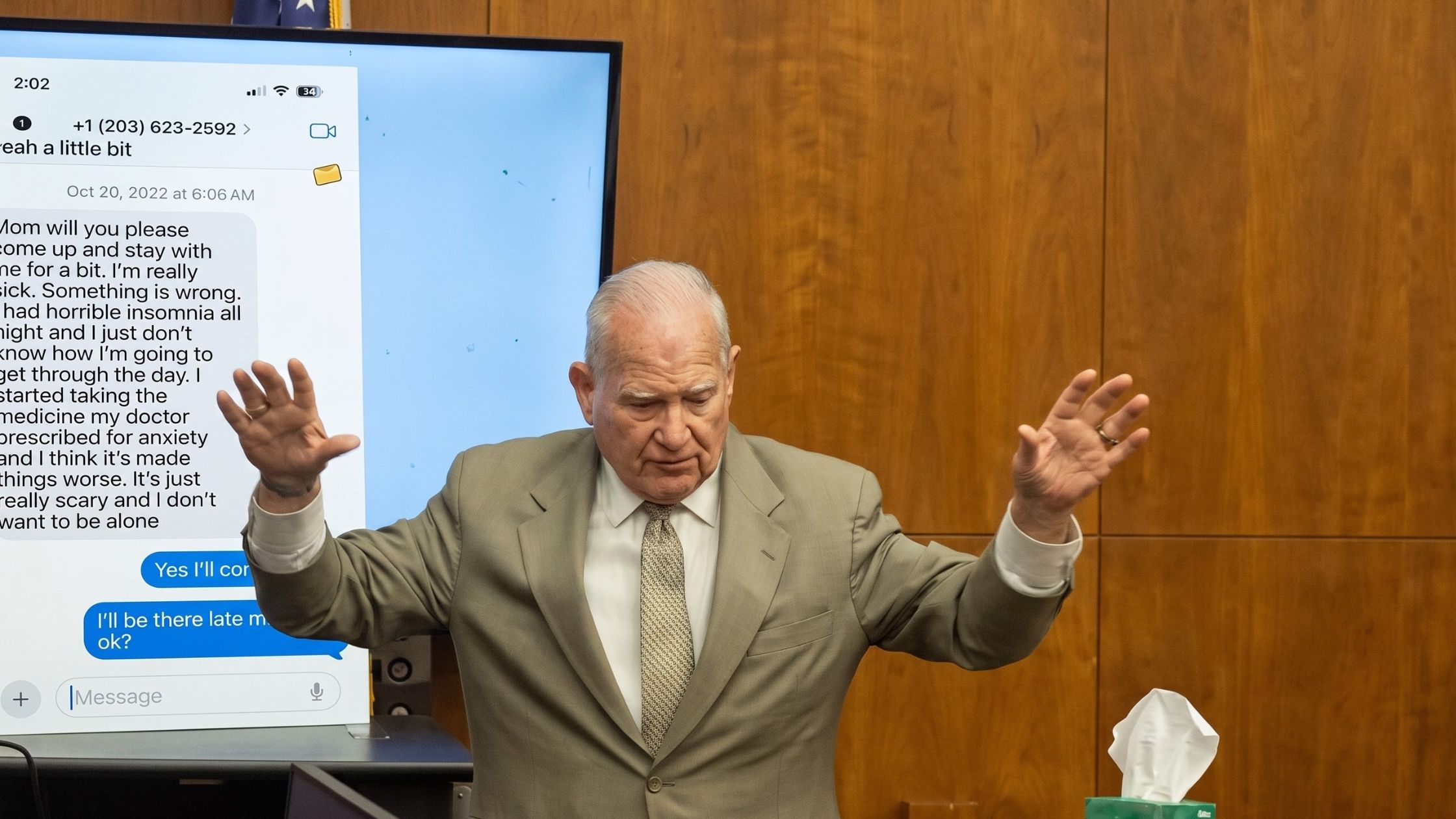
How about a text that she had sent to her mother on October 20th, sir? I know you indicated in your report that you had a chance to review all of the computer searches, text messages, Apple... All that stuff, right?
Kirk Heilbrun (02:36:46):
Yes, that's right.
Kevin Reddington (02:36:47):
All right. Read that text, please. October 20th. This is a text that she sent to her mother. Read it.
Kirk Heilbrun (02:36:53):
Would you like me to read it out loud? I'd
Kevin Reddington (02:36:54):
Yeah, I'd like you to read it out loud.
Kirk Heilbrun (02:36:56):
All right. "Mom, will you please come up and stay with me for a bit? I'm really sick. Something is wrong. I had horrible insomnia all night, and I just don't know how I'm going to get through the day. I started taking the medicine my doctor prescribed for anxiety, and I think it's made things worse. It's just really scary and I don't want to be alone."
Kevin Reddington (02:37:20):
Did her mother come up the next day and stay with her?
Kirk Heilbrun (02:37:25):
Oh, I don't know. I'd have to go back and look at the records.
Kevin Reddington (02:37:28):
I'm sure. You know, sir, that she actually climbed into the bed with her mother to sleep with her mother when her mother was staying with her during this period of time?
Kirk Heilbrun (02:37:36):
No, I didn't know that.
Kevin Reddington (02:37:42):
In the middle of November, sir, she texted her mother-in-law, which would be Pat's mother, Sue. This would be Sue Clancy, who was also a labor and delivery nurse, right?
Kirk Heilbrun (02:37:51):
Yes, that's correct.
Kevin Reddington (02:37:51):
She texted Sue while she was at work as a nurse, right?
Kirk Heilbrun (02:37:55):
Yes.
Kevin Reddington (02:37:56):
And Sue was in the emergency room and actually realized that Lindsay was at the hospital and stated that she felt unwell. Is that right?
Kirk Heilbrun (02:38:04):
Yes.
Kevin Reddington (02:38:05):
Did Sue see her in the hospital, if you know?
Kirk Heilbrun (02:38:09):
I think she met with her in the emergency room.
Kevin Reddington (02:38:12):
Okay. And then her mother-in-law was trying to help her out and referred her to another person that was a friend of a friend, so to speak, right? To help her out?
Kirk Heilbrun (02:38:22):
The nurse practitioner, is that who you're talking about?
Kevin Reddington (02:38:24):
Yep. Yes. Yeah.
Kirk Heilbrun (02:38:25):
Yes, that's right.
Kevin Reddington (02:38:26):
And she was able to meet with that individual, Paul, until she left, I think, like a week later. She went on to another job, right?
Kirk Heilbrun (02:38:36):
I think that's right, yes.
Kevin Reddington (02:38:37):
And that's when she saw Nurse Gelada, was that correct?
Kirk Heilbrun (02:38:41):
To my memory, that's correct, yes.
Kevin Reddington (02:38:43):
And then would you agree with me, sir, that at this timeframe in November, she was having real difficulty with sleep disruption, yes?
Kirk Heilbrun (02:38:51):
Yes, I would.
Kevin Reddington (02:38:52):
You had concerns all along about this starting in mid-October about the impact of the medications on her insomnia, correct?
Kirk Heilbrun (02:39:03):
Yes. Insomnia was one of the first problems that she experienced when she started taking the medication in October.
Kevin Reddington (02:39:10):
She expressed the fact that she believed that the medications were obviously having an adverse effect on her. They were damaging her brain, right?
Kirk Heilbrun (02:39:18):
She did express that view, yes.
Kevin Reddington (02:39:20):
And then she still, however, had a positive outlook and was, "Hoping that things would turn around in her life and that she could get back to being herself," is a quote, right?
Kirk Heilbrun (02:39:29):
Yes, that's right.
Kevin Reddington (02:39:30):
But instead, and I quote your words yesterday, "It got worse."
Kirk Heilbrun (02:39:36):
Yes.
Kevin Reddington (02:39:38):
"Late in November, she's still having a lot of trouble sleeping. She thought that she was close to," and I quote, "The end of her rope." Bad analogy, but nevertheless, that's what she said, right?
Kirk Heilbrun (02:39:48):
Yes, it is.
Kevin Reddington (02:39:50):
"She was feeling off, disconnected, sort of like a zombie," your words, testifying here yesterday, sir, correct?
Kirk Heilbrun (02:39:56):
Correct.
Kevin Reddington (02:39:57):
"She was reporting at this point, panic symptoms, concerns about the benzodiazepines," correct?
Kirk Heilbrun (02:40:03):
Yes.
Kevin Reddington (02:40:03):
"Indicated that she was disoriented and forgetful," correct?
Kirk Heilbrun (02:40:07):
Correct.
Kevin Reddington (02:40:07):
You told us that she stated that she was disconnected from her body, isn't that correct?
Kirk Heilbrun (02:40:12):
That's how she described feeling, yes.
Kevin Reddington (02:40:15):
"Could not relate to people, felt that she was in a disassociative state," isn't that right?
Kirk Heilbrun (02:40:21):
Yes, that is right.
Kevin Reddington (02:40:21):
"Though that the medication was resulting in this type of development in her life," correct? She felt the medications were contributing to this?
Kirk Heilbrun (02:40:33):
Yes, that's correct.
Kevin Reddington (02:40:35):
And in December, and I quote you, "It's not getting better." It got from worse, it got better, well, actually, not better, it got worse again, didn't it, in December?
Kirk Heilbrun (02:40:47):
December was probably the worst month for her as she described it.
Kevin Reddington (02:40:52):
And in December, sir, you recall that she indicated, and I quote in your testimony, "Horrible, intrusive thoughts." She had thoughts about harming herself potentially as she continued to experience these thoughts later into December, correct?
Kirk Heilbrun (02:41:07):
Yes, that's right.
Kevin Reddington (02:41:08):
These thoughts, did anyone, anyone say to her, "Are these thoughts, are these coming from outside your head? Are they coming from inside your head? Are they male voices? Are they female..." Anybody ask anything about thoughts, what they were, according to the medical records, not according to your guess?
Kirk Heilbrun (02:41:32):
That's a standard kind of question when you're being-
Speaker 5 (02:41:34):
Objection.
Kevin Reddington (02:41:34):
My question, sir, is you read the medical records-
Judge (02:41:37):
No, overruled.
Kevin Reddington (02:41:39):
Can you answer that question based on Dr. Heilbrun's review of the medical records of what this young lady went through in that hell that she was living?
Kirk Heilbrun (02:41:49):
Is your question, did someone ask her about hallucinations or thoughts?
Kevin Reddington (02:41:56):
Yeah, if I come to you for help and I say, "I've got intrusive thoughts about killing myself. And God forbid, I'm thinking about killing my kids. I've got these thoughts in my head." Would you ask me, "Are they voices? Thoughts? Whatever. Does anybody ask that question?
Kirk Heilbrun (02:42:13):
Yes. That's a standard question that psychiatrists ask at the beginning of each appointment. It's a standard mental status question.
Kevin Reddington (02:42:21):
Okay. Did any one of those psychiatrists ask Lindsay Clancy that question according to the medical records? Anyone?
Kirk Heilbrun (02:42:30):
Ms. Clancy completed the answer to those questions-
Kevin Reddington (02:42:35):
What questions?
Kirk Heilbrun (02:42:35):
... on a number of occasions. If I might.
Kevin Reddington (02:42:40):
What questions?
Speaker 5 (02:42:40):
He's answered the question.
Judge (02:42:40):
No, go ahead.
Kevin Reddington (02:42:40):
What questions?
Judge (02:42:42):
Finish that question and I'll let you have that question.
Kirk Heilbrun (02:42:43):
Okay.
Judge (02:42:43):
Finish the answer.
Kirk Heilbrun (02:42:45):
Questions such as, "Are you hearing voices? If so, describe those," and so on. And the typical response that she gave as part of a question like that was, "No."
Kevin Reddington (02:42:59):
About when someone says, "I've got dark thoughts." Does anybody, professionals, ask, "What are the dark thoughts?" Is that-
Kirk Heilbrun (02:43:11):
If somebody said, "I'm having dark thoughts," then the follow-up question would be, "Tell me more. What are the thoughts? Just give me some descriptions of what you're having, what you're thinking, what it's like," and so on.
Kevin Reddington (02:43:23):
So if a patient goes to a doctor and says, "I'm having these intrusive thoughts, I'm having dark thoughts, I'm having thoughts of..." And at this same timeframe in December, she's talking about harming the children, correct?
Kirk Heilbrun (02:43:40):
She said that those thoughts had come to her at times.
Kevin Reddington (02:43:43):
At times?
Kirk Heilbrun (02:43:44):
Yes.
Kevin Reddington (02:43:44):
And she'd mentioned that to her husband, didn't she?
Kirk Heilbrun (02:43:49):
That's what she said, yes.
Kevin Reddington (02:43:51):
Did you talk to her husband about it?
Kirk Heilbrun (02:43:55):
Yes, I did talk to her husband about it.
Kevin Reddington (02:43:56):
Tell you that she said that to him?
Kirk Heilbrun (02:43:58):
Yes.
Kevin Reddington (02:44:00):
A couple of times she said it to him, right?
Kirk Heilbrun (02:44:06):
A couple of times she said, "I'm having thoughts," and he asked her, "Give me more detail if you could." And she said, "They're just thoughts. It's not a plan," that sort of thing.
Kevin Reddington (02:44:17):
You got this girl living in her house with her kids saying she's having dark thoughts, saying she's thinking of harming the children. And Patrick's response, according to your testimony, is just basically just, "Power through it, you'd be okay."?
Speaker 5 (02:44:33):
Objection.
Judge (02:44:34):
Overruled.
Kirk Heilbrun (02:44:39):
No, that was not his response as he described it. He asked more questions because one of the things that she had been dealing with for some time are thoughts about hurting herself and possibly the kids. And so what he did was try to get more information about the details. He asked questions that a mental health professional would also ask, which is-
Kirk Heilbrun (02:45:00):
Questions that a mental health professional would also ask, which is how often, what are they like, do you have a plan? Things like that. And she pretty consistently said, "No, I don't have a plan. And this is how often it happens, but they're just thoughts."
Kevin Reddington (02:45:21):
So let's talk about that because that's apparently the standard reaction if a patient comes to a doctor and says, "I'm having dark thoughts, intrusive thoughts, I'm thinking of hurting myself, I'm thinking of hurting the kid." You say, "Do you have a plan?" That's a question you ask, right?
Kirk Heilbrun (02:45:38):
That's one of the questions that you ask, yes.
Kevin Reddington (02:45:40):
If the person says, "Nah, I don't have a plan. I'm just having these thoughts," and you just basically move on, give them more drugs, what do you do?
Kirk Heilbrun (02:45:49):
No, you don't move on. You're aware that the person has reported having those thoughts and you've appraised the risk and the risk has to do with things like how imminent is it? How serious is it? Are there means? Is there a plan? What sort of detail is involved and so on.
(02:46:07)
And so basically what you do at that point is you take it seriously, but you also try to describe how seriously to take it, so.
Kevin Reddington (02:46:20):
Okay. Would you agree, sir, that she was complaining through December about these unwelcome and internal thoughts. Is that correct?
Kirk Heilbrun (02:46:30):
Yes.
Kevin Reddington (02:46:31):
It's important for your evaluation because when you asked the question, "When you're experiencing these thoughts, were they your own thoughts or were they auditory hallucinations?" And she indicated to you, "They're my own thoughts," is what your testimony was, right? Yesterday?
Kirk Heilbrun (02:46:45):
That's correct.
Kevin Reddington (02:46:47):
But she made clear that these were unwelcome and that they were intrusive. Is that correct?
Kirk Heilbrun (02:46:51):
Yes, she did.
Kevin Reddington (02:46:52):
So she's answering your questions honestly. She certainly isn't trying to fake that she's hearing all sorts of voices yelling at her and things like that. She's answering honestly, correct?
Kirk Heilbrun (02:47:02):
Yes.
Kevin Reddington (02:47:04):
Very cooperative, correct?
Kirk Heilbrun (02:47:05):
Yes, correct.
Kevin Reddington (02:47:08):
You then would indicate, sir, that in your evaluation as you went on, that she described an experience on December 15th and she described December 15th as being literally one of the worst days in her life, right?
Kirk Heilbrun (02:47:23):
Yes.
Kevin Reddington (02:47:25):
Why was it one of the worst days of her life?
Kirk Heilbrun (02:47:33):
Well, it was one of the worst days because things were getting more intense and difficult and the thoughts that she was experiencing were harder to handle for her.
Kevin Reddington (02:47:50):
As a result of that, her husband Pat took her to the hospital, right?
Kirk Heilbrun (02:47:56):
Correct.
Kevin Reddington (02:47:57):
And you indicated that it looked like she was having general anxiety symptoms, right? That's your testimony yesterday?
Kirk Heilbrun (02:48:08):
It looked from what the records reflected that anxiety was something that they were focusing on her experiencing.
Kevin Reddington (02:48:20):
And then you said in your testimony, "But not so much the postpartum." What does that mean?
Kirk Heilbrun (02:48:31):
It means that in December she would have been seven months away from giving birth to Callan and consequently it was less likely to be postpartum than depression for other reasons or bipolar or major depression or something like that, rather than postpartum depression or postpartum psychosis, something like that.
Kevin Reddington (02:49:03):
Because you know that postpartum is not a medical diagnosis. That's just the fact that you had a baby, right?
Kirk Heilbrun (02:49:09):
I do know that, yes.
Kevin Reddington (02:49:12):
Okay. And when she went to that hospital, did they provide any help for her or any medication or what happened on December 15th?
Kirk Heilbrun (02:49:22):
She did not stay in the hospital very long. And so no, she didn't remain there long enough to get the kind of help that you would usually get on an inpatient basis.
Kevin Reddington (02:49:37):
But the next day or thereabouts, she goes back to see Tufts, right?
Kirk Heilbrun (02:49:40):
Yes.
Kevin Reddington (02:49:40):
Okay. So she immediately tries to reach out for help to anybody that would listen to her, right?
Kirk Heilbrun (02:49:49):
She was trying hard to get help.
Kevin Reddington (02:49:53):
Now we get to December 20th. December 20th wasn't a very good day either, was it?
Kirk Heilbrun (02:50:00):
Well, that was the day she went to the Rhode Island Hospital that had a postpartum program.
Kevin Reddington (02:50:11):
Now you know from looking at the medical records that in fact it was recommended to her, I think by maybe the LICSW young lady, Latiesha Dukes, maybe I'm wrong, they're in the records.
(02:50:25)
Someone told her to get in touch with this Rhode Island hospital, right?
Kirk Heilbrun (02:50:31):
Yes.
Kevin Reddington (02:50:31):
They specialized in postpartum care for women that possibly are going through postpartum psychosis or postpartum depression, right?
Kirk Heilbrun (02:50:42):
Yes.
Kevin Reddington (02:50:43):
And Pat, her husband took her and dropped her off and then he went skiing with Cora, is that correct?
Kirk Heilbrun (02:50:48):
Correct.
Kevin Reddington (02:50:50):
And he dropped her off in that hospital and she was evaluated by a doctor and some people, correct?
Kirk Heilbrun (02:50:58):
Yes.
Kevin Reddington (02:50:59):
And you reviewed those medical records, right?
Kirk Heilbrun (02:51:00):
I did.
Kevin Reddington (02:51:01):
And when you reviewed the medical records, did you see that she was also involved in group discussions and crayons and coloring and things like that?
Kirk Heilbrun (02:51:08):
Yes, I did.
Kevin Reddington (02:51:09):
Yeah. Did that help her out, do you think, coloring?
Kirk Heilbrun (02:51:11):
There's a number of things that they try to do. I think coloring as such would not be helpful.
Kevin Reddington (02:51:19):
Okay.
Kirk Heilbrun (02:51:19):
But there's art therapy and there's various other kinds of things that people are involved in.
Kevin Reddington (02:51:24):
All right. So various other things that people are involved in. So I assume the people you're referring to would be the employees of the hospital?
Kirk Heilbrun (02:51:33):
Or the patients who are attending the postpartum program.
Kevin Reddington (02:51:37):
Okay. So what exactly was the program? What did they do that one day that she was there? She was there for eight hours. What did they do?
Kirk Heilbrun (02:51:45):
She wasn't accepted as part of that program.
Kevin Reddington (02:51:48):
I didn't ask you about that. I asked you what did they do?
Kirk Heilbrun (02:51:52):
Well, they evaluated her, is my understanding from reviewing the records.
Kevin Reddington (02:51:56):
And then what happened, sir, when they evaluated her?
Kirk Heilbrun (02:51:59):
They evaluated her and they indicated that she was not appropriate for their program.
Kevin Reddington (02:52:04):
And you testified yesterday that, and I quote, "They said she did not necessarily fit into their postpartum program. They did offer her three other programs." You remember that, sir?
Kirk Heilbrun (02:52:18):
Yes.
Kevin Reddington (02:52:18):
Okay. And then you indicated that, "Patient was offered several options, including inpatient treatment for medication management," right?
Kirk Heilbrun (02:52:31):
Yes.
Kevin Reddington (02:52:32):
"A partial hospitalization program focused on general mental health," right?
Kirk Heilbrun (02:52:38):
Yes.
Kevin Reddington (02:52:38):
Where was that program?
Kirk Heilbrun (02:52:40):
I don't know.
Kevin Reddington (02:52:41):
"Or continued outpatient management," right?
Kirk Heilbrun (02:52:45):
Yes.
Kevin Reddington (02:52:45):
What is that, like going to see Tufts, outpatient management?
Kirk Heilbrun (02:52:48):
Yes. That's living at home in the community and being treated by a psychiatrist, which is what Dr. Tufts was.
Kevin Reddington (02:52:57):
Right. Well, okay. So, "Patient plans to follow up with her outpatient provider for guidance," is what you said yesterday, right?
Kirk Heilbrun (02:53:06):
Yes.
Kevin Reddington (02:53:07):
And she did the next day, right?
Kirk Heilbrun (02:53:09):
Yes.
Kevin Reddington (02:53:10):
And do you think that a doctor who has been licensed as a physician psychiatrist advertising that they specialize in postpartum, postnatal issues is qualified to treat a young woman with this symptomology that she brought to that desk. Oh, I'm sorry, to the television set?
Kirk Heilbrun (02:53:37):
I don't understand your question.
Kevin Reddington (02:53:39):
Well, you know that she never met... Tufts never met this girl. She never met her, ever, until she sat in that witness stand.
Kirk Heilbrun (02:53:46):
I understand that their treatment was done remotely.
Kevin Reddington (02:53:50):
Remotely? So when I say the television, that's what I mean. It's like you're on a Zoom, you're on whatever. I apologize for that.
Kirk Heilbrun (02:53:56):
Ah. Yes. Yeah.
Kevin Reddington (02:53:58):
So she went the next day and actually remotely accessed a meeting with Dr. Tufts, right?
Kirk Heilbrun (02:54:04):
Yes.
Kevin Reddington (02:54:06):
And then she went back onto her schedule with Dr. Tufts, but that didn't help so much. Is that correct? You indicated that she was still numb, she was still having suicidal ideation, things of that nature, right?
Kirk Heilbrun (02:54:20):
Correct.
Kevin Reddington (02:54:21):
Okay. One of the things that you said though, sir, yesterday is that her admission to the hospital was because they did not feel, and I quote that, "She did not necessarily fit into their program." You recall that?
Kirk Heilbrun (02:54:43):
You mean their failure to accept her into the day program?
Kevin Reddington (02:54:47):
The failure to help her, period. They told her to leave.
Kirk Heilbrun (02:54:52):
It's my understanding that what they said was that you don't fit with our program because it's not a postpartum phenomenon and that's what the program is about.
Kevin Reddington (02:55:06):
Did you really read those records?
Kirk Heilbrun (02:55:09):
Yes. Yes, I did.
Kevin Reddington (02:55:10):
Okay. So help me again-
Kirk Heilbrun (02:55:11):
And I wrote something about... In my report, I wrote something about it.
The Court (02:55:15):
Wait for the next question, okay?
Kirk Heilbrun (02:55:16):
Yes, Your Honor.
Kevin Reddington (02:55:17):
So you read the records from that Women & Infants Hospital in Rhode Island?
Kirk Heilbrun (02:55:22):
Yes.
Kevin Reddington (02:55:22):
[inaudible 02:55:23] this jury, right?
Kirk Heilbrun (02:55:23):
Yes.
Kevin Reddington (02:55:24):
And what was the word, the language, the word salad, you just said to me that they didn't accept her because of what?
Prosecutor (02:55:29):
Objection.
The Court (02:55:30):
Yeah. You rephrase that.
Kevin Reddington (02:55:33):
What was it you just said to this jury, they wouldn't accept her? Why?
Kirk Heilbrun (02:55:37):
It was a day program for women experiencing postpartum difficulties, and their evaluation of Ms. Clancy was that her difficulties were more related to general mental health, but not particularly to postpartum difficulties. And so she did not-
Kevin Reddington (02:55:57):
Go ahead.
Kirk Heilbrun (02:55:58):
If I might?
Kevin Reddington (02:55:59):
Yeah, you might.
Kirk Heilbrun (02:56:00):
If she might be more appropriate for somebody... She might be more appropriate for a general mental health program, but not so much for a postpartum day program, which is what they had.
(02:56:14)
So they didn't say that you don't need help. They just said that you don't fit with our program.
Kevin Reddington (02:56:21):
Would it surprise you to know, sir, that they said that she didn't fit with their program, as you put it, because of the overlay of over-medication that her doctors had caused to that point? Do you have any memory of that at all?
Kirk Heilbrun (02:56:43):
There were questions that they raised about the medication.
Kevin Reddington (02:56:46):
It wasn't just questions. They said that's the reason, the secondary diagnosis as to why they wouldn't accept this young lady is because of the medications that she had been prescribed, over-medicating.
Kirk Heilbrun (02:57:02):
The...
Kevin Reddington (02:57:02):
Do you recall seeing that in those records?
Kirk Heilbrun (02:57:05):
Yes. I recall a diagnosis of depression, which was not specified further because there were medicine complications.
Kevin Reddington (02:57:15):
Do I have to get the medical records and read them to you?
Kirk Heilbrun (02:57:18):
I actually have something in my report so I can read it back to you.
Kevin Reddington (02:57:22):
Can you pull it out and tell me what the discharge diagnosis was?
Kirk Heilbrun (02:57:23):
Yes.
Prosecutor (02:57:23):
Exhibit 220.
Speaker 6 (02:57:23):
Which ones are you looking for?
Kevin Reddington (02:57:23):
220, I guess. Women & Infants Hospital records.
Kirk Heilbrun (02:58:39):
I'm on page 18 of my report and-
Kevin Reddington (02:58:43):
[inaudible 02:58:44] discharge diagnosis?
Kirk Heilbrun (02:58:46):
The records indicate a diagnosis of generalized anxiety disorder and depressive disorder without further specification, and I quote, "Due to adverse drug effects."
Kevin Reddington (02:59:01):
Anything else?
Kirk Heilbrun (02:59:03):
Yes. They indicate that her chief complaint was feeling numb and crazy depressed, identified passive suicidal ideation, notes that the... No.
Kevin Reddington (02:59:18):
I'm sure you can read all the diagnoses. My question, sir, is simple. It's on the discharge diagnosis. That's all.
Kirk Heilbrun (02:59:24):
Yes. The discharge diagnosis was anxiety and depression.
Kevin Reddington (02:59:29):
And secondary to what?
Kirk Heilbrun (02:59:30):
They didn't specify more about the depression because it was due to adverse drug effects.
Kevin Reddington (02:59:40):
Okay. And in your review of the records, sir, did you then see that the doctor at the Women & Infants at least was concerned enough about the over prescriptions that she reached out to Dr. Jollotta to speak to her?
Kirk Heilbrun (02:59:54):
Dr. Jollotta?
Kevin Reddington (02:59:58):
Sorry, Nurse Practitioner Jollotta.
Kirk Heilbrun (02:59:59):
Yes.
Kevin Reddington (03:00:02):
Okay. It's like captain, major, that type of thing. But Jollotta, you know who she is, right?
Kirk Heilbrun (03:00:06):
I do, yes. Okay.
Kevin Reddington (03:00:08):
Did they reach out to Nurse Practitioner Jollotta?
Kirk Heilbrun (03:00:12):
I did not see that in the records.
Kevin Reddington (03:00:14):
Can we break here, Judge, because I got to get the records.
The Court (03:00:18):
All right. All right. It's 11:00. So why don't we take the morning recess at this time and we'll come back shortly.
Kirk Heilbrun (03:00:26):
Okay.
Bailiff (03:00:26):
Court, all rise, please. [inaudible 03:00:33]. Jurors will exit the courtroom.
The Court (03:01:09):
All right. We'll be in recess at this time. Thank you.
Bailiff (03:01:10):
Court stands for the recess. Please exit the courtroom.
Clerk (03:36:32):
Your Honor, for the purpose of the record, we've returned back to the trial of Commonwealth versus Lindsay Clancy. All parties are present, excluding the jury.
William Sullivan (03:36:39):
All right. We ready for the jury, counsel? Okay. Yeah.
Bailiff (03:36:40):
Order. All rise. Jurors enter it.
(03:36:40)
This court is now in session to be seated, please.
Clerk (03:37:50):
Your Honor, for the purpose of the record, we return back to the trial of Commonwealth versus Lindsay Clancy. All parties are present, including the defendant and including the 18 jurors.
William Sullivan (03:37:58):
All right. Attorney Reddington.
Kevin Reddington (03:38:00):
Thank you. So I now have, sir, Exhibit 220, which would be the records from the Women and Infants Hospital that you read prior to coming in here today, correct?
Kirk Heilbrun (03:38:13):
Yes.
Kevin Reddington (03:38:15):
And when you read the records, would you agree with me, sir, that there was a history of present illness, which means they would ask Lindsay questions about how she felt, what her medications were, things like that, right?
Kirk Heilbrun (03:38:27):
Yes, I would.
Kevin Reddington (03:38:28):
And when you were reviewing this, did you note that she indicated that she was feeling, and I quote, because it's in quotes, "Crazy, depressed, numb to all emotion." "Can't feel love." "My life is becoming a disaster." You saw those?
Kirk Heilbrun (03:38:50):
Are you quoting from the records or from my report?
Kevin Reddington (03:38:55):
Records, Exhibit 220.
Kirk Heilbrun (03:38:57):
Okay. Yes, I would agree that those were words that were used when I reviewed the records.
Kevin Reddington (03:39:05):
And when you were talking with Lindsay, did you ask her what she meant by saying she can't feel love?
Kirk Heilbrun (03:39:15):
Yes. She said that she felt like a shell. She felt hollow. She felt like a zombie. She felt emotionally flat as a pancake, which is also one of the phrases that was used in those records to describe her mood.
Kevin Reddington (03:39:33):
Okay. "My life is becoming a disaster." "Can't feel fear." What did that mean? Did you ask anything like that? Can't feel fear.
Kirk Heilbrun (03:39:44):
I didn't ask her specifically about can't feel fear. She indicated that she couldn't feel things emotionally that.
Kevin Reddington (03:39:56):
Worried that she is "messed up beyond repair." That was in the records, correct?
Kirk Heilbrun (03:40:03):
That was several places, yes, including the records.
Kevin Reddington (03:40:06):
"Takes all the effort in the world just to breathe." That was in the records, correct?
Kirk Heilbrun (03:40:12):
Yes.
Kevin Reddington (03:40:13):
And in the interviews of friends and family, would you agree in this timeframe, which was in December to the end of December, that she was having difficulty even getting out of bed?
Kirk Heilbrun (03:40:25):
Yes.
Kevin Reddington (03:40:26):
"She felt very heavy. She couldn't even walk. She had difficulty with her personal hygiene," correct?
Kirk Heilbrun (03:40:34):
Yes.
Kevin Reddington (03:40:36):
"Was worried about how she's going to take care of her kids and feed them and watch them while Patrick was working," right?
Kirk Heilbrun (03:40:42):
Yes.
Kevin Reddington (03:40:45):
And one of her goals, and I quote, "Was to come off meds and be able to sleep," end quote.
Kirk Heilbrun (03:40:55):
Yes.
Kevin Reddington (03:40:56):
Now, insomnia, you'd agree with me, is very serious.
Kirk Heilbrun (03:41:00):
Oh, I would absolutely agree with you. Yes.
Kevin Reddington (03:41:02):
And that can lead to any number of things, right?
Kirk Heilbrun (03:41:04):
Yes.
Kevin Reddington (03:41:04):
It can even lead to psychosis, right?
Kirk Heilbrun (03:41:07):
Yes.
Kevin Reddington (03:41:08):
Okay. I asked you about the treatment plan and recommendations that the district attorney had asked you about as well. And if I may, and if you need to look at it, let me know. It says, "Treatment plan, admit to DHP." Do you know what DHP is?
Kirk Heilbrun (03:41:25):
No.
Kevin Reddington (03:41:26):
Okay. "Medication. Recommended tapering off Seroquel starting with 200 milligrams tonight and follow up with outpatient provider." That would be who? Gelata?
Kirk Heilbrun (03:41:42):
At the time, it could have been Gelata or Tufts.
Kevin Reddington (03:41:46):
And then indicating, sir, that diagnosis that we talked about, if I may approach, can you. Right here, doctor, just read number one and two for the jury, please.
Kirk Heilbrun (03:42:03):
Number one is GAD, which stands for generalized anxiety disorder. Number two is depression, unspecified, rule out due to adverse drug effects.
Kevin Reddington (03:42:16):
So when you rule out and have a concern about adverse drug effects, one of the things that I imagine one would do is to reach out to the person that's prescribing the drugs, right?
Kirk Heilbrun (03:42:33):
It's possible. There could be other strategies as well. You could change the medication, you could discontinue it. There could be a number of things.
Kevin Reddington (03:42:40):
And when you read the record, sir, again, page nine under treatment plan, did you make note of the fact, and I quote, "Of note, we attempted to reach current outpatient provider, Rebecca Gelata, NP, but did not receive a call back." You see that?
Kirk Heilbrun (03:43:01):
I may have seen that. I didn't note it in what I wrote here.
Kevin Reddington (03:43:06):
In any event, patient plans to reach out to previous provider who would be Jennifer Tufts, and she did that, right?
Kirk Heilbrun (03:43:14):
Yes.
Kevin Reddington (03:43:19):
Okay. Now, one of the other things that you had made reference to, sir, is that you relied on is when her husband came home and found Lindsay on the ground in the snow after she had jumped out the window, he spoke with her, is what you told this jury, right?
Kirk Heilbrun (03:43:43):
Yes.
Kevin Reddington (03:43:45):
And can you tell us again what it is that he said to her and what she said to him?
Kirk Heilbrun (03:43:49):
He said, "What did you do?" And she said, "I tried to kill myself." And then he said, "Where are the kids?" And she said, "In the basement."
Kevin Reddington (03:44:01):
Now, what is your source of that information, sir?
Kirk Heilbrun (03:44:09):
It was in the records and I also did a collateral interview with-
Kevin Reddington (03:44:13):
Of who?
Kirk Heilbrun (03:44:14):
Patrick Clancy.
Kevin Reddington (03:44:16):
Did you listen to the 911 tape?
Kirk Heilbrun (03:44:18):
No, I did not.
Kevin Reddington (03:44:19):
If I tell you, would you be surprised, sir, that she had significant damage, not only to her back, her spine, and was hemorrhaging, but also to her throat?
Kirk Heilbrun (03:44:36):
No, I would not be surprised. That was a... She injured herself very badly when she jumped out that window.
Kevin Reddington (03:44:46):
If I suggest to you, sir, that if you listen to the 911 tape as it relates to Patrick Clancy interacting with her, that she can only make grunting noises, would you be surprised at that?
Kirk Heilbrun (03:45:05):
I would be surprised, yes.
Kevin Reddington (03:45:06):
And you never listened to that tape?
Kirk Heilbrun (03:45:07):
I did not.
Kevin Reddington (03:45:13):
Went into McLean Hospital, and that would be the locked wards of McLean Hospital. She was there for five days, correct?
Kirk Heilbrun (03:45:20):
That's correct.
Kevin Reddington (03:45:21):
And then she was released at her request to attend Cora's birthday, right?
Kirk Heilbrun (03:45:26):
Yes.
Kevin Reddington (03:45:27):
When she was released, would you agree, sir, that. Well, while she was there, she continued to describe her mood as numb, denying things like that she's not having hallucinations and suicidal thoughts or homicidal thinking at the time, and that would be prior to her discharge, is that right?
Kirk Heilbrun (03:45:47):
There was a lot in that question, so if you could break it down for me, I'd appreciate it.
Kevin Reddington (03:45:51):
No, I'm just going to ask, sir, would you agree with me that she indicated what her mood was prior to discharge, right? Well, as a doctor, you're not going to let somebody walk out the door of a locked ward in the hospital without making sure that, in your opinion, that it's okay for the person to be released to their home, family, things of that nature, right?
Kirk Heilbrun (03:46:18):
I'm looking at the part of my report-
Kevin Reddington (03:46:20):
Sir, can you understand my question? I don't care about your report. I'm asking you about when someone is in a hospital, you don't release them unless you feel they're not a danger to themself or others, right?
Kirk Heilbrun (03:46:32):
Yes.
Kevin Reddington (03:46:33):
Okay.
Kirk Heilbrun (03:46:33):
The answer to that question is yes.
Kevin Reddington (03:46:34):
And she was released, right, from the hospital?
Kirk Heilbrun (03:46:38):
Yes.
Kevin Reddington (03:46:39):
And she then was allowed to go home and go to her daughter, Cora's birthday, right?
Kirk Heilbrun (03:46:44):
That's correct.
Kevin Reddington (03:46:45):
And this was on January 5?
Kirk Heilbrun (03:46:47):
January 5, yes.
Kevin Reddington (03:46:49):
And she was described in the records as being cooperative and pleasant, right?
Kirk Heilbrun (03:46:53):
Cooperative, pleasant, no psychosis, no suicidal or homicidal ideation. Mood described as "good," and not anxious.
Kevin Reddington (03:47:03):
Good for you. Anything else you want to add?
Jennifer Sprague (03:47:05):
Objection.
William Sullivan (03:47:06):
Sustained. Next question.
Kevin Reddington (03:47:09):
So after discharge, would you agree, sir, that she had what she described as a small shred of hope after discharge because she thought that she was off the Seroquel and felt that was what was causing her a lot of her problems, right?
Kirk Heilbrun (03:47:27):
Yes, I would agree with that.
Kevin Reddington (03:47:29):
Okay. But the intrusive suicidal ideation and thoughts returned, isn't that right?
Kirk Heilbrun (03:47:37):
Within a week, yes.
Kevin Reddington (03:47:39):
And they were pretty bad, weren't they?
Kirk Heilbrun (03:47:40):
Yes, they were.
Kevin Reddington (03:47:42):
And again, she's describing, according to your testimony yesterday, symptomology that you said of combined two and three, that would be on the little diagram you put up on the board, right, for the jurors to look at, the blue thing that you had with the one, two, three, four, five, six, seven?
Kirk Heilbrun (03:47:58):
The PowerPoint slide, yes.
Kevin Reddington (03:47:59):
Right. So you combine two and three on the slide, but you talked about this before, is what you indicate. And this is after she started taking the medication. Anxiety didn't get better. She had difficulty, great difficulty with insomnia and that she was numb, right? Yet again, right?
Kirk Heilbrun (03:48:20):
Yes, correct.
Kevin Reddington (03:48:20):
And a zombie yet again, right?
Kirk Heilbrun (03:48:23):
Yes.
Kevin Reddington (03:48:24):
And she didn't see any improvement. Is that right, sir?
Kirk Heilbrun (03:48:28):
No, that's not right.
Kevin Reddington (03:48:29):
Okay. Well, "In fact, she thought it was getting a lot worse." And so basically what she thought is that the symptoms that she was experiencing following taking the medications prescribed beginning in October, she said the symptoms were getting worse, particularly new symptoms which were insomnia. It's page 126 of your testimony [inaudible 03:48:52].
Kirk Heilbrun (03:48:52):
Oh, okay. Yes. I misunderstood your question.
Kevin Reddington (03:48:54):
That's all right. No problem.
Kirk Heilbrun (03:48:55):
Sorry.
Kevin Reddington (03:48:56):
That's okay. And then you further indicated that moving on to number five on your chart, one of the things she also said is that she was focusing on making the anxiety, helping the anxiety getting better through medication, right?
Kirk Heilbrun (03:49:12):
Yes.
Kevin Reddington (03:49:12):
It was also counseling. She went to the counseling through Latiesha Dukes. Ms. Gelata was still treating her, correct?
Kirk Heilbrun (03:49:21):
The counseling was limited, but yes, that is correct. She was involved in some counseling.
Kevin Reddington (03:49:25):
So it was limited. Is that a bad thing? Did this woman not want-
Jennifer Sprague (03:49:30):
Objection.
Kevin Reddington (03:49:30):
- to go to anybody that would help her, sir? Are you trying to tell the jury that she was avoiding help?
Jennifer Sprague (03:49:35):
Objection.
William Sullivan (03:49:35):
Sustained. Next question.
Kevin Reddington (03:49:36):
So it was limited. How was it limited?
Kirk Heilbrun (03:49:40):
It was short term and supportive as opposed to something where in the field you might pick a cognitive behavioral therapist, which is empirically supported for things like anxiety and depression and patients and things like that.
Kevin Reddington (03:50:00):
Who makes that decision? Does a person like this make that decision, sir? Is it up to the patient to make a decision of cognitive, whatever it is you just said?
Kirk Heilbrun (03:50:13):
Yes. It's certainly one of the things that an individual can do is looking for a referral from somebody who would be a cognitive behavior therapist or something like that. So, yes.
Kevin Reddington (03:50:30):
Go ahead. I don't want to cut you off.
Kirk Heilbrun (03:50:32):
I'm finished.
Kevin Reddington (03:50:32):
[inaudible 03:50:33].
Kirk Heilbrun (03:50:33):
I'm finished.
Kevin Reddington (03:50:35):
She was focusing on trying to make this anxiety and make her feelings about her feelings go away. She wanted to be herself again, right?
Kirk Heilbrun (03:50:43):
Yes, that's right.
Kevin Reddington (03:50:44):
Now there's nothing wrong with that, right? For a person to want to do that?
Kirk Heilbrun (03:50:47):
Not at all.
Kevin Reddington (03:50:48):
Okay. You indicated that she was concerned about resolving her problems and the district attorney then asked you about if this is some type of her taking control of her life. You indicated that she is trying to take control-
Kevin Reddington (03:51:00):
Control of her life. You indicated that she is trying to take control of her life, remember that?
Kirk Heilbrun (03:51:06):
I testified that it was important that she felt in control and that she could make things happen and improve things through focusing and discipline and hard work.
Kevin Reddington (03:51:20):
And that's what you already agreed, that she was a person that wasn't afraid of hard work, right?
Kirk Heilbrun (03:51:27):
Yeah. On the contrary, she worked hard and she got a lot of results from working-
Kevin Reddington (03:51:34):
So that's not an issue that would be something that would be a black mark against her, that she's trying to take control of her life as it relates to these medications and what they're doing to her and her internal feelings at postpartum, if that's what she believed?
Kirk Heilbrun (03:51:48):
I was not trying to develop black marks against her. I was just trying to-
Kevin Reddington (03:51:51):
Oh, I'm sorry. I thought you said-
Kirk Heilbrun (03:51:54):
... describe how she thinks and feels and behaves.
Kevin Reddington (03:51:54):
Sorry, you're right.
Judge (03:51:55):
All right. Next question.
Kevin Reddington (03:51:56):
I though you said, yesterday, that you put two marks over this category, three marks over this category, this is possible, that's possible. You were considering these things, right?
Kirk Heilbrun (03:52:07):
That was on another issue.
Kevin Reddington (03:52:08):
Okay.
Kirk Heilbrun (03:52:09):
Yeah.
Kevin Reddington (03:52:09):
So as it relates to resolving the problems, that would include talking to doctors about different medications to try, researching medications on her own. This is your testimony. Asking friends and family for tips. Really? You're supposed to ask friends and family for tips about your mental psychosis, your mental state?
Kirk Heilbrun (03:52:33):
I'm not sure what the question is.
Kevin Reddington (03:52:35):
Well, Dr. Heilbrun testified, yesterday, as it relates to, in response to questions from the district attorney about her resolving her problems, including talking to doctors about different medications to try, researching medications on her own, and asking friends and family for tips.
Lawyer (03:52:54):
Objection. Is there a question?
Kevin Reddington (03:52:56):
Yeah. The question is, is that good medical advice, sir, to tell a sick person who comes to a doctor for help to go ask their friends and family for tips?
Kirk Heilbrun (03:53:08):
One of the things I would say is that when you want very much to improve, you, of course, ask your doctor and whoever else you're working with, but you might also ask other people in the family or friends any recommendations that they might have. That's something that you do.
Kevin Reddington (03:53:31):
And when you say, "Something you do," what are you referring to? The women that come to a doctor in postpartum depression, postpartum psychosis and ask for help, that they should go talk to their neighbors?
Kirk Heilbrun (03:53:43):
I think that one of the things that's a natural human inclination is to talk to people who are close to you, friends and family and so on, and say, "This is a problem I'm having. Do you have any advice or can you help in any way?"
Kevin Reddington (03:53:57):
And then over the course of the time that she was going through this experience into late January, she had a lot of providers offer a lot of diagnoses and there were a lot of complicated considerations, so much so that the diagnosis that was given to her being, at that time, adjustment disorder with anxiety and depressions, generalized anxiety disorder, major depressive disorder, bipolar disorder, bipolar disorder II, postpartum depression, postpartum psychosis, postpartum stress disorder. Those are your words, sir.
Kirk Heilbrun (03:54:29):
Yes.
Kevin Reddington (03:54:30):
And that was all in January, wasn't it? Right? Stop saying no.
Kirk Heilbrun (03:54:39):
Are you asking me whether she had all the symptoms of all those disorders in January?
Kevin Reddington (03:54:44):
Your words, sir, your words, sir, for late January-
Lawyer (03:54:46):
Objection. If we can have the question and the response.
Judge (03:54:48):
Yeah. Good. Next question. Go ahead.
Kevin Reddington (03:54:51):
Did I just read right what you said in your testimony yesterday?
Kirk Heilbrun (03:54:54):
I'm not understanding your question, Mr. Reddington.
Kevin Reddington (03:54:57):
She also had "psychotropic medication with adverse reaction," your words to this jury yesterday.
Kirk Heilbrun (03:55:04):
Yes.
Kevin Reddington (03:55:05):
What is psychotropic medication with adverse reaction? What does that mean?
Kirk Heilbrun (03:55:11):
It's pronounced psychotropic, and-
Kevin Reddington (03:55:12):
I'm sorry.
Kirk Heilbrun (03:55:13):
Oh, okay. Psychotropic medication is medication that is prescribed to help treat symptoms of mental or emotional disorder, and it helps to improve, hopefully, the symptoms that you experience. And there was another part to your question, I think.
Kevin Reddington (03:55:35):
Yeah. It's called adverse.
Kirk Heilbrun (03:55:37):
Yes. These medications are available because, for what they're prescribed for, they help most people. They have to go through clinical trials and all sorts of things. But for a few people, there are side effects and what we call adverse reactions and they don't help. In fact, they might make things worse. And it appeared, to me, from reviewing the records, that for Ms. Clancy, she's one of those few people where the reactions were very different, very poor. They were not the kind of reactions that were designed to have the medication prescribed for and improve the symptoms. She just had the opposite happen.
Kevin Reddington (03:56:31):
Look at her. You look at her, sir. Did she have adverse reactions, in your mind, after you evaluated her, looked at the medical records, and looked at all of the scripts that she had?
Lawyer (03:56:43):
Objection.
Kevin Reddington (03:56:44):
Do you believe that she had adverse reactions?
Judge (03:56:47):
Sustained as to the form.
Kevin Reddington (03:56:48):
Do you believe that she had adverse reactions?
Kirk Heilbrun (03:56:52):
To the medication that she had been prescribed since September?
Kevin Reddington (03:56:57):
Did she have adverse reactions, sir, up to the time of late January when you had no problem answering questions for the DA yesterday? Did she have adverse reactions into late January?
Kirk Heilbrun (03:57:10):
I believe she was having adverse reactions from the time she began taking the medication in October up to and including January.
Kevin Reddington (03:57:20):
Do you think that the treatment that she got from Tufts and Jollota was good?
Lawyer (03:57:25):
Objection.
Judge (03:57:26):
Overruled.
Kirk Heilbrun (03:57:30):
I don't know. That's not something that I evaluated as part of my evaluation of Ms. Clancy.
Kevin Reddington (03:57:38):
You testified, yesterday, that she was returning to exercising in December, and then the district attorney followed up and indicated, "Well, she went to the Kingsbury Club in December." Remember that question?
Kirk Heilbrun (03:57:50):
I don't, actually.
Kevin Reddington (03:57:52):
No? Do you know what the Kingsbury Club is? It sounds pretty fancy.
Kirk Heilbrun (03:57:55):
I don't, actually.
Kevin Reddington (03:57:57):
Do you know that it's just an exercise place with a pool that you can bring your kids, and a little restaurant?
Kirk Heilbrun (03:58:02):
Once again, I don't know what the Kingsbury Club is.
Kevin Reddington (03:58:04):
Well, there's no problem with a woman trying to exercise to try to avoid drugs and try to get herself out of any depressed state that she might be in after having a baby, right? No problem with that?
Kirk Heilbrun (03:58:14):
On the contrary, it's a good idea if she can do it, and it's something that she used, exercise, all her life to help manage her mood and do better.
Kevin Reddington (03:58:24):
One of the questions the DA asked you, yesterday, is about the manic state or hypomanic state and exercise and things of that nature, and you answered that she did some exercise. Well, she did more than some exercise right after having Callan, didn't she?
Kirk Heilbrun (03:58:37):
She did.
Kevin Reddington (03:58:37):
What was she doing?
Kirk Heilbrun (03:58:41):
She got up at 4:00 a.m., she ran three miles. She did half an hour on the Peloton, did an exercise class, so she was doing a fair amount of exercise.
Kevin Reddington (03:58:54):
How about a road race shortly after she had the baby?
Kirk Heilbrun (03:58:58):
Yes. It's my understanding that she did that, too. Yes.
Kevin Reddington (03:59:00):
During that period of time, while she's exercising and running and road races and all the rest, sir, would you agree, sir, that that coincided with the same time that they were involved with the cleaning out of the garage and removing property and selling things? Would you agree with that?
Kirk Heilbrun (03:59:17):
Yes.
Kevin Reddington (03:59:18):
Would you agree that at the same time she was doing the beach blanket bingo or whatever it is on television where she's selling people things, like videos, and lost money doing it?
Kirk Heilbrun (03:59:33):
Would I agree what?
Kevin Reddington (03:59:34):
Would you agree that she was selling videos online and it turned out that it was a scam and she lost her money?
Kirk Heilbrun (03:59:42):
I would agree that she was involved in something like that. I didn't know that she lost her money.
Kevin Reddington (03:59:45):
Okay. So we have the exercise, we have the scam, we have the hyper cleaning, all of that. Would you agree that that is just a little bit indicative of what you said to this jury, that you were struggling over trying to find mania, manic, hypomania? Agree with that?
Kirk Heilbrun (04:00:07):
I would agree that those could be symptoms of a manic episode, which I was having a hard time identifying as she was clearly experiencing something like that. But I did end up with a diagnosis of bipolar II, and that reflected my thinking that some of those things that Mr. Reddington has just described could be symptoms of a manic disorder, although less serious than a bipolar I diagnosis.
Kevin Reddington (04:00:37):
Okay. District attorney asked you about anxiety that you felt that she was suffering. Your answer was, "Well, if it works-
Lawyer (04:00:43):
Objection, may we approach sidebar.
Judge (04:00:43):
Sure. Yeah. Counsel.
Kevin Reddington (04:06:12):
So district attorney asked you a question, yesterday, sir, and it was in reference to doing things, and I quote, like, "Exercise to compliment medication and therapy," and your answer, and I quote, "Well, if it works. If it doesn't work... It doesn't work for some people. And the use effectively over the course of their lives, particularly if they have anxiety, that might not fully need treatment, but it's something that might interfere your life a little bit." What did you mean by that?
Kirk Heilbrun (04:06:42):
I mean that exercise is something that isn't useful for managing anxiety for some people, but for other people, it's quite useful.
Kevin Reddington (04:06:52):
Okay. In reference to determination as to a manic episode, your response, sir, was that there were times when she felt, as she described, that after the birth of different children, she felt good, she felt on top of the world, she felt really close to them, her husband and her kids and so on, but it's also something that it didn't look like a manic episode so much that it looked like she was feeling good and getting back into exercise and stuff.
Kirk Heilbrun (04:07:36):
Yes.
Kevin Reddington (04:07:36):
That was your answer yesterday. Is that in reference to the struggle that you had to try to get to a manic episode? That's what you said yesterday, right?
Kirk Heilbrun (04:07:46):
Yes, and-
Kevin Reddington (04:07:46):
Okay. The answer's yes. Can I ask about the transcript for her? She can cover it.
Lawyer (04:07:47):
I'd like to read it first.
Kevin Reddington (04:07:48):
Okay.
Lawyer (04:08:17):
Thank you.
Kevin Reddington (04:08:39):
Okay. When you were talking with her in Tewkesbury, either you or the other guy in the hospital interviewing her one of those three days-
Kirk Heilbrun (04:08:49):
Yes.
Kevin Reddington (04:08:50):
Let me back up. Would you agree with me, sir, that if a person has a memory while they're in a psychosis, that it's very possible that they could be imagining that they did something, but in fact, the facts, objective facts, would show she didn't?
Kirk Heilbrun (04:09:08):
It's possible that being in an actively psychotic condition could affect the way information is processed and therefore could affect the accuracy of their memory.
Kevin Reddington (04:09:20):
So, for example, she told you that after she slashed her wrists and after she tried to slit her throat, that she used the knife to cut the screen before she threw herself out the window, right?
Kirk Heilbrun (04:09:35):
Yes.
Kevin Reddington (04:09:36):
Was the screen cut?
Kirk Heilbrun (04:09:41):
I understand that it was not.
Kevin Reddington (04:09:45):
Did that give you pause?
Kirk Heilbrun (04:09:53):
There are a number of things that I don't think are all that important in terms of memory difficulties and accuracy of memory, and that was one of them.
Kevin Reddington (04:10:05):
Do you recall this morning indicating that you recounted that Lindsay told you that she felt, "Like it wasn't her," as though she were watching herself commit the killings and that she was simply responding to the voice rather than consciously deciding what to do? Do you remember saying that this morning, sir?
Kirk Heilbrun (04:10:23):
I do, yes.
Kevin Reddington (04:10:25):
Would you agree that that description is consistent, almost black letter definition, with profound disassociation?
Kirk Heilbrun (04:10:33):
My testimony was-
Kevin Reddington (04:10:34):
No, no, no. Is that, sir, consistent with profound disassociation?
Kirk Heilbrun (04:10:43):
No, it is consistent-
Kevin Reddington (04:10:45):
So the answer is no. The answer is no?
Kirk Heilbrun (04:10:48):
Well, I was about to give the rest of the answer.
Kevin Reddington (04:10:49):
I'm sure you were, but the answer is no, is what you're saying, right? I just read to you what you testified to this jury this morning, right? Did I?
Kirk Heilbrun (04:10:58):
You used-
Kevin Reddington (04:10:59):
Hello? Did I read what your words were this morning?
Kirk Heilbrun (04:11:03):
I don't remember exactly what my words were this morning.
Kevin Reddington (04:11:06):
If Dr. Heilbrun told this jury that when Lindsay was talking to you and/or Mack in the hospital, she felt, and I quote, "Like it wasn't her, as though she were watching herself commit the killings and that she was simply responding to the voice rather than consciously deciding what to do," question is, would you agree, sir, that that, watching oneself, is consistent with disassociation?
Kirk Heilbrun (04:11:37):
Disassociation that is peritraumatic, which is what I testified-
Kevin Reddington (04:11:41):
So the answer is yes?
Kirk Heilbrun (04:11:43):
Well, you said profound dissociation, so the answer was no.
Kevin Reddington (04:11:46):
One last time, I've knocked out profound, I'm just asking, is that consistent with disassociation?
Kirk Heilbrun (04:11:51):
It is consistent with peritraumatic dissociation.
Kevin Reddington (04:11:53):
Okay.
Kirk Heilbrun (04:11:54):
Yes.
Kevin Reddington (04:11:54):
And briefly, what is disassociation?
Kirk Heilbrun (04:11:59):
Dissociation is the sense that you are removed from yourself, you're not feeling like yourself. It's something like you're in a position where your sense of time and your sense of self are altered, and it's also the sort of thing where you don't feel as if it's you anymore. Sometimes you feel as though you're watching a body that's you, but it's not really you.
Kevin Reddington (04:12:38):
And disassociation, you'd agree, and the DSM, using that book, is in fact defined as an altered mental state, is that correct?
Kirk Heilbrun (04:12:50):
Yes.
Kevin Reddington (04:12:51):
Okay. And would you agree with me that, in your evaluations of Lindsay, after you guys had the chance to speak to her and consider all of the documentation, your opinion ended up, using your words, being, in your mind, two possible explanations? We talked about that, right?
Kirk Heilbrun (04:13:09):
Yes, we did.
Kevin Reddington (04:13:09):
Okay. And then you indicated that there were some possible things that made me believe that there was severe mental illness involved, right?
Kirk Heilbrun (04:13:18):
Yes, there were.
Kevin Reddington (04:13:18):
And there was severe mental illness involved, right?
Kirk Heilbrun (04:13:22):
There were some possible things that made me think that it might have been a psychotic episode.
Kevin Reddington (04:13:28):
Right. But there were severe mental illnesses involved here, right?
Kirk Heilbrun (04:13:37):
Yes, there were.
Kevin Reddington (04:13:37):
Okay.
Kirk Heilbrun (04:13:38):
It's just a question of which kind.
Kevin Reddington (04:13:40):
Semantics.
Kirk Heilbrun (04:13:41):
Yes.
Kevin Reddington (04:13:42):
You talked about thought broadcasting, right?
Kirk Heilbrun (04:13:45):
Yes, I did.
Kevin Reddington (04:13:46):
And thought broadcasting, sir, would be if somebody hears a voice and is concerned that somebody else might have heard it, right?
Kirk Heilbrun (04:13:55):
No. Thought broadcasting-
Kevin Reddington (04:13:56):
I'm not going to ask you what though broadcasting is. Are you aware that Lindsay Clancy indicated to anybody that she was hearing or having these intrusive thoughts in her mind, yes or no?
Kirk Heilbrun (04:14:08):
Yes.
Kevin Reddington (04:14:09):
Did she indicate that she was afraid that people could read her mind or knew what these thoughts were or whatever they were in her mind, intrusive thoughts?
Kirk Heilbrun (04:14:19):
She was afraid of that. And so, one of the reasons that I asked her about the difference between hallucinations-
Kevin Reddington (04:14:26):
Sir.
Judge (04:14:27):
Hold on, please.
Kevin Reddington (04:14:29):
I can't be more clear, Judge.
Judge (04:14:30):
Two questions, all right? And then if the Commonwealth wants to follow up, they'll be able to do that.
Kirk Heilbrun (04:14:41):
All right.
Judge (04:14:41):
Go ahead.
Kevin Reddington (04:14:42):
Did she, according to Dr. Heilbun's review, all the information in all the hours of talking to you, determine that she was afraid that people could read her thoughts or knew what her intrusive dark thoughts were?
Kirk Heilbrun (04:14:57):
Yes.
Kevin Reddington (04:14:58):
Who did she say that to? Just who?
Kirk Heilbrun (04:15:03):
Well, she said it to me.
Kevin Reddington (04:15:05):
Okay.
Kirk Heilbrun (04:15:05):
She said it to Dr. Mack.
Kevin Reddington (04:15:06):
Yeah, I'm sure she said it to Mack, too. Put you guys aside. Who else, like people, normal people, did she say that to? Not that you're not normal, but I mean people like friends or family or citizens or whatever.
Kirk Heilbrun (04:15:17):
I believe she said it to Patrick.
Kevin Reddington (04:15:20):
Okay.
Kirk Heilbrun (04:15:21):
And she may have said it to others as well.
Kevin Reddington (04:15:24):
She may have said it to others as well. This is one of-
Kirk Heilbrun (04:15:26):
I don't remember who else she said it to, but she said it to Patrick-
Kevin Reddington (04:15:29):
Well, how can you come in here and testify about a young lady that is saying to people that she's having thoughts that are intrusive and dark and that she's worried that other people are reading her mind and know about it and you don't even know who she said it to?
Lawyer (04:15:42):
Objection.
Judge (04:15:43):
No, overruled.
Kirk Heilbrun (04:15:54):
One of the things that she said is that her thoughts were intrusive and loud and that sort of thing. And one of the things that she said was that she thought that because of that, other people might be hearing them or might know what they were.
Kevin Reddington (04:16:21):
Even worried about dropping little Carla off at the school and she was afraid that the teachers could hear her voices or thoughts. Did you read that?
Kirk Heilbrun (04:16:32):
I did read that, and that's one of the reason I asked her for the difference.
Kevin Reddington (04:16:37):
Right. So that refreshed your memory that there was another person that she was concerned about-
Kirk Heilbrun (04:16:42):
Yes, I believe that's right. Yes.
Kevin Reddington (04:16:44):
How about her friends? Do you recall her telling her friends that she was worried about the teachers being able to read her thoughts?
Kirk Heilbrun (04:16:50):
I do not.
Kevin Reddington (04:16:53):
You indicated, yesterday, that one of the concerns or one of the issues or possibilities at the time of the killings was acute psychosis, right?
Kirk Heilbrun (04:17:04):
I thought one of the possible explanation-
Kevin Reddington (04:17:07):
I don't want to let you run off, sir.
Judge (04:17:09):
No. Counsel, next question.
Kevin Reddington (04:17:12):
Do you agree, sir, that you testified, yesterday, that at the time of the killings, one of the possible concerns that you had was whether or not there was an acute psychosis?
Kirk Heilbrun (04:17:26):
One of the possible explanations for her motivation and her state at the time-
Kevin Reddington (04:17:30):
So the answer is yes, right?
Lawyer (04:17:32):
Objection.
Judge (04:17:33):
No, overruled.
Kevin Reddington (04:17:35):
That's what you said, yesterday, right?
Kirk Heilbrun (04:17:37):
Not exactly the way you phrased it, and that's what I'm responding to.
Kevin Reddington (04:18:08):
Yesterday, sir, you were asked the next part of the evidence or what you saw against acute psychosis, and you referenced this discussion of whether this was postpartum. So let's stop there for a minute. Again, you know that postpartum is not a diagnosis, right?
Kirk Heilbrun (04:18:27):
I do know that, yes.
Kevin Reddington (04:18:28):
Okay. But the reason that it was not, as you put it, postpartum is because she was about eight months away from having given birth to Callan, right?
Kirk Heilbrun (04:18:39):
Yes.
Kevin Reddington (04:18:40):
And most of the explanations from the authorities, like DSM-5, would point to maybe one month after birth, or maybe give a little bit, maybe two months after birth, or something like that. That's what you said yesterday to the jury.
Kirk Heilbrun (04:18:57):
Yes.
Kevin Reddington (04:18:58):
And what's that based on in Dr. Heilbun's mind? What's that cut off about? One month, maybe two?
Kirk Heilbrun (04:19:05):
It's based on what DSM-5 says, or the Cleveland Clinic actually said six to eight weeks, if you look at their website. So it's based on accepted authority within the field.
Kevin Reddington (04:19:19):
Is it World Health Organization-accepted authority in the field?
Kirk Heilbrun (04:19:23):
It's one accepted authority, yes.
Kevin Reddington (04:19:25):
Okay, and what do they say?
Kirk Heilbrun (04:19:26):
I don't know what they say.
Kevin Reddington (04:19:28):
Would you be surprised if I told you they say up to a year that a woman can be experiencing postpartum psychosis or postpartum depression, up to a year or even longer?
Kirk Heilbrun (04:19:38):
There are different kinds of outcomes and time periods that different organizations use.
Kevin Reddington (04:19:46):
I'm not asking about outcomes and time periods. I'm asking about the World Health Organization cutoff for a woman with postpartum depression or psychosis, what's the timeframe?
Kirk Heilbrun (04:19:55):
Well, I don't know.
Kevin Reddington (04:20:03):
And then you indicated, "Now, it could be something else, and there was certainly some stuff that I saw that were symptoms of depression and other sorts of things that she experienced in January, but given the time, it was less likely, I though, to be postpartum." What did you mean by that?
Kirk Heilbrun (04:20:22):
I meant that she was eight months after giving birth to Callan, and if you look at two sources of authority, which I relied on the DSM-5 and the Cleveland Clinic, then neither one of those would suggest that postpartum was the more likely explanation as opposed to something else.
Kevin Reddington (04:20:42):
So if we put aside the DSM, when was the DSM... Strike that. Would you agree that the DSM virtually only mentions the whole concept of postpartum psychosis, post postpartum depression in two paragraphs?
Kirk Heilbrun (04:21:04):
I would agree that they don't consider it to be a mental diagnosis in the same sense that other diagnostic areas are described in that manual.
Kevin Reddington (04:21:17):
Okay. Think that should change?
Lawyer (04:21:20):
Objection.
Judge (04:21:21):
No, overruled.
Kirk Heilbrun (04:21:24):
Do I think it should change?
Kevin Reddington (04:21:25):
Yeah, you.
Kirk Heilbrun (04:21:29):
The way I look at this is that the DSM-5 and the Cleveland Clinic and the World Health Organization reflect different outcomes, and I think that one of the things that they do on the conservative end is they reflect something that is basically a month... Excuse me, a month or two months, and something else on the very extended end is a good bit longer. I think it depends on a number of things in terms of how it changes, and I'm not in a position to offer informed opinion on that, really.
Kevin Reddington (04:22:16):
Obviously.
Lawyer (04:22:18):
Objection.
Judge (04:22:19):
It'll be stricken.
Kevin Reddington (04:22:23):
Doctor, if Ms. Clancy had a genuine command hallucination which in fact did cause her to feel compelled to carry out the killing of her children and herself, would you agree that she lacks substantial capacity to conform her conduct to the requirements of the law, if in fact that was a genuine command hallucination that she believed?
Kirk Heilbrun (04:22:47):
That would depend on a number of things. It would depend, for example-
Kevin Reddington (04:22:51):
Let's not go through a number of things. So your answer is no?
Lawyer (04:22:55):
Objection.
Kirk Heilbrun (04:22:56):
My answer would be it depends.
Kevin Reddington (04:22:58):
Okay, so it depends.
Judge (04:22:59):
Next question.
Kevin Reddington (04:23:00):
Would you agree, sir, that in December of 2022, she told you that at that timeframe she had these thoughts that were in her head that would "pop into her head," intrusive thoughts that included that her brain was damaged and that she had to kill herself? And she told you that, right?
Kirk Heilbrun (04:23:23):
She did.
Kevin Reddington (04:23:23):
Do you believe that she was telling you the truth, sir?
Kirk Heilbrun (04:23:28):
Yes.
Kevin Reddington (04:23:39):
I stand corrected in one regard, sir. This morning, I started off my questions by asking you about 49 years ago when you published an article on postpartum psychosis and you agreed you were
in college or something, but in fact it was not postpartum psychosis. It was about schizophrenia, wasn't it?
Kirk Heilbrun (04:24:02):
I'd have to think back 49 years, but I-
Kirk Heilbrun (04:24:02):
I'd have to think back 49 years, but I think that's right. Yes.
Kevin Reddington (04:24:06):
Transcripts of interviews with 32 schizophrenic patients, 15 males, 17 female, all with primary or secondary paranoid symptomology were edited only to delusion-relevant material. Does that refresh your memory, sir?
Kirk Heilbrun (04:24:18):
It does.
Kevin Reddington (04:24:19):
Okay. So it wasn't postpartum psychosis. You've never written about postpartum psychosis, right?
Kirk Heilbrun (04:24:24):
That's right.
Kevin Reddington (04:24:25):
Okay. So, finally, sir, would you agree ... And if you don't, just say, "No, I don't agree." Postpartum depression. Are there tests that can be administered to? I'm not talking about a guy who's upset about his job. I'm talking about a woman who's just had a baby, who's going through the postpartum period exhibiting signs of depression and/or psychosis, okay?
Kirk Heilbrun (04:24:53):
Yes.
Kevin Reddington (04:24:54):
All right. Would you agree with me, a person can complain that they're less able to laugh or see the funny side of their life? Is that a symptom, sir, if you know?
Kirk Heilbrun (04:25:06):
Are you asking me if that's a symptom of postpartum depression specifically or depression more generally?
Kevin Reddington (04:25:11):
Oh no. I'm asking you about postpartum depression, sir. That's what I'm talking about right now.
Kirk Heilbrun (04:25:16):
All right.
Kevin Reddington (04:25:17):
Okay. Do you agree that a patient would complain that they're less able to laugh and see the funny side of life?
Kirk Heilbrun (04:25:25):
That's a symptom of depression. It could be postpartum or-
Kevin Reddington (04:25:26):
You're going to tell me it's a symptom of depression constantly.
Kirk Heilbrun (04:25:29):
All right.
Kevin Reddington (04:25:29):
My question is, do you agree that it's a symptom of postpartum depression?
Kirk Heilbrun (04:25:38):
Yes.
Kevin Reddington (04:25:38):
Okay. Not looking forward to things.
Kirk Heilbrun (04:25:46):
And let me just say-
Kevin Reddington (04:25:47):
Oh no, I don't want to let you do anything. Can you just tell me-
Kirk Heilbrun (04:25:49):
[inaudible 04:25:50].
Kevin Reddington (04:25:49):
... if letting someone stopping looking forward to things is a complaint that is common to postpartum depression?
Kirk Heilbrun (04:25:58):
Yes.
Kevin Reddington (04:25:59):
Anxious and worried for no good reason.
Kirk Heilbrun (04:26:05):
Yes.
Kevin Reddington (04:26:05):
Lindsay complained of anxiety and being worried for no good reason constantly, right?
Kirk Heilbrun (04:26:11):
Yes.
Kevin Reddington (04:26:12):
She blamed herself for a lot of things in her life. Isn't that right?
Kirk Heilbrun (04:26:17):
She did, yes.
Kevin Reddington (04:26:19):
And she was not looking forward to the future. She was not happy with her life in the sense of the way she felt and wanted to go back to the way she was, right?
Kirk Heilbrun (04:26:28):
That's right.
Kevin Reddington (04:26:30):
How about complain ... When I say complain, I don't mean complaining. It's just that's the language you guys use. Complained about overwhelmed. Her day is overwhelming.
Kirk Heilbrun (04:26:40):
Yes.
Kevin Reddington (04:26:41):
So unhappy that she would cry constantly.
Kirk Heilbrun (04:26:44):
Yes.
Kevin Reddington (04:26:45):
Sad and miserable.
Kirk Heilbrun (04:26:47):
Yes.
Kevin Reddington (04:26:48):
Thoughts of harming herself, which is according to the Mass Department of Mental Health, a flag in and of itself. She had thoughts of harming herself, right?
Kirk Heilbrun (04:26:59):
She did.
Kevin Reddington (04:26:59):
Okay. So those are all of the postpartum depression symptoms that a person can have according to Mass General Hospital's three-year review of postpartum depression and psychosis. So she hit all of these symptoms, right?
Kirk Heilbrun (04:27:17):
Those are symptoms of postpartum depression. They're also symptoms of depression broadly.
Kevin Reddington (04:27:21):
Okay. I'm asking you, sir, are they symptoms of postpartum depression?
Kirk Heilbrun (04:27:25):
Yes.
Kevin Reddington (04:27:26):
All right. There's a tool that psychologists can use with a woman who's coming to a doctor for help because of the symptoms of postpartum depression. Is that correct?
Kirk Heilbrun (04:27:41):
Yes.
Kevin Reddington (04:27:42):
And what is that tool?
Kirk Heilbrun (04:27:43):
I don't know what the tool is, but I'm sure there is a measure of it, yes, of postpartum depression.
Kevin Reddington (04:27:49):
Okay. Have you ever used that measure?
Kirk Heilbrun (04:27:51):
I have not.
Kevin Reddington (04:27:52):
Have you ever read about it?
Kirk Heilbrun (04:27:55):
Possibly.
Kevin Reddington (04:27:56):
Do you even know what it is?
Kirk Heilbrun (04:27:57):
I don't know what it is.
Kevin Reddington (04:28:01):
How about postpartum psychosis, sir? Same study. Hearing voices or a voice commanding a person to act. That's in the DSM, right?
Kirk Heilbrun (04:28:12):
Yes.
Kevin Reddington (04:28:12):
Okay.
Kirk Heilbrun (04:28:12):
Command hallucinations, yes.
Kevin Reddington (04:28:14):
Delusional beliefs or distorted reality is a symptom that a person can complain of, right?
Kirk Heilbrun (04:28:22):
Delusional beliefs, yes-
Kevin Reddington (04:28:27):
And distorted reality.
Kirk Heilbrun (04:28:27):
... and false beliefs, yes.
Kevin Reddington (04:28:27):
Yes. Next statement. Confused, disorganized thinking. She had that, right? It's in your report, I think, that she was baking or making or doing ... Making a pie or something and forgot where she was. She was-
Kirk Heilbrun (04:28:42):
Yes. She was having trouble with memory, attention, and concentration.
Kevin Reddington (04:28:45):
All right. Anxious and worried for no good ... Strike that. I apologize. Severe sleep deprivation. She had that, right?
Kirk Heilbrun (04:28:54):
Yes.
Kevin Reddington (04:28:54):
Rapid mood swings. She had that, right?
Kirk Heilbrun (04:28:58):
Not sure she had that.
Kevin Reddington (04:29:00):
Well, how about the time that Patrick told you that she would repeatedly find herself in the living room on the sofa and bury her head in the pillow and rock back and forth crying hysterically?
Kirk Heilbrun (04:29:11):
When you said mood swings, that implies that at one moment you're feeling down and sad and depressed and in another moment you're feeling quite differently.
Kevin Reddington (04:29:22):
Right. And now she took the kids-
Kirk Heilbrun (04:29:23):
So I don't see that the mood swings she had-
Judge (04:29:24):
Gentleman, [inaudible 04:29:24].
Kevin Reddington (04:29:24):
Oh, all right. Go ahead. Go ahead.
Judge (04:29:25):
Go ahead, doctor.
Kirk Heilbrun (04:29:26):
Yeah. I don't see that she was experiencing mood swings so much as she was experiencing symptoms of sadness and feeling down and lack of motivation, which are symptoms of depression.
Kevin Reddington (04:29:36):
What is akasthesia?
Speaker 7 (04:29:36):
[inaudible 04:29:41]?
Kevin Reddington (04:29:41):
A-K-A-S-T-H-E-S-I-A, I believe.
Kirk Heilbrun (04:29:45):
Yeah, I'd have to look that one up.
Kevin Reddington (04:29:47):
Okay. Feeling overwhelmed. She felt overwhelmed?
Kirk Heilbrun (04:29:52):
She did, yes.
Kevin Reddington (04:29:53):
Not herself; family seeing the change, obviously, right?
Kirk Heilbrun (04:29:59):
Repeat the question, please.
Kevin Reddington (04:30:00):
Yeah. Not herself; family seeing the change.
Kirk Heilbrun (04:30:05):
Yes, correct.
Kevin Reddington (04:30:06):
Right. Lord knows. I mean the mother-in-law, the father-in-law, her mother, her father, her husband, neighbors, people could see the change in her, right?
Kirk Heilbrun (04:30:15):
Yes, they could.
Kevin Reddington (04:30:15):
Okay. Continuing on with postpartum psychosis. Not herself. Thoughts of harming her children. That's a big red flag, isn't it?
Kirk Heilbrun (04:30:27):
Yes.
Kevin Reddington (04:30:28):
Okay. Thoughts of suicide. She complained of that, right?
Kirk Heilbrun (04:30:32):
Correct.
Kevin Reddington (04:30:33):
Poor insight. She had poor insight the end of January, didn't she?
Kirk Heilbrun (04:30:37):
I would not say she had poor insight, no. I think she understood pretty much where she was and the difficulty she was having and was aware of a number of things about that.
Kevin Reddington (04:30:52):
That's all I have, Your Honor. Thank you.
Judge (04:30:57):
Judy Sprague.
Jennifer Sprague (04:30:58):
Thank you, Your Honor. Doctor, those symptoms that Attorney Reddington just read you about postpartum depression, are those also symptoms for general depression?
Kirk Heilbrun (04:31:11):
They're symptoms for general depression. They are, to some extent, symptoms of major depression, which is a more extreme version of general depression. They are also symptoms of bipolar disorder and bipolar II, and I thought at the end of this evaluation that her correct diagnosis was bipolar II.
Jennifer Sprague (04:31:34):
And why was that?
Kirk Heilbrun (04:31:39):
One of the reasons, as I testified yesterday, is that she has been in Tewksbury for three and a half years, and that is her diagnosis of record bipolar disorder. But what that indicates to me is that having had the chance to see her, prescribe medications, and do a number of things, that they really think that she has a mood disorder of a fluctuating kind, a bipolar sort, as opposed to a major depression or some other kind of disorder.
Jennifer Sprague (04:32:14):
Now, you were asked by defense counsel about the fact that you interviewed Miss Clancy three years, a little over three years, after she killed her children, and your testimony was it's better to interview the person as soon as possible, right?
Kirk Heilbrun (04:32:29):
Correct.
Jennifer Sprague (04:32:30):
But you were able to watch Dr. Resnick's interview of the defendant about three months, three and a half months, after the incident happened, correct?
Kirk Heilbrun (04:32:37):
Yes.
Jennifer Sprague (04:32:38):
And you were able to review all of her records leading up to when she killed the children and then after she killed the children all the way up to present day, correct?
Kirk Heilbrun (04:32:47):
Yes.
Jennifer Sprague (04:32:47):
Is that something that you typically have when you do these forensic reviews, that much information, medical history and information on a patient?
Kirk Heilbrun (04:32:56):
I had more records information in this case than I have ever had in my career.
Jennifer Sprague (04:33:04):
Also, were you aware that you weren't allowed to interview the defendant until the court gave permission?
Kirk Heilbrun (04:33:12):
I really wasn't. I didn't know how the process worked.
Jennifer Sprague (04:33:15):
But as soon as you were informed that you could meet with the defendant, you did, correct?
Kirk Heilbrun (04:33:22):
Yes.
Jennifer Sprague (04:33:23):
And the fact that you had all of these resources, the records, the prior interviews, the recorded interviews of witnesses, the criminal file, the collateral interviews that you did, did that in any way aid you in overcoming whatever deficits you might have had in interviewing her three years later?
Kirk Heilbrun (04:33:42):
It did, yes.
Jennifer Sprague (04:33:43):
And how so?
Kirk Heilbrun (04:33:45):
Because of how extensive the records were from different people, different observations, different times and so on, they, in effect, created something that I would have tried to do myself if there had been fewer records available. So I would have tried, for example, to ...
Kevin Reddington (04:34:05):
I'm going to object to what he would have done.
Judge (04:34:07):
Overruled.
Kirk Heilbrun (04:34:09):
I would have tried to conduct a number of collateral interviews. I would have tried to go out and get some of the records myself if they'd not been available and provided to me. Usually I have to work a lot harder to get 10% of the records that I had in this case.
Jennifer Sprague (04:34:28):
And you were provided with her complete psychiatric history from September through present day, correct?
Kirk Heilbrun (04:34:36):
I was.
Jennifer Sprague (04:34:38):
Now, you were asked about being retained by our office and speaking to the prosecutors in the case. Did anyone from my office or myself or Miss Buckingham ever tell you what your decision or what your evaluation should say in this case?
Kirk Heilbrun (04:34:53):
No.
Jennifer Sprague (04:34:54):
And did we ever put any pressure on you in any way, shape, or form to come out on what defense counsel calls our side?
Kirk Heilbrun (04:35:03):
No.
Jennifer Sprague (04:35:04):
And he also asked you about your interview itself with the defendant. At any point in time, was your conversation with Miss Clancy hostile or aggressive or rude in any way?
Kirk Heilbrun (04:35:19):
No.
Jennifer Sprague (04:35:20):
Did she ever ask you to stop and say she couldn't do it any longer?
Kirk Heilbrun (04:35:24):
She did not.
Jennifer Sprague (04:35:25):
In fact, she declined a break at one point in time, correct?
Kirk Heilbrun (04:35:29):
For one of the days, yes. That was the third day.
Jennifer Sprague (04:35:34):
Prior to reading the records in this case, did you form an opinion as to what her criminal responsibility was?
Kirk Heilbrun (04:35:42):
No. In fact, I worked very hard to avoid forming any kind of opinion until very late in the process, when I'd had the chance to go through all the records, do the three days of evaluation, do the collateral interviews, and get everything I could have, because that's the kind of thing that helps you handle what's been referred to as confirmation bias, which is starting out with a good idea or a conclusion and then being drawn to the things that support that and avoiding the things that don't.
Jennifer Sprague (04:36:18):
Would an example of confirmation bias be giving a press conference in which you diagnose a patient before you even do an evaluation of that patient, and then finding that same diagnosis that you initially made?
Kirk Heilbrun (04:36:33):
Well, an example of that would be saying before you had ever met with somebody that I have a diagnosis, and then meeting with them and then possibly resulting in your providing that diagnosis. So it could well be an influence associated with confirmation bias.
Jennifer Sprague (04:37:01):
Now, you were asked about the defendant telling you that she didn't like to leave the children and how that impacted your evaluation of the defendant, and I think you were cut off on your answer. So if you could just tell us what you saw in terms of ... Or heard from the defendant in terms of her not wanting to leave her children and how that impacted or influenced your evaluation.
Kirk Heilbrun (04:37:31):
That was an important consideration.
Kevin Reddington (04:37:33):
Objection. It's not responsive.
Judge (04:37:34):
No, I'll allow. Go ahead.
Jennifer Sprague (04:37:34):
If you could answer.
Kirk Heilbrun (04:37:40):
Yeah. That was an important consideration because one of the things that would go through your mind if you decided to take your own life would be something very important to you, like your children. And over a number of years and in a number of different-
Kevin Reddington (04:38:00):
[inaudible 04:38:01].
Judge (04:38:00):
I'm sorry?
Kevin Reddington (04:38:01):
This is way outside the scope of cross-examination.
Judge (04:38:03):
No, I would allow this. Go ahead.
Jennifer Sprague (04:38:05):
Proceed.
Kirk Heilbrun (04:38:08):
Over a number of years and in a number of different contexts, she didn't like to leave the kids. So the question might be, if you were possibly inclined to think about taking your own life, what would happen with the kids and would they suffer without you and could other people take care of them? And that turned out to be something that I thought was consistent with not wanting to leave your kids and not wanting them to suffer and so on. It all went together in how she thought about her own kids, felt about her own kids.
Jennifer Sprague (04:38:46):
You were also asked by defense counsel in cross-examination about the defendant's concerns about taking Zoloft while breastfeeding. Do you recall in your interview with the defendant when she mentioned that as a result of her practice in labor and delivery as a nurse, she was aware that millions of pregnant women and postpartum women took Zoloft with no problem?
Kirk Heilbrun (04:39:14):
I do not recall that, no.
Jennifer Sprague (04:39:14):
But that would be in your interview if it happened?
Kirk Heilbrun (04:39:16):
Yes.
Jennifer Sprague (04:39:18):
Now, defense counsel asked you about your answer from direct testimony about all of the prescriptions and the different doctors being confusing. But being confusing was your description of seeing all that information, not the defendant's description, correct?
Kirk Heilbrun (04:39:42):
Yes, that's right.
Jennifer Sprague (04:39:43):
And could you explain that and how it was confusing in what way?
Kirk Heilbrun (04:39:47):
She had a number of diagnoses that people assigned to her, a number of symptoms, and one of the things that she experienced is that people were saying that she had something pretty minor, adjustment disorder with anxiety or adjustment disorder with mild depression or things like that, all the way up to things that were really major and really severe, postpartum psychosis, that sort of thing, and there were a number of things in between.
(04:40:18)
So she was not sure what they were saying and she was not sure whether they were prescribing the right medication for her, and even if it was something that she experienced, whether she was reacting badly to that medication.
(04:40:34)
So that's basically my understanding that there were a lot of things that people said, mental health care providers, some of them were pretty minor as far as what was wrong with her and some of them were not minor.
Jennifer Sprague (04:40:51):
And in terms of the defendant being unsure about the effects the medication was having on her, she expressed a specific concern about Seroquel, correct?
Kirk Heilbrun (04:41:02):
Yes.
Jennifer Sprague (04:41:03):
And what was her concern about Seroquel?
Kirk Heilbrun (04:41:09):
It was giving her big problems with sleeping and she thought that part of the numbness and not being able to feel and that sort of thing was associated with that medication as well. So she thought it was really affecting her badly.
Jennifer Sprague (04:41:26):
After she went to McLean Hospital, she was no longer on any of those medications that she had been on from September through December, correct?
Kirk Heilbrun (04:41:35):
Correct.
Jennifer Sprague (04:41:36):
And she had been weaned off the Seroquel in particular, correct?
Kirk Heilbrun (04:41:39):
Yes.
Jennifer Sprague (04:41:40):
And so, after leaving McLean Hospital, the two medications she was on upon discharge was trazodone and Valium, correct?
Kirk Heilbrun (04:41:47):
Yes.
Jennifer Sprague (04:41:56):
Now, you were asked about thought broadcasting and the defendant thinking that people could hear her thoughts. You said that there was some difference there between thought broadcasting and what the defendant explained to you was happening. Could you tell us what she said to you in your interview and how that impacted your evaluation?
Kirk Heilbrun (04:42:16):
Yeah, she said that they were thoughts. They were unwelcome and intrusive thoughts, but they were thoughts just like many people would have. If they were particularly insistent, they were particularly vivid thoughts, then you might think that, "Oh, people can pick this up from what I'm experiencing."
(04:42:35)
But that is not a psychotic symptom, having vivid thoughts. On the other hand, if you hear a voice like somebody might hear my voice, it's an external sort of a thing, then that is very likely a psychotic symptom.
(04:42:51)
And so, I tried to ask her to describe the difference between the two and specify whether it was an external voice, which would have been an hallucination, or an internal thought, which would have been an unwelcome intrusive thought. She said except for on January 24th, what she was experiencing were thoughts rather than hallucinations.
Jennifer Sprague (04:43:12):
Internal thoughts versus external auditory hallucinations, is that right?
Kirk Heilbrun (04:43:17):
Yes.
Jennifer Sprague (04:43:20):
Now, defense counsel asked you, before all of these medications and before all the treatment, if Lindsay Clancy was a happy woman. But didn't she go to Dr. Tufts in the first place because she was struggling?
Kirk Heilbrun (04:43:36):
She was anxious about returning to work. She had been having a very good time with her family that summer. But as the fall approached and Patrick's paternity leave expired and she was thinking about returning to work and scheduled to return to work, that made her anxious.
Jennifer Sprague (04:43:57):
And so, it's not as if Dr. Tufts went to her home randomly and handed her a prescription. She actually went to Dr. Tufts with some mental health concerns and Dr. Tufts treated her, correct?
Kirk Heilbrun (04:44:08):
Yes.
Jennifer Sprague (04:44:15):
And from your review of the records and from everything that you've learned in this case, including your interviews with her, is it accurate that Miss Clancy never told any of her providers, any of her medical providers or any of the hospitals that she visited, that she had thoughts of harming her children?
Kirk Heilbrun (04:44:35):
That is my recollection, that she did not share that information with any mental health providers.
Jennifer Sprague (04:44:44):
And in your review of the records for Dr. Tufts, Nurse Practitioner Jollotta, mental health workers Leticia Dukes, and also at McLean Hospital, isn't it true, isn't it accurate that in all of those records, it indicates that the defendant denied suicidal ideation, denied homicidal ideation, denied auditory hallucinations, denied visual hallucinations, except for saying that she felt suicidal in December?
Kirk Heilbrun (04:45:18):
Yes, that is accurate.
Jennifer Sprague (04:45:20):
And isn't it accurate that throughout those records, they all document, all those providers document, that there are no signs or symptoms of psychosis that are either observable or that she reported?
Kirk Heilbrun (04:45:32):
Yes, that is accurate.
Jennifer Sprague (04:45:36):
Now you were asked about her visit to Women and Infants in Rhode Island, and defense counsel asked you if they refused to help her and told her to leave. But they did offer to help her, didn't they? They offered her three different programs. Isn't that correct?
Kirk Heilbrun (04:45:53):
Yes. They referred her elsewhere to programs that they thought were more appropriate for what was wrong with her.
Jennifer Sprague (04:46:04):
Reading from page nine of Exhibit 220 in the records, it states, "Currently, she's complaining of insomnia and mental numbness, which she attributes to taking Seroquel. She desires to down-titrate the Seroquel and work on getting better sleep. Because her symptoms occurred late in postpartum period and are not clearly related to perinatal factors, the patient was advised that the WIH DHP," which would be the Women and Infants Hospital postpartum program, "is not a suitable treatment facility for her. This was discussed with both patient and husband, and both are in agreement with this. Patient's husband feels strongly that patient has been overmedicated and misdiagnosed.
(04:46:47)
Patient was offered several options for her, including inpatient treatment for medication management, a partial hospitalization program focused on general mental health, or continued outpatient management. Patient plans to follow up with her outpatient provider for guidance." Correct?
Kirk Heilbrun (04:47:02):
Yes.
Jennifer Sprague (04:47:03):
And so, it was Patrick who said that she was overmedicated, correct?
Kirk Heilbrun (04:47:09):
Well, he was one of the two of them who said that. She also thought that she was overmedicated.
Jennifer Sprague (04:47:15):
But the people at Women and Infants Hospital, the ones who are doing the evaluation, don't say in their diagnosis that she was overmedicated. They list adverse drug effects. Correct?
Kirk Heilbrun (04:47:28):
They listed, "Rule out adverse drug effects."
Jennifer Sprague (04:47:31):
And what does it mean when they write in a diagnosis, "Rule out adverse drug effects"?
Kirk Heilbrun (04:47:35):
It means it's possible, but it has yet to be confirmed.
Jennifer Sprague (04:47:38):
And there's nowhere in the diagnosis any doctor or mental health professional saying that she was in fact overmedicated, correct, in the diagnosis portion here?
Kirk Heilbrun (04:47:52):
Oh, of Women and Infants?
Jennifer Sprague (04:47:53):
Yes. I'm sorry. Women and Infants.
Kirk Heilbrun (04:47:55):
Yes, I did not see anything like that.
Jennifer Sprague (04:47:58):
And is there a difference between being overmedicated and having adverse drug effects?
Kirk Heilbrun (04:48:04):
Well, I think you're asking a medical question right now, and I'm a psychologist, not a medical professional. So I don't think I'm going to answer that.
Jennifer Sprague (04:48:12):
Okay. Now, in the diagnosis, you stated earlier that there was general anxiety disorder, correct?
Kirk Heilbrun (04:48:19):
Among the diagnoses, yes.
Jennifer Sprague (04:48:21):
And depression unspecified, rule out due to adverse drug effects, correct?
Kirk Heilbrun (04:48:25):
Yes.
Jennifer Sprague (04:48:26):
So that means depression, but you have to look further into it to rule out or rule in whether or not the medication's having an effect?
Kirk Heilbrun (04:48:34):
Yes.
Jennifer Sprague (04:48:35):
So that's not sure. That's not saying she's depressed because of the medication, correct?
Kirk Heilbrun (04:48:41):
They're just saying it's possible. Need to look into it.
Jennifer Sprague (04:48:45):
And in this, what I just read to you, the defendant was telling them that she thought it was the Seroquel and she wanted to titrate down, meaning slowly go off of the medication, correct?
Kirk Heilbrun (04:48:56):
Yes.
Jennifer Sprague (04:48:57):
And then she went to Dr. Tufts after this and to Nurse Practitioner Jollotta. Nurse Practitioner Jollotta actually gave her a prescription to titrate down, correct?
Kirk Heilbrun (04:49:07):
Yes.
Jennifer Sprague (04:49:08):
Exactly what the defendant was looking for, correct?
Kirk Heilbrun (04:49:12):
Yes, that's correct.
Jennifer Sprague (04:49:23):
You were asked by defense counsel about the defendant getting worse and worse and worse, but was that between September and December or was that in January?
Kirk Heilbrun (04:49:35):
It didn't begin until October, when she began taking the medication. She seemed to get worse and worse into November and December. Then following her discharge from McLean on January 5th, she seemed to be somewhat improved in different ways, including her sleep was better and her mood was slightly better and things like that. So if I had to describe it, it was worse from October into November into December, and then somewhat better and somewhat improving in January.
Jennifer Sprague (04:50:16):
You were asked by defense counsel about ... You had mentioned cognitive behavioral therapy might be something that someone would look into, and he asked you if that was on the patient to do that, correct?
Kirk Heilbrun (04:50:29):
Yes, I think that's right.
Jennifer Sprague (04:50:31):
Were you aware that there are searches on the defendant's cellphone where she looked up cognitive behavioral therapy or CBT therapy?
Kirk Heilbrun (04:50:40):
Yes.
Jennifer Sprague (04:50:40):
And so, she was actively engaging in her treatment and looking up that type of therapy, correct?
Kirk Heilbrun (04:50:49):
That was one of a number of things that she was searching for information on and looking for, yes.
Jennifer Sprague (04:50:57):
And despite searching for information on it and looking for, she never made an appointment, to your knowledge, for that type of therapy?
Kirk Heilbrun (04:51:05):
To my knowledge, she did not.
Jennifer Sprague (04:51:08):
You were asked about peri-traumatic disassociation, about how a person feels outside of their body watching what they're doing. Did I describe that accurately?
Kirk Heilbrun (04:51:20):
Yes.
Jennifer Sprague (04:51:21):
And in that scenario where someone might be experiencing that during a traumatic event, does that mean they're not in control of what they're doing?
Kirk Heilbrun (04:51:32):
No, it doesn't mean that. It means it kind of influences their perception and their memory and so on, but it doesn't completely remove their self-control.
Jennifer Sprague (04:51:48):
You were asked about psychosis and whether someone in psychosis would automatically act on a command hallucination and not be responsible, and you said it depends.
Kirk Heilbrun (04:52:07):
Yes.
Jennifer Sprague (04:52:08):
Is that correct?
Kirk Heilbrun (04:52:08):
Yes.
Jennifer Sprague (04:52:08):
Why does it depend?
Kirk Heilbrun (04:52:11):
Because symptoms of psychosis, including command hallucinations, don't necessarily take away your knowledge, your understanding, or your self-control. They can in some instances, but in other instances, they don't. One of the things that people do to try to retain more control is things like distracting themselves, praying, doing other things that basically make a difference in terms of supporting and boosting their self-control.
(04:52:52)
And so, there's no automatic connection between any mental disorder, including psychotic mental disorders, and the legal standard for knowing that something is wrong or conforming one's conduct to the requirements of the law. That's why we go through all this in such detail.
Judge (04:53:15):
[inaudible 04:53:15]. Oh, next question.
Jennifer Sprague (04:53:16):
Doctor, can someone who is experiencing psychosis with a command hallucination, can that person know the difference between right and wrong?
Kirk Heilbrun (04:53:26):
Yes.
Kevin Reddington (04:53:26):
It's way outside the scope of question.
Judge (04:53:29):
Next question.
Jennifer Sprague (04:53:31):
And can someone who is experiencing psychosis conform their behavior to the law?
Kevin Reddington (04:53:37):
Same objection.
Kirk Heilbrun (04:53:38):
No.
Judge (04:53:38):
Overruled.
Kirk Heilbrun (04:53:40):
In some cases, they can, yes.
Jennifer Sprague (04:53:42):
Is that what you were talking about just a few moments ago, when someone can be in a state of psychosis, hearing a command, telling them to do something, and they try to avoid doing what they're told to do?
Kirk Heilbrun (04:53:55):
Yes.
Jennifer Sprague (04:53:56):
And you gave some examples, someone trying to distract themselves with music or something like that, correct?
Kirk Heilbrun (04:54:03):
Yes.
Kevin Reddington (04:54:04):
I'm going to stop objecting, but I have a standing objection to the leading, Judge. This is my objection.
Judge (04:54:09):
All right. It's redirect. I'll allow the Commonwealth to use a leading question to direct the witness to a certain area of inquiry, and then just non-leading questions at that point.
Jennifer Sprague (04:54:22):
Okay. I have nothing further. Thank you.
Judge (04:54:23):
All right.
Kevin Reddington (04:54:23):
A couple of things. Sir, first of all, counsel was asking you a question about the inconsistent statement or what have you. You indicated, sir, if I stand corrected, you administered a test, the MMPI, to her, right?
Kirk Heilbrun (04:54:45):
Yes, I did.
Kevin Reddington (04:54:46):
And one of the sub-
Jennifer Sprague (04:54:48):
Objection. Beyond the scope.
Kevin Reddington (04:54:52):
No, she asked about inconsistent statements.
Judge (04:54:54):
No. Yeah, overruled.
Kevin Reddington (04:54:56):
It's the K Scale or the Lie Scale, right? Yes or no. Just, please, yes or no.
Kirk Heilbrun (04:55:04):
The MMPI does have a K Scale-
Kevin Reddington (04:55:06):
Okay.
Kirk Heilbrun (04:55:07):
... and it does have an L scale.
Kevin Reddington (04:55:09):
That measures if a person, to you as the administering psychologist, is bluntly lying, right?
Kirk Heilbrun (04:55:18):
No.
Kevin Reddington (04:55:18):
Okay. Does it also, in your testing, determine if the person is exaggerating their symptoms?
Kirk Heilbrun (04:55:26):
Yes. It's much closer to that.
Kevin Reddington (04:55:28):
The answer is yes. Thank you. When you administered the test to Lindsay close to three years later, you indicated that it was the fact that it was late that you administered the test. It was testing her at the time it was administered, right?
Kirk Heilbrun (04:55:42):
That's right.
Kevin Reddington (04:55:43):
And one of the things that ... The results, by the way, if I understand, looking at your transcript of testimony, is regardless of all of your explanations about MMPI and the other psychological testing, she was not elevated on anything except the suicide scale, right?
Kirk Heilbrun (04:55:59):
That's correct.
Kevin Reddington (04:56:00):
Okay. So she wasn't, according to the testing you administered when you saw her with Mack, exaggerating, lying, malingering, anything like that, right?
Kirk Heilbrun (04:56:10):
That's correct.
Kevin Reddington (04:56:11):
Okay. And one of the things that you did in your report, sir, regarding the lying or the malingering is you made reference to, I believe, Dr. Resnick, Phillip Resnick. You know him, right?
Kirk Heilbrun (04:56:22):
I do.
Kevin Reddington (04:56:23):
He's a significant authority in the field of filicide, is that right?
Kirk Heilbrun (04:56:27):
He is.
Kevin Reddington (04:56:28):
And Dr. Resnick indicated, sir, that his opinion as to the lack of malingering as well as yours, right?
Kirk Heilbrun (04:56:39):
Yes, he did.
Kevin Reddington (04:56:39):
Okay. And you made reference to one of Dr. Resnick's articles actually in your report, correct?
Kirk Heilbrun (04:56:46):
Some of his research on-
Kevin Reddington (04:56:49):
The answer is yes? We can make this easy. The answer is yes? Did you look at and cite Dr. Phillip Resnick's research report?
Kirk Heilbrun (04:57:00):
His research? Yes, I did.
Kevin Reddington (04:57:01):
Okay. And are you aware, sir, that what you cited is ...
Dr. Kirk Heilbrun (04:57:00):
... his research, yes, I did.
Kevin Reddington (04:57:01):
Okay. And are you aware, sir, that what you cited is outdated? Are you familiar with the 2012 article by Dr. McCarthy-Jones collaborating with Dr. Resnick talking about the largest study of hallucinations ever conducted in the world?
Dr. Kirk Heilbrun (04:57:19):
I'm aware that as a researcher, you build on some of the things-
Kevin Reddington (04:57:23):
No, not what researchers do. Are you aware of that report?
Dr. Kirk Heilbrun (04:57:30):
No.
Kevin Reddington (04:57:30):
Okay. Are you aware, sir, that that study was after the report that you cited in your report, and it involved 191 individuals who were asked almost 400 questions about auditory hallucinations? You aware of that?
Dr. Kirk Heilbrun (04:57:45):
No.
Kevin Reddington (04:57:45):
And are you aware, sir, that in fact it was determined that auditory hallucinations can come from within and it can come from without in that report? You're not aware of that, right?
Dr. Kirk Heilbrun (04:57:54):
No.
Kevin Reddington (04:57:54):
No?
Dr. Kirk Heilbrun (04:58:01):
No.
Kevin Reddington (04:58:02):
Okay. Only other thing, there's been a lot of talk about how you had to wait, it took a while, you had to get court orders to visit with Lindsay to conduct your investigation, right?
Dr. Kirk Heilbrun (04:58:16):
Yes.
Kevin Reddington (04:58:16):
Okay. You're not suggesting or trying to leave with this jury that it was me or my office that interfered or impeded, I think the question was that you were unable to see her, I had nothing to do with that, right?
Speaker 8 (04:58:27):
Objection. Can we go sidebar?
Kevin Reddington (04:58:27):
No.
Judge William Sullivan (04:58:27):
Yeah, go on.
Kevin Reddington (04:58:28):
I have no further questions, Your Honor.
Judge William Sullivan (05:03:37):
Commonwealth?
Speaker 8 (05:03:37):
No.
Judge William Sullivan (05:03:38):
All right. Thank you, doctor. You may step down. Thank you.
Dr. Kirk Heilbrun (05:03:40):
Thank you, Your Honor.
Judge William Sullivan (05:03:53):
All right. Well, members of the jury, we're going to take the afternoon recess at this point. We'll come back, call [inaudible 05:04:00], their last witness. And so during lunch, you know the drill. Don't talk about it, don't read about it, don't listen to it. Put it out of your head. I'll have you back here at two o'clock, okay? Thank you.
Speaker 9 (05:04:13):
Court, all rise. Juries [inaudible 05:04:50] please.
Judge William Sullivan (05:04:51):
Anything we need to discuss before two o'clock?
Jennifer Sprague (05:04:54):
No, Your Honor.
Judge William Sullivan (05:04:54):
Counsel?
Kevin Reddington (05:04:54):
Very good.
Judge William Sullivan (05:04:54):
All right.
Kevin Reddington (05:04:57):
Thank you.
Judge William Sullivan (05:04:57):
We'll see everybody at two o'clock. Thank you.
Jennifer Sprague (05:04:58):
Okay.
Speaker 9 (05:04:58):
Court stand for recess. Please exit the courtroom.
Speaker 10 (05:30:00):
(silence)
Clerk (06:13:20):
Return back to the trial of Commonwealth versus Lindsay Clancy. All parties are present, excluding the jury.
Judge William Sullivan (06:13:26):
All right. Counsel, you all set for the jury?
Jennifer Sprague (06:13:28):
Yes.
Attorney Kevin Reddington (06:13:28):
Yes.
Judge William Sullivan (06:13:28):
Counsel? All right.
Speaker 11 (06:13:28):
[inaudible 06:13:29].
Clerk (06:14:41):
Do we still have a trial scheduled in Brockton on Monday?
Speaker 14 (06:14:43):
Yes.
Clerk (06:14:44):
When it was [inaudible 06:14:47]?
Speaker 12 (06:14:56):
Court, all rise. Jurors entering. This court's now in session. Please be seated.
Clerk (06:15:24):
Your Honor, for purpose of the record, we return back to the jury trial in the matter of Commonwealth versus Lindsay Clancy. All parties are present, including the Defendant and including the 18 jurors.
Judge William Sullivan (06:15:33):
All right. Commonwealth?
Jennifer Sprague (06:15:35):
Thank you, Your Honor. The Commonwealth calls Dr. Gregory Saathoff.
Speaker 13 (06:15:39):
[inaudible 06:15:48].
Dr. Gregory Saathoff (06:15:52):
Thanks.
Speaker 12 (06:15:52):
Good afternoon, sir. You stop right there. Raise your right hand for the clerk, please.
Clerk (06:15:56):
Good afternoon. Do you solemnly swear that the testimony and the evidence you shall give to the court and the jury in the matter now pending between the Commonwealth and the Defendant at the bar shall be the truth, the whole truth, and nothing but the truth, so help you God?
Dr. Gregory Saathoff (06:16:04):
I do.
Clerk (06:16:04):
Thank you. You may have a seat.
Speaker 12 (06:16:04):
Okay. Watch your step, please.
Judge William Sullivan (06:16:04):
All right. Good afternoon, Doctor.
Dr. Gregory Saathoff (06:16:04):
Afternoon.
Judge William Sullivan (06:16:04):
All right. Attorney Sprague.
Jennifer Sprague (06:16:17):
Thank you, Your Honor. Good afternoon. Can you please state and spell your name for the record?
Dr. Gregory Saathoff (06:16:21):
Yes. First name is Gregory, G-R-E-G-O-R-Y. Last name Saathoff, S-A-A-T-H- O-F-F.
Jennifer Sprague (06:16:31):
And can you describe for us your educational background?
Dr. Gregory Saathoff (06:16:35):
Yes. I received my undergraduate degree at the University of Notre Dame, and then my medical degree, my MD, at the University of Missouri, and then my residency in psychiatry at the University of Virginia.
Jennifer Sprague (06:16:53):
And can you describe for us your occupation?
Dr. Gregory Saathoff (06:16:56):
Yes. I'm a professor of emergency medicine and public health sciences at the University of Virginia. I also see patients in the Virginia Department of Corrections, where I also teach students. Then I also serve as the senior psychiatrist for the FBI's Behavioral Analysis Unit in Quantico.
Jennifer Sprague (06:17:20):
And how long have you been the senior psychiatrist for the FBI's Behavioral Analysis Unit, or BAU?
Dr. Gregory Saathoff (06:17:29):
Since 1996.
Jennifer Sprague (06:17:31):
And are there other psychiatrists who contract with the FBI for that department?
Dr. Gregory Saathoff (06:17:39):
Well, certainly for the FBI writ large, there are psychiatrists who work with them, but as for the Behavioral Analysis Unit at Quantico, we sometimes have Walter Reed fellows who are psychiatrists. But other than that, I am the psychiatrist for the Behavioral Analysis Unit.
Jennifer Sprague (06:18:02):
And what does that entail?
Dr. Gregory Saathoff (06:18:06):
It entails working with the Behavioral Analysis Units on crimes and concerns, whether it is with children, I'm occasionally asked to consult with the Behavioral Analysis Unit relating to children, crimes against children, also crimes against adults, and also national security issues, and in particular issues relating to threat assessment.
Jennifer Sprague (06:18:42):
And are you or do you consider yourself a forensic psychologist?
Dr. Gregory Saathoff (06:18:47):
A psychiatrist, yes.
Jennifer Sprague (06:18:48):
Sorry, I apologize. And what is the role of a forensic psychiatrist?
Dr. Gregory Saathoff (06:18:53):
Well, a forensic psychiatrist examines issues with mental illness, and it's really the interface of mental illness and the law. Sometimes that can involve criminality. Most often, forensic psychiatrists are engaged in assessing mental status at the time of an offense or competency, but also forensic psychiatrists can consult institutions or also treat patients within facilities, such as jails and prisons.
Jennifer Sprague (06:19:33):
So, that work that you do as a forensic psychiatrist, is that in addition to working with the Behavioral Analysis Unit at the FBI and working at UVA in teaching and your work in the Bureau of Prisons?
Dr. Gregory Saathoff (06:19:46):
Yes.
Jennifer Sprague (06:19:48):
And in terms of your work as a forensic psychiatrist, have you done evaluations and testified on behalf of both prosecution and defense as a forensic psychiatrist?
Dr. Gregory Saathoff (06:20:00):
Yes.
Jennifer Sprague (06:20:01):
Approximately how many times have you testified in court as a forensic psychiatrist?
Dr. Gregory Saathoff (06:20:13):
Maybe 40 to 45 times? Something like that.
Jennifer Sprague (06:20:18):
And are you board certified in forensic psychiatry?
Dr. Gregory Saathoff (06:20:21):
No.
Jennifer Sprague (06:20:22):
And why not?
Dr. Gregory Saathoff (06:20:24):
Well, when I finished my residency, I was interested in public psychiatry. And so I also was in the military, and so military psychiatry and public psychiatry in a teaching hospital was very important to me. As time went on, I was consulted by the FBI. They wanted to meet with me based upon a paper that I had published. And by the time I was more heavily involved in forensic psychiatry and particular assessment of individuals, by that point, the way to be board certified within forensic psychiatry would require a one-year fellowship. And at that point in my life, I just did not have the time to be able to devote to a one-year fellowship in addition to the other things that I was doing.
Jennifer Sprague (06:21:26):
So, instead of the one-year fellowship, did you have more on the job training as a forensic psychiatrist?
Dr. Gregory Saathoff (06:21:32):
Yes.
Jennifer Sprague (06:21:33):
And as a forensic psychiatrist, have you evaluated subjects for things like competency and criminal responsibility?
Dr. Gregory Saathoff (06:21:42):
Yes, I have. And let me just say also in addition to on the job experience, it's important to get teaching and training. And so I've taken advantage of courses within the Institute for Law, Psychiatry and Public Policy at the University of Virginia and other opportunities as well, in terms of even taking a board review course that was very helpful and quite comprehensive.
Jennifer Sprague (06:22:14):
So, you've had other training other than the fellowship in order to be a forensic psychiatrist?
Dr. Gregory Saathoff (06:22:20):
Yes.
Jennifer Sprague (06:22:26):
And can you talk a little bit about the work that you've done with inmates?
Dr. Gregory Saathoff (06:22:33):
I'm sorry, can you repeat that?
Jennifer Sprague (06:22:34):
Can you talk a little bit about the work that you've done for the Bureau of Prisons with inmates?
Dr. Gregory Saathoff (06:22:39):
Yes. Well, specifically, most of my work has been with the Virginia Department of Corrections rather than the Bureau of Prisons. And since 1992, I guess, maybe 34 years, I have assessed and treated patients within the prison system, both men and women at men and women's facilities. And in that time, I have brought medical students and residents and fellows and taught them. So, over the course of my career thus far, I've brought more than 2,500 medical students and residents into the prison system to learn about psychiatry and significant mental illness.
Jennifer Sprague (06:23:31):
And in the course of your evaluating and treating female inmates, did you have the opportunity to evaluate and treat female inmates who had killed their children?
Dr. Gregory Saathoff (06:23:44):
Yes.
Jennifer Sprague (06:23:45):
And how often was that, that would occur, that you would treat that type of patient?
Dr. Gregory Saathoff (06:23:55):
Well, in consulting to a maximum security women's prison, I would say five to seven women who had killed their children.
Jennifer Sprague (06:24:11):
And in terms of your interactions with them, you said that you evaluated them. Did that involve diagnosing them?
Dr. Gregory Saathoff (06:24:18):
Correct.
Jennifer Sprague (06:24:19):
And then what did the treatment involve?
Dr. Gregory Saathoff (06:24:22):
Treatment involved working with a team within the system. Prisons have psychologists and social workers and those who are responsible for working with patient inmates. Medication treatment is very important, but also there are important therapeutic aspects. For a number of years, I ran a group in prison, as I felt that that was important and my students felt that that was important as well.
Jennifer Sprague (06:25:03):
And in terms of the group you ran, what type of group was that?
Dr. Gregory Saathoff (06:25:08):
It was a therapy group in which individuals were brought together, all who were diagnosed with a significant mental illness, and being able to speak about their experience and also how to deal with issues or how they dealt with issues over and above the medications that they were receiving.
Jennifer Sprague (06:25:35):
And in your experience in the Department of Correction at the Bureau of Prisons treating these patients, and also in your experience working at the FBI, did you encounter individuals who suffered from psychosis?
Dr. Gregory Saathoff (06:25:51):
Yes, very much so.
Jennifer Sprague (06:25:52):
And could you estimate how many patients you have treated who suffered from psychosis?
Attorney Kevin Reddington (06:26:00):
I'm going to object at this point, Judge.
Judge William Sullivan (06:26:01):
Overruled.
Dr. Gregory Saathoff (06:26:09):
Thousands. I spent 15 years running an inpatient admissions unit in a teaching state hospital. And so-
Attorney Kevin Reddington (06:26:15):
First sidebar.
Judge William Sullivan (06:26:15):
Sure.
Jennifer Sprague (06:29:11):
Excuse me. Doctor, you were about to describe a hospital that you had previously worked at, is that correct?
Dr. Gregory Saathoff (06:29:16):
Yes.
Jennifer Sprague (06:29:17):
And where was that, and what type of hospital?
Dr. Gregory Saathoff (06:29:19):
It was a state hospital in Virginia, near Charlottesville, Virginia, where the University of Virginia is. It was a teaching hospital with medical students and residents, and was a facility that dealt with some of the most severely mentally ill individuals who would have been committed to the hospital.
Jennifer Sprague (06:29:49):
And how long were you at that hospital in that role?
Dr. Gregory Saathoff (06:29:54):
15 years.
Jennifer Sprague (06:29:54):
And during that timeframe, is that when you saw the thousands of patients that you treated with psychosis?
Dr. Gregory Saathoff (06:30:02):
I saw them there, yes, but also within the prison system, and of course, during training, during my residency.
Jennifer Sprague (06:30:13):
Have you ever written any articles about postpartum psychosis?
Dr. Gregory Saathoff (06:30:17):
Yes.
Jennifer Sprague (06:30:18):
And when was that?
Dr. Gregory Saathoff (06:30:22):
We published an article in 1987 relating to two cases of postpartum psychosis that I actually saw when I was an intern. One was my patient and one was one that I consulted on.
Jennifer Sprague (06:30:43):
And that article that you wrote, was that entitled Postpartum psychosis induced by bromocriptine?
Dr. Gregory Saathoff (06:30:48):
Yes.
Jennifer Sprague (06:30:48):
What was bromocriptine?
Dr. Gregory Saathoff (06:30:52):
So, bromocriptine, at that time, was a medication that was used to inhibit or to stop lactation. Some women would, after birth, make a decision, for whatever reason, that they were not able to breastfeed. And so in those days, this medication, bromocriptine, was used to inhibit lactation.
Jennifer Sprague (06:31:23):
And in your treatment of one patient and what you learned of the second patient, did you come to a conclusion that bromocriptine was having some effect of inducing postpartum psychosis?
Dr. Gregory Saathoff (06:31:36):
Yes.
Jennifer Sprague (06:31:37):
And is that what you wrote the article about?
Dr. Gregory Saathoff (06:31:39):
Yes.
Jennifer Sprague (06:31:40):
And eventually after you wrote this article, were there other studies that cited to your article?
Dr. Gregory Saathoff (06:31:47):
Yes. And let me just emphasize, I was one of five authors of that article.
Jennifer Sprague (06:31:52):
And eventually was bromocriptine... Did people stop using that to stop lactation in women?
Dr. Gregory Saathoff (06:32:04):
Yes. The FDA took it off the market, I believe, in 1994 or 1995. Not just for the reason of postpartum psychosis, but also for other problems, cardiac problems and the rest, that bromocriptine sometimes caused in people.
Jennifer Sprague (06:32:21):
And to your knowledge, was your article with the other co-authors the first article that brought to scientific attention this issue with bromocriptine and postpartum psychosis?
Dr. Gregory Saathoff (06:32:35):
I'm sorry, can you ask that question again?
Jennifer Sprague (06:32:36):
Sure. To your knowledge, was this article that you wrote with others the first article that brought to scientific attention the possible link between bromocriptine and postpartum psychosis?
Dr. Gregory Saathoff (06:32:49):
That's my understanding. There were a few letters to journals commenting about bromocriptine and a connection, but I think the first article that was written was ours, that we wrote about the two women who suffered postpartum psychosis.
Jennifer Sprague (06:33:14):
Now, you've mentioned your experience in diagnosing and treating psychosis. What is psychosis?
Dr. Gregory Saathoff (06:33:21):
Well, psychosis, it can take a number of forms. I think we most often think about people who are psychotic as having hallucinations, and so we call those perceptual disturbances. It's oftentimes auditory hallucinations, so people hearing voices or sounds, but they also can be other types of hallucinations as well. Not as common in psychosis, such as visual hallucinations or even what we call tactile hallucinations, where the sense of touch is affected, or olfactory hallucinations. Most commonly, it is auditory hallucinations though, if we're talking about those perceptual disturbances.
(06:34:21)
Now, there are other areas that psychosis can show itself. Delusions are fixed false beliefs. They can be bizarre or non-bizarre. And sometimes, people who have auditory hallucinations also have delusions. Sometimes you can have psychosis or someone can be psychotic with just a delusion and no perceptual disturbance, no type of hallucination.
(06:35:07)
And the third area is with regard to thought and how people communicate. So, in that part of psychosis, when it demonstrates itself, is that people have a great difficulty communicating with even speech disorganization. They may engage in what we call neologisms or making up words that have a specific meaning for them, but no one else. And the way that thought is translated, either in writing or in speech, oftentimes people who are psychotic and also have a difficult time with stringing their words together...
Dr. Gregory Saathoff (06:36:01):
... stringing their words together. So what we would call looseness of associations. So really there are three arenas that psychosis can show itself, maybe in all three, the perceptual disturbances, the delusions, but also related to thought and communication. But it's also possible to be psychotic and have just one of those three elements.
Jennifer Sprague (06:36:35):
And is psychosis its own mental illness or a symptom of mental illness?
Dr. Gregory Saathoff (06:36:41):
Psychosis is a symptom.
Jennifer Sprague (06:36:43):
And why is it a symptom of mental illness and not its own defined mental illness?
Dr. Gregory Saathoff (06:36:54):
Well, because there are many different possible causes of psychosis. Someone who has a serious medical problem, for example, can actually become psychotic. A brain tumor is one example in which those symptoms of psychosis show themselves. But there are other ways that people can experience psychosis. Some can be secondary to say drug abuse. There's certain drugs like cocaine or amphetamines or bath salts that can cause people to have the kind of perceptual disturbances or delusions or problems with communicating that I talked about. So really, I think it's just important to know that it is not a cause. It represents a significant finding or presentation. Schizophrenia is one diagnosis where we will see psychosis in a number of forms, but also someone who has a serious mood disorder or schizoaffective disorder or a brief psychosis. So there are many different roads that can lead to psychosis. And so it's important to find out what's originating because that's how we make the best decisions about how to treat any psychotic symptoms that we're seeing.
Jennifer Sprague (06:38:38):
And doctor, the signs and symptoms of psychosis that are present, is that dependent on the underlying cause, the mental illness or whatever is causing the psychosis?
Dr. Gregory Saathoff (06:38:56):
Yes. When you say dependent, it just is clearly something that is a result of or a manifestation of the illness. For example, there are many different things that can cause a fever. And so while a fever is a symptom, it's a presentation that's very significant and can be very significant. What we need to do in medicine and psychiatry is find out, well, what is the cause? Because that is what's going to lead to the most appropriate treatment.
Jennifer Sprague (06:39:35):
So for example, an analogy would be a bacterial infection can cause a fever. Bipolar disorder can cause psychosis.
Dr. Gregory Saathoff (06:39:47):
Correct.
Jennifer Sprague (06:39:50):
Now, you mentioned earlier serious mental illness. What is considered to be a serious mental illness?
Dr. Gregory Saathoff (06:39:59):
Well, serious mental illnesses affect a small portion of the population, a smaller portion, maybe 4%. So people who have schizophrenia have a serious mental illness, people who have bipolar one, which is manic depressive illness, that is a serious mental illness. Schizoaffective disorder is also a serious mental illness. So while many people can have symptoms of mental illness and can benefit from treatment, either psychotherapy or medication or some kind of combination, there are some that are just really, really profound and that's a much smaller percentage.
Jennifer Sprague (06:40:48):
And so serious mental illness, is that sometimes shortened to SMI?
Dr. Gregory Saathoff (06:40:52):
Yes.
Jennifer Sprague (06:40:53):
Now, is there something called any mental illness, AMI?
Dr. Gregory Saathoff (06:40:57):
Yes.
Jennifer Sprague (06:40:57):
And what would be in that category of any mental illness?
Dr. Gregory Saathoff (06:41:01):
So any mental illness would be certainly adjustment disorders or anxiety disorders, mild depression, depression without psychotic features, for example. PTSD, which can have significant symptoms, is also something that would go under the category of any mental illness.
Jennifer Sprague (06:41:36):
Now, were you asked to do a forensic evaluation of Lindsay Clancy?
Dr. Gregory Saathoff (06:41:42):
Yes.
Jennifer Sprague (06:41:42):
And you were asked to do that by the Plymouth County District Attorney's Office, correct?
Dr. Gregory Saathoff (06:41:48):
Correct.
Jennifer Sprague (06:41:49):
And did you receive direct payment from the Plymouth County District Attorney's office for your evaluation?
Dr. Gregory Saathoff (06:41:59):
No.
Jennifer Sprague (06:42:00):
How did that work between the DA's office and your services?
Dr. Gregory Saathoff (06:42:05):
So I do my work in testimony and the like through the University of Virginia. So my department is the recipient of any funds that come from the work that I do. I get a salary from the university that is not dependent on the number of cases that I am involved with or whatever. So I don't receive payment myself. I see it as part of my job as a professor.
Jennifer Sprague (06:42:38):
And in terms of your work with the university, does the university have any impact or influence on what your evaluation is or what your conclusions are?
Dr. Gregory Saathoff (06:42:51):
No, not at all.
Jennifer Sprague (06:42:58):
For your review of Lindsey Clancy, what types of records and other materials did you review?
Dr. Gregory Saathoff (06:43:07):
Well, they were extensive. They involved significant medical records, not just the psychiatric records, outpatient, inpatient, but also medical records. Certainly the hospital records from McLean, the hospital records from Tewksbury, but also emergency department visits at South Shore and Mass General Hospital. So significant body of medical and mental health records, both inpatient and outpatient. But in addition, there was a substantial amount of grand jury materials that I reviewed and videos, for example, videos not only of interviews of individuals. But also in January when the Clancy family went to the museum where they went to the Cape Codder water park, was able to review those kinds of videos as well. I also received the reports from both the government, but also the defense. And so those experts who were retained, I had an opportunity to review those. The list of materials is very significant. CVS records, for example, pharmacy records, and law enforcement records, for example, the police reports and things like that from that day, 24 January 2023 in which the event occurred.
Jennifer Sprague (06:45:07):
And doctor, is it typical for you to have such a breadth of records and information, both pre-killing and post-killing when you do a forensic evaluation?
Dr. Gregory Saathoff (06:45:21):
No, I wouldn't say that's typical. Certainly for any evaluation, it's important to try and obtain as much information as possible. But in this case, I think the amount of information was truly significant.
Jennifer Sprague (06:45:42):
And you also interviewed the defendant, correct?
Dr. Gregory Saathoff (06:45:46):
Yes, I did.
Jennifer Sprague (06:45:47):
And how many times did you interview her and for how long?
Dr. Gregory Saathoff (06:45:51):
I interviewed Ms. Clancy on two occasions. One was on the 29th of May of this year and the other was the 4th of June. I believe on the 29th of May, I interviewed her for approximately six, six and a half hours. And then the second time in June, June 4th, it was about five hours.
Jennifer Sprague (06:46:17):
And were those interviews in person or on Zoom?
Dr. Gregory Saathoff (06:46:20):
They were by way of Zoom.
Jennifer Sprague (06:46:22):
And why were they by way of Zoom?
Dr. Gregory Saathoff (06:46:30):
For personal reasons, I was unable to travel at that time. And so I requested the ability to have an interview by way of a Zoom video platform, and that was approved.
Jennifer Sprague (06:46:49):
And did you find that doing the interviews by Zoom inhibited your ability to evaluate Ms. Clancy in any way?
Dr. Gregory Saathoff (06:47:01):
Well, I think there are always limitations when one is not physically present, when one is seeing someone in a video setting. Sometimes it takes longer to be able to get information and establish rapport. Some other limitations are just having an opportunity to see the environment that the individual is in. I have done evaluations in the past using a Zoom format. There are certainly advantages to being in person.
Jennifer Sprague (06:47:53):
Did you, in your interviews with Ms. Clancy, have any difficulties having her answer questions or establishing a rapport with her?
Dr. Gregory Saathoff (06:48:06):
No. She was very pleasant, very responsive to questions that I asked on both occasions.
Jennifer Sprague (06:48:22):
Were there any benefits to doing the interviews on Zoom?
Dr. Gregory Saathoff (06:48:27):
Well, one benefit that one doesn't always have with an in-person evaluation is that a platform like this can also save the entire interview and both video of the interviewer, myself, but also Ms. Clancy. So if someone wants to really understand that the interview and how it went, you not only have a transcript, but you have a video that really demonstrates the course of the interview, how it went. And that can be very helpful. That can be more helpful than if as a clinician or as an assessor, I am writing notes, because when you're writing notes, sometimes it's harder to be able to attend to the individual. So certainly being able to have a transcript of the interview is helpful, and I think it makes the process more transparent as well, which I think is a positive.
Jennifer Sprague (06:49:49):
As part of your evaluation in this case, did you also interview what's known as collaterals or other people who knew the defendant?
Dr. Gregory Saathoff (06:49:56):
Yes, I did.
Jennifer Sprague (06:49:57):
Who did you interview?
Dr. Gregory Saathoff (06:49:59):
Well, I interviewed Patrick Clancy, also on a Zoom platform.
Jennifer Sprague (06:50:08):
And after you had reviewed all of the records that were provided to you and the criminal file and all the evidence that was provided to you and conducted these interviews, both with Ms. Clancy and Patrick Clancy, were you able to conduct an analysis of all of that material in order to come to your eventual conclusions?
Dr. Gregory Saathoff (06:50:30):
Yes.
Jennifer Sprague (06:50:31):
And if we could just go through your analysis of this case, and if we could start with, I think what you called in your report, Ms. Clancy's characterization of the command auditory hallucinations.
Dr. Gregory Saathoff (06:50:45):
Yes. So Ms. Clancy stated to me and some other evaluators that her hallucination, that of an external voice, something coming from outside, outside of her head, occurred when she was standing at the refrigerator. She said that she was in the process of making her children their dinner when she received a call from Patrick Clancy, returned the call. And then as soon as she finished the call with Patrick Clancy, she said that that is when she heard the voice, "This is your last chance. You have to kill your kids and then kill yourself." And so that was what she told a number of us.
(06:52:03)
There are also other accounts that she made to individuals that were quite a bit different, to Dr. Spinelli, for example. She said that the voice happened at what, 5:10 or 5:15 PM, as soon as Patrick Clancy left on his errands. And she described the voice to Dr. Spinelli as increasing in intensity, but saying, "This is your last chance. You have to kill your kids before you kill yourself." But also that her children would suffer if she did not do that. When I asked her about the voice that she heard, again, she said that it started really right after the telephone call at 5:34 with her husband, Patrick. And she said it was a man's voice. It was very clear. It was external. Other words came from outside of her head, that it was constant. So this phrase, "This is your last chance, you have to kill your kids and then kill yourself," was something that was repeated over and over and over and over again during that period that she strangled her children.
(06:53:53)
And then just as soon as it had started, it stopped when she had finished strangling the children.
Jennifer Sprague (06:54:08):
Doctor, was there anything about what she reported to you about the voice that was significant to you in your evaluation, and if so, why?
Dr. Gregory Saathoff (06:54:31):
Well, what was significant to me is that she had not spoken about hearing voices before that in any of the mental health professionals, the psychiatrists, the nurse practitioners, the physicians and staff in the emergency departments or at McLean. And so this was the first time that she reported, that was documented, but also that she experienced an auditory hallucination, according to what she told me. So that was unusual. And then also what was very unusual was the fact that the voice stopped with the strangling of her youngest son, Callan. And that she went upstairs and then proceeded to engage in behavior in an effort to kill herself, but that the voice had stopped as soon as she had strangled her last Callan, her youngest child.
Jennifer Sprague (06:56:13):
If I could stop you there for a moment and ask you, you said that it's unusual that this was the first time that she had heard this voice. Why is that unusual?
Dr. Gregory Saathoff (06:56:30):
Well, she had certainly suffered with symptoms of mental illness, depression and anxiety most specifically. Anxiety that she had reported to Dr. Tufts in mid-September. And then certainly symptoms that later on included suicidal ideation and also what she said were dark or intrusive thoughts to harm her children that she mentioned to her husband and her mother on, I think, two occasions.
Jennifer Sprague (06:57:18):
And Doctor, you also mentioned that it was unusual that the voice stopped after Callan was killed. Why is that unusual?
Dr. Gregory Saathoff (06:57:33):
Well, I've worked with... Compared to other patients that I've treated who have had command auditory hallucinations-
Speaker 15 (06:57:47):
I'm going to object to that, Your Honor. Same objection was raised before.
Judge (06:57:50):
Counsel, can I see it?
Jennifer Sprague (07:00:13):
Doctor, based on your training and experience in dealing with diagnosing and treating people who have psychosis and what you've learned in all your training and schooling, is it typical for someone in psychosis to hear a voice only one time, never before and never after?
Dr. Gregory Saathoff (07:00:35):
No.
Jennifer Sprague (07:00:37):
And again, based on your training and experience, is it typical for someone in psychosis to hear a voice that's constant rather than intermittent?
Dr. Gregory Saathoff (07:00:50):
No, that is not typical.
Jennifer Sprague (07:00:52):
And what does it mean, the difference between a constant voice and an intermittent voice?
Dr. Gregory Saathoff (07:00:58):
Well, an intermittent voice would come and go. It wouldn't necessarily just keep playing over and over again as if it were on a tape, which Ms. Clancy told me that it was a voice. It's the same thing in the same tone, repeated over and over and over until she had strangled Callan.
Jennifer Sprague (07:01:30):
Is it typical, based on your training and experience, for someone to hear command hallucinations and then for them to stop abruptly?
Dr. Gregory Saathoff (07:01:40):
No. Committing the act is not curative of the voice. I've not ever seen that.
Jennifer Sprague (07:01:53):
Doctor, based on your training and experience, someone in psychosis, hearing a voice without accompanying delusions, is that typical?
Dr. Gregory Saathoff (07:02:10):
That would be pretty rare. It's absolutely not typical.
Jennifer Sprague (07:02:17):
In talking to Ms. Clancy, did you speak to her about the concerns she had that if she had voiced thoughts of harming her children to medical providers, that her children would've been taken away?
Dr. Gregory Saathoff (07:02:32):
Yes.
Jennifer Sprague (07:02:33):
And did you see that as a delusional thought?
Dr. Gregory Saathoff (07:02:37):
No. Certainly with the requirements that healthcare professionals have to report any issues that could cause harm to children, for example, as required reporters, it's very rational for her to be concerned that by voicing her thoughts of harm could cause her children. Certainly an assessment and a rapid assessment and a determination about how best to keep the children safe. So I didn't see that as irrational, but rather rational, just understanding the healthcare system.
Jennifer Sprague (07:03:32):
And when reviewing the records and speaking to Ms. Clancy, did you see or notice any delusional statements or beliefs surrounding the hearing of that voice on the 24th?
Dr. Gregory Saathoff (07:03:44):
No, I didn't.
Jennifer Sprague (07:03:47):
Now, based on your training and experience, is it typical for someone in psychosis to hear a voice and immediately act on it?
Dr. Gregory Saathoff (07:03:55):
No.
Jennifer Sprague (07:03:56):
And why is that?
Speaker 15 (07:03:57):
I'd like to have a [inaudible 07:03:59] hearing at this point, Judge, on this. I'd like to test his qualifications to this.
Judge (07:04:06):
Same objection, same ruling. Yeah.
Jennifer Sprague (07:04:10):
So your opinion is it's not typical, correct?
Dr. Gregory Saathoff (07:04:12):
Correct.
Jennifer Sprague (07:04:21):
Now, you mentioned the defendant told you that when she received the call from her husband at 5:33 and called him back at 5:34, that she was getting dinner ready for her children, correct?
Dr. Gregory Saathoff (07:04:35):
Yes.
Jennifer Sprague (07:04:36):
And did she tell you what she was about to get out of the refrigerator?
Dr. Gregory Saathoff (07:04:41):
Yes. She said she was at the refrigerator and that the refrigerator door was open, and that she was getting chicken nuggets out of the refrigerator section for her children.
Jennifer Sprague (07:04:56):
Now, in your collateral interview with Patrick Clancy, did you learn from him that when he left the residence, the children were already eating chicken nuggets on the couch?
Dr. Gregory Saathoff (07:05:06):
Yes.
Jennifer Sprague (07:05:08):
And did Patrick Clancy tell you that Dawson in particular was eating chicken nuggets and green beans out of a bowl on the couch?
Dr. Gregory Saathoff (07:05:14):
Yes, that's what he told me.
Jennifer Sprague (07:05:16):
And is it fair to say that there are crime scene photographs showing a bowl on the couch?
Dr. Gregory Saathoff (07:05:23):
Yes.
Jennifer Sprague (07:05:25):
And so is there any significance to you in the defendant telling you that when she got the phone call from Patrick, when he's at CVS, that she's making chicken nuggets versus Patrick telling you that that had already happened and the crime scene photos showing you the bowl was already on the couch?
Dr. Gregory Saathoff (07:05:46):
Well, it's inconsistent.
Jennifer Sprague (07:05:48):
And are inconsistencies like that important in your evaluations in cases like this?
Dr. Gregory Saathoff (07:05:55):
Yes.
Jennifer Sprague (07:05:55):
And how so?
Dr. Gregory Saathoff (07:06:05):
Well, looking at someone's mental status at the time of an offense, it's important to understand what was going on in their mind at the time. And in this case, the widely divergent reports from Lindsay Clancy versus her husband Patrick raised questions about what she is telling me and how things are happening. So certainly that's a cause for significant concern. One of them is not correct in their statement.
Jennifer Sprague (07:07:03):
And in terms of what you testified about earlier about the defendant giving you one version of what the voice told her, and giving Dr. Spinelli a different version of what the voice told her, is there any significance in your evaluation to that?
Dr. Gregory Saathoff (07:07:21):
Yes.
Jennifer Sprague (07:07:22):
And what is that?
Dr. Gregory Saathoff (07:07:24):
Well, again, it's markedly inconsistent. Ms. Clancy was very clear with me about the time that the voice started and that it was constant for a period of time until the children were killed and then it stopped. And according to Dr. Spinelli's report, Ms. Clancy stated that the voice started much, much earlier, actually when Patrick Clancy left. And so we're talking about a significant difference in time and those two just, they don't match. So it's hard to, which version is the one that I should consider.
Jennifer Sprague (07:08:36):
Now, further along in your analysis, you talk about Ms. Clancy's outward portrayals misleading her family and providers. What do you mean by that? And what did you see in the records and in your interview of her?
Dr. Gregory Saathoff (07:08:53):
Yes. Well, in looking back at her history, for example-
Dr. Gregory Saathoff (07:09:00):
Her history, for example, with Patrick. She dated Patrick when she was in nursing school, and that was at a time that she was experiencing fairly significant anxiety, according to her, such that she went to a psychiatrist and was treated for her anxiety with Prozac and Wellbutrin and also propranolol. And this was for a fairly significant period of time during their dating, approximately a year. And when I spoke with Mr. Clancy, and also in other testimony and collateral information, he was completely unaware that she was experiencing mental health symptoms at that time that they were dating, or that she was taking medication. And he said he did not learn that she had taken medication, mental health medication, Prozac, Wellbutrin. Those are both antidepressants as well as propranolol, which helps with anxiety, particularly with the kind of presentations that she was doing. But he was unaware until during this time that she was having great difficulty, November, December time period.
Jennifer Sprague (07:10:35):
And that's of 2022?
Dr. Gregory Saathoff (07:10:36):
Yes. But there are other aspects too where the portrayal, her portrayal misled others in terms of how she was doing.
Jennifer Sprague (07:10:56):
Can you give us an example of that?
Dr. Gregory Saathoff (07:10:59):
Yes. Well, in the numerous text messages, which really varied, there were times when she stated that she was doing very well. And for example, even in the days leading up to the 24th of January 2023, the photographs that she was sending on Instagram and the like really portrayed something very different than what she stated, later stated was going on inside. With regard to providers, Ms. Clancy told me that during this period that she was having such difficulty, and that was really starting in October. She started taking medication in October. Ms. Clancy told me that she was having a real difficulty with some symptoms and anxiety and the like.
(07:12:42)
Her mother-in-law suggested to her that there was a doctor that she knew named Rose who was willing to talk with her just on an informal basis. And so as I understand, this doctor made time for her to be seen, not in an official way, not as in a doctor-patient relationship, but just to get an understanding about Ms. Clancy's problems and that this doctor recommended Lamictal or Lamotrigine as a medication that could be very helpful with regard to the depression she was experiencing, the issues with mood and the like. And so in looking at Tufts' notes, there is a note I believe on December 1st of 2022 in which they discuss Lamictal as a real possible medication. And then by mid-December, it was really a very, very difficult time. The whole month of December in many ways was very difficult. But after this experience-
Speaker 16 (07:14:27):
Yeah, if we have a question.
Jennifer Sprague (07:14:29):
So you've talked about the defendant seeing the provider named Rose and getting the recommendation for Lamictal, the defendant talking to Dr. Tufts about the Lamictal. Was there another provider that she talked to about Lamictal?
Dr. Gregory Saathoff (07:14:44):
Yes.
Jennifer Sprague (07:14:44):
And who was that?
Dr. Gregory Saathoff (07:14:46):
That was Nurse Practitioner Jollotta.
Jennifer Sprague (07:14:50):
And eventually was Lamictal prescribed by one of these providers?
Dr. Gregory Saathoff (07:14:54):
Well, really by both. And when you say talking, it was a written communication and not a verbal one.
Jennifer Sprague (07:15:07):
And so could you tell from the records whether or not Ms. Clancy filled the prescription for Lamictal?
Dr. Gregory Saathoff (07:15:14):
Yes.
Jennifer Sprague (07:15:15):
What is Lamictal?
Dr. Gregory Saathoff (07:15:18):
Lamotrigine is actually... Lamictal is an anticonvulsant that was approved for bipolar disorder back in the early 2000s, I think 2003, for bipolar disorder. Now it's used for epilepsy, but also been found by the FDA to be extremely helpful in depression related to bipolar disorder.
Jennifer Sprague (07:15:50):
And after receiving the three recommendations to try Lamictal and the prescription from Dr. Tufts, which she filled, did the defendant tell you whether or not she took the Lamictal?
Dr. Gregory Saathoff (07:16:05):
She told me that she had decided not to take the Lamictal because she was concerned about the potential for a rash, a serious rash.
Jennifer Sprague (07:16:17):
And the fact that three providers recommended this medication to help her and the defendant chose not to take it because of the potential of this rash, was that significant to you in any way in your evaluation?
Dr. Gregory Saathoff (07:16:33):
Yes.
Jennifer Sprague (07:16:33):
And how so?
Dr. Gregory Saathoff (07:16:36):
Well, Dr. Tufts had written the prescription and it had been filled. Actually, Nurse Jollotta also wrote a prescription for the Lamictal and Ms. Clancy told her, "Well, you can cancel that because I already have a prescription of Lamictal from Dr. Tufts." What was concerning was that I don't see evidence that Dr. Tufts was notified that she had decided against the Lamictal. And so that would have given a provider an opportunity to think about something else that also could help in this domain, but yet Ms. Clancy had decided not to take it, but also not to tell the doctor that she had decided not to take it.
Jennifer Sprague (07:17:33):
Doctor, was there also something that you noticed in the way she described, Ms. Clancy described to you how she was feeling at McLean Hospital when she was there versus the description of her feelings in the McLean records?
Dr. Gregory Saathoff (07:17:55):
Yes.
Jennifer Sprague (07:17:56):
And what was the difference between the two and how was it significant in your evaluation?
Dr. Gregory Saathoff (07:18:05):
I recall that she told me that she felt like a zombie, very, very significantly affected. And certainly while the records at McLean demonstrate that she was not doing well, there were differences in terms of how she characterized that.
Jennifer Sprague (07:18:38):
And when a patient is characterizing how she felt at a certain time in different ways, one to you and a different way to her actual provider at the time, is that concerning in any way?
Dr. Gregory Saathoff (07:18:49):
Well, yes.
Jennifer Sprague (07:18:56):
And why is that?
Dr. Gregory Saathoff (07:18:58):
Well, the more candid a patient can be with the symptoms that they're experiencing, the better able the prescriber is to make a determination about how best to treat those symptoms. And also it can be very helpful in diagnosis as well.
Jennifer Sprague (07:19:20):
And did you also take note of the appointment Dr. Tufts had with the defendant on January 23rd, 2023 in the records and the fact that the defendant denied experiencing suicidal or homicidal ideation in that meeting?
Dr. Gregory Saathoff (07:19:39):
Yes.
Jennifer Sprague (07:19:39):
And how was that significant, if it was?
Dr. Gregory Saathoff (07:19:45):
Well, Ms. Clancy had been looking into alternative treatments and had discussed with Dr. Tufts earlier the potential for esketamine. This is an FDA approved medication that has to be administered by a doctor within a facility, but it can have rapid positive effects in treating depression. And so in that note, Dr. Tufts wrote that the potential for esketamine treatment or transcranial magnetic stimulation were ones that they were exploring.
Jennifer Sprague (07:20:45):
Doctor, did you discuss with Ms. Clancy or did she describe to you in any detail her ability to suppress her feelings and mold her behavior into what she wanted people to see?
Dr. Gregory Saathoff (07:21:01):
Yes.
Jennifer Sprague (07:21:02):
And what did she tell you about that?
Dr. Gregory Saathoff (07:21:05):
Well, I believe it was a Christmas time with her family, a morning breakfast, in which she stated she was not feeling well, not doing well, but yet felt the need to act like she was cooking and helping her husband cook. And she questioned why she would do that or engage in that behavior when her family knew that she was struggling and having difficulty. So she used the word fake with regard to just how she was attempting to present to her family. So this was on reflection in talking to me about that behavior at that time.
Jennifer Sprague (07:21:53):
And did she also tell you about an incident at Spaulding Hospital when she was interacting with a friend of hers who was visiting there after she went to Spaulding Hospital for rehabilitation?
Dr. Gregory Saathoff (07:22:06):
Yes.
Jennifer Sprague (07:22:07):
And what did she tell you about that?
Dr. Gregory Saathoff (07:22:10):
She told me that this friend who visited was a long time friend from when they were both really quite young, and that when this friend visited, Ms. Clancy engaged in, I'm trying to remember how she characterized it, gossip, really talking about the old times and catching up basically on news that this friend, I believe her name was Amy Bevins, they had similar or shared experiences. And so Ms. Clancy told me she was upset at Spaulding Hospital because this superficial conversation that she had without discussion of the incident of 24 January 2023, that that gave an impression, maybe a false impression of Ms. Clancy and that it hurt the friendship as a result. And she felt that Spaulding Hospital, had they provided better psychiatric care, better mental health care, she would not have been so superficial in talking with her friend.
Jennifer Sprague (07:24:04):
Did she also express anger to you that the staff at Spaulding had prioritized her spinal cord injury needs over her mental health needs?
Dr. Gregory Saathoff (07:24:13):
I'm sorry, can you repeat that?
Jennifer Sprague (07:24:15):
Did Ms. Clancy tell you or express anger to you that the staff at Spaulding Hospital had prioritized her spinal cord injury needs over her mental health needs?
Dr. Gregory Saathoff (07:24:26):
Yes.
Jennifer Sprague (07:24:30):
Your Honor, at this time, I'd like to put into evidence excerpts from the Spaulding records showing the mental health consult and treatment of Ms. Clancy.
Speaker 17 (07:24:41):
No objection.
Speaker 16 (07:24:43):
They may be admitted.
Jennifer Sprague (07:24:50):
And so doctor, did you have an opportunity to review the Spaulding records?
Dr. Gregory Saathoff (07:24:55):
Yes.
Jennifer Sprague (07:24:55):
And did you see in the Spaulding records that not only a psychiatrist, but also a psychologist and a social worker met with Ms. Clancy while she was at Spaulding multiple times?
Dr. Gregory Saathoff (07:25:06):
Yes.
Jennifer Sprague (07:25:06):
And is there anything about the inconsistency of Ms. Clancy telling you that she didn't receive that treatment or that focus at Spaulding versus what the records show that are significant in your evaluation of her?
Dr. Gregory Saathoff (07:25:23):
Well, it's inconsistent and doesn't match up with that collateral information. So her depiction of the lack of mental health care at Spaulding didn't match up with the evidence from Spaulding in terms of the documents. Spaulding is a rehab hospital and they were really concentrated on the spinal injury, but also did have mental health services available.
Jennifer Sprague (07:26:02):
And doctor, moving along in your analysis, did you look into and evaluate the defendant's decision to send Patrick Clancy on errands on January 24th, 2023?
Dr. Gregory Saathoff (07:26:17):
Yes.
Jennifer Sprague (07:26:18):
And what stood out to you as significant in what you learned from the records and from Ms. Clancy herself in that area?
Dr. Gregory Saathoff (07:26:28):
I asked Ms. Clancy to tell me about that afternoon and specifically that decision for takeout. And as I recall, she told me that she texted her husband, Patrick, basically to say, "What would you think about having takeout? It's been a long day." And a fairly broad, open-ended request, and that he responded positively. And from then she made the arrangements to look up the distance between her home, their home and ThreeV Restaurant in Plymouth, but also looking at basically making plans to have the food ordered. And she had texted her husband ultimately and asked him about to tell her what order to make. And so in looking at the record, it was really reversed.
(07:28:11)
Instead of starting with asking her husband, "What would you think about takeout? How about us getting takeout?" The record shows that Ms. Clancy did a lot of searching prior to that in terms of ThreeV, the distance and the like. So there were getting information prior to requesting a text, sending a text to her husband. And in the text, rather than saying, "What would you think about getting takeout?" She said, "How about getting takeout at ThreeV? It's been a long day." Et cetera. And so this reversal, in terms of what she told me and what actually we see in the collateral, I thought was significant.
Jennifer Sprague (07:29:28):
How so?
Dr. Gregory Saathoff (07:29:30):
Well, she told me that the only restaurant that she could think of, could remember about getting takeout was ThreeV. And Patrick told me that they had never gotten takeout from ThreeV. He named West End Grill and Chestnut Grill as places that were in Duxbury and close by that they liked and that they often got takeout from. They had been to ThreeV and they liked it. They had gone as a family, but they had never gotten takeout there, takeout from ThreeV. And so presenting not just the idea of takeout, but how about ThreeV, and she had already done lots of checking about distance and the like, I thought was inconsistent. What I saw from the record was not what she told me in terms of the order in which she made those decisions. And so I saw that as being significant.
Jennifer Sprague (07:31:01):
And was there a similar scenario with the request of Patrick from the defendant to also go to CVS?
Dr. Gregory Saathoff (07:31:11):
Yes.
Jennifer Sprague (07:31:12):
And so what was the difference between what she told you about the plan to go to CVS or what she told Patrick and what she had done in terms of research?
Dr. Gregory Saathoff (07:31:24):
Well, the research for, I think it was MiraLAX, which was suggested for Cora's constipation. They had had an appointment that morning in pediatrics, and this was suggested that the MiraLAX and CVS was something that Ms. Clancy looked into sometime after 4:00, but not long after 4:00 and well before she contacted her husband, but that she did not communicate to her husband the importance of picking up MiraLAX at CVS, who she had called until really right before he left. So he had planned on going to 3V, driving to ThreeV almost six miles to get the takeout. And then she also added on that other errand right before he left.
Jennifer Sprague (07:32:38):
And so was it significant to you that she had researched the MiraLAX and looked into CVS an hour before, but just added that part of the errand on right before her husband left?
Dr. Gregory Saathoff (07:32:52):
Yes.
Jennifer Sprague (07:32:53):
And why?
Dr. Gregory Saathoff (07:32:55):
Well, it lengthened the trip. It added one extra obligation for Patrick, and that would make for a longer time that he was away.
Jennifer Sprague (07:33:17):
And moving along in your analysis, you discussed Ms. Clancy's suicide attempt, and you say that it was serious, but required sequential decision making. Is that correct?
Dr. Gregory Saathoff (07:33:29):
Can you just repeat that? I'm sorry.
Jennifer Sprague (07:33:31):
Sure. In your report, you described Ms. Clancy's suicide attempt as serious, correct?
Dr. Gregory Saathoff (07:33:36):
Correct.
Jennifer Sprague (07:33:37):
And you also state that it required sequential decision making, is that correct?
Dr. Gregory Saathoff (07:33:42):
Yes.
Jennifer Sprague (07:33:42):
Can you talk a little bit about why you found that it was serious and how you found that it required that sequential decision making?
Dr. Gregory Saathoff (07:33:52):
Well, I think in looking over her records previous to that day, 24 January, she had contacted Aspire twice, the suicide hotline, and spoken to them. And really, as I recall, since early December, had been speaking about suicidal ideation. So this was something that was significant for her. There was, of course, an assessment in the emergency department on the 15th of December. So you look through the record and you do see that she was concerned about self-harm and suicidal ideation. If we look at the actual day after the children were killed or after the children were strangled, Callan was still living at the time that EMS arrived. She told me that she got a knife from the butcher block in the kitchen and then went upstairs and attempted to cut herself, that she also took pills or took an overdose. And I asked her about that, really trying to understand-
Speaker 17 (07:35:50):
Objection as to what he was trying to say.
Speaker 16 (07:35:53):
Overruled.
Dr. Gregory Saathoff (07:35:57):
Really to try and understand how she accomplished the overdose, because if you're swallowing lots and lots of pills, that can be difficult. And so essentially, how many times, how many handfuls of pills did you take or whatever? And then she told me that she had slashed the screen and dove out of the window.
Jennifer Sprague (07:36:28):
Doctor, if I could ask you a question, in terms of taking the pills, what did Ms. Clancy tell you about how she took the pills?
Dr. Gregory Saathoff (07:36:40):
I'm sorry?
Jennifer Sprague (07:36:41):
What did Ms. Clancy tell you about how she took the pills?
Dr. Gregory Saathoff (07:36:51):
It wasn't really very clear. I was-
Speaker 17 (07:36:55):
Objection. Requesting what she said is the question.
Jennifer Sprague (07:36:59):
Do you recall what she said?
Dr. Gregory Saathoff (07:37:01):
I'm sorry?
Jennifer Sprague (07:37:02):
Do you recall what she said about taking the pills, whether she took handfuls or did something else?
Dr. Gregory Saathoff (07:37:06):
Oh, she did not say that she took handfuls. She did not describe the overdose in any specific terms.
Jennifer Sprague (07:37:19):
Did she tell you anything about crushing up pills?
Speaker 17 (07:37:21):
Objection, leading question.
Speaker 16 (07:37:25):
It's already been answered. Next question.
Jennifer Sprague (07:37:28):
Did she give you any other information about taking the pills?
Dr. Gregory Saathoff (07:37:32):
No.
Jennifer Sprague (07:37:45):
Now, if you could tell us that portion that I asked you about earlier, what is sequential decision making and how did you see that in her behavior?
Dr. Gregory Saathoff (07:37:58):
Well, as I mentioned, after strangling the three children with the exercise bands, she went up the steps, went to the kitchen, she got a knife, and then ascended yet another group of steps to her bedroom, to their bedroom, and described the attempt or cutting her wrists as well as her neck, and also described the overdose and barely... It was just hard for me to get a good idea about how specifically the overdose occurred, what she did. But she omitted some things that I thought were significant.
Jennifer Sprague (07:39:23):
And what things did she omit that you think were significant?
Dr. Gregory Saathoff (07:39:27):
Well, she omitted the fact that she had actually crushed the pills. And I found that to be quite significant.
Jennifer Sprague (07:39:39):
And how did you learn that she had crushed the pills?
Dr. Gregory Saathoff (07:39:44):
I learned after interviewing her husband, Patrick, and he went through that evening and talked about coming to the home and the like, and mentioned that on the bedside table, there was a wine tumbler with powdered medication, crushed up medication, that there was still some in the wine tumbler. And I had not heard... I mean, she had not told me that she had actually crushed the medication. And I know that in Dr. Resnick's report and also in what Lindsay Clancy told me that she had lemonade in that wine tumbler when she took the overdose. And when I asked Patrick Clancy, he told me that he didn't think they had any lemonade in the house, that that was not typical at all.
Jennifer Sprague (07:41:05):
And doctor, what is the significance-
Speaker 17 (07:41:07):
Let him finish, please. Thank you.
Jennifer Sprague (07:41:10):
I'm sorry, were you not finished?
Speaker 16 (07:41:11):
You done with it? Hold on. You done with that answer?
Dr. Gregory Saathoff (07:41:12):
Yes.
Speaker 16 (07:41:12):
All right. Next question.
Jennifer Sprague (07:41:14):
And so doctor, what is the significance to you, if anything, of this atypical use of lemonade and the crushed powder in the cup?
Dr. Gregory Saathoff (07:41:25):
You say what is atypical?
Jennifer Sprague (07:41:27):
I think you just said that Patrick Clancy said it wasn't typical to have lemonade, correct?
Dr. Gregory Saathoff (07:41:32):
Correct.
Jennifer Sprague (07:41:33):
So is there any significance to you to the fact that there was lemonade in the cup and that there was powder residue in the cup? Or strike that. Was there any significance to the fact that Lindsay Clancy told you that there was lemonade in the cup and that Patrick Clancy saw powdered residue in the cup?
Dr. Gregory Saathoff (07:41:56):
Yes. It made sense that lemonade would be in the cup if you're trying to take an overdose of medication that you've-
Dr. Gregory Saathoff (07:42:00):
If you're trying to take an overdose of medication that you've crushed, just because of the bitterness that these pills have, so that made sense. I asked her more about the lemonade, and she told me that it had been in the wine tumbler from the night before.
Jennifer Sprague (07:42:25):
Okay. And in terms of the decision-making process, what types of decisions is she making? Are you referring to what to take and how to take it and when to take it and when to cut herself, those types of decisions?
Dr. Gregory Saathoff (07:42:43):
Well, crushing pills is really a challenge if you don't have the right equipment, if you don't have a mortar and a pestle that they might have in a pharmacy. And so, what I wondered about was that process of crushing the pills to the point that they were powder in order then to put them in lemonade and then drink them. I mean, to crush pills, significant number of pills, into fine powder is not an easy thing to do, particularly if you don't have the right equipment. It's just kind of a laborious process.
(07:43:50)
It was Patrick Clancy who told me about the door being locked, and she told me she did not recall locking the door.
Jennifer Sprague (07:43:59):
Okay. And in terms of Ms. Clancy's ability to execute the strangulation of her children, is there anything about how she did it, what she did, that stood out to you in your evaluation?
Dr. Gregory Saathoff (07:44:19):
Yes.
Jennifer Sprague (07:44:20):
And what is that?
Dr. Gregory Saathoff (07:44:25):
Ms. Clancy told me that she, after the phone call with her husband, she returned the call. That was when she took Dawson down the steps into her husband's office to strangle him. And I asked Ms. Clancy about what she remembered about what she said to Dawson to get him to go down the steps and leave his sister and brother upstairs, and was there resistance, verbalization, et cetera, crying? And she said she could not recall that. She could only recall bringing him down the steps and then strangling him.
(07:45:25)
And then she repeated that. The next child was Cora, that she went back upstairs and did not recall how she got Cora down the steps, how Cora came down the steps, but then brought her into a different area, kind of a living room area in the basement and strangled Cora.
(07:45:54)
And then lastly, that she went up to get Callan. And I asked her, I said, "Where was Callan upstairs?" And she said, "Well, maybe in a playpen." She said she couldn't really remember but then bringing Callan down, and he was the last child to be strangled, all during this time where this voice is over and over again saying, "This is your last chance. You have to kill the children before you kill yourself."
Jennifer Sprague (07:46:27):
Doctor, is there any significance to the fact that this voice is telling her to kill the children, but not telling her how to kill the children?
Dr. Gregory Saathoff (07:46:37):
Yes.
Jennifer Sprague (07:46:38):
And what is that?
Dr. Gregory Saathoff (07:46:45):
Just like adults, children have a will to survive, strong, strong will to survive. I think it's just part of being human. And so, I know that Dr. Resnick described Ms. Clancy as acting as if she were a puppet, but the children are not puppets. And just in looking at the Cape Codder video, where Ms. Clancy is holding Callan, and Dawson and Cora are there; I mean, they both are active. They can walk. They can run. And so, to make the determination about-
Mr. Reddington (07:48:01):
I'm going to object, Your Honor [inaudible 07:48:03].
Judge (07:48:04):
Can I see Counsel at sidebar?
(07:48:05)
All right. Doc, you may step down if you'd like. You may step down at this time.
Dr. Gregory Saathoff (07:52:09):
Step down?
Judge (07:52:19):
Yes, please.
(07:52:19)
All right. Well, Members of the Jury, we're going to break for today. All right? And in talking to Counsel over here, it is anticipated that the evidence will close tomorrow. All right? So I just wanted to give you a little bit of a heads-up in regards to that.
(07:52:36)
Now, the way it works in a case like this is it requires, after the evidence closes, I have to meet with the attorneys and go over some of the instructions. So it's probably, and you've all seen how good I am in my predictions about the schedule, but it's probable that we will be doing closing arguments, not tomorrow, but the day after. All right? So the anticipation is the evidence will wrap up, finish tomorrow, and then we'll start arguments and charge the next day with deliberations that day. All right? So I just wanted to give you as much heads up as I can. Well, I don't even want to go where I think about this prediction, but I think it's a good one. So I just wanted to give you some idea of where we are in regards to this.
(07:53:27)
So I'm going to excuse you until tomorrow morning. You've heard a lot of evidence, but you haven't heard all of it. All right? And like I've said before, you haven't heard the closing arguments of the attorneys. You haven't heard the law that you're going to have to apply to this. So you still have to keep an open mind. You still have to follow those instructions. Don't read anything about this. Don't listen to anything about this. Don't watch anything about this, and don't talk about it with anyone. You've been so good at following those instructions for all these weeks. I'm just going to ask you to kind of hang with those instructions a little bit longer. And so with that, I'm going to excuse you until tomorrow morning. We'll continue with the witness who's on the stand. And like I said, I anticipate that the close of evidence will be tomorrow. Okay? So with all my thanks, as I've done it all the time, thank you so much, and I look forward to seeing you tomorrow. Okay?
Speaker 18 (07:54:42):
Court, all rise. [inaudible 07:54:59], please. It's this way.
Jennifer Sprague (07:55:02):
[inaudible 07:55:03] it's a flash drive of-
Mr. Reddington (07:55:02):
Okay, thank you.
Jennifer Sprague (07:55:02):
... that video.
Speaker 18 (07:55:02):
Jurors have exited the courtroom. This court's in session. Please be seated.
Judge (07:55:07):
Anything that we need to address before tomorrow morning?
Mr. Reddington (07:55:11):
No.
Jennifer Sprague (07:55:11):
No.
Judge (07:55:11):
All right. Mr. Reddington?
Mr. Reddington (07:55:14):
No, thank you.
Judge (07:55:15):
All right. Thank you, Counsel. Thank you, everyone. We'll be in recess until tomorrow at nine o'clock.
Speaker 18 (07:55:19):
Court, all rise.