


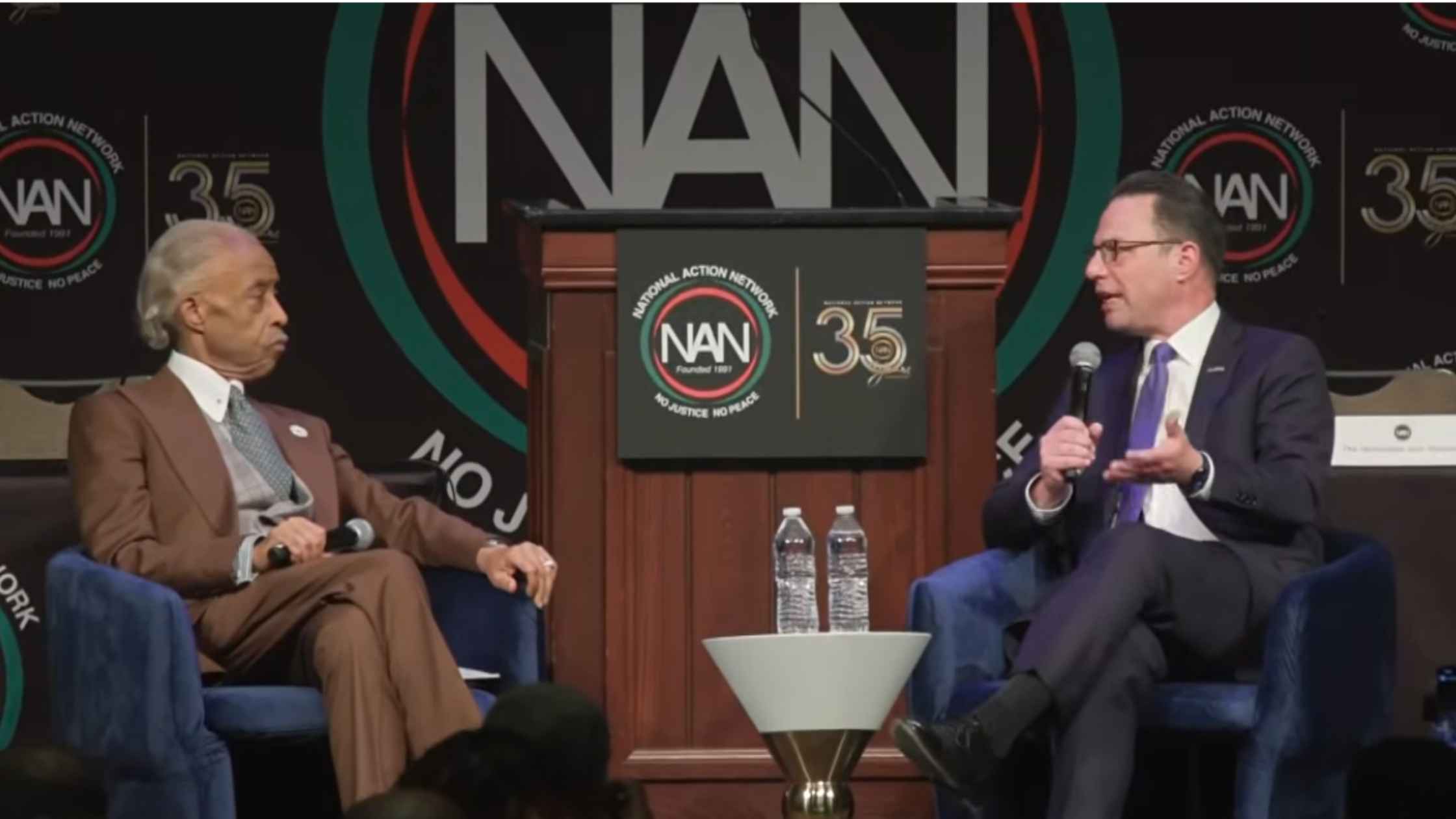
Rev Al Sharpton (00:00):
Shapiro. Thank you. Governor, let me ask you, before I get into Pennsylvania, which you've been governor now and some of the things you're doing there. How do you respond where we are as a country after the situation with Iran last night?
Shapiro (00:28):
Well, first off, I think we have to acknowledge this was a war of choice by the President of the United States. A war I did not support, and a war where the president never came to the American people and said, "This is our objective, or these are our objectives." And if you don't know why you went in, you sure as heck don't know when it's time to come out or how to get out. The president's going to do everything in his power today to spin us and tell us different tales and make up a whole bunch of stuff. But as I look at it, he destroyed a whole lot of innocent lives. The nuclear program that he claimed was destroyed seven or eight months ago. He claimed he had to go back in and address. Unclear whether he did that.
(01:18)
The strait of war moves, which used to be open, which was a key reason why we could keep gas prices low, is now somehow being controlled by the Iranians. Not sure that's a good idea. Certainly not. And then he claimed that he wanted regime change and he went from a 90-year-old dictator to like a 60-year-old dictator. So I'm not sure how any of this is better for any of us. And what it is just the latest example of the kind of chaos Donald Trump brings to everything he touches.
(01:51)
I view all of these issues through the prism of what is in the best interest of America's national security? And the manner in which the President of the United States has gone about this, I think makes us less safe, not more safe.
Rev Al Sharpton (02:05):
How, as governor and your fellow governors, how have you found working with the Trump administration in Washington? When it comes to services, when it comes to the interaction that governors have had with other presidents.
Shapiro (02:21):
Look, I took an oath of office to uphold the Constitution of the United States and the Constitution of the Commonwealth of Pennsylvania. I serve 13 million people, and my job is to try and advance the ball down the field every day, make their lives a little bit better. Their schools better, their safety better, more jobs and economic opportunity. If you go back to the Biden-Harris administration, on a bad day, it was neutral. And on most days, they were there to help us.
(02:51)
On a normal day in the Trump administration, they are taking away people's rights. They are taking away billions of dollars of resources we depend on to educate our kids. To provide healthcare to people, especially in rural communities in my state. I have had to sue this president as governor 23 times. By the way, I've never lost, and we've recovered billions of dollars of funds that they've taken away. And by the way, we've also stood up for our values.
(03:25)
When the Trump administration ripped down signs at Independence Hall in Philadelphia, telling our actual history, the story of slavery. Trying to whitewash what happened in Philadelphia, we joined a lawsuit with our mayor in Philadelphia, Cherelle Parker. We won, those signs are back up. So we will stand up for people's rights. We will bring back the dollars that are taken away from us. And I will never, ever, ever back down to a fight with this administration when it comes to standing up for the people of Pennsylvania.
Rev Al Sharpton (03:59):
That brings me to the climate in the country is polarized. And I think that it is a dangerous environment with that kind of polarization. You and your family suffered a violent situation. First of all, your family, they're fine, everybody.
Shapiro (04:25):
Thank God. Yes. Thank you.
Rev Al Sharpton (04:27):
And how did we get here and how do we come out of this? Because when we see open hostilities, racism, antisemitism, Islamophobia, all at a high pitch. And then you get a president that mocks Muslims on Easter Sunday on a social ... I mean, this is unthinkable. I mean, Southern bigots in the '60s would be blushing at the stuff that he does.
Shapiro (05:03):
So let me address this in two ways. First, if I may, just from a personal perspective and second about where our country is today. First, on a personal level, we're a year from the attack on my family. We had just concluded our communal Passover Seder, just gotten the kids up to sleep. And that's when a person broke into our home threw Molotov cocktails all throughout the governor's residence. Blew up part of the residence. And then was hunting me down with a metal hammer trying to kill me. That person's in jail now for up to 50 years.
(05:43)
And I want to just say on a personal note, I am a prayerful person. Faith has always been central in my life. And I'm not here to preach at anybody or tell you what to believe, but it has always been important to me. Until that moment, I never understood the power of prayer of others to heal me. When I had people reaching out of other faiths, praying for me and my family, that actually connected me in a deeper way to my own faith. And there are people in this room who reached out. You reached out, others did. And I must say that that was healing for our family. We don't have the physical scars of political violence, but certainly it took an emotional toll on our family. And honestly, the hardest thing for me in that process was trying to be a father throughout. Not being a governor, but being a father to our four children.
(06:39)
As it relates to how we got here, Rev, let me just say that part of the reason why tensions are so high, why we're seeing more political violence. We've always had, sadly, political violence in our system, but why we're seeing more of it is because our leaders, in many cases, are failing us. I think the central role for a leader is to keep people safe. And one of the best ways to do that is to speak and act with moral clarity. When you attack people based on what they look like or where they come from, who they love or who they pray to, everyone is less safe.
(07:20)
Folks will say to me all the time, "Gov, we're seeing a rise in antisemitism." And yes, we are empirically. But you know, we're also seeing a rise in Islamophobia and racism and bigotry in all forms. And attacking one person because of what they look like or how they pray makes everyone less safe. The President of the United States has a responsibility to do better. When you tweet like that, not you, but what you referenced the other day, attacking Muslims, making fun of Islam. A beautiful religion, a wonderful faith. What you are really doing is saying, "Those people are okay to attack."
Shapiro (08:00):
You are giving a pass to that. And when you give a pass to that, everyone is less safe. There's more chaos. There's more cruelty in our world. We should have a President of the United States, even if we disagree on healthcare policy or tax policy or whatever, we should at least at baseline have an honorable President of the United States. We do not have that right now.
Rev Al Sharpton (08:25):
You have a motto, GSD, get stuff done. We say GSD in Harlem, but we use the S a little differently. But anyway.
Shapiro (08:38):
In Philly, I use a different S word too.
Audience (08:41):
[inaudible 00:08:42]
Shapiro (08:42):
That's right. We got a few people from Philly here, obviously.
Audience (08:45):
Salem Baptist.
Shapiro (08:46):
There you go.
Audience (08:46):
[inaudible 00:08:50]
Shapiro (08:51):
Everybody from Pennsylvania stand up. There you go.
Rev Al Sharpton (08:55):
Oh, we have a lot of Pennsylvania in the house.
Audience (08:55):
[inaudible 00:09:01]
Rev Al Sharpton (08:55):
All right.
Shapiro (08:55):
Look at that.
Audience (08:55):
Salem Baptist.
Shapiro (09:02):
That's my church. How about that? Pastor Mitchell.
Audience (09:14):
Yes.
Rev Al Sharpton (09:14):
I mean, I don't want to-
Shapiro (09:15):
What, you don't think a Jew can go to a Baptist church? Come on. That's my pastor.
Audience (09:18):
[inaudible 00:09:22]
Rev Al Sharpton (09:22):
All right. If you say so, that's fine. Explain to me what GSD is, and let me come straight at it. What are you getting done in Pennsylvania?
Shapiro (09:35):
Look, GSD is get stuff done. My whole reason for being in this business is that I believe government can be a force for good in people's lives. I was also raised to understand that I have a responsibility to others. My mom, a Philadelphia school teacher, my dad, the local pediatrician, the local baby doc. And my faith teaches me to serve. Part of my scripture teaches me that no one is required to complete the task, but neither are we free to refrain from it. And I think in many ways that's universal. It means each of us has a responsibility to get off the sidelines, get in the game, and to do our part.
(10:19)
So to me, government has to show tangible difference making in people's lives. Whether I'm in a rural community or I'm in Center City, Philly, or downtown Pittsburgh, folks kind of want the same four things, Rev. They want a good school for their kids and grandkids, they want a safe street for that kid to walk down, they want economic opportunity, which means a job in the neighborhood that they want to live in and a neighborhood they can afford to live in. And then fourth and finally, they may not articulate it this way, but they just want their freedoms and their rights protected. They don't want government reaching in and telling them what books their kids are allowed to read or how they are allowed to vote or whether RFK is going to make healthcare decisions for their kids. I want to make healthcare decisions for my kids. And so that GSD mentality is how we approach things. It's why we completely changed the way we fund our public schools, not only increased funding by 30%, but for the first time ever, we drive those dollars out to schools that have been historically disadvantaged.
(11:24)
It's a reason why, yes, we've invested in hiring 2,000 more police officers in Pennsylvania, but also $886 million in church groups and civic groups and other organizations working on violence prevention. And violent crime is down 13%, fatal gun violence is down 43% in Pennsylvania. It's why we're investing in creating jobs. We have the only growing economy in the Northeastern part of the United States, created more jobs than all but two states in the country. And I'm particularly proud that the jobs we're creating have been, in large measure, driven by our investments in historically disadvantaged businesses. We have increased our state procurement in Black-owned businesses by 40% since I took office. That's helping drive our economy. And at the end of the day, we're also treating everyone with respect. We believe everyone deserves opportunity. The federal government is saying certain people don't count. We're putting everybody at the table and lifting up everybody and giving more people an opportunity to succeed. That's what GSD is, the freedom to chart your own course and the opportunity to succeed.
Rev Al Sharpton (12:39):
Let me push you on that because that's part of what National Action Network is about. When you talk about small businesses, clearly we need a lot of social programming, but we also need the ability to be able to do business. Our people in the financial industry's investment, people in private business, how are you working... You alluded to it, but give me a little detail on how you're working with small businesses and even larger businesses that have been excluded? I don't think we are asking for a favor. We're asking to stop the disfavor.
Shapiro (13:17):
It actually goes back to my campaign for governor. It was a priority to make sure that the entity with the most powerful purchasing power in Pennsylvania, the state government, did a better job of giving more people opportunities. It came up when I was interviewing folks to be my lieutenant governor. And I'm proud of the fact that I chose Austin Davis, who was a young state representative at the time and is now our commonwealth's first Black lieutenant governor. And by the way, he always tells me the youngest lieutenant governor in the country. He always rubs that in my face. But we both shared that priority. And then when it was time to govern, the first thing we did was go out to our small businesses, our small diverse businesses and say, "Hey, how come you're not competing for this contract or that procurement?" And you know what they'd say very honestly? We didn't even know it was happening."
(14:09)
And so you would have historically, government would say, "Well, we're going to set aside this many contracts for these small diverse businesses." And then they'd never bid on the work. We decided to look at it a different way. First, I put Austin in charge of the committee that was doing this work together with the head of our Department of General Services, a wonderful Black man, a veteran, someone who has served this country honorably, a gentleman named Reggie McNeil. And we said, "We're not going to create these arbitrary numbers, but what we're going to do is reach out to small diverse businesses, sign them up to be certified in the Commonwealth of Pennsylvania, and then encourage them to bid." Because my view is the more bids you get, the better deal you get for the taxpayers of Pennsylvania and the more opportunity you give to others.
(14:58)
So get this, we've signed up 600 new small businesses to be certified in Pennsylvania. That's a lot. 443 of them are small diverse businesses. They're competing for contracts. They are winning. And by the way, a 40% increase in small, diverse, Black-owned businesses getting work in the Commonwealth of Pennsylvania. It's because we've been focused on it, not because we set some arbitrary number or we created some arbitrary metric. We're just saying we're going to reach out to you. We're going to encourage you to compete. And when you compete, we all win. You get to hire more people in your community. We get a better product for the taxpayers of Pennsylvania, and we're creating more opportunity across the board. It's working what we're doing in Pennsylvania. We're creating more opportunity and we're going to keep at it.
Rev Al Sharpton (15:51):
We've seen one of the linchpins of President Trump's second term as he came in blazing
Rev Al Sharpton (16:00):
... thing about DEI, diversity, equity, and inclusion. And this organization certainly has been dealing with that, reparations, a lot of issues on how you make up the gap. I mean, this wasn't just some gap that was by nature. It was structural legal gap that put certain people behind, Blacks, women, Asians, but blacks from days of slavery onto now, the disparity. If you could address the issue, whether it's called DEI or whatever, but of dealing with making sure that locked out communities are able to be part of the process and try to equalize the disadvantages, what would that be?
Shapiro (16:50):
I refuse to let any Pennsylvanian be scapegoated because of what they look like or how they worship or where they come from. I refuse to allow that to happen. We believe diversity is our strength in the Commonwealth. We continue to have an office of diversity and equity and inclusion. When other states have shuddered them, we continue to do that work. And it's apparent in all of the policies, whether it's driving out billions of dollars to school districts that have historically been left behind, whether it's creating a new small, pardon me, a new historically disadvantaged business fund seated with $60 million to invest in those historically disadvantaged businesses, whether it's trying to write some of the injustices in our criminal justice system by passing sweeping probation reform, by doing double the number of pardons and commutations that my predecessor did three years into my term to give people second chances by making sure that indigent defense is now funded at the state level to ensure that there's more equity and opportunity there. To making sure that the voices I hear when I'm sitting around the table, trying to figure out, do we go this way or that way on a particular issue are diverse voices and voices that have different lived experiences than me and different perspectives than me.
(18:19)
And so it's seeding all of those decisions with those elements of diversity that are critically important to ending up with a better outcome for the people of Pennsylvania.
(18:31)
Look, Rev, when I'm sitting behind my desk, I'm looking up at the portraits of those who came before me. The first guy to lead Pennsylvania back in 1682 was a guy named William Penn. He arrived aboard a ship called Welcome on what is now the banks of Chester, Pennsylvania. And he wanted to establish a place that would be his words, not mine, a model to the nations, a place that would be welcoming for people of all faiths of all different walks of life. And now, 300 plus years later, it's my responsibility to carry that forward.
(19:11)
Now, I want to be clear about something. William Penn never imagined a guy who worships like me serving as governor, and he probably never imagined me sitting in a room full of folks who look like you being integral parts of our politics.
(19:25)
I get that. But I do think what he set in motion, I have a responsibility to carry forward, to build a place that will be welcoming for all. What the President of the United States doesn't understand is when you try to shut certain people out, you make us all less safe. You make the American economy less competitive, and I think you make America less of a beacon of freedom and hope and opportunity to the world. And all three of those things are dangerous, and that's why we've got to reverse what this president is doing.
Rev Al Sharpton (20:03):
You were Attorney General, so you know criminal justice well. You also know some of the problems we've had in criminal justice. This organization has dealt... We just had victims on. What do you see as ways that we need to deal with the accountability of law enforcement, but at the same time, keep crime going down like you've talked about in Pennsylvania, because I think people misconstrue that many of us that are questioning certain police tactics, that we're anti-police? No, we're anti-police brutality. So how do you see the policy that could really serve both? Because we don't want high crime. We don't want police not to police because the high crime areas are in our areas. But at the same time, we don't want to have to run from the cops and the robbers.
Shapiro (21:01):
No, and I think that's a great point. I think that's a great point. And I think it's a nuance that is lost if you're just scrolling through Twitter or you're just watching some news coverage.
(21:19)
I've spent a lot of years listening, not to some of that news coverage or watching Twitter, but actually sitting in the community, listening. And what folks tell me there is exactly what you just said, maybe not as artfully as you said it, but they want police in their community. They want constitutional policing in their community. They want police who look like the community, who understand the responsibility of getting out of their patrol car, walking the beat, and knowing the names of the children in the community. I've worked incredibly hard as attorney general and as governor to build that trust. We spent a lot of time, and I watched your commentary on NBC and elsewhere about what we saw playing out in Minnesota with ICE.
(22:03)
One of the things that I spoke about as it relates to what they were doing, law enforcement was doing in Minnesota is they were eviscerating the number one tool law enforcement has to keep a community safe. And that number one tool is not a gun, it's not a badge, it's not a radio or a patrol car, it's trust. Law enforcement has a responsibility to earn that trust. And when they do, it's the most powerful tool to be able to work with the community as we've done in Pennsylvania-
(22:43)
And we've changed our laws in Pennsylvania to have different review commissions and other steps needed to hold police accountable. And when you talk to police chiefs who are responsible, they also want to be held accountable. They want more training. They want to make sure that there's more opportunities to build that trust with the community. And I've always prouded myself on being a bridge between a community that wants to be safe and also free and with law enforcement who want to go out and do a dangerous job every day, get home to their families and do it in a way that models exemplary behavior. And when those things don't work, we've got to make sure that there's accountability, and we've done that in Pennsylvania.
Rev Al Sharpton (23:26):
I know we're out of time, but let me ask you this.
(23:28)
What do you think that the midterm elections that we're looking at this year, what do you think that the Democratic Party has to do better to appeal to Americans to come out and turn this country away from the kind of presidency that we're dealing with now, at least if the midterms go Democrats way,
Rev Al Sharpton (24:01):
... they have a stop gate with the House if they get it. What should the Democrats be doing more?
Shapiro (24:07):
So I woke up this morning in Pennsylvania, in a few hours I'll be back there. Pennsylvania is the ultimate swing state, the swingiest of all swing states, right? The toughest state to win in and a heck of a tough state to govern in. We've got a divided congressional delegation. I've got a State Senate led by Republicans by two seats and a State House led by Democrats by one seat. One of the only governors in the country with a divided legislature. In these midterms, we've got four competitive US congressional races that I'm going all in on so we can make Hakeem Jeffries the speaker of the House.
(24:47)
And by the way, for those of you in Pennsylvania, I'm running for reelection as governor this year. And I think what we need, not just in competitive swing states, but all across America, Rev, we need a national referendum on Donald Trump and on what is happening in Washington DC. If you don't like what you see on TV, if you are upset and angered, rightfully so, by the chaos and the cruelty and the corruption that we see every day, well, you got to get out and vote.
(25:22)
And even in a state that is a foregone conclusion on how their politics are, they're overwhelmingly Democrat or overwhelmingly Republican, imagine how different it is if instead of 50% or 60% of the public coming out to vote, 90% come out. And send a message and shock the nation about some of these races I believe we are poised to win. We need a national referendum.
(25:50)
To the other part of your question, as it relates to Democrats, I'll tell you what I'm going to do. I'm going to run on that GSD agenda. I'm going to run on how we've made people's lives better, their schools, their safety, their economic opportunity. How we've defended our freedom and how we've defended all people in our state and still managed to create more opportunity. Showing that our diversity is a strength, not a weakness as Donald Trump thinks.
(26:18)
I believe that that GSD approach, showing people that government can make their lives a little bit better, whether they're going down to the DMV or whether they're trying to get their kid the healthcare services that they need. A byproduct of making government work is that that person walks away with their problem solved and maybe, maybe just a little less cynical, a little bit more hopeful.
(26:44)
And with a little bit more hope in our system, Rev, I don't think there's anything that can hold us back. And we can build a real coalition that's not only going to win in 2026, but it's going to give us the momentum to carry us forward as a nation.
Rev Al Sharpton (26:58):
I know we've got to go. But just between you and I, let's forget about 2,000 people.
Shapiro (27:05):
I can't forget about the folks from Pennsylvania.
Rev Al Sharpton (27:08):
All right. Well, just remember them, but just me and you talking.
Shapiro (27:12):
Just you and me.
Rev Al Sharpton (27:12):
Yeah. You're running for reelection and if you are reelected, are you considering running for president in 2018?
Shapiro (27:21):
Just you and me.
Rev Al Sharpton (27:22):
Just me and you. Just between us.
Shapiro (27:25):
Look, we have, I think, some incredibly talented folks in the Democratic Party. And what I think we are poised to do, if we have this national referendum in the midterms, and if people show up in record numbers, we have an opportunity to have a real debate within our party about what we stand for, about what our affirmative vision is. Which can't just be about banging Donald Trump every day. It has to be about what we are going to do to make people's lives better.
(27:58)
And I think that that is a debate that our party hasn't had for a good long while. And that debate is not only going to help the Democratic Party, I think it's going to be healthy for this country. And what I can tell you for sure is that I want to be a part of that debate. Bring the common sense sensibility of what we do in Pennsylvania to that conversation.
(28:18)
As to who's a candidate at the end of the day, that's for another day. But right now, what is critically important is that we have this national referendum in the midterms. And then we have an honest conversation as a party and as a country about what direction we want to go.
(28:32)
Donald Trump has torched our norms, has dismantled most of the federal government, has created chaos every day. What we need to do is not rebuild what was broken down, but build something better. And the way you do that is through calm, through strength, through real dialogue, even with people you don't agree with on every issue, and doing what we do in Pennsylvania every day, which is to find common ground and a path forward. And I'll be a part of that conversation.
Rev Al Sharpton (29:04):
Let me say this. In 2020, we challenged the Democratic candidates to debate in Harlem. For the first time I got them to debate at the Apollo Theater. And they had me ask the first question because I convened it. Then in 2004, I ran. Then 2008, we had all the candidates here, Obama and every ... So this has been a quarter of a century of bringing people forward. What I just heard you say, and maybe I didn't get it right, is that you think that you want to be possibly part of our National Action Network 2028 Democratic Presidential Debate?
Shapiro (29:50):
I don't know that I said that.
Rev Al Sharpton (29:51):
But you didn't deny it either.
Shapiro (29:53):
I don't know that I said that. Here's what I will say.
Rev Al Sharpton (29:55):
You didn't deny it.
Shapiro (29:56):
I'm not showing up in any room where anybody's wearing a Knicks jersey, okay? So I know I just lost half the room, but next time I show up, I'll be in my Sixers hoodie and we'll have a conversation. Thanks, Rev.
Rev Al Sharpton (30:13):
All right. Governor Josh Shapiro, thank you.
Shapiro (30:16):
Appreciate it. Thank you.
Rev Al Sharpton (30:16):
All right. Thank you. Give him a hand.