


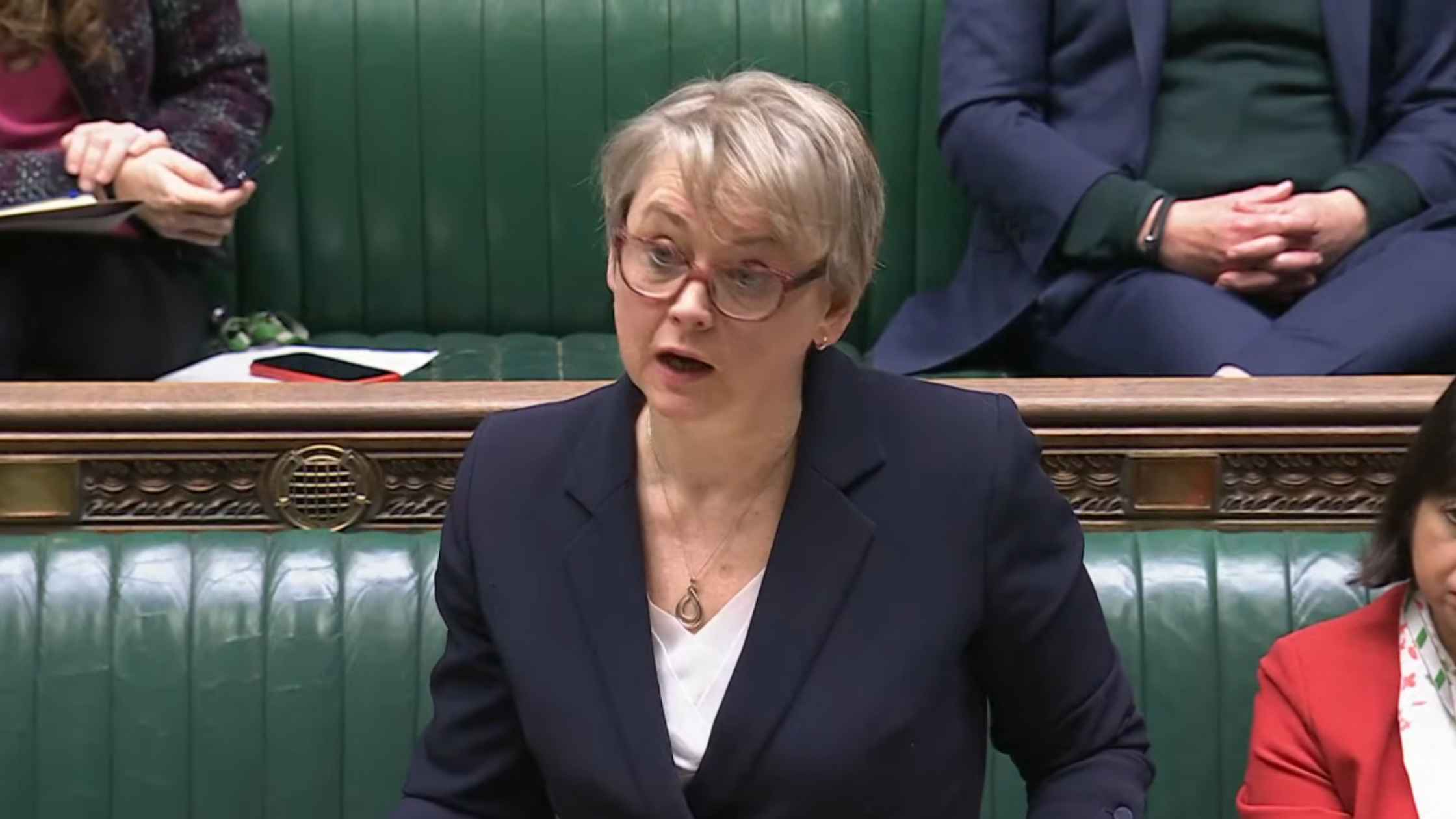
Yvette Cooper (00:00):
For properly supporting UK security and for the US, the most successful state visit leading to major tech investment in the UK with the UK prime minister who talks frequently to the US and deep partnerships on security, intelligence, and the military and are close working now on Gaza, on the peace process, on the crisis in Sudan, and of course, fundamentally on Ukraine.
(00:27)
Many times in the past, we took a cross-party approach. I would just expect her to do the same on the matters that really about the future of this country. This government will continue to stand up for Britain's interests, for our prosperity, and for our values.
Caroline Nokes (00:45):
Chair of the Foreign Affairs Committee, Emily Thornberry.
Yvette Cooper (00:48):
Thank you very much.
Emily Thornberry (00:48):
Good afternoon, Speaker. If a large and powerful country abducts the leader of another, however abhorrent that leader is, and then tries to intimidate the smaller country in order, it says itself, to gain access to its resources, doesn't the foreign secretary agree that this should be called out? Not just by Britain but by our Western allies. We should be calling it out for what it is. A breach of international law.
(01:17)
It is not for the country that is breaking the law to say whether or not it has broken the law. It is for the West, surely, to stand up and say, "Call it as it is." Doesn't she therefore share my concern that there might be a profound risk of international norms changing? If we don't do that, it may become okay. And that is a risk that we then risk living in a world where might is right. And surely that isn't in Britain's interests.
Yvette Cooper (01:49):
Secretary, can I just thank my honorable right honorable end for her question and also recognize that she has been consistent in her opposition to the Maduro regime even when she was under pressure not to be through many years. And I know that she and I would probably agree that a man who is currently being investigated for crimes against humanity and who has such a history of political repression as well as economic destruction and corruption should not be leading a country.
(02:24)
And she rightly refers to the issues around international law. And I've set out our commitment to international law, and she will know that my predecessor, as foreign secretary talked about, progressive realism where we set out the progressive principles we follow, how important international law is, because of the framework that it sets that is in our interests, not just reflecting our values but also that we engage with the world with the way it is. And I can assure her that as part of that, I have raised this issue of international law with Secretary of State Rubio and made clear that we will continue to urge all countries to follow it.
Caroline Nokes (03:04):
Please with the liberal Democrats, Edward Davey.
Edward Davey (03:07):
Thank you, Madam Deputy Speaker. Can I associate myself and my party with the comments from the foreign secretary about the tragedy in Crans-Montana? Madam Speaker, when President Reagan invaded Grenada, Margaret Thatcher said this. "We in the Western democracies use our force to defend our way of life. We do not use it to walk into other people's countries. We try to extend our beliefs not by force but by persuasion."
(03:37)
I'm disappointed that we've heard nothing as clear and courageous from either Prime Minister or the Foreign Secretary or today's Conservative Party. Maduro is a brutal, illegitimate dictator, but that does not give President Trump a free pass for illegal action. This wasn't about liberating the Venezuelan people. Trump's refusal to back Nobel Prize winner Maria Machado, Maduro's brave liberal opponent, shows Trump has no interest in Venezuelan democracy. This is about Trump believing he can grab anything he wants and get away with it. This time, oil.
(04:17)
We know what happens when an American president launches an illegal war under the pretext of an imminent threat. It's why we oppose the Iraq war and why we condemn Trump today. National sovereignty matters. International law matters. Without them, the world is far more dangerous, and we are all less safe.
(04:43)
Anyone who thinks Trump's actions will make China or Russia think twice is either hopelessly desperate or desperately naive. Putin and Xi will be using this president to strengthen their hands in Ukraine and Taiwan. And Madam Deputy Speaker, anyone who thinks Trump will stop with Venezuela hasn't read his new national security strategy. He's already threatening Columbia, Cuba, and Greenland, even democracies across Europe. Does the foreign secretary not realize how ridiculous it looks to refuse to call this what it is, a clear breach of international law?
(05:25)
Will she at least publish all the advice the government has received on the legality of Trump's actions?
Caroline Nokes (05:34):
Secretary.
Yvette Cooper (05:37):
Well, let me say to the honorable gentlemen that we do, I hope, agree on the brutality of the Maduro dictatorship. And also, I would hope that Venezuela has … It is better for Venezuela not to be led by somebody like Maduro. And therefore, the most important thing now for Venezuela is for it to have a transition to democracy. And I have spoken directly to the US Secretary of State about that and also about the potential role that the UK can play in that because, unusually, we have a very senior and experienced charge de faire in Venezuela who has longstanding relationships with the Venezuelan opposition, with the regime, and also, of course, we have the close relationship with the US. That puts us in a particular position and gives us a particular responsibility in order to keep progress being made toward that democratic transition because stability will not be maintained unless there is a transition that is in the will of the people.
(06:45)
We say to him just in terms of international law, again, we have made very clear that our commitment to international law and the way that it must guide our decisions in UK foreign policy, and we will continue to raise it with our partners, both in public and in private, it is important that we do so. And as for the issue on government legal advice, he will know that the ministerial code is very clear about government not either publishing or commenting on different illegal advice.
Caroline Nokes (07:20):
Diane Abbott.
Diane Abbott (07:22):
Nobody in this chamber wants to defend the regime of Maduro, but what some of us want to do is to stand up for the importance of a rules-based international order.
(07:42)
And I might add, because my parents were born overseas, I take the question of national sovereignty extremely seriously, and you cannot have a situation where a country, because it is bigger and stronger, walks into a smaller country, snatches its political leadership, whatever you think of that political leadership, but snatches its political leadership, helicopters it out, and puts it on a show trial in an outside country. That cannot be something which this government is prepared to support.
(08:24)
And let me add, I know that the opposition are blithe about what Trump is doing. Blithe. Blithe.
(08:44)
I know the opposition are blithe about what Trump is doing, but let me say this. There will be countries that will look at Trump's attitude and carelessness to issues of sovereignty, and they will think, what happens if they have that threat? Who will be willing to stand up for them? Who will be willing to stand up for their national sovereignty? As far as I have heard thus far, it won't necessarily be our ministers. And there will be individuals-
Caroline Nokes (09:26):
Order. Order. The right honorable lady must get to a question shortly, please.
Diane Abbott (09:32):
Questionnaires. What would the foreign secretary say to British voters, ordinary British voters, not particularly left-wing British voters, that do not understand why a British prime minister is not willing to stand up for an international rules-based order and is not willing to defend national sovereignty?
Yvette Cooper (10:00):
Well, what I would say to my right honorable friend is that the support for a rules-based international order and for international law is a central part of our foreign policy and the decisions that the UK government makes and the actions that we take. There is an approach which says that, look, this is a new world of great power, politics, and spheres of influence and which rejects the role for the international law. That is not our view, not only because we believe it is right, it is part of our values and part of our progressive values, but also because it is in UK interests as well to do so. It's why we believe not just in the UN charter but also more broadly in international law and a rules-based framework as well. But it's also why we believe in rules-based alliances and the maintenance of those alliances.
(10:54)
And contrary to the approach of the sort of great power strategic hemispheres, we believe in the Transatlantic Alliance and the NATO alliance. That is why we're taking such a strong position on Greenland and Denmark, but it is also why we work with close allies and talk to them on many issues privately as well as publicly.
Caroline Nokes (11:15):
Father of the House, Sir Edward Leigh.
Sir Edward Leigh (11:19):
At the end of the foreign secretary's statement, I'm no wiser as to whether the government approves this action and believes or does not believe that whether it breaks international law. Now, the prime minister is such a devotee of international law. He's not prepared to defend our own borders from the small boats and take necessary action.
(11:40)
Why is it that there's one law for the American president doing what is right for his country and defending his country, but there's a different law from us? The simple question is, does the government believe this breaks international law? Does it approve this action?
Caroline Nokes (11:55):
Foreign Secretary.
Yvette Cooper (11:56):
Well, I think, as I said in my statement, as the Prime Minister said on Saturday, there can be no tears shed for the Maduro regime and the damage that it has done over many years. It is for the US to set out the legal position behind their actions. We were not involved in those actions. We continue to be guided by international law in our approach, and we continue to work now for the most important issue to get transitioned to peaceful democracy in Venezuela.
Caroline Nokes (12:32):
Richard Burgon.
Richard Burgon (12:34):
Thank you, Madam Deputy Speaker. It was the prime minister that decided to disregard the United Nations Charter when it came to Trump's bombing, killing, and kidnapping of the head of states. I think it speaks volumes that the Prime Minister has chosen not to come to this House to explain his decision. The reality is this. If it were Putin doing this, the Prime Minister would not be saying, "Oh, it's up to the Russians to decide whether or not this is legal." But this is exactly what the Prime Minister said in relation to Trump's disgusting attack on Venezuela.
(13:18)
Isn't the reality that the Prime Minister is willing to ditch international law and sidestep the United Nations Charter in order to appease Donald Trump? And doesn't this cowardly, craven approach drag this country's reputation through the dirt?
Caroline Nokes (13:37):
Secretary.
Yvette Cooper (13:39):
Well, I just say to the honorable member I do find it hard to not remember his support and welcoming for the Maduro regime, a regime which is currently being investigated for crimes against humanity.
Caroline Nokes (14:05):
Sir Jeremy Hunt.
Sir Jeremy Hunt (14:10):
Most people's view of Maduro's capture will be, "Good riddance," and I would have liked the government to be more categoric in supporting US action in removing an illegitimate and evil dictator. But, if the new US approach extends to the annexation of Greenland, the sovereign territory of a NATO member, it could mean the end of the alliance with disastrous consequences.
(14:34)
How much planning is going on at the foreign office to actually make sure such a disaster doesn't happen? We understand the discussions between allies have to be in private, but what it looks like from the outside is that Europe is weak and divided. Can she reassure the House the right conversations are happening and we are not just hoping for the best?
Caroline Nokes (14:56):
Foreign secretary.
Yvette Cooper (14:57):
Well, let me just reiterate our strong support for the Greenlanders and for Denmark. Greenland is part of the kingdom of Denmark, and it is the future for Greenland is for them to decide, not for anybody else, notwithstanding any of the things that we have heard the US say or others say as well. We are very clear about that, and I have raised this issue internationally, and we will continue to do so, but we are very firm in our view on this point.
Caroline Nokes (15:27):
Phil Brickell.
Phil Brickell (15:28):
Thank you, Madam Deputy Speaker. My constituents don't mourn the removal of Nicholas Maduro who oversaw violent repression of his own people, a fraudulent presidential election, and horrific human rights abuses for many years, but they are alarmed about the unilateral regime change sought by the Trump administration in order to access Venezuelan oil resources. Two wrongs don't make a right.
(15:50)
What measures is the foreign secretary taking to support opposition leaders, including 2025 Nobel Prize winner, Maria Corina Machado?
Yvette Cooper (16:00):
As a result of the work of our charge de faire and the work of our embassy in Venezuela, that we have maintained when other countries have not. As I have said, that does put us in a particularly significant position in terms of being able to support a transition to democracy. That is what we have always argued for. To get that transition to democracy. It is exactly why I have spoken to Maria Corina today and why we will keep in close touch in order to be able to recognize their call as a first step for the end to political repression in Venezuela. That must happen.
Caroline Nokes (16:39):
Edward Morello.
Edward Morello (16:42):
I will not mourn the passing of the Maduro regime, but I will mourn the passing of the rules-based international order. If we accept the premise that a big-power country can do what it want without any ramifications anywhere in the world, then we accept the behavior of Putin over the last few decades and the behavior of Xi Jinping in the future. We cannot allow it to stand. And it is clear that our future security lies with closer cooperation with our European allies.
(17:13)
What is she doing to ensure that the UK stands in lockstep with those people that do share our values?
Caroline Nokes (17:17):
Foreign secretary.
Yvette Cooper (17:22):
Well, we have strengthened our relationship with our European partners. Indeed, I've been in touch with the Danish foreign minister today exactly on the issue around Greenland. And we will continue to support the rules-based international order but also the UN charter and international law. But all I would just say to him is I really would warn members against making equivalence here around what Putin has done in Ukraine where thousands of children have been kidnapped, where they have invaded a country led by a democratically elected President Zelenskyy. We should be careful about recognizing what we say and the implications of it.
Caroline Nokes (18:03):
Dan Carden.
Dan Carden (18:05):
Thank you, Madam Deputy Speaker. I welcome the foreign secretary statements in what is an incredibly complex international situation. Maduro stole elections, murdered opponents, and nine million Venezuelans were forced to flee their country. Venezuelans will be both fearful and hopeful for the future, but this episode shows the US shift to the Western hemisphere, leaving European security more exposed and US willingness to interfere in foreign states with serious implications for our NATO ally, Denmark.
(18:41)
Does she agree what the UK can now usefully do is use any influence we have to pursue a transition to democracy for Venezuela and to learn from this event, accelerating our UK defense and national security commitments?
Caroline Nokes (18:57):
Foreign Secretary.
Yvette Cooper (18:59):
My honorable friend is exactly right about both the fear and hope felt by many people in Venezuela. That is the views that we have had reflected back to us as well over the weekend too. And that is why we are certainly doing everything we can in the unusual position that we are in, given our experience and relationships, in order to promote and support that transition to a democracy. I do also agree with him about the importance of us increasing our defense investment. It is why we have now the biggest increase in defense investments since the end of the Cold War.
Caroline Nokes (19:35):
Sir John Whittingdale.
Sir John Whittingdale (19:37):
Thank you, Madam Deputy Speaker. The Maduro and Chavez regime was characterized by widespread human rights abuse, criminality, and economic destitution, and many Venezuelans are rightfully and understandably celebrating its end. But I have to say to the foreign secretary that after over half an hour, it is still not clear whether the UK government actually agrees with what has been done. She referred to the discussion taking place in the UN Security Council at the moment.
(20:05)
Can she say what the position of the UK will be at that meeting?
Caroline Nokes (20:10):
Foreign Secretary.
Yvette Cooper (20:12):
Well, I set out our position at the beginning of a statement, which is that we supported and have long supported a peaceful transition to a democracy from an authoritarian regime. We shed no tears for the removal of Maduro, but we also want to see the establishment of a democracy and a transition, a peaceful transition, to a democracy which we do not yet have in Venezuela. That is what we will work toward, and we will always argue for the upholding of international law.
Caroline Nokes (20:49):
Members will be aware that there are very many of you wishing to contribute to this statement. There's another statement to come and an important debate later. Please, can I encourage you to make questions short? Tan Singh Dhesi.
Tan Singh Dhesi (21:02):
Thank you very, Madam Deputy Speaker. Whether it's Venezuela, Greenland, Ukraine, Palestine, or Taiwan, the UK government is right to champion international rule, but we must face facts. The global rules-based order is crumbling before our eyes as increasingly nations disregard those rules and national interest, Trump's longstanding alliances. And in this new era of strongman politics, whether we like it or not, military strength is the ultimate guarantor of our security and sovereignty.
(21:39)
Secretary of State, what steps are the government taking to accelerate investment in defense and send a clear signal so that we are respected by both friend and foe globally?
Caroline Nokes (21:51):
Foreign Secretary.
Yvette Cooper (21:53):
Well, Margaret is right to say, and I said in a speech just before Christmas, that the global rules-based order is under pressure from different directions. However, we believe it remains important. It is particularly important, and it is in our interests and the nature of our country and history. It is in our interest, but it is also a fundamental part of our values. And we believe that the international law and rules-based order are fundamentally a foundation for peace and security across the world. We do have to engage with the world as we find it, not as we would like it to be. That does mean continuing to advocate for international law, both with people right across the world, including directly with our allies, but it also means increasing our investment in defense because, fundamentally, protecting our national security has to be the most important priority for government.
Caroline Nokes (22:54):
Tom Tugendhat.
Tom Tugendhat (22:55):
Thank you, Madam Deputy Speaker. Surely the real story coming out today and over the last few days is the revelation that we should all have known that this country has opted out of protecting in the international rules-based system. We have not significantly invested in defense, and even the commitment that the Foreign Secretary speaks of does not keep pace with defense inflation. Doesn't this really reveal a simple truth that, as the Prime Minister revealed on Sunday, he hasn't even spoken to the American president? The Americans did it without us because the Americans don't give a damn what this house thinks.
Caroline Nokes (23:33):
Foreign Secretary.
Yvette Cooper (23:35):
I guess I would just have to ask, who was it who didn't significantly invest in defense over the last 14 years? It's this government which is substantially increasing investment in defense and also chairing the coalition of the willing and also sharing leadership on the international stage as well. And what has struck me becoming foreign secretary and having discussions with governments all across the world over the last few months is how much those governments are saying how welcome it is that Britain is back.
Caroline Nokes (24:12):
Nick Smith.
Nick Smith (24:15):
Madam Deputy Speaker, Maduro was an illegitimate president. From Caracas in the New York Times today, Colette Capriles describes a struggle for survival, a primitive capitalism, a web of bosses, private loyalties, corrupt practices, and institutional ruins that replaced public life in Venezuela.
(24:40)
Can I ask the foreign secretary, what can the UK do to support the development of strong civic institutions there that can help build a new Venezuela?
Caroline Nokes (24:50):
Foreign Secretary.
Yvette Cooper (24:52):
My honorable friend is exactly right because, look, there is a risk, a real risk, of instability in Venezuela now. And building civil society, giving people in Venezuela the hope rather than the fear now, ensuring there is stability, but also building up capacity. Working with opposition parties and with other organizations is now going to be crucial. That is something we are strongly advocating for. It is something that I have discussed with the US Secretary of State and said that we will continue to make a priority based on the work that our excellent charge de faire has been doing over many years, but now we need to do it extensively, including in discussion with opposition parties.
Caroline Nokes (25:34):
Pete Wishart.
Pete Wishart (25:35):
It's hard to find an occasion when a British Prime Minister has looked so irrelevant and spineless on an era defining international issue as this one does on this occasion. We are witnessing an existential threat to the international rules-based order, and the prime minister can't even rouse himself to give it even the meekest of defenses. France, Spain, Brazil, Mexico, and the UN Secretary General have all been clear that the Trump administration has violated international law.
(26:09)
When will the prime minister and the foreign secretary find their voices and join that chorus of condemnation?
Caroline Nokes (26:17):
Foreign Secretary.
Yvette Cooper (26:18):
Well, what I would say is the prime minister's response has been very much in line with the leaders of countries, not just across Europe but across the world as well. And we continue to stand up for and highlight the importance of international law but also to focus on the realities in Venezuela where there has been huge damage done over a long time, including with the interference by Iran and by Russia in Venezuela as well and to focus on what should be all of our priorities now which is getting a democratic transition for Venezuela.
Caroline Nokes (26:54):
Lizzi Collinge.
Lizzi Collinge (26:55):
Thank you, Madam Deputy Speaker. We speak today from the heart of our democracy where power transfers peacefully according to the will of the people. I thank the Foreign Secretary for her statement. And does she agree with me that democracy is the right of all people, no matter where they live? And does she further agree with me that it's for Venezuelans to decide what their future holds?
Caroline Nokes (27:17):
Foreign Secretary.
Yvette Cooper (27:18):
I completely agree with my honorable friend, and the people of Venezuela have been denied that democratic right for far too long. Election results have not been respected, and they have faced some of the most horrendous political repression, including on an industrial scale. The July 2024 elections were clearly not respected, and the official results were never published. That is why we continue to work to talk to the opposition parties and also to talk to others in Venezuela.
Speaker 1 (27:55):
Of course, Madam Deputy Speaker, quite a lot depends on what now happens, but Mr. Maduro stole the elections in Venezuela in plain sight. He is a narco terrorist and has destroyed the lives of tens of thousands of American citizens and more widely and made huge amounts of money out of it.
(28:17)
Isn't the world a better place with him before the courts in New York? And in this case, do not the ends justify the means?
Caroline Nokes (28:25):
Foreign Secretary.
Yvette Cooper (28:32):
I think that Venezuela is in a stronger position without Maduro leading them, especially given the horrendous human rights abuses, the huge damage to their economy as well, but he said at the beginning … The implication from what he said was that this is important about what happens next. And what happens next really does matter. And that is where the UK is determined to do everything we can to make sure that that is a transition to a democracy and to stability as well because I don't think Venezuela will have stability without a proper democratic transition.
Caroline Nokes (29:11):
John McDonnell.
John McDonnell (29:15):
The Secretary of State has said that the role of the government has been to uphold international law. Part of upholding international law is to call out crimes when they're witnessed. And what we've seen here, the Article 2.4 of the United Nations Charter is very explicit about the illegality of entering into a foreign state with armed force. And that's why I have to say I found it shameful that the prime minister and ministers today in the news rounds have refused to condemn this action because, in not condemning the action, I think Trump will interpret that as the green light to go in wherever to steal the national assets of those countries. And as a result of that, we're all in a more dangerous place.
Yvette Cooper (30:08):
Well, what I would say to my honorable friend is the importance of promoting international law in the most effective way also means promoting the rules-based order and the rules-based alliances that we have. It means being able to raise issues around international law, both publicly and privately, in a way that has the greatest results to defend the rules-based order. That is what we will continue to do, and that frankly is what is in the UK's interest.
Caroline Nokes (30:40):
Alicia Kearns.
Alicia Kearns (30:42):
Thank you very much, Speaker. Venezuelans are relieved to be free of Maduro tyranny. However, Venezuela risks remaining a failed state rather than a free state unless the international community comes together. Oil companies are not state builders, nor are they capable of democratic capacity building or enabling political transitions. I was surprised there's no mention in the foreign secretary's statement of plans to evacuate British nationals if possible, nor how many British nationals are in country. I also asked what phone calls the foreign secretary has had since this action with the leader of Commonwealth country and nation Guyana, to whom we have an important relationship. And if she hasn't spoken to that leader, why?
Caroline Nokes (31:19):
Foreign Secretary.
Yvette Cooper (31:21):
As they set out, I think, in my statement, there are estimated 500 British nationals in Venezuela. We did look at all necessary possible crisis responses over the weekend. We stood up the crisis facility in the foreign office to ensure that we were ready to respond if necessary at any point. It did not go beyond the response that we did put out around changing travel advice. And over the weekend, British nationals were advised to shelter in place while it was assessed what might be happening next. We have had some consular contact, but it has been very limited, and we have obviously been available to any British nationals who want our support, as we would continue to be.
(32:05)
We are also in contact with Commonwealth countries and also with overseas territories. In particular, my honorable friend is following up with overseas territories who are particularly affected by instability in the region.
Caroline Nokes (32:19):
Rachel Blake.
Rachel Blake (32:20):
Thank you, Madam Deputy Speaker. I'm grateful for the foreign secretary's remarks. And she's talked about instability in the region and the need for grassroots investment in order for there to be a peaceful transition. Can she share with us the assessment that she's made about the impact of economic instability in the region and the role of businesses in the region and how that instability could feed into and damage the possibility of a peaceful transition?
Caroline Nokes (32:48):
Secretary.
Yvette Cooper (32:48):
My honorable friend is exactly right because the nature of the economic crisis in Venezuela over the last decade has pushed huge numbers of Venezuelans into extreme hardship. It is one of the reasons why so many Venezuelans have left the country, and estimated one in four Venezuelans have left the country over the last 10 years as a result. And this should be a country with a strong economy. It is very important to build that up, but crucially, that has to be to the benefit of the people of Venezuela, not to the benefit of criminals or corrupt regimes.
Caroline Nokes (33:24):
Richard Foord.
Richard Foord (33:26):
Madam Deputy Speaker. This is about being principled. What if we were to learn from the White House that Greenland had been the source of cocaine or fentanyl flowing to the United States? Even if we don't expect a fabricated pretext on Greenland or imminent US intervention there, will the government please condemn the unilateral action in Venezuela by the Trump administration before we see a complete breakdown of the rules-based order?
Caroline Nokes (33:52):
Secretary.
Yvette Cooper (33:53):
Well, I think you will have heard in my statement me setting out very strongly our position on Greenland, on Denmark, and we will continue to do so because we are very clear this is about the NATO Alliance, this is about the rules-based order, and this is about our close ally.
Caroline Nokes (34:13):
Andy Slaughter.
Andy Slaughter (34:14):
Thank you, Madam Deputy Speaker. I welcome the foreign secretary's statement that she will abide by international law, and I would not expect her to publish the legal advice she's received from the law offices and others, but I would expect her to set out the government's own analysis of whether and how the acts of US forces toward Venezuela comply with the rule of law. Will she now do that?
Yvette Cooper (34:40):
Well, as you'll know, honorable friend will obviously know the constraints in the ministerial code in terms of discussing the legal advice. We, as I said, have set out that it is obviously for the US to set out publicly their legal basis for the actions that they have taken. We have raised the issue of international law.
Yvette Cooper (35:00):
Well, I have directly raised that with the US Secretary of State, set out our views and our concerns, and the importance of urging all partners to abide by international law.
Madam Deputy Speaker (35:11):
Simon Hoare.
Simon Hoare (35:12):
Thank you, Madam Deputy Speaker. The essay question is not whether Mr. Maduro was a good man. That is a clear no-brainer. The essay question here, as others have asked, is whether the actions of the US president were legal, and America cannot be expected to mark her own homework. So, two questions to the Foreign Secretary, if I may. The first is, what body or bodies would she identify as being the responsible body to adjudicate on the legality of the American action? And secondly, the Vice President of Venezuela has this afternoon been sworn in as the new President. Her hands are as tainted with the previous regime as Maduro. What read across should this House have from that incident?
Madam Deputy Speaker (36:02):
Foreign Secretary.
Yvette Cooper (36:03):
Well, the UN Security Council has been discussing the issue about Venezuela today, and I'm sure those international discussions will continue. On the issue of the Vice President being sworn in, we continue not to recognize the legitimacy of the Venezuelan regime. We do want to see stability and a transition to democracy, and we are urging the Vice President to take now the steps for that transition and to a democracy that respects the will and the human rights of the Venezuelan people.
Madam Deputy Speaker (36:38):
Perran Moon.
Perran Moon (36:39):
[inaudible 00:36:39], Madam Deputy Speaker, I accept that Venezuela is a brutal and failed and highly dangerous state. But across Eastern Europe, the implications of this action will be deeply destabilizing. Can I ask the Foreign Secretary in her discussions with the US Secretary of State, when she mentioned international law with him, did she reference the message that this action sends to Putin and Russia's ambitions in Europe?
Madam Deputy Speaker (37:10):
Foreign Secretary.
Yvette Cooper (37:11):
Well, what my old friend will know is that we continually discuss the threat from Russia and the importance of the Transatlantic Alliance supporting Ukraine with the US, and I have discussed that many times with the US Secretary of State. The Prime Minister has discussed that continually with the US President, and we are clear about the importance of defending Ukraine. The Prime Minister will tomorrow be part of the Coalition of the Willing, which is exactly about supporting Ukraine, and we have to ensure that as we build those international alliances, we do so in the most effective way to support Ukraine. I can also assure him that I raise the issue of international law and the concerns that we have with the US Secretary of State.
Madam Deputy Speaker (37:59):
Gavin Robinson.
Gavin Robinson (38:00):
Thank you very much, Madam Deputy Speaker. I think it's clear that the Foreign Secretary supports the end, if not the means. And I think it is clear that she accepts the outcome, though she can't bring herself nor the government to condone the actions of President Trump. But today, we learned that the Chinese have warned against both touching the oil resources of Venezuela, and also demanded the return of President Maduro. Does she see that as saber-rattling or is she concerned?
Madam Deputy Speaker (38:31):
Foreign Secretary.
Yvette Cooper (38:33):
Well, what I'll say is that I know that there have been many concerns about the engagement, particularly as well of Iran and Russia in the oil industry in Venezuela, and he referred to issues around China and the position of the Chinese government. What I would just say is I think the oil industry in Venezuela should be benefiting the people of Venezuela, not other countries, not corrupt regimes, but actually, the people of Venezuela.
Madam Deputy Speaker (39:12):
Stella Creasy.
Stella Creasy (39:13):
Thank you, Madam Deputy Speaker. The truth is, the warning signs that the rules-based order is at risk have been there for some time. In her evidence to the Congress during the impeachment inquiry into President Trump, the former White House Advisor on Russia and Europe, Fiona Hill, claimed that an informal offer was made by Russia to withdraw their support for Venezuela in exchange for America withdrawing its support for the Ukraine. In the light of these events, will the Foreign Secretary confirm in her conversations with our American counterparts that this specific allegation has been raised, and what response she had?
Madam Deputy Speaker (39:50):
Foreign Secretary.
Yvette Cooper (39:51):
Well, I think we continue to have very important discussions with the US about Ukraine and about support for Ukraine. And many of those discussions have been about the security guarantees that the US would provide as part of a peace agreement for Ukraine. Those security guarantees involve the US providing that support, working with other European countries. That will continue to be a central objective of our foreign policy now.
Madam Deputy Speaker (40:25):
Sir Bernard Jenkin.
Sir Bernard Jenkin (40:27):
Thank you, Madam Deputy Speaker. To those who still harbor illusions about an idealized world of international rules which will be abided by all, shouldn't we just say, "Well, welcome to the real world," where Mike very often proves to be right, and we have to face the circumstances that we are in. Can I therefore give my support to the government's ambivalence, as supported by my right honorable friend, who I think also rightly criticized the slow pace of rearmament, and that's all she disagreed with the government about. But can she now avoid blowing the bridges that we have with the United States, and use that influence? And doesn't she agree it really would be stupid to slag off President Trump now when we want to have influence over what he does next?
Madam Deputy Speaker (41:26):
Foreign Secretary.
Yvette Cooper (41:28):
Well, and I need to address some of the bigger points that he's raising about the international rules-based order and the sort of global power of politics. We obviously, and he and I are old enough to have the experience and reflections on the Cold War, which was all about the great power, politics and the difficulties also at a time when post the Second World War, we had worked hard to develop a rules-based order alongside those big military global tensions. So, this has been a part of global history for a long time. The tensions between how you maintain an international law and an international rules-based order, and also how you engage with the different competing interests sometimes from some of the biggest countries in the world, sometimes from some of the smaller countries in the world who have particular power in particular areas.
(42:22)
In terms of the UK's approach, we continue to believe in the importance of a rules-based order and the importance of that kind of international framework. We also engage with the world as it is, the world as we face it, and we need to be able to do so and to be agile in responding to that.
Madam Deputy Speaker (42:39):
Imran Hussain.
Imran Hussain (42:41):
Thank you, Madam Deputy Speaker. Regardless of what is said in this place, it is clear for all to see that Trump's illegal actions in Venezuela are a blatant violation of international law, and now he has Greenland clearly in his sight.
(43:02)
And frankly, the response from the international community and our own government has been shameful. How can we pretend to defend international law, but actually, how can we pretend to defend international law when we refuse to even condemn the most blatant of violations and do not apply it equally? The reality is, we are sending a green light that the international rules no longer apply. And let's call this what this is. Trump's actions are not about democracy. It's about oil and old-fashioned colonialism.
(43:46)
So, I give the Foreign Secretary the opportunity again. If she truly believes and wants to stand up for international law, she should stand up on that despatch box and condemn these illegal actions. And if she does not, then she should admit-
Madam Deputy Speaker (44:00):
[inaudible 00:44:01].
Imran Hussain (44:00):
[inaudible 00:44:01].
Madam Deputy Speaker (44:00):
I think we've got the gist. We really do need to have shorter questions or everyone is simply not going to get in. Foreign Secretary.
Yvette Cooper (44:13):
Yeah. I would just remind the Honorable Member, the Maduro regime was a deeply authoritarian and corrupt regime, which allowed countries like Russia and Iran and Hezbollah to intervene to increase their influence in that country. We should not shed a tear for the end of the Maduro regime. What we should do is work for democracy. That is in our values, that is what we will continue to do, and we will also continue to stand up for international law.
Madam Deputy Speaker (44:41):
Alistair Carmichael.
Alistair Carmichael (44:44):
Thank you, Madam Deputy Speaker. Last time I saw this degree of agreement between the government and opposition front ventures in relation to foreign policy was in the run-up to the war in Iraq.
Audience (44:52):
Amen, [inaudible 00:44:53].
Alistair Carmichael (44:52):
And we all know how that ended. But can I welcome what the Foreign Secretary says about being clear that the leadership of Venezuela must reflect the will of the Venezuelan people. So, when she spoke to Secretary Rubio, did she condemn President Trump's assertion that he should run Venezuela for the foreseeable future?
Audience (45:12):
Hear, hear.
Madam Deputy Speaker (45:12):
Foreign Secretary.
Yvette Cooper (45:14):
Well, I think what we've seen happen in practice is obviously the US do not have boots on the ground in Venezuela, and the Vice President has been sworn in. We are continuing not to recognize the Vice President as a legitimate regime in Venezuela, and continuing to press for a democratic transition. I discussed with the US Secretary of State the importance of a democratic transition, the importance of working with the opposition, and also the role that the UK could play in doing that, because I think ultimately, this has to be about making sure that the will of the Venezuelan people is respected.
Madam Deputy Speaker (45:56):
Sonia Kumar.
Sonia Kumar (45:57):
Thank you, Madam Deputy Speaker. United Nations Charter States Article 2.4, "All members shall refrain in the international relations from the threat or use of force against territorial integrity or political independence of any state." Does the Secretary of State agree that even when a president lacks democratic legitimacy, any peaceful transition in Venezuela must be in the hands of their people and not dictated by foreign governments who must follow international law.
Audience (46:29):
Hear, hear.
Yvette Cooper (46:31):
I think that peaceful transition is essential, and it has to be to democracy and it has to be about reflecting the will of the Venezuelan people. That is why I have spoken today to Maria Corina Machado, and that is what we will continue to press for and our embassy in Caracas will continue to press for.
Madam Deputy Speaker (46:53):
Dr. Andrew Murrison.
Andrew Murrison (46:54):
Will the government use any influence its silenced on Venezuela is buying to impress on President Trump that whilst it may be expedient for the UK to acquiesce in the removal of a hideous old tyrant, Nicolas Maduro, hemispheric proto-colonialism that threatens UK interests or the integrity of any commonwealth country or any European neighbor would destroy the special relationship that has existed between our countries since the Second World War.
Madam Deputy Speaker (47:28):
Foreign Secretary.
Yvette Cooper (47:29):
So, I think the Honorable Member is effectively referring to Greenland and to Denmark. Let me just be really clear. This part of, Greenland is part of the Kingdom of Denmark, and we have said so extremely strongly, we will continue to do so. The Prime Minister has said so today, and I have been in touch with the Danish Foreign Minister today. You will have seen the strong statements not just from the Danish Prime Minister, but from other leaders, particularly across the Nordic states as well. This is immensely important to us, we are all NATO allies. We need to all work together. That is part of how we strengthen our security.
Madam Deputy Speaker (48:08):
Peter Prinsley.
Peter Prinsley (48:09):
Thank you, Madam Deputy Speaker. So, there is a central question here, which is simply put. If we do not condemn the American actions in Venezuela, what is to stop dictators around the world acting in a similar way against our allies and our interests? Does the Secretary of State agree that rules do matter?
Audience (48:30):
Hear, hear.
Madam Deputy Speaker (48:30):
Foreign Secretary.
Yvette Cooper (48:31):
Well, I think I have been clear that not only that rules matter, that international law matters, and also, that we need to ensure we look at the different circumstances of different situations and rightly approach each one in turn. It is why we have set out the position that we have today on Greenland. And I do also say, I do really caution honorable members against creating equivalence between different situations in different parts of the world, very different circumstances in very different countries. We have to be realistic about the differences between them in the approach that we take.
Madam Deputy Speaker (49:13):
Jeremy Corbyn.
Jeremy Corbyn (49:14):
Thank you, Madam Deputy Speaker. Has the Foreign Security had an opportunity to study the United States national security statement that they made at the end of November, in which they appear to give themselves the right to intervene in any country in the Western hemisphere in order to exploit raw materials and minerals? Is she not concerned that threats, overt threats are now being made against Columbia and Cuba, as well as the illegal kidnapping of Maduro? Is she going to make any representations to the USA about that as well?
Audience (49:44):
Hear, hear.
Madam Deputy Speaker (49:44):
Foreign Secretary.
Yvette Cooper (49:47):
Well, let me just say on Columbia, for example, we have worked closely with the government of Columbia. We are continue to be the pen holder on Columbia at the UN and continue to work closely with them. We also have made representations around aspects around the national security strategy, where we take a very different view to the US. All I would say to the honorable gentleman, I know he has a long history in this area, but it has included support for the Maduro regime, which is now being investigated for crimes against humanity.
Madam Deputy Speaker (50:24):
Paula Barker.
Paula Barker (50:25):
Thank you, Madam Deputy Speaker. Compliance with international law is not an either or, and I'm extremely concerned that the action of the United States shows utter disdain for international law and leaves enormous uncertainty over the future of Venezuela. It removes a leader whose rule was corrupt and cruel, but rather than celebrating, many people there are now stocking up on food and medicines out of concerns of what comes next. Trump's rationale around stopping drug trafficking rings hollow, following his pardon for ex Honduran President Hernandez. So, what specific actions will the government take to stabilize the situation so the Venezuelan people can decide their own future, and also to ensure President Trump does not act on his threats against Columbia, Cuba, and Greenland?
Madam Deputy Speaker (51:13):
Foreign Secretary.
Yvette Cooper (51:14):
Well, I think I've responded obviously on the other countries as well, but look, the critical issue now is to ensure that Venezuela can be on a track towards democracy that respects the will of the Venezuelan people, but also the human rights of the Venezuelan people. And the first step on that has to be the ending of political repression and the release of political prisoners. So, that is an issue that I have discussed with the leader of the Venezuelan opposition. It's also an issue that I have raised with the US Secretary of State as well, and it is an issue that we will be pursuing through our embassy where we do have particular weight and expertise.
Madam Deputy Speaker (52:00):
David Mundell.
David Mundell (52:01):
Thank you, Madam Deputy Speaker. Can the foreign secretary say a bit more about engagement with the Commonwealth? Because not only are two Commonwealth countries immediately adjacent to Venezuela, there is an important Commonwealth network across the Caribbean, and surely there must be a danger at this moment that some of those countries might think that their interests are better served by looking to the United States than to the Commonwealth and the UK.
Madam Deputy Speaker (52:26):
Foreign Secretary.
Yvette Cooper (52:29):
We do continue with very strong engagement with the Commonwealth and are continuing so as well in the light of the weekend's events too. There are commonwealth countries and also overseas territories that have been heavily affected by the instability in the region, including the instability driven by the Maduro regime, the scale of the narco trafficking, but also and the criminal gang operations, and also the scale and pace of migration as well that has been very destabilizing. We are engaging with them as well to be able to work with them on ensuring that there can be stability in the region, because that is in everyone's interests.
Madam Deputy Speaker (53:11):
Kirsteen Sullivan.
Kirsteen Sullivan (53:13):
Thank you, Madam Deputy Speaker. There can be no question that is for the people of Venezuela to choose its future and for the international community to support democracy and uphold international law. Whilst there's no denying the illegitimacy and brutality of Maduro's regime, does she share my fears that such unilateral action sends a dangerous message to deathbots and tyrants throughout the world that might is right, and it endangers peace and democracy throughout the world?
Audience (53:45):
Hear, hear.
Madam Deputy Speaker (53:46):
Foreign Secretary.
Yvette Cooper (53:47):
So, I think we obviously have to keep in mind this was an authoritarian dictator who is being investigated by the International Criminal Court for crimes against humanity. And therefore, that is why the prime minister said we'll shed no tears for the removal of Maduro, but we also believe in the international rules-based order and in the importance of countries respecting that and we have raised that with the US.
Madam Deputy Speaker (54:16):
Richard Tice.
Richard Tice (54:17):
Thank you, Madam Deputy Speaker. Maduro was an enemy of the West. And whilst there is disagreement in this house about the means, I think there is much agreement that actually, the Venezuelan people are better off without Maduro. But can I ask the Foreign Secretary to comment more about the constructive influence that the UK and other Western allies can have to ensure an early return for the Venezuelan people to a democracy?
Audience (54:43):
Hear, hear.
Madam Deputy Speaker (54:44):
Foreign Secretary.
Yvette Cooper (54:46):
Well, I think the most important issue now is to ensure that Venezuela can be on that track to democracy. That means there has to be stability right now. We need to prevent further instability or criminality, but also means that that starting with the end to political repression, the release of political prisoners who are held across Venezuela. Those are some of the things that opposition parties are calling for as the urgent first steps. Those are the things that the UK will press for, and we will press for directly in Venezuela and in our relationship with the US as part of this process going forward.
Madam Deputy Speaker (55:22):
Matt Western.
Matt Western (55:24):
Thank you, Madam Deputy Speaker. There's clearly no question about the illegitimacy of Maduro's presidency, but there are questions about President Trump driving a coaching horses through the global rules-based order. How should we, the UK, now view the United States' national security strategy in the light of this recent action?
Madam Deputy Speaker (55:43):
Foreign Secretary.
Yvette Cooper (55:46):
So, the US set out their national security. We separately have set out our national security strategy, which is different, clearly, from theirs. And I have raised with the US some particular issues around the US national security strategy. It is for them obviously to set out their priorities as a democratically elected government.
(56:06)
I think this comes back to the issue about, we believe in the importance not just of hemispheres of interest, but actually of the Transatlantic Alliance. And that has been a cornerstone of UK security, we have this unique security partnership with the US. That remains important, that alongside the international rule of law.
Madam Deputy Speaker (56:28):
Aphra Brandreth.
Aphra Brandreth (56:29):
Thank you, Madam Deputy Speaker. I welcome the removal of Nicolas Maduro, who for too long oppressed the people of Venezuela. The history shows that the aftermath of intervention can be as consequential as the intervention itself. What specific steps is the Foreign Secretary taking to ensure that there is no vacuum for instability or hostile actors to exploit, both within Venezuela and across the wider region, particularly other hostile state actors such as Russia, China, and Iran?
Madam Deputy Speaker (57:00):
Foreign Secretary.
Yvette Cooper (57:03):
I think that's an extremely important issue, and that is exactly the issue I've discussed with US Secretary of State Rubio yesterday as to how we ensure that there is stability in Venezuela, and that stability is then on the pathway to democracy because the… And look, I don't believe stability will be maintained if there is not that route to democracy and the plan and the transition to democracy, but equally it is hugely important to ensure that we do not have greater destabilization, including by countries like Russia and Iran, but also by the criminal gangs that have been so deeply destructive and were allowed to become so powerful under the Maduro regime.
Madam Deputy Speaker (57:43):
Warinder Juss.
Warinder Juss (57:43):
Thank you, Madam Deputy Speaker. I welcome the confirmation that this government supports international law and now wants to see a safe and peaceful transition to a legitimate government that reflects the will of the people in Venezuela. But would the Foreign Secretary at least agree with me that if Donald Trump's unilateral action was in breach of international law and the UN charter, it has created a very dangerous precedent?
Madam Deputy Speaker (58:10):
Foreign Secretary.
Yvette Cooper (58:11):
Well, the reason that we stand up for the UN charter and international law is partly because it reflects our values and partly because it reflects our interests, and because that UN charter, that international law framework really is the underpinning of peace and security across the globe. Of course, throughout its history, throughout the history and the UN charter, throughout decades of history, that has always been tested and strained with the reality of different kinds of international affairs all over the world and will continue to be so, but we still believe in the importance of advocating for international law and to doing so with our closest allies as well.
Madam Deputy Speaker (58:55):
Ellie Chowns.
Ellie Chowns (58:57):
Thank you, Madam Deputy Speaker. The US attack on Venezuela is clearly a breach of international law.
Audience (59:02):
Yeah.
Ellie Chowns (59:03):
Now, of course, Maduro's violent repressive regime must be held accountable, but the Venezuelan people need and deserve international support that upholds international law, not the unilateral, unlawful US oil imperialism that we've seen. So, does the Foreign Secretary recognize that a key function of the Foreign Secretary, any foreign secretary, is to defend and uphold international law? Does she recognize that a year of pandering to and pussyfooting around, Donald Trump has had no restraining effect instead has emboldened him, and will she condemn that illegal US action?
Madam Deputy Speaker (59:37):
Foreign Secretary.
Yvette Cooper (59:38):
Well, let me say just what's in the interests of the people of Venezuela, because that was where she started her discussion. And what I think is in the interests of the people of Venezuela is not the Maduro regime, but a transition to democracy. We have worked for many years for a peaceful transition to democracy, in line with international law, and that continues to be our policy. But we will work with the reality on the ground, we will work with all of those involved, and we will use the particular assets that we have with our experienced embassy in order to promote the transition to democracy in as safe and stable a way as possible. That's exactly why we are in touch with the Venezuelan opposition.
Madam Deputy Speaker (01:00:25):
Jon Trickett.
Jon Trickett (01:00:26):
Thank you very much, Madam. And can I say there were three conditions which the Foreign Secretary set to judging the transition. That it'd be peaceful, that it'd be compliant with international law, and that it had the support of the Venezuelan people. All of those three conditions were broken by a lethal attack by a foreign power, planned not in Caracas but in Washington, and in breach of the UN charter. But can I ask the Foreign Secretary to turn her mind for a second to advise her House on her reaction to the President's idea that is going to seize the Venezuelan oil and turn Venezuelan state into a colony? None of those things could be part of any labor government supporting them.
Audience (01:01:14):
Hear, hear.
Madam Deputy Speaker (01:01:14):
Secretary.
Yvette Cooper (01:01:16):
Well, I would say to my orbital friend, is the Maduro regime did not have the support of the Venezuelan people. That was the consequence of the July 2024 election, for which they have continually refused to publish the results because of all of the evidence that Maduro had lost the election. And also, we have been very clear that the oil in Venezuela should be to the benefit of the Venezuelan people, that is what's most important now.
Madam Deputy Speaker (01:01:50):
Sir Geoffrey Clifton-Brown.
Sir Geoffrey Clifton-Brown (01:01:52):
Thank you, Madam Deputy Speaker. The Foreign Secretary has repeated time after time today that she believes in the rules-based on the system. Therefore, will she argue for that vociferously at the United Nations so that the world knows what British values are? Will she also discuss with the American administration a realistic plan to get Venezuela into a democracy and make it clear, as she's just said, that the oil benefits the Venezuelan people and no one else?
Audience (01:02:20):
Hear.
Madam Deputy Speaker (01:02:20):
Foreign Secretary.
Yvette Cooper (01:02:23):
So, I think yes is the answer to his questions. We are continuing to raise and promote international law through the United Nations and the Security Council. Also continuing to raise the importance of international law with the US administration on a range of different issues, and also continuing to argue for a democratic transition in which Venezuelan assets should be used for the Venezuelan people.
Madam Deputy Speaker (01:02:50):
After the next contribution, I'm going to come to Steve Darling from the Liberal Democrats. Kim Johnson.
Kim Johnson (01:02:56):
Thank you, Madam Deputy Speaker. If the Foreign Secretary believes that the rules-based order is important, then why has she and the prime minister not condemned the actions of Trump? And does she agree with me that he's nothing more than a megalomaniac, and this is imperials by another name?
Audience (01:03:19):
Hear, hear.
Madam Deputy Speaker (01:03:19):
Foreign Secretary.
Yvette Cooper (01:03:19):
Well, again, what I would say is the Maduro regime has been deeply damaging for the people of Venezuela. We don't shed a tear for the end of the Maduro regime. We do believe, however, that it is essential that we get a peaceful transition to democracy in line with the rule of law and in line with international law. That is what we have continued to argue for over many years and are continuing to argue for now, because that is what is in the interests of the Venezuelan people.
Madam Deputy Speaker (01:03:51):
Steve Darling.
Steve Darling (01:03:52):
Thank you, Madam Deputy Speaker. And with Donald Trump taking a leaf out of the Putin playbook and becoming a international gangster in the Americas, what assurance can the Secretary of State say, give this chamber that the coalition of the willing to protect Ukraine will become the coalition of the capable to defend Ukraine?
Audience (01:04:16):
Yeah.
Madam Deputy Speaker (01:04:17):
Foreign Secretary.
Yvette Cooper (01:04:19):
Well, again, I really would say, advise members against, somehow suggesting there is equivalence between what happened this weekend and Putin's brutal invasion of Ukraine. The kidnapping of thousands of children in Ukraine, the targeting of a democratically elected President Zelenskyy, and the continued war in Ukraine, where we will continue to work with the US in defense of Ukraine. That is why we are pursuing the issue of security guarantees as part of NATO, as part of our transatlantic alliance, which is immensely important to the security of the UK and to the security of Ukraine.
Madam Deputy Speaker (01:05:08):
Steve Witherden.
Steve Witherden (01:05:09):
Thank you, Madam Deputy Speaker. President Trump has behaved like a member of a criminal gang. Bombing Venezuela, a sovereign country, kidnapping its head of states and its family, and killing many in the process. Where next? Columbia, Cuba, Mexico, Panama, Greenland, here? Does my right honorable friend agree that if we do not stand up to deviance and bullies like Trump, they will only be emboldened to repeat their illegal acts elsewhere?
Audience (01:05:40):
Hear, hear.
Madam Deputy Speaker (01:05:41):
Foreign Secretary.
Yvette Cooper (01:05:41):
I'll just point out to my honorable friend that Maduro was not a recognized head of state by the UK government and by many governments, not least because of the deep corruption, the refusal to respect the July 2024 election, and the deep damage that he had done, including now being investigated for crimes against humanity. And also the impact, he talked about the impact on neighboring countries. Neighboring countries have also suffered deep damage as a result of the Maduro regime allowing criminal gangs to operate so extensively from Venezuela, and also the rapid migration of so many people from Venezuela as a result of the crisis.
Madam Deputy Speaker (01:06:26):
David Reed.
David Reed (01:06:27):
Thank you, Madam Department Speaker. I've listened to the Foreign Secretary now for the last hour and a half, and I'm still completely unclear what the government's foreign policy position is of Venezuela. So I'll ask a more direct question. Does the Foreign Secretary agree with the United States' Donroe Doctrine?
Madam Deputy Speaker (01:06:44):
Foreign Secretary.
Yvette Cooper (01:06:45):
Well, the US has set out, I think, very different versions of the Monroe document has been interpreted, Doctrine has been interpreted in very, very many different ways over decades and through generations in different ways, and historians will dispute that. What I can set out is the UK's approach and our foreign policy approach, which is to stand up for Britain's interests in security and prosperity and also our values. That is why we not only stand up for the international rule of law, but why we also maintain the crucial security alliances which are based on laws and values such as NATO and our transatlantic partnership.
Madam Deputy Speaker (01:07:31):
Justin Madders.
Justin Madders (01:07:32):
Thank You, Madam Deputy Speaker. I think the foreign Secretary set out how it's possible not to shed a tear for Maduro's removal, but also to be concerned about upholding international law. And in that regard, this should not be seen as a green light for Greenland. So with that in mind, could she confirm to the House that when she spoke to Secretary State Rubio, she specifically registered the UK government's position in respect of Greenland?
Madam Deputy Speaker (01:07:56):
Foreign Secretary.
Yvette Cooper (01:07:58):
So I have been in touch with the US Secretary of State about our position on Greenland. The Prime Minister has also made it extremely clear today, and obviously have made it very clear to the House. We feel this very strongly is important, that Greenland is part of Denmark and also that the future of Greenland is for the people of Greenland and nobody else.
Madam Deputy Speaker (01:08:23):
Ben Lake.
Ben Lake (01:08:25):
[inaudible 01:08:25], Foreign Secretary, I shed no tears for the fall of the Maduro regime. However, I do fear for the precedent that President Trump's actions have set over the weekend. Can I ask Foreign Secretary, for assessment for global stability if dictators and despots across the world will take a very simple lesson from the US's actions this weekend that might is right?
Audience (01:08:46):
Hear, hear.
Madam Deputy Speaker (01:08:46):
Foreign Secretary.
Yvette Cooper (01:08:47):
Well, what we have seen obviously is a dictator in Maduro who is no longer running his country and he and I rightly, neither of us will shed any tears for that. It is important, however, that we uphold international law and the rules-based order, and also our values. And those values include recognizing the democracy and sovereignty for the Venezuelan people, which has frankly not been respected by the Maduro regime over very many years.
Madam Deputy Speaker (01:09:20):
Ian Lavery.
Ian Lavery (01:09:21):
Thank you, Madam Deputy Speaker. The whole world is asking now, who's next? Who is on this list? Is it Cuba, Mexico, Panama, Greenland, Canada, or Columbia? The attack on Venezuela sparked a wave of regional instability, including in Colombia. The Colombian Peace Agreement, Madam Deputy Speaker, is under threat, exacerbated by the rhetoric from President Trump who was outrageously smeared Petro as a drug dealer and threatened further military intervention targeting Columbia directly.
Speaker 2 (01:10:00):
… given the UK's rule as UN Security Council pen ruler for the Colombian Peace Agreement, will the Secretary of State make immediate representations to our US counterparts to cease these reckless threats against a close UK partner?
Madam Deputy Speaker (01:10:16):
Secretary.
Yvette Cooper (01:10:18):
Well, what I would say to my honorary friend is the instability of the region has or has been heavily exacerbated and driven by the Maduro regime, by the scale of migration, by the trafficking and the operations of criminal gangs, and also by the escalating influence from Iran, from Hezbollah, and from Russia in the region as well.
(01:10:41)
On Colombia, he rightly says we are the pen holder and we support the peace process that was agreed and we have worked closely with the Colombian government. On sustaining that peace process, we believe that is extremely important. We will dare that through the UN and through with all our allies and we will continue to do so.
Madam Deputy Speaker (01:10:59):
Ben Spencer.
Ben Spencer (01:11:00):
Thank you, Madam Deputy Speaker. As charity all party group on Nordic countries, I'm very grateful to her and the leader of the opposition's comments regards to Denmark and Greenland. I'm also very grateful that she's confirmed just a few moments ago that she and the prime minister have been raising directly the issue about respect for sovereignty for that key NATO ally. Why then did it take so long for the prime minister to publicly espouse to support so delayed after the Swedish and Finnish and other countries have done so?
Madam Deputy Speaker (01:11:31):
Foreign Secretary.
Yvette Cooper (01:11:33):
Well, he did so this morning when he was asked about it.
Madam Deputy Speaker (01:11:40):
Alan Germel.
Alan Germel (01:11:41):
Thank you, Madam Deputy Speaker. The UK's operating interest should be to maintain international law and to keep as many countries as possible in the global rules-based order, and ensuring that what's happened in Venezuela is not a gift to Russia or China. Is the foreign secretary sure that we can maintain our position at the Security Council and promote our values, interests, and the rules-based order?
Madam Deputy Speaker (01:12:02):
Foreign Secretary.
Yvette Cooper (01:12:03):
That is what we need to continue to do. The approach to progressive realism that my predecessor set out as part of our manifesto was about how we pursue our values, but also how we recognize the world as it is, not which is un-sadly, often not the way we want it to be. How we continue to pursue those values in the most effective way, both publicly and privately through our alliances and how we make sure that our foreign policy and our decisions are guided by international law.
Madam Deputy Speaker (01:12:34):
Tim Farren.
Tim Farren (01:12:36):
Thank you, Madam Deputy Speaker. Britain is historically America's best friend. And best friends tell their friends when they are acting appallingly. They don't go into toadying mode. As my right vulnerable friends have mentioned already, in 2003, in this house, a Labor government voted with Conservative support to illegally invade Iraq.
Assembly (01:13:00):
Hear, hear.
Tim Farren (01:13:01):
And the consequences was the undermining of international law, the emboldening of despots around the world, and Britain's security and safety and significance massively degraded. Have we learned nothing from that lesson of nearly 25 years ago? And have we not learned the one lesson above all of history? And that is if you appease bullies, you soon become their victims.
Assembly (01:13:21):
Hear, hear.
Yvette Cooper (01:13:23):
Well, let me just say again to the honorable member, I think the continual false equivalence with other issues around the world does not help any of the arguments and the issues that we are dealing with.
(01:13:40)
We have an important issue now in terms of what happened in Venezuela. The operations that took place over the weekend, the UK was not a part of. We have set out a different foreign policy approach to Venezuela based on peaceful transition, support for democracy and the promotion of the international law, which we will continue to do.
(01:14:05)
But it is right that we do that in response to the world that we are in, to the alliances that we need to build in order to pursue our values and our interests. And in this case, in the case of Venezuela, to pursue democracy for Venezuela.
Madam Deputy Speaker (01:14:22):
Alex Sober.
Alex Sober (01:14:22):
Thank you, Madam Department Speaker. Democracy and human rights are sacrosanct. A new great game is replacing the international rules-based order where might beats what is right. Does the Secretary of State share my concerns that our allies in Ukraine, Taiwan, elsewhere are less secure now than they were a week ago?
Assembly (01:14:44):
Hear, hear.
Yvette Cooper (01:14:46):
So what I would say to them is I think throughout our history, there have been tensions and throughout the history since the Second World War. There have been tensions between the issues around the rules-based order, the international law that we have championed throughout. But also for example, during the Cold War, the big tensions between major countries and some of the debates now that take place around global powers and also around different hemisphere spheres of interest as well.
(01:15:17)
In terms of how the UK should navigate through that, we continue to maintain and uphold the importance of international law and also the importance of the rules-based order and the international framework of law because we believe it is in our interests and we believe it is the right thing to do. And we will continue to do that.
(01:15:35)
But as part of that, we also have to maintain those rules-based alliances, the alliances that are built on our values and underpinned by our values and laws, including the NATO alliance, including the Transatlantic Alliance. And that is important too. And that I think is crucial when it comes to Ukraine, something that I know he has strongly worked on for a long time.
Madam Deputy Speaker (01:16:00):
Anderson.
Anderson (01:16:00):
Thank you, Madam Deputy Speaker. 30% of the US Naval's fleet is positioned off the coast of Venezuela at the moment. These have been redeployed from many locations, particularly where there's joint UK, US deployments, such as Bahrain, where the fifth fleet have sent most of their ships over to Venezuela. There's 90% of the data cables between Europe and Asia. We are being left exposed in certain areas if this goes past the middle of January. What risk assessments are we taking to look to assure that our troops are not exposed more than they need to be?
Assembly (01:16:37):
Hear, hear.
Yvette Cooper (01:16:39):
Well, on the issue of the undersea cables, this has been an important issue that we have looked at, not just in terms of UK defense, but also internationally as well. It is something that we discussed at NATO, something that we discuss as part of our alliances as well. And is why I think we do need to take much more seriously the operations of things like the Russian shadow fleet, some of the Russian operations in our waters, and we will continue to do so.
Madam Deputy Speaker (01:17:12):
Melanie Ward.
Melanie Ward (01:17:13):
Thank you, Madam Deputy Speaker. There's been much discussion of international law today, but of course what matters is that it is uphill that's such a dangerous time in the world.
Assembly (01:17:23):
Hear hear.
Melanie Ward (01:17:23):
Our own country is less safe when it is not. And so in the context of both Venezuela and Greenland, will the government reaffirm its commitment to the UN charter as a key instrument of international law? And will it vote accordingly at the UN Security Council?
Assembly (01:17:38):
Hear, hear.
Yvette Cooper (01:17:40):
We do continue to support the UN Charter. It is the foundation of our peace and security, and we will continue to support it and its principles in all of our international debates.
Madam Deputy Speaker (01:17:54):
Lisa Smart.
Lisa Smart (01:17:55):
Thank you, Madam Deputy Speaker. I welcome the foreign secretary's clarity on the UK's approach to Greenland, that it's up to Greenlanders and Danes to determine their future and no one else. I wonder if she could be equally clear on whether any US bases in the UK will be permitted to be used for any potential military action towards Greenland.
Madam Deputy Speaker (01:18:15):
Foreign Secretary.
Yvette Cooper (01:18:17):
Well, we don't want to see any military action on Greenland, and that should not arise because this is a fellow NATO country. We are NATO members. And altogether we should work on our security together.
Madam Deputy Speaker (01:18:31):
Just as an update to members, I'm only going to run this statement until quarter past, so questions and answers will need to be very short if everyone's going to get in. And the second statement will probably only get about 45 minutes. Clive Effort.
Clive Effort (01:18:45):
Thank you, Madam Speaker. My honorable friend, Forliva Ashington has already raised the issue of the threat to Columbia and the Secretary of State has set out quite correctly that we are the pen holder at the United Nations for the Peace Accord that was achieved in 2016. Achieved after protracting the negotiations between war in factions. And it's heavily based on our own agreements in Northern Ireland. So will the Secretary of State assure me that she's stressing to her counterparts in America, the threat to peace in Columbia, that if we were to unravel that peace accord in any way in response to what's happened in Venezuela?
Assembly (01:19:29):
Hear, hear. Hear, hear.
Yvette Cooper (01:19:31):
I can assure my honorable friend that we continue to support and uphold the 2016 Peace Accords. And also as the pen holder, as he rightly says, we work closely with the Colombian government on this and on how to deal with a range of threats to their stability. I will also recognize, of course, the Maduro regime did contribute to that instability in Columbia as a result of both the migration and the criminal operations, but we will continue to work with the Colombian government.
Madam Deputy Speaker (01:20:07):
Benoviously Jactie.
Benoviously Jactie (01:20:07):
Thank you, Madame Speaker. In November, I asked the government what our position would be if the US took military action in Venezuela in light of the new US National Security Strategy, which clearly outlines the US administration's position regarding the Western Hemisphere and denial of influence to non-hemispheric competitors. The answer wasn't clear.
(01:20:24)
So following her discussion with Secretary Rubio, what assessment has she made that Venezuela may be the first domino in a chain across Central America that ends with Mexico? And also, if we don't now recognize Delcy Rodriguez as the legitimate president, is she one of the individuals we've already sanctioned?
Madam Deputy Speaker (01:20:40):
Foreign Secretary.
Yvette Cooper (01:20:42):
So we want to see regional stability. We want to see calm and stability across the region and partnership working between nations. I think that is crucial in terms of the … Delcy Rodriguez has clearly been part of the Maduro regime for a long period of time. And that is why we believe that there needs to be a transition to democracy in Venezuela that engages all of the different opposition parties and all of the different players within Venezuela. And that is what we will work to do, and that is what I have discussed with Secretary Rubio.
Madam Deputy Speaker (01:21:24):
Torco Creighton.
Torco Creighton (01:21:24):
Thank you, Madam Deputy Speaker. And can I thank the foreign secretary for her statement and for her stamina? And over that last hour and 40 minutes, no one has regretted the downfall of Nicholas Maduro, but not withstanding what the Secretary of State has talked about, this tension between practical, progressive realism and political principle, few of us can condone his kidnapping to stand trial in the domestic courts of another country.
(01:21:56)
This is all hallmarks of a treacherous deal between the remnants of the Maduro regime and the United States. But does the Secret State also accept that it signals the end of the rules-based international order?
Assembly (01:22:08):
Hear, hear.
Torco Creighton (01:22:08):
And the fraying of that order benefits not our friends in the West, but our foes in the East as well.
Madam Deputy Speaker (01:22:14):
Foreign Secretary.
Yvette Cooper (01:22:17):
I think I would just reiterate the point that I've made about the … There have always been challenges and strains around frameworks of international law and the realities of particular issues in different parts of the world. We as the UK have always argued for the maintenance of that rules-based order, but also on some of the alliances that uphold that rules-based order. And for us, one of those alliances is the Transatlantic one as well. So that means we need both to maintain support for the rules-based order and to maintain some of the crucial partnerships that have upheld that rules-based order. And we need to be able to do both.
Madam Deputy Speaker (01:23:00):
Sarel Sultana.
Sarel Sultana (01:23:02):
Thank you, Madame Deputy Speaker. Two days ago, the United States carried out an illegal and unprovoked military attack on Venezuela, killing at least 40 people. During that attack, the Venezuelan president and his wife were abducted from their home and taken to the US on bogus drug related charges.
(01:23:18)
This Labor government is now refusing to assess whether this is legal. So I ask the Secretary of State this: if a foreign power accused the British prime minister of breaking its domestic law, bombed targets in the UK, killed dozens of British citizens and abducted the prime minister and his wife in the middle of the night, would the government be able to say that was legal or is international law only something that applies when Donald Trump says it can? And in that case, is the prime minister and this Labor government anything more than Donald Trump's poodle?
Madam Deputy Speaker (01:23:51):
Foreign Secretary.
Yvette Cooper (01:23:51):
So I think the honorable member seems to be making an equivalence between the Maduro regime and the democratically elected UK prime minister.
Assembly (01:24:02):
Hear, hear.
Yvette Cooper (01:24:02):
I just think that this equivalence thing is just really inappropriate and we should recognize both the huge damage that the Maduro regime has done and including the fact that it is under investigation by the International Criminal Court for crimes against humanity. [inaudible 01:24:22]
Madam Deputy Speaker (01:24:23):
Just to give an update on my previous announcement, this statement will now run its course because the backbench business debate has been postponed for a future date.
Assembly (01:24:34):
Hear, hear.
Madam Deputy Speaker (01:24:35):
Calvin Bailey.
Calvin Bailey (01:24:37):
Thank you, Madame Speaker. The Maduro government had no democratic legitimacy, but return to gumbo diplomacy and strong man-led spheres of influence is not in our national interest. The rules-based international order is not teetering, but it is collapsing. This is disastrous, but we cannot just bemoan it. We must respond to this threat by building up the coherence of our own block, which is Europe. Does the foreign secretary agree that these developments demonstrate that the absolute priority must be not on noises off, but on deepening our connections hard and soft with our own continent?
Assembly (01:25:16):
Hear, hear.
Madam Deputy Speaker (01:25:17):
Foreign Secretary.
Yvette Cooper (01:25:19):
Well, I think we should strengthen our European partnerships. That's what we have been doing. We should also strengthen our own investment in defense [inaudible 01:25:27] week with the Americans as part of discussing security guarantees for Ukraine. Those security guarantees that we have been discussing involving the US are also about the security of Europe, the security of Ukraine, security of the UK, and ultimately the upholding of international law.
Madam Deputy Speaker (01:25:45):
Monica Harding.
Monica Harding (01:25:47):
Thank you, Madam Deputy Speaker, does the foreign secretary agree that failing to call out your allies publicly when they violate international law alongside one's enemies, which is easy, weakens adherence for international law fundamentally, and therefore will she denounce in this chamber the US's illegal actions in Venezuela and the snatching of his president, however vile? And will she confirm that if it comes to a vote at the UN Security Council, that the UK will stand up the international law and will not abstain?
Assembly (01:26:19):
Hear, hear.
Madam Deputy Speaker (01:26:19):
Foreign Secretary.
Yvette Cooper (01:26:21):
Well, the UK continues to argue for international law to ensure that international law guides and frames the decisions that we take as part of our foreign policy, and I have directly raised the issues of international law, particularly around Venezuela with the US Secretary of State, and we continue to do so. Upholding international law also means upholding some of the alliances that sustain that international law, and that is what we will continue to do.
Madam Deputy Speaker (01:26:52):
Rachel Maskell.
Rachel Maskell (01:26:53):
Thank you, Madame Deputy Speaker. In order to hold up international law, it's important that there's robust accountability on two fronts. Firstly, on how we use the intelligence that we have as a country ahead of actions being taken. And I wonder if the foreign secretary can say how she used the UK intelligence before this operation, but also the accountability after an event and how we will call the US president to account in the light that he is a city member of the UN Security Council.
Madam Deputy Speaker (01:27:27):
Foreign Secretary.
Yvette Cooper (01:27:28):
Well, the UN Security Council obviously been discussing Venezuela today. That is what the UN Security Council would expect the UN Security Council to do on a significant issue. We have obviously shown a deep intelligence cooperation, security cooperation with Five Eyes countries. On this particular operation, we were not involved and also not informed in advance and nor were other countries.
Madam Deputy Speaker (01:28:00):
Mike Martin.
Mike Martin (01:28:02):
Thank you, Madam Deputy Speaker. The US has abducted the leader of Venezuela, yet the government can't say whether it's legal or illegal. Let's try an easier one, Madam Deputy Speaker. If the US were to abduct the premiere of Greenland, would that be illegal or illegal?
Assembly (01:28:22):
Hear, hear.
Madam Deputy Speaker (01:28:22):
Foreign Secretary.
Yvette Cooper (01:28:22):
Again, I would say to the honorable member, there's a continual searching for equivalence when it is really inappropriate to do so. We have made very clear our position on Greenland. The future of Greenland is for Greenlanders and for the Danes, not for other countries, be that the US or any other country around the world.
Madam Deputy Speaker (01:28:48):
Jim Hayes.
Jim Hayes (01:28:49):
Thank you, Madame Deputy Speaker. Like the foreign secretary, we want an end to this brutal regime. I hope now that Venezuela can move to a democracy with full control of its oil and resources following this breach of the UN charter. The leader of the opposition says that, "We live," and I quote her, "in a fundamentally different world and an increasingly dangerous world." After all, no UK prime minister previously has had to stand up so fulsomely for Greenland and Denmark security.
(01:29:15)
So when the facts change, should our stance not change too? Should we not be working more closely with the European Union and EU member states to deepen our security and our economic ties, but do we not also need the European Union to be more flexible and pragmatic about what it constitutes as alignment with the UK?
Assembly (01:29:34):
Hear, hear.
(01:29:34)
Hear, hear.
Madam Deputy Speaker (01:29:34):
Foreign Secretary.
Yvette Cooper (01:29:34):
Well, we are strengthening our security cooperation with European allies. We heard increasing security, partnerships, discussions, both with groups of other European countries, also with the EU as a whole, and also with the NATO members in Europe too. So that has been crucial. It's a central part of the coalition of the willing, and I think those partnerships need to continue to deepen.
Madam Deputy Speaker (01:30:01):
Shockout Adam.
Shockout Adam (01:30:02):
Thank you, Madam Deputy Speaker. As the minister justifies in her statement, a flagrant breach of international law by citing that Venezuela's drop in GDP, narcotics trafficking, and gold trading.
(01:30:15)
I mean, these are issues that could affect countless countries around the world. But let me remind the Secretary of State, in the words of the person who perpetrated this action, Donald D. Trump, of why he committed this action. "The US is going to have a presence in Venezuela as it pertains to oil. We are going to take out tremendous amount of wealth from the ground. We are going to run Venezuela."
(01:30:37)
So can I ask the foreign secretary to take a leaf out of Donald Trump's book and answer a question once? Does the government support US colonial expansionism or does the government believe in the rules-based world order? Which is it? It can't be both.
Assembly (01:30:50):
Hear, hear.
Yvette Cooper (01:30:52):
Well, the government supports democracy for Venezuela. Their people of Venezuela have been denied that democracy for far too long. We should support that democracy. We should support the international law and the rules-based order and make sure that a future government of Venezuela reflects the will of the people and respects the human rights of the Venezuelan people.
Assembly (01:31:17):
Hear, hear.
Madam Deputy Speaker (01:31:17):
Marcus Campbell Savers.
Marcus Campbell Savers (01:31:18):
Thank you, Madam Deputy Speaker. May I ask the minister if she's reflected on the well-documented difficulties that arise when the US assumes administrative control of occupied territory difficulties we saw all too clear during the Iraq conflict. And given these lessons, will the government press our American allies to ensure we see an early credible election, one that enfranchises the estimated seven million Venezuelans who immigrated during Maduro's time at office? Wouldn't this offer the most legitimate route back to democracy and spare the US the burden and risk inherent in attempting to administer another state? And doesn't this whole situation to displace autocracy demonstrate a needs to establish a new consensus that updates the principles that govern the intervention in failed states?
Madam Deputy Speaker (01:32:08):
Foreign Secretary.
Yvette Cooper (01:32:10):
I think the honorable member makes a sort of important, thoughtful point about the way in which frameworks need to work, but he is right that this needs to be the transition to democracy at the earliest opportunity. The first stages in that are ensuring there is stability and then the release of the political prisoners, the return of political opposition members so that they can come back to Venezuela because he cannot fight a free and fair election whilst there is still political repression in place.
Madam Deputy Speaker (01:32:41):
Christine Jodu.
Christine Jodu (01:32:41):
Thank you very much, Madam Deputy Speaker. I have to say this is one of the most depressing days I've spent in this chamber in the past few years, because while I welcome the foreign secretary's commitment to democracy in Venezuela and to repeated commitment to the rules-based international system and our alliances, I cannot, I cannot bring that together with this government's abject failure to condemn the actions of Donald Trump in breaking international law.
Assembly (01:33:13):
Hear, hear.
Christine Jodu (01:33:14):
And the concern that is created reflected in statements by the leaders of Greenland, Denmark, Sweden, the foreign secretary herself at the dispatch bot. So how is the government going to reconcile that blatant contradiction?
Assembly (01:33:30):
Hear, hear.
Yvette Cooper (01:33:31):
Well, I think set out already, our clear position on Greenland, the importance of international law, but also the importance of working through our different alliances and being prepared to raise issues, be it around international law or other issues, both privately and publicly as well. And what we need to do is to ensure we can pursue the UK interests and also our values. And we do that through the discussions that will be taking place this week on Ukraine, and we do this through the pursuit of democracy and our values in Venezuela as well.
Madam Deputy Speaker (01:34:12):
James Nation.
James Nation (01:34:15):
Thank you, Madame Deputy Speaker. I was reading this morning that a former Under Secretary of Defense for Readiness in the US said that he is not aware of, and I quote, "Any plans for how the next few days will actually be managed by the US." So can I ask the foreign secretary what specific reassurances she has received from US counterparts that that isn't the case, that there is a plan in place, and the work that we're doing with our international partners, particularly from NATO, to make sure that support is provided.
Madam Deputy Speaker (01:34:39):
Foreign Secretary.
Yvette Cooper (01:34:42):
Well, one of the reasons that I spoke to the US Secretary Rubio yesterday was in order to be able to engage on what the plans now should be going forward. I think there obviously, given the level of criminal gang operations in Venezuela, given the different factions that there have been in Venezuela, preventing greater instability right now, making sure we can get that stable basis and the plan for democracy is immensely important. There is a very strong civil society, opposition groups and so on, but they need to be enabled and supported in order to make sure that we can get that peaceful democratic transition. It will be crucially important.
Madam Deputy Speaker (01:35:24):
Jim Alistair.
Jim Alistair (01:35:27):
[inaudible 01:35:27] Most members of this house will agree with the government that there are no tears to be shed over the removal of the brutal regime in Venezuela. My question for this foreign secretary is this: does, and if so how does such a desirable outcome impact on the government's view of what is permissible within international law?
Madam Deputy Speaker (01:35:57):
Foreign Secretary.
Yvette Cooper (01:35:59):
Well, look, there is always a debate to be had about how you respond to different kinds of hybrid threats and complex threats in different countries. And there are also different interpretations that can be made. It's also why we have said, look, it is for the US to set out its interpretation and its legal basis for any action that it takes, but we continue to promote the importance of the international law as it is set out and the UN charter. He will know there are other areas where we have argued for, for example, reforms to the interpretation of the ECHR, for example, other areas of international law for other reasons to modernize, but we continue to stand up for the principles of the UN charter.
Madam Deputy Speaker (01:36:46):
Paul Wall.
Paul Wall (01:36:47):
Thank you, Madame Deputy Speaker. From state sponsored assassination attempts to illegal invasions. In recent years, we've seen an alarming rise in the number of countries that are behaving like rogue states, including countries that are members of the permanent members of the security council. And I name Russia given what happened on British soul in Salisbury.
Assembly (01:37:07):
Hear, hear.
Paul Wall (01:37:07):
But does she agree with me that actually the international rules-based order and international law should be a fundamental principle and practice of the UK, and that's something that we expect other countries to uphold in all circumstances?
Assembly (01:37:21):
Hear, hear. Hear, hear.
Yvette Cooper (01:37:23):
I do completely agree with my honorable friend, and sometimes it could feel right now as if the rules-based order is under particular threat and challenge, and that was a point I raised before Christmas in Lokano speech. I would say that I think it probably has been under challenge before and it has endured, partly because countries like the UK have continued to advocate for it and we must continue to do so.
Madam Deputy Speaker (01:37:48):
Callan Miller.
Callan Miller (01:37:50):
Thank you, Madame Deputy Speaker. The people of Greenland are concerned today. And I welcome the foreign secretary statement earlier that the UK bases that are used by the US Air Force will not be used for any attack on Greenland. Could she please confirm that she will make that clear to Secretary of State Rubio the next time they speak?
Assembly (01:38:05):
Hear, hear.
Yvette Cooper (01:38:06):
Let's be really clear that we are all members of NATO, the UK, Denmark, the US. That is why it is so important that we continue to ensure the sovereignty of Greenland and of Denmark and why we have made our views on that particularly clear to the US.
Madam Deputy Speaker (01:38:30):
Patricia Ferguson.
Patricia Ferguson (01:38:32):
Thank you, Madam Deputy Speaker, and I very much welcome the Foreign Secretary's statement this afternoon, and I would agree with her that Maduro was a corrupt dictator who frankly cared nothing for the lives of his own people.
Assembly (01:38:43):
Hear, hear.
Patricia Ferguson (01:38:44):
And I welcome the Foreign Secretary's comments about the importance of upholding international law. So does the Foreign Secretary agree with me that if we believe in a world order with clear rules about sovereignty, we cannot pick and choose when those rules do and do not apply? Otherwise, what is to stop others with further bad intentions from taking advantage of that situation and of following suit?
Assembly (01:39:11):
Hear, hear.
Yvette Cooper (01:39:12):
Well, again, let me say we continue to support the international law and to promote it both publicly and privately with our allies and also to pursue the alliances and to sustain the alliances, which are important as underpinning parts of the rules-based order. That does include our NATO alliance, it includes our Transatlantic Alliance. And we maintain those longstanding partnerships as well as part of upholding international law.
Madam Deputy Speaker (01:39:47):
Danny Kruger.
Danny Kruger (01:39:48):
Thank you very much indeed, Madam Deputy Speaker. The Biden administration offered a $25 million reward for the capture and detention of President Maduro. And this country has passively supported regime change in Venezuela since we froze the gold reserves held at the Bank of England in 2019. So now that President Trump has followed through on the implicit policy of both our countries and achieved the outcome that the whole world wanted, can the foreign secretary tell the House what conditions will need to be met for the money that is owned by the Venezuelan people to be returned by the Bank of England?
Madam Deputy Speaker (01:40:22):
Foreign Secretary.
Yvette Cooper (01:40:26):
Well, as he rightly points out, successive governments have not recognized the Venezuelan regime. That is the basis on which the independent Bank of England took its decision. We continue not to recognize the Venezuelan regime because it's important that we have the pressure in place to have a transition to a democracy, which is also about the will of the Venezuelan people. So obviously there are independent decisions for the Bank of England to take, but our principles are about maintaining and pursuing the stability and the transition to democracy and that is what is guiding our approach to recognition.
Madam Deputy Speaker (01:41:10):
Dr. Scott Arthur.
Dr. Scott Arthur (01:41:11):
Thank you, Madam Deputy Speaker. And I do thank the foreign secretary for a statement. She's been getting lots of advice in response, but I don't think any of us really envy her position. And I thank as well for talking to the leader of the opposition, María Corina Machado. I think it's absolutely the right thing to do. She did outline how she spoken to Secretary of State Rubio about a transition to democracy. So I guess the quick question is there any kind of timeline associated with that? And on recognition of a Venezuelan government, will that only happen once it has a democratic government actually elected?
Madam Deputy Speaker (01:41:45):
Foreign Secretary.
Yvette Cooper (01:41:47):
So we don't have the timelines for this currently. And what the Venezuelan opposition have said is the first step has to be an end to political repression, the release of political prisoners and also the return, the safe return to Venezuela of opposition politicians, because without that, you cannot have free and fair elections. So that is the first step we are pressing for is an end to the political repression, and that is what we are urging the transition vice president, now acting president to do.
Madam Deputy Speaker (01:42:27):
Dr. Al Pinkerton.
Dr. Al Pinkerton (01:42:28):
Thank you, Madam Deputy Speaker. There's an old warning from Benjamin Franklin, "If you do not hang together, you will hang separately." Given the events in recent days in Venezuela, given the act of threats against Cuba and Mexico, and in the past Canada and today, Greenland, can I ask the foreign secretary, where is the line? What is the Rubicon now for the United Kingdom, the crossing of which that would force us to recognize that our silence today will only lead to greater challenge tomorrow? And is it not time that we hang together with our values-based allies to stand up against Trump's colonial possession taking in Central America, whether or not it's in the Western Hemisphere or elsewhere?
Assembly (01:43:14):
Hear, hear.
Yvette Cooper (01:43:16):
Well, I think, again, the equivalence across different countries is the wrong approach to take. I think that also does not recognize the scale of damage done by the Maduro regime, and also that what we need to do in order to promote international law is also to promote some of the partnerships that underpin it. It's why we need to work closely, not just with the coalition of the willing that is meeting tomorrow to discuss Ukraine, but also to ensure that there are US security guarantees, which is an important part of our security alliance with the US. And also that on Greenland, we and other European countries have made our position clear.
Madam Deputy Speaker (01:44:04):
Ikbal Mohammed.
Ikbal Mohammed (01:44:05):
Thank you, Madam Deputy Speaker. The unstoppable machine of American imperialist invasions has killed millions in Iraq, Afghanistan, Libya, and Syria from aiding and arming and abetting a genocide in Palestine to now the invasion and abduction of a leader in Venezuela, for oil, minerals, gold, and to protect the petrodollar. This has nothing to do with democracy or narco-terrorism. With ongoing threats to Greenland, Cuba, Columbia, and Mexico, the list of gangsterist aggression continues unopposed. Has the global rule-based order now collapsed or did it ever even exist for Western warmongering powers?
Assembly (01:44:52):
Hear, hear.
Yvette Cooper (01:44:53):
Well, I just strongly disagree with the honorable member's characterization. We have a strong security
Yvette Cooper (01:45:00):
… security partnership with the US and with other countries, not just through NATO, but also a direct security partnership and the US is our strongest security ally. But that alliance is also based on values and based on principles as well.
(01:45:17)
We build that relationship or we continue to sustain that relationship as part of our support for and continued respect for international law.
Patricia Ferguson (01:45:29):
Martin Wrigley.
Martin Wrigley (01:45:31):
Thank you very much Madam Deputy Speaker. What message does the foreign secretary think that this weekend's outbreak of unilateral acts of violent kidnap and taking assets outside of international law sends to Vladimir Putin, in particular with reference to Russia's view of the need to seriously negotiate peace with Ukraine?
(01:45:50)
Will the foreign secretary confer with her Ukrainian counterparts about giving our Ukrainian guests the option for a right to settle in the UK? And will the minister meet with me and Ukrainian guests to discuss options moving forward?
Yvette Cooper (01:46:06):
Well, I just think fundamentally it is wrong to make any kind of equivalence between what is happening in Venezuela and what is happening in Ukraine. It's fundamentally different and the US is playing a hugely important role in pursuing a peace process for Ukraine and also in the discussions around security guarantees, which again is immensely important. He raises the issue of Ukrainians living in the UK, as he well may know, we have a Ukrainian family continuing to live with us, and I take this issue extremely importantly. He will also then recognize, however, this is now a matter for the home secretary and not for me as the foreign secretary.
Judith Cummins (01:46:48):
Sammy Wilson.
Sammy Wilson (01:46:53):
Thank you Madam Deputy Speaker. The Secretary of State is right that no one should shed any tears at the end of Maduro's rule. Would it surprise her that Sinn Fein, first of all, defended the fraudulent election as being electorally robust and then attended the inauguration event for the president in order to show what they said solidarity with him, highlighting once again, how they're still wedded to criminality and to terrorism.
(01:47:20)
But there's an opportunity now that the Americans have done good for the Venezuelan people by removing the corrupt cancer, which so damaged her country. Can she outline what steps can our country take to ensure that democracy is restored in Venezuela? And from her discussions with the Americans, how much will they cooperate with us in that venture?
Yvette Cooper (01:47:43):
I think no one should be defending the Maduro regime. I've talked specifically to the US Secretary of State about the transition to democracy. The US have said that this is important, but we need to make sure that those conditions are in place, starting with the ending of political repression.
Patricia Ferguson (01:48:05):
Cameron Thomas.
Cameron Thomas (01:48:08):
Thank you Madam Deputy Speaker. President Maduro was illegitimate, but Donald Trump's incursion, illegal incursion into Venezuela puts him in the company of Vladimir Putin and will embolden President Xi's ambitions for Taiwan.
(01:48:19)
More pressing for the UK is that a repeatedly threatened occupation of Greenland would see Putin's ambition for NATO's disintegration come to pass. Given that there are numerous US assets in the UK, what discussions has the government had with our European counterparts, including the Danes, to prepare European security against the threat now posed and explicitly stated by the President of the United States?
Yvette Cooper (01:48:47):
Yeah, I really just have to say to the Honorable Member, trying to make equivalence between the US and Russia is just ridiculous. It's totally ridiculous and deeply, deeply inappropriate. A country where we have seen the Russian invasion of Ukraine and also the kidnapping of Ukrainian children.
(01:49:12)
And in contrast, our relationship with the US in which they are discussing now security guarantees for Ukraine, I think that's hugely important.
Judith Cummins (01:49:25):
Ayoub Khan.
Ayoub Khan (01:49:26):
Thank you, Madam Deputy Speaker. Absent international rule-based order leads to chaos, and we all know that within chaos there is order. And sadly, that order is where the strongest survive and the most vulnerable and weak die, neither just nor morally right.
(01:49:45)
So I ask the foreign secretary, how can we be both champions and advocates for international rules-based order, yet wholly equivocal when it comes to calling out this flagrant breach of international law?
Group (01:50:00):
Hear, hear.
(01:50:00)
Hear, hear.
Yvette Cooper (01:50:02):
Well, we have set out our renewed commitment to international law and also the importance of maintaining some of the underpinning alliances, rules-based alliances that are so important for sustaining the rules-based order.
(01:50:15)
It's why we will continue to argue for international law and also to continue to maintain things like the NATO alliance and the partnership and why we'll continue to raise these issues both publicly and privately with our allies.
Judith Cummins (01:50:31):
Daisy Cooper.
Daisy Cooper (01:50:33):
Thank you, Madam Deputy Speaker. The President Trump's actions are not about drugs they are about oil.
Group (01:50:38):
Hear, hear.
Daisy Cooper (01:50:38):
They are not about regional stability, they're about regional dominance, and they are not about upholding the law, they are about breaking it. The foreign secretary has said that the government has been clear, but she has not been clear on any of those three points.
(01:50:53)
The world has changed this weekend, and it will change again very quickly. So can the foreign secretary say whether there is a single strategic decision or practical step that this government has taken in the last 72 hours to shore up our national security or thus of our allies, especially Denmark?
Yvette Cooper (01:51:15):
Well, we've got discussions going on on the coalition of the willing, the preparations for them as we speak, the discussion's being taken tomorrow. Those are all about strengthening our national security as part of strengthening Ukraine's national security.
Judith Cummins (01:51:33):
Adnan Hussain.
Adnan Hussain (01:51:34):
Thank you, Madam Deputy Speaker. The foreign secretary repeatedly emphasizes the government's commitment to international law. I, as I'm sure with many of my colleagues across the House, remain confused as to the foreign Secretary's position in respect of President Trump's actions in Venezuela.
(01:51:55)
Whether they were in line with international law and whether she believes breaching a nation's sovereignty is indeed a breach of international law and order. It could simply be a yes or a no.
Group (01:52:07):
Hear, hear.
Yvette Cooper (01:52:10):
Well, as I have said, we won't shed a tear for Maduro and for his deeply damaging regime. It is for the US to set out the legal basis of their actions, which we were not involved in.
(01:52:23)
We will promote now the democratic transition, which is something we have continually argued for as part of the policies that we have set out over many years on Venezuela, and we will continue to stand up for international law.
Judith Cummins (01:52:39):
Josh Babarinde.
Josh Babarinde (01:52:40):
Thank you, Madam Deputy Speaker. Throughout this statement, the foreign secretary appears to have taken comfort in the UK not having been involved in the US's illegal attack in Venezuela.
(01:52:53)
But the foreign secretary cannot escape the reality that for as long as this government fails to call out Trump for his actions, this government is complicit in his demolition of the international rules-based order.
(01:53:07)
So when will the government put its head above the parapet in the spirit of the likes of Charles Kennedy back in 2003 and condemn the US president's attempt to turn our world into his wild west?
Group (01:53:22):
Hear, hear.
(01:53:22)
Hear, hear.
Yvette Cooper (01:53:22):
Well, again, I would say to the Honorable Member that he shouldn't make false equivalents in different situations and that would be inappropriate to do so.
(01:53:32)
We will continue to work with the US in the discussions this week on the defense of Ukraine, which is in itself about maintaining international law and the rules-based order, just as we will also continue to raise issues around international law in our private discussions with them and in public debates as well.
Judith Cummins (01:53:53):
Chris Coghlan.
Chris Coghlan (01:53:55):
Thank you, Madam Deputy Speaker. Few of us regret the departure of Maduro, but many of us are alarmed by the breach of international law, but I am most alarmed by Trump's concurrent threat to Greenland and his previous threat to Canada.
(01:54:08)
The foreign secretary says that she likes to deal with the world as it is. So precisely how many NATO allies does Donald Trump have to threaten until the government recognizes that Donald Trump is a clear threat to the survival of liberal democracy in the 21st century.
Group (01:54:24):
Hear, hear.
Yvette Cooper (01:54:26):
We are working with the US administration on support for Ukraine, which is about support for a democratic sovereign state that has been threatened by and invaded by an authoritarian Russian regime. And it is the US that is pursuing peace that is also discussing security guarantees for Ukraine. So I really do think his characterization of the world we are in is just wrong.
Judith Cummins (01:55:02):
James McCleary.
James McCleary (01:55:03):
Madam Deputy Speaker, there has been widespread speculation in recent days and hours, in fact, about a possible US operation to seize a tanker, which previously operated in Venezuela, which the United States has been pursuing is now off the Irish coast.
(01:55:17)
Any such operation would very likely involve UK air bases. What steps is the government taking to ensure that any deployments of US forces from UK bases, whether in relation to this tanker or other targets it may define in Europe, are in full compliance with international law?
Group (01:55:33):
Hear, hear.
Yvette Cooper (01:55:35):
So we always ensure that any action that the UK takes is in compliance with international law. He will know that those issues for the Ministry of Defense also takes immensely seriously issues around international law as well, and it is for them to comment on the way in which international law is applied.
Judith Cummins (01:56:00):
[inaudible 01:56:04].
Speaker 3 (01:56:04):
Thank you, Madam Deputy Speaker. At the weekend, Donald Trump invoked the Monroe Doctrine. From her statement, the foreign secretary seems to accept that the UN Charter is secondary to great power spheres of influence in some cases.
(01:56:20)
So what criteria does she use to decide when the charter is trumped by 19th century thinking? And she's talked a lot about alliances today. The great game of alliances in the 19th century ended very, very badly.
Group (01:56:36):
Hear, hear.
(01:56:36)
Hear, hear.
(01:56:36)
Hear, hear.
Yvette Cooper (01:56:38):
Well, that is why the alliances that we stand up for today are ones that are based on our values and longstanding rules and relationships. That is what the NATO alliance is. It is based on our values and is immensely important.
(01:56:56)
I'm not sure if he is saying he disagrees with the NATO alliance. That's been the cornerstone of our security for a very long time.
Judith Cummins (01:57:04):
John Mill.
John Mill (01:57:05):
Thank you, Madam Deputy Speaker. This government has bent over backwards not to criticize President Trump directly, but that only makes him think he can get away with more and more. If President Trump really does invade Greenland, it's the end of NATO, the end of the special relationship.
(01:57:25)
So will the foreign secretary accept that the best way for us to protect Greenland today is to explicitly say that President Trump is indeed acting outside international law?
Group (01:57:37):
Hear, hear.
(01:57:37)
Hear, hear.
Yvette Cooper (01:57:40):
Again, I think he wants to treat equivalents in a whole series of different situations. We have been very clear about our view on Greenland.
Judith Cummins (01:57:48):
The final question on this statement, Jim Shannon.
Jim Shannon (01:57:52):
Thank you, Madam Deputy Speaker. You definitely have the strongest legs in this chamber. You've been bobbing for over three hours. Can I thank the secretary of state very much for her statement and for her strong commitment as well?
(01:58:03)
But will the secretary of state further outline what support we can offer our US allies to ensure that democracy is restored or indeed is created in Venezuela? That nation has great potential to do so much good.
(01:58:17)
And further, what support can our UK government offer to secure the daily needs of so many young people who have been ignored for many, many years and left in poverty for far, far too long. Thank you.
Yvette Cooper (01:58:30):
I think he's right about the future of Venezuela and the future for these Venezuelan people, including young people in Venezuela who have been pushed into hardship, into poverty by the corruption of the regime and by the criminality of the regime.
(01:58:45)
There is an opportunity now, but it is fragile. It is very fragile. We have to ensure that we can support stability in Venezuela and this transition to democracy, which is so crucial. Those are the points we will continue to make as part of our discussions with the US, and also that is the work that our embassy on the ground will continue to do.
Judith Cummins (01:59:06):
And that concludes the statement on Venezuela. I'd like to thank the foreign secretary who's taken over 90 questions and who has been on her feet for two and a quarter hours. Thank you.
(01:59:15)
We now move on to the next statement, which is the Middle East and North Africa. And if I can give the front benches just a few moments to swap round. Statement, Minister Hamish Falconer.
Hamish Falconer (01:59:35):
Madam Deputy Speaker, there have been a number of developments in the Middle East that I'd like to update the house on, including Gaza, Iran, Yemen, and Syria. I'd also like to take the opportunity to provide an update on the case of Alaa Al-Fattah, which has been a subject of debate during the parliamentary recess.
(01:59:53)
Beginning with Gaza, the humanitarian situation remains desperate. Even with the ceasefire, half a million people are struggling to find enough food. A hundred thousand people are in catastrophic conditions. The peace plan was clear.
(02:00:09)
The Israeli government agreed to let aid in without interference through the UN and other international organizations. At the same time, Hamas must disarm. Their weapons must be decommissioned and they must allow a path to lasting security for Palestinians.
(02:00:29)
More trucks are entering Gaza, and this is very welcome. But right now, key crossings remain closed, convoys are being turned back, medical and shelter supplies are blocked, and NGOs are being banned. We joined nine other countries in stating that this is not acceptable over the recess. The peace plan cannot work if NGOs are shut out. Israel's decision to ban 37 of them is unjustifiable. Furthermore, many trucks entering Gaza carry commercial goods which face fewer barriers than humanitarian aid. This means perversely, it is currently easier to get cigarettes and luxury goods into Gaza than the basic medicines and shelter that people so desperately need.
(02:01:20)
Too much aid is still stuck at Gaza's borders. Thousands of tents and shelter supplies funded by the UK are waiting to get in. Families are sheltering from winter floods and storms under rubble. They are suffering from hypothermia and sewage running in the streets. This is unforgivable.
(02:01:42)
We have not wavered in our commitment to help. This financial year, we're providing 116 million pounds for humanitarian and other aid, healthcare, food, clean water, and sanitation, including treatment for 800,000 Palestinians through UK-Med.
(02:01:59)
The UK formerly recognized Palestine last autumn to protect the viability of a two-state solution and create a path towards lasting peace for the Israeli and Palestinian people. We welcome the establishment of full diplomatic relations with the state of Palestine-
Group (02:02:17):
Hear, hear.
Hamish Falconer (02:02:17):
And I can confirm the establishment of the Palestinian embassy in London today.
Group (02:02:24):
Hear, hear.
Hamish Falconer (02:02:24):
Let me now turn to Iran, where we've seen protests enter a ninth day following the rapid depreciation of the currency. We are disturbed by reports of violence against those who are courageously exercising their right to peaceful protest. We are monitoring developments closely and we urge Iran, protect fundamental freedoms, including access to information and communications.
(02:02:48)
The UK was integral to the delivery of the Iran Human Rights Resolution adopted by the UN Third Committee in November. It called on Iran to halt its human rights violations, including in relation to women and girls, ethnic and religious minorities, and of course, to stop the use of the death penalty.
(02:03:07)
We will continue to work with partners to hold Iran to account for its rights records. I know that many in this house will also be thinking about Craig and Lindsay Foreman who spent Christmas in detention in Iran.
(02:03:22)
We are deeply concerned that they have been charged with espionage. We're focused on supporting them and their family, and we remain in regular contact with the Iranian authorities. The foreign secretary raised their case with the Iranian foreign minister on the 19th of December.
(02:03:39)
I also wish to provide the House an update on another Consular case that has been in the spotlight for many years, Alaa Al-Fattah. Supporting British nationals overseas is at the heart of the work of the foreign office, and the provision of that consular support is based on the circumstances of the case. Following Mr. Al-Fattah's registration as a British citizen in 2021, successive governments gave him consular support and made it a priority to argue for his release. That is why it was welcomed by ministers across the government and many others in this house when he was released from detention in September and reunited with his family in the UK on Boxing Day.
(02:04:27)
However, we recognize and share the deep concern felt across the country following the subsequent emergence of extremely disturbing historical social media posts by Mr. Al-Fattah.
(02:04:41)
Let me emphasize once again that the historical posts were abhorrent and I joined my colleagues in condemning them wholeheartedly. It is right that Mr. Al-Fattah has apologized.
(02:04:55)
I fully recognize the profound distress these posts have caused in particular to the Jewish community in this country, especially in the context of rising antisemitism and recent horrific attacks against Jewish people, both in this country and around the world, and I very much regret that.
(02:05:15)
The prime minister, the deputy prime minister, the foreign secretary, and I were all unaware of those historical posts, as were the civil servants working on the case.
(02:05:27)
The foreign secretary has therefore asked the permanent undersecretary to urgently review the department's systems for conducting due diligence on high profile consular and human rights cases to ensure that all necessary lessons are learned.
(02:05:40)
The foreign secretary has undertaken to update the Foreign Affairs Select Committee on the changes that the department will put in place.
(02:05:50)
I turn now to the dramatic developments in Yemen, which we are monitoring closely. I welcome calls by the Yemen's president for dialogue in the South. I welcome two Saudi Arabia's offers to host a conference and the United Emirates call for deescalation.
(02:06:09)
A swift diplomatic resolution will best serve the Yemeni people. We remain committed to supporting Yemen's unity, including the Yemeni Presidential Leadership Council and the Government of Yemen as we set out in the recent UK-led UN Security Council statement.
(02:06:27)
I, the foreign secretary and the national security advisor have all been in regular contact with our partners in Yemen, the Kingdom of Saudi Arabia and the United Arab Emirates about the situation. We will continue to work closely with them.
(02:06:40)
We must not forget that Yemen already faces one of the world's worst humanitarian crises. 18.1 million people are facing acute food insecurity. I saw it for myself in November when I visited clinics supported by the UK in Aden.
(02:06:58)
Responding to this crisis is a priority for the UK with the largest donor to the Yemen humanitarian needs and response plan, maintaining our commitment to 139 million pounds in humanitarian aid this fiscal.
(02:07:10)
Let me turn to Syria where the past year has seen remarkable change. The Syrian government has shown commitment to tackling security threats, joining the global coalition against Daesh and committing to dismantle Assad's chemical weapons stockpiles.
(02:07:26)
In my engagement with the Syrian government, I have heard directly a commitment to build a Syria for all Syrians. But despite this progress, the challenges remain immense. There have been outbreaks of sectarian violence in the last year, most recently in Latakia at the end of December.
(02:07:44)
The recent attack on US soldiers in Palmyra is a reminder of the enduring Daesh threat. A stable Syria is firmly in the UK's interest, reducing the risk of irregular migration, terrorism, and other threats to our national security. That is why we have stepped up our engagement and support to Syria over the last year.
(02:08:06)
The UK remains an active partner in the global coalition against Daesh, and on the 3rd of January, the RAF conducted a joint strike with France on an underground Daesh facility north of Palmyra. The UK will continue to do what is necessary to prevent a Daesh resurgence and support Syria's stability and protect UK national security. Madam Deputy Speaker, I hope this update on developments in the Middle East over recess is helpful to the House. His Majesty's government remains committed to playing its full role in the Middle East.
Judith Cummins (02:08:39):
Shadow Foreign Secretary Dame Priti Patel.
Priti Patel (02:08:42):
Thank you Deputy Speaker. Britain's place in the world matters, and this side of the house is clear that our influence should be used to its fullest to support efforts to combat the complex and dangerous conflicts and tensions that we speak too often about when it comes to the Middle East in this house.
(02:08:58)
From Israel to Gaza, Iran, Syria, and Yemen, the UK can and should be able to make a difference. On Iran, on these benches, we stand with the brave Iranians in their fight for freedom against a terrorist supporting despotic and oppressive government.
Group (02:09:16):
Hear.
Priti Patel (02:09:16):
Their fight for freedom must prevail. So can I ask the minister what discussions have taken place with our partners in the region over the actions that can be taken to stop the regime's cruel and barbaric acts against those campaigning for freedom?
(02:09:31)
Iran threatens our own domestic security by continuing with its nuclear weapons program, providing weapons and drones to Russia, its backing of China and oppression in Hong Kong.
(02:09:42)
Britain must send them a clear signal by imposing more sanctions on them, taking action to stop the sanctions busting that takes place through cryptocurrencies and other methods that facilitate and bankroll this tyrannical regime.
(02:09:56)
Can I ask why the government and its ministers in his statement today have been silent specifically on those issues? And where is the plan now to keep Britain safe from Iran?
(02:10:06)
And what is being done to secure the immediate release from Iran's cruel captivity of Lindsay and Craig Foreman. The two British nationals who tragically are still in captivity. I appreciate that he refers to the call that took place on the 19th of December, but what practical measures are being done?
(02:10:25)
On Gaza, Hamas continues to breach the ceasefire in Gaza. They have refused to release the body of the remaining Israeli hostage Ran Gvili, which has been in terrorist captivity for over 820 days. Can I ask the minister what pressure is being put on Hamas to adhere to the terms of the ceasefire, to disarm and bring Ran back to his family?
(02:10:50)
Will he also confirm, and he's mentioned this on aid, that 4,200 trucks are being delivered in aid to Gaza each week in accordance with the 20 point peace plan that is being overseen by COGAT and the CMCC. Is he meeting with CMCC and COGAT to see the operational delivery of this aid and the role that the United States is playing in securing this aid delivery?
(02:11:17)
And on the licensing of NGOs, can the minister confirm that the number of agencies that have been through the licensing program, how many have been, and what contribution are they now making? We know, we understand, we've heard so much in recent weeks and months about terrorists infiltrating aid agencies and diverting aid.
(02:11:38)
So what discussions has he had with ministers within the Israeli government as well and his counterparts to work with them to find practical solutions that address the serious concerns that have been raised so that more aid can get through and is not compromised to terrorists?
(02:11:55)
On reforms of the Palestinian authority, why is the government still backing them with taxpayers' money while they continue with the pay-to-slay program and when will this practice stop?
(02:12:06)
Turning to Yemen, I agree with the minister's comments made about Yemen and the conflict and the humanitarian suffering. Every single success of government has worked tirelessly to secure more aid and to support our global efforts when it comes to the suffering in Yemen.
(02:12:23)
But what direct discussions has the minister had with the UAE and Saudi Arabia who are both longstanding partners and players, particularly over the recent dispute and tensions that have taken place and is there a bridging role that Britain can play here? And what planning is underway with our partners in the region to respond to further threats from the Houthis?
(02:12:45)
And on Syria, the targeted actions on Daesh were absolutely essential, but there are still many concerns about the stability when it comes to Syria. When will progress be made when it comes to tackling the sectarian violence, protecting minority rights, delivering the democratic transition?
(02:13:02)
What quantity of chemical weapons has been disposed of? What measures are being taken to stop the criminality, the gangs, the drugs, and the weapons?
(02:13:10)
And finally, Madam Deputy Speaker, on the Al-Fattah case, I welcome the way in which the FCDO in particular has now instigated this inquiry. Can I ask when this inquiry will be completed in terms of what has happened?
(02:13:25)
Was the government informed by any other government departments in terms of the views that were expressed? And I recognize what the minister said thus far.
(02:13:35)
And will the ministers in particular, will be now in the home office, pick this case up and work fast to strip him off his citizenship as this side of the house has been requesting over the recent recess period?
Group (02:13:49):
Hear, hear.
(02:13:49)
Hear, hear.
(02:13:49)
Hear, hear.
Hamish Falconer (02:13:52):
Madam Deputy Speaker, I can confirm that I have been in touch with my counterparts in both the UAE and Saudi Arabia and indeed spoke to the Yemeni foreign minister this morning. We are in intensive discussions with all of our partners in the region on the questions in Yemen, which are very significant.
(02:14:08)
I did not speak about the Houthis, but they remain a very significant threat and I saw some of that threat during my visit to Yemen in November.
(02:14:16)
In relation to Syria, I thank her for her spirit of cross-party cooperation on the strikes that we conducted. There remain very significant questions which are outstanding about the security of Syria, which I'm sure she and other members of the House will have been tracking.
(02:14:35)
The violence in the end of December is indeed concerning. There has been progress on a range of questions. We need to see the independent reviews that were conducted into the violence, both in the coastal areas and in the South, followed through including accountability measures, and I have made those points, as has the foreign secretary directly to our Syrian counterparts.
(02:14:56)
She asked the important questions about chemical weapons. I'm very pleased that there is now an OPCW program engaged to ensure the destruction of chemical weapons.
(02:15:06)
That will be of real interest to this house given the extent to which chemical weapons in Syria have been discussed here even before the time I was elected. And that is welcome progress and important for regional security.
(02:15:17)
On Iran, she is right to highlight the bravery of the protestors. She will have seen, I'm sure, also our spokesperson statement over the course of the last few days. And the remarks I have just made, we are speaking, of course, to our partners in the region.
(02:15:35)
We are careful in the way we discuss matters in Iran. It is absolutely obvious that some in the leadership of Iran wish to portray these protests as being externally animated. Of course, they are not. This is a response from the Iranian people themselves.
(02:15:51)
In relation to Mr. Al-Fattah and the next steps. He was, as she knows well, provided citizenship by the previous government. That is not something that is stripped lightly. She would have seen the remarks of the home secretary during home office, all questions earlier during the day.
(02:16:11)
In terms of the timeline of the review, we intend it to be swift. We want to draw a line under this matter as quickly as we can and ensure that in all other cases, appropriate lessons are being learned.
(02:16:22)
In relation to aid, I would… Sorry, aid in Gaza, I'd like to be clear, Madam Deputy Speaker, we are talking here about charities like Oxfam and Save the Children. Credible charities supported by the British public who have donated generously over the course of Christmas.
(02:16:39)
There has, of course, been concerns in relation to aid in Gaza. We have ensured wherever they have been raised, they have been investigated, but we should not let that take away from the credibility of the organizations involved.
Group (02:16:53):
Hear, hear.
Hamish Falconer (02:16:54):
It is vital that those aid agencies are able to work. 30% of Gazan's cannot afford basic food. She is right to say that there has been an increase in the aid going into Gaza, but it is not yet in line with the 20 point plan.
(02:17:12)
Still, UN truck shipments are going in less numbers than was agreed. I think the numbers of 250 aid trucks from the UN going in a day, only 147 are going in. It is welcome that commercial goods are getting into Gaza, but as I said in my statement, it is vital that it is the lifesaving humanitarian aid, in particular tents and medicines that get in.
Judith Cummins (02:17:39):
Patricia Ferguson.
Patricia Ferguson (02:17:40):
Thank you, Madam Deputy Speaker. And I thank my Honorable friend for his statement this afternoon.
(02:17:47)
And I entirely agree with him that at a time when the humanitarian crisis in Gaza remains so desperately urgent that the decision by the Israeli government to withdraw accreditation from 37 aid agencies, 37 extremely credible aid agencies such as Caritas Internationalis, ActionAid, and the International Rescue Committee is an act of cruelty.
(02:18:12)
And will the minister therefore join with me in condemning this decision and urge Israel in the strongest possible terms to rescind it immediately before more deaths are occurring in Gaza and the West Bank because of the lack of the humanitarian aid that we need?
(02:18:32)
And will he also urge them to open up the Rafah crossing as a matter of extreme urgency?
Judith Cummins (02:18:36):
[inaudible 02:18:37] Minister.
Hamish Falconer (02:18:39):
I thank my Honorable friend for the question. We have engaged extensively with the Israeli government, both on the importance of overturning both against the NGO registration provisions when they were announced against the registration process that she describes, and we have also called repeatedly for the opening of the Rafah crossing, as well as other vital crossings.
Judith Cummins (02:19:03):
Calum Miller, the Lib Dem spokesperson.
Calum Miller (02:19:06):
Thank you, Madam Deputy Speaker, and thanks to the minister for advanced sight of his statement. I regret the government is presenting developments on four significant states in one statement, but I'll do my best to respond in the time afforded to me.
(02:19:17)
While the attention of the world is seized by the illegal actions of the US president, it is crucial that the UK works closely with our allies to support just, lawful and humanitarian action in the Middle East.
(02:19:29)
After two years of widespread destruction, people in Gaza are already facing severe shortages of food, clean water and medical supplies in the midst of winter. What immediate action is the government taking to persuade Israel to reverse its decision to bar reputable international aid agencies from Gaza and the West Bank?
(02:19:48)
The continued expansion of settlements in Palestinian land by Netanyahu's extremist cabinets since the House last met is explicitly intended to undermine any prospect of a two-state solution. So will the government implement immediate
Calum Miller (02:20:00):
… Immediate sanctions on members of the Israeli cabinet, a full ban on the import of settlement goods, and finally publish its response to the 2024 ICJ ruling that Israel's occupation is illegal under international law.
(02:20:12)
The Liberal Democrats condemn the violent repression of public demonstrations in Iran. The casual threats from the US president to take unilateral military action merely serve to escalate tensions. So how is our government working with European and regional partners to coordinate lawful external pressure on Iran, and when will the government commit to proscribing the Iranian Revolutionary Guard Corps under UK law?
(02:20:36)
The people of Yemen desperately need peace, yet regional powers continue to intervene to support the armed factions. So will the government review all arms export licenses to Saudi Arabia and UAE to ensure that UK weapons are not enabling them to sustain the conflict? The UN estimate that around 24 million Yemenese desperately need food and protection. How is the UK ensuring that humanitarian aid reaches those most in need, particularly in areas where access is restricted or contested?
(02:21:05)
The Liberal Democrats support limited multilateral strikes against Daesh in Syria to ensure the eradication of their infrastructure and to counter their dangerous and violent ideology in the Middle East. Can the minister confirm that the government is confident these recent strikes were fully compliant with international law and proportionate to the threat? And what steps is the government taking to ensure the new Syrian government is protecting the rights of all, including minorities and women?
Hamish Falconer (02:21:33):
Thank you, Madam Deputy Speaker, and I thank the Liberal Democrat spokesperson for the spirit of the question. To address why I put so many developments into the statements, there were so many developments that I wish to update the house at the earliest opportunity and provide colleagues an opportunity to ask questions on any element of it.
(02:21:58)
We will continue to voice our position in relation to the absolute vital importance of the right to assembly in Iran and indeed a right to communications as well. And we will continue to do that alongside our partners and indeed in our own voice as well. I am confident and can assure the house that the strikes on Iran were consistent and compliant with international law. As I said to the Shadow Foreign Secretary, we continue to raise the importance of accountability in relation to violence in Syria with the Syrian government.
(02:22:39)
In relation to developments in Yemen, particularly on questions of aid, there is, I'm afraid, a very significant divergence between the ability of the UK to deliver aid in the areas controlled by the Houthis and the areas not controlled by the Houthis. The Houthis have continued to seize aid workers and indeed aid premises. It is simply not possible under these circumstances to have an aid operation which operates at the scale of the needs of the Yemeni people.
(02:23:12)
I call again on the Houthis, as I have repeatedly, to release all those they've detained, to leave those offices, and to abide by humanitarian principles. If they do not, it is simply not possible for the UK or indeed any other humanitarian actor to ensure that the Yemenis get the support that they require.
(02:23:32)
In relation to armed sales, as I know the Liberal Democrat spokesperson is aware, we have the most robust arrangements in the world and I'm confident that they have been followed in this case, but of course we keep these matters, as ever, under close review.
Madam Deputy Speaker (02:23:48):
John McDonnell.
John McDonnell (02:23:51):
I was one of those MPs who campaigned hard for the release of Alaa Abd El-Fattah. So can I say to the minister, it's important that when the considerations are taking place about the overall process around that, there is an accurate narrative? And the narrative partly is this, that yes, there were vile social media interventions by this person, which we all condemn, but which he apologized for. But more than that, he became a campaigner in his own country for civil rights in Egypt, because he's a joint citizen, for civil liberties, civil rights, religious freedom, campaigned against antisemitism, and for that has served 10 years in prison.
(02:24:33)
Not many in this chamber has gone anywhere near that record of campaigning for these civil liberties, so maybe that narrative could be taken into account when consideration is taken about this individual.
Madam Deputy Speaker (02:24:44):
Yes, sir.
Hamish Falconer (02:24:47):
Madam, I thank the right honorable gentlemen for his question. And Madam Deputy Speaker, I do not want to prejudge what the review may find, but we provide constant resistance to many thousands of British nationals every year. There is of course a debate, which the Shadow Foreign Secretary alluded to, about whether or not he should have been made a citizen in 2021, but in 2024, when we became a government, he was undoubtedly a British citizen. We will continue, I am sure, to provide consular assistance on a non-judgmental basis. If a British national is in considerable distress overseas, if there are outstanding questions about their treatment, then British nationals of all kinds can rely on the support of the United Kingdom.
Madam Deputy Speaker (02:25:36):
Tom Tugendhat.
Tom Tugendhat (02:25:36):
Madam Deputy Speaker, may I first of all welcome the statements the minister has made? I certainly agree with him on the strikes in Syria and the view he's taken towards the Houthis in Yemen who have murdered so many people over recent years.
(02:25:51)
May I ask him about a separate aspect of the Iranian situation that we're seeing? We're seeing extraordinarily courageous protestors on the streets all across Iran in various different cities and towns, but we're also seeing Russian cargo aircraft coming in, landing in Tehran, presumably carrying weapons and ammunition. And we're hearing reports of large amounts of gold leaving Iran. I was wondering whether he could update the house on any of those reports which suggest that the regime itself is preparing for life after the fall.
Madam Deputy Speaker (02:26:23):
Sir.
Hamish Falconer (02:26:26):
Madam Deputy Speaker, for reasons I'm sure the right honorable gentleman will understand, I'm not in a position to give a detailed update on the reports he alludes to. I would simply underline the point I made in my statement, which is that the freedom of assembly, the right to protest are inalienable rights of the Iranian people, and we want to see the Iranian government respect that.
Madam Deputy Speaker (02:26:50):
Melanie Ward.
Melanie Ward (02:26:52):
Thank you, Madam Deputy Speaker. And let me start by thanking the minister for all his work on Yemen, which gets too little attention and it's a personal commitment of his, and the humanitarian crisis there is truly horrific.
Speaker 4 (02:27:03):
Here, here.
Melanie Ward (02:27:03):
As he said, over Christmas, the Israeli government banned 37 international humanitarian organizations, many of them British, from delivering life-saving aid in the State of Palestine. They include medical aid for Palestinians, the International Rescue Committee, Action Aid, and Médecins Sans Frontières. In doing so, Israel follows in the footsteps of other aid-banning regimes such as North Korea, Russia, and Myanmar. More civilians are dying as a result.
(02:27:35)
We know from the last two years that words and statements have no impact on the behavior of this Israeli government, so when will the UK take real action, impose sanctions on all of those Israeli government officials who are involved in this illegal inhumane ban on humanitarian organizations?
Speaker 4 (02:27:57):
Here, here.
(02:27:57)
Here, here.
(02:27:57)
Here, here.
Hamish Falconer (02:27:57):
Madam Deputy Speaker, my honorable friend speaks with considerable experience of delivering aid in Palestine. She will know I won't comment further on sanctions, but this question of the NGOs' ability to operate in Gaza is obviously vital for the very, very pressing questions which face the Palestinian people, and the British government will continue to [inaudible 02:28:20].
Madam Deputy Speaker (02:28:20):
David Mundell.
David Mundell (02:28:21):
Okay, thank you, Madam Deputy Speaker, and I also very much welcome the fact that the minister made such a reference to Yemen. As the honorable lady has just said, we often talk in this chamber that Sudan doesn't get enough attention, but the attention that's been focused on Yemen, given the scale of the crisis there, has been pitiful, I'm afraid, in this parliament, and I hope today reflects a change in that.
(02:28:46)
But how can he convince us that he and the foreign office can actually deliver on prioritizing these issues when, as we've already heard in the previous statements, there are so many other issues that are commanding attention?
Madam Deputy Speaker (02:29:01):
Sir.
Hamish Falconer (02:29:05):
Madam Deputy Speaker, I would just like to fulsomely emphasize that I would like it if there were fewer issues on the international stage and indeed in the Middle East, particularly over the Christmas period, but there clearly is a range of very, very significant and important developments which are happening both in the region I am responsible for and indeed those of my colleagues.
(02:29:26)
Yemen is a priority for us. I was glad to be the first minister to visit in six years. The developments subsequent to my visit obviously underline both how dramatic the stakes are in Yemen and how important it is that the UK remains focused. It's one of the reasons why I've been speaking to my colleagues in Yemen, in the Kingdom of Saudi Arabia and the United Arab Emirates over the last few days.
Madam Deputy Speaker (02:29:51):
Paul Waugh.
Paul Wall (02:29:53):
Thank you, Madam Deputy Speaker. Can I welcome the fact that as the minister said, the UK is spending 116 million pounds this financial year on aid to Palestinians? That's vital aid for healthcare, food, clean water, and sanitation. But the fact remains that that aid is often stuck at the border because of the continued closure of the Rafah crossing.
(02:30:11)
But also, more importantly, at a time of humanitarian crisis in Gaza, which is desperately urgent, the decision by the Israeli government to withdraw support or accreditation for the NGOs like Action Aid, Care International, International Rescue Committee, and the Norwegian Refugee Council is an act of calculated and unconscionable cruelty, isn't it? And will the minister join me in condemning that act, and as my honorable friend says, consider urgently the question of sanctions against Israeli ministers responsible for it?
Speaker 4 (02:30:42):
Here, here.
Madam Deputy Speaker (02:30:42):
Minister.
Hamish Falconer (02:30:45):
My honorable friend has been a [inaudible 02:30:47] campaigner on these issues since he arrived in the house. I don't have much further to add. The British position is absolutely clear in relation to the deregistration of NGOs. We opposed the proposals when they were first mooted and we oppose the deregistration now.
(02:31:01)
These are credible organizations he refers to. Many of them featured in the disasters, the DEC appeal that was ongoing through Christmas. And I know that many of our constituents, including my constituents in Lincoln, will have contributed fulsomely because they are so keen to see aid entering Gaza in the way that we all know it needs to.
Madam Deputy Speaker (02:31:22):
Monica Harding.
Monica Harding (02:31:25):
Thank you, Madam Deputy Speaker.
(02:31:25)
The minister speaks at length about humanitarian need and the UK's desire to lead. Yet the reality is that this government has cut aid to its lowest level of this century. The OPTs, Yemen and Syria all face cuts. In Syria alone, this year aid has been slashed by 35%. So how can the government credibly claim urgency on humanitarian access, stability and peace whilst simultaneously withdrawing aid budgets?
(02:31:51)
And in Gaza, the minister rightly condemns the suspension of licenses of our NGOs, but the restriction of humanitarian aid is against international humanitarian law. So beyond the words, what consequences will this government place on the Israeli government?
Speaker 4 (02:32:08):
Here, here.
Madam Deputy Speaker (02:32:08):
Sir.
Hamish Falconer (02:32:11):
Madam Deputy Speaker, we've talked at some length before about the actions we've taken, including sanctions against two Israeli ministers. I won't, for the reasons I've already alluded to, speculate on sanctions from the dispatch box.
(02:32:25)
On the questions that the honorable lady asks about aid, I mean, it's absolutely incontrovertible that we have made tough decisions in relation to aid budgets, but we also have to be clear on the restrictions that are in place, which no amount of money can overcome. We talked about the situation in Yemen, particularly in the Houthi controlled areas. I am not saying that the overall volumes of aid do not matter, but some of the questions on which in all of these contexts are most vital is whether or not access for that aid is allowed. You can spend an awful lot of money on aid which then ends up waiting in warehouses, and that's why we have been focused in the way that we have.
Madam Deputy Speaker (02:33:06):
Debbie Abrahams.
Debbie Abrahams (02:33:10):
Thank you, Madam Deputy Speaker. And I welcome my honorable friend's statement. On the lack of progress in Gaza, this is a real concern, and then on top of this, this shockingly callous display by the Israeli government in banning the 37 organizations, it just is incomprehensible.
(02:33:29)
But I want to focus on what's happening in the West Bank and people being stripped of their land, murdered in cold blood as these illegal settlements are expanding. When will the government act in lockstep with international allies and use the legislative tools at their disposal, such as the 2018 Sanctions and Anti-Money Laundering Act, so that we can stop the illegal trade that is happening and make sure that we're banning goods, services, and investments from the illegal settlements?
Speaker 4 (02:34:07):
Here, here.
(02:34:07)
Here, here.
Hamish Falconer (02:34:10):
I thank the honorable lady for her question, and I know she's written to me and the foreign secretary on these questions and I'll respond fully to that letter.
(02:34:19)
She knows that the government is deeply concerned by the expansion, both in settlements themselves and violence associated with it. That's why we joined our E4 colleagues from France, Germany, and Italy in a statement on this, that's why we condemned the most recent announcements from the Israeli government in relation to settlements, and it is why we have continued to press them not just on the approval of settlements, but also on correspondent banking, which is an issue of vital importance to the Palestinian economy. It was good that there was a temporary extension of correspondent banking arrangements for the West Bank, but that must be extended further.
Madam Deputy Speaker (02:34:59):
Dr. Andrew Murrison.
Dr. Andrew Murrison (02:34:59):
Madam Deputy Speaker, can I thank the minister for a comprehensive regional update? It looks like we may be seeing the beginning of the end of a wicked regime that has ruled Iran since 1979.
(02:35:19)
However, despite the best intentions of Israel and the US last year, a large part of Iran's nuclear inventory remains intact and potentially poses a threat if the regime crumbles. What measures can be taken, reasonably taken, to ensure that that inventory is secured and that it is put beyond use by any maligned state or non-state actors?
Madam Deputy Speaker (02:35:52):
Minister.
Hamish Falconer (02:35:52):
Madam Deputy Speaker, my predecessor is knowledgeable in these questions and invites me to comment on a speculative proposal; what would happen should the Iranian government fall in response to the protests?
(02:36:08)
I have learned in this job not to make predictions or to speculate in this way. In that way, all I will say is that the status of Iran's nuclear program remains of the utmost interest and priority to the British government. It is why we reimposed the snapback sanctions late last year. We will continue to monitor these developments very, very closely. Nuclear proliferation is amongst the gravest threats, not just to regional, but global security, and we'll continue to give it the focus that it deserves.
Madam Deputy Speaker (02:36:38):
Imran Hussain.
Imran Hussain (02:36:39):
Thank you, Madam Deputy Speaker. The reality is that Israel continues to breach the ceasefire whilst the international community continues to offer words and statements of concern without any real action. As we've already heard in the chamber today, this week, it announced that 37 international aid organizations will now be prevented from distributing aid in the occupied Palestinian territories. That means more women and children already starving will die in continuation of Israel's genocide in Gaza.
(02:37:21)
Does the minister not think that the time for words of concern and statements of concern without action is over? And when will he finally announce proper, meaningful action, including ending all arms sales, widespread sanctions on Israel in the same way we have done to Russia for its war crimes in Ukraine, and ending all trade with illegal settlements?
Speaker 4 (02:37:48):
Here, here.
Madam Deputy Speaker (02:37:50):
Sir.
Hamish Falconer (02:37:50):
Madam Deputy Speaker, I have set out already the continued aid efforts. I've set out the work we're doing both alone and alongside partners to ensure that these points that we're discussing this evening are made with the force that they require to the Israeli government and will continue to do so.
Madam Deputy Speaker (02:38:10):
Chris Law.
Chris Law (02:38:11):
Thank you, Madam Deputy Speaker. It won't surprise you that I'm going to echo more or less what many people have said on Gaza across this house, which is 1.6 million people are facing starvation, winter floods, winter storms, freezing temperatures; aid has been totally blockaded. 37 NGOs, including Médecins Sans Frontières, Norwegian Refugee Council, Action Aid, Oxfam, and others are denied access; and less than 10% of aid that was received before October '23 is now getting through.
(02:38:44)
And the question that keeps getting asked in this house is this: "What's the next concrete step that this UK government is prepared to take?" If we can't discuss sanctions and all we discuss and talk, is there something else that can be given that's offered to all of us in this house who are desperate to hear some further progress that's going to be made?
Madam Deputy Speaker (02:39:02):
Sir.
Hamish Falconer (02:39:06):
I can reassure the honorable gentleman this has been a priority through the Christmas period. We will continue to work on it with the urgency that it requires and I'll continue coming to the house to provide updates.
Madam Deputy Speaker (02:39:15):
Stella Creasy.
Stella Creasy (02:39:16):
Thank you, Madam Deputy Speaker.
(02:39:19)
I feel I must press the minister on this issue about the settlements that were announced over the Christmas period, further 19 of them in the West Bank, because Minister Smotrich has been explicit; this is about deliberately making it impossible to establish the Palestinian state. It brings to the total in the last three years alone, 69 new settlements in the West Bank, several of which were ones that had previously been dismantled. These actions are provocative at best, deeply disturbing for the peace process that will benefit so many people in both Israel and Palestine as a result.
(02:39:57)
He has said that the government condemns them, but we know in this history of this crisis that condemnation isn't enough. We do need concrete action. So what more can he tell us about his conversations with our allies in America, for example, who I know are also concerned about the settlements [inaudible 02:40:12] he take to stop this deliberate attempt to stop the peace process?
Madam Deputy Speaker (02:40:16):
Minister.
Hamish Falconer (02:40:18):
Madam Deputy Speaker, let me say a little bit about those 19 settlements that were announced. I condemned them immediately. I have sanctioned the minister in question, Minister Smotrich. I announced it in June. He has completely committed politically to oppose the establishment of a Palestinian state.
(02:40:36)
As I announced in my statement, today we have a Palestinian embassy in London. The British government now irrevocably recognizes a Palestinian state. I recognize the force of what she says. There are ministers in the Israeli government completely opposed to the establishment of a Palestinian state. That is not the policy of the British government, and it is not the actions that I and the rest of the government have taken since July '24.
Madam Deputy Speaker (02:41:01):
Kit Malthouse.
Kit Malthouse (02:41:03):
Madam Deputy Speaker, as the minister pointed out, the situation in Gaza remains catastrophic, and I join with other colleagues in recognizing that against that backdrop, the barring of these aid agencies or access by these aid agencies is particularly cruel and wicked. And it's horrifying to think what the motivation might be.
(02:41:21)
But of course, these agencies also deliver services in the West Bank, where as colleagues have also pointed out, the situation deteriorates with home demolitions, summary executions, and seemingly psychopathic thugs roaming the territory, burning homes and attacking innocent Palestinians.
(02:41:43)
We have happily though recognized the State of Palestine and have, as the minister said now, established full diplomatic relations. So against that backdrop, if the Palestinian government were to request that the UK cease trading with foreign nationals illegally resident on its territory, on what basis would we refuse?
Madam Deputy Speaker (02:42:10):
Minister.
Hamish Falconer (02:42:11):
I will, as I did with his colleague, resist the temptation to be drawn into speculative questions, but just to be clear, the West Bank is considered Palestinian territory; Israeli goods must be labeled as being produced within greenline Israel if they are to benefit from the trade arrangements they have with the UK. If they are not produced in greenline Israel, they are subject to very different arrangements indeed.
(02:42:44)
I understand, I think the right honorable gentleman has signed the letter that my colleague has, and I'll provide a full response in due course.
Madam Deputy Speaker (02:42:53):
Matt Weston.
Matt Weston (02:42:54):
Thank you, Madam Deputy Speaker.
(02:42:56)
I just want to pick up on the point that my honorable friend was talking about in terms of aid getting in and the paucity of that, but just the utter ridiculousness of how Israel is frustrating not just the quantity of aid, but really the basic elements of aid, such as tent poles and tents or razor blades, whatever, or generators, claiming that somehow they are dual use and therefore a potential threat.
(02:43:21)
Could I urge him really in terms of humanitarian basis to pick this up with his opposite number about just how wrong this is and how he's denying humanitarian aid to the people of Palestine?
Madam Deputy Speaker (02:43:35):
Sir.
Hamish Falconer (02:43:39):
My honorable friend makes important points. The dual use list, which is restricting aid into Gaza, is clearly having very, very significant humanitarian effects covering a wide, wide range of items, including the shelter items he described. It has also had a very adverse effect on the ability to ensure even the rudiments of health provision in Gaza. We have and will continue to call on the Israeli government to review the dual use list and ensure that vital supplies get in in the quantity that is required with the urgency demanded.
Madam Deputy Speaker (02:44:17):
Brian Mathew.
Brian Mathew (02:44:18):
Madam Deputy Speaker, I welcome the minister's statement and the good news about the establishment of the Palestinian Embassy today in London. My question, however, concerns Sudan.
(02:44:33)
As a member of the International Development Committee, the latest assessment we have on the number of killings in Al Fashir is now 75,000 people. The horror that those poor people are living and dying through every day demands action before the city of El Obeid suffers the same fate or worse. With millions of people at risk of starvation through this war, what discussions are being had with the UAE to stop the flow of weapons, and with the African Union to see an expeditionary peace force put together to save Sudan?
(02:45:16)
Thank you.
Madam Deputy Speaker (02:45:17):
Minister.
Hamish Falconer (02:45:19):
The honorable gentleman is right to highlight this situation in Sudan. It is the worst humanitarian crisis of our time despite the many other pressures that I described in other parts of the world. We are doing all we can politically and diplomatically to end the fighting. It remains a priority for the foreign secretary and the Minister for Africa, and we're working alongside the US-led quad, including in engagements with our colleagues in Saudi Arabia, the Emirates and all those with an ability to influence.
Madam Deputy Speaker (02:45:49):
Andy Slaughter.
Andy Slaughter (02:45:50):
Thank you very much, Madam Deputy Speaker.
(02:45:52)
This morning, I had the honor to attend the official opening of the Palestinian Embassy in my constituency by His Excellency, Ambassador Husam Zomlot, and also by 14-year-old Abida, evacuated to the UK for medical treatment after losing two of his limbs in Israeli bombings.
(02:46:13)
Can I thank the minister for his work in achieving recognition, which his predecessors failed to do in the past 80 years-
Speaker 4 (02:46:20):
Here, here.
Andy Slaughter (02:46:22):
… And also for supporting the medical evacuations? But can I press him on this point about action against settlements?
(02:46:29)
When the Israeli government has declared policy of using settlements to prevent that very Palestinian state that we have just recognized, what practical steps or what reason can he give for not taking action to stop investment in settlements and to stop trade with settlements?
Speaker 4 (02:46:47):
Here, here.
Hamish Falconer (02:46:51):
I thank my honorable friend for his kind opening remarks. It's easy with so much going on to lose sight of the individual cases in these conflicts, and meeting some of the children that we have medically evacuated is a truly humbling reminder, both of the horror of war, the horror of what is happening in Gaza, but also the power of the UK to really make a difference to people's lives. So I'm grateful to him for bringing it to the house's attention.
(02:47:23)
We are not only committed to a Palestinian state, we have recognized one. We have set out clearly where that Palestinian state is and that clearly has implications under international law; points we have made both in relation to the most recent set of settlements announced by the Israeli government and indeed some of the other very significant settlements, including the E1 settlement that have been announced. There are also steps that we are taking in relation to the correspondent banking questions, which are also vital. I can assure my honorable friend and indeed the house that we will continue to work on these issues through the new year.
Madam Deputy Speaker (02:48:02):
Ellie Chowns.
Ellie Chowns (02:48:02):
Thank you, Madam Deputy Speaker. I thank the minister for his statement. He rightly condemns the outrageous blocking of delivery of humanitarian aid that's desperately needed in Gaza. His statement did not mention the West Bank, but his colleagues have highlighted another development over the Christmas period was the decision of the Israeli Security Council to permit establishment of 19 new settlements.
(02:48:26)
Now, the minister rightly condemned this, but repeated condemnation, which is repeatedly ignored by an Israeli government that repeatedly breaks international law is simply not enough. So will the minister finally take the very straightforward, concrete step that is open to him of banning all trade with illegal settlements? They are illegal, their proceeds are proceeds of crime. Why will he not take that step?
Madam Deputy Speaker (02:48:59):
Mr.
Hamish Falconer (02:49:00):
Madam Deputy Speaker, I remind the house that I've announced three waves of sanctions in relation to settlements in the West Bank. I've announced sanctions on both Mr. Smotrich and Mr. Ben-Gvir, the two politicians in the Israeli government that colleagues from across the house have most often referred to in their understandable concern about the expansion of settlements.
(02:49:23)
I will respond to the letter in relation to goods. As I said to the honorable gentleman from the conservative benches, there are very different arrangements in place for trade with those settlements in the occupied Palestinian territories.
Madam Deputy Speaker (02:49:39):
Tan Singh Dhesi.
Tan Singh Dhesi (02:49:42):
Thank you very much, Madam Deputy Speaker.
(02:49:44)
The number of illegal settlements approved by the Netanyahu government in the occupied West Bank has shamefully reached the highest level since 2017. Alongside this, as the wholly inadequate level of humanitarian aid reaching desperate Palestinians in Gaza, the Israeli government has cruelly withdrawn the accreditation of a further 37 NGOs and has also cruelly blacklisted some essential items.
(02:50:15)
Does the minister agree that this continued intolerable suffering must stop, and what is the UK government doing to increase aid and ensure that NGOs can operate freely to distribute aid to the vulnerable and the dying?
Madam Deputy Speaker (02:50:33):
Sir.
Hamish Falconer (02:50:33):
My honorable friend has pushed these points with force and I know that he will continue to do so in this house.
(02:50:41)
I've set out our position on deregistration. I've set out our position too about the importance of removing restrictions and ensuring that the aid we and so many others are providing, including I'm sure some of his constituents in Slough via the DEC appeal, gets to the people who need it in Gaza, and we'll continue to work on that.
Madam Deputy Speaker (02:51:01):
Shockat Adam.
Shockat Adam (02:51:02):
Thank you, Madam Deputy Speaker.
(02:51:03)
More than 500 aid workers have been killed by Israel in Gaza since October 2023. Back in October 2024, our prime minister said to Israel, and I quote, that, "The world will not tolerate any more excuses on humanitarian assistance." So can I please ask the minister to explain any tangible policy steps that the UK will take, not words, not condemnation, tangible policies, now that Israel has taken further actions to obstruct much needed aid and endangered our aid workers?
Madam Deputy Speaker (02:51:39):
Minister.
Hamish Falconer (02:51:41):
The honorable gentleman is right to talk of the danger to aid workers. He and I know many others across the house will be aware that more than 500 aid workers have died in the Gaza conflict. I have set out some of what we are doing to try and ensure that aid gets into Gaza. We will continue to take those steps. We will continue to work with our partners in the way that I have set up.
Madam Deputy Speaker (02:52:05):
Tom Rutland.
Tom Rutland (02:52:06):
Thank you, Madam Deputy Speaker.
(02:52:08)
I agree with the minister that Mr. El-Fattah tweets are abhorrent, and I'm glad that the government has made its position on his views clear, but I cannot understand the clear lack of due diligence on such a high profile case, which has led to getting him over here being a priority for successive governments. It calls into question the adequacy of the procedures within the FCDO if even the civil servants working on the case were not aware of his tweets.
(02:52:32)
So can the minister set out what he will do to ensure that due diligence is conducted on high profile consular cases so that officials can provide advice and ministers can make decisions with as full an understanding as possible of the facts relating to any particular case?
Madam Deputy Speaker (02:52:48):
Minister.
Hamish Falconer (02:52:49):
It is precisely the concerns that my honorable friend outlined that led to the Foreign Secretary commissioning the permanent under-secretary to conduct the swift review I described in my statement, and we'll update the house when it's concluded.
Madam Deputy Speaker (02:53:02):
Caroline Voaden.
Caroline Voaden (02:53:04):
Thank you, Madam Deputy Speaker.
(02:53:05)
It's quite difficult to know what to focus on in this wide-ranging statement; the rights of women and girls in Iran or the awful situation in Yemen. But I would like to focus on the situation with Israel banning 37 international aid organizations like MSF and Oxfam from Gaza.
(02:53:21)
Now, in the minister's statement, he uses passive language. He says, "Too much aid is still stuck at Gaza's borders." Now this might be the ex Reuter's editor in me, but I'd like to say that I think that's wrong. The aid is not stuck at Gaza's border. It is being deliberately held there in an act of cruelty by the Israeli government, who does not want the aid to help the people of Gaza.
(02:53:44)
So could the minister please tell the house exactly what the UK government is doing to restore access? What leverage are they using to force the Israeli government to reverse this cruel decision and when will they work with EU allies to bring in much wider sanctions? Perhaps it's time for trade, sporting, cultural sanctions against Israel so they will really listen rather than just a passive statement which is clearly making no impact on the Israeli government's actions.
Speaker 4 (02:54:10):
Here, here.
Madam Deputy Speaker (02:54:11):
Minister.
Hamish Falconer (02:54:13):
I hesitate to argue with an editor, but I think it's been absolutely clear in my statement today and indeed all of my statements from the moment I went myself to Al-Arish to the warehouses where aid was being blocked by the Israeli government from crossing the border. It is absolutely clear what the British government's view is about the restrictions on aid which are imposed by the Israeli government.
Madam Deputy Speaker (02:54:35):
Rachael Maskell.
Rachael Maskell (02:54:36):
Thank you, Madam Deputy Speaker.
(02:54:38)
The provision of aid is needed at pace. The provision of healthcare is needed at pace. And yet over the last 27 months, pace has not been the response. And what I would say to the minister is how is he taking a step back and looking, for instance, at the instruments available to him, like the international law
Speaker 5 (02:55:00):
… framework to ensure that that can operate at pace because clearly without pace, the Israeli government feels that it has impunity to do whatever it wishes.
Speaker 6 (02:55:10):
Minister.
Hamish Falconer (02:55:12):
Madam Deputy Speaker, as I alluded to in my last answer, we have wanted more aid into Gaza since almost the first day we were the government. I have traveled extensively to the region and seen the restrictions on aid. I have called repeatedly for the Israelis to allow that aid in. We will continue to work to try and see that aid getting in at the pace and the scale that is required. We are doing a range of things. We are part of the CMCC, which the shadow foreign secretary visited and I believe met our UK embeds within the CMCC. We have worked with the Jordanians on airdrops. We have gone to Alarish ourselves to make these points. The foreign secretary went to Jordan in November. I would not wish her or anybody else in the chamber or watching at home to draw any other conclusion than the British government is committed to getting aid in as quickly as possible.
Speaker 6 (02:56:14):
Mike Martin.
Mike Martin (02:56:15):
Thank you, Madam Deputy Speaker. I'd like to pick up this theme mentioned across the House around increased settlements and trade. And along with the concerns expressed from across the House, I have a particular concern that currently there are Israeli settlements that are trading with the UK, but passing their goods off as coming from Israel. As the minister said himself, there's more favorable trading arrangements if you do trade with Israel vis-a-vis trading with the settlements. So will the British government commit to publishing segregated trade statistics by category of good and by origin of good vis-a-vis green line Israel versus the settlements?
Speaker 6 (02:56:54):
Mister.
Hamish Falconer (02:56:57):
The honorable gentleman asked an important question and he raises the specter of those in the occupied Palestinian territory falsely labeling their goods as being within the green line. Publishing more detail about goods which he alludes to potentially being falsely labeled would probably not enlighten the house or anybody else on what the truth of the situation is. What I would say to all of those who are in the occupied Palestinian territory, who are producing goods in settlements is if they breach the arrangements set out very clearly for trade with the UK, then they will be in breach. The HMRC will investigate and we will take action.
Speaker 6 (02:57:41):
Paula Barker.
Paula Barker (02:57:43):
Thank you, Madam Deputy Speaker. As the minister alluded to from the dispatch box, British taxpayers have witnessed atrocities committed by Israeli authorities in Gaza, then acted to genetics to NGOs that are ordinarily able to deliver much needed humanitarian aid to Gaza. However, Israeli authorities continue to impede full humanitarian access, leaving Gabe paid for by the British public out of the reach of those who urgently need it. Can the minister explain to the British public how the UK plans to urgently solve this ongoing issue and ensure an end to the obstruction of British charities?
Speaker 6 (02:58:20):
Minister.
Hamish Falconer (02:58:24):
Thank my honorable friends for the question. As I set out in the statement, it is very clear in the 20 point plan what the provisions around aid need to be, and they include the unimpeded operation of the UN and humanitarian agencies. That is what we need to see, and we are talking to all of our partners, as well as raising these points directly with Israel to ensure that as she says, the aid provided from the UK and many other places gets into Gaza in the way that it needs to.
Speaker 6 (02:58:51):
Adnan Hussain.
Adnan Hussain (02:58:53):
Thank you, Madam Deputy Speaker. As Israel continues its brutal treatment of Palestinians in Gaza, aid remains blocked even as people face flooding, severe weather and freezing conditions that have already claimed the lives of infants. I asked the minister why the government is not demanding full unrestricted access for international aid workers, UN agencies and medical teams. And I ask why is foreign media still barred from Gaza? What is the UK doing to ensure independent, international journalists can report freely so the world can see the true scale of the devastation and the horrific crimes being committed?
Speaker 6 (02:59:32):
Minister.
Hamish Falconer (02:59:33):
Madam Deputy Speaker, I've set out already why we want international NGOs in Gaza, why it's so vital that aid can get in an unimpeded way. It is also vital that international journalists and indeed journalists of all kinds are able to report freely.
Speaker 6 (02:59:49):
Alex Sobel.
Alex Sobel (02:59:50):
Thank you, Madam Deputy Speaker. I know the minister is aware of the case of Marwan Barghouti. Marwan Barghouti's case was reported by the Inter-Parliamentary Union to have been in violation both of the Oslo Accords and the Geneva Convention after abducted by Israel from the West Bank and put on trial in Israel. He will have seen the reporting today that sanctioned Minister Ben Guevara said that Barghouti should be executed, an unconscionable statement by a sanction Israeli minister. Can I ask the minister where the government has assessed the compatibility of Mr. Barghouti's trial detention with international humanitarian human rights law where this informed any representations made the Israeli authorities beyond calling for IRC, ICRC access?
Speaker 6 (03:00:38):
Minister.
Hamish Falconer (03:00:39):
Well, let me be clear the British government opposes the use of the death penalty in all cases everywhere as a principled position. The treatment of detainees in Israel has been a question that we have also raised recently, and I'm happy to revert to him on the more detailed question he asks about Mr. Barghouti.
Speaker 6 (03:01:01):
Chris Coghlan.
Chris Coghlan (03:01:02):
Deputy Speaker, I was extremely proud to serve on the anti-DISH campaign in the foreign office and the army. I think it's important to recognize that that campaign is both just and I believe represents the UK actually learning the lessons from Afghanistan and Iraq and what has been a large and successful intervention. And I strongly welcome the new government in Syria, but it is of course concerning that there has been an increase in ISIS activity in the last year. But perhaps the most intractable issue with ISIS in my experience is the 27,000 ISIS members and their families in prisoner camps in Syria, including many children who are being radicalized. Can minister assure me that both the government and global coalition is monitoring this risk and taking what practical measures it can to prevent the next generation of ISIS emerging?
Speaker 6 (03:01:54):
Minister.
Hamish Falconer (03:01:57):
I thank the Gallant member for his service both in the foreign office and in the British military. And I can confirm that the council in Northeast Syria remain a high priority for the Bush Government.
Speaker 6 (03:02:07):
Dr. Scott Arthur.
Dr. Scott Arthur (03:02:12):
Thank you, Madam Deputy Speaker. And I do thank the minister for his statement and also for being so quickly to condemn Netanyahu and yet again try to block aid into Gaza and also for condemning those new settlements, which hopefully won't actually go forward. But I do want to talk about Iran. Before Christmastime, I visited a few schools near the Southwest, Burrimur, Balerno, Curry, Tynecastle. And there I met young people who were really keen to vote. We've got a Scottish Parliament election this year. But I contrast that with what I see on social media, young people in Iran around the same age, out in the street risking everything to vote, particularly women given the enormous pressures in this country. So will he join me in applauding these young people in Iran, particularly women for all they're doing. And when he meets his counterpart, will he remind them that these people have the right to protest and the right to determine their country's future.
Speaker 6 (03:03:03):
Minister.
Hamish Falconer (03:03:05):
I thank him for the question. We do remind the Iranian authorities of the right to protest. It is vital that that right is able to be conducted both with access to communications, which have come under pressure in Iran in recent days and indeed without the threat of violence.
Speaker 6 (03:03:24):
Ayoub Khan.
Ayoub Khan (03:03:25):
Thank you, Madam Deputy Speaker. Deep down, we all know that there is no real ceasefire. How can it be a ceasefire when more than 500 civilians, Palestinians have been murdered? Approximately 100 of them children. We all celebrated the new year with family and friends with fireworks when IDF soldiers celebrated New Year's by firing unlimited bullets to Gaza blindly. The level of depravity is unspeakable. And now we know that 37 reputable organizations are being prevented from providing humanitarian aid. There is one suggestion. We know that nine countries along with the UK expressed their concern. Can I ask the minister, what stops the minister, this government, from joining with those nine countries and making a visit to the ICC and raising this matter so we get a ruling and then enforce it if necessarily with military?
Hamish Falconer (03:04:26):
The honorable gentlemen will be familiar with the deliberations of the ICC already in relation to this conflict. The ICC is supported by the UK, but it operates independently and at a distance rightly from the ministers of this country and any other.
Speaker 6 (03:04:46):
Kim Johnson.
Kim Johnson (03:04:47):
Thank you, Madam Deputy Speaker. And I'd like to thank my honorable friend for a statement and his continued work in the region. But Madam Deputy Speaker, the IDF continued to deliberately target children in Gaza. The ongoing genocide and the systemic destruction of medical facilities in the region means that those desperately sick and injured children are unable to access the medical attention they need. But I'd like to thank the minister for meeting with Abida and Mahmoud to medically evacuated children hosted by the prime minister in number 10 just before Christmas. But will the minister update the house in terms of what work is going on in terms of increasing the numbers of Gaza and children that will be medically evacuated to this country for the need that they need, the support they need?
Speaker 6 (03:05:45):
Minister.
Hamish Falconer (03:05:47):
I was deeply moved to meet the injured Gazan children with my honorable friends. As I said, during that meeting, it is vital that we ensure that children in Gaza have access to the healthcare that they need. It is vital that the supplies to provide that healthcare are able to get into Gaza. It is in most cases going to be more appropriate that children who have to leave Gaza to get medical assistance are provided that assistance in the region, but there are clearly specialized cases where the UK can make a real contribution and we continue to look at that and I'll return to the house shortly on it.
Speaker 6 (03:06:31):
Jim Shannon.
Jim Shannon (03:06:32):
Thank you Madam Deputy Speaker. Can I thank the minister very much for his very detailed statement? It's much appreciated by all of us in this house who have a very, very deep interest in human rights and we thank him for that. We know his hearts in it and we appreciate it. Iran is in the throes of street protests for the price of access to food. 31 people killed. Women and girls denied basic human rights. But for years, Christians by [inaudible 03:06:58], Sunnis, and many other religious groups have been directly abused and murdered. Churches destroyed. Religious groups have been denied access to education, to health, to jobs, to property. Even the right to have their own burials of their co-religions and their own graveyards. It is truly time, in my belief, to step up all actions to protect these religious groups in Iran and to give the freedom that Iranian people desire. What can be done with the Iranian government in exile to deliver the freedom, the liberty, the democracy, and for a secular and non-nuclear republic that all Iranians desire. Thank you.
Speaker 6 (03:07:36):
Minister.
Hamish Falconer (03:07:38):
I thank the honorable gentlemen. We set out alongside many of our partners in the international system, a statement covering a range of rights-based issues as at the UN Third Committee in November. Freedom of expression, freedom of religion are important rights, which we will continue to advocate across the world.
Speaker 6 (03:08:01):
James Naish.
James Naish (03:08:03):
Thank you, Madam Deputy Speaker. And on behalf of my constituents, I welcome the establishment of the Palestinian Embassy in London today. Just turning to Syria, its long-term stability depends on protecting its longstanding diversity and preventing sectarian violence, as the minister has alluded to. In light of recent violence and the lack of progress this weekend in integrating the Syrian democratic forces in Northeastern Syria international institutions, I wonder what the minister would say about the progress that's being made in terms of building an inclusive Syria for the future.
Speaker 6 (03:08:37):
Minister.
Hamish Falconer (03:08:38):
It is vital that Syria is a place which is seen as safe and secure, not just by its majority, but the important minorities which are a vital part of Syria's fabric. My honorable friend refers to the Kurds of Northeast Syria. There's also, of course, a range of other minorities not limited to the Alawites, the Druze, and others. It is vital that the Syrian government provides all minority communities in Syria with assurance of their place in the new Syria, and we discuss these questions regularly with the Syrian government.
Speaker 6 (03:09:19):
Calvin Bailey.
Calvin Bailey (03:09:20):
Thank you, Madam Deputy Speaker. The combined operation of Royal Air Force Typhoons and French aircraft in Syria reminds us of the continuing threat Daesh plays to the people of Syria and our partners in the region, the importance of our European allies and the importance of funding a strong and capable military. Would my honorable friend or would the minister agree with me that we should honor our brave servicemen that took part in this operation and can he outline what steps are being taken to ensure the continued security of Syria?
Hamish Falconer (03:10:01):
I would like to thank my gallant friend for his service in the RAF. I'm very proud to be the MP for RAF Waddington. He probably trumps me honestly in closeness to the RAF, given his long service there. They performed vital work in countering the threat of Daesh. In Syria, we will continue both with our diplomatic and all other levers to ensure that Daesh does not reemerge in Syria and pose a threat not just to Syria, but to the region and indeed the UK.
Speaker 6 (03:10:36):
Kirsteen Sullivan.
Kirsteen Sullivan (03:10:38):
Thank you, Madam Deputy Speaker. Late last year, I made constituents who run a community link with Jayyus in the West Bank. Villagers there have described a daily life of hostility and obstruction by police and intimidating threatening intrusions by nearby settlers. Despite Israeli court rulings in favor of the villagers on repeated occasions, can the minister advise how the UK's recognition of the State of Palestine will translate into practical states to protect communities like Jayyus and advance peace security and democratic governance?
Speaker 6 (03:11:20):
Minister.
Hamish Falconer (03:11:21):
I thank my honorable friend and her constituents. We will continue to take actions as required to ensure that the rights of Palestinians are protected. Indeed, as my honorable friend alludes to, Israeli courts have upheld those rights on a number of occasions and it is vital that the rule of law is seen and does operate in these areas.
Speaker 6 (03:11:46):
Warinder Juss.
Warinder Juss (03:11:46):
Thank you. Deputy Speaker. I thank the minister for his statement and for all the work that he has been doing on these issues. What reason has the Israeli government given us for stopping these NGOs from operating in Gaza? And if it is absolutely clear, as has been mentioned by other members in the house, that it is a deliberate act of cruelty to prevent healthcare and aid going into Gaza and to defeat the peace plan. What action are we taking as a UK government against Israel and to reinstate the NGOs?
Speaker 6 (03:12:21):
Minister.
Hamish Falconer (03:12:23):
As they've set out publicly, the Israeli governments have sought more detail about the Palestinian staff of these NGOs. Many of these NGOs have not provided it given concerns over the targeting of aid workers. That impasse has led to the deregistration of many of these NGOs. A number of international parties, including in the UK, have proposed acceptable solutions consistent with humanitarian principles to try and navigate these concerns, but they have not been taken up.
Speaker 6 (03:13:00):
Douglas McAllister.
Douglas McAllister (03:13:01):
Thank you, Madam Deputy. The minister advised in his statement that consular cases of British citizens detained abroad are at the heart of the work of the foreign office and provided an update on some of these cases. My West Dunbartonshire constituent, Jagtar Singh Johal, remains arbitrarily detained in India for over eight years now. Madam Deputy Speaker, in two weeks time it will be 3000 days. What is being done now to secure his release beyond just raising his case with Indian counterparts? We've been doing that for eight years with no effect.
Speaker 6 (03:13:35):
Minister.
Hamish Falconer (03:13:38):
I know how dedicated my honorable friend is to the case of his constituents. I raised, in particular, the cases in Iran, I wouldn't want the House to draw conclusions about relative priority. There are a range of cases across the world of great sensitivity, and I'm sure the minister responsible for India where his constituent is deteriorated be happy to meet him to discuss it further.
Speaker 6 (03:14:04):
Sonia Kumar.
Sonia Kumar (03:14:05):
Thank you, Madam Deputy Speaker. I welcome the Palestinian embassy, but with a crisis in Gaza still acute, the Israeli government's decision to strip NGOs of accreditation is unconscionable and puts vulnerable families at even greater risk. I welcome the steps taken to bring injured Gazan children here for treatment, but many are just too unwell to travel. What additional steps, whether through field hospitals, specialist equipment and teams and medicines will the minister provide for children still in Gaza who are unable and not stable enough to travel to receive this specialist treatment?
Speaker 6 (03:14:41):
Minister.
Hamish Falconer (03:14:41):
I thank my honorable friend for the question. I need to be clear that the contribution that the UK has made in the provision of aid to children is always going to be a tiny drop in the ocean of overall need. We are working in the ways that I've set out to try and ensure that medical assistance is provided in Gaza with all of the equipment and expertise that that involves. Where that is not possible, we have provided aids to the Egyptian healthcare system in order to support Palestinians there. I have met some of them myself in Alaris General Hospital, but where there are, as I set out to my honorable friend from Liverpool, where there are specialized cases, then we must indeed look at them and I'll say more to the House and due course about that.
Speaker 6 (03:15:35):
And the final question, Emily Darlington.
Emily Darlington (03:15:39):
Thank you, Madam Deputy Speaker. Firstly, I'd like to thank the minister for taking over an hour's worth of questions on the updates that he's provided right across the region. And I know it's a very difficult job that he has to do, particularly with the decimation of US aid and the cuts in our own aid. I wanted to ask a question about what we are doing to open the borders for those people who have family and connections to the UK to be able to escape the horror that they're in in Gaza and be able to get a visa to visit family here in the UK. Can he update the house on any progress he's had in getting those borders open or any discussions he's had with the home office to stop the restriction of biometric and be able to apply for visas from within Gaza?
Speaker 6 (03:16:28):
Minister.
Hamish Falconer (03:16:31):
My honorable friend has been a commission campaigner for cases in her own constituency, and I know that there are colleagues right across the house with constituency and personal interest in these cases. As I said to the house shortly before we rose, there are a range of cases where we have been able to provide support both in relation to chiefing students, some of the medically injured children that we've discussed already. It remains a real challenge to ensure that people with a legitimate reason to travel are able to do so, and I'm happy to take up any individual cases with them.
Speaker 6 (03:17:09):
And that concludes the statement.
Speaker 7 (03:17:11):
Point of order.
Speaker 6 (03:17:12):
Point of order, Daisy Cooper.
Daisy Cooper (03:17:13):
Thank you, Madam Deputy Speaker. On a point of order, could you please advise how I might elicit satisfactory responses to a series of written questions that I have tabled to the treasury on the impact of business rates on retail, hospitality, and leisure businesses? I had asked for very specific figures relating to the number of businesses the treasury expect to be eligible for transitionary reliefs, how many premises will be brought into paying rates for the first time as a result of the recent evaluations and an analysis of the number of businesses who previously enjoyed RHL reliefs and would see increases from the 1st of April. None of these questions, Madam Deputy Speaker, none of them have received substantive replies. I raised the matter with the leader of the House by letter before Christmas, but have not yet had a response. Could you please advise me whether there are any other routes available to me and other parliamentarians so we can receive accurate and data rich responses to questions so we can effectively scrutinize government policy, which is hammering our high streets?
Speaker 6 (03:18:12):
I thank the honorable lady for notice of a point of order, which will have been heard by the government front bench. As has been said before, the chair is not responsible for the content of minister's answers. However, the procedure committee is conducting an inquiry into written parliamentary questions, which is accepting evidence until Friday, the 16th of January, and I am sure that they will be interested in the issues that the honorable lady raises. Presentation of bill. In the absence of the member, we will move on to the next item of business. We now come to motion number two relating to the environmental audit committee. Jessica Morden.
Jessica Morden (03:18:53):
I beg to move.
Speaker 6 (03:18:55):
The question is, as on the order paper, as many as are of that opinion say aye.
Speaker X (03:18:58):
Aye.
Speaker 6 (03:19:00):
Of the contrary no. I think the ayes have it. The ayes have it.
Speaker 7 (03:19:05):
I bet to move that this house do now adjourn.
Speaker 6 (03:19:07):
The question is that this house do now adjourn. Alice MacDonald.
Alice MacDonald (03:19:12):
Thank you very much, Madam Deputy Speaker. I'm pleased to bring this debate forward today on government support for the rights of women and girls in Afghanistan, because put simply, the situation for women and girls there is catastrophic. As Human Rights Watch have said, it is the most serious women's rights crisis in the world. Since coming to power in 2021, the Taliban have launched an all out attack on women, systematically stripping away the economic, political, and social rights of millions of women and girls. Today, I'll speak about what this means in practice and how the UK government can support women and girls in Afghanistan.
(03:19:45)
But to start, I want to pay tribute to Afghan women themselves who despite everything they endure continue to fight for their rights, both in Afghanistan and from overseas. Their hope rings true in a young woman, let's call her Nayla, whose right to finish her degree was stolen by the Taliban. She said, "In the deep silence, something inside me refuses to break. In the darkness, I've held onto my dreams like small candles in my hands, protecting the fragile flames from the wind. I write in my secret notebook, whisper my dreams to the night sky and promise myself that one day the world will hear Afghan girls again." But I've heard from many Afghan women that they feel the world has simply forgotten them. We must be clear that we stand with them. So let us ask today what more can we do?
(03:20:29)
The government but ourselves as parliamentarians to support women and girls in Afghanistan. Some people might ask, "Why have I chosen to speak about this topic? Why with so much life conflict across the world should we care about this issue today?" Because not only is this wrong, because if we do not stand with Afghan women and girls, if the world tolerates the erasure of their rights, we are sending a message that the rights of women and girls everywhere are up for negotiation, that the world doesn't care enough, that we will turn a blind eye when half of our population are under threat. That is a message that I refuse to send and I hope this whole house refuses to send, because if you care about women's rights anywhere, you must care about women's rights in Afghanistan.
(03:21:07)
As Fawzia Koofi an Afghan politician and former deputy speaker of the Afghan Parliament said recently at the International Development Select Committee, "Today, millions of girls in Afghanistan's hopes stripped away from them. It is not only us, we are the frontline defenders of this. It can reach anywhere, any country." So let me turn to the situation on the ground. The dystopian fantasy played out in many films and fiction is a real world nightmare in Afghanistan. Women's and girls' rights have been systematically erased alongside their presence from public life. No right to education post-primary school, no right to employment, no right to travel by themselves. Of course, before the Taliban took power, there were huge challenges with Afghanistan ranked amongst the lowest countries in the world for gender equality, but there had also been hard worn gains, gains that are being systematically undone one by one under the cool hound of the Taliban.
Speaker 8 (03:21:57):
[inaudible 03:21:59]
Jim Shannon (03:22:01):
Madam Chair, first of all, can I commend the honorable lady for no reason or for bringing this forward? I spoke to her beforehand, just to give her an idea of what I was thinking about. As of late 2025, over 37,200 people have been reselling the UK from Afghanistan through government sponsored schemes, specialized safe and legal routes, including the ACRS and ARAP schemes. Targeted demographic is crucial for the minister, and we must do more to ensure that these schemes focus specifically on vulnerable groups and especially women. So does the honorable lady agree with me and with others as well? There's more that we can do in terms of resettlement to protect women and girls by creating safe and legal pathways to ensure their safety from the Taliban. Thank you very much.
Alice MacDonald (03:22:50):
Thank you honorable member for that important point, and he is right. Resettlement routes and the governor set out new proposals in immigration, which has a focus on safe routes, and it is important that we do stand with female human rights defenders from Afghanistan. Many of them came over here before. It wasn't easy for them. Many people worked incredibly hard here to make that the case, and I hope that we can have safer passages that are much clearer in how people can access them. I'll give my time.
Speaker 9 (03:23:15):
The house is very grateful to a honorable member for giving way. She and I are members and officers of the All Party Parliamentary Group for Afghan women and girls. And on the point of education and access to healthcare for women, we hosted a meeting last year with Dr. Feroz as a former minister for health in Afghanistan, and he spoke very movingly about the case for medical care for Afghan women. But one of his key asks was more support in Afghanistan for women to be trained as midwives to improve maternal outcomes. I'm anticipating potentially some of the minister's responses here. I know how challenging it is, but does she agree with me that this is something that we should be able to take away to discuss from a bilateral perspective?
Speaker 6 (03:23:53):
Alice MacDonald.
Alice MacDonald (03:23:54):
I thank the honorable member for her contribution and everything that she's done as chair of the APPG, but also for a long time advocating for Afghan women and girls. I totally agree and I'll come on to healthcare a bit later in my speech. But just to return to education, Afghanistan is the only country in the world that bans girls from attending school beyond the primary level, depriving 1.5 million girls of secondary education. Girls stripped to their right to learn and their hopes and dreams for the future. Secondly, employment. The Taliban have incrementally removed women from professional roles. Instead, they're confined to their home. Over the last three months, we've heard that the Afghan Ministry of Defense and the Afghan Army have reportedly prevented women employees from entering the UN compound and its premises across the country, forcing them to work from home, further isolating women and impacting on the effective delivery of aid.
Speaker 10 (03:24:43):
[inaudible 03:24:45]
Emily Darlington (03:24:46):
My honorable friend, sorry, the first day back. I thank my honorable friend for giving way. Milton Keynes is proud to host four hotels house full of Afghan evacuees. I had the pleasure of meeting many women who had completed their education, had become professionals, had finished university, had become-