







James Kariuki (11:06):
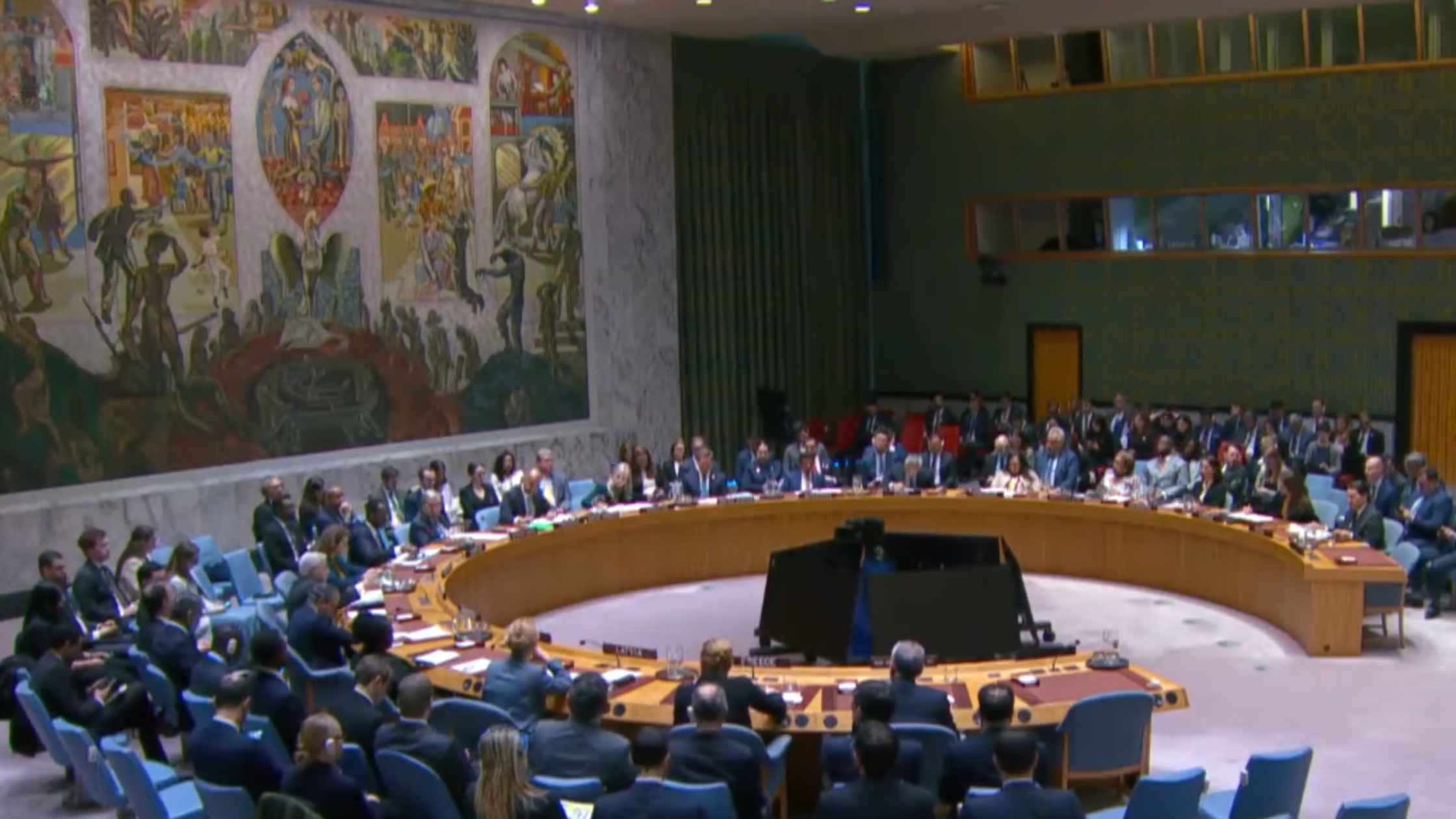
10, 112th meeting of the Security Council is called to order. The provisional agenda for the meeting is the situation in the Middle East. The agenda is adopted. In accordance with Rule 37 of the Council's Provisional Rules of Procedure, I invite the representatives of the Islamic Republic of Iran and Israel to participate in this meeting. It is so decided. In accordance with Rule 39 of the Council's Provisional Rules of Procedure, I also invite His Excellency, Mr. Majed A. Abdulaziz, Permanent Observer of the League of Arab States to the United Nations to participate in this meeting. It is so decided. The Security Council will now begin its consideration of item two of the agenda. I warmly welcome the Secretary-General, His Excellency, Mr. António Guterres, and I give him the floor.
António Guterres (12:22):
Mr. President, excellencies, ladies and gentlemen. I will speak directly to three areas today, the principles, the facts, and the way out. First, the principles. The UN Charter provides the foundation for the maintenance of international peace and security. Article 2nd of the charter clearly states, "All members shall refrain in their international relations from the threat or use of force against the territory integrity or political independence of any state." International law and international humanitarian law must always be respected. That is why since this morning, I have condemned the massive military strikes by the United States and Israel against Iran. And I also condemned the subsequent attacks by Iran, violating the sovereignty and territorial integrity of Bahrain, Iraq, Jordan, Kuwait, Qatar, Saudi Arabia, and United Arab Emirates.
(13:35)
We are witnessing a grave threat to international peace and security. Military action carries the risk of igniting a chain of events that no one can control in the most volatile region of the world. Let me be clear. There is no viable alternative to the peaceful settlement of international disputes. Lasting peace can only be achieved through peaceful means, including genuine dialogue and negotiations.
(14:08)
Mr. President, second, the facts. The situation on the ground is very fluid. There are many unconfirmed reports. Here is what we know. About 20 cities across Iran, including Tehran, Isfahan, Qom, Shahriar, and Tabriz have reportedly been attacked. In Tehran, large explosions were reported in the district that includes the presidential palace and the compound of the Supreme Leader. Several high-ranking officials have reportedly been killed, including, according to Israeli sources, Iran's Supreme Leader, Ali Khamenei, that I am not in a position to confirm. Iran's airspace has been closed and the country is under a near- total internet blackout.
(15:03)
The attacks have reportedly caused significant civilian casualties. According to Iranian media, an air strike killed at least 85 people and injured many more at a girls school in Minab, Hormogan Province. And a school in Tehran was also reportedly hit, causing two deaths. Mr. President, military action is expanding rapidly across the region, creating an increasingly volatile and unpredictable situation and heightening the risk of miscalculation.
(15:38)
According to Israeli sources, 89 people have been injured in Iran's subsequent strikes on Israel, and there were also impacts in the occupied West Bank. Iran has announced that in reaction to U.S. and Israeli air strikes, it targeted U.S. military assets in the region. These strikes have reportedly hit civilian areas and infrastructure in the countries that I have already mentioned. Indirect impact of falling debris was also reported in Lebanon and Syria. Most Gulf states successfully intercepted Iranian strikes.
(16:17)
However, the UAE reported that one civilian was killed by debris from an intercepted missile. In Iraq, there are reports of drone and missile attacks from both sides. There are also reports that Iran is closing the Strait of Hormuz for international shipping. Mr. President, the U.S. and Israel attacks occurred following the third round of indirect talks between the U.S. and Iran mediated by Oman. Preparations have been made for technical talks in Vienna next week, followed by a new round of political talks. I deeply regret that this opportunity of diplomacy has been squandered. Mr. President, third, the region and the world need a way out now. I call for deescalation and an immediate cessation of hostilities. The alternative is a potential wider conflict with grave consequences for civilians and regional stability. I strongly urge all parties to return immediately to the negotiating table, notably on the Iran nuclear program. I note that the U.S. President has reportedly talked with leaders of Saudi Arabia, Qatar, and the United Arab Emirates. Iran's Foreign Minister has reportedly spoken to his counterparts in GCC countries and Iraq. And everything must be done to prevent a further escalation. To this end, I call on all Member States to strictly uphold their obligations under international law, including the UN Charter, to respect and protect civilians in accordance with international humanitarian law, and to ensure nuclear safety. Let us act responsibly and together to pull the region, and our world, back from the brink. Thank you.
James Kariuki (18:14):
I thank the Secretary-General for his briefing. I now give the floor to those Council members who wish to make statements. I give the floor to the Representative of France.
Jérôme Bonnafont (18:26):
Thank you, Mr. President. And I'd like to thank the Secretary-General of the United Nations, His Excellency, António Guterres, for his comprehensive, enlightening briefing. I'd also like to thank the Presidency of the Council for having convened this meeting at such short notice. The President of the French Republic, Mr. Emanuel Macron, asked that the Council immediately deal with this issue given the seriousness of the moment. Mr. President, this region needs peace. And in order to do this, we need Iran to respect its international obligations. We are very concerned at the launch of this new war between the United States, Israel, and Iran. The escalation underway is dangerous for everyone, and it must cease immediately. Faithful to principles and detachment to the United Nations, France calls for deescalation, and we would recall that respect for international law is the condition for stability and long-term security in the region and throughout the world.
(19:29)
We robustly condemn the indiscriminate attacks by Iran against several countries of the region. It is essential that we ensure the protection of civilians, and we express our solidarity with the countries that have been struck, Saudi Arabia, Bahrain, the United Arab Emirates, Jordan, Kuwait, Qatar, and with our regional partners. And we are ready to deploy the means necessary to protect them if they so request. We will take all measures necessary to ensure the security of our citizens in the Middle East. Mr. President, the events today come in the context of the ongoing pursuit by Iran of its nuclear program that is destabilizing and is contrary to the general guarantees system and resolutions of this Council. For years now, despite the diplomatic efforts deployed by France with our partners, Iran has not taken the opportunity to conclude an agreement with regard to a peaceful settlement with regard to its nuclear program.
(20:35)
In parallel, Iran has reduced its cooperation with the International Atomic Energy Agency, which for a long time now, has not been able to guarantee the peaceful nature of the Iranian nuclear problem. For many months now, the agency has not had access to the most sensitive sites of the Iranian program. Transparency has still not been provided with regard to the Iranian stock of highly enriched at 6% uranium, which represents an amount which is potentially enough to produce around 10 explosive nuclear warheads. The situation is such and so serious that last August, we launched the procedure to reestablish the Security Council sanctions in response to the clear non-respect by Iran of its commitments over and above its nuclear program. It's also the ballistic program and the regional actions taken by Iran that continue to constitute sources of major destabilization. Iran is continuing also a policy of systematic destabilization in countries of the region, through the support that it provides to its regional allies, be that Hamas, Hezbollah in Lebanon, the Houthis in Yemen, or previously the regime of regime of Bashar al-Assad in Syria.
(21:56)
We remain profoundly concerned by the suffering of the Iranian people, given the systematic and brutal repression that they have suffered for many years. For several weeks now, this people has seen an unleashing of unjustifiable state violence because it had the courage to demonstrate for a better life and for freedom. The Iranian people must be able to exercise their fundamental rights and must be able to freely decide their destiny. Mr. President, on the 28th of September, resolutions of this Council with regard to the Iranian nuclear program were reestablished. These resolutions called upon Iran to suspend its enrichment activities of uranium to cooperate with the IAEA with regard to its ballistic activities. The Council must ensure that these resolutions are implemented also by ensuring that the 1737 Committee is functioning properly. Iran must commit finally to good faith negotiations with regard to its nuclear and ballistic program and also with regard to its regional action. France, together with the E3, has been mobilized now for 20 years to find a negotiated diplomatic solution, the only thing that will solve this issue in a viable way. Together with our partners, we showed in 2015 with the JCPOA and Resolution 2231 of this Council that it was possible to reach an agreement. Today still, the peaceful settlement of disputes must be our priority. We feel that an agreement is possible, and that's why Iran must seriously commit to negotiations to achieve this. We will remain available together with our partners to find a robust, verifiable, and lasting solution that will guarantee that Iran never has a nuclear weapon. At this serious time, the Council must come together to call for deescalation for respect of international law and search for a negotiated solution in order to reestablish lasting peace in the region. Thank you.
James Kariuki (23:55):
I thank the Representative of France for the statement, and I give the floor to the Representative of Bahrain.
Speaker 1 (23:59):
[foreign language 00:24:03]
Latvia Representative (24:03):
Thank you, President. At the outset, I would like to thank the United Kingdom for heeding our call and for inviting to this session at this important moment. I also extend our appreciation to His Excellency, the Secretary-General, for his briefing and for the information regarding the recent events and the repercussions on regional and international peace and security. Mr. President, my country never expected ... my country, which is a champion of peace and coexistence, never expected to be targeted by wanton aggressions without any justification. On behalf of the government of the Kingdom of Bahrain, my country strongly condemns the missile attacks targeting vital facilities and residential areas inside the kingdom of Bahrain on Saturday. They were launched by the Islamic Republic of Iran, which confirmed its responsibility for these cowardly attacks. These attacks are a violation of our sovereignty and territorial integrity and the safety of our people, and they represent an indirect and unjustified attack that violates flagrantly international, the law UN charter.
(25:27)
It is also a grave threat to international and regional peace and security. The Kingdom of Bahrain strongly condemns these acts of aggression, which represent an unprecedented escalation. We reaffirm that targeting our territories, our vital facilities and residential buildings is a hostile act that is rejected and we will deal with it firmly. Mr. President, the Kingdom of Bahrain is today under attack that are part of the missile attacks targeting several sisterly states in the region in recent hours, including the United Arab Emirates, the State of Kuwait, the State of Qatar, the Kingdom of Saudi Arabia, missiles targeting sites in Jordan and in the Syrian Arab Republic. These grave developments reflect an escalatory pattern targeting our collective security. Mr. President, the Kingdom of Bahrain reaffirms that these attacks represent a blatant violation of the prohibition to threat or use force against the territorial integrity of states as per paragraph four of Article 2 of the UN Charter.
(26:54)
We hold the government of Iran fully responsible for these attacks, and the kingdom rejects any justifications or explanations aiming at justifying these hostile activities or to violate international law. We reaffirm our statefast commitment to the principles and purposes of the UN Charter, and we reserve our full and inherent right to answer in a commensurate manner with the scope of these attacks and to take all measures necessary to reestablish our security, safety, to protect our territories, our citizens, and our residents according to Article 151 of the UN Charter and pursuant to international law in coordination with our partners and allies. Mr. President, the Kingdom of Bahrain calls upon the Security Council to shoulder its responsibilities in confronting these grave violations and to adopting a firm position to end these hostilities, to condemn them and prevent their recurrence in a way that guarantees regional and international peace and security.
(28:06)
Allow me now to deliver this statement on behalf of the GCC countries, the United Arab Emirates, the Kingdom of Saudi Arabia, the Sultanate of Oman, the State of Qatar, the State of Kuwait, and my country, the Kingdom of Bahrain, as well as on behalf of the Kingdom of Jordan and the Syrian Arab Republic. At the outset, and on behalf of the GCC countries, Jordan and Syria, I would like to thank you, Mr. President, for convening this session, and I thank the Secretary-General for his briefing.
(28:44)
And as stated in the letter addressed to the presidency today, several missile attacks launched by Iran targeted the United Arab Emirates, the Kingdom of Saudi Arabia, the Sultanate of Oman, the State of Qatar, the State of Kuwait, and my country, the Kingdom of Bahrain, as well as the Hashemite Kingdom of Jordan and the Syrian Arab Republic in a blatant violation of the sovereignty of these states and territorial integrity and in a violation of their safety and in violation of principles of international law and the UN charter. This represents a rejected escalation that threatens the security and stability of the region. These Iranian wanton and irresponsible actions also caused the injury of several residents and nationals in these countries and killed one civilian at least.
(29:34)
They also damaged several facilities and civilian infrastructure besides disrupting air navigation in the region and also threatens to disrupt maritime navigation through the Hermes Straits. This is a violation of international law and will have very grave international repercussions. Our countries reaffirm that these violations constitute a violation of the prohibition of the threat or use of force against the territorial integrity of states as per paragraph four of Article 2 of the UN Charter. We hold the government of Iran fully responsible for these attacks and we reject any justifications or explanations to justify this hostile behavior or to manipulate rules of international law. We reaffirm that Article 51 of the charter does not justify in any way these cowardly attacks. GCC countries strongly condemn and denounce this Iranian wanton aggression and we reaffirm that targeting civilians and civilian infrastructure is condemned and rejected by all international and human standards.
(30:56)
We reiterate our full solidarity with the sisterly countries that were targeted and we stress that the security of the sisterly countries are part and parcel of our security and that targeting any of these states means or represent a threat to the security and stability of the whole region. And we warn against the repercussions of this refused escalation. Mr. President, these Iranian attacks are not compatible with the good neighborliness principles and they cannot be accepted in any way. We strongly reject using the territories of the countries of the region as scene to score points or to expand the conflict, following the efforts made by the GCC countries, Jordan and the region as a whole, in order to facilitate dialogue between Iran and the international community in order to settle differences in peaceful means and to avoid escalation in the region. While the GCC countries reaffirm that their steadfast commitment to the purposes and principles of the UN Charter, they reserve their full and inherent right to self-defense pursuant to Article 51 of the UN Charter and reserve the right to retaliate against this brutal attack in a compassionate manner and in line with international law. We reserve the right to take all necessary measures to restore security and stability and to protect our territories, our people, and residents, and to guarantee our sovereignty, security, stability, and national interests.
(32:41)
Mr. President, in conclusion, the GCC countries appreciate all the positions supporting our sovereignty and security. We call upon the security Council to shoulder all its responsibilities in confronting these grave Iranian violations and to take a firm stance condemning and refusing these unjustified and irresponsible attacks and preventing their recurrence in a way that guarantees regional and international stability and security. We call for containing this crisis to preserve the stability, security of the region, to protect its peoples and to avoid a wider confrontation. Thank you, President.
James Kariuki (33:27):
I thank the Representative of Bahrain for the statement. I now give the floor to the Representative of the Russian Federation. [inaudible 00:33:33]
Vasily Nebenzya (33:34):
Mr. President, we'd like to thank the Secretary-General for his briefing. First of all, I wish to express our firm rejection of the fact that the presidency today ... that the meeting today is taking place under the agenda item, the situation in the Middle East. We wish to recall that Russia and China requested that it be held under the agenda item, threats to international peace and security. That request was also contained in the relevant letter of the Iranian colleagues. The aggression that Iran has been subjected to today threatens to lead to escalation in an already escalated region and it could go far beyond its borders. Particularly given the fact that one of the two initiators of this military venture is far from being a state in the region, attempts by the British presidency to artificially downplay the degree of danger of the current situation is simply unacceptable. The presidency also grossly scorned Russia and China's request
Vasily Nebenzya (35:00):
... quest to invite as a briefer to today's meeting, the professor at Colombia University, Jeffrey Sacks. The British colleagues do everything they can to assert the importance of inviting representatives of civil society to Security Council meetings. That clearly does not apply to cases when world recognized academics are going to present the truth that is unacceptable to the Western governments. In recent hours, we have witnessed a further extremely dangerous ratcheting up of escalation in the Middle East. Early in the morning of the 28th of February, the United States and Israel began launching massive military strikes on the territory of Iran.
(35:52)
It was declared that one of the aims of the attacks were, one of the targets were the senior political leadership of the country and also a civilian nuclear facilities.
(36:03)
In real time, we are getting reports from the Iranian authorities about casualties, including among the civilian population. More than 200 people have died in 24 provinces of the country. We were particularly aggrieved to learn of the strike on a girls' school in Minab, where it is reported that 85 children were killed.
(36:26)
We express our sincere condolences to the family and loved ones of the victims, and we wish a swift recovery to the injured. Our country will do everything necessary to ensure the security and safety of Russian citizens that are on the territory of the Islamic Republic of Iran.
(36:44)
Mr. President, Washington and West Jerusalem's actions are nothing other than yet another unprovoked act of armed aggression against a sovereign and independent UN member state in violation of the charter of the organization and of the fundamental principles of international law. They are openly aimed at further interfering in the internal affairs of Iran and at destroying a state that has found disfavor with the West.
(37:24)
The US and Israel's irresponsible step, reckless step, as we warned previously, has already led to a sharp escalation of the situation across the region. Bahrain, Jordan, Qatar, Kuwait, the United Arab Emirates and Syria and Saudi Arabia have all been affected. And those countries that have repeatedly and said to their American partners that they don't need this escalation in the Middle East.
(37:53)
Moreover, the US and Israel military operation has been a betrayal of diplomacy. These countries once again are bringing to bear military force against Iran at the very height of negotiations, just as they did in June 2025.
(38:12)
Just the day before yesterday, on the 26th of February in Geneva, there was the latest round of US-Iranian contacts with the facilitation of Aman. The Minister of Foreign Affairs of Iran, Abbas Araghchi noted that an understanding and agreement had been reached to continue the dialogue. For our part, we underscore that the Russian side has repeatedly received signals that the Israelis have no interest in a military confrontation with Iran. And then despite Tehran's willingness to engage in the diplomatic process, it once again is stabbed in the back.
(38:54)
Moreover, the fact that Washington for such a long time and methodically was building up its military presence in the region only confirms the fact that aggression against Iran was planned in advance.
(39:08)
The actions of the United States and Israel risk triggering a humanitarian and economic catastrophe. Of particular concern, once again, are the threats to nuclear safety and security and radiological safety and security. The statements today from the President of the United States, Donald Trump, to the effect that this operation was aimed at preventing Iran from acquiring a nuclear weapon, are not justified. They are unfounded. Tehran has consistently stated that it does not have any such plans and that is fulfilling its obligations under the Nuclear Non-Proliferation Treaty.
(39:50)
Moreover, Iran has repeatedly underscored its readiness to put at the basis of new agreements with the United States the preservation of its status as a non-nuclear weapons state, provided that there is observation and respect for the legitimate right of the Islamic Republic of Iran as a state party to the NPT to develop peaceful nuclear technologies.
(40:19)
Against this backdrop, the attempts of Western countries to justify the US and Israeli aggression, as though there were some alleged threats to international peace and security are unfounded. These are threats that were allegedly coming from the Iranian nuclear program. We, of course, recall that the only source of reliable information in this regard are the relevant reports of the IAEA Director General, and those reports never indicated that. And they never said that Iran may be engaging in the development of a nuclear weapon.
(40:55)
The objects that strikes are being launched against are under the agency's safeguards, that is to say a priori. They cannot be used for any such activities. Against this backdrop, we expect that the IAEA Director General, Rafael Grossi, will provide unambiguous assessments and will condemn this latest undermining of the NPT's authority and undermining of the global regime for the non-proliferation by the USA and Israel. Nuclear energy objects, including the Bushehr nuclear power plant, cannot in any circumstances be the target of strikes by armed forces. That is unacceptable.
(41:37)
Mr. President, we note that today's events were the latest phase of consistent escalatory steps around Iran by Western countries. That includes the US-Israeli strikes on the country's territory in June 2025 and the US's open interference and the open interference by US allies in the domestic political situation in Iran in January of this year.
(42:04)
We also remember the failed attempts by the United Kingdom, France and Germany to trigger the mechanism to restore the effect of Security Council anti-Iran resolutions, the so-called snapback mechanism.
(42:18)
However, that did not happen. Russia and a number of other UN member states repeatedly and in detail explained the reasons why the United Kingdom, France and Germany did not have the right to invoke that mechanism.
(42:33)
However, that did not work in the United States and Israel. Once again, have brought military force to bear. There are obvious parallels with the events of 2003 when the US representatives waived a test tube around in this room to justify their invasion of Iraq by saying that there were weapons of mass destruction present there that no one actually found.
(42:59)
In 2023, US Vice President JD Vance said that the Iraq campaign was unforced. As a result, innocent Iraqis and Americans died, and Washington had to learn that lesson. However, as it turns out, that lesson has not yet been learned.
(43:22)
In the statements of the European colleagues, and we'll hear that again today, instead of condemning aggression and the deaths of Iranian civilians, we once again we hear the statement of the President of France, Emmanuel Macron, saying, "The Iranian regime must understand that it has no other option but to engage in good faith negotiations to end its nuclear and ballistic programs as well as its regional destabilization activities."
(43:55)
Similar assessments were voiced by the Prime Minister of the United Kingdom, Keir Starmer. These absurd statements were then backed up by a joint statement of the leaders of the United Kingdom, France and Germany, condemning only Iran's strikes on the countries in the region.
(44:15)
Colleagues, just think for a moment. This sort of reaction is coming at a time when Iran has been subject to armed attack, a military attack at the peak of an active negotiating process. The hypocrisy of our European colleagues knows no borders. These aren't even double standards. It's a parallel reality, the other side of the looking glass.
(44:42)
In the English language, there's an ideal term to describe the situation, victim blaming. One gets the impression that London, Paris, and Berlin are living within illusions that they have created for themselves and are broadcasting to the world. However, attempts to mislead the international community are doomed to fail. Any common sense person will fully well understand who is responsible, who bears responsibility for this latest uncontrolled escalation.
(45:14)
Mr. President, we demand that the United States and Israel immediately cease their aggressive actions. An alternative to resolving the Iranian subject, including its nuclear component, the alternative to peaceful and diplomatic means simply does not exist and it never has. We insist on the immediate resumption of political and diplomatic settlement efforts and the pursuit of solutions based on international law, mutual respect, and a balance of interests. Russia, unchangingly, stands ready to provide all necessary assistance for that work.
(45:51)
Thank you.
James Kariuki (45:54):
I thank the representative of the Russian Federation for the statement, and I give the floor to the representative of China.
Fu Cong (46:02):
Thank you, President. I thank Secretary General Guterres for his briefing and support his call for deescalation and return to diplomatic negotiations.
(46:14)
Today, the United States and Israel brazenly launched military strikes against targets inside Iran, causing a sudden escalation of regional tensions. China is deeply concerned about this development. China consistently advocates that all parties should abide by the purposes and principles of the UN charter and opposes and condemns the use or threat of force in international relations.
(46:42)
China stresses that the sovereignty, security, and territorial integrity of Iran and other regional countries must be respected. China is deeply saddened by the large number of civilian casualties caused by the conflict. At all times, the red line for protecting civilians in armed conflict must not be crossed, and the indiscriminate use of force is unacceptable. China calls on all parties to fulfill their obligations and international law, including international humanitarian law, effectively ensure the safety of civilians and avoid attacks on civilian facilities.
(47:24)
The use of force is not the right way to settle international disputes. It only intensifies hatred and confrontation. The escalation and spill over of tensions in the Middle East serves no one's interests. Dialogue and negotiations are the only way to resolve differences. China caused an immediate cessation of military actions to prevent further cycles of escalation.
(47:48)
The military strikes occurred at a time when the US and Iran were engaged in diplomatic negotiations, which is shocking. The parties concerned should demonstrate political sincerity, resume dialogue and negotiations as soon as possible, and return to the right track of a political solution.
(48:10)
China stands ready to work with the international community to advance peace efforts and help restore peace and stability in the Middle East at an early date.
(48:19)
I thank you, President.
James Kariuki (48:26):
I thank the Representative of China for the statement, and I give the floor to the representative of Colombia.
Jérôme Bonnafont (48:32):
Mr. President, I'd like to thank the United Kingdom in its capacity as President of the Security Council for the prompt convening of this emergency meeting at the request of several countries, including Colombia. We would also like to thank the Secretary General for the information shared, and we welcome the delegations participating at this meeting.
(48:55)
Colombia is taking the floor guided by an essential conviction. The protection of human life must always be at the heart of international decisions, and we are also equally convinced that the United Nations Charter is binding. Colombia reaffirms its unequivocal defense of international law and of the purposes and principles of the charter.
(49:21)
International peace and security, the peaceful settlement of disputes, the prohibition of the use or the threat of the use of force, the sovereign equality of states, respect for the sovereignty, territorial integrity, and political independence of all states and non-intervention.
(49:43)
Mr. President, we are facing a serious military escalation that threatens to spill over into a regional confrontation with unpredictable consequences. The use of force and the logic of reprisals are substituting diplomacy, dialogue, and law. In the face of this alarming situation, we condemn any military action that is contrary to the charter, wherever it comes from.
(50:12)
Our country has been consistent in this organization and in this council. No state may unilaterally claim the right to attack another in order to impose regime change, and that principle does not depend on who the actor is, as it is a pillar of the international order. The prohibition of the use or threat of force enshrined in the charter does not admit selective interpretations.
(50:43)
When that principle is violated, international security does not prevail. The law of the strongest takes over. When force replaces law, the international order is weakened, and barbarism takes its place. And the first to lose are civilians.
(51:03)
Colombia condemns the attacks and expresses solidarity with the peoples of Bahrain, Qatar, the UAE, Saudi Arabia, Jordan, and Kuwait. Colombia expresses its deep concern over the human cost of this escalation. Bombings are exposing entire communities to fear and to risk, including girls and boys.
(51:27)
No military goal can justify under any circumstances civilians being caught in the crossfire or becoming victims of indiscriminate attacks. The protection of life must always be our highest priority. Life cannot be considered collateral damage.
(51:49)
In this regard, we strongly condemn reported attacks against civilians and against civilian objects. This is in clear violation of international humanitarian law, particularly the principle of distinction, and we urge the immediate cessation of hostilities.
(52:11)
Strict respect for international law and international humanitarian law is not optional. The protection of the civilian population is a legal and moral obligation.
(52:24)
Mr. President, for these reasons, Colombia prioritizes dialogue and the peaceful settlement of disputes, not because we are naive, but on the basis of our experience. Because we know that war does not resolve conflicts. On the contrary, it worsens them. It makes them more cruel, perpetuates them, and passes them on to future generations.
(52:48)
Defending international law does not mean ignoring reality. Iran has international obligations that it must fully comply with, particularly in the nuclear and human rights fields. With regard to Iran's nuclear program, full, effective and transparent cooperation with the International Atomic Energy Agency is essential. Therefore, we call on Iran to return to the path of dialogue and negotiations in good faith with a view to guaranteeing unrestricted access to nuclear facilities subject to monitoring and verification and to resolving outstanding safeguards issues under the treaty on the non-proliferation of nuclear weapons.
(53:39)
Colombia reaffirms the universal goal of general and complete nuclear disarmament. And in that context, we insist that Iran's nuclear program must be maintained exclusively for peaceful purposes in compliance with its international obligations. Collective security is not built with more weapons, but with more guarantees.
(54:03)
Likewise, we join the urgent call of the IAEA for the parties to exercise restraint in the use of force, particularly against nuclear facilities, taking into account the enormous risks that such actions represent.
(54:22)
Furthermore, Iran has the obligation to respect and guarantee the human rights and fundamental freedoms of its population, which are not a concession of the state. Much rather, these are rights that are inherent to human dignity.
(54:40)
But we also state with the same degree of firmness that Iran's non-compliance in these areas cannot serve as justification for the unilateral carrying out of military attacks against a state. The full application of the charter is indispensable for the credibility of multilateralism and the preservation of the international order.
(55:07)
International peace and security are not built by violating the sovereignty or the territorial integrity of states, nor through reprisals. They are built through rules and through dialogue.
(55:22)
Mr. President, Colombia calls on all parties to exercise restraint and deescalation, to urgently return to the diplomatic path, to strictly respect international law, and to strengthen existing multilateral mechanisms. It is a priority to move forwards towards a framework for regional dialogue that allows us to address the underlying causes of instability in the Middle East.
(55:48)
Therefore, we propose the convening of a peace conference for the region under the auspices of the United Nations in order to achieve sustainable political solutions. War is not a foregone conclusion. It is a political decision, but so is peace.
(56:07)
Today, the true responsibility of the international community and of this council is to choose it, assuming with historical responsibility its primary mandate to preserve international peace and security.
(56:22)
The United Nations Organization cannot fall short of the gravity of this moment. It needs to choose to stop destruction before it becomes irreversible and make space for diplomacy before it is too late.
(56:39)
Thank you very much.
James Kariuki (56:41):
I thank the Representative of Colombia for the statement, and I give the floor to the representative of the United States.
Mike Waltz (56:48):
Thank you. Distinguished delegates, this is a moment in history that requires moral clarity, and President Trump has met the moment. The most fundamental duty of any sovereign government is the protection of its people. Operation Epic Fury is directed towards specific and strategic objectives, to dismantle missile capabilities that threaten allies, to degrade naval assets used to destabilize international waters, and to disrupt the machinery that arms proxy militias, and to ensure the Iranian regime never, ever can threaten the world with a nuclear weapon.
(57:38)
As President Trump said last night, for decades, the Iranian regime has willfully destabilized the world. It has killed American forces and citizens, threatened regional allies, and jeopardized the security of international shipping, upon which the world depends. Its massive support for violent proxies, declared terrorist organizations, the Houthis, Hezbollah, Hamas, and others has brought bloodshed and disorder across the Middle East for far too long.
(58:10)
This is not speculation. We know this to be true, and our men and women have paid for the actions of this regime and the IRGC with their lives. No responsible nation can ignore persistent aggression and violence. The regime in Tehran has led attacks that have cost American lives, hundreds of US Marines in Lebanon, thousands of troops in Iraq. American hostage after hostage has suffered, our ships fired upon dozens of times in the Red Sea.
(58:45)
Iran has armed and financed militant organizations that undermine lawful governments and destabilize an already fragile region. Iran's continued pursuit of advanced missile capabilities, coupled with its refusal to abandon nuclear ambitions, despite diplomatic opportunities, presents a grave and mounting danger.
(59:09)
The international community has long affirmed a simple and necessary principle. Iran cannot have a nuclear weapon. That principle is not a matter of politics. It's a matter of global security. And to that end, the United States is taking lawful actions.
(59:29)
This body, the United States Security Council, has acted repeatedly on this threat. 20 years ago, starting in 2006, Resolution 1696 demanded that Iran suspend all uranium enrichment related and reprocessing activities invoking chapter seven of the UN charter and adopting a legally binding resolution.
(59:53)
When Iran failed to comply, the council, this council, followed with resolution 1737 imposing mandatory sanctions, including bans on nuclear related materials and technology, asset freezes on key individuals and entities linked to their nuclear program in establishing a sanctions committee.
(01:00:14)
Subsequent resolutions, 1747 in the year 2007, expanded arms embargoes and asset freezes. Resolution 1803 and 2008 tightened restrictions on dual use goods and calling for the inspections of Iranian cargo. Resolution 1835 in 2008 reaffirmed the need for full compliance. And resolution 1927 in 2010, which was the most comprehensive, banning ballistic missile activities, tightening the conventional arms embargo, targeting the IRGC and shipping lines and prohibiting new Iranian banking relationships built a robust multilateral framework to curb Iran's nuclear and missile pursuits.
(01:01:00)
These measures, again, adopted under chapter seven, represented the world's collective judgment that Iran's actions pose a threat to international peace and security. And despite numerous opportunities for an alternative path, Iran remained defiant.
(01:01:20)
And the Security Council decided on September 19th of last year, 2025, to restore these measures, snapback sanctions, sending a clear message that the world will not acquiesce to threats and half measures, and Tehran would be held to account.
(01:01:39)
On top of these actions by the UN, American diplomacy was attempted, repeatedly and in good faith. President Trump, Secretary Rubio, our special envoys, Witkoff and Kushner, were relentlessly dedicated to diplomacy, but diplomacy cannot succeed where there is no genuine willingness to cease aggression, where there is no genuine partner for peace.
(01:02:07)
As President Trump said today, and he spoke directly to the Iranian people, he said, quote, "To the proud, great people of Iran. I saw tonight that the hour of your freedom is at hand." The entire world has witnessed the regime's wholesale slaughter of innocent civilians. The sad irony is that this same regime will attempt to lecture us today about human rights and the rule of law. Its presence here in this council makes a mockery of this body, but where the UN lacks moral clarity, the United States of America will maintain it.
(01:02:54)
Indiscriminate and unprovoked attacks by the Iranian regime today against our regional partners, Kuwait, the United Arab Emirates, Bahrain, Qatar, Jordan, and others reinforce precisely why such actions are necessary. The regime has not only struck military assets, but civilian infrastructure as well. Those who stand with us must know that their security is not negotiable. The safety of our allies is not conditional. It is assured.
(01:03:29)
The bottom line is this, colleagues. Our allies and partners can count on the United States and can count on President Trump.
(01:03:39)
Colleagues, peace is not preserved by appeasing those who threaten it. Peace is preserved through strength in the face of terror. History has taught us that the cost of inaction is far greater than the burden of decisive action. And our president, President Trump, has taken that decisive action today.
(01:04:07)
I thank you.
James Kariuki (01:04:09):
I thank the Representative of the United States for the statements, and I give the floor to the representative of Denmark.
Christina Markus Lassen (01:04:16):
Thank you, Mr. President, and thank you to the UK presidency for convening the council for this urgent meeting following the latest developments in the Middle East. I also wish to thank the Secretary General for his statement.
(01:04:29)
Today's developments are deeply concerning and pose the risk of further destabilizing an already volatile situation at a time of heightened tensions in the Middle East. Mr. President, let me reiterate our deep concern over Iran's unacceptable behavior related to its nuclear program, its ballistic missiles, its destabilizing activities in the region and beyond, and its violent crackdown and repression against its own people.
(01:04:59)
As a consequence, the European Union with Denmark's active support has adopted strong sanctions against Iran, just like we have always been promoting diplomatic efforts to address the nuclear and ballistic missile programs through a negotiated solution.
(01:05:16)
I also wish to express Denmark's condemnation of Iran's attacks today on countries of the region. This must stop immediately. We express our full solidarity with partners in the region under attack. Mr. President, at this critical juncture, deescalation is imperative. A broader regional escalation would have devastating consequences for the Middle East and for international peace and security. We call for maximum restraint and respect for international law, including international humanitarian law.
(01:05:50)
What is needed is for diplomatic efforts to reduce tension and for the negotiations to resume in good faith as the only viable lasting solution to the Iranian nuclear issue. Iran must never be allowed to develop or acquire a nuclear weapon. This is essential for regional and international security.
(01:06:13)
Finally, Mr. President, for years now, we have heard the Iranian people calling for dignity, for opportunity, and for their fundamental rights to be respected. For too long, authorities in Tehran have failed to heed these calls. We call on Iran to refrain from further attacks, give up their weapons programs, and to meaningfully engage with the international community in a manner consistent with its international obligations and the will and inspirations of its own citizens.
(01:06:45)
I thank you.
James Kariuki (01:06:45):
I thank the representative of Denmark for the statement, and I give the floor to the representative of Pakistan.
Asim Iftikhar Ahmad (01:06:54):
Thank you, President. I would like to thank the Secretary General for his sobering presentation and assessment of the unfolding situation in the Middle East after concerning developments in the region.
(01:07:11)
We concur with this view that there is no viable alternative to a peaceful settlement. President, Pakistan condemns the initiation of unwarranted attacks against the Islamic Republic of Iran in violation of international law. Yet again, these attacks come at a time when renewed diplomatic efforts were underway to reach a peaceful and negotiated solution. Such a course of action will undermine the peace and stability of the entire region with far-reaching consequences.
(01:07:53)
Pakistan also condemns the attacks against the Kingdom of Saudi Arabia, Bahrain, Jordan, Kuwait, Qatar, and the United Arab Emirates, and stands in solidarity with all these brotherly countries, and underscores the need to exercise maximum restraint.
(01:08:15)
This is extremely unfortunate since several brotherly Arab countries were in fact supporting dialogue and emphasizing the need to avoid escalation. We particularly laud Oman's role in facilitating and mediating dialogue between Iran and the United States. These unprovoked attacks therefore constitute blatant violations of the sovereignty of the brotherly Gulf states.
(01:08:44)
Pakistan also condemns the unfortunate death of a Pakistani national in the UAE during this dastardly attack. We urge all sides to refrain from any further actions that may undermine the security and territorial integrity of other regional countries.
(01:09:04)
President, we regret the fact that diplomacy has once again been derailed as these attacks have happened right in the middle of negotiations. These military actions undermine dialogue and further erode trust that was already in short supply.
(01:09:24)
We offer our condolences and sympathies to civilians caught in the middle of these violent acts. Our thoughts go out to the school children in Iran and many civilians elsewhere and the family of the Pakistani national who was killed during attacks on the United Arab Emirates earlier today.
(01:09:44)
President, the purposes and principles of the UN charter are inviolable and sacrosanct. The charter prohibits threat or use of force against territorial integrity or political independence of states.
Asim Iftikhar Ahmad (01:10:00):
... Parks and reiterates the call for full respect for international law, including the UN Charter as well as the international humanitarian law. We are deeply alarmed at the risk of regional conflagration. Safety and wellbeing of millions of our compatriots in the countries of the region is also top priority for Pakistan. Pakistan is maintaining close contact and coordination with brotherly neighboring countries, including at the leadership level. We are ready to extend our support towards peaceful resolution of outstanding issues. Pakistan has consistently advocated the primacy of peaceful settlement of disputes and the imperative of avoiding confrontation and conflict in a region already beset by tensions and volatility. As the Secretary General has also noted. Diplomacy and dialogue should be the guiding principles for achieving negotiated settlement of all contentious issues in accordance with the rights, obligations, and responsibilities of the party's concern. Pakistan calls on all sides to immediately halt escalation and urgently resume diplomacy with the view to achieving a peaceful negotiated resolution to this crisis. Thank you so much.
James Kariuki (01:11:26):
I thank the representative of Pakistan for the statements and I give the floor to the representative of Greece.
Christina Markus Lassen (01:11:32):
Thank you, Mr. President, for convening this meeting at such a short notice. I would like also to thank the Secretary General for his briefing and his messages on respecting the principles of the UN Charter and his calling on deescalation and the peaceful settlement of the situation. Mr. President, we express our deep concern following today's escalation. Our reign should be to return to substantial negotiations towards the peaceful settlement in line with international law and the UN Charter. As the council meets in this critical moment, we would like to stress the following.
(01:12:20)
First, restraint is imperative. The risk for a wider regional confrontation with potentially grave consequences for international peace and security is real. Absent a swift diplomatic solution, we might now face the consequences of prolonged crisis. All parties must therefore exercise restraint, prevent a further spiral of violence, and work urgently to reopen credible channels of dialogue. Our prime minister and minister of foreign affairs are in constant contact with our partners in the region. We strongly condemn the Iranian strikes in Bahrain, Jordan, Kuwait, Qatar, Saudi Arabia, and the United Arab Emirates.
(01:13:13)
Second, Greece has consistently expressed its strong concern regarding Iran's nuclear program. Iran must never be allowed to acquire a nuclear weapon. The accumulation of significant quantities of uranium enriched up 60% by a non-nuclear weapon state raises serious proliferation concerns and has no credible civilian justification. Full cooperation with the IAEA and strict adherence to international obligations are indispensable. It is widely believed that strong, permanent, and verifiable oversight on Iran's nuclear and ballistic programs is a precondition for stability in the region. Diplomacy grounded in verification and transparency remains the only sustainable path forward.
(01:14:12)
Third, maritime security in the Gulf, the Strait of Hormuz and the Red Sea must be fully respected by all sides. Even more now of all times, stability is of the outmost importance. Where Iran and [inaudible 01:14:30] lies in the region to reframe from any retaliatory action that could endanger freedom of navigation, threaten commercial shipping, or further destabilize global energy and trade flaws constituting a blatant violation of the international law of the Sea as reflected in nucleus.
(01:14:53)
Fourth, the protection of civilians and respect for international law must remain absolute priorities. Adherence by all member states to the UN Charter, international humanitarian law and human rights law becomes even more critical. Civilians must not bear the cost of military escalation. The humanitarian consequences of further confrontation could be severe.
(01:15:21)
In closing, Mr. President, the stakes for regional and global peace are exceptionally high. We urge Iran to immediately engage in meaningful and good faith negotiations with a view to achieving a durable negotiated solution. Dialogue and diplomatic engagement aimed at the restoring stability and providing credible security assurances for all concern must prevail. Failure is not an option. I thank you.
James Kariuki (01:15:54):
I thank the representative of Greece for the statement, and I give the floor to the representative of Somalia.
Somalia Representative (01:16:02):
Thank you, Mr. President. I have the honor to deliver this statement on behalf of the A3 members of the Security Council, namely the Democratic Republic of the Congo, Liberia, and my own country, Somalia. We thank the presidency for prominently convening this emergency meeting on the situation in the Middle East. The A3 thanks the Secretary General for his thorough update on this warrant and rapidly evolving development in the Middle East and its implications on international peace and security. We also echo the secretary general message of today's military escalation in the Middle East. We welcome the representative of Iran to this meeting.
(01:16:51)
Mr. President, the A3 aligns itself with the statement of the chairperson of the African Union Commission, his excellency, Mahamoud Ali Youssouf, on the US-Iran military escalation issued on February 28th of 2026.
(01:17:08)
The reported military strikes carried out by the United States in coordination with their Israeli forces against targets inside the Islamic Republic of Iran and Iran's subsequent response represents a perilous and deeply troubling escalation. One that marks a serious intensification of hostilities in the Middle East and threatens to engulf the entire region in an uncontrollable cycle of violence, suffering, and pain. The A3 condemns the missiles and drone attacks carried out by Iran against the sovereign territories of Bahrain, Kuwait, Qatar, Saudi Arabia, and the United Arab Emirates. The A3 reiterates that all member states must respect their obligations under international law, including the charter, which prohibits the threat of the use of force against the territorial integrity or political independence of any state or in any other manner inconsistent with the purposes of the United Nations. These actions risk further destabilizing the Middle East and underscore the urgent imperative to safeguard broader peace and internalist ability, particularly as the geographic scope of military activity expands beyond the initial parties to the conflict.
(01:18:47)
The A3 remains steadfast in its commitment to the fundamental principles of international law and the charter of the United Nations. At the same time, the A3 recognizes the concerns of all states in the region, which must be addressed through dialogue and peaceful means in accordance with international law and the UN Charter. We believe that all member states share a responsibility to act in accordance with these commitments and that these are essential foundations for international cooperation and peaceful coexistence.
(01:19:28)
Mr. President, the A3 calls for restraint, urgent deescalation, and sustained dialogue. All parties must act fully in accordance with international law and the United Nations Charter to safeguard international peace and security. Our position underscores the importance of dialogue, the peaceful settlement of disputes and respect of international law. It's important for all parties to exercise restraint and responsibility, uphold international law, and avoid any actions that could escalate tensions or threaten regional peace and stability.
(01:20:13)
The A3 stresses that the spill-over effects of these hostilities imperil countless lives and threaten to deepen existing crises. The A3 expresses its solidarity with the people of the region and reiterates that the African Union's commitment to peace, stability, and mutual respect among nations and regions. Mr. President, in this regard, the A3 urges all parties to prioritize diplomatic engagements, including the ongoing international mediation efforts facilitated by the Sultanate of Aman to prevent further deterioration and uphold international rules-based order. At this critical juncture, the A3 calls for the swift return to the path of negotiations as the only viable means to reach a sustainable agreement regarding the Iranian nuclear program. Sustainable peace can only be achieved through diplomacy, not through force. The A3 strongly reaffirms the urgent necessity of establishing a Middle East zone free of nuclear weapons and other weapons of mass destruction, applicable to all states in the region without exception, in accordance with relevant international resolutions.
(01:21:40)
We also stress the need for all Middle Eastern countries to join the treaty on the non-proliferation of nuclear weapons as a step toward regional and global security. We emphasize the paramount importance of protecting civilians and civilian infrastructure, including in the context of cross-border strikes and retaliatory actions, and as well as refraining from targeting nuclear facilities that are under International Atomic Energy Agency safeguards, in line with relevant IAEA resolutions and the United Nations Security Council decisions. The A3 reaffirms its commitment to multilateralism and the principles of the United Nations Charter. We urge all parties to act with responsibility and wisdom, placing the wellbeing of the region, of the region's people above all other considerations. It's important to seize this moment to redouble our efforts for deescalation and to support a diplomatic process that can deliver peace, stability, and security for all states in the Middle East.
(01:22:54)
The A3 stands ready to support all efforts within this council and in cooperation with regional and international partners to facilitate a peaceful, inclusive, and lasting resolution to the situation in the Middle East. I thank you, Mr. President.
James Kariuki (01:23:11):
I thank the representative of Somalia for the statement, and I give the floor to the representative of Panama.
Vasily Nebenzya (01:23:19):
Thank you, Mr. President. We thank your presidency for convening this meeting, and we acknowledge the presence of the representatives of the countries that are honoring us with their participation. We would also like to thank the Secretary General, António Guterres, for his briefing at this meeting. Less than a year ago, we were in this same chamber deliberating on similar events to those that are of concern to us at this meeting. And these are events that today are still developing, which prevents us from entirely knowing their scope and their consequences. However, we must ask ourselves whether the repetition of these actions can really lead to different results and to a sustainable solution or whether on the contrary, the aggressive cycle of attacks and counterattacks will only lead to an escalation of violence with increasingly serious and unpredictable consequences to the detriment of international peace and security.
(01:24:38)
Let us recall that in January, we considered the brutal and disproportionate use of force by Iran against its population, which was legitimately exercising its right to protest. According to estimates from independent media and non-governmental organizations, that resulted in the deaths of thousands of people. These previous facts point to a delicate situation in the country and the region, and they represent a clear and worrying warning of the possible real and human consequences of the escalation of the armed conflict. The Republic of Panama notes with grave concern, the severity of recent events, which could trigger a regional conflict with serious direct repercussions on neighboring countries, such as those that have just been suffered by Bahrain, the United Arab Emirates, Qatar, Kuwait, Jordan, and Saudi Arabia, which Panama considers to be lamentable. This scenario must be avoided, especially in a context in which the Middle East has already been seriously affected by various crises in recent years, the consequences of which may transcend and cause harm beyond the immediate region and may affect the rest of the world with incalculable consequences.
(01:26:21)
The intensification of tensions will only increase instability and suffering, particularly impacting the most vulnerable populations, those that are always the first to suffer the consequences of conflicts. In this uncertain and dangerous situation that we face, we are reminded that it is essential to guarantee the respect for and protection of the civilian population during conflict in accordance with international humanitarian law and the values that this council is called upon to protect. Therefore, we reiterate our urgent call for dialogue, restraint, and the cessation of the use of force. Diplomacy and negotiation in accordance with the principles enshrined in the charter of the United Nations and international law must prevail as the preferred and effective means for the peaceful settlement of disputes. Thank you very much.
James Kariuki (01:27:26):
Representative of Panama for the statements, and I give the floor to the representative of Latvia.
Latvia Representative (01:27:32):
Thank you, Mr. President. Allow me to begin by thanking the United Kingdom as presidency of this council for convening this meeting on such a short notice. I would also like to thank the Secretary General for the briefing provided. For decades, Iran has been a malign, destabilizing actor in the region and beyond. It has repeatedly and systematically violated its international obligations and posed a threat to international peace and security. The Iranian regime has attacked and destabilized neighbors, exported terrorism, developed an illegal ballistic missile program, and participated in widespread sanctions a convention. Iran has violated UN Security Council resolutions 1696, 1737, 1747, 1803, 1835, 1929, and this aggressive behavior is consistent. It spans decades.
(01:28:32)
While international law must be respected at all times, the Iranian regime has continuously ignored its responsibilities, unbinding commitments under the JCPOA and NPT. The regime has openly maintained its illegal nuclear program, despite repeated and genuine diplomatic engagement from the European Union, the UK, and the US.
(01:28:53)
The EA Board of Governors has confirmed over the last eight months that Iran is failing to engage and to grant monitors access to installations, and this is unacceptable. Iran must seize its illegal nuclear program, comply with its international obligations and return to the negotiating table. For decades, Iran has maintained terror as its modus operandi. Iran has supported, armed, financed, and trained terrorist groups such as Hamas, Hezbollah, and the Houthis. It has enabled and emboldened attacks against countries near and afar. It has caused the death of thousands of civilians. It has promoted radicalization and the spread of terrorism and undermined global energy and maritime security. Beyond the Middle East, Iran has directly supported Russia's war of aggression in Ukraine. More than 50,000 of the same Iranian Shahed drones now striking numerous countries in the Middle East have been transferred by Iran to Russia. Iranian weapons, Iranian technology have contributed to killing thousands of innocent Ukrainians and like Russia in Ukraine, Iran is now bringing terror to innocent civilians in the Gulf countries.
(01:30:09)
Latvia stands with the brave people of Iran. Brave people that have endured so much, decades of brutality and repression. Recently, this council met to address the atrocities perpetrated by the Islamic regime against its own people in the streets of Iran. Latvia and the European Union have already imposed sanctions against the IRGC. The Iranian people must be able to determine their own future free from violence and repression. Mr. President, Latvia joins the call for an immediate cessation of hostilities and urgent deescalation. We call on all sides to protect civilians and avoid further escalation. Latvia condemns the unprovoked Iranian strikes against countries in the region, namely our fellow member of the council, Bahrain, and Jordan, Kuwait, Qatar, Saudi Arabia, the United Arab Emirates. Strikes in these countries constitute a threat to regional and international peace and security, and we stand in solidarity with our partners. I thank you.
James Kariuki (01:31:15):
I thank the representative of Latvia for the statement. I shall now make a statement in my capacity as a representative of the United Kingdom. I thank the Secretary General for his briefing.
(01:31:29)
Colleagues, this is a fragile moment for the Middle East. The United Kingdom played no role in the strikes against Iran, but we are under no illusion about the nature of the Iranian regime. The Iranian regime has murdered thousands of its own people simply for exercising their fundamental rights and freedoms. Iran has repeatedly ignored calls to find a durable and acceptable solution to the nuclear issue, while continuing to destabilize the region through its support to proxies and partners. We strongly condemn Iranian strikes across the region, including the attacks on a hotel in Dubai, the attack on Kuwait's civilian airport, and attacks on civilian targets in Bahrain.
(01:32:25)
We extend our support and solidarity to all our partners, many of which are not parties to the conflict. Regional stability remains a priority. As my prime minister stated, UK forces are active and British planes are in the sky today as part of coordinated regional defensive operations to protect our people and regional partners, as the United Kingdom has done before and in line with international law. Reports of strikes on civilians and civilian infrastructure are deeply alarming. The protection of civilians and full respect for international law is critical. Iran must never be allowed to develop a nuclear weapon. That is why we, alongside our French and German partners, have continually supported efforts to reach a negotiated solution. We have always been clear that only a diplomatic solution can fully and sustainably address these threats. We want to see the swiftest possible resolution that ensures security and stability for the region.
(01:33:48)
Iran must refrain from further strikes and its appalling behavior to allow a path back to diplomacy. We will continue to work with our partners to this end in support of peace and security and the protection of civilian life across the region. I resume my function as president of the council. I now give the floor to the representative of the Islamic Republic of Iran.
Islamic Republic of Iran Representative (01:34:22):
In the name of God the Compassion and the Merciful, we appreciate the Secretary General for his briefing and his contribution to this meeting. We express our sincere appreciation to the Russian Federation and China for supporting the convening of this emergency meeting of the Security Council to address the manifest aggression committed by the United States and Israeli regime. I also thank those council members, in particular China, Pakistan, and the Russian Federation, who have today taken principle position in condemnation, this unlawful act. And it is regrettable that some members of this body in a blatant double standard disregarded the fragrant act of aggression committed by the US and Israel on Iran and condemn Iran for using its inherent right to self-defense on the UN Charter.
(01:35:21)
Mr. President, this morning, the United States regime jointly and in coordination with the Israeli regime initiated an unprovoked and premeditated aggression against the Islamic Republic of Iran for the second time in the decent months. Why deliberately attacking civilian populated areas in multiple large cities of Iran where millions of people reside? As a result of this brutal armed attack, hundreds of civilians have been killed and injured. The aggression and atrocious crime of the United States regime and the Israeli regime and the deliberate and persistent targeting of civilian infrastructure are going. In addition to the new civilian residential building, the aggressors have also targeted a school in the city of Minab, Hormozgan province, killing more than 100 children. The number of innocent civilians continues to rise. This is not only an act of aggression, it is a war crime and a crime against humanity.
(01:36:35)
Yet today, once again, the representative of the United States through a regrettable pattern has attempt to distort facts and rely on misinformation to justify the blatant aggression of the United States and Israel against my country. The fact, however, are unequivocal.
(01:36:58)
The justification advanced by the representative of the United States today are illegal and entirely devoid of legal foundation. The baseless allegation invoked to defend this unlawful use of force have no standing under international law. The invocation of preemptive attack claims of imminent threats or other substantiated political claims cannot legitimize aggression. Such claims are unfounded legally, morally, and politically, and they contradicted the clear principles of the charter of the United Nations. I also categorically reject the assertion made by the representative of France, the United Kingdom, and certain other Western members regarding Iran's peaceful nuclear program. This claims lack a factual and legal basis.
(01:37:56)
Mr. President, distinguished colleagues, the President of the United States and the Prime Minister of the Israeli regime have openly claimed responsibility for this act of aggression and have explicitly articulated regime change as their objective, an unmistakable admission of their intent to violate Iran's sovereignty and territorial integrity. The President of the United States has falsely described this aggravation as necessary to neutralize an imminent threat to the American people. This is nothing more than a deliberate attempt to mislead the international community and the US public opinion and manufacture concern for unlawful war.
(01:38:47)
Similarly, the representative of the United States has cynically sought to mislead this council, yet history provide ample documentation that the foreign policy of the United States has repeatedly relied on unlawful force covered intervention and political manipulation to alter the governments of other member states. District court is well established. The reality is clear and undeniable. What is taking place today against my country by the United States and the terrorist regime of Israel is a blatant act of aggression, a full-fledged violation of international law. No justification, no accusation, no narrative of disinformation can legitimize or excuse this manifest crime and aggression.
(01:39:42)
Mr. President, we have communicated on several occasions with this council and the Secretary General about warm and gearing statement and interfering actions in the internal affairs of Iran by the president of the US in a blatant violation of the UN Charter international law and call for the council action. Regrettably all were unanswered. The issue before the council is straightforward. Whether any member of the state may, including a permanent member of this council, throw the use of force question or aggression, determine the political future of another state or impose control over its affairs.
(01:40:29)
International law and the charter are explicit on this matter. Article two, paragraph four of the charter categorically prohibits the threats of use of force against the territorial integrity or political independence of any state. Mr. President, against this backdrop, I would like to make the following points. One. What is occurring against my country is a clear act of aggression. It is an open armed aggression against the Islamic Republic of Iran. The United States and Israel war today is not merely a war against Iran. It is a war against the charter of the United Nations. A war against international law and a war against the international legal order upon which the United Nations and the Security Council have been built for over eight decades.
(01:41:25)
As the charter affirms, the United Nations was established to save succeeding generations from escort of war. The charter adopt in 1945 is founded upon this fundamental principle. Members shall refrain from threat or use of force in international relations. The sole exception is the inherent right of self-defense under Article 51 and then only in the event of an armed attack. The military aggression carried out by the United States and Israel satisfies none of the criteria of lawful self-defense. Accordingly, the action of the United States and Israel constitute a manifest violation of Article two, a peremptory norms and a fundamental principle of international law accepted by all member states. Neither the charter nor international law recognize internal materials of a state as justification for the use of force by other states where this otherwise no international legal order could endure, the rule of law would be replaced by the rule of force.
(01:42:42)
Two. In responding to aggression on large scale war, the Islamic Republic of Iran is exercising its inherent unlawful right of self-defense under Article 51 of the charter of the United Nations. The armed force of the Islamic Republic of Iran are utilizing all the necessary defensive capabilities and means to confront this criminal aggression and deter the hostile acts. Consequently, all basis facilities and assess of the hostile forces in the region shall be regarded as legitimate military objective within the framework of Iran's lawful exercise of self-defense. Iran will continue to exercise its right of self-defense decisively and without hesitation until the aggression ceases in full and unequivocal terms.
(01:43:40)
Three. Iran remains firmly committed to respecting the sovereignty and territorial integrity of its neighboring countries. Under no circumstances will we target the sovereignty people or interest of our neighboring countries in the Persian Gulf. Our legitimate response have been directed solely and exclusively at the basis and assess of the hostile government of the United States that operate beyond the control of the host states. Priority has been given to the targets that diminish the aggressor capability and capacity to continue its malign actions. We had previously and formally conveyed this warming to the Secretary General and the Security Council. Four, despite continuous US hostile policy, we were sincerely and seriously pursuing the path of diplomacy and dialogue to reach a just, fail and sustainable agreement. Yet for the second time in the midst of the negotiation, the United States betrayed diplomacy and resorted to force and launched an attack against my country in blatant violation of charter of the United Nations,
Islamic Republic of Iran Representative (01:45:00):
... Nation presently interfering in Iran internal affairs. They are even calling on the people to riot against their own government. The recent record of the United States toward Iran is equally clear. Since January 2025, the U.S. administration again reinstated the hostile approach, including the policy of so called maximum pressure and economic strangulation duration through sweeping sanctions. The general assembly has repeatedly voted by overwhelming majorities against such unilateral coercive measures. The objective of these illegal measures has been transparent: unconditional surrender. Despite repeated warning by Iran to the Secretary General and the council regarding serious violation of the Charter by a permanent member, the council has regrettably failed to discharge its priority primary responsibility: allowing the erosion of the rule of law in favor of the rule of force.
(01:46:10)
Five, just as the Israeli regime succeeded in dragging the United States into the quagmire of war with Iran, the United States in turn is deliberately seeking to expand the scope of the conflict by exploiting spaces in the Persian Gulf region. The hostile U.S. government dream of swallowing Iran and forcing the Islamic Republic of Iran into submission will never be realized. This war before being a contest of military equipment and advanced technologies is a battle of wills. And in that battle, the Islamic Republic of Iran will prevail. Furthermore, the Islamic Republic of Iran has repeatedly affirmed its commitment to diplomacy and negotiation. However, it will never submit to pressure question of force. Diplomacy has rules and principles. It cannot coexist with aggravation.
(01:47:18)
Six, the duty of council members is to defend international law and specifically the Charter. They are not called upon to judge the political system of states nor to determine whether military aggression or economic siege leads to freedom or domination. Expression of concerns and empty condemnation are not sufficient. The council must act. Pursuant to Article 39 of the Charter, the security council must immediately determine the United States and Israeli regime have committed an act of aggression and demand the immediate cessation of its unlawful use of force, including any explicit or implicit threats against Iran and require binding assurance of non [inaudible 01:48:10]. Affirm that the United States and Israeli regime bear full international responsibility for all materials and moral damage inflicted upon the infrastructure and facilities of the Islamic Republic of Iran and are obligated to provide full reparation.
(01:48:29)
Let me conclude, Mr. President, with a simple and undeniable truth. Israel and the United States have attacked Iran. They have violated international law and the Charter of the United Nations. They must be held accountable. So long as this aggravation continues, Iran will continue to exercise its inherent right of self-defense firmly, proportionately, and without hesitation until the aggression ends. The Security Council must act now and stop this act of aggression immediately. Silence is complicity in this crime. I thank you.
James Kariuki (01:49:12):
I thank the representative of the Islamic Republic of Iran for the statement, and I give the floor to the representative of Israel.
António Guterres (01:49:19):
Mr. President, for 47 years, the Islamic regime in Iran has led crowds in chanting, [foreign language 01:49:30]. Mr. Iravani, do you want to translate this chants? Your leaders have been chanting it for years in public events, in your parliament. [foreign language 01:49:51]. They mean death to Israel, death to America. Israeli and American flags were painted on roads so they could be trampled. Our flags were burned in public squares. This is not the anger of a radical fringe. It is state sanctioned hatred. And while those [foreign language 01:50:24] chants echoed, uranium was enriched, centrifuges span, missiles were built, facilities were buried deep underground. It was never just empty rhetoric. It was preparation for action. But today, alongside our ally, the United States, we act to stop it. Israel stands before you today, having acted with the United States to confront and stop an existential threat before it became irreversible.
(01:51:05)
The operation targets nuclear infrastructure, ballistic missile sites, the machinery of repression that fuels terror across our region. We did not act of impulse. We did not act of aggression. We acted out of necessity because the Iranian regime left no reasonable alternative. This joint effort will continue for as long as the threat remains. We thank President Trump and acknowledge the close cooperation between Israel and the U.S. which has brought the alliance between our countries to an all time high in peace and in war. Let us be clear about what we are confronting.
(01:51:56)
This regime has built nuclear weapons in blatant disregard of international law and UN resolutions. It has brutally murdered its own citizens and crush [inaudible 01:52:13]. It's happening now as we speak in cities in Iran. It has expanded missile arsenals and armed proxies across the region. It has openly declared its intention to erase Israel from the map. Now, as it faces consequences, it is launching missiles and drones across the region, endangering the UAE where a Pakistani citizen unfortunately was killed. Jordan, Kuwait, Bahrain, Qatar, Iraq. As we speak in the last hour, Iraq targeted the city of Tel Aviv. Civilian. They don't target military bases. Civilians. Struck a building in Tel Aviv. An innocent woman was killed and 21 people were injured. This is a regime that destabilizes wherever it reaches. It spreads violence outward while crushing freedom at home. It is not reacting. It is expanding. It is a machinery of radicalism that does not recognize borders.
(01:53:33)
Mr. President, diplomacy was exhausted. Iran was required to stop enriching uranium, stop heavy water projects, stop developing nuclear capable missiles, and allow full inspections. Iran did none of it. Instead, it fortified its nuclear facilities so we cannot get to them, accelerated missile production and continued to fund terror. Since the last operation in the summer, they spent billions on their proxies. The resolutions were clear. The strategy was just as clear. Delay, delay, delay. But we will not be played. And it's simple what they were planning. They were building the means to corner us, to force an irreversible reality with our backs against the wall. That is not a future Israel will accept. No responsible nation should.
(01:54:46)
This operation is guided by clear objectives. Eliminate immediate threats, dismantle the nuclear program, destroy its ballistic missile production, neutralize naval threats, break the proxy network that destabilizes the region. The operation was carried out in order to protect the people of Israel within the framework of the ongoing armed conflict between Israel and Iran, in line with the UN Charter and in accordance with international law. Our forces stand ready to stop extremism armed with nuclear weapons. To the soldiers of the IDF, our boys and girls, my son, my daughter, we salute you. You stand like lions defending our people. An entire nation stands behind you. We have heard the condemnation from few member states, from the secretary general. But we all know that escalation did not begin today. It began when Iran armed proxies and exported terror, expanded missiles and drones, advanced its nuclear program in violation of its commitments, turned on its own people, beating, imprisoning, executing. Where was the outrage of the UN? Where were the consequences? Now, Israel acts to prevent an irreversible threat and the condemnation is immediate. This is the definition of hypocrisy. Some call this aggression. We call it necessity. We call it survival. Mr. President, history has taught us never to ignore those who openly call for our destruction. When a regime says it will destroy Israel, when it chants death to Israel, when it promises to wipe Haifa and Tel Aviv off the map, we believe it. We genuinely believe it. When we see those hundreds of ballistic missiles that are launching to Israel, we believe the threats. We do not ignore them. We do not gamble with our survival. We act.
(01:57:38)
Now, let me address the brave people of Iran. You are not our enemies. This operation is not directed at you. It is directed at the regime that has silenced you, imprisoned you, and invested in missiles and uranium while your economy suffers. You deserve better. It is this regime, the [inaudible 01:58:08], the revolutionary guard who have dragged your country into isolation. The world does not fear a free Iran. It fears a radical regime armed with nuclear weapons and driven by extremism. Your future should not be defined by those who chant for death. As President Trump has said, "The Iranian people deserve dignity, security, and the chance to shape their own destiny." We are thinking about you. You are seen. You are not alone. The future of Iran belongs to its people. We stand with you.
(01:58:54)
Mr. President, this week, Jewish families all around the world celebrate Purim. Many Israelis will do so now in a bomb shelter. The story of Purim happened more than 2,500 years ago in the same place. In ancient Persia, an evil minister by the name of Haman sought to wipe out the Jewish people and it began with words, with chants. It became a decree. It could have become a genocide, but Queen Esther refused to remain silent. She stepped forward. She spoke up. She acted before it was too late. That is a lesson we learned. It is not only an ancient lesson. It is a modern one. Last week, I stood at the gates of Auschwitz with dozens of UN ambassadors. We stood in a place that shows what happens when radicalism and extremism grows and no one stops it in time. Before the Holocaust, some leaders, serious leaders believed that they could calm aggression with concessions. They were completely wrong. Giving in did not stop evil. It strengthened it. Winston Churchill understood what Queen Esther understood long before him. When destruction is declared and weapons are being prepared and assembled, leaders must act. Not later. Now.
(02:00:51)
Today, President Trump and Prime Minister Netanyahu understand that same lesson. For decades, the Iranian regime has built missiles in which uranium armed proxies and spread terror far beyond its borders. This regime is not only Israel's enemy. It is an enemy of stability, an enemy of every peace loving nation. In this joint operation, Israel and the U.S. are acting together, not because we seek conflict, because we refuse to ignore declared destruction. We are stopping extremism before it becomes unstoppable. We will ensure that no radical regime armed with nuclear weapons and ballistic missiles can threaten our people or the entire world. Thank you, Mr. President.
James Kariuki (02:01:57):
I thank the Representative of Israel for the statement. I will now give the floor to his excellency, Mr. Maged A. Abdelaziz, permanent observer of the League of Arab States to the United Nations.
Latvia Representative (02:02:12):
Thank you, Mr. President. I thank the presidency for convening this emergency session today. I also extend my thanks to the Secretary General for his powerful and comprehensive briefing. The Security Council convenes today at a pivotal moment in the history of the United Nations. A moment that unfortunately represents a glaring failure of the multilateral international system, a failure the League of Arab States has long warned against. Regrettably, it is a moment in which the Arab-Israeli conflict has expanded into a full-scale regional war, through which Israel seeks through this escalation to evade ending its occupation of Palestinian territories to prevent the establishment of an independent Palestinian state and to obstruct Palestine's admission to the UN in implementation of the two state solution and the core principles of international legitimacy.
(02:03:11)
Israel has done so by expanding the scope of its brutal military aggression against the Palestinian people in Gaza and the West Bank by intensifying its efforts to annex the West Bank and through repeated military attacks on Syria, Lebanon, Yemen, and Iran, all in a misguided attempt that is categorically rejected both regionally and internationally to impose Israel's hegemony on the Middle East by using military means. Even if it is at the expense of the member states of the League of Arab States and at the expense of the suffering of their peoples under Israeli policies and attacks aimed at imposing the law of force instead of the force of law.
(02:03:58)
At the council's previous meeting on this item last week, the foreign minister of Israel, the occupying power, made extremist religious assertions, thus offering clear evidence of the arrogance of Israel, which seeks to impose its own extremist religious interpretation on the word, claiming that all Palestinian land, including the West Bank, which cannot be annexed under President Trump's plan and under Security Council Resolution 2803, "All this Palestinian land has belonged to Israel for thousands of years." Such claims reflect an unmistakable contempt for the legal, historical and foundational principles upon which international legitimacy have been built in this council and in this organization.
(02:04:52)
Despite the announcement two days ago in Geneva that negotiations between the United States and Iran on the Iranian nuclear file has made some progress, Israel has blatantly disregarded all these developments in pursuit of narrow self-serving interests. It has launched a wanton military attack at dawn today against the Islamic Republic of Iran, claiming that the attack was intended to prevent Iran from acquiring nuclear weapons.
(02:05:22)
At the same time, Israel itself refuses to join the Nuclear Non-Proliferation Treaty. It refuses to subject its nuclear facilities to the IAEA's comprehensive safeguards regime. And refuses at the same time to attend the United Nations Conference on the establishment of a Middle East zone free of nuclear weapons and other WMDs. That conference held for the seventh consecutive year at the United Nations last November. With the active participation of the Islamic Republic of Iran in all its sessions and with the continued boycott of Israel and one permanent member of this council, this Israeli boycott of this important conference is clear. Although the conference seeks to achieve the same goal, which is to eliminate the ambiguous nuclear capabilities, both Israeli and Iranian, and this Israeli stand reflects the fact that Israel wants to remain the only state acquiring ambiguous nuclear capabilities in the Middle East and capable of producing nuclear weapons, which is something that Middle East countries cannot accept, Mr. President.
(02:06:52)
Despite all the above, the clear escalation among all parties amounts to a cowardly and unjustified military assault by the Islamic Republic of Iran on several Arab states that are members of the League of Arab States. This escalation threatens to widen the scope of the military conflict and risks igniting a full scale regional war. The General Secretariat of the League of Arab States have issued an official statement from which I quote. "The General Secretariat of the League of Arab States strongly condemns the Iranian attacks on the state of Qatar, the Kingdom of Bahrain, the state of Kuwait, the United Arab Emirates, and the Hashemite Kingdom of Jordan. And I add the Kingdom of Saudi Arabia, Syria, and Lebanon.
(02:07:46)
These missile attacks constitute a blatant violation of the sovereignty of states that advocate for peace and have worked to advance stability and did not participate in the war. The General Secretariat expresses full solidarity with these Arab states in confronting these attacks and affirms its support for any measures they take to defend themselves and to protect their populations. The Secretariat stresses that Arab states have taken clear positions regarding the Iranian crisis by rejecting military action against Tehran. Several Arab states exerted tremendous efforts to further mediation and to prevent the escalation we are witnessing today. The General Secretariat is deeply concerned by the grave dangers posed by the current situation in the region. It calls upon all influential parties in the international community to act immediately to deescalate as quickly as possible to prevent the expansion of regional instability and violence and return immediately to dialogue."
(02:08:56)
In conclusion, Mr. President, the League of Arab States joins the Secretary General of the United Nations in urging all states to respect their obligations under international law, including the UN Charter, which clearly prohibits the threat or use of force against the territorial integrity or political independence of any state and prohibits any use of force inconsistent with the purposes and principles of the United Nations, especially when it involves attacking nuclear facilities which could have catastrophic consequences for entire populations.
(02:09:35)
The League also joins the United Nations in calling for an immediate cessation of hostilities and deescalation to prevent a wider regional conflict that would have dire repercussions for regional stability in the Middle East. From this standpoint, the League of Arab States urges the Security Council, particularly with the United States assuming the council's presidency beginning tomorrow, to lead the collective security regime, to immediately hold military operations and to return to negotiations on all tracks inspired by the positive momentum generated by last week's Board of Peace meeting and by the role of President Trump in advancing global peace and in full respect for the established mechanisms of the multilateral international system, far from any geopolitical confrontations that will only prevent us from achieving global peace. Thank you, President.
James Kariuki (02:10:42):
I thank his excellency, Mr. Maged Abdelaziz, for the statement. The representative of the United States has asked for the floor to make a further statement.
Mike Waltz (02:10:51):
Thank you, Mr. President. I wish to exercise my right of reply to the so called representative of the Iranian regime. The United States strongly rejects this ridiculous and frankly farcical assertion that U.S. actions are inconsistent with international law. For 47 years, the Iranian regime has chanted, "Death to America" at every turn, at every opening of its parliament. It has sought to eradicate the state of Israel. It has waged unending campaign of bloodshed and mass murder. It is responsible for a series of unprovoked armed attacks targeting the United States and Israel, violations of the UN Charter, and threats to international peace and security across the Middle East. It has even attempted to assassinate the U.S. president, President Trump. It has done so not only directly, but through its proxies seeking to hide and mask its bad actions while publicly claiming to be a victim.
(02:12:08)
Iran's menacing activities directly endanger the United States, our troops, our bases overseas, our partners, our allies around the world. The United States has made every effort to negotiate a peaceful resolution of this conflict with Iran, but Iran has failed to take that opportunity. So in close coordination with the government of Israel, the United States has taken lawful actions to address these threats in line with Article 51 of the Charter of the United Nations. And Mr. President, I'll just say on a final note, you know who is not complaining tonight? You know who is not citing the vagaries of international law? You know who is celebrating in the streets around the world? The Iranian people. Mr. President, maybe, perhaps just maybe they will finally be free. I thank you.
James Kariuki (02:13:09):
I thank the Representative of the United States for the statements. The representative of Bahrain has also asked for the floor to make a further statement. I give them the floor.
Translator 2 (02:13:20):
Thank you, Mr. President. I apologize for taking the floor once again. I would like to reread a paragraph from the statement of the GCC countries, Jordan and Syria. Accurately, it is as follows and I quote. "As we have pointed out in the letter addressed to you today, a number of Iranian missile attacks have targeted today, the UAE, the Kingdom of Saudi Arabia, the state of Qatar, the state of Kuwait, and my country, the kingdom of Bahrain, and the Hashemite kingdom of Jordan and the Syrian Arab Republic in a flagrant violation of the sovereignty and territorial integrity of these countries," I thank you.
James Kariuki (02:14:16):
I thank the representative of Bahrain for the statements. The representative of Iran has asked for the floor to make a further statement.
Islamic Republic of Iran Representative (02:14:23):
Thank you. I have one word only. I advise to the representative of the United States to be polite. It will be better for yourself and the country you represent. Thank you.
James Kariuki (02:14:37):
The representative of the United States has asked for the floor to make a further statement.
Mike Waltz (02:14:40):
Frankly, I'm not going to dignify this with another response, especially as this representative sits here in this body representing a regime that has killed tens of thousands of its own people and imprisoned many more simply for wanting freedom from your tyranny. Thank you, Mr. President.
James Kariuki (02:15:08):
Okay. There were no more names inscribed on the list of speakers. Before adjourning the meeting, as this is really the last meeting of our presidency in the month of February, I would just like to express my thanks on behalf of the delegation of the United Kingdom, to members of the council, the Secretary General, and members of the Secretariat for all their support this month. The meeting is adjourned.