
Study: Defense Attorneys Find AI Analysis Superior
A new survey reveals that most criminal defense lawyers are already using AI in their work. See how they use and think about this emerging development.


As AI has taken the world by storm, we've seen legal professionals gradually start to introduce it into their workflows (learn more in our AI in law stats roundup piece). The same is true among criminal defense lawyers, who are using it to improve evidence analysis, case preparation, and more.
However, AI is not without its challenges and limitations, all of which lawyers need to account for. Issues like analysis biases, data security issues, and ethics concerns are huge roadblocks when it comes to firm-wide integration of even the most popular legal AI tools.
To understand how AI is being used in criminal defense and where the trends are heading, we surveyed more than 500 defense attorneys, asking about their current AI applications, the benefits they’ve observed, potential future value, concerns, limitations, and more.
Key Takeaways
- A majority (56%) of defense attorneys say AI outperforms traditional methods for evidence analysis.
- Nearly three-quarters (71%) have used AI in their criminal defense work.
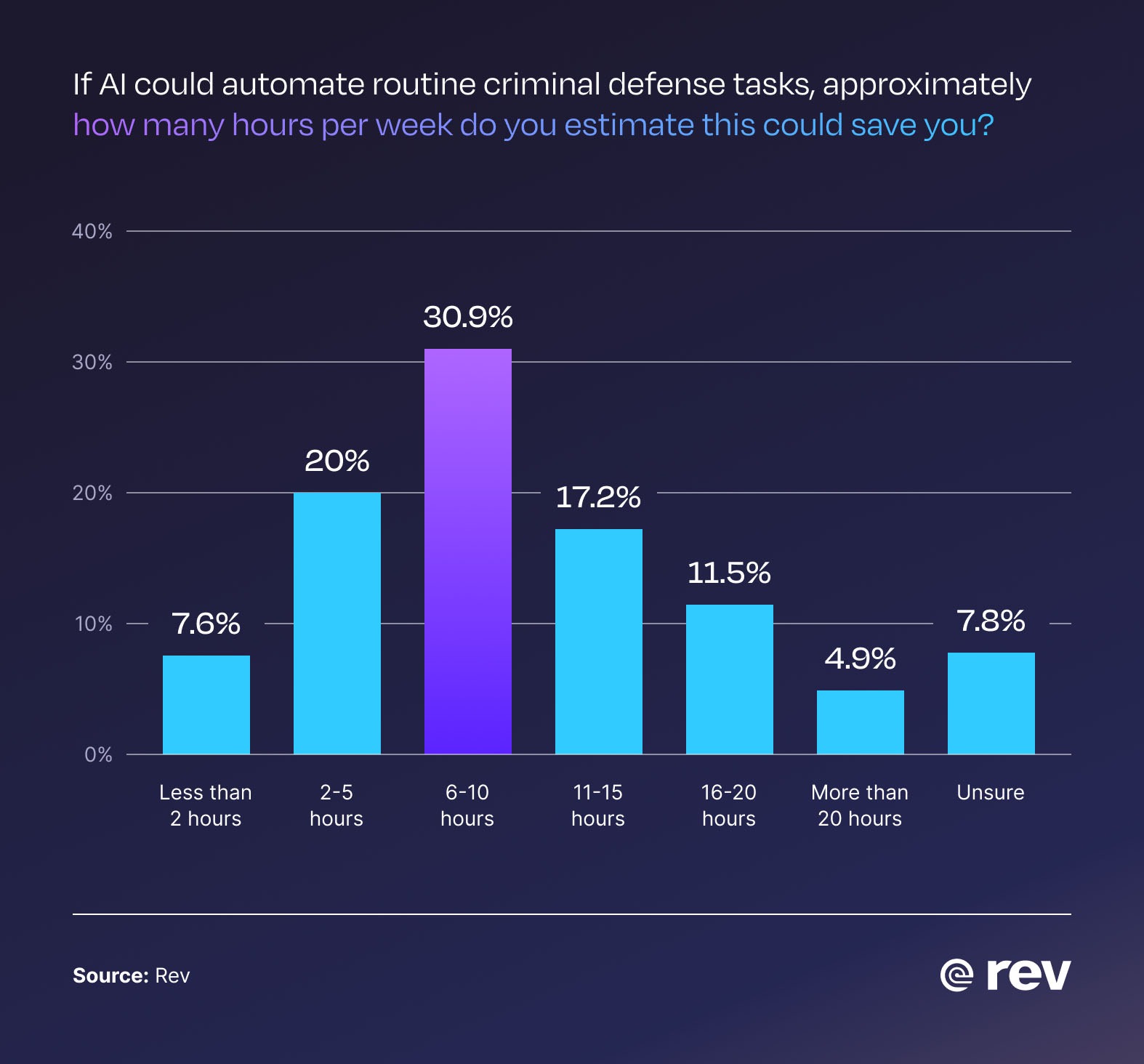
- Nearly two-thirds (65%) believe that AI could save them 6-10 hours per week.
- 45% of defense attorneys estimate that AI could save their criminal defense practice more than $30,000 annually.
- Just 14% of defense attorneys are committed to traditional methods over AI.
Over 50% of Defense Attorneys Say AI Can Outperform Traditional Evidence Analysis Methods
It’s one of the biggest questions in the industry right now: do humans trust AI to do their most crucial work? According to our survey, they do.
56% of criminal defense attorneys said that AI works better for evidence analysis than traditional (aka manual) methods, suggesting that AI-powered analyses stand up to scrutiny from even the toughest critics.
To add to that, open skepticism surrounding AI's analysis quality is marginal at best, with only 12% of respondents saying that there is no significant difference between AI and human-led evidence review and analysis.
On top of the gains in quality, AI and speech tech can categorize, analyze, and summarize digital evidence in bulk up to 120x faster than manual processes. This helps lawyers act quickly and take steps to protect their clients without the specter of slowdowns and delays getting in the way.
This combination of speed and accuracy might be why fewer than 1 in 5 (16%) criminal defense lawyers say they have never used AI to analyze evidence, and nearly 40% of criminal defense lawyers think 50% or more of their work will involve AI by 2030.
Those bucking up against this growing trend are finding themselves in the minority. Only 14% of respondents said they’re still set on using traditional methods over AI, in spite of the clear benefits.
Looking to the future, we can expect that the majority of defense attorneys will continue to find ways to leverage AI as they seek to level the playing field without getting stuck in the weeds of repetitive tasks.
71% of Defense Attorneys Have Already Used AI Tools

Forget the notion of AI as a niche tool. AI is one of the fastest-growing trends in the legal industry, with nearly three-quarters (71%) of defense attorneys stating that they have used AI in their criminal defense work.
AI's use cases go well beyond automating repetitive tasks and cutting costs. Defense attorneys are showing us that AI can also execute extremely complex, in-depth procedures that can help build stronger cases and fundamentally improve how they fight for their clients.
For example, 37% of respondents said that AI has enhanced accuracy when reviewing documents or transcripts, and 34% said that they have used AI to improve evidence organization and accessibility.
With AI assistance, lawyers can also streamline complex analytical and review procedures to minimize the risk of evidence issues, a costly error, or amissed opportunity. AI can surface case-defining insights like procedural errors and contradictions in witness statements within minutes, helping defense attorneys quickly overcome prosecution blind spots and get results for their clients.
Many are already seeing proof of this in their own work, with 26% of respondents stating that they have used AI to identify inconsistencies in witness statements and testimonies. Another 26% said that they've used AI to find key details in a case that were previously overlooked.
65% of Attorneys Believe AI Could Save 6-10+ Hours per Week
Legal work is often slowed by repetitive, burdensome administrative tasks, which have contributed significantly to 4 in 5 lawyers experiencing burnout in the past year. Using AI for criminal defense, lawyers can improve efficiency by cutting out that administrative work and focusing their time on more strategic, value-additive tasks.
Nearly two-thirds (65%) of respondents believe that AI could save them at least 6-10 hours per week. To put that into perspective, 10 hours per week equates to about one full-time week of work saved per month.
The time-saving nature of AI goes far beyond speculation, though. 39% of criminal defense attorneys report that using AI has helped them reduce total case preparation time. In complex cases with clients depending on you, every hour matters, and this opens up time for you to be more proactive in fighting for better outcomes.
For example, Robert Southwell, Criminal Defense Lawyer at Southwell Law, is using Rev to cut back on exhausting prep work and improve accuracy at the same time. He says, "It's a massive time-saver for the whole team and ensures we don't miss crucial details. Plus, professional transcripts often pick up nuances that might get lost if you're just taking notes."
And it’s not just lawyers seeing the benefit of integrating AI into their daily workflows. According to our study on AI prompting, a good prompt can increase answer satisfaction and speed by 280%. This means legal teams can save days of case preparation time by letting AI tools handle transcript summarization, discovery review, evidence analysis, and more.
Lawyers Estimate AI Could Save Criminal Defense Practices $30K+ Annually
Time isn't the only thing that criminal defense lawyers believe AI can save. 45% of lawyers estimate that AI could save their criminal defense practice more than $30,000 annually.
Legal work is expensive, and it can be further exaggerated by errors. In legal documents where the required margin of error is effectively zero, a single error can spell thousands of dollars or more in consequences. With the output quality that many AI criminal defense tools offer, errors like these could soon become a thing of the past.
However, not all lawyers are entirely sold on AI's cost-saving potential just yet. Just under 1 in 5 (19%) respondents remain unsure about any potential savings, which suggests that some lawyers may still be waiting for proof of ROI before they begin implementing it.
Despite this, only about 1 in 4 defense lawyers (26%) listed cost as a top concern for implementation, suggesting that lawyers are willing to shell out for tools that will actually help them work faster with fewer errors.
Most Defense Attorneys Confidently Understand AI, but Nearly All of Them Have Concerns
Our survey found that the majority of defense attorneys (58%) now rate themselves as confident in their understanding of the AI tools available for criminal defense work.
With that understanding, however, comes skepticism. A staggering 94% of criminal defense attorneys had at least one concern about AI in their work, showing that AI still has a long way to go before legal professionals are ready to trust it fully.
Their main AI concerns include:
- Output accuracy (63%)
- Ethical concerns (57%)
- Data security and confidentiality risks (50%)
- Potential for bias (46%)
While we are huge champions of AI here at Rev, we know these are valid concerns. Any defense attorney would be wise to be aware of where AI can fail, especially since our recent study on AI users shows that the biggest adopters of AI experience the most AI hallucinations.
Even so, AI illiteracy remains one of the biggest barriers to AI adoption, with more than 1 in 3 criminal defense attorneys (36%) saying that they simply lack the training and skills to properly use AI for criminal defense.
Our study found that most employees who receive training feel that they are getting better and more efficient with AI. Those who don’t receive any company-mandated training? Well, they’re not only worse off when they try to use the tools, but their efficiency drops as well.

Most Defense Lawyers Will Adopt AI Within 5 Years — But Some Are Waiting for Results
Despite widespread concerns, our survey shows that most defense attorneys are prepared to adopt AI as a criminal defense law tool within five years.
In fact, 15% of criminal defense lawyers already use AI as a part of their daily workflows, with another 15% of respondents stating that they would adopt AI for criminal defense within the year.
While many defense attorneys have already made their decision to adopt AI, some have deeper concerns and are planning to wait it out a bit before buying in. 22% of defense attorneys said that they would wait to see results from other lawyers. Another 22% stated that they would need extensive peer validation and regulatory guidance to consider adoption. We can expect to see these respondents adopt AI as positive results roll in from those already invested.
When evaluating AI tools to implement, defense attorneys are looking at a few key considerations. Chief among them is data security, with 55% of respondents citing data security as one of their top considerations. Given that even one security breach can result in compromised cases and severe loss of trust, attorneys often don’t feel they can afford to take the risk.
50% of respondents also cited the need for bar association approval, which is critical for maintaining trust that lawyers are upholding their obligations to clients and courts.
We are proud to be the State Bar of Texas’s first AI partner, and we are committed to upholding the standards required for approval by legal organizations and professional associations.
Streamline Criminal Defense With AI Tools
Bottom line: defense attorneys are open to the idea of using AI. With Rev, defense attorneys can work faster without compromising accuracy, and all without significantly harming their bottom line. Rev’s platform has been through extensive vetting to provide attorneys with what they need and uphold the integrity of every case they handle.
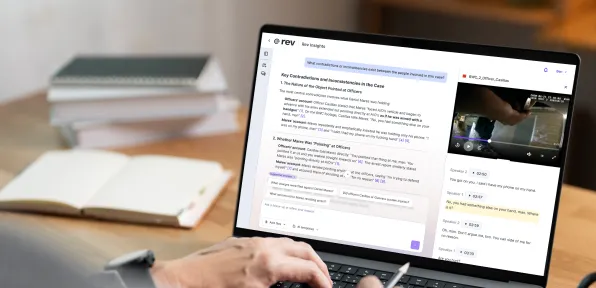
Rev's AI Transcription can convert hours of audio or video content into text in minutes, with a world-class 96%+ accuracy rating. Rev also allows lawyers to upload scores of case files at once and use targeted queries to quickly flag multi-file insights that could alter case strategy. With these capabilities, you spend less time doing busy work and more time getting the outcomes your clients are depending on.
Methodology
The survey was conducted by Centiment for Rev. The survey was fielded between September 11 and September 29, 2025. The results are based on 511 completed surveys. In order to qualify, respondents were screened to be residents of the United States, over 18 years of age, and identify as legal professionals working in criminal defense or criminal justice. Data is unweighted, and the margin of error is approximately +/-4% for the overall sample with a 95% confidence level.